

系统工程与电子技术 ›› 2026, Vol. 48 ›› Issue (3): 894-907.doi: 10.12305/j.issn.1001-506X.2026.03.16
• 系统工程 • 上一篇
张龙1, 朱连宏1,*, 杨波1, 雷震1,2, 冯轩铭1,3
收稿日期:2025-09-26
出版日期:2026-03-25
发布日期:2026-04-13
通讯作者:
朱连宏
作者简介:张 龙(1990—),男,博士研究生,主要研究方向为智能化装备体系设计与评估基金资助:Long ZHANG1, Lianhong ZHU1,*, Bo YANG1, Zhen LEI1,2, Xuanming FENG1,3
Received:2025-09-26
Online:2026-03-25
Published:2026-04-13
Contact:
Lianhong ZHU
摘要:
针对复杂对抗环境下反舰导弹目标识别面临的特征模糊、诱饵欺骗性强及传统识别算法鲁棒性不足等问题,提出一种多模态自适应融合网络(multimodal adaptive fusion network, MFA-Net)。该模型采用参数非共享分支分别提取雷达、红外与电子支援措施的异构特征,通过通道-空间双维注意力机制实现跨模态自适应融合,引入基于动量迭代方法的对抗训练策略,以极小极大优化框架增强模型内在鲁棒性,提升其在干扰条件下的决策稳定性。通过Macro-F1分数、抗干扰鲁棒性、推理时效构建非线性综合识别效能指数。实验表明,MFA-Net模型的综合识别效能指数达0.853 1,显著优于几种对比模型,干扰强度灵敏度分析进一步验证了模型在不同对抗等级下的性能稳定性。
中图分类号:
张龙, 朱连宏, 杨波, 雷震, 冯轩铭. MFA-Net:一种面向复杂对抗环境的反舰导弹智能识别多模态自适应融合网络[J]. 系统工程与电子技术, 2026, 48(3): 894-907.
Long ZHANG, Lianhong ZHU, Bo YANG, Zhen LEI, Xuanming FENG. MFA-Net: a multimodal adaptive fusion network for intelligent recognition of anti-ship missiles in complex adversarial environments[J]. Systems Engineering and Electronics, 2026, 48(3): 894-907.
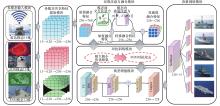
图1
MFA-Net网络架构图"
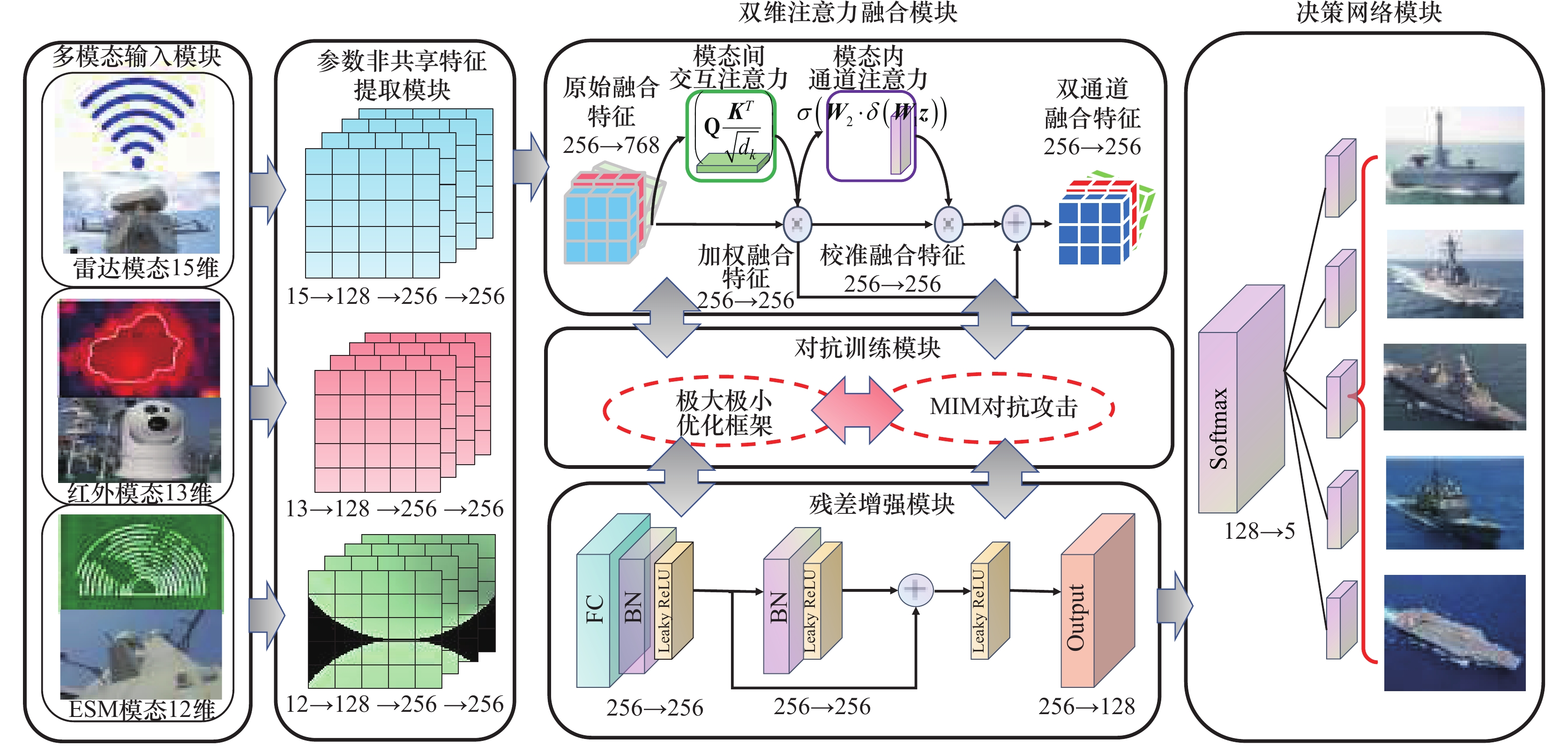

表1
模态特征提取子网络通用参数配置"
| 模态 | 输入维度 | 网络深度 | 隐藏层维度序列 | 输出维度 |
表2
反舰导弹智能识别多模态特征体系"
| 传感器 模态 | 特征类别 | 特征名称 | 维度 | 量纲 | 军事含义与解释 |
| 雷达 | 能量与散射 | RCS | 1 | dBsm | 目标大小与隐身性的核心度量 |
| RCS起伏标准差 | 1 | dB | 目标散射稳定性,用于识别舰型 | ||
| 运动特性 | 径向速度 | 1 | m/s | 目标接近/远离速度,火控解算基础 | |
| 径向加速度 | 1 | m/s² | 目标机动意图判断依据 | ||
| 高分辨像 | 距离像主峰幅度 | 5 | V | 对应舰艇突出结构,是型号识别的关键 | |
| 距离像质心 | 1 | m | 散射中心分布位置 | ||
| 距离像方差 | 1 | m² | 散射分布离散度 | ||
| 距离像偏度 | 1 | — | 散射分布不对称性 | ||
| 微动特性 | 微多普勒谱熵 | 1 | — | 量化微动复杂性,有效鉴别真假目标 | |
| 极化特性 | 极化熵 | 1 | — | 区分目标形状复杂度与材质,抗欺骗干扰 | |
| 共极化/交叉极化比 | 1 | dB | 进一步鉴别目标材质与海面杂波 | ||
| 红外 | 辐射强度 | 最大辐射强度 | 1 | W/sr | 最强热源温度,决定发现距离 |
| 平均辐射强度 | 1 | W/sr | 目标整体热轮廓强度 | ||
| 辐射对比度 | 1 | — | 目标与海背景的分离难易度 | ||
| 统计分布 | 辐射强度标准差 | 1 | W/sr | 热分布的均匀性 | |
| 辐射熵 | 1 | — | 热模式复杂性,真目标熵值高 | ||
| 形状轮廓 | 目标占空比 | 1 | — | 预估目标大小 | |
| 目标长宽比 | 1 | — | 区分舰型(如航母与驱护舰) | ||
| 轮廓紧致度 | 1 | — | 形状规则度,诱饵通常更规则 | ||
| 热源分析 | 热源数量 | 1 | — | 关键判别指标,真实舰船多稳定热源 | |
| 最强热源位置X | 1 | pixel | 识别舰艇朝向 | ||
| 最强热源位置Y | 1 | pixel | 识别舰艇朝向 | ||
| 光谱特性 | 中波/长波红外强度比 | 1 | — | 鉴别真假目标的核心特征 | |
| 纹理特征 | 中波红外纹理特征均值 | 1 | — | 描述热图细腻程度,抗干扰 | |
| ESM | 基本参数 | 射频 | 1 | MHz | 识别雷达频段,判断威胁等级 |
| 脉冲重复间隔 | 1 | μs | 识别雷达模式与型号 | ||
| 脉冲宽度 | 1 | μs | 判断雷达功能与作用距离 | ||
| 到达角AOA | 1 | ° | 对辐射源进行定向 | ||
| 信号强度 | 1 | dBm | 估算辐射源距离 | ||
| 调制样式 | 频率调制类型 | 1 | — | 识别雷达体制与抗干扰能力 | |
| 脉冲调制类型 | 1 | — | 识别雷达编码方式 | ||
| 指纹特征 | 载频稳定度 | 1 | ppm | 辐射源个体识别的关键指纹 | |
| 脉冲上升时间 | 1 | ns | 硬件电路固有特征,难以模仿 | ||
| 脉冲下降时间 | 1 | ns | 同上,用于抗欺骗干扰 | ||
| 脉冲顶部起伏 | 1 | % | 表征发射机功率稳定性的指纹 | ||
| 频谱旁瓣特性 | 1 | dBc | 表征发射机频谱纯度的指纹 |
表3
模型性能对比结果"
| 模型 | Macro-F1 | 鲁棒性 | 延迟/ms | CREI | 军事意义解读 |
| CNN | 0.818 7 | 0.247 8 | 2.302 3 | 0.589 8 | 响应迅捷,易于部署;然其抗干扰能力极差,在强电磁对抗中易被瘫痪, 仅适用于和平环境或低威胁侦察 |
| ResNet-1D | 0.725 7 | 0.303 2 | 4.993 3 | 0.581 3 | 虽具备一定深度特征学习能力,但决策迟缓且易受欺骗, 在高速突防场景下难以胜任,面临被战场淘汰的风险 |
| SE-ResNet-1D | 0.757 3 | 0.445 0 | 5.830 5 | 0.663 3 | 通过内在注意力机制提升了抗干扰韧性,但实时性是其致命短板, 适合用于后方情报中心进行深度分析 |
| MulT | 0.919 4 | 0.514 2 | 2.930 1 | 0.762 4 | 识别精度顶尖,在多模态融合上表现出色;但其鲁棒性不足以应对体系化、 高烈度电子对抗,是需重点保护的尖刀力量 |
| MFA-Net | 0.909 9 | 0.722 8 | 2.272 4 | 0.853 1 | 在精度、抗干扰与实时性上取得最佳平衡,是复杂电磁环境下可靠决策的基石, 能显著提升导弹突防概率与体系作战效能 |
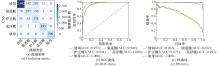
图2
CNN模型混淆矩阵、ROC曲线及PR曲线对比"
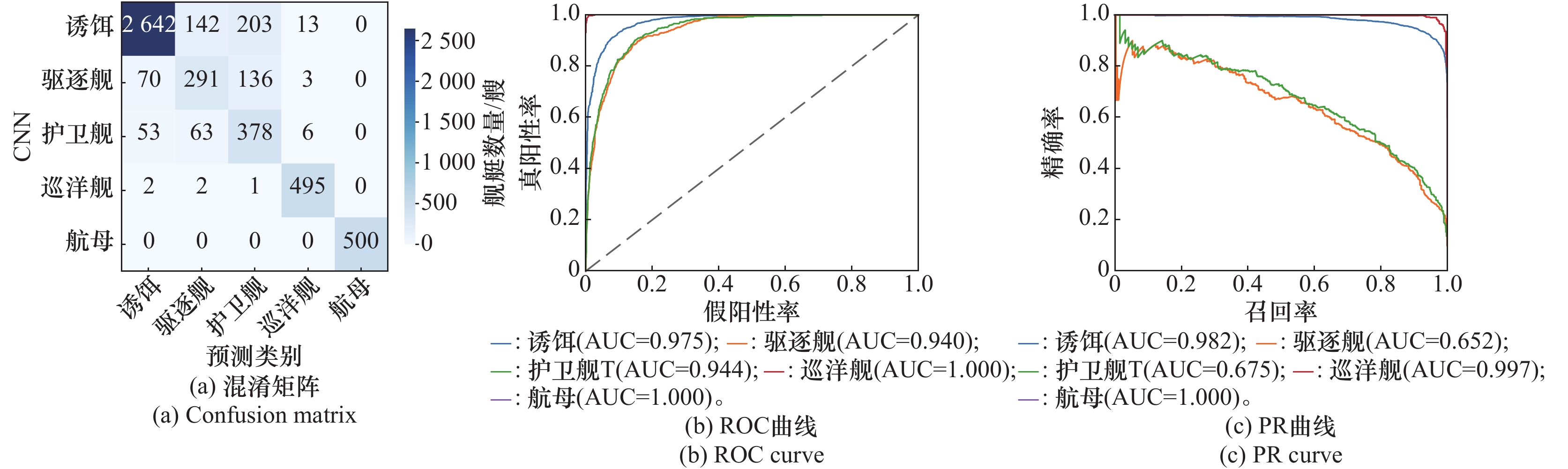
图3
ResNet-1D模型混淆矩阵、ROC曲线及PR曲线对比"
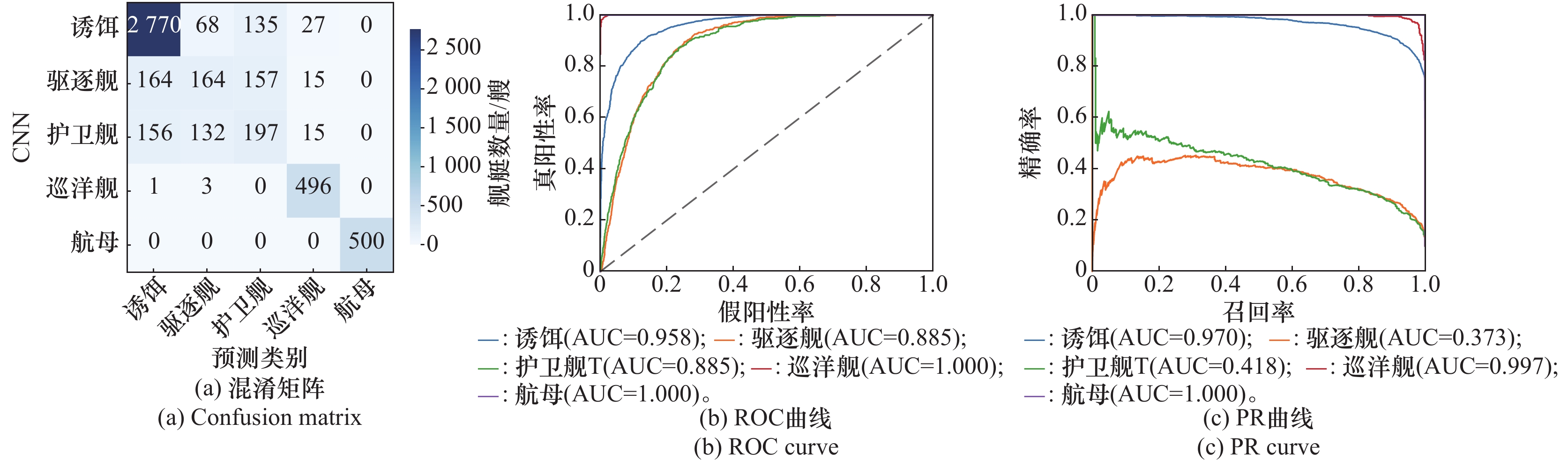
图4
SE-ResNet-1D模型混淆矩阵、ROC曲线及PR曲线对比"
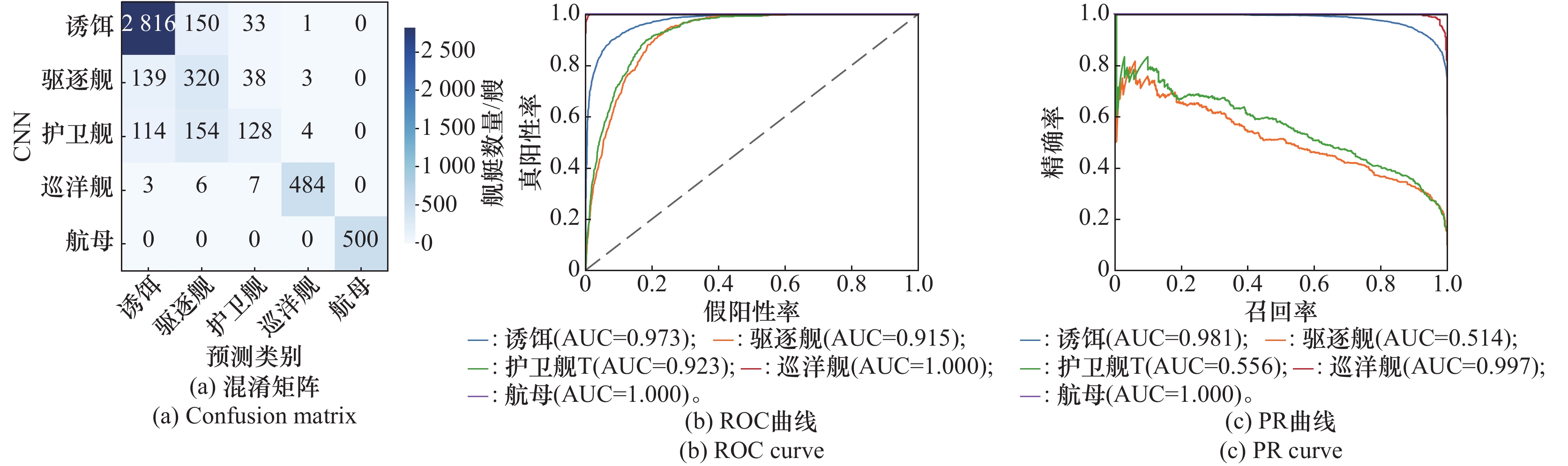
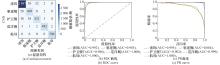
图5
MulT模型混淆矩阵、ROC曲线及PR曲线对比"
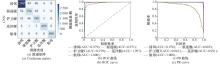
图6
MFA-Net模型混淆矩阵、ROC曲线及PR曲线对比"
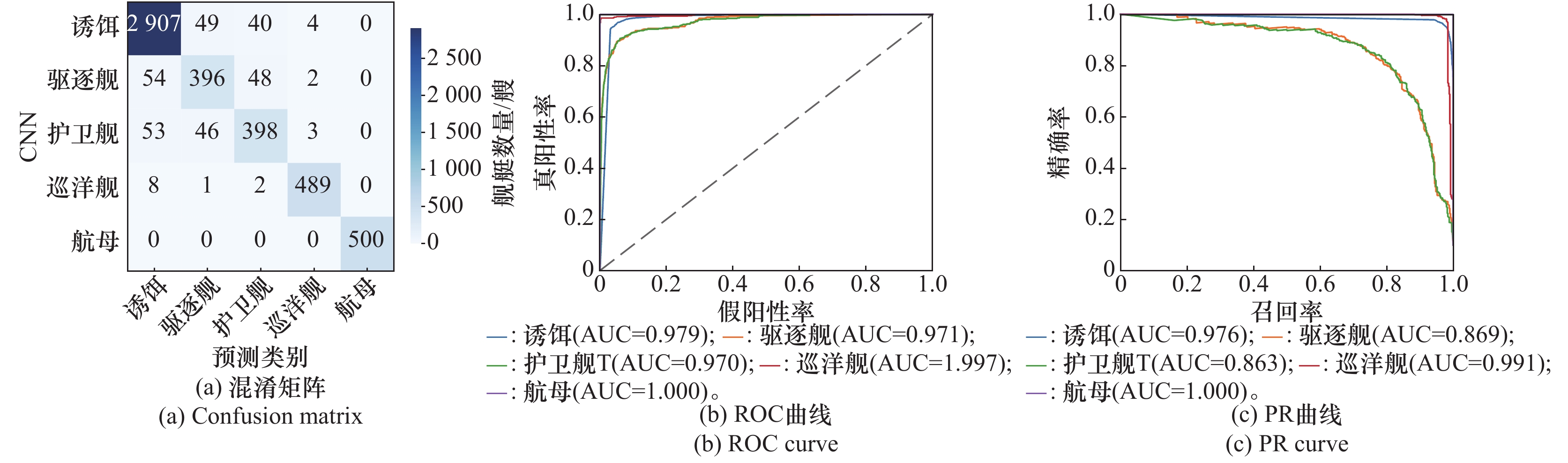

图7
各模型学习特征的 t-SNE可视化对比"

图8
不同干扰强度下各模型鲁棒性对比"
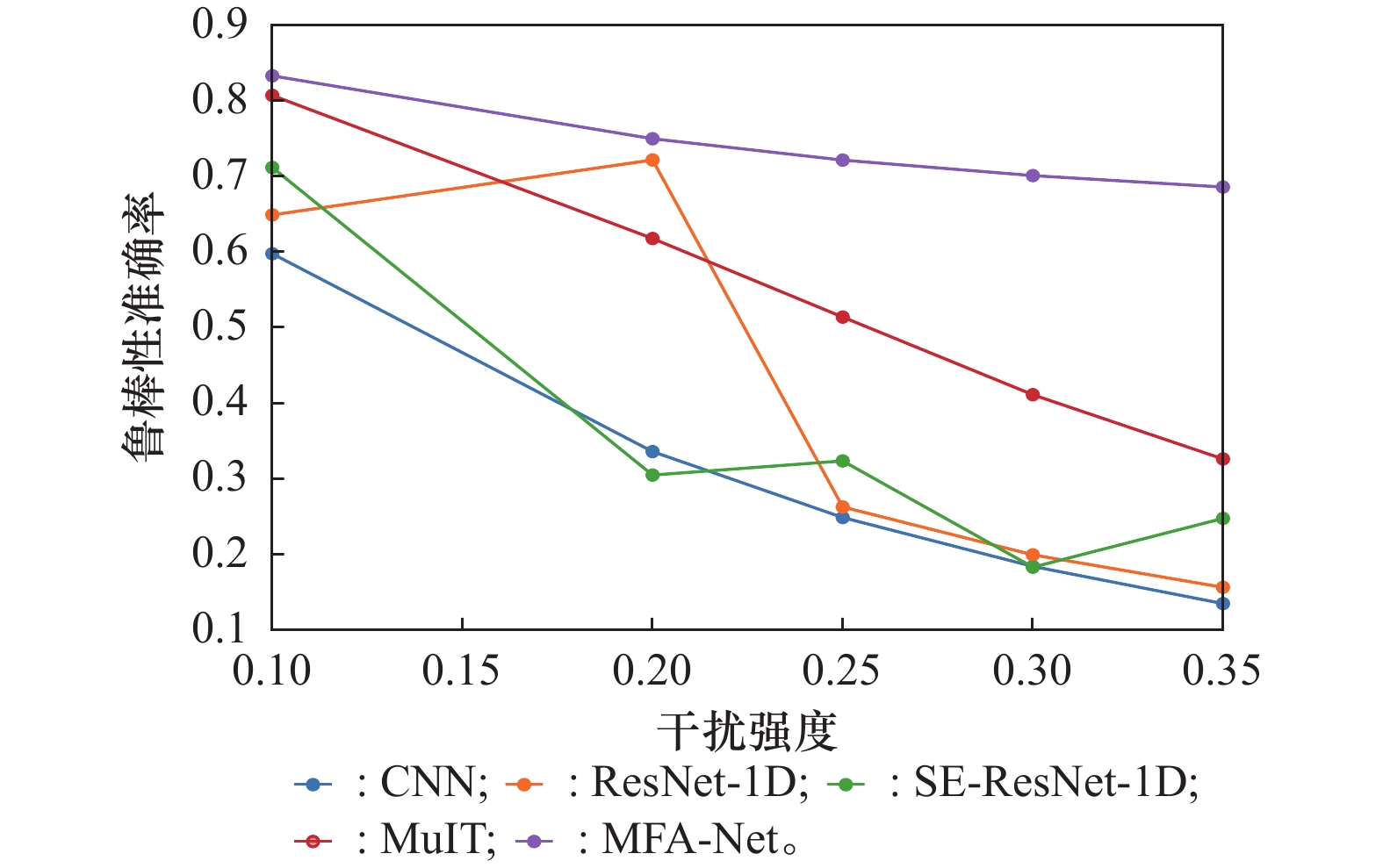
图9
不同模型在4个关键指标上的性能对比"
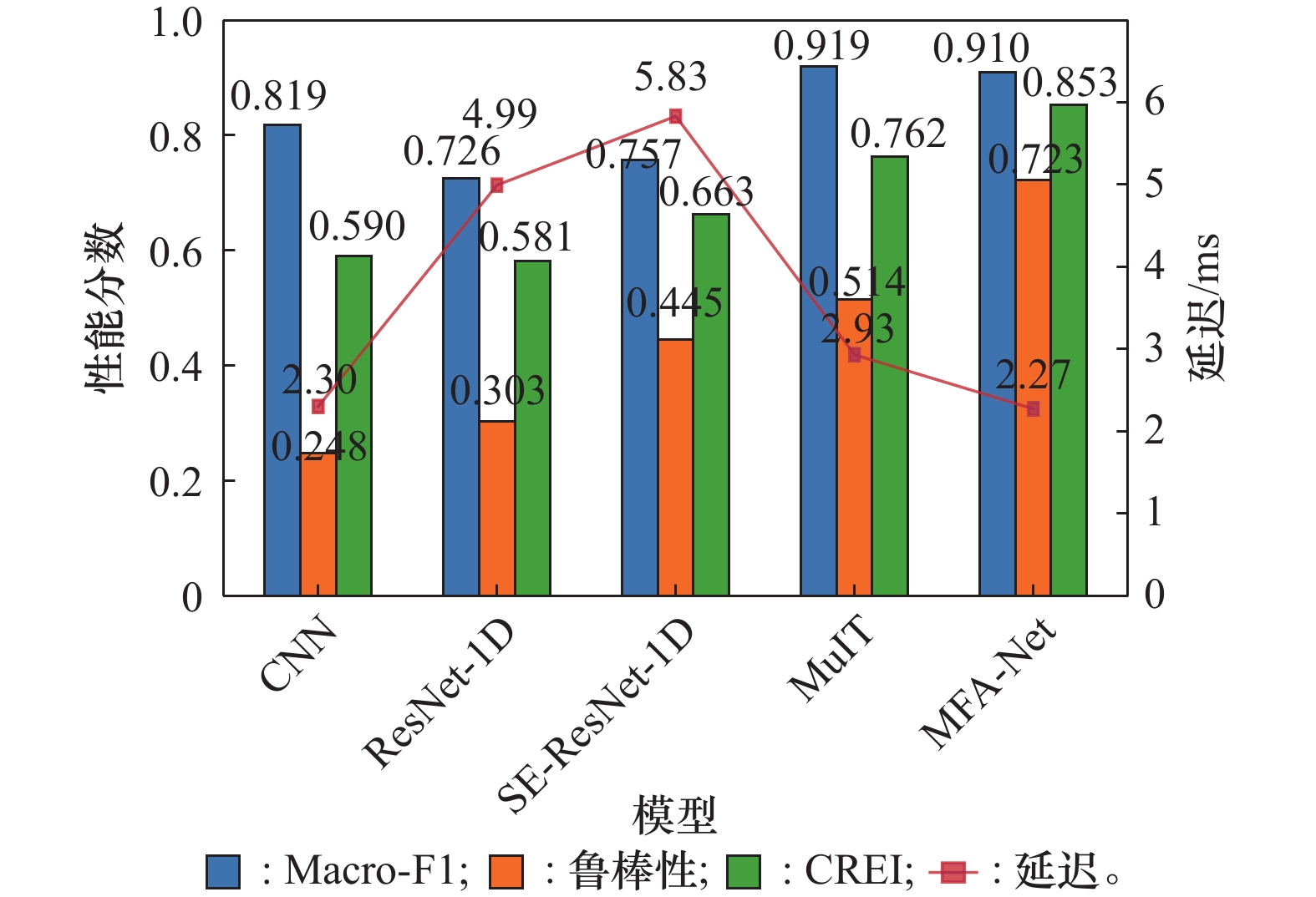
表4
消融实验结果分析"
| 模型配置 | Macro-F1 | 鲁棒性 | CREI |
| A | 0.841 2 | 0.523 5 | 0.701 5 |
| B | 0.881 5 | 0.385 0 | 0.674 3 |
| C | 0.896 8 | 0.655 1 | 0.802 1 |
| D | 0.909 9 | 0.722 8 | 0.853 1 |
| 1 |
李丹, 于邵祯, 杨华东. 国外水面无人艇环境感知技术前沿进展[J]. 兵工学报, 2024, 45 (S2): 97- 104.
doi: 10.12382/bgxb.2024.0860 |
|
LI D, YU S Z, YANG H D. Progress on environmental perception technology of foreign unmanned surface vehicles[J]. Acta Armamentarii, 2024, 45 (S2): 97- 104.
doi: 10.12382/bgxb.2024.0860 |
|
| 2 |
ERTOP M, ÖTER A, KARA A. Counter measuring anti-ship missiles for surface naval platforms: a machine learning approach with explainable artificial intelligence[J]. IEEE Access, 2025, 13, 107313- 107327.
doi: 10.1109/ACCESS.2025.3581163 |
| 3 |
LU F X, DAI Q Y, YANG G, et al. Online task planning method of anti-ship missile based on rolling optimization[J]. Journal of Systems Engineering and Electronics, 2024, 35 (3): 720- 731.
doi: 10.23919/JSEE.2024.000059 |
| 4 | LI Y L, ZHANG D, FAN L, et al. Performance analysis of ship target recognition in multi-band infrared images based on deep learning[C]//Proc. of the 7th International Conference on Transportation Information and Safety, 2023: 432−436. |
| 5 | 包为民, 朱建文, 张洪波, 等. 高超声速飞行器全程制导方法[M]. 北京: 科学出版社, 2021: 12-52. |
| BAO W M, ZHU J W, ZHANG H B, et al. Full range guidance method for hypersonic aircraft[M]. Beijing: Science Press, 2021: 12−52. | |
| 6 |
LIM D, GIANELLI C D, LI J. Automatic target recognition in missing data cases[J]. IEEE Aerospace and Electronic Systems Magazine, 2017, 32 (7): 40- 49.
doi: 10.1109/MAES.2017.150273 |
| 7 |
LIU G, AN Z B, LAO S Y, et al. Firepower distribution method of anti-ship missile based on coupled path planning[J]. Journal of Systems Engineering and Electronics, 2022, 33 (4): 1010- 1024.
doi: 10.23919/JSEE.2022.000097 |
| 8 |
WANG L Y, FU Q, ZHU R, et al. Research on high precision localization of space target with multi-sensor association[J]. Optics and Lasers in Engineering, 2025, 184, 108553.
doi: 10.1016/j.optlaseng.2024.108553 |
| 9 | 胡磊, 许星晗, 肖鹏, 等. 时间序列缺失数据处理方法综述[EB/OL]. [2025-08-15]. https://link.cnki.net/urlid/44.1240.TP.20250716.1838.114. |
| HU L, XU X H, XIAO P, et al. Review of missing data processing methods in time series[EB/OL]. [2025-08-15]. https://link.cnki.net/urlid/44.1240.TP.20250716.1838.114. | |
| 10 |
KARASAKAL O, KARASAKAL E, SILAV A. A multi-objective approach for dynamic missile allocation using artificial neural networks for time sensitive decisions[J]. Soft Computing, 2021, 25 (15): 10153- 10166.
doi: 10.1007/s00500-021-05923-x |
| 11 | LIANG F T, CHEN X, HE S, et al. An aerial target recognition algorithm based on self-attention and LSTM[J]. Computers, Materials & Continua, 2024, 81(1): 1101−1121. |
| 12 | 黄治军, 衣晓, 关欣. 基于锚定思想的新型雷达与ESM异步关联算法[EB/OL]. [2025-08-20]. https://link.cnki.net/urlid/11.2422.tn.20250703.1125.011. |
| HUANG Z J, YI X, GUAN X. Radar and ESM asynchronous association algorithm based on anchoring concept[EB/OL]. [2025-08-20]. https://link.cnki.net/urlid/11.2422.tn.20250703.1125.011. | |
| 13 |
陈晓萱, 徐书文, 胡绍海, 等. 基于卷积与自注意力的红外与可见光图像融合[J]. 系统工程与电子技术, 2024, 46 (8): 2641- 2649.
doi: 10.12305/j.issn.1001-506X.2024.08.12 |
|
CHEN X X, XU S W, HU S H, et al. Infrared and visible light image fusion based on convolution and self attention[J]. Systems Engineering and Electronics, 2024, 46 (8): 2641- 2649.
doi: 10.12305/j.issn.1001-506X.2024.08.12 |
|
| 14 | SONG Z Y, XIAO H T, ZHU Y L, et al. A novel approach to detect the unresolved towed decoy in terminal guidance[J]. Chinese Journal of Electronics, 2012, 21 (2): 367- 373. |
| 15 |
XUE W B, AI J Q, ZHU Y A, et al. AIS-FCANet: long-term AIS data assisted frequency-spatial contextual awareness network for salient ship detection in SAR imagery[J]. IEEE Trans. on Aerospace and Electronic Systems, 2025, 61 (5): 15166- 15171.
doi: 10.1109/TAES.2025.3588484 |
| 16 |
PARK S, VIEN A G, LEE C. Cross-modal transformers for infrared and visible image fusion[J]. IEEE Trans. on Circuits and Systems for Video Technology, 2024, 34 (2): 770- 785.
doi: 10.1109/TCSVT.2023.3289170 |
| 17 |
ZHAO Y Y, ZHENG Q C, ZHU P H, et al. TUFusion: a transformer-based universal fusion algorithm for multimodal images[J]. IEEE Trans. on Circuits and Systems for Video Technology, 2024, 34 (3): 1712- 1725.
doi: 10.1109/TCSVT.2023.3296745 |
| 18 | JIAO T Z, GUO C P, FENG X Y, et al. A Comprehensive survey on deep learning multi-modal fusion: methods, technologies and applications[J]. Computers Materials & Continua, 2024, 80 (1): 1- 35. |
| 19 |
LI J, WANG X P, LV G Q, et al. GA2MIF: graph and attention based two-stage multi-source information fusion for conversational emotion detection[J]. IEEE Trans. on Affective Computing, 2024, 15 (1): 130- 143.
doi: 10.1109/TAFFC.2023.3261279 |
| 20 |
CAI J H, ZHANG M, YANG H F, et al. A novel graph-attention based multimodal fusion network for joint classification of hyperspectral image and LiDAR data[J]. Expert Systems with Applications, 2024, 249, 123587.
doi: 10.1016/j.eswa.2024.123587 |
| 21 | YAO G H, HU Z H. SNR estimation method based on SRS and DINet[C]//Proc. of the 15th International Conference on Computer Modeling and Simulation, 2023: 218−224. |
| 22 |
MEI L Y, YIN Z M, WANG S, et al. ECRLoRa: LoRa packet recovery under low SNR via edge–cloud collaboration[J]. ACM Transactions on Sensor Networks, 2024, 20 (2): 40.
doi: 10.1145/3604936 |
| 23 | ZHOU Q H, ZHANG S Y, HUANG L, et al. A compact broadband radar jamming system with photonic multidimensional modulation[J]. IEEE Trans. on Microwave Theory and Techniques, 2025. DOI:10.1109/TMTT.2025.3639615. |
| 24 |
HUANG W Q, ZHANG J L, LU W, et al. A moving target deceptive jamming algorithm for SAR based on azimuth deramp-keystone processing and scale Fourier transform[J]. IEEE Sensors Journal, 2026, 26 (1): 804- 816.
doi: 10.1109/JSEN.2025.3633757 |
| 25 |
HAO Y S, ZHANG Y. A Lightweight convolutional neural network for ship target detection in SAR images[J]. IEEE Trans. on Aerospace and Electronic Systems, 2024, 60 (2): 1882- 1898.
doi: 10.1109/TAES.2023.3344396 |
| 26 |
WANG Q H, LI Z W, ZHANG S Q, et al. SMAE-fusion: integrating saliency-aware masked autoencoder with hybrid attention transformer for infrared-visible image fusion[J]. Information Fusion, 2025, 117, 102841.
doi: 10.1016/j.inffus.2024.102841 |
| 27 |
ZHANG R H, LI L, ZHANG Q, et al. Differential feature awareness network within antagonistic learning for infrared-visible object detection[J]. IEEE Trans. on Circuits and Systems for Video Technology, 2024, 34 (8): 6735- 6748.
doi: 10.1109/TCSVT.2023.3289142 |
| 28 |
DENG H M, ZHANG Y. FMR-YOLO: infrared ship rotating target detection based on synthetic fog and multiscale weighted feature fusion[J]. IEEE Trans. on Instrumentation and Measurement, 2024, 73, 5001717.
doi: 10.1109/tim.2023.3336445 |
| 29 |
LI W X, CHEN Q, GU G H, et al. Object matching of visible-infrared image based on attention mechanism and feature fusion[J]. Pattern Recognition, 2025, 158, 110972.
doi: 10.1016/j.patcog.2024.110972 |
| 30 |
ZHANG Y B, ZHANG Q Y, ZHAO H T, et al. Multisource heterogeneous specific emitter identification using attention mechanism-based rff fusion method[J]. IEEE Trans. on Information Forensics and Security, 2024, 19, 2639- 2650.
doi: 10.1109/TIFS.2024.3353594 |
| 31 |
LI H F, YANG Z Y, ZHANG Y F, et al. MulFS-CAP: multimodal fusion-supervised cross-modality alignment perception for unregistered infrared-visible image fusion[J]. IEEE Trans. on Pattern Analysis and Machine Intelligence, 2025, 47 (5): 3673- 3690.
doi: 10.1109/TPAMI.2025.3535617 |
| 32 | CHEN J, YANG L L, LIU W, et al. LENFusion: a joint low-light enhancement and fusion network for nighttime infrared and visible image fusion[J]. IEEE Trans. on Instrumentation and Measurement, 2024, 73, 5018715. |
| 33 |
LIANG W, LI Y H, XU J L, et al. QoS prediction and adversarial attack protection for distributed services under DLaaS[J]. IEEE Trans. on Computers, 2024, 73 (3): 669- 682.
doi: 10.1109/TC.2021.3077738 |
| 34 | CHENG H R, ZHANG M, SHI J Q. A Survey on deep neural network pruning: taxonomy, comparison, analysis, and recommendations[J]. IEEE Trans. on Pattern Analysis and Machine Intelligence, 2024, 46 (12): 10558- 10578. |
| 35 |
HU J W, LI W G, ZHANG Y, et al. Cross-domain few-shot fault diagnosis based on meta-learning and domain adversarial graph convolutional network[J]. Engineering Applications of Artificial Intelligence, 2024, 136, 108970.
doi: 10.1016/j.engappai.2024.108970 |
| 36 |
CALI U, CATAK F O, HALDEN U. Trustworthy cyber-physical power systems using AI: dueling algorithms for PMU anomaly detection and cybersecurity[J]. Artificial Intelligence Review, 2024, 57, 183.
doi: 10.1007/s10462-024-10827-x |
| 37 | ZHU S C, JIANG M, KONG J, et al. Vari-FocalFuse: sparse attention with adaptive attention spans for image fusion[J]. IEEE Signal Processing Letters, 2025, 32, 4139- 4143. |
| 38 | 邵凯, 朱苗苗, 王光宇. 基于生成对抗与卷积神经网络的调制识别方法[J]. 系统工程与电子技术, 2022, 44 (3): 1036- 1043. |
| SHAO K, ZHU M M, WANG G Y. Modulation recognition method based on generative adversarial and convolutional neural network[J]. Systems Engineering and Electronics, 2022, 44 (3): 1036- 1043. | |
| 39 |
VANCAEYZEELE T, GALLANT J, LAUWENS B, et al. Design considerations for co-use of electromagnetic railguns used for naval artillery and against anti-ship missiles[J]. IEEE Trans. on Plasma Science, 2025, 53 (10): 2831- 2837.
doi: 10.1109/TPS.2025.3588597 |
| 40 |
ZHANG Y, FAN Y, SUN M, et al. Practical integrated guidance and control for the high-speed anti-ship missile to counter switching targets under a short time-to-go condition[J]. International Journal of Aeronautical and Space Sciences, 2022, 23, 143- 156.
doi: 10.1007/s42405-021-00422-7 |
| [1] | 程鲲, 雷洪涛, 吕志轩. 改进YOLOv8的轻量级无人机跟踪方法[J]. 系统工程与电子技术, 2026, 48(3): 737-750. |
| [2] | 包玉刚, 贾皓翔, 赵旦峰. 基于高阶递归网络的单幅图像去雨滴模型[J]. 系统工程与电子技术, 2026, 48(1): 12-21. |
| [3] | 陈海青, 汪刘应, 刘顾, 王龙, 葛超群, 陈孟州. 合成孔径雷达图像去噪算法研究进展[J]. 系统工程与电子技术, 2026, 48(1): 94-105. |
| [4] | 李开明, 张袁鹏, 罗迎, 代肖楠. 弹道导弹雷达目标识别研究进展[J]. 系统工程与电子技术, 2025, 47(9): 2870-2889. |
| [5] | 季策, 马相宇, 牟晓宇, 赵家毅. TS-GRU-VTA:基于深度学习的车辆信道估计方案[J]. 系统工程与电子技术, 2025, 47(9): 3093-3098. |
| [6] | 闫小伟, 凌冲, 石胜斌. 地表未爆子弹药快速检测系统设计与实现[J]. 系统工程与电子技术, 2025, 47(8): 2639-2645. |
| [7] | 张琬滢, 高由兵, 李泽一, 李鹏飞, 张伟. 基于双路径特征融合网络的背景信号抑制算法[J]. 系统工程与电子技术, 2025, 47(7): 2406-2413. |
| [8] | 张新征, 闫梦可, 朱晓林. 噪声伪标签容忍的半监督SAR目标识别[J]. 系统工程与电子技术, 2025, 47(6): 1796-1805. |
| [9] | 姜智杰, 宋恒, 胡楠, 段兰茜, 曹平. 隧道环境毫米波雷达目标识别与分类算法[J]. 系统工程与电子技术, 2025, 47(5): 1453-1460. |
| [10] | 聂千祁, 沙明辉, 朱应申, 王崇宇, 崔念强. 基于盲源分离结合奇异谱分析的雷达多分量信号识别方法[J]. 系统工程与电子技术, 2025, 47(4): 1168-1175. |
| [11] | 袁磊, 杨艳娟, 郭毅, 戴鹏. 相关噪声下基于深度学习的LDPC码码率半盲识别算法[J]. 系统工程与电子技术, 2025, 47(4): 1335-1345. |
| [12] | 沈夏闰, 李若楠, 张昊田. 基于CVAE-LSTM的服务器KPI异常检测[J]. 系统工程与电子技术, 2025, 47(3): 1019-1027. |
| [13] | 刘晓琳, 郭梦娇, 李卓. Dueling DQN优化下的航班延误自适应图卷积循环网络预测方法[J]. 系统工程与电子技术, 2025, 47(2): 568-579. |
| [14] | 付卫红, 张鑫钰, 刘乃安. 基于多尺度融合神经网络的同频同调制单通道盲源分离算法[J]. 系统工程与电子技术, 2025, 47(2): 641-649. |
| [15] | 张文中, 侯长波, 赵鹏旗, 刘思成. 基于GCN的无人机目标航迹关联[J]. 系统工程与电子技术, 2025, 47(12): 4005-4011. |
| 阅读次数 | ||||||
|
全文 |
|
|||||
|
摘要 |
|
|||||
