

系统工程与电子技术 ›› 2026, Vol. 48 ›› Issue (5): 1502-1514.doi: 10.12305/j.issn.1001-506X.2026.05.06
罗雨泉1( ), 何雨强1(), 李雅鑫2,*(), 梁松2, 王俊1
收稿日期:2025-02-24
接受日期:2025-06-23
出版日期:2026-05-27
发布日期:2026-05-27
通讯作者:
李雅鑫
E-mail:luoyuquanhz@163.com;buaahyq@buaa.edu.cn;lyx_hnu@126.com
作者简介:罗雨泉(1994—),男,博士研究生,主要研究方向为雷达信号处理、深度学习、人体感知基金资助:
Yuquan LUO1(), Yuqiang HE1(), Yaxin LI2,*(), Song LIANG2, Jun WANG1
Received:2025-02-24
Accepted:2025-06-23
Online:2026-05-27
Published:2026-05-27
Contact:
Yaxin LI
E-mail:luoyuquanhz@163.com;buaahyq@buaa.edu.cn;lyx_hnu@126.com
摘要:
人体姿态估计在人机交互、活动识别与健康监测等领域具有广泛的应用前景。传统基于光学传感器的方法易受光照条件限制且存在隐私泄露风险,而基于可穿戴设备的技术则存在使用繁琐、长期佩戴不适等问题。为此,提出一种基于卷积神经网络(convolutional neural network, CNN)、双向长短期记忆(bidirectional long-short term memory, BiLSTM)网络和多头注意力(multi-head attention, MHA)机制时空融合框架的毫米波雷达人体姿态估计方法。通过自主研发的毫米波雷达设备生成高质量点云数据,引入滑动窗口机制将单帧点云扩展为多帧时间序列数据。结合CNN提取空间特征,采用BiLSTM进行时序建模,引入MHA机制进一步优化全局特征表达能力。基于多帧点云数据的时空信息融合框架能够充分挖掘时空特征,有效缓解雷达点云稀疏性问题,显著提升了姿态估计的精度与鲁棒性。实验结果表明,所提方法能够实现25个骨骼关节点的定位,x,y,z轴平均误差分别为2.69 cm、2.49 cm与2.98 cm,为毫米波雷达在人体姿态估计中的应用提供了解决方案,具有广泛的实际应用潜力。
中图分类号:
罗雨泉, 何雨强, 李雅鑫, 梁松, 王俊. 基于CNN-BiLSTM-MHA时空融合框架的毫米波雷达人体姿态估计[J]. 系统工程与电子技术, 2026, 48(5): 1502-1514.
Yuquan LUO, Yuqiang HE, Yaxin LI, Song LIANG, Jun WANG. Millimeter-wave radar human pose estimation based on CNN-BiLSTM-MHA spatio-temporal fusion framework[J]. Systems Engineering and Electronics, 2026, 48(5): 1502-1514.
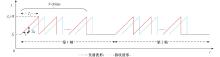
图1
FMCW雷达发射和接收波形"
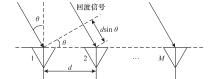
图2
FMCW雷达接收天线阵列和相位关系"
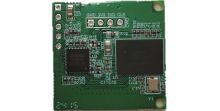
图3
BHYY_MMW6044 59-64 GHz印刷板"
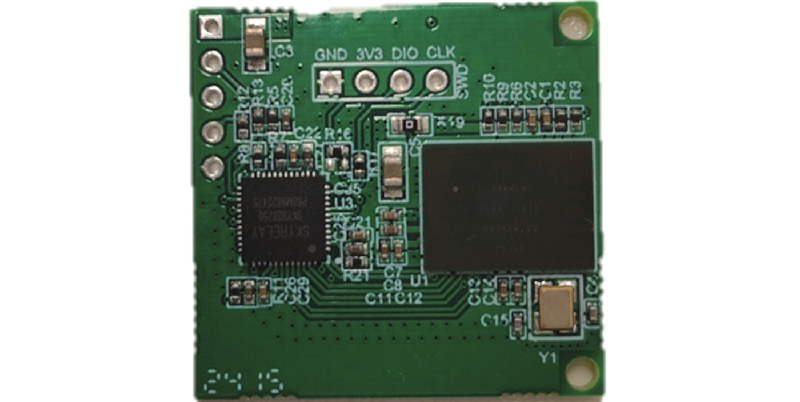
图4
对输入数据应用滑动窗口示意图"
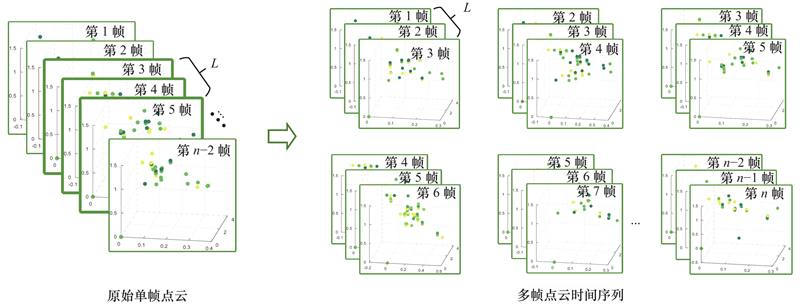
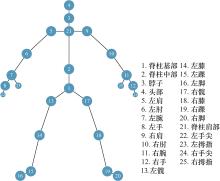
图5
人体骨骼姿态模型"
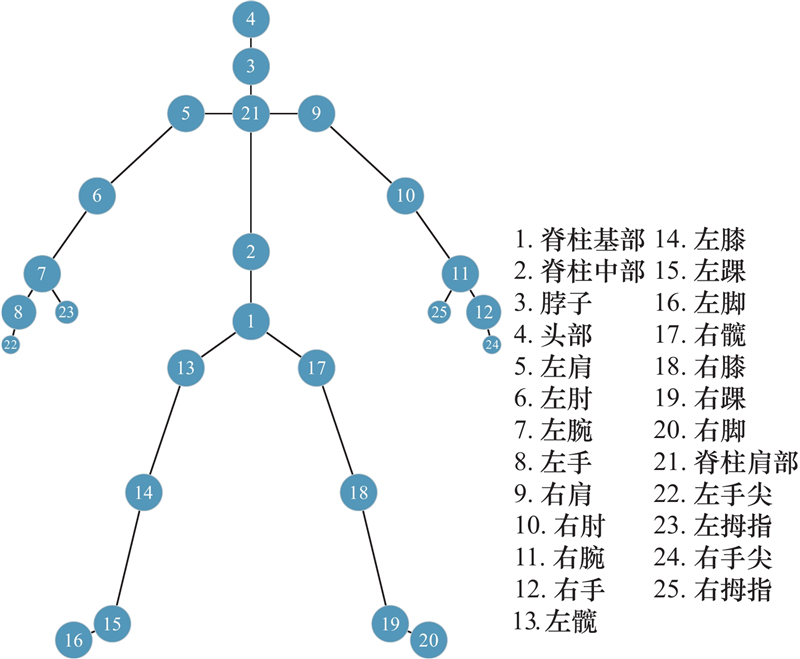
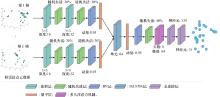
图6
CNN-BiLSTM-MHA架构"
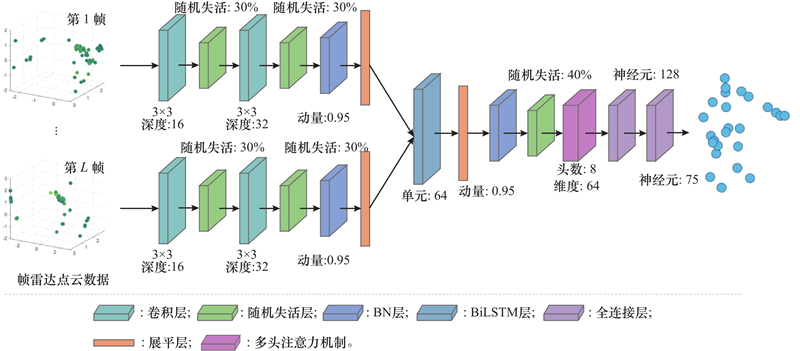
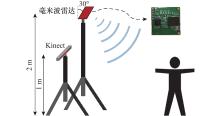
图7
数据采集设备位置关系图"
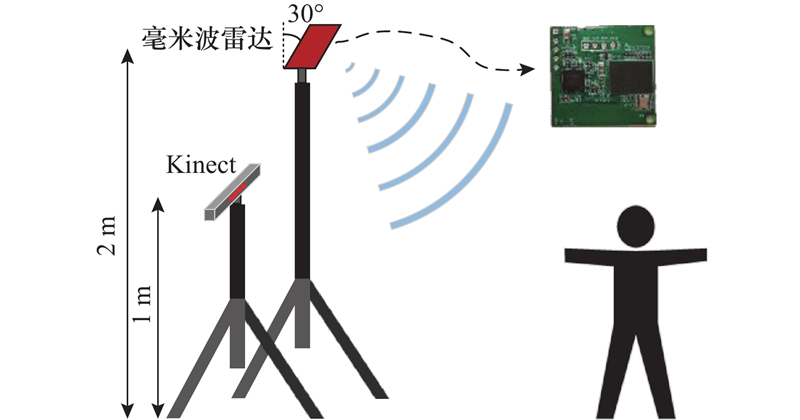
图8
实验场景"
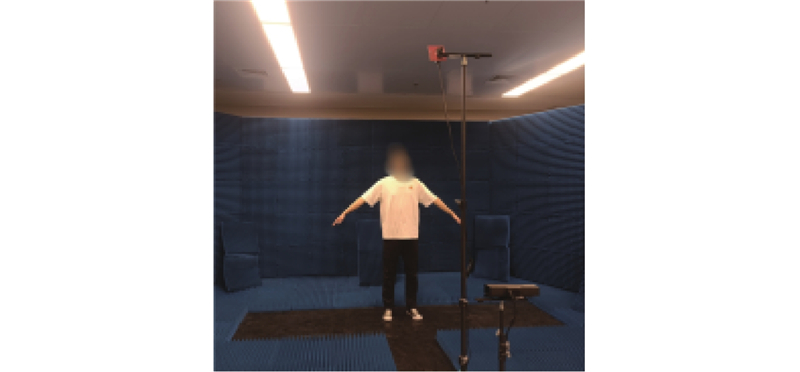
图9
25个骨骼关节点平均MAE(公开数据集)"
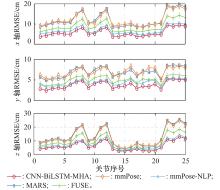
图10
25个骨骼关节点平均RMSE(公开数据集)"
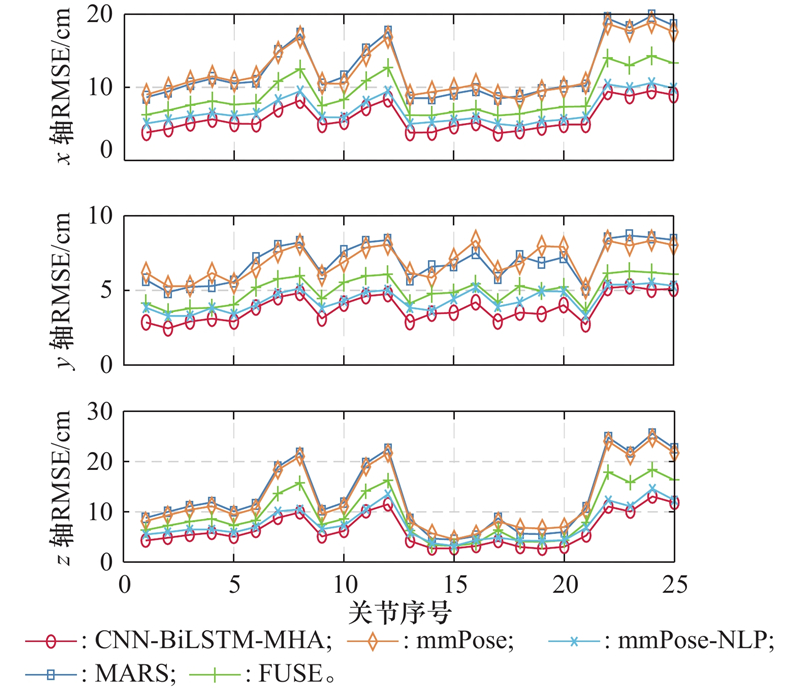
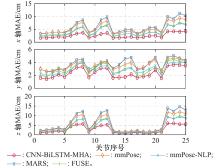
图11
25个骨骼关节点平均MAE(自建数据集)"
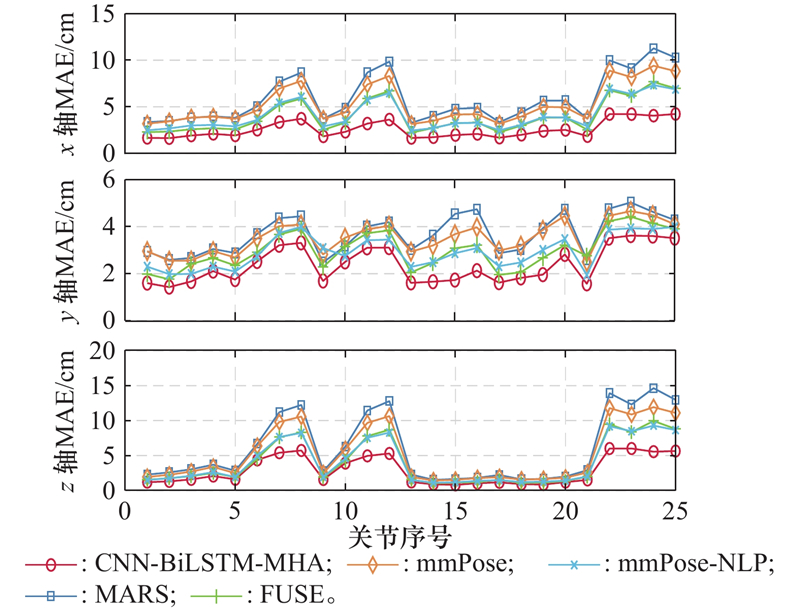
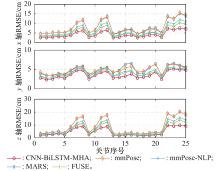
图12
25个骨骼关节点平均RMSE(自建数据集)"
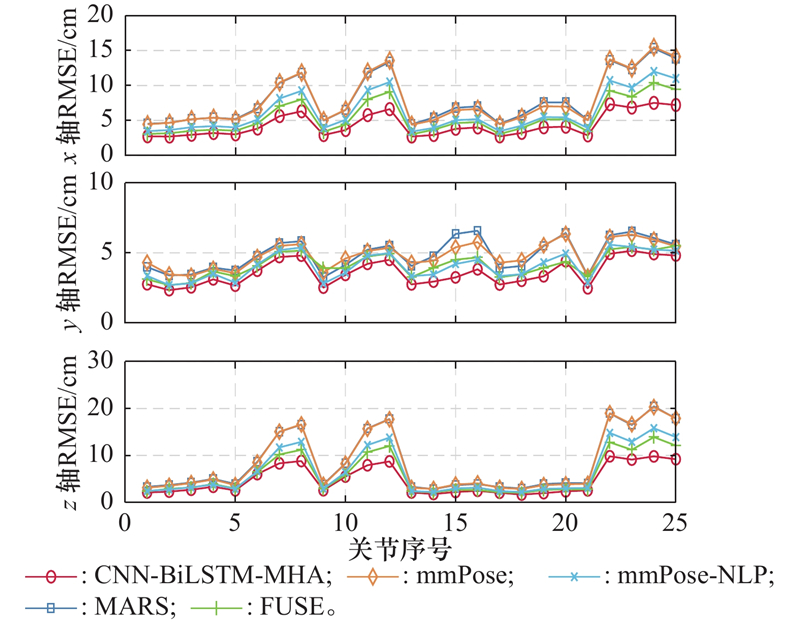
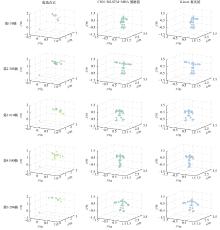
图13
人体姿态估计可视化结果"
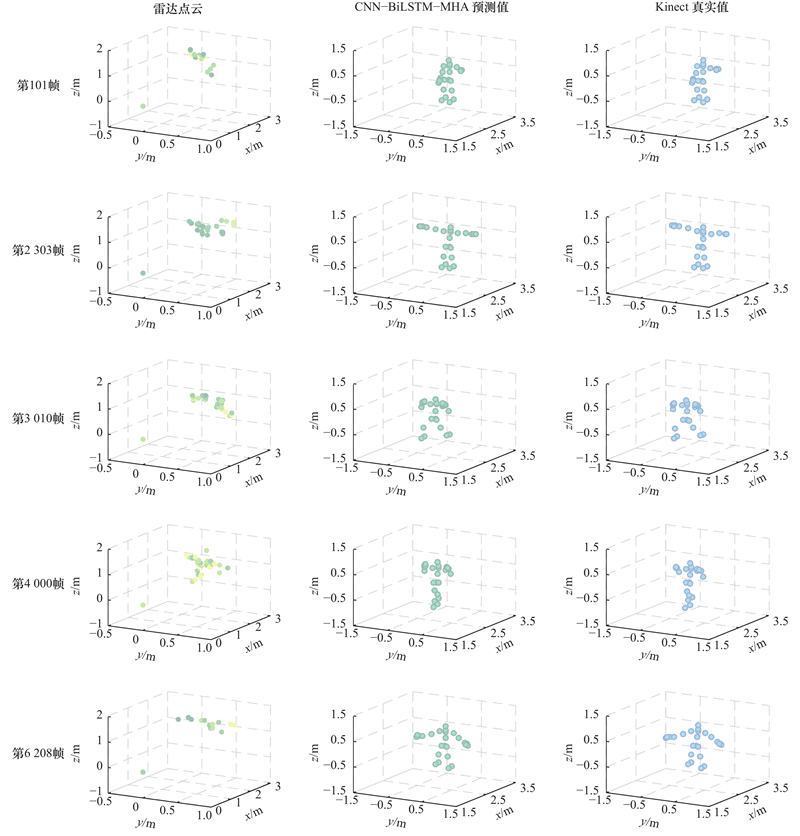
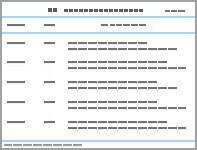
表1
不同模型25个人体骨骼关节平均定位误差(公开数据集)"
| 数据集 | 模型 | x | y | z | 平均值 | |||||||
| MAE | RMSE | MAE | RMSE | MAE | RMSE | MAE | RMSE | |||||
| 文献[ | MARS | 9.25 | 12.26 | 5.15 | 6.92 | 9.63 | 12.91 | 8.01 | 10.70 | |||
| mmPose | 8.55 | 12.24 | 5.20 | 6.94 | 8.69 | 12.55 | 7.48 | 10.58 | ||||
| FUSE | 6.70 | 8.87 | 3.74 | 5.02 | 6.95 | 9.33 | 5.79 | 7.74 | ||||
| mmPose-NLP | 4.00 | 6.86 | 2.94 | 4.38 | 4.11 | 7.82 | 3.68 | 6.25 | ||||
| CNN-BiLSTM-MHA | 3.20 | 5.85 | 2.49 | 3.81 | 3.40 | 6.42 | 3.13 | 5.45 | ||||
表2
不同模型25个人体骨骼关节平均定位误差(自建数据集)"
| 数据集 | 模型 | x | y | z | 平均值 | |||||||
| MAE | RMSE | MAE | RMSE | MAE | RMSE | MAE | RMSE | |||||
| 自建数据集 | MARS | 5.90 | 7.99 | 3.69 | 4.89 | 5.98 | 8.47 | 5.19 | 7.12 | |||
| mmPose | 5.30 | 7.92 | 3.52 | 4.83 | 5.21 | 8.40 | 4.68 | 7.05 | ||||
| FUSE | 4.00 | 5.43 | 2.99 | 4.14 | 4.06 | 5.88 | 3.69 | 5.15 | ||||
| mmPose-NLP | 4.13 | 6.17 | 2.94 | 4.08 | 4.06 | 6.54 | 3.71 | 5.59 | ||||
| CNN-BiLSTM-MHA | 2.61 | 4.34 | 2.37 | 3.59 | 2.90 | 4.72 | 2.63 | 4.22 | ||||
表3
不同点云特征25个人体骨骼关节平均MAE"
| 点云特征 | x | y | z | 平均值 |
| xyz | 3.12 | 2.94 | 3.33 | 3.13 |
| xyz+v | 2.61 | 2.37 | 2.90 | 2.63 |
| xyz+I | 4.08 | 3.23 | 4.34 | 3.88 |
| xyz+v+I | 4.20 | 3.24 | 4.20 | 3.88 |
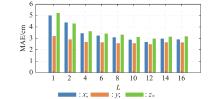
图14
不同滑动窗口长度25个人体骨骼平均MAE"
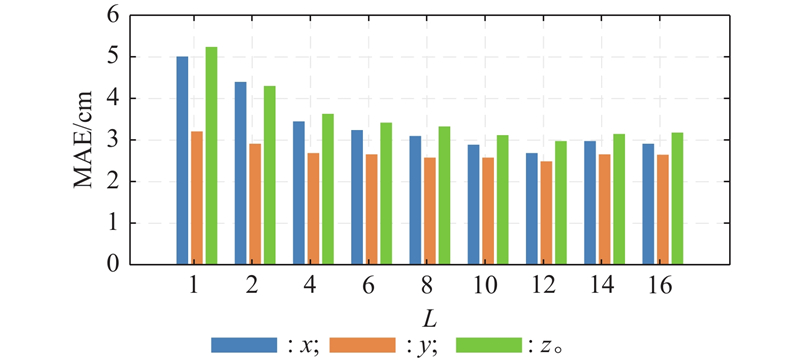
表4
不同CNN结构25个人体骨骼关节平均MAE"
| CNN结构 | x | y | z | 平均值 |
| BN× MP× | 2.94 | 2.86 | 3.10 | 2.97 |
| BN√ MP× | 2.61 | 2.37 | 2.90 | 2.63 |
| BN× MP√ | 3.28 | 2.88 | 3.21 | 3.12 |
| BN√ MP√ | 4.64 | 4.82 | 4.44 | 4.63 |
表5
不同模块25个人体骨骼关节平均MAE"
| 模块 | x | y | z | 平均 |
| BiLSTM× | 5.83 | 4.78 | 6.20 | 5.60 |
| LSTM | 3.09 | 2.74 | 3.30 | 3.04 |
| MLP | 3.90 | 3.28 | 4.06 | 3.75 |
| Transformer | 3.28 | 2.77 | 3.46 | 3.17 |
| BiLSTM | 2.61 | 2.37 | 2.90 | 2.63 |
表6
有无MHA机制25个人体骨骼关节平均MAE"
| 模型配置 | x | y | z | 平均 |
| 无MHA | 2.69 | 2.49 | 2.98 | 2.72 |
| 有MHA | 2.61 | 2.37 | 2.90 | 2.63 |
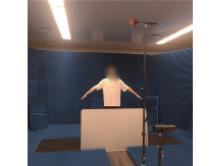
图15
遮挡实验场景"
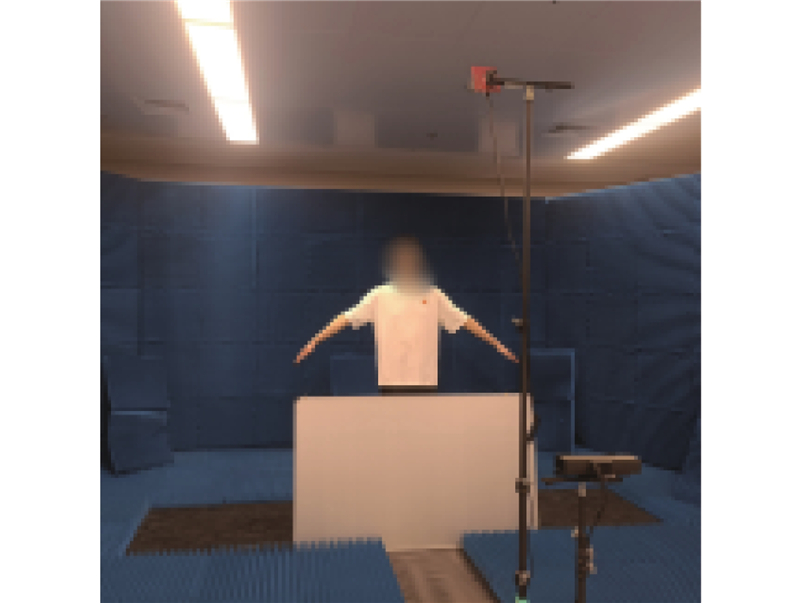
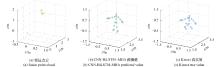
图16
遮挡实验结果"
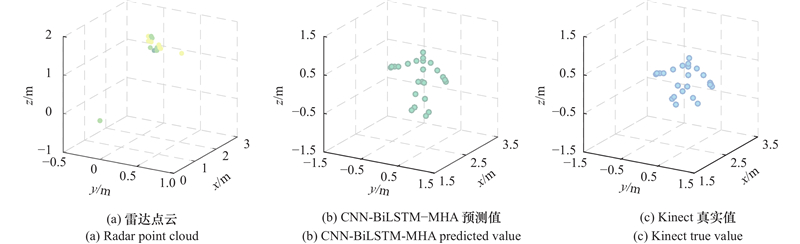
表7
遮挡实验非遮挡关节平均MAE"
| 实验场景 | x | y | z | 平均值 |
| 有遮挡 | 3.14 | 2.89 | 3.66 | 3.23 |
| 无遮挡 | 2.88 | 2.58 | 3.28 | 2.91 |
| 1 |
SONG Y X, ZHAO Y, YU H, et al. mmWave radar-based WPT/VMD noncontact repetitive motion counter[J]. IEEE Sensors Journal, 2023, 23 (19): 23145- 23157.
doi: 10.1109/JSEN.2023.3307390 |
| 2 |
FUKUSHIMA T, BLAUBERGER P, RUSSOMANNO T G, et al. The potential of human pose estimation for motion capture in sports: a validation study[J]. Sports Engineering, 2024, 27 (1): 19.
doi: 10.1007/s12283-024-00460-w |
| 3 |
ZHOU Y J, HUANG H, YUAN S, et al. MetaFi++: WiFi-enabled transformer-based human pose estimation for metaverse avatar simulation[J]. IEEE Internet of Things Journal, 2023, 10 (16): 14128- 14136.
doi: 10.1109/JIOT.2023.3262940 |
| 4 | 张春杰, 王冠博, 陈奇, 等. 基于纯自注意力机制的毫米波雷达手势识别[J]. 系统工程与电子技术, 2024, 46 (3): 859- 867. |
| ZHANG C J, WANG G B, CHEN Q, et al. Gesture recognition based on millimeter-wave radar with pure self-attention mechanism[J]. Systems Engineering and Electronics, 2024, 46 (3): 859- 867. | |
| 5 | 杨德贵, 许道峰. 基于时频域特征融合的IR-UWB穿墙雷达人体行为识别方法[J]. 系统工程与电子技术, 2024, 46 (3): 849- 858. |
| YANG D G, XU D F. Human behavior recognition method of IR-UWB through wall radar based on time-frequency domain feature fusion[J]. Systems Engineering and Electronics, 2024, 46 (3): 849- 858. | |
| 6 |
CHEN J, CHEN D Y, JIANG H X, et al. Skeleton-based 3D human pose estimation with low-resolution infrared array sensor using attention-based CNN-BiGRU[J]. International Journal of Machine Learning and Cybernetics, 2024, 15 (5): 2049- 2062.
doi: 10.1007/s13042-023-02015-0 |
| 7 |
NANDAGOPAL S, KARTHY G, OLIVER A S, et al. Optimal deep convolutional neural network with pose estimation for human activity recognition[J]. Computer Systems Science and Engineering, 2023, 44 (2): 1719- 1733.
doi: 10.32604/csse.2023.028003 |
| 8 |
BOUDLAL H, SERRHINI M, TAHIRI A, et al. A novel approach for simultaneous human activity recognition and pose estimation via skeleton-based leveraging WiFi CSI with YOLOv8 and mediapipe frameworks[J]. Signal, Image and Video Processing, 2024, 18 (4): 3673- 3689.
doi: 10.1007/s11760-024-03031-5 |
| 9 |
CHOI J Y, HA E, SON M, et al. Human joint angle estimation using deep learning-based three-dimensional human pose estimation for application in a real environment[J]. Sensors, 2024, 24 (12): 3823.
doi: 10.3390/s24123823 |
| 10 |
WU X, ZHANG H Y, KONG C X, et al. LiDAR-based 3-D human pose estimation and action recognition for medical scenes[J]. IEEE Sensors Journal, 2024, 24 (9): 15531- 15539.
doi: 10.1109/JSEN.2024.3373192 |
| 11 |
LAN S C, YE L, ZHANG K. Applying mmWave radar sensors to vocabulary-level dynamic chinese sign language recognition for the community with deafness and hearing loss[J]. IEEE Sensors Journal, 2023, 23 (22): 27273- 27283.
doi: 10.1109/JSEN.2023.3324369 |
| 12 |
ZHU Y A, XIAO M R, XIE Y J, et al. In-bed human pose estimation using multi-source information fusion for health monitoring in real-world scenarios[J]. Information Fusion, 2024, 105, 102209.
doi: 10.1016/j.inffus.2023.102209 |
| 13 |
SHIAO Y, CHEN G Y, HOANG T. Three-dimensional human posture recognition by extremity angle estimation with minimal IMU sensor[J]. Sensors, 2024, 24 (13): 4306.
doi: 10.3390/s24134306 |
| 14 | YU S, ZHAI D H, XIA Y, et al. Synthetic depth image-based category-level object pose estimation with effective pose decoupling and shape optimization[J]. IEEE Trans. on Instrumentation and Measurement, 2024, 73, 5026718. |
| 15 |
LI D, MU Q, YUAN Y L, et al. 6D pose estimation based on 3D edge binocular reprojection optimization for robotic assembly[J]. IEEE Robotics and Automation Letters, 2023, 8 (12): 8319- 8326.
doi: 10.1109/LRA.2023.3327933 |
| 16 |
LI X, ZHANG D, LI M, et al. Accurate head pose estimation using image rectification and a lightweight convolutional neural network[J]. IEEE Trans. on Multimedia, 2023, 25, 2239- 2251.
doi: 10.1109/TMM.2022.3144893 |
| 17 |
LIU S N, ZHAO L, YANG X, et al. Remote drowsiness detection based on the mmWave FMCW radar[J]. IEEE Sensors Journal, 2022, 22 (15): 15222- 15234.
doi: 10.1109/JSEN.2022.3186486 |
| 18 |
SKARIA S, HENDY N, AL-HOURANI A, et al. Machine-learning methods for material identification using mmWave radar sensor[J]. IEEE Sensors Journal, 2023, 23 (2): 1471- 1478.
doi: 10.1109/JSEN.2022.3227207 |
| 19 | 蔡嘉怡, 初萍, 庄伦涛, 等. 基于空间属性特征的毫米波雷达身体干扰识别[J]. 系统工程与电子技术, 2024, 46 (10): 3365- 3374. |
| CAI J Y, CHU P, ZHUANG L T, et al. Millimeter-wave radar body interference recognition based on spatial attribute features[J]. Systems Engineering and Electronics, 2024, 46 (10): 3365- 3374. | |
| 20 |
YU C X, XU Z, YAN K, et al. Noninvasive human activity recognition using millimeter-wave radar[J]. IEEE Systems Journal, 2022, 16 (2): 3036- 3047.
doi: 10.1109/JSYST.2022.3140546 |
| 21 |
HUANG Y C, LI W, DOU Z, et al. Activity recognition based on millimeter-wave radar by fusing point cloud and range-Doppler information[J]. Signals, 2022, 3 (2): 266- 283.
doi: 10.3390/signals3020017 |
| 22 |
MOON J Y, KIM B K, KANG J, et al. Fixed point cloud normalization and none-sequential modeling for hand gesture recognition based on short-range mmWave radar sensor’s sparse time-series point cloud[J]. IEEE Sensors Journal, 2024, 24 (7): 10656- 10668.
doi: 10.1109/JSEN.2024.3362473 |
| 23 | WANG Z M, JIANG D, SUN B, et al. A data augmentation method for human activity recognition based on mmWave radar point cloud[J]. IEEE Sensors Letters, 2023, 7 (5): 6002404. |
| 24 |
SENGUPTA A, JIN F, ZHANG R Y, et al. mm-pose: real-time human skeletal posture estimation using mmWave radars and CNNs[J]. IEEE Sensors Journal, 2020, 20 (17): 10032- 10044.
doi: 10.1109/JSEN.2020.2991741 |
| 25 | LI G Z, ZHANG Z, YANG H M, et al. Capturing human pose using mmWave radar[C]//Proc. of the IEEE International Conference on Pervasive Computing and Communications Workshops, 2020. |
| 26 | AN S Z, OGRAS U Y. MARS: mmWave-based assistive rehabilitation system for smart healthcare[J]. ACM Transaction on Embedded Computing Systems, 2021, 20 (5s): 72. |
| 27 | AN S Z, OGRAS U Y. Fast and scalable human pose estimation using mmWave point cloud[C]//Proc. of the 59th ACM/IEEE Design Automation Conference, 2022: 889−894. |
| 28 |
SENGUPTA A, CAO S Y. MmPose-NLP: a natural language processing approach to precise skeletal pose estimation using mmWave radars[J]. IEEE Trans. on Neural Networks and Learning Systems, 2023, 34 (11): 8418- 8429.
doi: 10.1109/TNNLS.2022.3151101 |
| 29 |
HU S T, CAO S Y, TOOSIZADEH N, et al. MmPose-FK: a forward kinematics approach to dynamic skeletal pose estimation using mmWave radars[J]. IEEE Sensors Journal, 2024, 24 (5): 6469- 6481.
doi: 10.1109/JSEN.2023.3348199 |
| 30 | 舒月, 傅东宁, 陈展野, 等. 基于 RD-ANM 的毫米波雷达动目标超分辨 DOA 估计方法[J]. 雷达学报, 2023, 12 (5): 986- 999. |
| SHU Y, FU D N, CHEN Z Y, et al. Super-resolution DOA estimation method for a moving target equipped with a millimeter-wave radar based on RD-ANM[J]. Journal of Radar, 2023, 12 (5): 986- 999. | |
| 31 |
LEE K M, LEE I S, SHIN H S, et al. Reconstruction of range-Doppler map corrupted by FMCW radar asynchronization[J]. Sensors, 2023, 23 (12): 5605.
doi: 10.3390/s23125605 |
| 32 |
ZHAO L F, LIN Z X, SUN R Y, et al. A review of state-of-the-art methodologies and applications in action recognition[J]. Electronics, 2024, 13 (23): 4733.
doi: 10.3390/electronics13234733 |
| [1] | 黄琼丹, 刘露露, 韩洁婧, 王佳鹏, 康仕林. 基于差异特征反投影融合的图像超分辨重建[J]. 系统工程与电子技术, 2026, 48(6): 1809-1818. |
| [2] | 孙景荣, 张华, 陈哲哲, 赵方正. 基于卷积神经网络的雾天道路能见度测量方法[J]. 系统工程与电子技术, 2026, 48(4): 1112-1124. |
| [3] | 蒋明煜, 张顺生, 肖思瑶. 面向轻量级交叉注意力卷积网络的SAR目标识别[J]. 系统工程与电子技术, 2025, 47(9): 2853-2861. |
| [4] | 陈文洁, 张浦, 史高翔, 刘林, 刘烜. 基于余弦校验关系的卷积神经网络LDPC码盲识别[J]. 系统工程与电子技术, 2025, 47(9): 3117-3125. |
| [5] | 姜智杰, 宋恒, 胡楠, 段兰茜, 曹平. 隧道环境毫米波雷达目标识别与分类算法[J]. 系统工程与电子技术, 2025, 47(5): 1453-1460. |
| [6] | 段阿敏, 张朝辉. 基于二次分解的混合神经网络蜂窝流量预测[J]. 系统工程与电子技术, 2025, 47(5): 1687-1697. |
| [7] | 王奇, 王子瑶, 郑峻峰. 考虑多源噪声及信号传输的雷达系统仿真模型[J]. 系统工程与电子技术, 2025, 47(3): 768-778. |
| [8] | 付卫红, 张鑫钰, 刘乃安. 基于多尺度融合神经网络的同频同调制单通道盲源分离算法[J]. 系统工程与电子技术, 2025, 47(2): 641-649. |
| [9] | 孔令宸, 刘桐辛, 周晨, 赵正予. 基于区域电离层高分辨率重构的到达时差定位分析[J]. 系统工程与电子技术, 2025, 47(11): 3521-3530. |
| [10] | 师英杰, 周东东, 雷泰然, 黄三傲, 徐科. 纵波EMAT优化与非接触管道液位监测[J]. 系统工程与电子技术, 2025, 47(11): 3531-3542. |
| [11] | 房瑞祥, 石晓进, 张云华. 基于MIAA的稀疏轨迹扫描毫米波三维成像算法[J]. 系统工程与电子技术, 2025, 47(11): 3612-3625. |
| [12] | 韦娟, 何德华, 宁方立. 基于自适应多分支卷积的声学场景分类[J]. 系统工程与电子技术, 2025, 47(10): 3148-3154. |
| [13] | 邵永琪, 杨丽花, 常澳, 任露露. RIS辅助的OFDM系统中时变信道估计方法[J]. 系统工程与电子技术, 2025, 47(1): 324-331. |
| [14] | 张明龙, 吴雨林, 魏文强, 沈园杰, 郭世盛, 崔国龙. 基于稀疏矩阵填充的级联毫米波雷达高分辨测角方法[J]. 系统工程与电子技术, 2024, 46(8): 2629-2640. |
| [15] | 张冬, 邢福逸, 徐允鹤, 钱鹏. 基于双模式切换的机载惯性/雷达组合导航方法[J]. 系统工程与电子技术, 2024, 46(8): 2770-2778. |
| 阅读次数 | ||||||
|
全文 |
|
|||||
|
摘要 |
|
|||||
