

系统工程与电子技术 ›› 2026, Vol. 48 ›› Issue (10): 3473-3484.doi: 10.12305/j.issn.1001-506X.2026.10.19
• 系统工程 • 上一篇
曲昊1,2( ), 吴晓莉1,2(), 晏彪1,2(), 张欣悦1,2(), 武愈涵1,2(), 吴传宇1,2(), 欧依琳1,2()
收稿日期:2025-09-24
接受日期:2026-02-11
出版日期:2026-10-25
发布日期:2026-09-30
通讯作者:
吴晓莉
E-mail:quhao_1218@163.com;wuxl@njust.edu.cn;yanbiao0109@163.com;969264885@qq.com;15951975551@163.com;chuanyuw213@163.com;oulihn@163.com
作者简介:曲 昊(2001—),女,硕士研究生,主要研究方向为认知增强基金资助:
Hao Qu1,2(), Xiaoli Wu1,2(), Biao Yan1,2(), Xinyue Zhang1,2(), Yuhan Wu1,2(), Chuanyu Wu1,2(), Yilin Ou1,2()
Received:2025-09-24
Accepted:2026-02-11
Online:2026-10-25
Published:2026-09-30
Contact:
Xiaoli Wu
E-mail:quhao_1218@163.com;wuxl@njust.edu.cn;yanbiao0109@163.com;969264885@qq.com;15951975551@163.com;chuanyuw213@163.com;oulihn@163.com
摘要:
在舰上多域协同作战环境中,自动化水平对指挥员认知表现具有显著影响。针对自动化水平对指挥员认知表现影响机制尚不明确的问题,提出一种基于多源数据融合的认知评估方法。该方法首先构建典型舰上多域指挥任务并设置四级自动化水平,然后采集被试的行为数据、眼动数据与主观负荷评分,最后对不同自动化条件下的认知表现进行综合分析,识别最优配置区间。实验结果显示,低自动化条件下被试认知参与度较高但负荷较重,高自动化条件下任务效率提升但正确率有所下降,并出现一定程度的自动化依赖。结果表明二级自动化在效率与认知增强之间实现较优平衡,为舰上指挥系统人机协同设计提供参考。
中图分类号:
曲昊, 吴晓莉, 晏彪, 张欣悦, 武愈涵, 吴传宇, 欧依琳. 自动化水平及依赖对多域指挥认知增强的影响[J]. 系统工程与电子技术, 2026, 48(10): 3473-3484.
Hao Qu, Xiaoli Wu, Biao Yan, Xinyue Zhang, Yuhan Wu, Chuanyu Wu, Yilin Ou. Impact of automation levels and dependency on cognitive enhancement for multi-domain command[J]. Systems Engineering and Electronics, 2026, 48(10): 3473-3484.
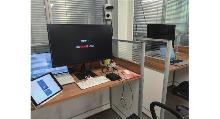
图1
实验环境"
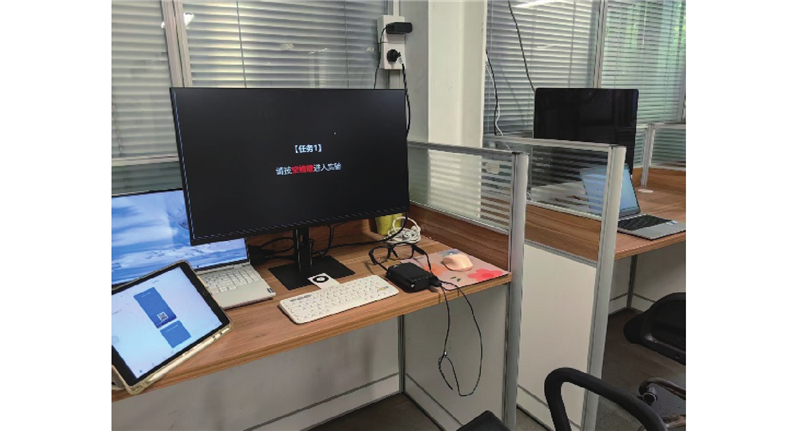
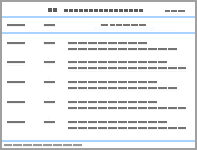
表1
舰上指挥任务设计"
| 任务流程 | 任务目标 |
| 发现目标 | 监控态势地图区域,及时发现潜在威胁 |
| 目标处理 | 对可疑目标进行目标类型的识别与威胁等级的分类, 做出应对策略 |
| 攻击决策 | 根据目标信息决策是否攻击目标,选择攻击平台与攻击方式 |
| 行动执行 | 最终确认攻击执行 |
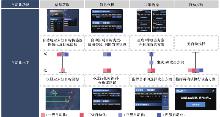
图2
自动化水平模型"
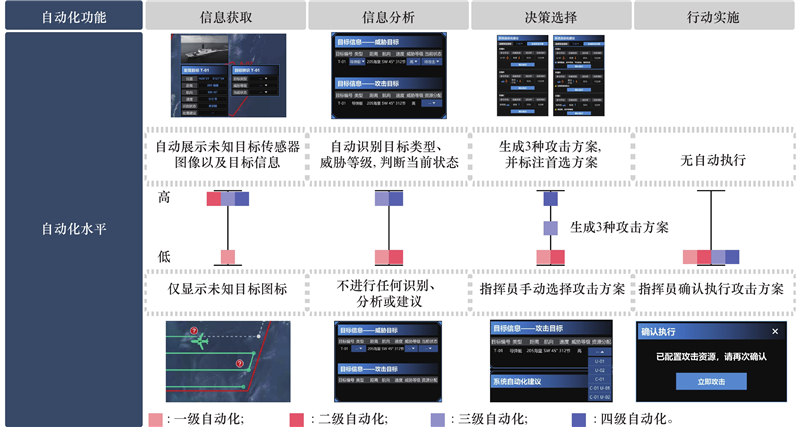

图3
实验流程"
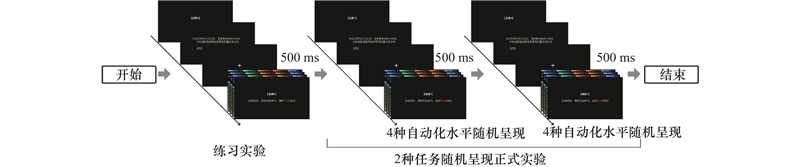
图4
AOI划分"
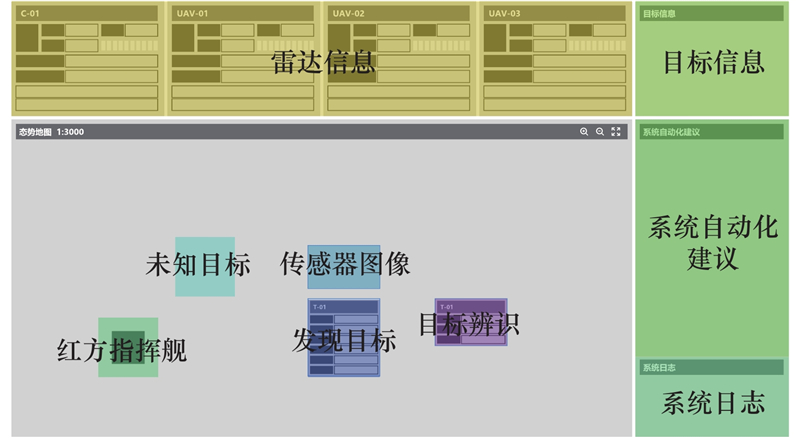
表2
眼动指标"
| 指标类别 | 眼动指标 |
| 注视类 | TDF |
| ADF | |
| NF | |
| TFF | |
| DFF | |
| 访问类 | TDV |
| ADV | |
| NV |
表3
眼动指标均值"
| 被试编号 | TDF_Mean | ADF_Mean | NF_Mean | TFF_Mean | DFF_Mean | TDV_Mean | ADV_Mean | NV_Mean |
| 1 | 1.10 | 0.16 | 3.00 | 3.12 | 0.13 | 1.20 | 0.54 | 1.06 |
| 2 | 1.18 | 0.17 | 3.67 | 4.16 | 0.15 | 1.27 | 0.49 | 1.11 |
| 3 | 2.48 | 0.21 | 7.24 | 7.72 | 0.17 | 2.76 | 0.72 | 2.17 |
| 4 | 2.20 | 0.21 | 5.08 | 8.22 | 0.18 | 2.33 | 0.86 | 1.64 |
| 5 | 2.64 | 0.27 | 6.15 | 6.79 | 0.25 | 2.81 | 0.90 | 1.88 |
| 6 | 1.00 | 0.11 | 3.88 | 4.16 | 0.12 | 1.15 | 0.35 | 1.40 |
| 7 | 1.98 | 0.21 | 5.03 | 4.24 | 0.17 | 2.12 | 0.60 | 1.68 |
| 8 | 0.92 | 0.12 | 4.00 | 4.04 | 0.12 | 1.20 | 0.40 | 1.44 |
| 9 | 1.14 | 0.18 | 2.93 | 3.70 | 0.15 | 1.22 | 0.38 | 1.15 |
| 10 | 1.01 | 0.17 | 2.67 | 4.69 | 0.16 | 1.08 | 0.42 | 1.24 |
| 11 | 1.47 | 0.16 | 3.94 | 4.78 | 0.14 | 1.60 | 0.42 | 1.40 |
| 12 | 1.26 | 0.19 | 3.00 | 2.86 | 0.16 | 1.34 | 0.51 | 0.96 |
| 13 | 1.07 | 0.16 | 2.88 | 3.59 | 0.15 | 1.13 | 0.41 | 1.11 |
| 14 | 0.23 | 0.07 | 1.38 | 2.75 | 0.08 | 0.43 | 0.30 | 0.67 |
| 15 | 1.82 | 0.20 | 6.26 | 5.72 | 0.20 | 2.20 | 0.60 | 2.07 |
| 16 | 0.87 | 0.13 | 2.85 | 2.16 | 0.10 | 0.96 | 0.34 | 1.17 |
| 17 | 0.84 | 0.16 | 3.19 | 4.07 | 0.16 | 0.96 | 0.31 | 1.58 |
| 18 | 1.10 | 0.11 | 3.78 | 4.08 | 0.10 | 1.18 | 0.28 | 1.57 |
表4
成分矩阵"
| 原始变量 | 主成分1 |
| TDF_Mean | 0.980 |
| ADF_Mean | 0.891 |
| NF_Mean | 0.926 |
| TFF_Mean | 0.880 |
| DFF_Mean | 0.855 |
| TDV_Mean | 0.985 |
| ADV_Mean | 0.904 |
| NV_Mean | 0.837 |
表5
主成分得分"
| 被试编号 | FAC1 |
| 1 | − |
| 2 | − |
| 3 | |
| 4 | |
| 5 | |
| 6 | − |
| 7 | |
| 8 | − |
| 9 | − |
| 10 | − |
| 11 | − |
| 12 | − |
| 13 | − |
| 14 | − |
| 15 | |
| 16 | − |
| 17 | − |
| 18 | − |
表6
被试分组结果"
| 被试编号 | ATI | 分组 |
| 2 | − | 主动组 |
| 3 | ||
| 4 | ||
| 5 | ||
| 7 | ||
| 10 | − | |
| 11 | − | |
| 12 | − | |
| 15 | ||
| 1 | − | 依赖组 |
| 6 | − | |
| 8 | − | |
| 9 | − | |
| 13 | − | |
| 14 | − | |
| 16 | − | |
| 17 | − | |
| 18 | − |
表7
NASA-TLX量表评分"
| 被试组别 | 评估维度 | 一级 | 二级 | 三级 | 四级 |
| 主动组 | 脑力需求 | 76.89 | 67.44 | 48.72 | 26.44 |
| 体力需求 | 55.06 | 48.78 | 36.28 | 19.89 | |
| 时间需求 | 64.39 | 57.00 | 38.50 | 31.06 | |
| 绩效表现 | 60.50 | 65.83 | 69.94 | 70.50 | |
| 努力程度 | 71.56 | 58.61 | 44.33 | 29.44 | |
| 受挫程度 | 58.83 | 53.72 | 44.50 | 28.50 | |
| 总计 | 64.537 | 58.565 | 47.046 | 34.306 | |
| 依赖组 | 脑力需求 | 77.61 | 62.39 | 39.94 | 21.28 |
| 体力需求 | 35.50 | 27.33 | 18.28 | 10.06 | |
| 时间需求 | 69.00 | 49.67 | 30.78 | 20.78 | |
| 绩效表现 | 54.83 | 59.22 | 58.33 | 54.22 | |
| 努力程度 | 70.94 | 55.17 | 28.28 | 17.56 | |
| 受挫程度 | 58.06 | 47.22 | 40.06 | 23.89 | |
| 总计 | 60.991 | 50.167 | 35.944 | 24.630 |
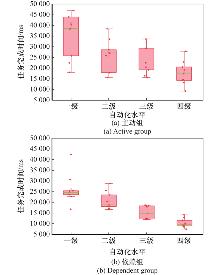
图5
任务完成时间箱线图"
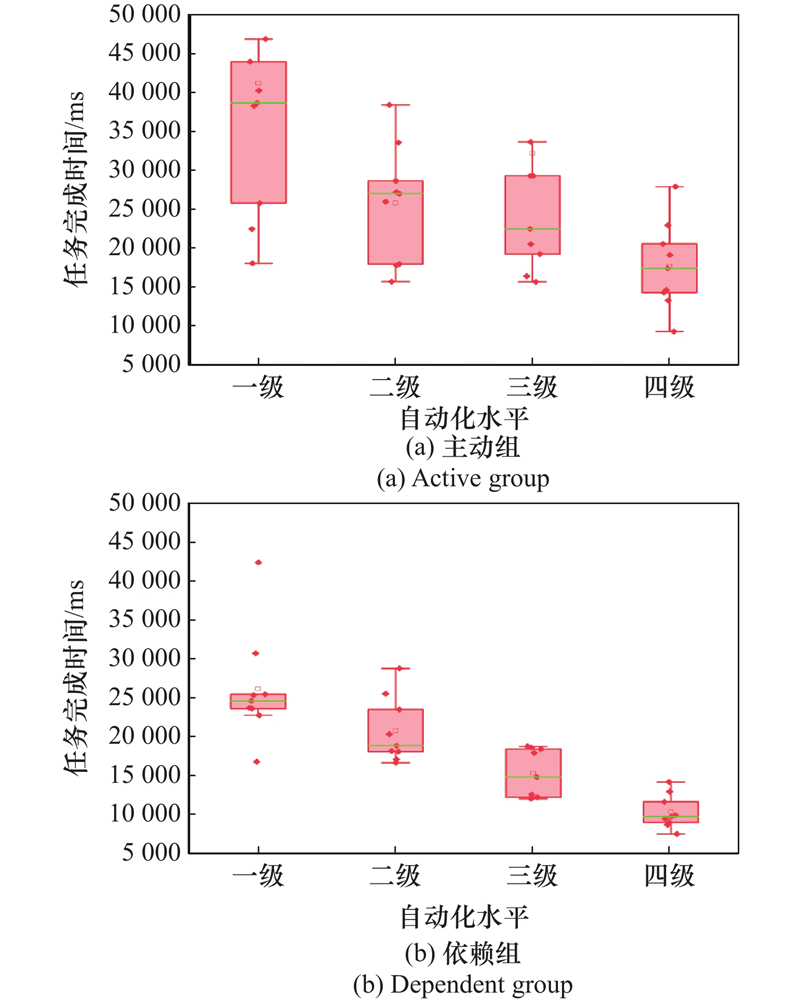
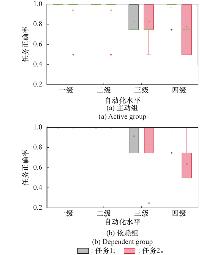
图6
任务正确率箱线图"
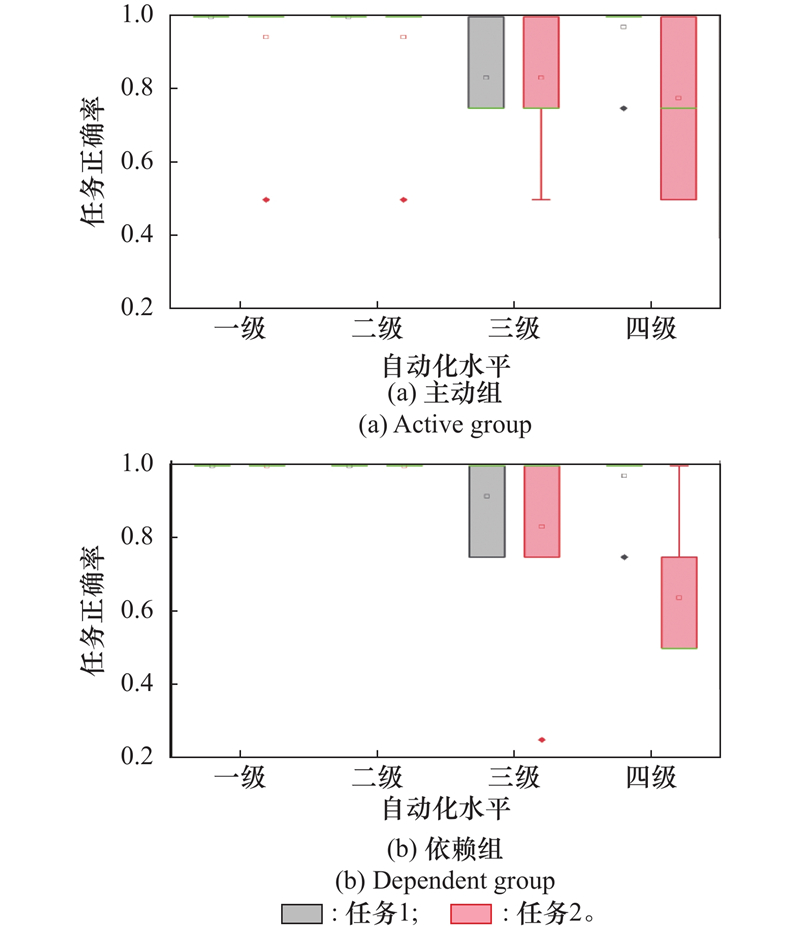
图7
TDF箱线图"
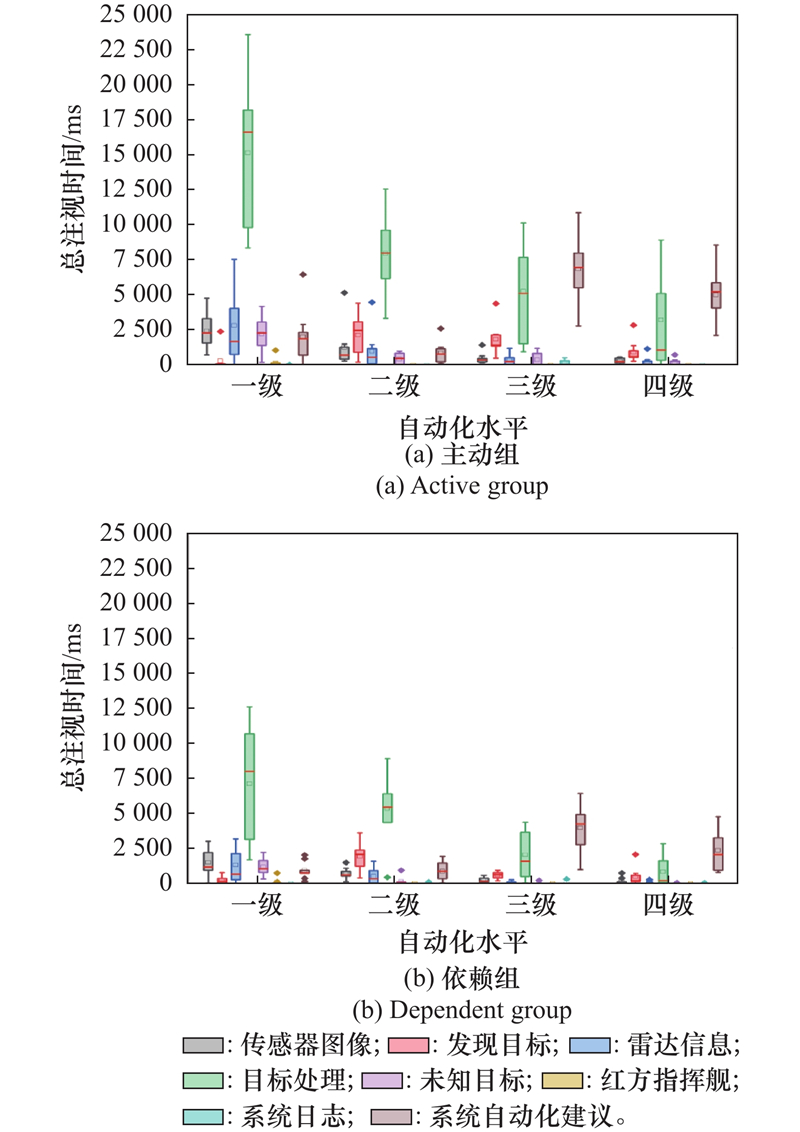
图8
注视点数量箱线图"
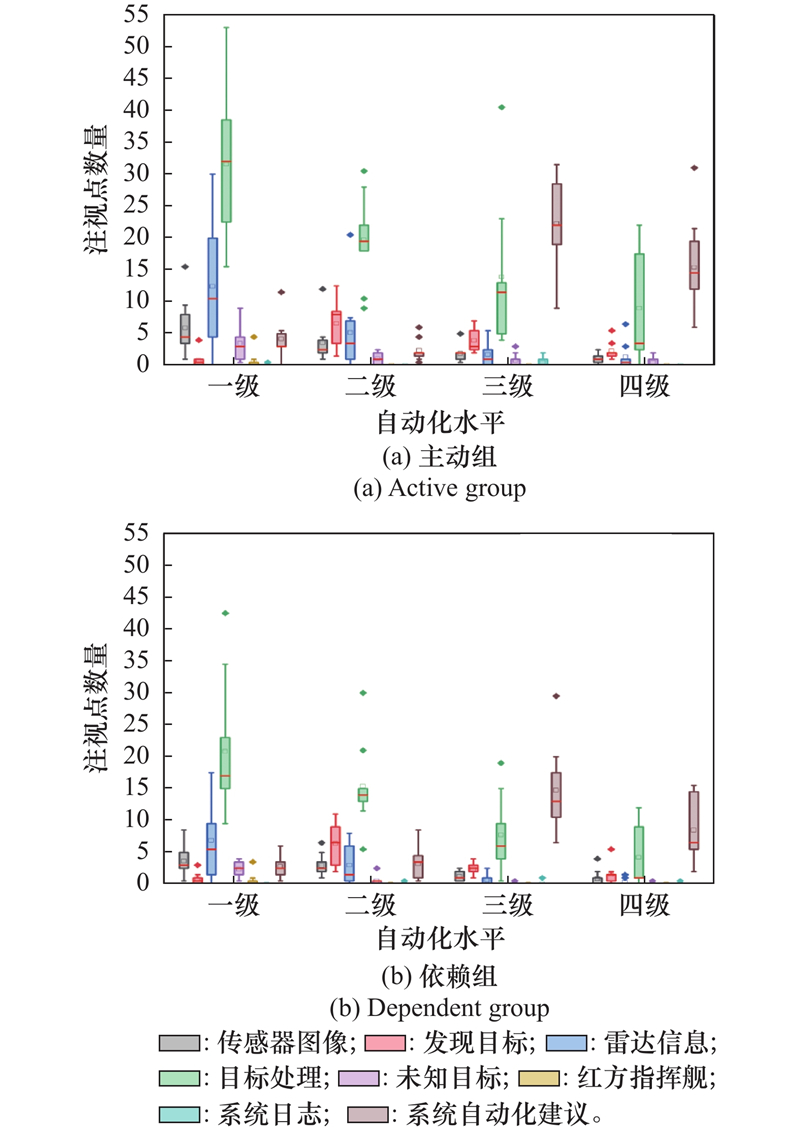
图9
TFF箱线图"
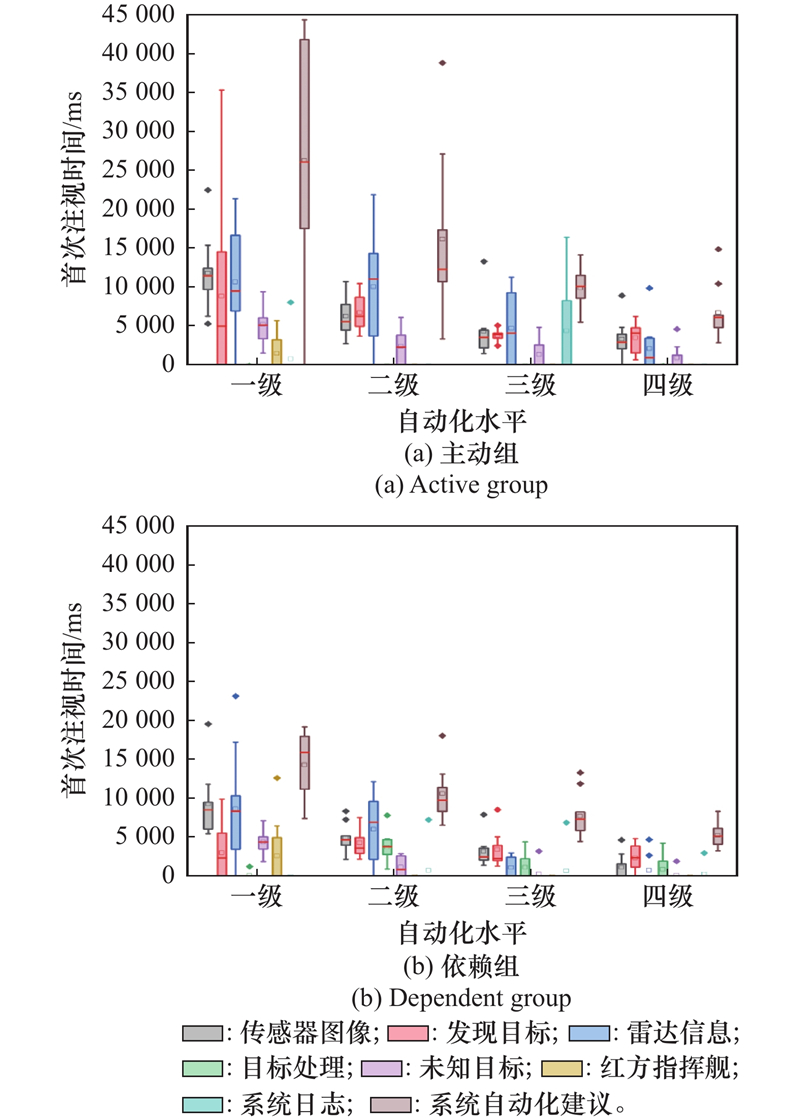
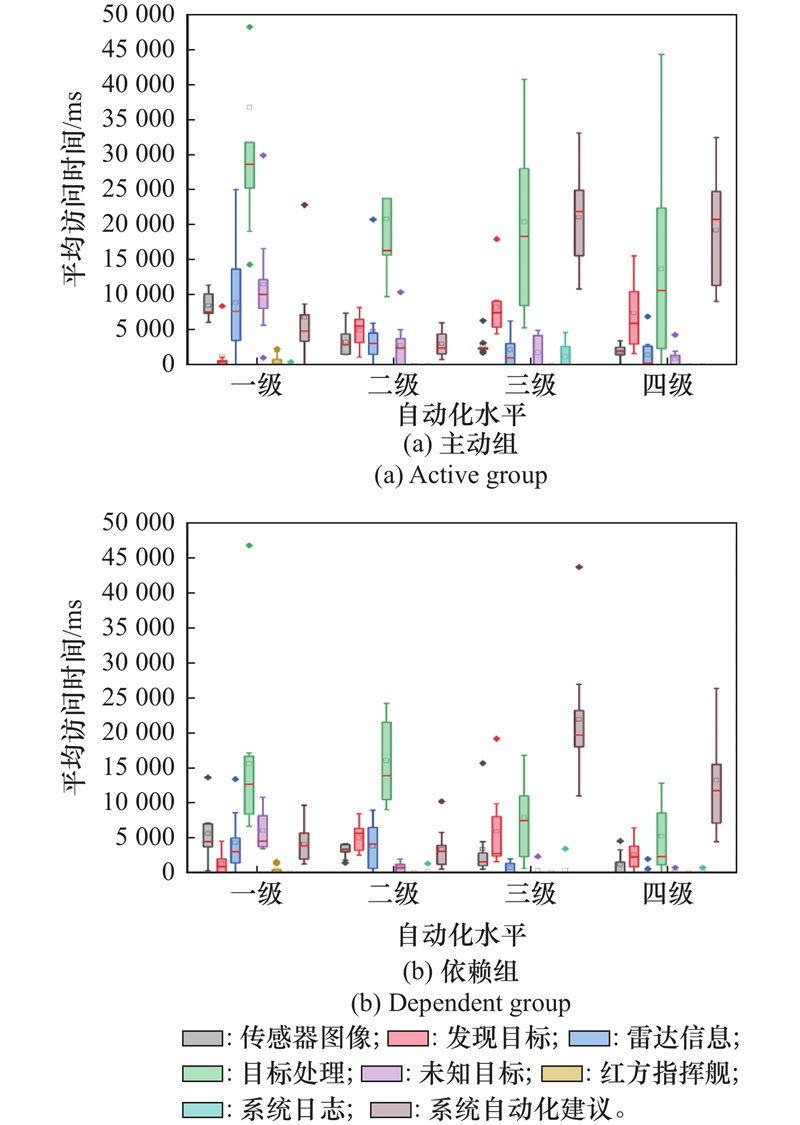
图10
ADV箱线图"
| 1 |
Vincenzi D A, Terwilliger B A, Ison D C. Unmanned aerial system (UAS) human-machine interfaces: new paradigms in command and control[J]. Procedia Manufacturing, 2015, 3, 920.
doi: 10.1016/j.promfg.2015.07.139 |
| 2 | Robinson R M, Mccourt M J, Marathe A R, et al. Degree of automation in command and control decision support systems[C]//IEEE International Conference on Systems, Man, and Cybernetics, 2016: 1184. |
| 3 |
Pang E S, Dai L C. Research on task complexity measurements in human-computer interaction in nuclear power plant DCS systems based on emergency operating procedures[J]. Entropy, 2025, 27 (6): 600.
doi: 10.3390/e27060600 |
| 4 |
Poornikoo M, Øvergård K I. Levels of automation in maritime autonomous surface ships (MASS): a fuzzy logic approach[J]. Maritime Economics & Logistics, 2022, 24 (2): 278.
doi: 10.1057/s41278-022-00215-z |
| 5 |
Veitch E, Alsos O A. A systematic review of human-AI interaction in autonomous ship systems[J]. Safety Science, 2022, 152, 105778.
doi: 10.1016/j.ssci.2022.105778 |
| 6 | Parasuraman R, Riley V. Humans and automation: use, misuse, disuse, abuse[J]. Human Factors, 1997, 39 (2): 230. |
| 7 |
Parasuraman R, Sheridan T B, Wickens C D. A model for types and levels of human interaction with automation[J]. IEEE Trans. on Systems, Man, and Cybernetics-Part A: Systems and Humans, 2000, 30 (3): 286.
doi: 10.1109/3468.844354 |
| 8 |
He R Z, He H, Zhang Y X, et al. Automating dependency updates in practice: an exploratory study on github dependabot[J]. IEEE Trans. on Software Engineering, 2023, 49 (8): 4004.
doi: 10.1109/TSE.2023.3278129 |
| 9 |
Roberts E, Abbott K. Investigating the under-reporting of automation dependency in air transport accidents worldwide[J]. Transportation Research Procedia, 2025, 88, 217.
doi: 10.1016/j.trpro.2025.05.027 |
| 10 |
Figalová N, Bieg H J, Reiser J E, et al. From driver to supervisor: comparing cognitive load and EEG-based attentional resource allocation across automation levels[J]. International Journal of Human-Computer Studies, 2024, 182, 103169.
doi: 10.1016/j.ijhcs.2023.103169 |
| 11 |
Passalacqua M, Pellerin R, Yahia E, et al. Practice with less AI makes perfect: partially automated AI during training leads to better worker motivation, engagement, and skill acquisition[J]. International Journal of Human-Computer Interaction, 2025, 41 (4): 2268.
doi: 10.1080/10447318.2024.2319914 |
| 12 |
Alberti A L, Agarwal V, Gutowska I, et al. Automation levels for nuclear reactor operations: a revised perspective[J]. Progress in Nuclear Energy, 2023, 157, 104559.
doi: 10.1016/j.pnucene.2022.104559 |
| 13 |
Markauskaite L, Marrone R, Poquet O, et al. Rethinking the entwinement between artificial intelligence and human learning: what capabilities do learners need for a world with AI[J]. Computers and Education: Artificial Intelligence, 2022, 3, 100056.
doi: 10.1016/j.caeai.2022.100056 |
| 14 | Bostrom N, Sandberg A. Cognitive enhancement: methods, ethics, regulatory challenges[J]. Science and Engineering Ethics, 2009, 15, 311. |
| 15 |
Fu Q W, Zhang L J, Xu Y Q, et al. The review of human-machine collaborative intelligent interaction with driver cognition in the loop[J]. Systems Research and Behavioral Science, 2025, 42 (4): 954.
doi: 10.1002/sres.3141 |
| 16 |
Broadbent D P, D‘innocenzo G, Ellmers T J, et al. Cognitive load, working memory capacity and driving performance: a preliminary fNIRS and eye tracking study[J]. Transportation Research Part F: Traffic Psychology and Behaviour, 2023, 92, 121.
doi: 10.1016/j.trf.2022.11.013 |
| 17 |
Daronnat S, Azzopardi L, Halvey M, et al. Inferring trust from users’ behaviours; agents’ predictability positively affects trust, task performance and cognitive load in human-agent real-time collaboration[J]. Frontiers in Robotics and AI, 2021, 8, 642201.
doi: 10.3389/frobt.2021.642201 |
| 18 | Zeitlhofer I, Zumbach J, Schweppe J. Complexity affects performance, cognitive load, and awareness[J]. Learning and Instruction, 2024, 94, 102001. |
| 19 |
Boyer M, Cummings M L, Spence L B, et al. Investigating mental workload changes in a long duration supervisory control task[J]. Interacting with Computers, 2015, 27 (5): 512.
doi: 10.1093/iwc/iwv012 |
| 20 |
Mao R Z, Li G Y, Hildre H P, et al. A survey of eye tracking in automobile and aviation studies: implications for eye-tracking studies in marine operations[J]. IEEE Trans. on Human-Machine Systems, 2021, 51 (2): 87.
doi: 10.1109/THMS.2021.3053196 |
| 21 |
Xu K M, Koorn P, De Koning B, et al. A growth mindset lowers perceived cognitive load and improves learning: integrating motivation to cognitive load[J]. Journal of Educational Psychology, 2021, 113 (6): 1177.
doi: 10.1037/edu0000631.supp |
| 22 |
Yan K T, Shao J, Zhu Z D, et al. Display interface design for rollers based on cognitive load of operator[J]. Journal of the Society for Information Display, 2021, 29 (8): 659.
doi: 10.1002/jsid.1009 |
| 23 |
Wenk N, Penalver-andres J, Buetler K A, et al. Effect of immersive visualization technologies on cognitive load, motivation, usability, and embodiment[J]. Virtual Reality, 2023, 27 (1): 307.
doi: 10.1007/s10055-021-00565-8 |
| 24 | Sethupathy U K A. Empowering intelligent decision-making: architecting resilient real-time data platforms with actionable visual dashboards[J]. International Journal of Advanced Engineering Technologies and Innovations, 2021, 1(2): 211. |
| 25 | Huang Q, Xu X, Wei Y, et al. The impacts of level of automation and cognitive secondary task on the cognitive load of armored vehicle crews[J]. Cognition, Technology & Work, 2025, 27 (3): 541. |
| 26 |
Gkintoni E, Antonopoulou H, Sortwell A, et al. Challenging cognitive load theory: the role of educational neuroscience and artificial intelligence in redefining learning efficacy[J]. Brain Sciences, 2025, 15 (2): 203.
doi: 10.3390/brainsci15020203 |
| 27 | 韩玉龙, 严建钢, 林云, 等. 舰载无人机编队协同对海突击作战关键技术综述[J]. 飞航导弹, 2015, (5): 47. |
| 28 |
Greenacre M, Groenen P J F, Hastie T, et al. Principal component analysis[J]. Nature Reviews Methods Primers, 2022, 2 (1): 100.
doi: 10.1038/s43586-022-00184-w |
| 29 |
Gouraud J, Delorme A, Berberian B. Influence of automation on mind wandering frequency in sustained attention[J]. Consciousness and Cognition, 2018, 66, 54.
doi: 10.1016/j.concog.2018.09.012 |
| 30 |
Wohleber R W, Matthews G, Lin J, et al. Vigilance and automation dependence in operation of multiple unmanned aerial systems (UAS): a simulation study[J]. Human Factors, 2019, 61 (3): 488.
doi: 10.1177/0018720818799468 |
| 31 |
Causse M, Mercier M, Lefrançois O, et al. Impact of automation level on airline pilots’ flying performance and visual scanning strategies: a full flight simulator study[J]. Applied Ergonomics, 2025, 125, 104456.
doi: 10.1016/j.apergo.2024.104456 |
| 32 |
Yang B, Inoue K, Yan Z H, et al. Influences of level 2 automated driving on driver behaviors: a comparison with manual driving[J]. IEEE Trans. on Intelligent Transportation Systems, 2023, 25 (1): 144.
doi: 10.1109/tits.2023.3308569 |
| 33 |
Cui X, Zhang Y J, Zhou Y W, et al. Measurements of team workload: a time pressure and scenario complexity study for maritime operation tasks[J]. International Journal of Industrial Ergonomics, 2021, 83, 103110.
doi: 10.1016/j.ergon.2021.103110 |
| [1] | 张少辉, 李璐璐, 李亚飞, 吴庆顺, 李冠峰, 徐明亮. 舰载机弹药保障作业规划方法研究综述[J]. 系统工程与电子技术, 2026, 48(4): 1303-1321. |
| [2] | 武愈涵, 吴晓莉, 张欣悦, 晏彪, 王名珺. 面向认知增强的MUM-T态势图视觉调控方法[J]. 系统工程与电子技术, 2026, 48(4): 1292-1302. |
| [3] | 晏彪, 吴晓莉, 张蓝, 刘潇, 方泽茜, 韩炜毅, 李琦桉. 有人/无人机协同指挥员的事件相关电位特征[J]. 系统工程与电子技术, 2026, 48(2): 578-587. |
| [4] | 魏建林, 林彦超, 唐慧龙, 张旺, 王伟. 基于改进MCTS的多无人机多任务联合决策[J]. 系统工程与电子技术, 2026, 48(2): 556-568. |
| [5] | 李正杰, 刘光远, 张浩为, 刘斌, 齐铖. 面向射频隐身的多无人机协同区域覆盖航迹优化方法[J]. 系统工程与电子技术, 2026, 48(1): 301-311. |
| [6] | 洪芳宇, 叶青, 张利宁, 伍国华. 面向区域搜索的车载多无人机协同任务规划方法[J]. 系统工程与电子技术, 2026, 48(1): 144-156. |
| [7] | 胡崇爽, 王纪凯, 李明浩, 豆亚杰, 姜江. 基于IVSFS的作战威胁人机协同评估框架[J]. 系统工程与电子技术, 2025, 47(6): 1855-1866. |
| [8] | 熊威, 张栋, 任智, 杨书恒. 面向有人/无人机协同打击的智能决策方法研究[J]. 系统工程与电子技术, 2025, 47(4): 1285-1299. |
| [9] | 尹中杰, 侯博, 靳啸龙, 范志良, 王海洋. 面向阵列天线抗干扰无人机的隐蔽诱骗方法[J]. 系统工程与电子技术, 2025, 47(2): 633-640. |
| [10] | 张进富, 曹云峰, 郭邦君, 王浩宇. 面向有人/无人机协同作战的体系架构正向建模方法[J]. 系统工程与电子技术, 2025, 47(12): 3935-3951. |
| [11] | 王名珺, 吴晓莉, 晏彪, 张欣悦, 武愈涵. 基于人机协同作战多通道交互系统的隐性知识挖掘[J]. 系统工程与电子技术, 2025, 47(10): 3313-3324. |
| [12] | 刘瑶, 夏阳升, 石建迈, 陈超, 黄金才. 车载多无人机协同多区域覆盖路径规划方法[J]. 系统工程与电子技术, 2023, 45(5): 1380-1390. |
| [13] | 李洪瑶, 李小强, 韩心中, 谢学立, 席建祥. 基于决策融合的多无人机协同目标检测识别算法[J]. 系统工程与电子技术, 2022, 44(3): 746-754. |
| 阅读次数 | ||||||
|
全文 |
|
|||||
|
摘要 |
|
|||||
