

系统工程与电子技术 ›› 2026, Vol. 48 ›› Issue (5): 1635-1646.doi: 10.12305/j.issn.1001-506X.2026.05.20
刘煊, 王肖霞, 杨风暴, 李菠, 陶映恺
收稿日期:2024-12-31
出版日期:2026-05-27
发布日期:2026-05-27
通讯作者:
王肖霞
作者简介:刘 煊(2000—),男,硕士研究生,主要研究方向为意图识别、态势感知基金资助:Xuan LIU, Xiaoxia WANG, Fengbao YANG, Bo LI, Yingkai TAO
Received:2024-12-31
Online:2026-05-27
Published:2026-05-27
Contact:
Xiaoxia WANG
摘要:
针对现有空间目标意图识别方法仅适用于单一目标,难以判别空间群目标意图的问题,提出一种适用于空间群目标的意图识别方法。首先,分析空间群目标运动特性,从群内目标的编队队形、目标类型、状态层和行动层4个维度构建意图特征集。然后,研究目标连续性特征模糊化处理方法,利用数据聚类构造模糊隶属度函数,实现连续性特征隶属度的动态调整。最后,基于相对距离将场景划分为近距离和远距离两类,通过挖掘不同场景下群目标多时段特征数据,建立编队子意图与群意图之间的序列规则,利用动态序列贝叶斯网络构建空间群目标意图识别模型,并结合不同场景验证该方法的有效性和优越性。实验结果表明,所提方法与基于模糊推理的方法相比,准确率提升了12.50%,证明了所提方法的有效性。
中图分类号:
刘煊, 王肖霞, 杨风暴, 李菠, 陶映恺. 基于贝叶斯网络的空间群目标意图识别方法[J]. 系统工程与电子技术, 2026, 48(5): 1635-1646.
Xuan LIU, Xiaoxia WANG, Fengbao YANG, Bo LI, Yingkai TAO. Bayesian network-based method for space group target intent recognition[J]. Systems Engineering and Electronics, 2026, 48(5): 1635-1646.
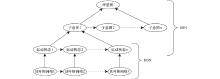
图1
DSBN意图识别模型"
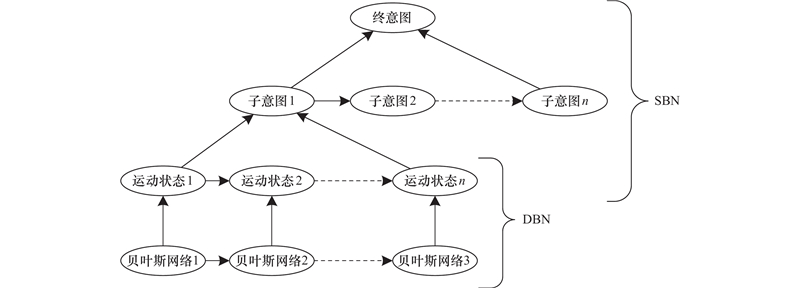
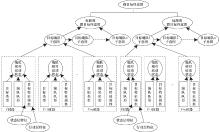
图2
空间群目标意图识别模型"
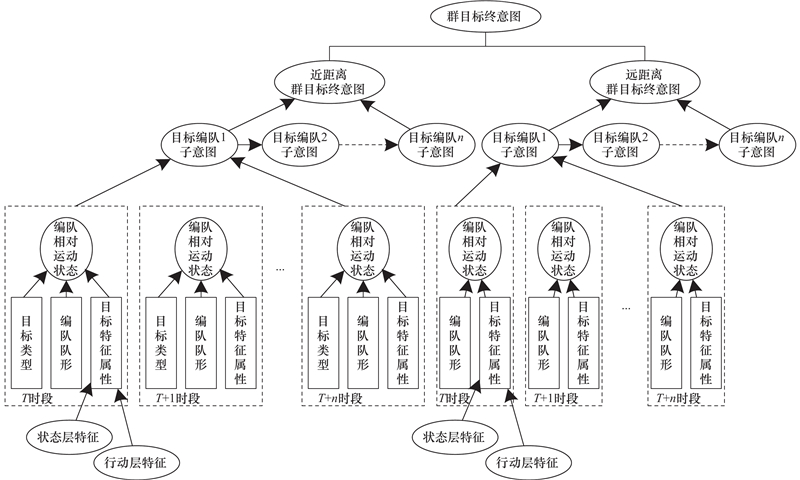
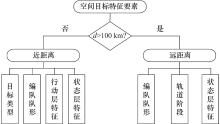
图3
空间目标意图特征要素"
表1
空间目标特征集"
| 名称 | 状态集划分 |
| 相对速度 | 慢,中,快 |
| 相对距离 | 近,中,远 |
| 飞行方向 | 正向,反向 |
| 轨道阶段 | 抵近,保持,飞离 |
| 目标姿态 | 三轴稳定,自旋稳定,翻滚状态 |
| 干扰状态 | 开,关 |
| 编队队形 | 椭圆,同心双椭圆,球面,三角形,无 |
| 目标类型 | 探测,评估,控制 |
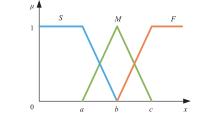
图4
相对速度隶属度函数"
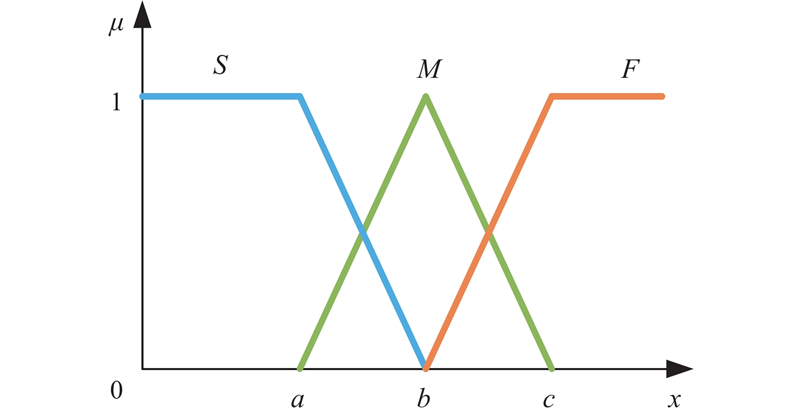
表2
相对运动状态与输入特征的条件概率(近)"
| 输入特征 | 特征状态 | 相对运动状态 | ||||
| 逼近 | 绕飞 | 跟飞 | 在轨机动 | 远离 | ||
| 相对速度 | 慢 | 0.1 | 0.1 | 0.3 | 0.2 | 0.2 |
| 中 | 0.3 | 0.8 | 0.6 | 0.7 | 0.3 | |
| 快 | 0.6 | 0.1 | 0.1 | 0.1 | 0.5 | |
| 相对距离 | 近 | 0.1 | 0.7 | 0.6 | 0.3 | 0.6 |
| 中 | 0.3 | 0.2 | 0.3 | 0.4 | 0.3 | |
| 远 | 0.6 | 0.1 | 0.1 | 0.3 | 0.1 | |
| 干扰状态 | 开 | 0.5 | 0.8 | 0.7 | 0.5 | 0.5 |
| 关 | 0.5 | 0.2 | 0.3 | 0.5 | 0.5 | |
| 飞行方向 | 正向 | 1 | 0.5 | 0.7 | 0.5 | 0 |
| 反向 | 0 | 0.5 | 0.3 | 0.5 | 1 | |
| 目标姿态 | 三轴稳定 | 0.1 | 0.8 | 0.7 | 0.7 | 0.1 |
| 自旋稳定 | 0.9 | 0.2 | 0.3 | 0.2 | 0.6 | |
| 翻滚状态 | 0 | 0 | 0 | 0.1 | 0.3 | |
| 轨道阶段 | 抵近 | 0.6 | 0.1 | 0.2 | 0.1 | 0 |
| 保持 | 0.4 | 0.8 | 0.7 | 0.7 | 0.4 | |
| 飞离 | 0 | 0.1 | 0.1 | 0.2 | 0.6 | |
| 目标类型 | 探测 | 0.5 | 0.6 | 0.6 | 0.2 | 0.3 |
| 评估 | 0.2 | 0.1 | 0.2 | 0.6 | 0.4 | |
| 控制 | 0.3 | 0.3 | 0.2 | 0.2 | 0.3 | |
| 编队队形 | 椭圆 | 0.2 | 0.3 | 0.2 | 0.1 | 0.2 |
| 同心双椭圆 | 0.1 | 0.3 | 0.3 | 0.2 | 0.1 | |
| 球面 | 0.2 | 0.3 | 0.2 | 0.2 | 0.1 | |
| 三角形 | 0.3 | 0.2 | 0.2 | 0.1 | 0.2 | |
| 无 | 0.25 | 0.25 | 0.25 | 0.25 | 0.25 | |
表3
相对运动状态转移概率(近)"
| 相对运动状态 | 逼近 | 绕飞 | 跟飞 | 在轨机动 | 远离 |
| 逼近 | 0.3 | 0.2 | 0.2 | 0.2 | 0.1 |
| 绕飞 | 0.1 | 0.3 | 0.2 | 0.2 | 0.2 |
| 跟飞 | 0.2 | 0.2 | 0.3 | 0.1 | 0.2 |
| 在轨机动 | 0.2 | 0.2 | 0.1 | 0.3 | 0.2 |
| 远离 | 0 | 0.1 | 0.1 | 0.3 | 0.5 |
表4
子意图和相对运动状态序列对应表(近)"
| 子意图 | 相对运动状态序列 |
| 抵近探测 | |
| 巡航探查 | |
| 近距后撤 | |
| 电磁干扰 |
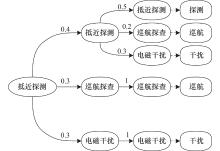
图5
近距离空间群目标终意图与子意图关系(部分)"
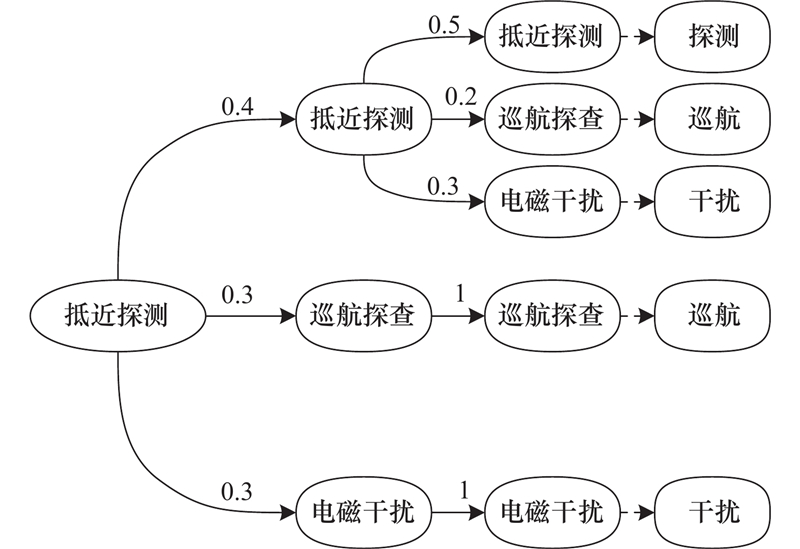
表5
相对运动状态与输入特征的条件概率(远)"
| 输入特征 | 特征状态 | 相对运动状态 | ||
| 逼近 | 在轨机动 | 远离 | ||
| 相对速度 | 慢 | 0.1 | 0.2 | 0.3 |
| 中 | 0.1 | 0.7 | 0.4 | |
| 快 | 0.8 | 0.1 | 0.3 | |
| 相对距离 | 近 | 0.1 | 0.3 | 0.6 |
| 中 | 0.3 | 0.4 | 0.3 | |
| 远 | 0.6 | 0.3 | 0.1 | |
| 飞行方向 | 正向 | 1 | 0.5 | 0.7 |
| 反向 | 0 | 0.5 | 0.3 | |
| 轨道阶段 | 抵近 | 0.6 | 0.1 | 0 |
| 保持 | 0.4 | 0.7 | 0.3 | |
| 飞离 | 0 | 0.2 | 0.7 | |
| 编队队形 | 椭圆 | 0.2 | 0.1 | 0.2 |
| 同心双椭圆 | 0.1 | 0.3 | 0.2 | |
| 球面 | 0.2 | 0.3 | 0.1 | |
| 三角形 | 0.3 | 0.2 | 0.3 | |
| 无 | 0.2 | 0.1 | 0.2 | |
表6
相对运动状态转移概率(远)"
| 相对运动状态 | 逼近 | 在轨机动 | 远离 |
| 逼近 | 0.5 | 0.3 | 0.2 |
| 在轨机动 | 0.2 | 0.5 | 0.3 |
| 远离 | 0.2 | 0.2 | 0.6 |
表7
子意图和相对运动状态序列对应表(远)"
| 子意图 | 相对运动状态序列 |
| 探测 | |
| 巡航 | |
| 撤退 |
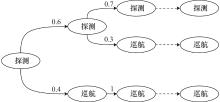
图6
远距离空间群目标终意图与子意图关系图(部分)"
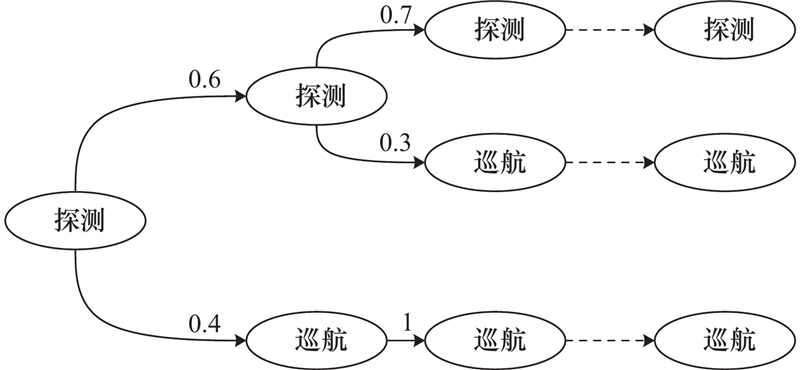
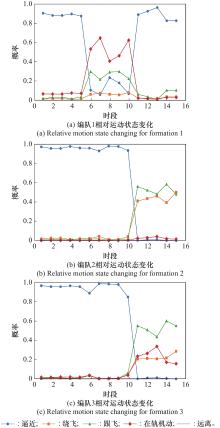
图7
各编队相对运动状态变化"
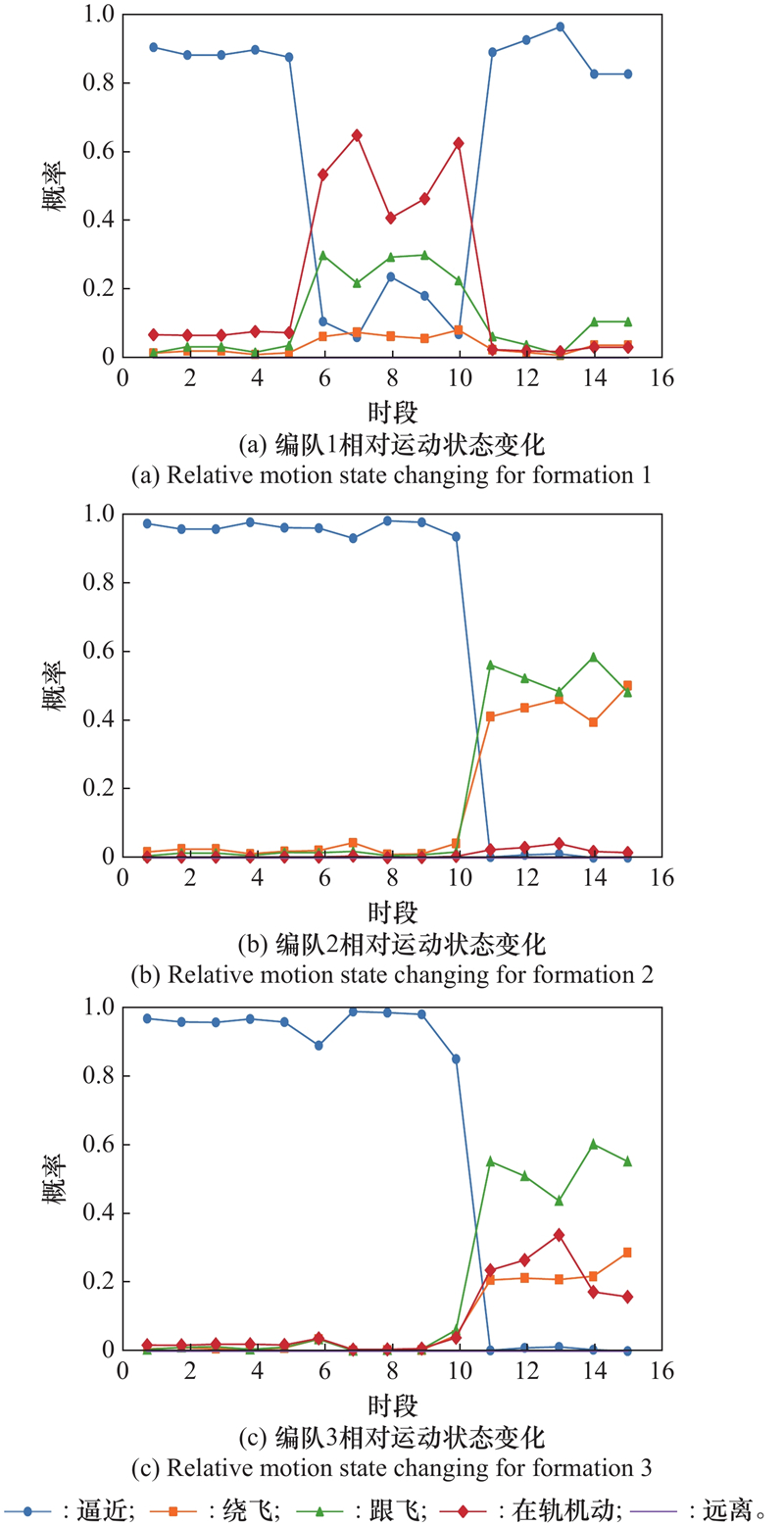
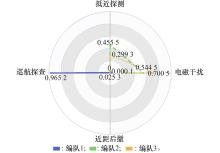
图8
各编队子意图概率"
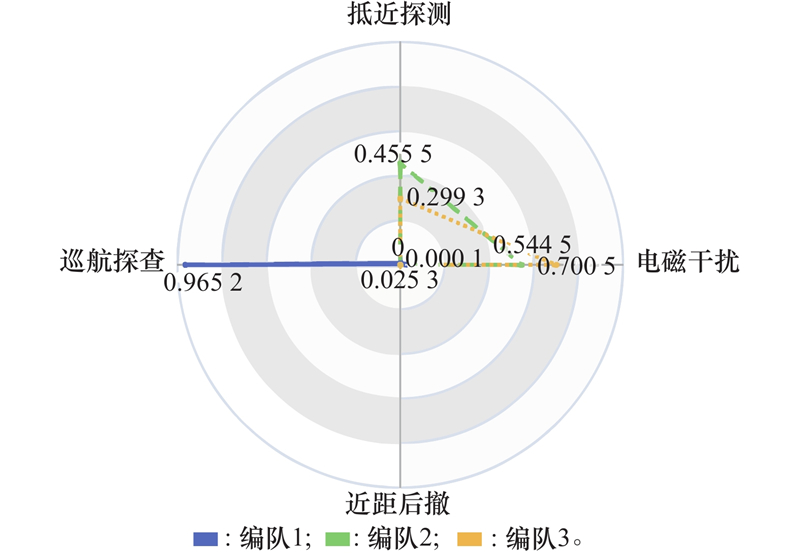
表8
空间群目标终意图概率"
| 终意图 | 概率 |
| 探测 | 0.007 5 |
| 巡航 | 0 |
| 干扰 | 0.992 5 |
| 撤离 | 0 |
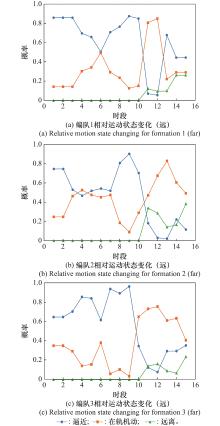
图9
各编队相对运动状态的变化(远)"
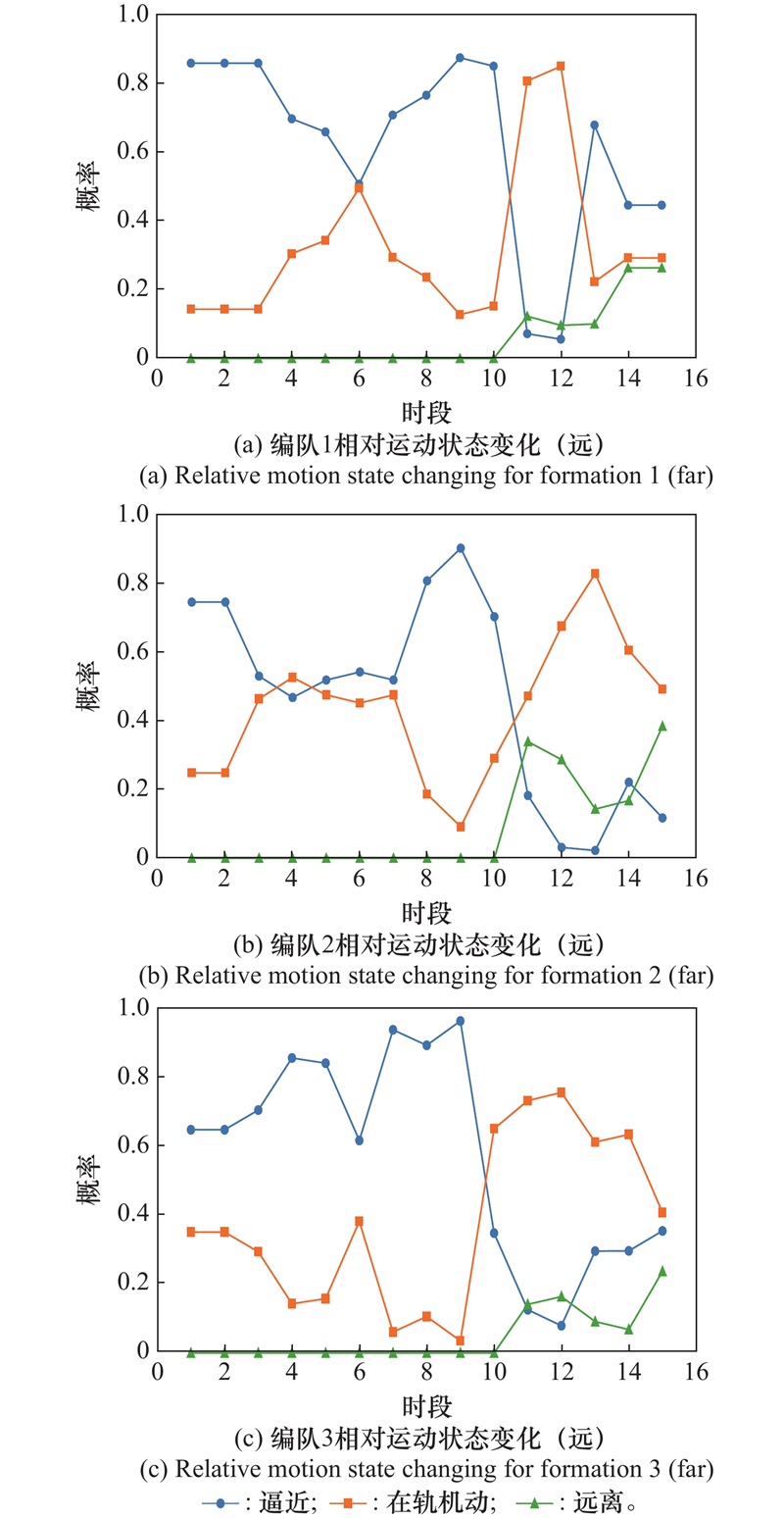
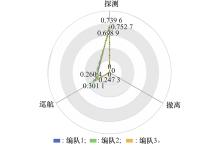
图10
各编队子意图概率(远)"
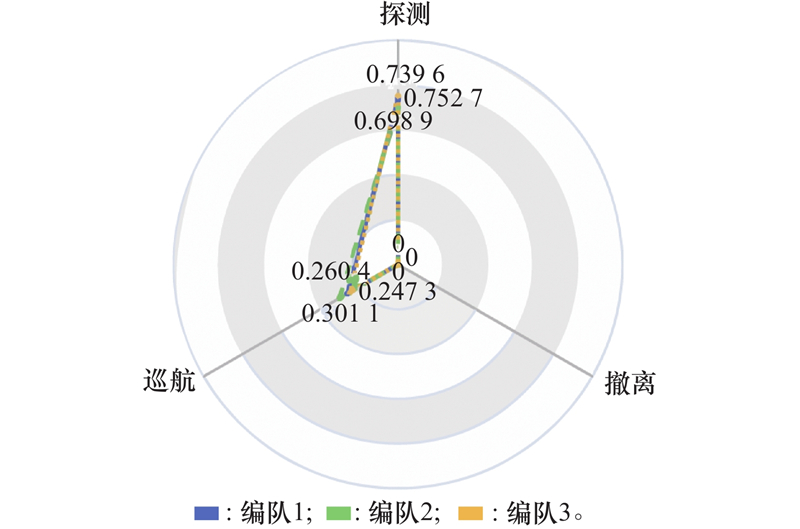
表9
空间群目标终意图概率(远)"
| 终意图 | 概率 |
| 探测 | 0.887 8 |
| 巡航 | 0.112 2 |
| 撤离 | 0 |
表10
不同方法的意图识别性能对比"
| 算法 | 准确率 |
| 本文算法 | 91.50 |
| 模糊推理 | 79.00 |
表11
算法复杂度计算公式"
| 实验方法 | 时间复杂度 | 空间复杂度 |
| DSBN(本文方法) | ||
| 模糊推理 |
表12
算法复杂度对比"
| 实验方法 | 时间复杂度 | 空间复杂度 |
| DSBN(本文方法) | ||
| 模糊推理 |
表13
算法平均时间和内存占用对比"
| 实验方法 | 单次平均时间/s | 平均内存占用/MB |
| DSBN(本文方法) | 0.873 | 36.43 |
| 模糊推理 | 0.832 | 16.37 |
表14
不同规模空间目标群模型性能对比"
| 规模等级 | 准确率/% | 单次平均时间/s |
| 中小规模空间目标群 | 91.50 | 0.873 |
| 大规模空间目标群 | 87.00 | 1.171 |
| 1 | XU H F, ZHAO J J, CHEN L X, et al. A review of methods of battlefield target combat intention recognition[C]//Proc. of the International Conference on Autonomous Unmanned Systems, 2023: 3686−3696. |
| 2 |
LI J S, YANG Z, LUO Y Z. Intention inference for space targets using deep convolutional neural network[J]. Advances in Space Research, 2025, 75 (2): 2184- 2200.
doi: 10.1016/j.asr.2024.10.006 |
| 3 | TROSO G, BONFIGLIO D, MAFFEI F, et al. Military space-advanced space command and control capability in space situational awareness[C]//Proc. of the IEEE 8th International Workshop on Metrology for Aerospace, 2021: 170−175. |
| 4 |
JIA Q L, XIAO J P, ZHANG Y H, et al. Space situational awareness systems: bridging traditional methods and artificial intelligence[J]. Acta Astronautica, 2025, 228, 321- 330.
doi: 10.1016/j.actaastro.2024.11.025 |
| 5 |
KAZEMI S, AZAD L N, SCOTT A K, et al. Orbit determination for space situational awareness: a survey[J]. Acta Astronautica, 2024, 222, 272- 295.
doi: 10.1016/j.actaastro.2024.06.015 |
| 6 |
CAO X Y, LIU S Y, WANG H Y, et al. Spacecraft intelligent orbital game technology: a review[J]. Chinese Journal of Aeronautics, 2025, 38 (6): 103480.
doi: 10.1016/j.cja.2025.103480 |
| 7 |
HUMBERTO B P, LAMARTINE N F. Dynamic multi-target three-way threat assessment in the context of air defense[J]. IEEE Access, 2024, 12, 141397- 141413.
doi: 10.1109/ACCESS.2024.3468248 |
| 8 |
HUANG C, XING A J, ZENG Q L, et al. Research on autonomous decision-making method for spacecraft in the mission of rendezvous and approaching to maneuvering target based on deep reinforcement learning[J]. Asian Journal of Control, 2025, 27 (5): 2541.
doi: 10.1002/asjc.3599 |
| 9 |
RENATO D C, CELSO M H. Reinforcement learning applied to a situation awareness decision-making model[J]. Information Sciences, 2025, 704, 121928.
doi: 10.1016/j.ins.2025.121928 |
| 10 |
SUMAROKOV V A. On controlling the motion of an advanced manned spacecraft using jet thrusters[J]. Journal of Computer and Systems Sciences International, 2024, 63 (2): 357- 370.
doi: 10.1134/S1064230724700242 |
| 11 | LIU T, LI Y H. Maneuverability and agility evaluation of fighter based on beck metrics[C]//Proc. of the Asia-Pacific International Symposium on Aerospace Technology, 2024: 1545−1555. |
| 12 | 李婷. 基于专家决策系统的空间战场态势感知研究[D]. 沈阳: 沈阳建筑大学, 2017. |
| LI T. Research on space battlefield situational awareness based on expert decision-making systems[D]. Shenyang: Shenyang Jianzhu University, 2017. | |
| 13 |
CAO Y, ZHOU Z J, TANG S W, et al. On the robustness of belief-rule-based expert systems[J]. IEEE Trans. on Systems Man and Cybernetics: Systems, 2023, 53 (10): 6043- 6055.
doi: 10.1109/TSMC.2023.3279286 |
| 14 |
陈黎, 李芳芳, 邹长虹. 基于动态贝叶斯网络和模板匹配的空中目标意图识别[J]. 现代防御技术, 2023, 51 (2): 62- 70.
doi: 10.3969/j.issn.1009-086x.2023.02.008 |
|
CHEN L, LI F F, ZHOU C H. Airborne target intent recognition based on dynamic Bayesian networks and template matching[J]. Modern Defense Technologies, 2023, 51 (2): 62- 70.
doi: 10.3969/j.issn.1009-086x.2023.02.008 |
|
| 15 |
DU J H, LU D D, LI F, et al. Trajectory prediction and intention recognition based on CNN-GRU[J]. IEEE Access, 2025, 13, 26945- 26957.
doi: 10.1109/ACCESS.2025.3539931 |
| 16 |
ZHANG C H, ZHOU Y, LI H Q, et al. STIRNet: a spatio-temporal network for air formation targets intention recognition[J]. IEEE Access, 2024, 12, 44998- 45010.
doi: 10.1109/ACCESS.2024.3379410 |
| 17 |
WANG X Y, ZHEN Y, CHAI S Y, et al. Intelligent recognition method of target tactical behavior intention in air combat based on deep learning[J]. Engineering Applications of Artificial Intelligence, 2024, 138, 109460.
doi: 10.1016/j.engappai.2024.109460 |
| 18 |
GUANGLEI M, RUNNAN Z, BIAO W, et al. Target tactical intention recognition in multiaircraft cooperative air combat[J]. International Journal of Aerospace Engineering, 2021, 18, 9558838.
doi: 10.1155/2021/9558838 |
| 19 |
JIANG J X, LIU J P, LIAO X W, et al. A Bayesian network approach for dynamic behavior analysis: real-time intention recognition[J]. Information Fusion, 2025, 118, 102873.
doi: 10.1016/j.inffus.2024.102873 |
| 20 |
ZHOU T, CHEN M, WANG Y, et al. Information entropy-based intention prediction of aerial targets under uncertain and incomplete information[J]. Entropy, 2020, 22 (3): 279.
doi: 10.3390/e22030279 |
| 21 |
ZHANG C H, ZHOU Y, LI H, et al. Combat intention recognition of air targets based on 1DCNN-BiLSTM[J]. IEEE Access, 2023, 11, 134504- 134516.
doi: 10.1109/ACCESS.2023.3337640 |
| 22 |
ZHANG Y, MA W C, HUANG F H, et al. A novel air target intention recognition method based on sample reweighting and attention-Bi-GRU[J]. IEEE Systems Journal, 2024, 18 (1): 501- 504.
doi: 10.1109/JSYST.2023.3319643 |
| 23 |
TENG F, SONG Y F, GUO X P. Attention-TCN-BiGRU: an air target combat intention recognition model[J]. Mathematics, 2021, 9 (19): 2412.
doi: 10.3390/math9192412 |
| 24 |
SUN Q B, ZHAO L R, TANG S Y, et al. Orbital motion intention recognition for space non-cooperative targets based on incomplete time series data[J]. Aerospace Science and Technology, 2025, 158, 109912.
doi: 10.1016/j.ast.2024.109912 |
| 25 |
CHO Y, KIM J. Intent inference of ship collision avoidance behavior under maritime traffic rules[J]. IEEE Access, 2021, 9, 5598- 5608.
doi: 10.1109/ACCESS.2020.3048717 |
| 26 | 邱钰桓. 多源信息融合的高轨目标威胁评估技术研究[D]. 南京: 南京航空航天大学, 2022. |
| QIU Y H. Research on threat assessment technology for high-orbit targets based on multi-source information fusion[D]. Nanjing: Nanjing University of Aeronautics and Astronautics, 2022. | |
| 27 |
乔殿峰, 梁彦, 马超雄, 等. 多域作战下的群目标意图识别与预测[J]. 系统工程与电子技术, 2022, 44 (11): 3403- 3412.
doi: 10.12305/j.issn.1001-506X.2022.11.15 |
|
QIAO D F, LIANG Y, MA C X, et al. Intent recognition and prediction of group targets in multi-domain operations[J]. Systems Engineering and Electronics, 2022, 44 (11): 3403- 3412.
doi: 10.12305/j.issn.1001-506X.2022.11.15 |
|
| 28 |
杨锐, 杨继龙, 刘晓凡, 等. 基于动态序列贝叶斯网络的空地协同作战意图识别[J]. 指挥控制与仿真, 2024, 46 (3): 75- 85.
doi: 10.3969/j.issn.1673-3819.2024.03.012 |
|
YANG R, YANG J L, LIU X F, et al. Intent recognition of air-ground collaborative operations based on dynamic sequence Bayesian networks[J]. Command Control and Simulation, 2024, 46 (3): 75- 85.
doi: 10.3969/j.issn.1673-3819.2024.03.012 |
|
| 29 |
WEI R K, SONG A Y, DUAN H X, et al. An effective procedure to build space object datasets based on STK[J]. Aerospace, 2023, 10 (3): 258.
doi: 10.3390/aerospace10030258 |
| 30 |
YANG X, WANG J Y, DUAN S S. Scale-consistent learnable PnP network for space target pose estimation[J]. IEEE Trans. on Geoscience and Remote Sensing, 2025, 63, 5610912.
doi: 10.1109/tgrs.2025.3541246 |
| 31 |
CHEN C H, CHOU H, HONG T P, et al. Cluster-based membership function acquisition approaches for mining fuzzy temporal association rules[J]. IEEE Access, 2020, 8, 123996- 124006.
doi: 10.1109/ACCESS.2020.3004095 |
| 32 |
AGGARWAL S, SINGH P. Cuckoo bat and krill herd based k-means++ clustering algorithms[J]. Cluster Computing, 2019, 22 (6): 14169- 14180.
doi: 10.1007/s10586-018-2262-4 |
| 33 |
TEBREIRO J A, LOPES A M. Computational complexity[J]. Entropy, 2017, 19 (2): 61.
doi: 10.3390/e19020061 |
| [1] | 张国庆, 姚桂鹏, 李纪强. 无人机/船协同降落的鲁棒自适应模糊控制[J]. 系统工程与电子技术, 2026, 48(6): 2081-2088. |
| [2] | 冯蕴雯, 吕世春, 柯倩云, 王锐, 刘晚移. 故障逻辑与贝叶斯时变评价网络融合的民机空调系统健康评估方法[J]. 系统工程与电子技术, 2026, 48(3): 859-871. |
| [3] | 宋子豪, 周焰, 程伟, 黎慧, 张晨浩. 基于对角掩蔽自注意力的空中目标意图特征插补方法[J]. 系统工程与电子技术, 2025, 47(8): 2463-2474. |
| [4] | 王阳阳, 高晓光, 茹鑫鑫. 高维数据局部贝叶斯网络结构学习[J]. 系统工程与电子技术, 2024, 46(8): 2676-2685. |
| [5] | 蔡一鸣, 马力, 陆恒杨, 方伟. 基于全流程并行遗传算法的贝叶斯网络结构学习[J]. 系统工程与电子技术, 2024, 46(5): 1703-1711. |
| [6] | 王紫东, 高晓光, 刘晓寒. 基于Stacking策略的集成BN网络目标威胁评估[J]. 系统工程与电子技术, 2024, 46(2): 586-598. |
| [7] | 高晓光, 闫栩辰, 王紫东, 刘晓寒, 冯奇. 基于评分缓存的节点序空间下BN结构学习[J]. 系统工程与电子技术, 2024, 46(12): 4091-4107. |
| [8] | 徐星光, 何星才, 任章. 有翼飞行器初制导阶段两段式协同集结方法[J]. 系统工程与电子技术, 2024, 46(10): 3492-3505. |
| [9] | 茹鑫鑫, 高晓光, 王阳阳. 基于模糊约束的贝叶斯网络参数学习[J]. 系统工程与电子技术, 2023, 45(2): 444-452. |
| [10] | 曾婷, 高帅, 孙富强, 赖小明, 李云, 李孝鹏. 人机环耦合效应下卫星天线装配概率风险分析[J]. 系统工程与电子技术, 2023, 45(2): 606-613. |
| [11] | 马钰棠, 孙鹏, 张杰勇, 王鹏, 闫云飞, 赵亮. 样本不平衡下的空中群组意图识别方法[J]. 系统工程与电子技术, 2022, 44(12): 3747-3755. |
| [12] | 李懿凡, 钱华明, 黄洪钟, 张庭瑜, 黄土地. 基于广义连续时间贝叶斯网络的指挥控制网络系统可靠性分析[J]. 系统工程与电子技术, 2022, 44(12): 3880-3886. |
| [13] | 王鹏, 孙紫荆, 张帆, 肖国松. 考虑概率型共因失效的多阶段任务系统可靠性分析模型[J]. 系统工程与电子技术, 2022, 44(12): 3887-3898. |
| [14] | 乔殿峰, 梁彦, 马超雄, 杨心语, 汪冕, 李建国. 多域作战下的群目标意图识别与预测[J]. 系统工程与电子技术, 2022, 44(11): 3403-3412. |
| [15] | 刘延钊, 黄志球, 沈国华, 王金永, 徐恒. 基于决策树和BN的自动驾驶车辆行为决策方法[J]. 系统工程与电子技术, 2022, 44(10): 3143-3154. |
| 阅读次数 | ||||||
|
全文 |
|
|||||
|
摘要 |
|
|||||
