

系统工程与电子技术 ›› 2026, Vol. 48 ›› Issue (8): 2659-2668.doi: 10.12305/j.issn.1001-506X.2026.08.14
• 系统工程 • 上一篇
汤罗浩, 雷洪涛, 石建迈, 刁博阳, 朱承
收稿日期:2024-12-13
修回日期:2025-05-16
出版日期:2025-12-04
发布日期:2025-12-04
通讯作者:
汤罗浩
基金资助:Luohao TANG, Hongtao LEI, Jianmai SHI, Boyang DIAO, Cheng ZHU
Received:2024-12-13
Revised:2025-05-16
Online:2025-12-04
Published:2025-12-04
Contact:
Luohao TANG
摘要:
随着装备智能化程度的提高,低成本的小型平台越来越受到青睐。任务规划者可对小型平台进行动态组合以满足任务需求,提升任务完成的经济性与灵活性,但面临更高的决策复杂度。针对平台选择面临的决策空间大、对抗性强、时效性要求高等挑战,研究多平台协同鲁棒团队形成问题,除了考虑平台的能力互补和使用成本之外,还考虑了团队鲁棒性和平台间的协同成本。针对这一非确定性多项式难问题,设计一种简单且高效的元启发式算法,能够在很短时间内得到高质量解。在不同规模的数据集上进行了计算实验,证明了所提算法的有效性。
中图分类号:
汤罗浩, 雷洪涛, 石建迈, 刁博阳, 朱承. 多平台协同鲁棒团队形成问题与算法[J]. 系统工程与电子技术, 2026, 48(8): 2659-2668.
Luohao TANG, Hongtao LEI, Jianmai SHI, Boyang DIAO, Cheng ZHU. Multi-platform collaborative robust team formation problem and algorithm[J]. Systems Engineering and Electronics, 2026, 48(8): 2659-2668.
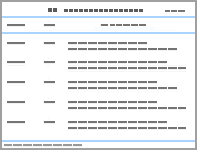
表1
Data-1数据集计算结果"
| M | N | 平均计算时间/s | 平均目标值 | GA Gap | ||||||||||||
| SA | RLS | MRLS | GA | BF | SA | RLS | MRLS | GA | GAbest | BF | Gap1/% | Gap2/% | ||||
| 5 | 15 | 0.2 | 0.1 | 3.6 | 1.3 | 0.3 | 0.0 | 0.0 | ||||||||
| 17 | 0.2 | 0.1 | 3.2 | 1.1 | 2.5 | 0.0 | 0.0 | |||||||||
| 19 | 0.2 | 0.1 | 3.9 | 1.7 | 14.4 | 0.0 | 0.0 | |||||||||
| 21 | 0.2 | 0.1 | 4.2 | 0.9 | 80.1 | 0.0 | 0.0 | |||||||||
| 23 | 0.1 | 0.1 | 4.0 | 1.1 | 565.8 | 0.0 | 0.0 | |||||||||
| 25 | 0.2 | 0.1 | 5.3 | 1.1 | 982.1 | 935.6 | 927.5 | 927.5 | 0.9 | 0.0 | ||||||
| 8 | 15 | 0.2 | 0.1 | 3.6 | 2.1 | 0.6 | 0.0 | 0.0 | ||||||||
| 17 | 0.2 | 0.1 | 4.2 | 2.2 | 2.2 | 0.0 | 0.0 | |||||||||
| 19 | 0.2 | 0.1 | 4.1 | 2.5 | 14.1 | 0.0 | 0.0 | |||||||||
| 21 | 0.2 | 0.1 | 3.5 | 1.2 | 146.3 | 0.0 | 0.0 | |||||||||
| 23 | 0.2 | 0.1 | 4.1 | 1.4 | 611.8 | 998.5 | 998.5 | 998.5 | 0.0 | 0.0 | ||||||
| 25 | 0.2 | 0.1 | 5.6 | 1.9 | 0.0 | 0.0 | ||||||||||
| 11 | 15 | 0.3 | 0.0 | 2.1 | 1.9 | 0.4 | 0.0 | 0.0 | ||||||||
| 17 | 0.2 | 0.1 | 4.3 | 1.6 | 2.6 | 0.0 | 0.0 | |||||||||
| 19 | 0.3 | 0.1 | 5.0 | 2.1 | 9.5 | 0.0 | 0.0 | |||||||||
| 21 | 0.2 | 0.1 | 4.2 | 1.1 | 147.3 | 0.5 | 0.0 | |||||||||
| 11 | 23 | 0.2 | 0.1 | 6.1 | 9.0 | 395.6 | 0.0 | 0.0 | ||||||||
| 25 | 0.2 | 0.1 | 4.1 | 1.1 | 0.8 | 0.0 | ||||||||||
| 14 | 15 | 0.2 | 0.1 | 2.4 | 0.9 | 0.3 | 0.0 | 0.0 | ||||||||
| 17 | 0.2 | 0.1 | 4.2 | 1.5 | 4.6 | 0.8 | 0.0 | |||||||||
| 19 | 0.3 | 0.0 | 3.0 | 1.6 | 2.9 | 0.0 | 0.0 | |||||||||
| 21 | 0.2 | 0.1 | 5.5 | 2.1 | 55.8 | 0.0 | 0.0 | |||||||||
| 23 | 0.2 | 0.1 | 4.3 | 1.4 | 863.7 | 0.5 | 0.0 | |||||||||
| 25 | 0.2 | 0.1 | 5.4 | 1.2 | 876.0 | 876.0 | 876.0 | 0.0 | 0.0 | |||||||
| 17 | 15 | 0.2 | 0.1 | 1.9 | 1.6 | 0.2 | 0.0 | 0.0 | ||||||||
| 17 | 0.3 | 0.0 | 3.0 | 1.4 | 1.5 | 0.0 | 0.0 | |||||||||
| 19 | 0.2 | 0.1 | 4.2 | 2.9 | 16.0 | 0.1 | 0.0 | |||||||||
| 21 | 0.2 | 0.1 | 4.0 | 2.0 | 105.2 | 0.0 | 0.0 | |||||||||
| 23 | 0.2 | 0.1 | 4.6 | 2.8 | 912.0 | 0.0 | 0.0 | |||||||||
| 25 | 0.2 | 0.1 | 6.7 | 4.5 | 0.0 | 0.0 | ||||||||||
| 20 | 15 | 0.2 | 0.1 | 3.5 | 3.0 | 0.7 | 0.0 | 0.0 | ||||||||
| 17 | 0.2 | 0.1 | 2.3 | 1.2 | 1.9 | 0.0 | 0.0 | |||||||||
| 19 | 0.2 | 0.1 | 4.2 | 1.2 | 22.7 | 935.0 | 935.0 | 935.0 | 0.0 | 0.0 | ||||||
| 21 | 0.3 | 0.1 | 2.9 | 2.9 | 20.7 | 0.0 | 0.0 | |||||||||
| 23 | 0.2 | 0.1 | 4.7 | 1.8 | 934.9 | 0.5 | 0.0 | |||||||||
| 25 | 0.2 | 0.1 | 5.6 | 4.2 | 0.0 | 0.0 | ||||||||||
表2
Data-2数据集计算结果"
| M | N | 平均计算时间/s | 平均目标值 | GA Gap | ||||||||||||
| SA | RLS | MRLS | GA | BF | SA | RLS | MRLS | GA | GAbest | BF | Gap1/% | Gap2/% | ||||
| 5 | 15 | 0.2 | 0.1 | 3.0 | 1.4 | 0.2 | 0.2 | 0.0 | ||||||||
| 17 | 0.2 | 0.1 | 3.4 | 1.8 | 1.7 | 0.0 | 0.0 | |||||||||
| 19 | 0.2 | 0.1 | 3.4 | 1.3 | 5.7 | 0.0 | 0.0 | |||||||||
| 21 | 0.1 | 0.1 | 3.4 | 0.8 | 76.9 | 0.0 | 0.0 | |||||||||
| 23 | 0.1 | 0.1 | 4.1 | 1.0 | 282.7 | 0.0 | 0.0 | |||||||||
| 25 | 0.2 | 0.1 | 4.6 | 1.7 | 0.0 | 0.0 | ||||||||||
| 8 | 15 | 0.2 | 0.1 | 2.1 | 1.1 | 0.2 | 0.0 | 0.0 | ||||||||
| 17 | 0.2 | 0.0 | 2.4 | 1.2 | 0.9 | 0.0 | 0.0 | |||||||||
| 19 | 0.2 | 0.1 | 3.5 | 1.1 | 12.2 | 0.0 | 0.0 | |||||||||
| 21 | 0.2 | 0.1 | 4.0 | 1.1 | 51.9 | 0.3 | 0.0 | |||||||||
| 23 | 0.2 | 0.1 | 4.6 | 1.5 | 300.6 | 0.0 | 0.0 | |||||||||
| 25 | 0.2 | 0.1 | 4.5 | 1.3 | 3.9 | 0.0 | ||||||||||
| 11 | 15 | 0.1 | 0.1 | 3.0 | 1.1 | 0.6 | 0.0 | 0.0 | ||||||||
| 17 | 0.2 | 0.1 | 3.9 | 1.0 | 1.7 | 0.0 | 0.0 | |||||||||
| 19 | 0.2 | 0.1 | 3.5 | 1.6 | 10.3 | 0.0 | 0.0 | |||||||||
| 21 | 0.2 | 0.1 | 3.5 | 1.1 | 100.5 | 0.0 | 0.0 | |||||||||
| 23 | 0.2 | 0.1 | 4.2 | 2.3 | 292.7 | 0.1 | 0.0 | |||||||||
| 25 | 0.2 | 0.1 | 6.9 | 4.5 | 492.2 | 0.0 | 0.0 | |||||||||
| 14 | 15 | 0.2 | 0.0 | 1.8 | 1.4 | 0.2 | 0.0 | 0.0 | ||||||||
| 17 | 0.2 | 0.0 | 2.2 | 1.2 | 1.1 | 0.0 | 0.0 | |||||||||
| 19 | 0.3 | 0.1 | 3.3 | 3.5 | 2.4 | 0.4 | 0.0 | |||||||||
| 21 | 0.2 | 0.1 | 4.2 | 1.7 | 51.4 | 0.0 | 0.0 | |||||||||
| 23 | 0.2 | 0.1 | 4.7 | 5.0 | 290.6 | 0.0 | 0.0 | |||||||||
| 25 | 0.2 | 0.1 | 5.5 | 1.3 | 0.0 | 0.0 | ||||||||||
| 17 | 15 | 0.2 | 0.1 | 2.5 | 2.0 | 0.3 | 0.0 | 0.0 | ||||||||
| 17 | 0.2 | 0.1 | 3.8 | 1.4 | 2.7 | 0.0 | 0.0 | |||||||||
| 19 | 0.3 | 0.1 | 4.8 | 2.1 | 4.6 | 0.0 | 0.0 | |||||||||
| 21 | 0.2 | 0.1 | 4.1 | 2.2 | 65.1 | 0.0 | 0.0 | |||||||||
| 23 | 0.2 | 0.1 | 5.7 | 1.7 | 314.6 | 0.0 | 0.0 | |||||||||
| 25 | 0.2 | 0.1 | 4.6 | 2.1 | 0.0 | 0.0 | ||||||||||
| 20 | 15 | 0.2 | 0.1 | 3.4 | 2.8 | 0.4 | 0.0 | 0.0 | ||||||||
| 17 | 0.3 | 0.0 | 1.5 | 6.6 | 0.9 | 0.0 | 0.0 | |||||||||
| 19 | 0.3 | 0.1 | 4.4 | 2.4 | 11.8 | 0.0 | 0.0 | |||||||||
| 21 | 0.2 | 0.1 | 5.0 | 2.1 | 31.3 | 0.0 | 0.0 | |||||||||
| 23 | 0.7 | 0.0 | 3.0 | 5.9 | 36.6 | 0.3 | 0.0 | |||||||||
| 25 | 0.2 | 0.1 | 5.1 | 3.5 | 0.0 | 0.0 | ||||||||||
表3
Data-3数据集计算结果"
| M | N | 平均计算时间/s | 平均目标值 | Gap/% | ||||||||
| SA | RLS | MRLS | GA | SA | RLS | MRLS | GA | GAbest | ||||
| 30 | 100 | 0.6 | 1.5 | 61.3 | 7.1 | 0.7 | ||||||
| 150 | 0.6 | 1.5 | 86.8 | 3.5 | 0.4 | |||||||
| 200 | 0.6 | 1.2 | 67.6 | 3.2 | 1.7 | |||||||
| 250 | 0.6 | 1.9 | 98.2 | 3.8 | 1.9 | |||||||
| 300 | 0.7 | 2.2 | 127.9 | 3.7 | 0.9 | |||||||
| 350 | 0.7 | 2.8 | 127.7 | 4.0 | 0.6 | |||||||
| 40 | 100 | 0.6 | 0.8 | 45.4 | 3.3 | 0.7 | ||||||
| 150 | 0.7 | 1.6 | 91.4 | 5.0 | 1.1 | |||||||
| 200 | 0.6 | 2.6 | 97.6 | 3.9 | 2.5 | |||||||
| 250 | 0.7 | 2.7 | 126.0 | 4.6 | 2.3 | |||||||
| 300 | 0.6 | 2.4 | 107.7 | 3.6 | 2.6 | |||||||
| 350 | 0.7 | 2.6 | 135.7 | 3.8 | 1.5 | |||||||
| 50 | 100 | 0.7 | 1.6 | 83.4 | 9.7 | 1.1 | ||||||
| 150 | 0.5 | 1.1 | 61.5 | 3.0 | 0.7 | |||||||
| 200 | 0.8 | 2.3 | 104.7 | 4.4 | 1.6 | |||||||
| 250 | 0.7 | 2.0 | 103.7 | 3.8 | 0.5 | |||||||
| 300 | 0.7 | 2.4 | 128.8 | 4.3 | 1.1 | |||||||
| 350 | 0.7 | 2.7 | 125.1 | 3.8 | 1.1 | |||||||
| 60 | 100 | 0.7 | 1.4 | 65.2 | 4.0 | 1.3 | ||||||
| 150 | 0.7 | 2.3 | 100.2 | 3.7 | 0.3 | |||||||
| 200 | 0.7 | 1.7 | 99.8 | 5.1 | 1.9 | |||||||
| 250 | 0.6 | 2.5 | 113.3 | 4.0 | 0.9 | |||||||
| 300 | 0.7 | 3.1 | 134.2 | 4.9 | 1.3 | |||||||
| 350 | 0.8 | 2.2 | 113.5 | 4.5 | 1.2 | |||||||
| 70 | 100 | 0.7 | 1.8 | 93.2 | 16.8 | 0.4 | ||||||
| 150 | 0.7 | 2.2 | 102.3 | 3.9 | 0.2 | |||||||
| 200 | 0.7 | 2.1 | 108.2 | 4.7 | 2.0 | |||||||
| 250 | 0.7 | 2.5 | 129.1 | 4.2 | 3.3 | |||||||
| 300 | 0.7 | 2.3 | 130.1 | 4.0 | 2.2 | |||||||
| 350 | 0.7 | 2.7 | 133.2 | 3.9 | 1.6 | |||||||
| 80 | 100 | 0.8 | 1.7 | 78.5 | 7.2 | 1.4 | ||||||
| 150 | 0.6 | 1.6 | 69.0 | 3.6 | 1.1 | |||||||
| 200 | 0.6 | 2.1 | 90.4 | 3.4 | 1.9 | |||||||
| 250 | 0.7 | 3.0 | 111.2 | 4.1 | 0.9 | |||||||
| 300 | 0.7 | 2.5 | 128.6 | 4.3 | 1.0 | |||||||
| 350 | 0.7 | 2.7 | 146.2 | 4.2 | 1.4 | |||||||
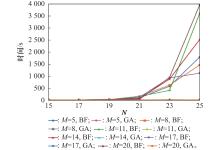
图1
BF和GA对Data-1的计算时间对比"
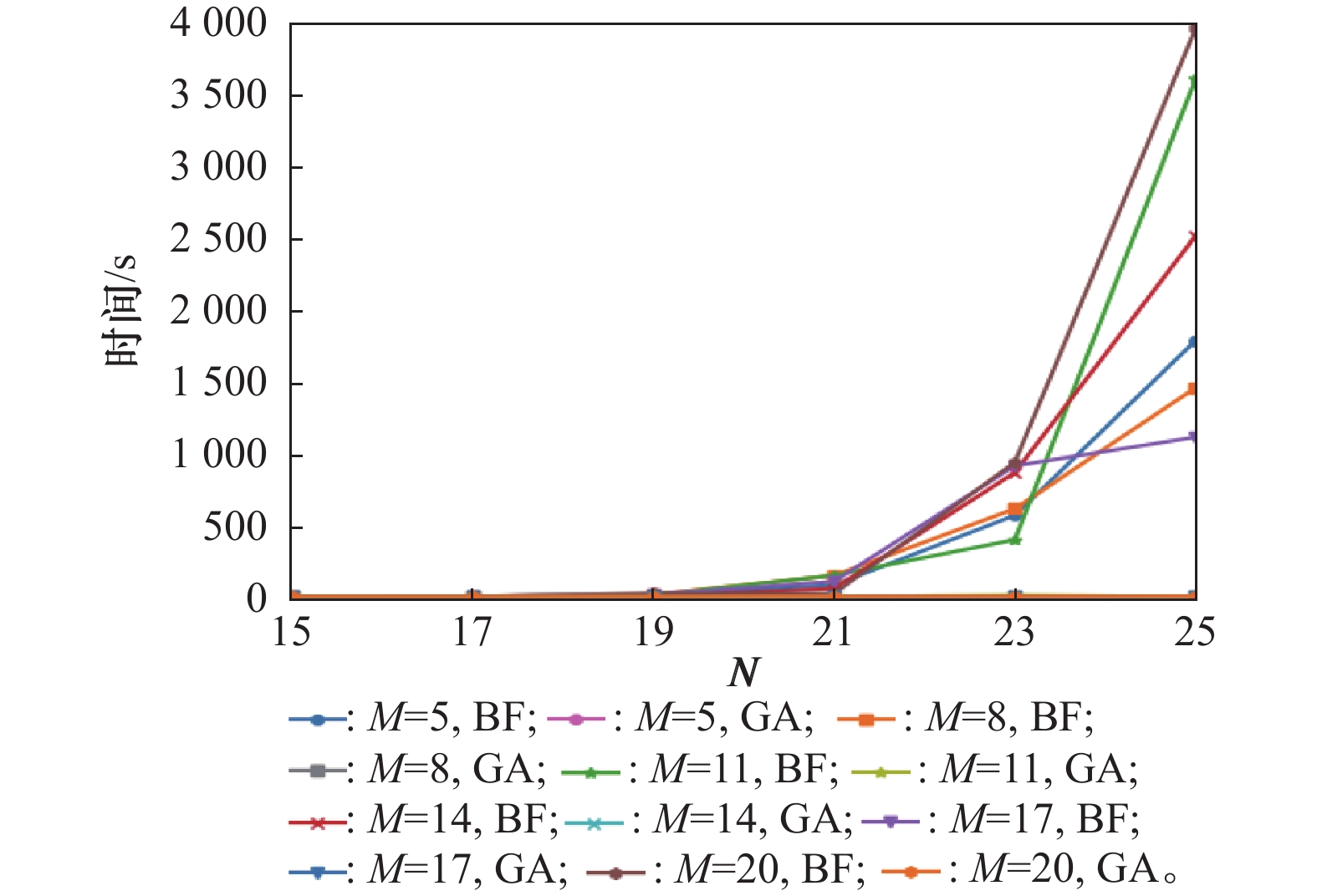
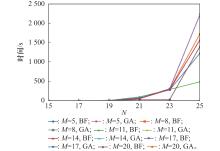
图2
BF和GA对Data-2的计算时间对比"
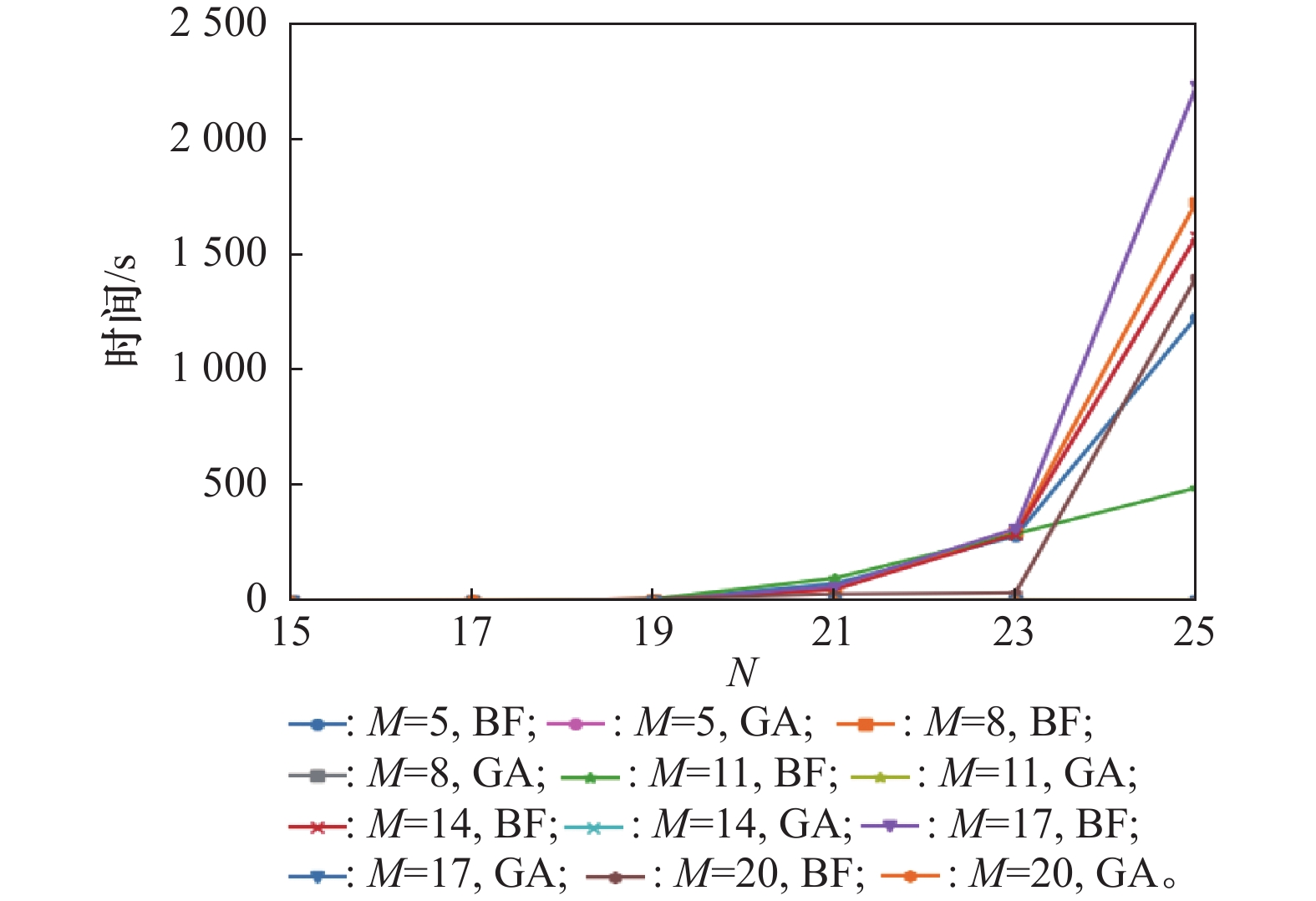
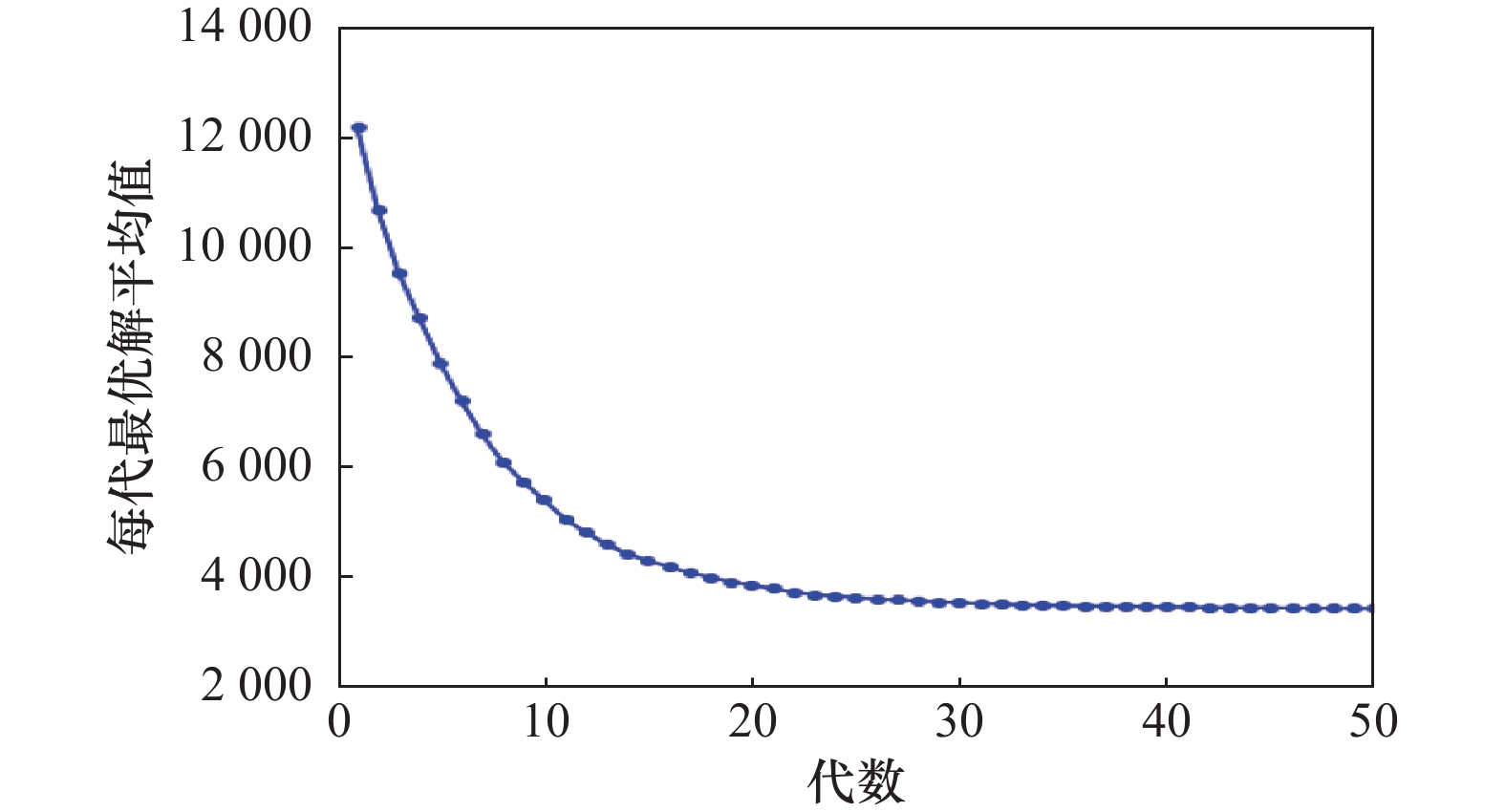
图3
GA对实例(M=14, N=25)计算20次平均收敛曲线图"
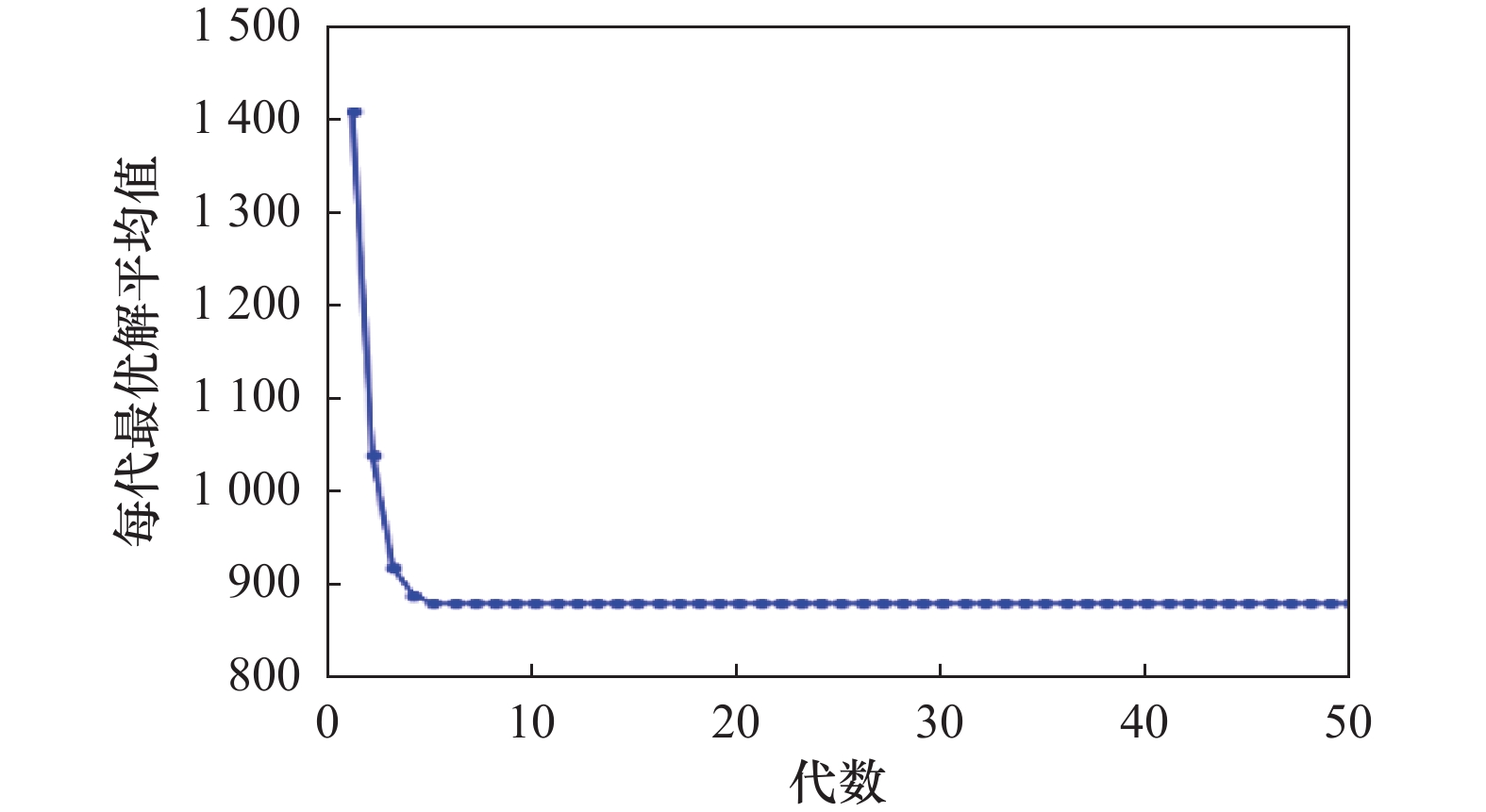
图4
GA对实例(M=70, N=350)计算20次平均收敛曲线图"
| 1 | DEPTULA D A R, PENNEY H. Mosaic warfare: designing a new way of war to restore america’s military competitiveness[J]. Air Force Magazine, 2019 (11): 51- 55. |
| 2 | CLARK B, PATT D, SCHRAMM H. Mosaic warfare: exploiting artificial intelligence and autonomous systems to implement decision-centric operations[EB/OL]. [2024-11-11]. https://csbaonline.org/research/publications/mosaic-warfareexploiting-artificial-intelligence-and-autonomous-systems-to-implement-decision-centric-operations. |
| 3 | LAPPAS T, LIU K, TERZI E. Finding a team of experts in social networks[C]//Proc. of the 15th ACM SIGKDD International Conference on Knowledge Discovery and Data Mining, 2009: 467−476. |
| 4 | MAJUMDER A, DATTA S, NAIDU K V M. Capacitated team formation problem on social networks[C]//Proc. of the 18th ACM SIGKDD International Conference on Knowledge Discovery and Data Mining, 2012: 1005−1013. |
| 5 | MEHDI K, AIJUN A. Discovering top-k teams of experts with/without a leader in social networks[C]//Proc. of the 20th ACM International Conference on Information and Knowledge Management, 2011. |
| 6 | TANG S J. Profit-driven team grouping in social networks[C]//Proc. of the 31st AAAI Conference on Artificial Intelligence, 2017. |
| 7 | BAGHEL V S, BHAVANI S D. Multiple team formation using an evolutionary approach[C]//Proc. of the 11th International Conference on Contemporary Computing, 2018. |
| 8 | JUÁREZ J, BRIZUELA C A. A multi-objective formulation of the team formation problem in social networks: preliminary results[C]//Proc. of the Genetic and Evolutionary Computation Conference, 2018: 261−268. |
| 9 |
SELVARAJAH K, ZADEH P M, KOBTI Z, et al. A unified framework for effective team formation in social networks[J]. Expert Systems with Applications, 2021, 177, 114886.
doi: 10.1016/j.eswa.2021.114886 |
| 10 |
GÓMEZ-ZARÁ D, DAS A, PAWLOW B, et al. In search of diverse and connected teams: a computational approach to assemble diverse teams based on members’ social networks[J]. PLoS One, 2022, 17 (11): e0276061.
doi: 10.1371/journal.pone.0276061 |
| 11 |
ATEF Y H, BERGMAN D, DAY R. Balancing stability and efficiency in team formation as a generalized roommate problem[J]. Naval Research Logistics, 2023, 70 (1): 72- 88.
doi: 10.1002/nav.22084 |
| 12 | 王伟, 刘付显. 多平台协同作战任务分配模型及算法[J]. 电光与控制, 2017, 24 (12): 11- 15,21. |
| WANG W, LIU F X. Task allocation model and its algorithm for cooperative combat of multiple platforms[J]. Electronics Optics & Control, 2017, 24 (12): 11- 15,21. | |
| 13 | 高程, 都延丽, 步雨浓, 等. 面向复杂多任务的异构无人机集群分组调配[J]. 系统工程与电子技术, 2024, 46 (3): 972- 981. |
| GAO C, DU Y L, BU Y N, et al. Heterogeneous UAV swarm grouping deployment for complex multiple tasks[J]. Systems Engineering and Electronics, 2024, 46 (3): 972- 981. | |
| 14 | KARGAR M, AN A, ZIHAYAT M. Efficient bi-objective team formation in social networks[M]//FLACH P A, DE-BIE T, CRISTIANINI N. Machine Learning and Knowledge Discovery in Databases. Heidelberg: Springer, 2012: 483−498. |
| 15 |
RAHMAN H, ROY S B, THIRUMURUGANATHAN S, et al. Optimized group formation for solving collaborative tasks[J]. The VLDB Journal, 2019, 28 (1): 1- 23.
doi: 10.1007/s00778-018-0516-7 |
| 16 | DORN C, DUSTDAR S. Composing near-optimal expert teams: a trade-off between skills and connectivity[M]//MEERSMAN R, DILLON T, HERRERO P. On the Move to Meaningful Internet Systems: OTM 2010. Heidelberg: Springer, 2010: 472−489. |
| 17 | ESGARIO J G M, SILVA I E D, KROHLING R A. Application of genetic algorithms to the multiple team formation problem[EB/OL]. [2024-11-11]. http: //arxiv.org/abs/1903.03523. |
| 18 | JUÁREZ J, BRIZUELA C A, TERASHIMA-MARÍN H, et al. Recombination operators for the multi-objective team formation problem in social networks[C]//Proc. of the IEEE Congress on Evolutionary Computation, 2024. |
| 19 |
BERKTAŞ N, YAMAN H. A branch-and-bound algorithm for team formation on social networks[J]. INFORMS Journal on Computing, 2021, 33 (3): 1162- 1176.
doi: 10.1287/ijoc.2020.1000 |
| 20 |
MUNIZ M, FLAMAND T. A column generation approach for the team formation problem[J]. Computers & Operations Research, 2024, 161, 106406.
doi: 10.1016/j.cor.2023.106406 |
| 21 |
FATHIAN M, SAEI-SHAHI M, MAKUI A. A new optimization model for reliable team formation problem considering experts’ collaboration network[J]. IEEE Trans. on Engineering Management, 2017, 64 (4): 586- 593.
doi: 10.1109/TEM.2017.2715825 |
| 22 | OKIMOTO T, SCHWIND N, CLEMENT M. How to form a task-oriented robust team[C]//Proc. of the 14th International Conference on Autonomous Agents and Multi-Agent Systems, 2015. |
| 23 | OKIMOTO T, RIBEIRO T, BOUCHABOU D, et al. Mission oriented robust multi-team formation and its application to robot rescue simulation[C]//Proc. of the 25th International Joint Conference on Artificial Intelligence, 2016. |
| 24 | CRAWFORD C, RAHAMAN Z, SEN S. Evaluating the efficiency of robust team formation algorithms[M]//OSMAN N, SIERRA C. Autonomous Agents and Multiagent Systems. Cham: Springer, 2016: 14−29. |
| 25 | 张润德, 蔡伟伟, 杨乐平, 等. 集群航天器鲁棒自适应快速任务分配[J]. 宇航学报, 2023, 44 (8): 1183- 1194. |
| ZHANG R D, CAI W W, YANG L P, et al. Robust adaptive rapid task assignment for spacecraft swarm[J]. Journal of Astronautics, 2023, 44 (8): 1183- 1194. | |
| 26 | 孙昱, 姚佩阳, 孙鹏, 等. 基于鲁棒多目标优化的智能体群组协同任务规划[J]. 控制与决策, 2016, 31 (11): 2045- 2052. |
| SUN Y, YAO P Y, SUN P, et al. Cooperative task scheduling method for agent group using robust multiobjective optimization approach[J]. Control and Decision, 2016, 31 (11): 2045- 2052. | |
| 27 | WOLSEY A L. Integer programming[M]. 2nd ed. Hoboken: John Wiley & Sons Wily, 2021. |
| 28 |
KENNETH S. Metaheuristics—the metaphor exposed[J]. International Transactions in Operational Research, 2015, 22 (1): 3- 18.
doi: 10.1111/itor.12001 |
| 29 |
PÉRICLES B C, MIRANDA M R F, ANDRÉ C A, et al. A multi-objective optimization approach for the group formation problem[J]. Expert Systems with Applications, 2020, 162, 113828.
doi: 10.1016/j.eswa.2020.113828 |
| 30 |
DERELI T, BAYKASOGLU A, DAS G S. Fuzzy quality-team formation for value added auditing: a case study[J]. Journal of Engineering & Technology Management, 2007, 24 (4): 366- 394.
doi: 10.1016/j.jengtecman.2007.09.005 |
| 31 |
ADIL B, TURKAY D, SENA D. Project team selection using fuzzy optimization approach[J]. Cybernetics and Systems, 2007, 38 (2): 155- 185.
doi: 10.1080/01969720601139041 |
| 32 | AVRADEEP B, VIVEK B, DINESH G, et al. Submodularity in team formation problem[C]//Proc. of the SIAM International Conference on Data Mining, 2014: 893−901. |
| 33 | FARASAT A, NIKOLAEV G A. Social structure optimization in team formation[J]. Computers & Operations Research, 2016, 74 (10): 127- 142. |
| 34 | DAS A, GÓMEZ-ZARÁ D, CONTRACTOR N. Forming diverse teams based on members’ social networks: a genetic algorithm approach[J]. Studies in Computational Intelligence, 2021, 944: 346−357. |
| [1] | 季策, 王琳珊, 牟辉. 基于DBSCAN-R的欠定盲源分离算法[J]. 系统工程与电子技术, 2026, 48(5): 1465-1473. |
| [2] | 王梓聪, 张剑. 基于雅可比显著图的电磁信号无目标平滑对抗攻击方法[J]. 系统工程与电子技术, 2025, 47(7): 2127-2135. |
| [3] | 尹建国, 盛文, 蒋伟. 基于深度残差收缩网络的雷达空中目标识别[J]. 系统工程与电子技术, 2024, 46(9): 3012-3018. |
| [4] | 陈吉源, 徐振海, 肖顺平. 基于子阵级处理的宽带非规则子阵相控阵鲁棒性干扰抑制[J]. 系统工程与电子技术, 2024, 46(2): 367-380. |
| [5] | 钟赟, 万路军, 姚佩阳, 张杰勇. 敏捷C2组织生成及演进的度量与优化[J]. 系统工程与电子技术, 2023, 45(4): 1090-1097. |
| [6] | 张天骐, 叶绍鹏, 刘鉴兴, 柏浩钧. 基于彩色图像Tetrolet变换的频数质心零水印算法[J]. 系统工程与电子技术, 2023, 45(1): 41-48. |
| [7] | 杨芷柔, 张虎, 刘静, 刘同林. 节点攻击策略下的军事通信网络结构优化算法[J]. 系统工程与电子技术, 2021, 43(7): 1848-1855. |
| [8] | 王哲, 李建华, 康东. 网络信息体系双层异质相依网络模型鲁棒性[J]. 系统工程与电子技术, 2021, 43(4): 961-969. |
| [9] | 王超, 郭基联, 沈安慰. 基于不对称依赖的相依网络级联故障分析[J]. 系统工程与电子技术, 2020, 42(5): 1093-1101. |
| [10] | 徐国明, 袁宏武, 薛模根, 王峰. 全偏振参量低秩稀疏分解伪彩色图像融合[J]. 系统工程与电子技术, 2020, 42(11): 2450-2460. |
| [11] | 陈旿, 范铭楷, 李泽宏, 金鑫, 洪亮. 蜂群无人机系统的网络鲁棒性设计[J]. 系统工程与电子技术, 2019, 41(11): 2633-2640. |
| [12] | 王尔申, 王玉伟, 曲萍萍, 蓝晓宇, 陈佳美. 基于代价的复杂网络边攻击策略有效性分析[J]. 系统工程与电子技术, 2018, 40(4): 919-926. |
| [13] | 徐秋坪, 王旭刚, 王中原. 滑翔制导炮弹自抗扰姿态解耦控制器设计[J]. 系统工程与电子技术, 2018, 40(2): 384-392. |
| [14] | 司光亚, 王飞, 李聪, 张昱. 基于交互网测量的武器装备体系鲁棒性分析[J]. 系统工程与电子技术, 2017, 39(7): 1506-1512. |
| [15] | 张岩, 李建增, 李德良, 杜玉龙. 快速自适应鲁棒性尺度不变的特征检测子[J]. 系统工程与电子技术, 2017, 39(6): 1406-1413. |
| 阅读次数 | ||||||
|
全文 |
|
|||||
|
摘要 |
|
|||||
