| 1 |
刘松涛, 雷震烁, 温镇铭, 等. 认知电子战研究进展[J]. 探测与控制学报, 2020, 42 (5): 1.
|
| 2 |
Stimson G W. Introduction to airborne radar[M]. Mendham: SciTech Publishing, 1998.
|
| 3 |
王海英, 张群英, 成文海, 等. LPI雷达信号调制识别及参数估计研究进展[J]. 系统工程与电子技术, 2024, 46 (6): 1908.
|
| 4 |
Linh M H, Minjun K, Seung K. Automatic recognition of general LPI radar waveform using SSD and supplementary classifier[J]. IEEE Trans. on Signal Processing, 2019, 67 (13): 3516.
doi: 10.1109/TSP.2019.2918983
|
| 5 |
何肖阳, 陈小龙, 杜晓林, 等. 基于CBAM-Swin-Transformer迁移学习的海上微动目标分类方法[J]. 系统工程与电子技术, 2025, 47 (4): 1155.
doi: 10.12305/j.issn.1001-506X.2025.04.12
|
| 6 |
杨德贵, 许道峰. 基于时频域特征融合的IR-UWB穿墙雷达人体行为识别方法[J]. 系统工程与电子技术, 2024, 46 (3): 849.
doi: 10.12305/j.issn.1001-506X.2024.03.10
|
| 7 |
徐桂光, 王旭东, 汪飞, 等. 基于SE-ResNeXt网络的低信噪比LPI雷达辐射源信号识别[J]. 系统工程与电子技术, 2022, 44 (12): 3676.
doi: 10.12305/j.issn.1001-506X.2022.12.11
|
| 8 |
Li S Y, Du X L, Cui G L, et al. A multiscale dual attention sparse dual network for time-frequency image denoising of radar signal[J]. IEEE Sensors Journal, 2024, 24 (14): 22588.
doi: 10.1109/JSEN.2024.3403856
|
| 9 |
Wan J, Yu X, Guo Q. LPI radar waveform recognition based on CNN and TPOT[J]. Symmetry, 2019, 11 (5): 725.
doi: 10.3390/sym11050725
|
| 10 |
Wu D M, Shi J P, Li Z H, et al. Contrastive semi-supervised learning with pseudo-label for radar signal automatic modulation recognition[J]. IEEE Sensors Journal, 2024, 24 (19): 30399.
doi: 10.1109/JSEN.2024.3439704
|
| 11 |
Huynh-The T, Doan V S, Hua C H, et al. Accurate LPI radar waveform recognition with CWD-TFA for deep convolutional network[J]. IEEE Wireless Communications Letters, 2021, 10 (8): 1638.
doi: 10.1109/LWC.2021.3075880
|
| 12 |
赵帅, 刘松涛, 汪慧阳. 基于PSO-CNN的LPI雷达波形识别算法[J]. 系统工程与电子技术, 2021, 43 (12): 3552.
doi: 10.12305/j.issn.1001-506X.2021.12.17
|
| 13 |
叶文强, 俞志富, 张奎. 基于DAE+CNN辐射源信号识别算法[J]. 计算机应用研究, 2019, 36 (12): 3815.
doi: 10.19734/j.issn.1001-3695.2018.07.0409
|
| 14 |
蒋伊琳, 尹子茹. 基于卷积神经网络的低截获概率雷达信号检测算法[J]. 电子与信息学报, 2022, 44 (2): 718.
doi: 10.11999/JEIT210132
|
| 15 |
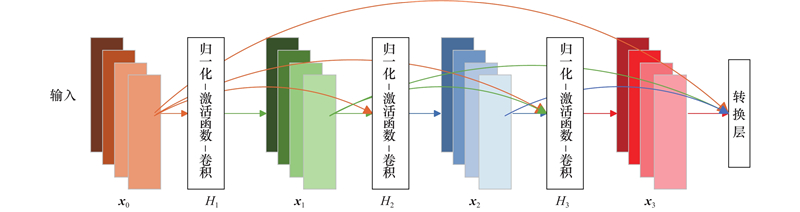
Huang G, Liu Z, Laurens V D M, et al. Densely connected convolutional networks[C]//IEEE Conference on Computer Vision and Pattern Recognition, 2017: 2261.
|
| 16 |
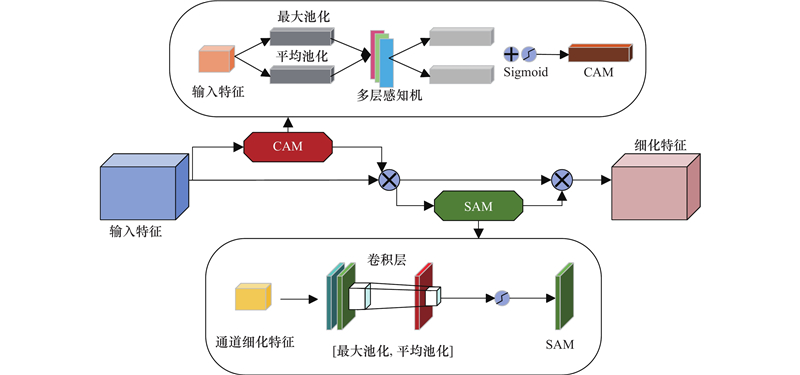
Woo S, Park J, Lee J Y, et al. CBAM: convolutional block attention module[C]//European Conference on Computer Vision, 2018: 3.
|
| 17 |
Yang Z G, Liu Y M, Gao Z H, et al. Attention enhancement with parallel groups for remote sensing object detection[C]//IEEE International Conference on Image Processing, 2024: 1032.
|
| 18 |
张天骐, 杨凯, 赵亮, 等. 多径衰落信道下MC-CDMA信号扩频序列周期盲估计[J]. 系统工程与电子技术, 2017, 39 (12): 2803.
|
| 19 |
Loffe S, Szegedy C. Batch normalization: accelerating deep network trainingby reducing internal covariate shift[C]//International Conference on Machine Learning, 2015: 448.
|
| 20 |
Han S, Mao H, Dally W J. Deep compression: compressing deep neural networks with pruning, trained quantization and huffman coding[J]. Fiber, 2015, 56 (4): 3.
|
| 21 |
谭诗利, 雷虎民, 王鹏飞. 基于正切Sigmoid函数的跟踪微分器[J]. 系统工程与电子技术, 2019, 41 (7): 1590.
doi: 10.3969/j.issn.1001‐506X.2019.07.21
|
| 22 |
Kalra M, Kumar S, DAS B. Target detection using smooth pseudo Wigner-Ville distribution[C]//IEEE Intelligent Computational Systems, 2018: 6.
|
| 23 |
黄庆东, 李晓瑞, 曹艺苑, 等. 基于高斯混合概率假设密度的运动参数估计组合平滑滤波算法[J]. 电子与信息学报, 2022, 44 (7): 2488.
doi: 10.11999/JEIT210439
|
| 24 |
Guo J, Esedoḡlu S. Median filters for anisotropic wetting/dewetting problems[J]. SIAM Journal on Scientific Computing, 2025, 47 (3): 2012.
|
| 25 |
Paszke A, Gross S, Massa F, et al. Pytorch: an imperative style, high performance deep learning library[J]. Advances in Neural Information Processing Systems, 2019, 32, 8026.
|
| 26 |
张本辉, 刘松涛, 晁玉龙. 基于DBO-DAOD的未知雷达调制方式识别算法[J]. 系统工程与电子技术, 2025, 47 (6): 1833.
doi: 10.12305/j.issn.1001-506X.2025.06.12
|
| 27 |
Lauren V D M, Hinton G. Visualizing data using t-SNE[J]. Journal of Machine Learning Research, 2008, 9, 2579.
|
| 28 |
Krizhevsky A, Sutskever I, Hinton G. ImageNet classification with deep convolutional neural networks[J]. Advances Inneural Information Processing Systems, 2012, 25, 1097.
doi: 10.1145/3065386
|
| 29 |
Tong S, Li S K. Design of VGG structured U-Net model for remote sensing green space information extraction[J]. Journal of Geovisualization and Spatial Analysis, 2025, 9 (1): 1.
|
| 30 |
He K M, Zhang X Y, Ren S Q, et al. Deep residual learning for image recognition[C]//IEEE Conference on Computer Vision and Pattern Recognition, 2016: 770.
|


 ), 刘松涛2(