Systems Engineering and Electronics ›› 2025, Vol. 47 ›› Issue (12): 4057-4067.doi: 10.12305/j.issn.1001-506X.2025.12.07
• Sensors and Signal Processing • Previous Articles
Clutter suppression method for airborne bistatic radar based on gridless sparse Bayesian learning
Junxian CHEN, Longfei SHI, Jialei LIU, Jiazhi MA
- State Key laboratory of Complex Electromagnetic Environmental Effects on Electronics and Information System,College of Electronic Science and Technology,National University of Defense Technology,Changsha 410073,China
-
Received:2024-07-23Revised:2024-11-23Online:2025-02-27Published:2025-02-27 -
Contact:Longfei SHI

CLC Number:
Cite this article
Junxian CHEN, Longfei SHI, Jialei LIU, Jiazhi MA. Clutter suppression method for airborne bistatic radar based on gridless sparse Bayesian learning[J]. Systems Engineering and Electronics, 2025, 47(12): 4057-4067.
share this article
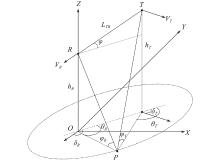
Fig.1
Geometric model of airborne bistatic radar"
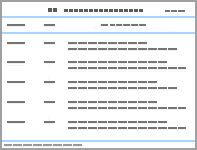
Table 1
Simulation parameters"
| 名称 | 数值 |
| 基线长度/km | 100 |
| 发射平台飞行高度/km | 3 |
| 发射平台飞行速度/(m/s) | 70 |
| 接收平台飞行高度/km | 3 |
| 接收平台飞行速度/(m/s) | 70 |
| 发射峰值功率/kW | 200 |
| 工作频率/GHz | 1 |
| 脉冲重复频率/Hz | 700 |
| 相参脉冲数/个 | 8 |
| 阵元方向图 | 余弦方向图 |
| 阵元方向图后向衰减系数/dB | −3 |
| 阵元增益/dB | 4 |
| 阵元数/个 | 8 |
| 发射增益/dB | 30 |
| 接收增益/dB | 30 |
| CUT双基距离和/km | 80 |
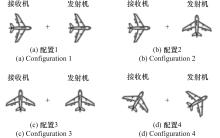
Fig.2
Four typical configuration modes"
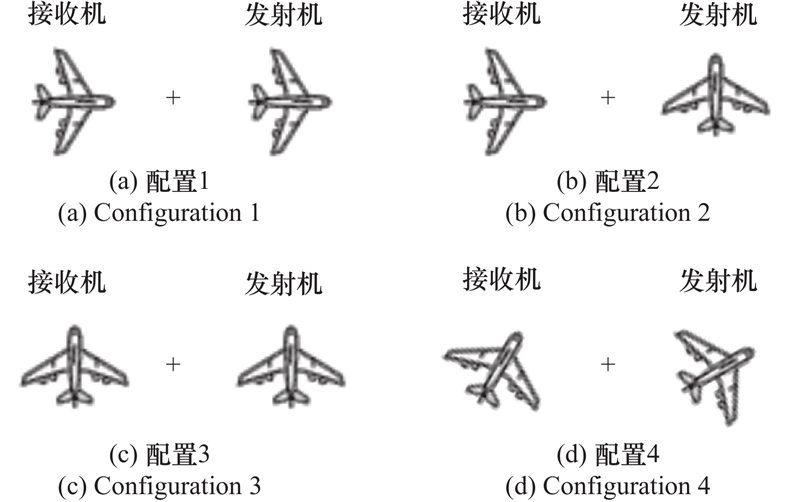
Table 2
Configuration modes of bistatic airborne radar (°)"
| 几何配置方式 | ||
| 航向一致 | 0 | 0 |
| 航向垂直 | 90 | 0 |
| 航向并行 | 90 | 90 |
| 航向交叉 | 30 | 60 |
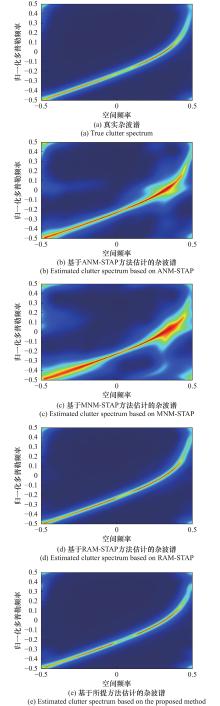
Fig.3
Estimation results of clutter spectrum in geometric configuration mode 1"
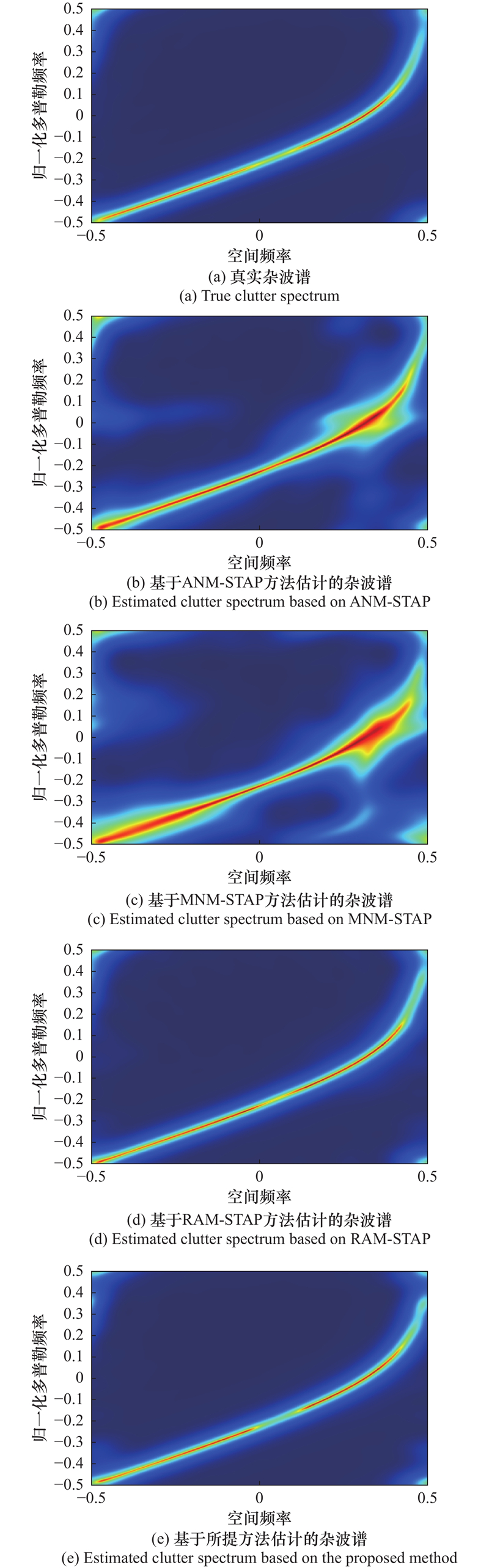
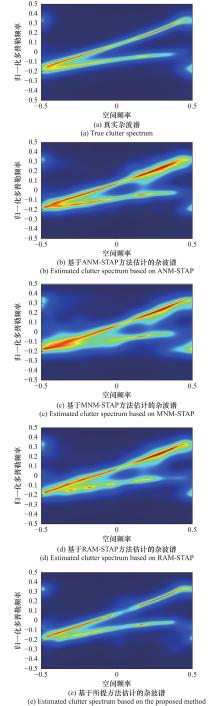
Fig.4
Estimation results of clutter spectrum in geometric configuration mode 2"
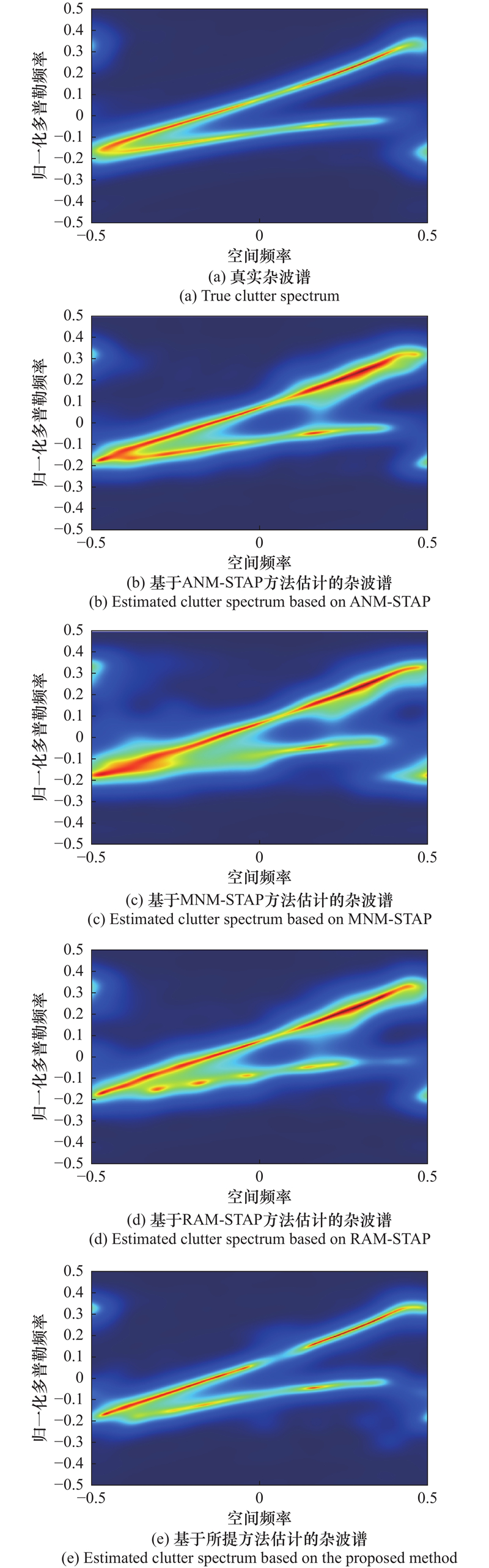

Fig.5
Estimation results of clutter spectrum in geometric configuration mode 3"
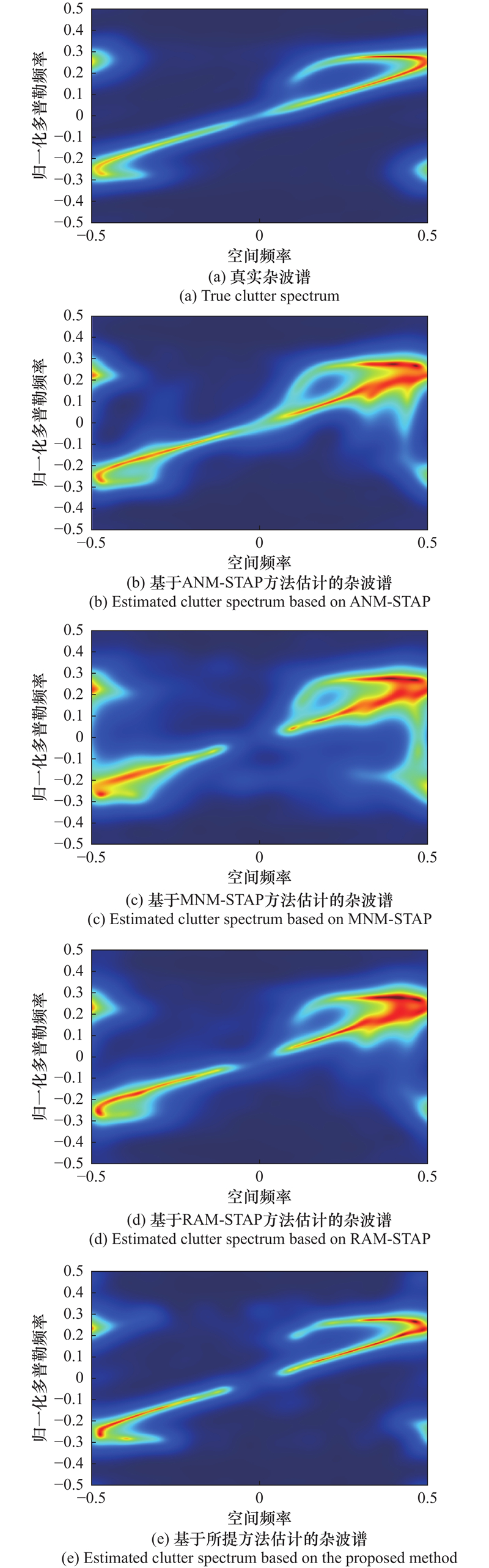
Fig.6
Estimation results of clutter spectrum in geometric configuration mode 4"
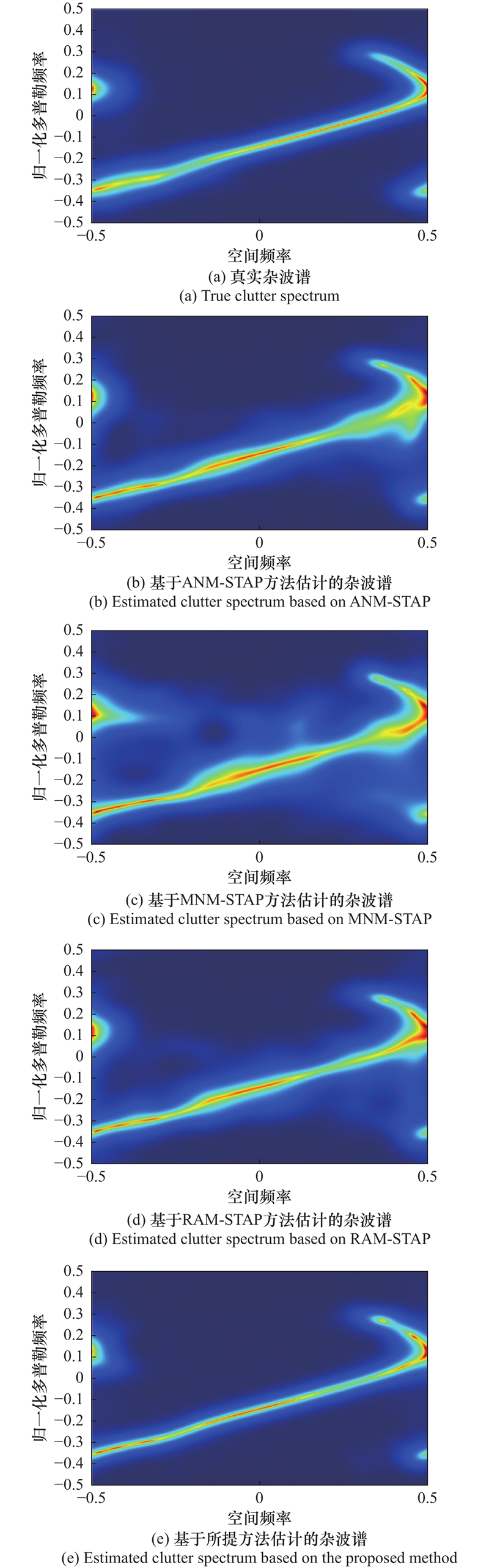

Fig.7
Eigenspectrum of CNCM reconstructed by different methods"
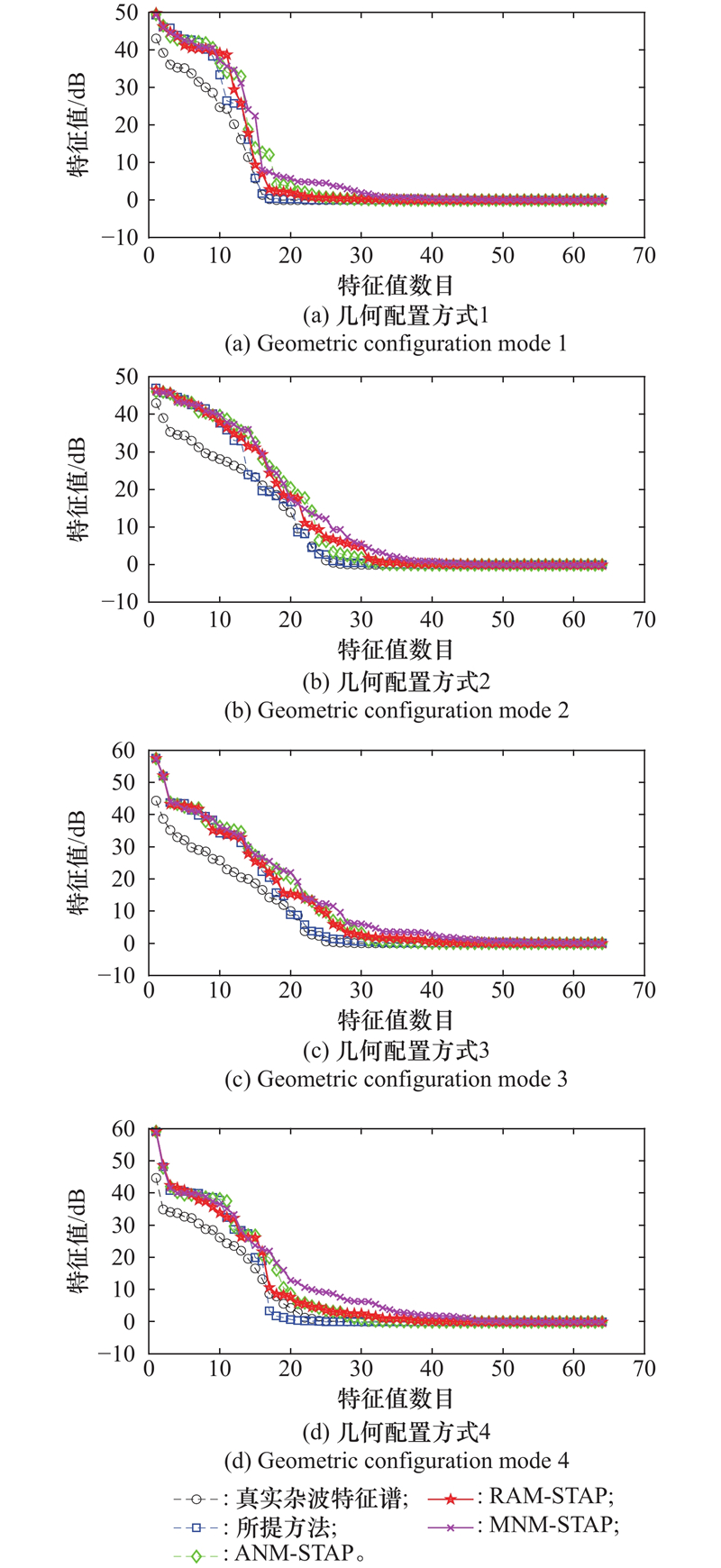
Fig.8
Comparison of SCNR loss performance of different methods"
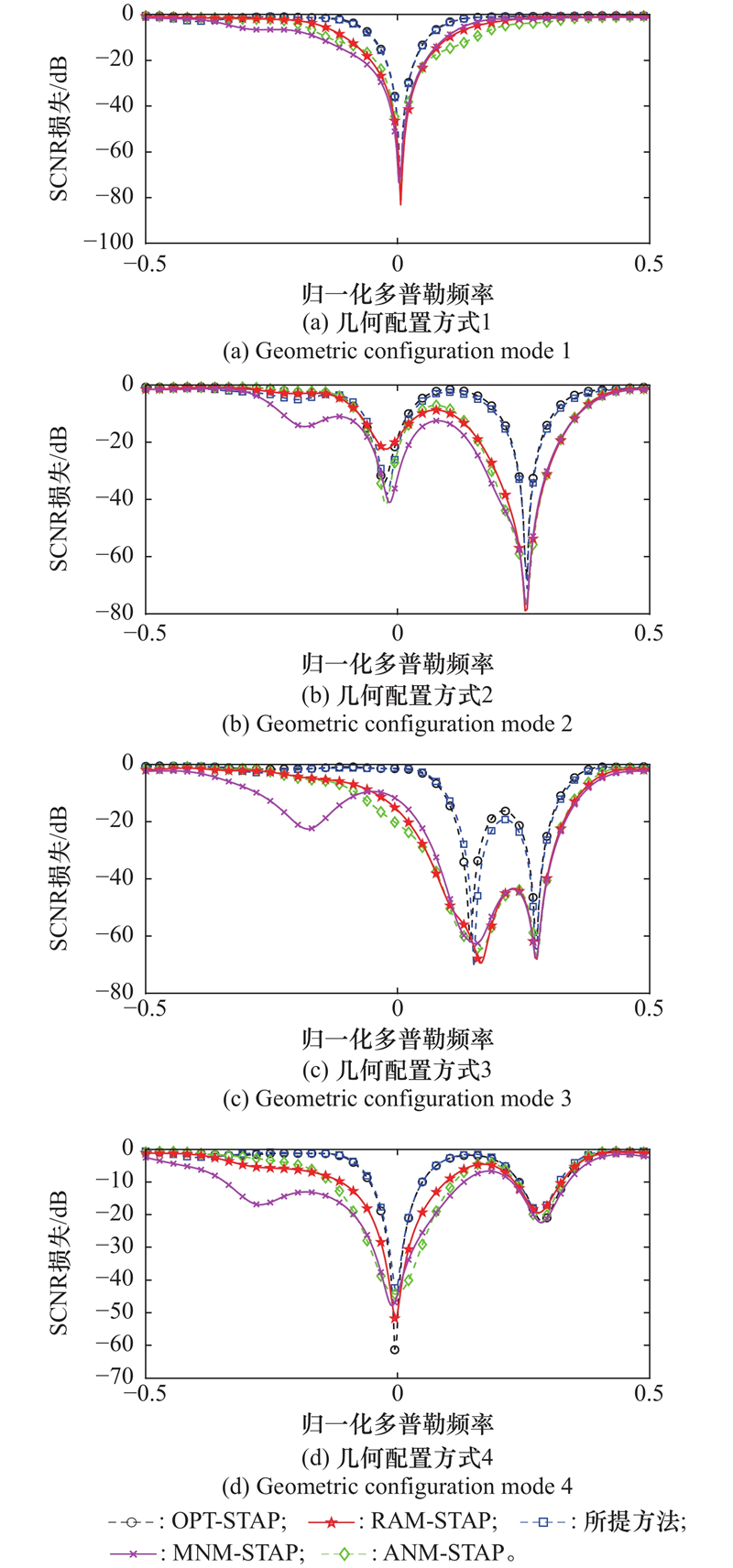
Fig.9
SCNR loss performance of different methods in the presence of random amplitude and phase errors"
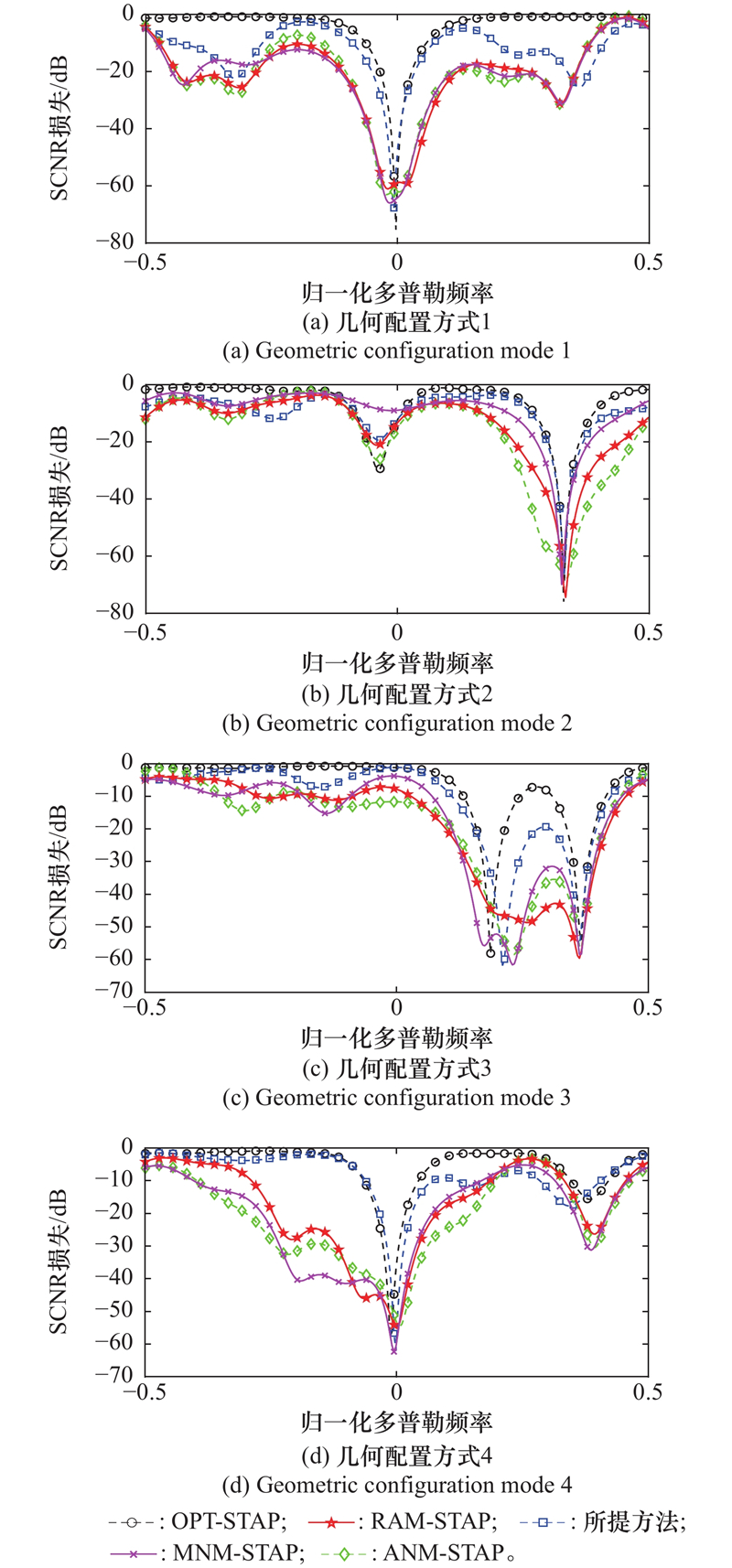
Fig.10
SCNR loss performance of different methods in the presence of ICM"
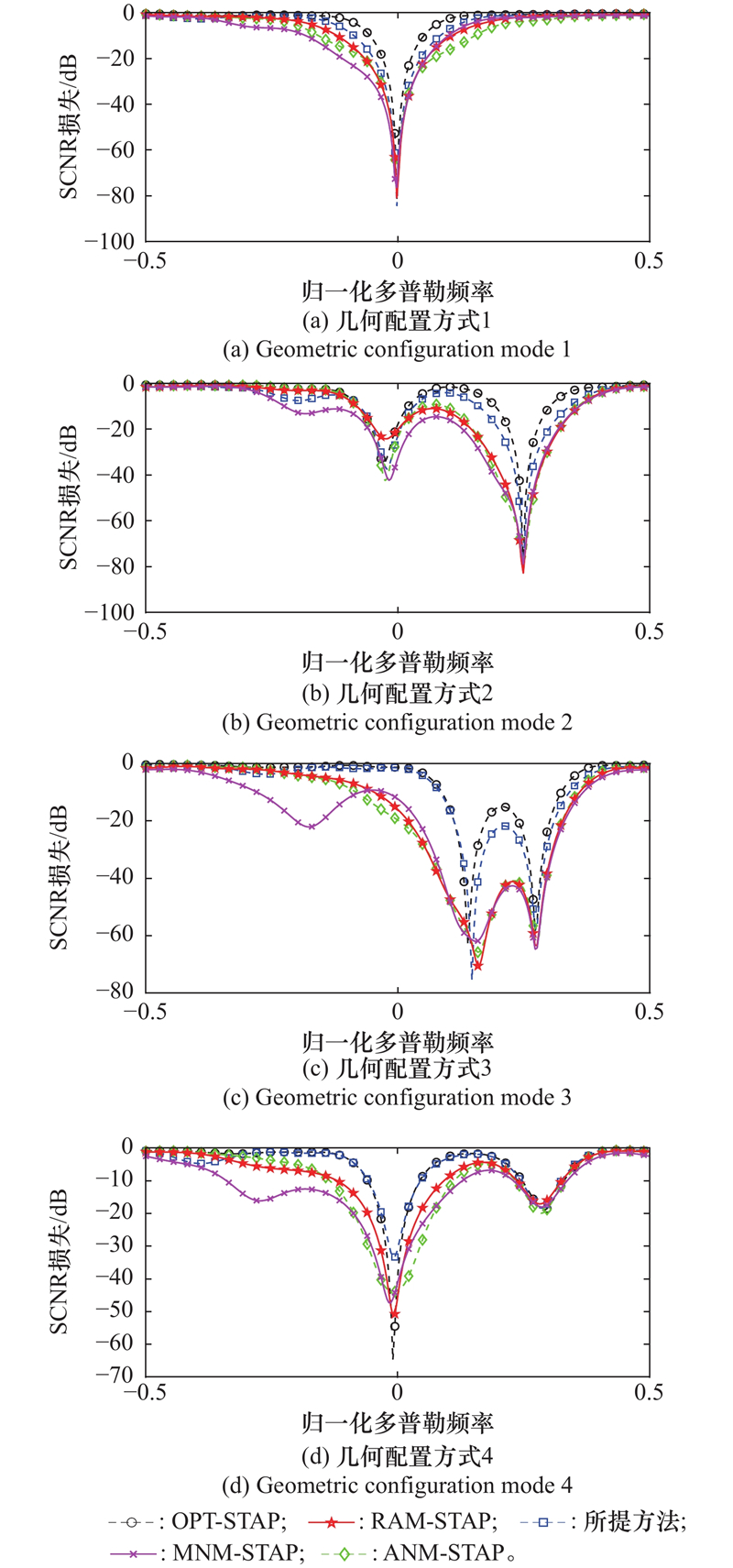
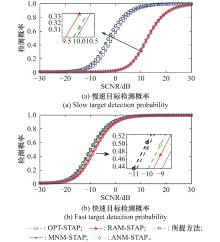
Fig.11
Target detection probability of different methods"

| 1 |
HUANG W J, WANG T, LIU K. A data and model-driven clutter suppression method for airborne bistatic radar based on deep unfolding[J]. Remote Sensing, 2024, 16 (14): 2516.
doi: 10.3390/rs16142516 |
| 2 | 谢文冲, 王永良, 熊元燚. 机载雷达空时自适应处理[M]. 北京: 清华大学出版社, 2024. |
| XIE W C, WANG Y L, XIONG Y Y. Space-time adaptive processing for airborne radar[M]. Beijing: Tsinghua University Press, 2024. | |
| 3 | 杨艺琼, 吴建新, 梁毅. 机载双基雷达波束域杂波抑制方法[J]. 系统工程与电子技术, 2024, 46 (6): 1935- 1945. |
| YANG Y Q, WU J X, LIANG Y. Airborne bistatic radar beam domain clutter suppression method[J]. Systems Engineering and Electronics, 2024, 46 (6): 1935- 1945. | |
| 4 | DUAN K Q, CHEN H, XIE W C, et al. Deep learning for high-resolution estimation of clutter angle-Doppler spectrum in STAP[J]. IET Radar, Sonar & Navigation, 2022, 16(2): 193−207. |
| 5 | CUI N, XING K, YU Z J, et al. Tensor-based sparse recovery space-time adaptive processing for large size data clutter suppression in airborne radar[J]. IEEE Trans. on Aerospace and Electronic Systems, 2022, 59 (2): 907- 922. |
| 6 | 李仲悦, 王彤. 基于稀疏贝叶斯学习的稳健STAP算法[J]. 系统工程与电子技术, 2023, 45 (10): 3032- 3040. |
| LI Z Y, WANG T. Sparse Bayesian learing based robust STAP algorithm[J]. Systems Engineering and Electronics, 2023, 45 (10): 3032- 3040. | |
| 7 |
LIU K, WANG T, WU J X, et al. On the efficient implementation of sparse Bayesian learning-based STAP algorithms[J]. Remote Sensing, 2022, 14 (16): 3931.
doi: 10.3390/rs14163931 |
| 8 |
CAO J X, WANG T, WANG D G. Beam-space post-Doppler reduced-dimension STAP based on sparse Bayesian learning[J]. Remote Sensing, 2024, 16 (2): 307.
doi: 10.3390/rs16020307 |
| 9 |
YUAN H D, XU H, DUAN K Q, et al. Sparse Bayesian learning-based space-time adaptive processing with off-grid self-calibration for airborne radar[J]. IEEE Access, 2018, 6, 47296- 47307.
doi: 10.1109/ACCESS.2018.2866497 |
| 10 |
LI Z Y, WANG T. ADMM-based low-complexity off-grid space-time adaptive processing methods[J]. IEEE Access, 2020, 8, 206646- 206658.
doi: 10.1109/ACCESS.2020.3037652 |
| 11 |
WANG J P, WANG J, ZUO L, et al. Airborne passive bistatic radar clutter suppression algorithm based on root off-grid sparse Bayesian learning[J]. Remote Sensing, 2022, 14 (16): 3963.
doi: 10.3390/rs14163963 |
| 12 |
LI M F, LI H. A novel fast iterative STAP method with a coprime sampling structure[J]. Sensors, 2024, 24 (12): 4007.
doi: 10.3390/s24124007 |
| 13 |
GAO Z Q, DENG W, HUANG P P, et al. Airborne radar space-time adaptive processing algorithm based on dictionary and clutter power spectrum correction[J]. Electronics, 2024, 13 (11): 2187.
doi: 10.3390/electronics13112187 |
| 14 |
LIU C, WANG T, LIU K, et al. A novel sparse bayesian space-time adaptive processing algorithm to mitigate off-grid effects[J]. Remote Sensing, 2022, 14 (16): 3906.
doi: 10.3390/rs14163906 |
| 15 |
DENG Y Q, PEI Z W, LI W G, et al. Clutter suppression algorithm with joint intrinsic clutter motion errors calibration and off-grid effects mitigation in airborne passive radars[J]. Applied Sciences, 2023, 13 (9): 5653.
doi: 10.3390/app13095653 |
| 16 |
ZHANG C X, ZHAO H L, CHEN W C, et al. Robust multiple-measurement sparsity-aware STAP with Bayesian variational autoencoder[J]. Remote Sensing, 2022, 14 (15): 3800.
doi: 10.3390/rs14153800 |
| 17 |
CANDE’S E J, FERNANDEZ G. Towards a mathematical theory of superp-resolution[J]. Communications on Pure and Applied Mathematics, 2014, 67 (6): 906- 956.
doi: 10.1002/cpa.21455 |
| 18 |
FENG W K, GUO Y D, ZHANG Y S, et al. Airborne radar space time adaptive processing based on atomic norm minimization[J]. Signal Processing, 2018, 148, 31- 40.
doi: 10.1016/j.sigpro.2018.02.008 |
| 19 |
ZHANG T, HU Y S, LAI R. Gridless super-resolution sparse recovery for non-sidelooking STAP using reweighted atomic norm minimization[J]. Multidimensional Systems and Signal Processing, 2021, 32, 1259- 1276.
doi: 10.1007/s11045-021-00784-x |
| 20 | LI Z Y, WANG T, SU Y Y. A fast and gridless STAP algorithm based on mixed-norm minimisation and the alternating direction method of multipliers[J]. IET Radar, Sonar & Navigation, 2021, 15(10): 1340−1352. |
| 21 |
LI J, WU R, LU I T, et al. Bayesian linear regression with cauchy prior and its application in sparse mimo radar[J]. IEEE Trans. on Aerospace and Electronic Systems, 2023, 59 (6): 9576- 9597.
doi: 10.1109/TAES.2023.3321585 |
| 22 |
MA J T, ZHANG J C, YANG Z Y, et al. Off-grid doa estimation using sparse Bayesian learning for mimo radar under impulsive noise[J]. Sensors, 2022, 22 (16): 6268.
doi: 10.3390/s22166268 |
| 23 |
WANG D G, WANG T, CUI W C, et al. A clutter suppression algorithm via enhanced sparse Bayesian learning for airborne radar[J]. IEEE Sensors Journal, 2023, 23 (10): 10900- 10911.
doi: 10.1109/JSEN.2023.3263919 |
| 24 | 吕晓德, 杨璟茂, 岳琦, 等. 基于稀疏贝叶斯学习的机载双基雷达杂波抑制[J]. 电子与信息学报, 2018, 40 (11): 2651- 2658. |
| LV X D, YANG J M, YUE Q, et al. Airborne bistatic radar clutter suppression based on sparse Bayesian learning[J]. Journal of Electronics & Information Technology, 2018, 40 (11): 2651- 2658. | |
| 25 |
WANG D G, WANG T, CUI W C, et al. A novel gridless space-time adaptive processing method based cyclic minimization[J]. Digital Signal Processing, 2023, 140, 104142.
doi: 10.1016/j.dsp.2023.104142 |
| 26 |
STEFFENS C, PESAVENTO M, PFETSCH M E. A compact formulation for the l2,1 mixed-norm minimization problem[J]. IEEE Trans. on Signal Processing, 2018, 66 (6): 1483- 1497.
doi: 10.1109/TSP.2017.2788431 |
| 27 |
QIN L G, LI J, LUO Y C, et al. A deep iterative neural network for structured compressed sensing based on generalized pattern-coupled sparse Bayesian learning[J]. Digital Signal Processing, 2023, 132, 103789.
doi: 10.1016/j.dsp.2022.103789 |
| 28 |
GIRI R, RAO B. Type I and type II Bayesian methods for sparse signal recovery using scale mixtures[J]. IEEE Trans. on Signal Processing, 2016, 64 (13): 3418- 3428.
doi: 10.1109/TSP.2016.2546231 |
| 29 | 王安安, 谢文冲, 王永良. 基于稀疏恢复的双基地机载雷达杂波抑制方法[J]. 系统工程与电子技术, 2024, 46 (2): 517- 525. |
| WANG A A, XIE W C, WANG Y L. Bistatic airborne radar clutter suppression method based on sparse recovery[J]. Systems Engineering and Electronics, 2024, 46 (2): 517- 525. | |
| 30 | 王安安, 谢文冲, 陈威, 等. 双基地机载雷达杂波和主瓣压制干扰抑制方法[J]. 系统工程与电子技术, 2023, 45 (3): 699- 707. |
| WANG A A, XIE W C, CHEN W. Clutter and main-lobe suppression jamming suppression method for bistatic airborne radar[J]. Systems Engineering and Electronics, 2023, 45 (3): 699- 707. | |
| 31 |
WANG Y L, CHEN J W, BAO Z, et al. Robust space-time adaptive processing for airborne radar in nonhomogeneous clutter environments[J]. IEEE Trans. on Aerospace and Electronic Systems, 2003, 39 (1): 70- 81.
doi: 10.1109/TAES.2003.1188894 |
| 32 |
ROBEY F C, FUHRMANN D R, KELLY E J, et al. A CFAR adaptive matched filter detector[J]. IEEE Trans. on Aerospace and Electronic Systems, 1992, 28 (1): 208- 216.
doi: 10.1109/7.135446 |
| [1] | Gang TAN, Shefeng YAN, Linlin MAO, Jirui YANG. Joint channel and impulsive noise estimation for underwater acoustic OFDM systems based on sparse Bayesian learning [J]. Systems Engineering and Electronics, 2025, 47(10): 3482-3491. |
| [2] | Yalong WANG, Jiaheng WANG, Jun LI, qin HE, Zishu HE. Direct data domain STAP method via joint-sparse characteristic of clutter and noise [J]. Systems Engineering and Electronics, 2024, 46(9): 2980-2987. |
| [3] | Yiqiong YANG, Jianxin WU, Yi LIANG. Airborne bistatic radar beam domain clutter suppression method [J]. Systems Engineering and Electronics, 2024, 46(6): 1935-1945. |
| [4] | Cheng LIU, Huake WANG, Yinghui QUAN, Guisheng LIAO. Non-uniform distance ambiguity clutter suppression method for airborne multi-carrier frequency control array [J]. Systems Engineering and Electronics, 2024, 46(2): 459-469. |
| [5] | Lei YANG, Weitian SUN, Xinyao MAO, Yabo XIA, Jinghe SANG. Bayesian enhancement algorithm for micro-Doppler feature of radar bird target [J]. Systems Engineering and Electronics, 2024, 46(2): 505-516. |
| [6] | An'an WANG, Wenchong XIE, Yongliang WANG. Bistatic airborne radar clutter suppression method based on sparse recovery [J]. Systems Engineering and Electronics, 2024, 46(2): 517-525. |
| [7] | Lutao LIU, Guoheng XU, Zhen WANG. Fast and high precision DOA estimation algorithm based on sparse recovery [J]. Systems Engineering and Electronics, 2024, 46(11): 3631-3638. |
| [8] | Ran LAI, Gang SUN, Wei ZHANG, Tao ZHANG. Space-time moving target parameter estimation algorithm based on non-convex relaxation of atomic norm [J]. Systems Engineering and Electronics, 2023, 45(9): 2761-2767. |
| [9] | Lei YANG, Yabo XIA, Xianhua LIAO, Xinyao MAO, Yuchen DOU, Huan YANG. Super-resolution ISAR imagery algorithm based on bi-sparsity Bayesian learning [J]. Systems Engineering and Electronics, 2023, 45(5): 1371-1379. |
| [10] | Zhongyue LI, Tong WANG. Sparse Bayesian learning-based robust STAP algorithm [J]. Systems Engineering and Electronics, 2023, 45(10): 3032-3040. |
| [11] | Anlin XU, Yu ZHANG, Feng ZHOU. High resolution ISAR imaging based on Beta process [J]. Systems Engineering and Electronics, 2022, 44(6): 1873-1879. |
| [12] | Hai LI, Weijie CHENG, Ruijie XIE. Wind speed estimation of low-altitude wind-shear based on homotopy sparse STAP [J]. Systems Engineering and Electronics, 2022, 44(4): 1174-1181. |
| [13] | Tao CHEN, Lin SHI, Mengyu SHEN. Gridless DOA estimation algorithm based on M-FIPM [J]. Systems Engineering and Electronics, 2022, 44(2): 427-433. |
| [14] | Xingjia YANG, Keqing DUAN, Xiang LI, Wei QI. Resolving range ambiguity for cooperative detection using UAV swarms [J]. Systems Engineering and Electronics, 2022, 44(2): 480-489. |
| [15] | Jun ZHANG, Xinyu ZHANG, Weidong JIANG, Yongxiang LIU, Xiang LI. Fast DOA estimation method using generalized approximate message passing [J]. Systems Engineering and Electronics, 2022, 44(10): 2995-3002. |
| Viewed | ||||||
|
Full text |
|
|||||
|
Abstract |
|
|||||