

系统工程与电子技术 ›› 2025, Vol. 47 ›› Issue (11): 3521-3530.doi: 10.12305/j.issn.1001-506X.2025.11.01
• 电子技术 •
孔令宸1( ), 刘桐辛1,*(), 周晨1(), 赵正予1,2()
收稿日期:2025-03-06
接受日期:2025-07-05
出版日期:2025-11-25
发布日期:2025-12-08
通讯作者:
刘桐辛
E-mail:konglingchen@whu.edu.cnE-mail;tongxin_liu@whu.edu.cn;chenzhou@whu.edu.cn;zhaozy@whu.edu.cn
作者简介:孔令宸(2002—),男,硕士研究生,主要研究方向为空间探测与信息处理
Lingchen KONG1(), Tongxin LIU1,*(), Chen ZHOU1(), Zhengyu ZHAO1,2()
Received:2025-03-06
Accepted:2025-07-05
Online:2025-11-25
Published:2025-12-08
Contact:
Tongxin LIU
E-mail:konglingchen@whu.edu.cnE-mail;tongxin_liu@whu.edu.cn;chenzhou@whu.edu.cn;zhaozy@whu.edu.cn
摘要:
针对短波到达时差(time-difference-of-arrival,TDOA)定位问题,提出一套基于多源数据同化和卷积神经网络(convolutional neural network,CNN)重构的电离层虚高修正算法。该方法首先利用卡尔曼滤波对电离层斜向返回探测和全球导航卫星系统(global navigation satellite system,GNSS)层析结果进行数据同化;随后使用CNN代替普通的插值方式对区域电离层参数进行拟合以获取求解TDOA定位问题所需要的时空网格点下的电离层参数;最后利用解析型射线追踪对辐射源和虚高进行一体化估计。以斜测结果进行精度分析,该方法相对于GNSS层析、线性插值、临频峰高半厚的估计精度分别提升了62.93%,64.54%,20.48%。同时,本文利用时间平稳序列检验方法对电离层稳定性进行分析,通过对比短波TDOA定位性能,明确电离层稳定性与定位性能呈明显的正相关性。
中图分类号:
孔令宸, 刘桐辛, 周晨, 赵正予. 基于区域电离层高分辨率重构的到达时差定位分析[J]. 系统工程与电子技术, 2025, 47(11): 3521-3530.
Lingchen KONG, Tongxin LIU, Chen ZHOU, Zhengyu ZHAO. Time-difference-of-arrival localization analysis based on regional ionospheric high resolution reconstruction[J]. Systems Engineering and Electronics, 2025, 47(11): 3521-3530.
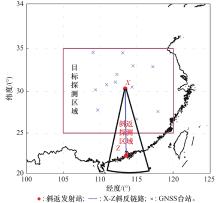
图1
探测站点与探测范围示意图"
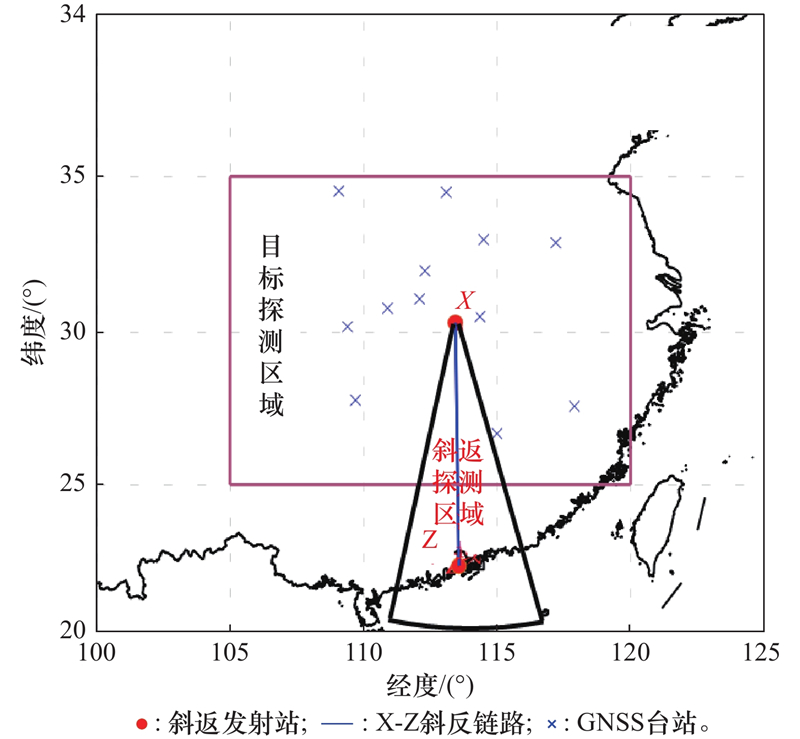
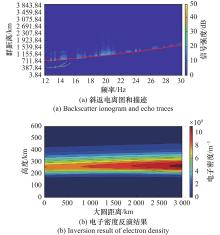
图2
斜返电离图描迹提取与反演结果"
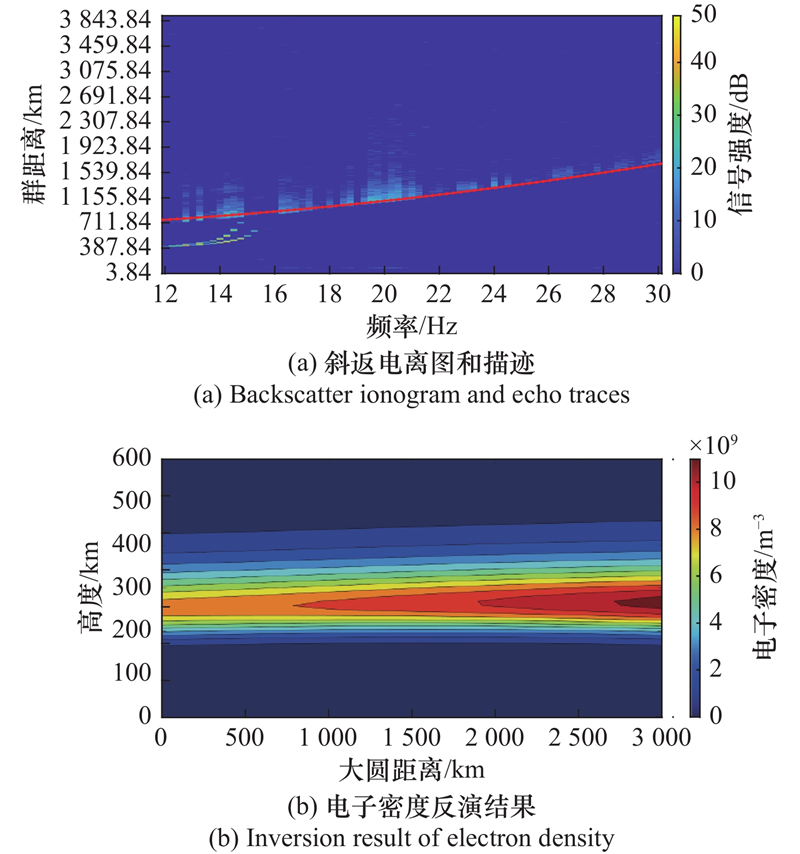
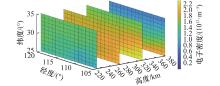
图3
电离层层析反演结果示意图"
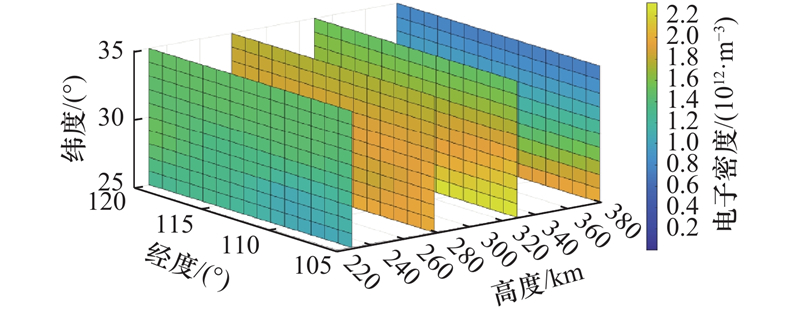
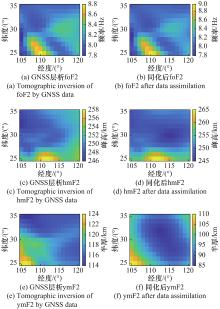
图4
数据同化前后粗糙网格化电离层模型"

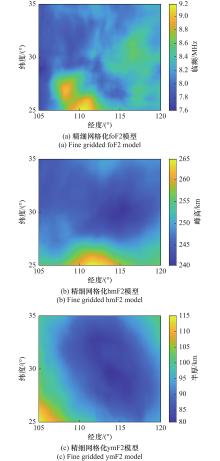
图5
精细网格化的电离层参数模型"
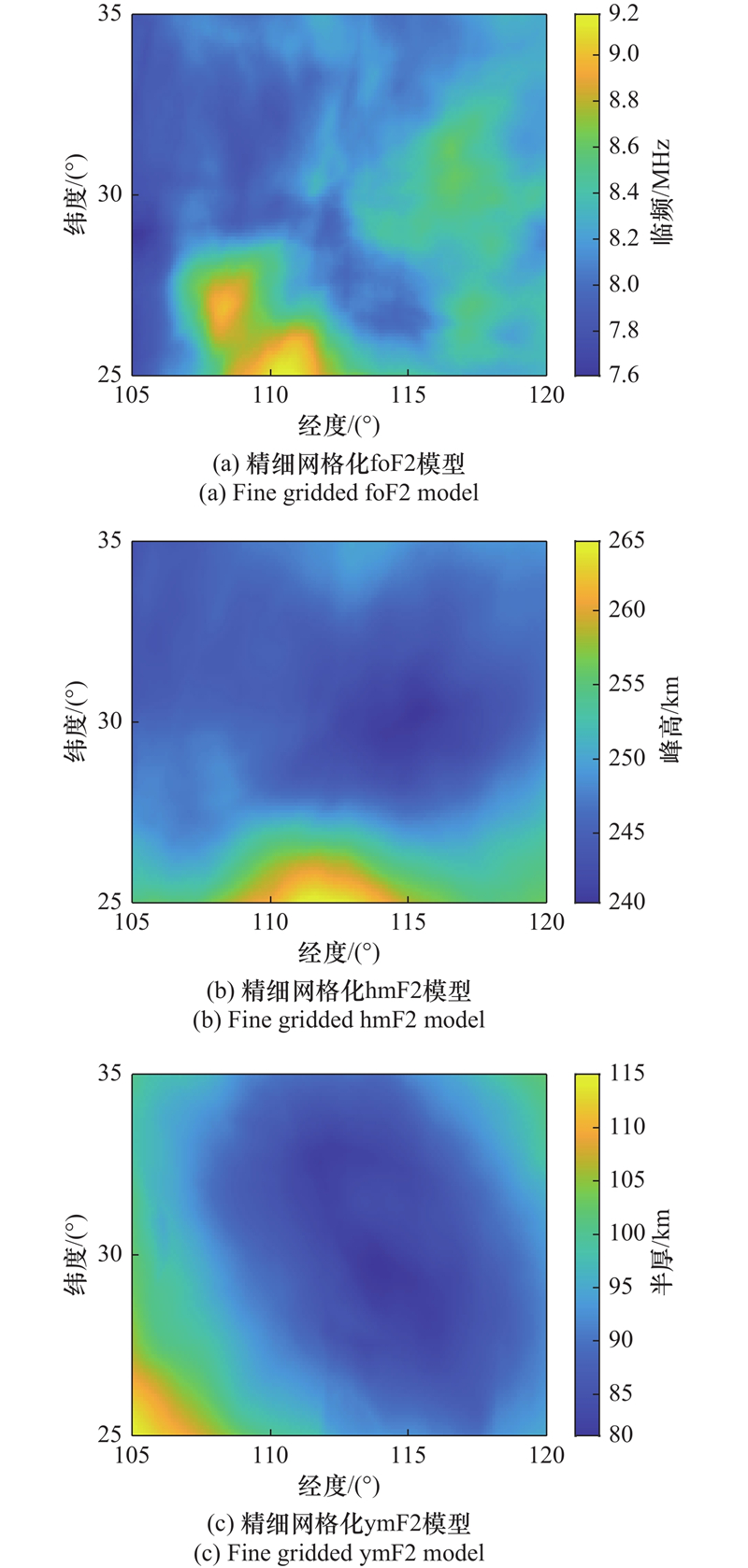
图6
CNN重构结果与GNSS层析结果对比"
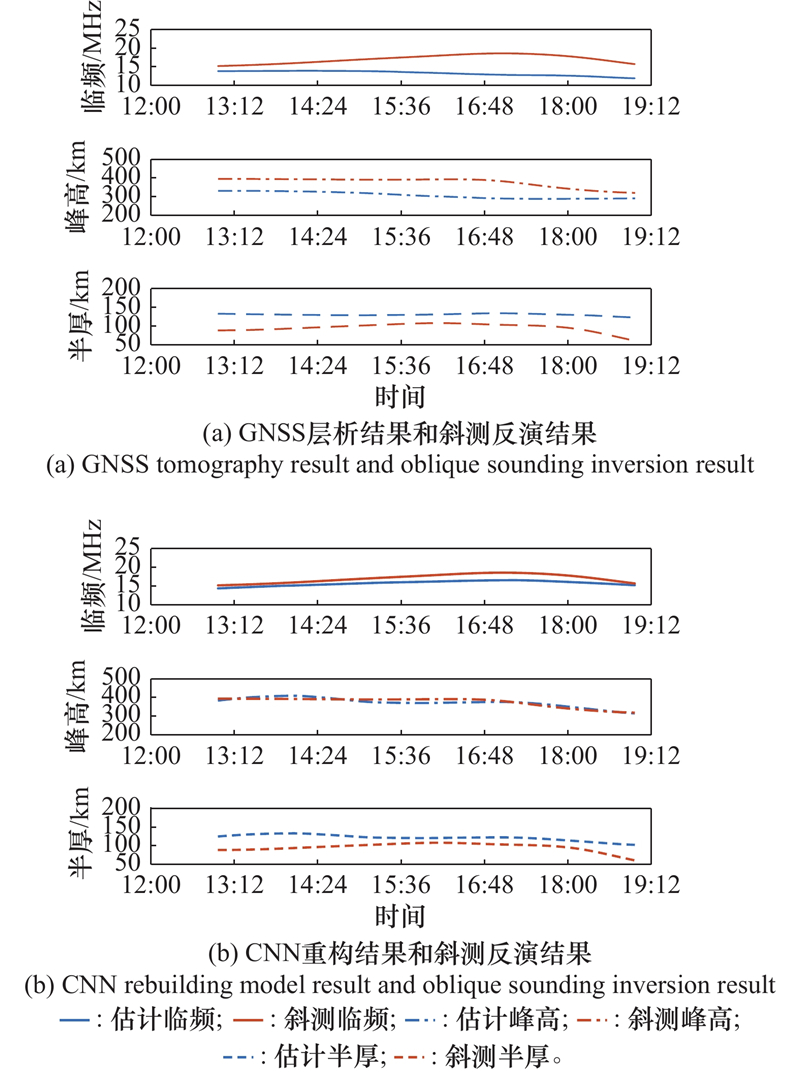
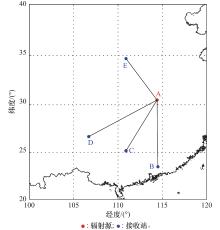
图7
短波到达时差定位站点分布示意"
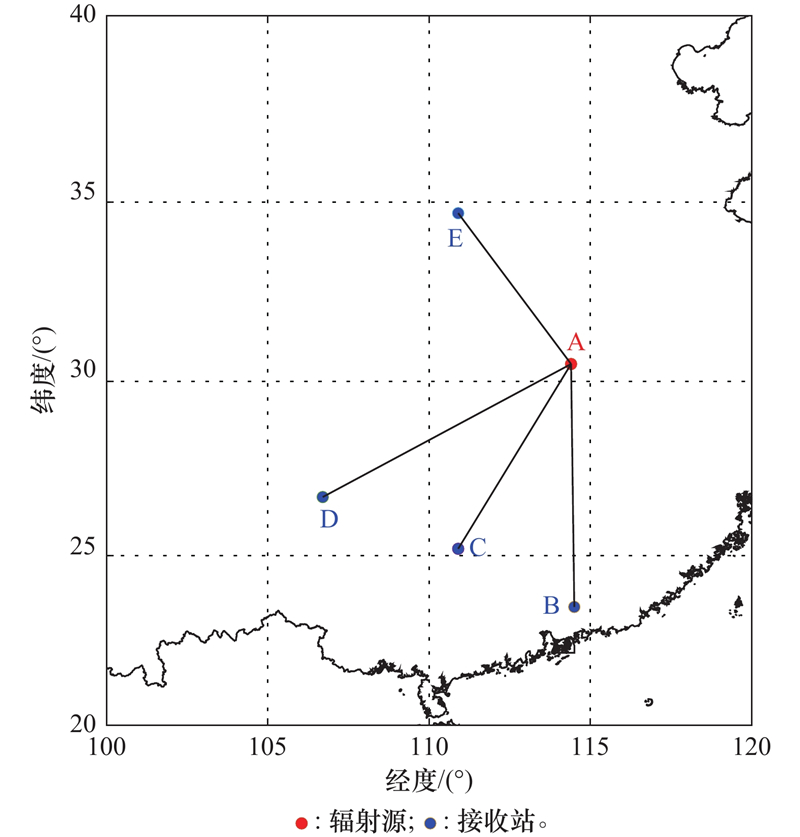
图8
不同时间定位结果"
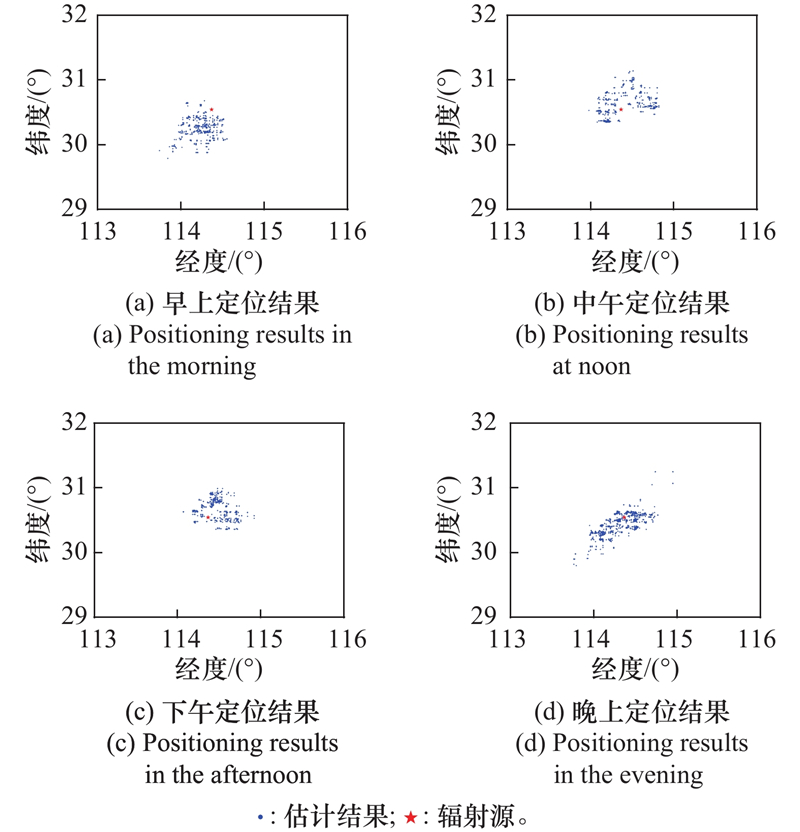
图9
不同时间定位误差"
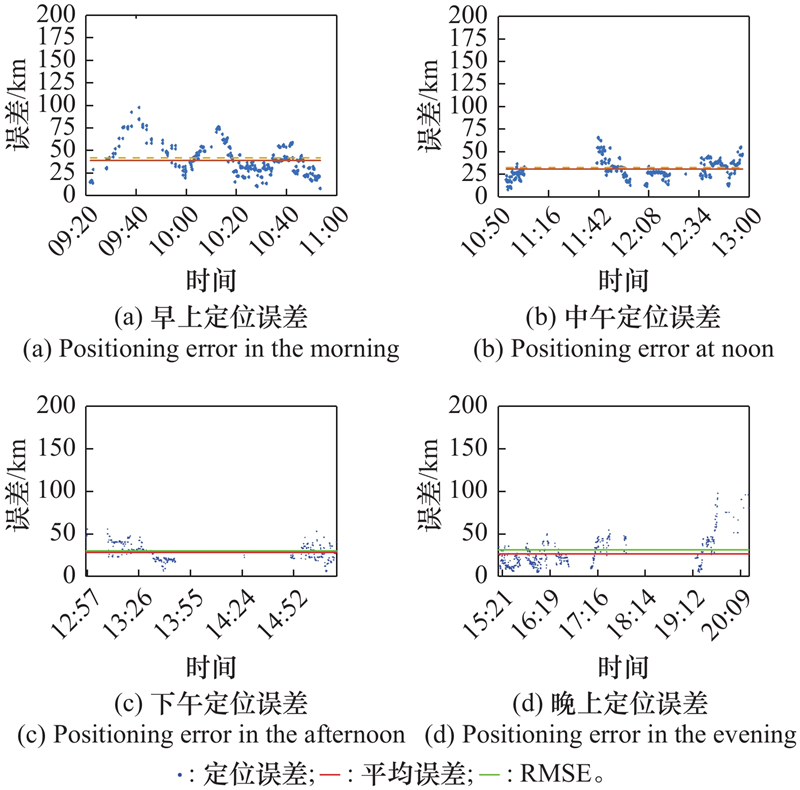
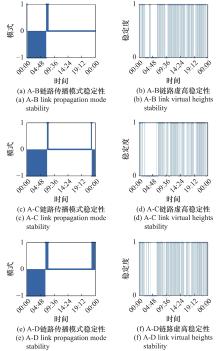
图10
传播模式稳定性与虚高稳定性"

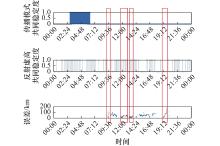
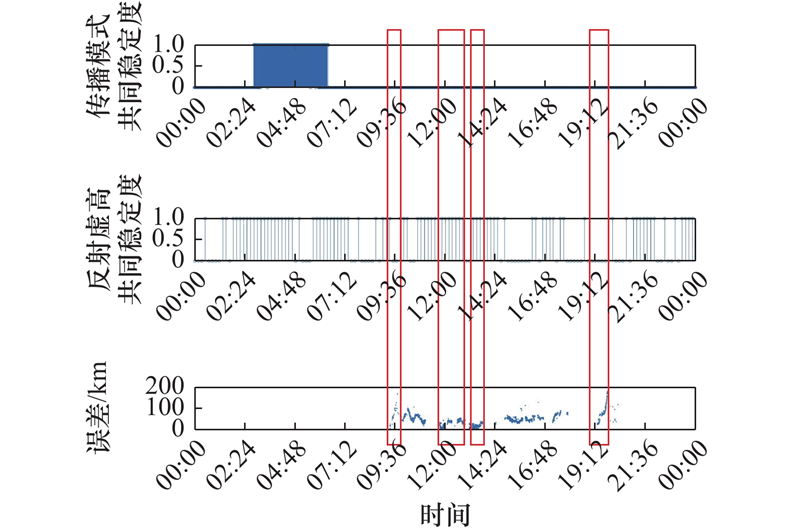
图11
电离层稳定性与定位误差对照"
| 1 | 刘选谋. 无线电波传播[M]. 北京: 高等教育出版社, 1987. |
| LIU X M. Radio wave propagation[M]. Beijing: Higher Education Press, 1987. | |
| 2 | 马跃. 短波辐射源到达时差定位与极限性能分析及优化[D]. 西安: 西安电子科技大学, 2022. |
| MA Y. Analysis and optimization of TDOA locationand limit performance of short wave emitter[D]. Xi’an: Xidian University, 2022. | |
| 3 | 李蕊, 邓亭强, 窦修全. 基于遗传算法优化的短波时差定位算法[J]. 电波科学学报, 2023, 38 (6): 1096- 1104. |
| LI R, DENG T Q, DOU X Q. High frequency TDOA geolocation method based on genetic algorithm optimization[J]. Chinese Journal of Radio Science, 2023, 38 (6): 1096- 1104. | |
| 4 | 熊年禄, 唐存琛, 李行健. 电离层物理概论[M]. 武汉: 武汉大学出版社, 1999. |
| XIONG N L, TANG C C, LI X J. Introduction to ionosphere physics[M]. Wuhan: Wuhan University Press, 1999. | |
| 5 | 姜春华. 武汉电离层探测系统数据的自动处理和分析[D]. 武汉: 武汉大学, 2015. |
| JIANG C H. Automatic processing and analysis of data from the wuhan ionospheric sounding system[D]. Wuhan: Wuhan University, 2015. | |
| 6 | MATERASSI M. The fluid ionosphere[J]. Atmosphere, 2025, 16(2): 147. |
| 7 | 唐英豪. 基于GNSS的电离层建模与应用[D]. 广州: 广州大学, 2023. |
| TANG Y H. Ionospheric modeling and application basd on GNSS[D]. Guangzhou: Guangzhou University, 2023. | |
| 8 | 赵海生, 许正文. 多数据源电离层层析成像方法[J]. 电波科学学报, 2011, 26 (4): 649- 653. |
| ZHAO H S, XU Z W. Multi-data-source ionospheric chromatography imaging methods[J]. Chinese Journal of Radio Science, 2011, 26 (4): 649- 653. | |
| 9 | BILITZA D, REINISCH B W. International reference ionosphere 2007: improvements and new parameters[J]. Advances in Space Research, 2008, 42 (4): 599- 609. |
| 10 |
BILITZA D. International reference ionosphere 2000[J]. Radio Science, 2001, 36 (2): 261- 275.
doi: 10.1029/2000RS002432 |
| 11 | RADICELLA S M. The NeQuick model genesis, uses and evolution[J]. Annals of Geophysics, 2009, 52(3/4): 417–422. |
| 12 |
CHAPMAN S. The absorption and dissociative or ionizing effect of monochromatic radiation in an atmosphere on a rotating earth[J]. Proceedings of the Physical Society, 1931, 43 (1): 26- 45.
doi: 10.1088/0959-5309/43/1/305 |
| 13 |
PIGNALBERI A, BILITZA D, COÏSSON P, et al. Validation of the IRI-2020 topside ionosphere options through in-situ electron density observations by low-Earth-orbit satellites[J]. Advances in Space Research, 2025, 75 (5): 4192- 4216.
doi: 10.1016/j.asr.2024.05.056 |
| 14 |
OSTANIN P A, KULYAMIN D V, KOSTRYKIN S V, et al. Four-dimensional variational data assimilation system for the Earth ionosphere[J]. Russian Journal of Numerical Analysis and Mathematical Modelling, 2025, 40 (1): 33- 46.
doi: 10.1515/rnam-2025-0003 |
| 15 | 张一帆. 基于Kalman滤波的电离层多源数据同化研究[D]. 天津: 中国民航大学, 2023. |
| ZHANG Y F. Research on ionospheric multi source data assimilation based on Kalman filtering[D]. Tianjin: Civil Aviation University of China, 2023. | |
| 16 |
HE J H, YUE X A. The impact of perturbing eddy diffusion and upper boundary on the ionosphere EnKF assimilation system[J]. Journal of Geophysical Research: Space Physics, 2021, 126 (8): e2021JA029366.
doi: 10.1029/2021JA029366 |
| 17 | SHI Z H, ZHI N, FU H Y, et al. A method for dSTEC interpolation: ionosphere kernel estimation algorithm[J]. IEEE Trans. on Geoscience and Remote Sensing, 2022, 60, 5804318- 18. |
| 18 |
LYU H, HERNÁNDEZ P M, LI M, et al. Global 3D ionospheric shape function modeling with kriging[J]. Journal of Geodesy, 2024, 98 (12): 104.
doi: 10.1007/s00190-024-01908-4 |
| 19 | REN H, JIANG Y P, LIU T. An anisotropic Kriging for ionospheric delay interpolation with a wide area reference network[J]. IEEE Trans. on Geoscience and Remote Sensing, 2024, 62, 5803413. |
| 20 | GEORGIEV S G, ERHAN M I. Lagrange interpolation on time scales[J]. Journal of Applied Analysis and Computation, 2022, 12 (4): 1294- 1307. |
| 21 |
BUNG D B, VALERO D. Optical flow estimation in aerated flows[J]. Journal of Hydraulic Research, 2016, 54 (5): 575- 580.
doi: 10.1080/00221686.2016.1173600 |
| 22 | 王红军, 徐浩然, 赵文元. 电磁频谱地图构建中的空间插值方法综述[J]. 电讯技术, 2025, 65 (1): 141- 151. |
| WANG H J, XU H R, ZHAO W Y. Survey on spatial interpolation methods for electromagnetic spectrum map construction[J]. Telecommunication Engineering, 2025, 65 (1): 141- 151. | |
| 23 |
ASAMOAH E N, CAFARO M, EPICOCO I, et al. A stacked machine learning model for the vertical total electron content forecasting[J]. Advances in Space Research, 2024, 74 (1): 223- 242.
doi: 10.1016/j.asr.2024.04.055 |
| 24 |
MA J, FU H, HUBA J D, et al. A novel ionospheric inversion model: PINN-SAMI3 (physics informed neural network based on SAMI3)[J]. Space Weather, 2024, 22 (4): e2023SW003823.
doi: 10.1029/2023SW003823 |
| 25 |
BHATT D, PATEL C, TALSANIA H, et al. CNN variants for computer vision: history, architecture, application, challenges and future scope[J]. Electronics, 2021, 10 (20): 2470.
doi: 10.3390/electronics10202470 |
| 26 | LIU C L, HSAIO W H, TU Y C. Time series classification with multivariate convolutional neural network[J]. IEEE Trans. on Industrial Electronics, 2018, 66 (6): 4788- 4797. |
| 27 | 李江华, 杨国斌, 姜春华, 等. 基于FPGA+ARM的电离层斜向探测系统设计[J]. 太赫兹科学与电子信息学报, 2021, 19 (4): 678- 683. |
| LI J H, YANG G B, JIANG C H, et al. Design of ionospheric oblique detection system based on FPGA+ARM[J]. Journal of Terahertz Science and Electronic Information Technology, 2021, 19 (4): 678- 683. | |
| 28 | 黄春雷, 杨国斌, 姜春华. 宽带多功能电离层探测系统接收机设计[J]. 现代电子技术, 2022, 45 (20): 157- 161. |
| HUANG C L, YANG G B, JIANG C H. Design of receiver for multi-function broadband ionospheric sounding system[J]. Modern Electronics Technique, 2022, 45 (20): 157- 161. | |
| 29 | 胡耀垓, 宋欢, 姜春华, 等. 小功率高频返回散射电离图的自动判读[J]. 华中科技大学学报(自然科学版), 2016, 44 (6): 104- 110. |
| HU Y G, SONG H, JIANG C H, et al. Automatic scaling for low-power HF backscatter ionograms[J]. Journal of Huazhong University of Science and Technology(Natural Science Edition), 2016, 44 (6): 104- 110. | |
| 30 | 张龙龙, 朱新慧, 罗远焱, 等. 一种基于传统MART的电离层层析新算法[J]. 测绘科学技术学报, 2018, 35 (5): 457- 461. |
| ZHANG L L, ZHU X H, LUO Y Y, et al. A new algorithm of ionospheric chromatography based on traditional MART[J]. Journal of Geomatics Science and Technology, 2018, 35 (5): 457- 461. | |
| 31 | 周晨, 雷勇, 赵正予, 等. 基于 GPS 层析反演和斜向返回探测反演的电离层二维电子密度重构[J]. 电子与信息学报, 2016, 38 (6): 1496- 1502. |
| ZHOU C, LEI Y, ZHAO Z Y, et al. Two dimensional ionospheric electron density reconstruction based on GPS tomography and oblique backscatter inversion[J]. Journal of Electronics & Information Technology, 2016, 38 (6): 1496- 1502. | |
| 32 | 王君明, 周晨, 李琛, 等. 基于信道模型的短波时差测量克拉美罗界分析[J]. 湘潭大学学报(自然科学版), 2024, 46 (1): 35- 43. |
| WANG J M, ZHOU C, LI C, et al. Cramer-Rao lower bound analysis of shortwave time difference measurements based on channel model[J]. Journal of Xiangtan University(Natural Science Edition), 2024, 46 (1): 35- 43. | |
| 33 | DYSON P L, BENNETT J A. A model of the vertical distribution of the electron concentration in the ionosphere and its application to oblique propagation studies[J]. Journal of Atmospheric and Terrestrial Physics, 1988, 50 (3): 251- 262. |
| 34 | QIAO J D, LIU Y, ZHANG F B, et al. Ionospheric TEC data assimilation based on Gauss–Markov Kalman filter[J]. Advances in Space Research, 2021, 68 (10): 4189- 4204. |
| 35 | 宋欢, 胡耀垓, 赵正予, 等. 基于混合遗传算法的斜测电离图参数反演[J]. 地球物理学报, 2014, 57 (3): 703- 714. |
| SONG H, HU Y G, ZHAO Z Y, et al. Inversion of oblique ionograms based on hybrid genetic algorithm[J]. Chinese Journal of Geophysics, 2014, 57 (3): 703- 714. | |
| 36 |
XIA N, XING B H. A direct localization method for HF source geolocation and experimental results[J]. IEEE Antennas and Wireless Propagation Letters, 2023, 22 (5): 1059- 1063.
doi: 10.1109/LAWP.2022.3232399 |
| 37 |
JAIN A, PAGANI P, FLEURY R, et al. HF source geolocation using an operational TDOA receiver network: experimental results[J]. IEEE Antennas and Wireless Propagation Letters, 2018, 17 (9): 1643- 1647.
doi: 10.1109/LAWP.2018.2860459 |
| 38 | 朱庆厚. 到达时间差(TDOA)测向定位研究[J]. 电讯技术, 2007, 47 (1): 53- 56. |
| ZHU Q H. Study on TDOA Direction finding and location measurement[J]. Telecommunication Engineering, 2007, 47 (1): 53- 56. | |
| 39 | HO K C, CHAN Y T. Solution and performance analysis of geolocation by TDOA[J]. IEEE Trans. on Aerospace and Electronic Systems, 1993, (4): 1311- 1322. |
| 40 | FOY W H. Position-location solutions by taylor-series estimation[J]. IEEE Trans. on Aerospace and Electronic Systems, 2007, 12 (2): 187- 194. |
| 41 | JAIN A, PAGANI P, FLEURY R, et al. Efficient time domain HF geolocation using multiple distributed receivers[C]//Proc. of the 11th European Conference on Antennas and Propagation, 2017: 1852−1856. |
| 42 | XIA N, XING B H. A direct localization method for HF source geolocation and experimental results[J]. IEEE Antennas and Wireless Propagation Letters, 2021, 20 (5): 728- 732. |
| 43 | 王婷. 多层反射条件下未知辐射源电离层反射定位的方法和性能分析[D]. 西安: 西安电子科技大学, 2018. |
| WANG T. Methods and performance analysis for unknown emitter geolocation via multilayer ionosphere reflection[D]. Xi’an: Xidian University, 2018. | |
| 44 | CROFT T A, HOOGASIAN H. Exact ray calculations in a quasi-parabolic ionosphere with no magnetic field[J]. Radio Science, 2015, 3 (1): 69- 74. |
| 45 | 李琛, 周晨, 王君明, 等. 基于经验电离层模型的短波时差定位理论分析[J]. 系统工程与电子技术, 2023, 45 (7): 1911- 1919. |
| LI C, ZHOU C, WANG J M, et al. theoretical analysis of shortwave TDOA geolocation based on empirical ionosphere model[J]. Systems Engineering and Electronics, 2023, 45 (7): 1911- 1919. | |
| 46 | KÖHNLEIN W. Electron density models of the ionosphere[J]. Reviews of Geophysics, 1978, 16(3): 341−354. |
| 47 | 何书元. 应用时间序列分析[M]. 北京: 北京大学出版社, 2003. |
| HE S Y. Applied time series analysis[M]. Beijing: Peking University Press, 2003. |
| [1] | 蒋明煜, 张顺生, 肖思瑶. 面向轻量级交叉注意力卷积网络的SAR目标识别[J]. 系统工程与电子技术, 2025, 47(9): 2853-2861. |
| [2] | 陈文洁, 张浦, 史高翔, 刘林, 刘烜. 基于余弦校验关系的卷积神经网络LDPC码盲识别[J]. 系统工程与电子技术, 2025, 47(9): 3117-3125. |
| [3] | 段阿敏, 张朝辉. 基于二次分解的混合神经网络蜂窝流量预测[J]. 系统工程与电子技术, 2025, 47(5): 1687-1697. |
| [4] | 付卫红, 张鑫钰, 刘乃安. 基于多尺度融合神经网络的同频同调制单通道盲源分离算法[J]. 系统工程与电子技术, 2025, 47(2): 641-649. |
| [5] | 韦娟, 何德华, 宁方立. 基于自适应多分支卷积的声学场景分类[J]. 系统工程与电子技术, 2025, 47(10): 3148-3154. |
| [6] | 邵永琪, 杨丽花, 常澳, 任露露. RIS辅助的OFDM系统中时变信道估计方法[J]. 系统工程与电子技术, 2025, 47(1): 324-331. |
| [7] | 于蕾, 邓秋月, 郑丽颖, 吴昊宇. 二阶逐层特征融合网络的图像超分辨重建[J]. 系统工程与电子技术, 2024, 46(2): 391-400. |
| [8] | 肖博文, 马泽远, 鲁天宇, 夏群利. 平台式导引头隔离度模型在线辨识方法[J]. 系统工程与电子技术, 2024, 46(11): 3595-3604. |
| [9] | 季然, 肖茂森, 李硕, 刘宇, 罗湛仪, 程嘉维. 基于机器学习的MRTD客观测试方法研究[J]. 系统工程与电子技术, 2024, 46(10): 3265-3270. |
| [10] | 杨帆, 马萍, 李伟, 杨明. 基于孪生网络的仿真模型智能排序评估方法[J]. 系统工程与电子技术, 2023, 45(7): 2060-2068. |
| [11] | 姜雨, 袁琪, 胡志韬, 吴薇薇, 顾欣. 基于气象因素的机场进离港延误预测[J]. 系统工程与电子技术, 2023, 45(6): 1722-1731. |
| [12] | 汪锐, 张天骐, 安泽亮, 王雪怡, 方竹. 基于联合特征参数和一维CNN的MIMO-OFDM系统调制识别算法[J]. 系统工程与电子技术, 2023, 45(3): 902-912. |
| [13] | 闫啸家, 梁伟阁, 张钢, 佘博, 田福庆. 基于RCNN-ABiLSTM的机械设备剩余寿命预测方法[J]. 系统工程与电子技术, 2023, 45(3): 931-940. |
| [14] | 宋波涛, 许广亮. 基于LSTM与1DCNN的导弹轨迹预测方法[J]. 系统工程与电子技术, 2023, 45(2): 504-512. |
| [15] | 黄妍妍, 盖绍彦, 达飞鹏. 三分支空间变换注意力机制的图像匹配算法[J]. 系统工程与电子技术, 2023, 45(11): 3363-3373. |
| 阅读次数 | ||||||
|
全文 |
|
|||||
|
摘要 |
|
|||||
