

系统工程与电子技术 ›› 2026, Vol. 48 ›› Issue (3): 1072-1082.doi: 10.12305/j.issn.1001-506X.2026.03.31
• 通信与网络 • 上一篇
金志刚, 刘泽培( ), 武晓栋
收稿日期:2024-12-02
出版日期:2026-03-25
发布日期:2026-04-13
通讯作者:
金志刚
E-mail:1022234040@tju.edu.cn
作者简介:刘泽培(1998—),男,博士研究生,主要研究方向为联邦学习、博弈论、强化学习、网络安全、隐私保护基金资助:
Zhigang JIN, Zepei LIU(), Xiaodong WU
Received:2024-12-02
Online:2026-03-25
Published:2026-04-13
Contact:
Zhigang JIN
E-mail:1022234040@tju.edu.cn
摘要:
物联网的安全与隐私保护是研究热点和技术难题。博弈论方法能够有效分析物联网系统中多方利益主体的博弈行为,在决策分析层面对防御技术形成重要补充。综述了近五年来博弈论在物联网安全与隐私保护中的应用,系统梳理了其在安全对抗中的应用场景与技术贡献。按照对抗主体的不同,相关研究分为两类:一类聚焦攻防双方的博弈,另一类针对特定物联网场景中不同组织之间的交互与协作。深入讨论了当前研究的挑战,包括均衡假设的合理性、计算复杂性以及算法实用性等问题,并展望了结合强化学习技术开发智能博弈安全机制的发展方向。
中图分类号:
金志刚, 刘泽培, 武晓栋. 物联网安全与隐私保护中博弈论的应用综述[J]. 系统工程与电子技术, 2026, 48(3): 1072-1082.
Zhigang JIN, Zepei LIU, Xiaodong WU. Survey of game theory applications in Internet of Things security and privacy[J]. Systems Engineering and Electronics, 2026, 48(3): 1072-1082.
表1
IoT特性与博弈论方法优势"
| IoT特性 | 代表场景 | 额外安全隐私风险 | 博弈论方法优势 |
| 物理与网络强耦合 | CPS | 增大安全暴露面,传统技术防御不适用 | 战略分析,灵活 的控制策略 |
| 资源受限 | 边缘计算 | 针对边缘传感器的DDoS攻击更具威胁,难 以部署传统强健的防御技术 | 高效的资源配置策略, 动态的任务卸载方案 |
| 隐私性 | MCS | 协议内生漏洞,多实体利益互动 | 弹性的隐私保护方案, 灵活的激励机制 |
表2
应用于安全和隐私问题的非合作与合作博弈模型的主要特征"
| 模型分类 | 模型名称 | 主要特征 |
| 非合作 博弈模型 | 零和博弈 | 博弈各方的收益之和总是等于“0” |
| Stackelberg模型 | 领导者先行动,追随者根据领导者的行动做出自己的选择 | |
| 贝叶斯博弈 | 至少有一名博弈者对其他博弈者的收益不完全知情 | |
| Potential博弈 | 所有博弈者改变策略的动机可以用势函数来表示 | |
| 随机博弈 | 随机博弈是一种按阶段顺序进行的重复博弈,具有概率过渡性 | |
| 合作 博弈模型 | 重复博弈 | 多次或无限次重复博弈时,博弈者通过契约看重更长远的收益 |
| 合作博弈 | 博弈者可以通过结成联盟并根据贡献分配收益 | |
| 讨价还价博弈 | 博弈者达成可执行的协议,协商如何分配收益 |
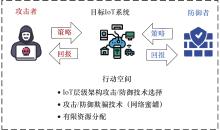
图1
攻击者与防御者之间对抗"
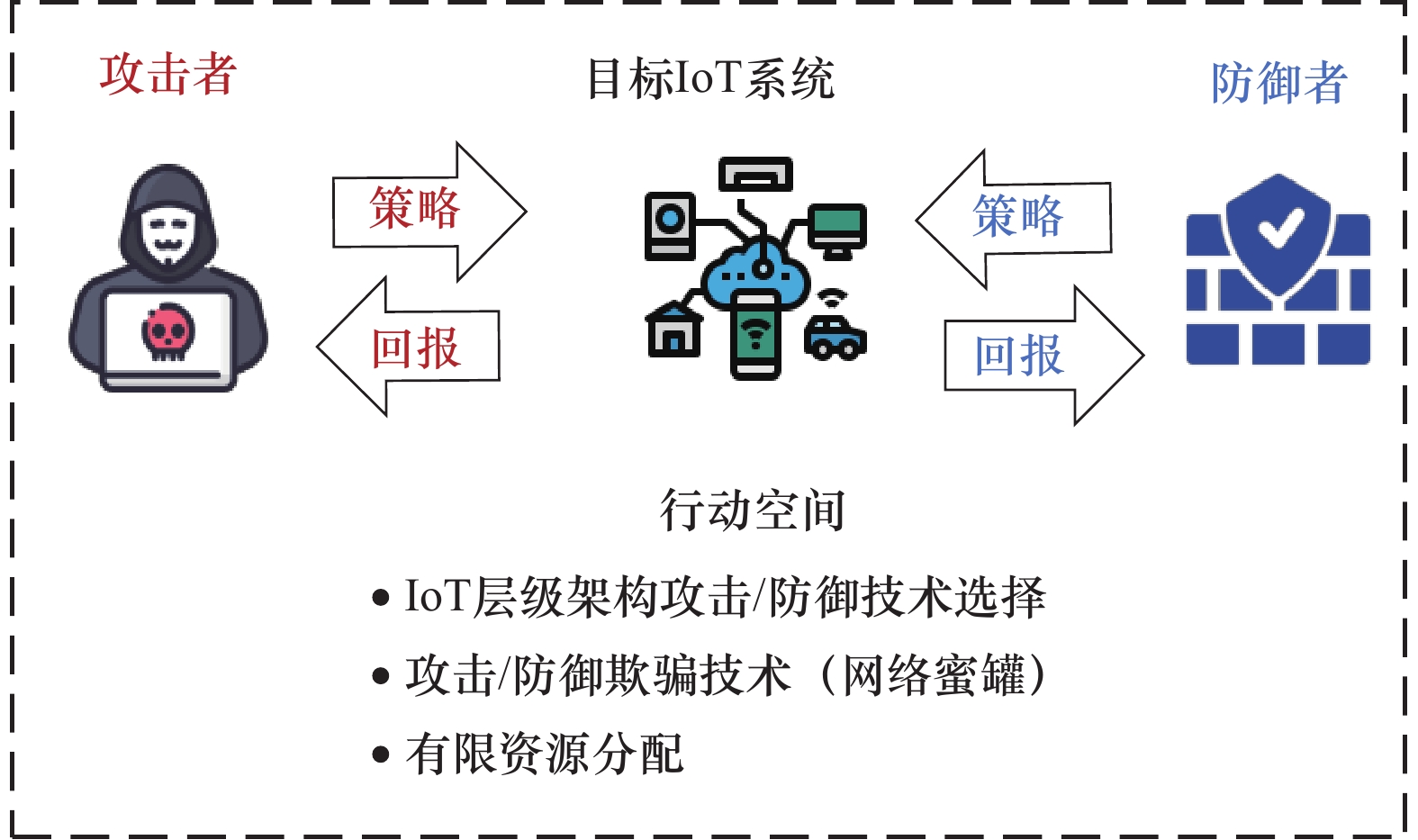
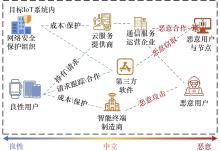
图2
IoT系统内不同组织之间的对抗"
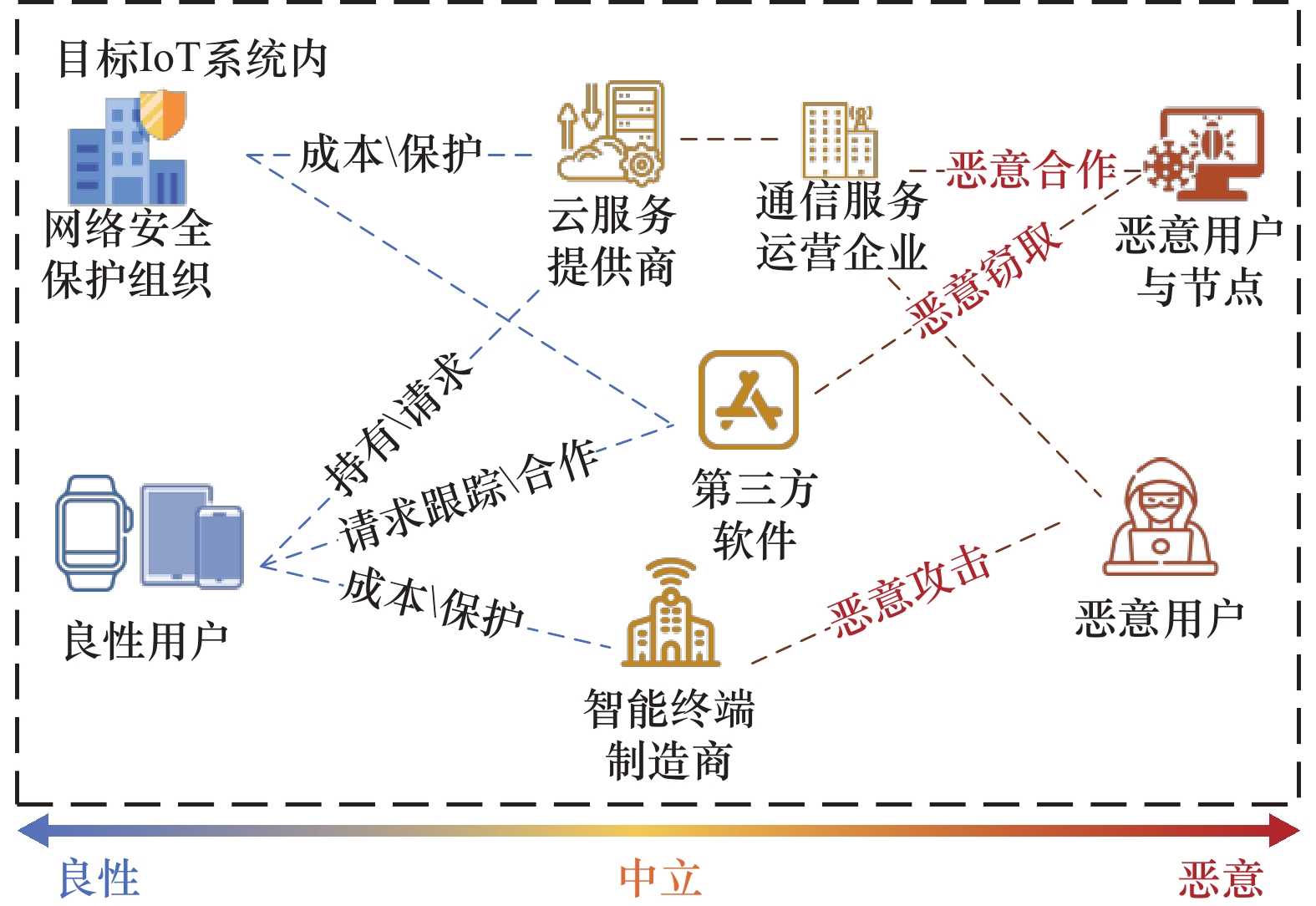
表3
基于博弈论的DoS/DDoS相关研究回顾"
| 博弈模型 | IoT应用场景 | 研究问题 | 点评 |
| 贝叶斯博弈 | 边缘计算[ | 任务卸载中的信息不对称问题 | 强调信息不对称条件下的任务调度优化,提升负载均衡性和抗攻击能力 |
| Potential博弈 | 边缘计算[ | DDoS攻击缓解的成本最小化 | 适用于静态场景,对高动态环境的适应性不足 |
| Stackelberg博弈 | 无线网络[ 切换系统[ | 功率分配优化和异步切换中的资源竞争 | 适合层次化决策场景(如功率调度),但计算复杂度较高 |
| 零和随机博弈 | 多通道网络 系统[ | 动态传输调度与攻击防御策略 | 动态学习方法显著增强对动态环境的适应性,适合复杂通信场景 |
| 双人零和博弈 | CPS[ | 无模型控制与能量差异化防御 | 数据驱动的控制策略有效性[ |
| 静态合作博弈 与微分博弈 | CPS[ | 多攻击者协作破坏CPS稳定性,跨层建模分析 攻击协作与防御竞争 | 结合物理层与网络层特性,揭示多攻击者情景下的系统对抗潜力 |
| 多阶段信号博弈 | 一般IoT[ | 主动防御框架结合移动目标防御和网络欺骗, 动态构建自适应网络属性 | 动态构建网络属性,有效缓解攻击影响,适用于需要快速适应的场景 |
表4
基于博弈论的蜜罐部署相关研究回顾"
| IoT应用 | 攻防互动场景 | 博弈模型 | 点评 |
| CPS | 低交互与高交互蜜罐部署[ | 贝叶斯博弈 | 考虑了资源和人工成本的限制 |
| 智能电网 | 低交互和高交互蜜罐并结合前景理论[ | 静态贝叶斯博弈 | 分析有限理性影响但只是在静态场景下 |
| 工业IoT | 动态有限理性结合SDN对抗APT[ | 进化博弈 | 进化稳定策略考虑有限理性有效分析动态场景 |
| 智能电网 | 博弈决策分析与IDS[ | 非合作博弈与 贝叶斯博弈 | 实现不完全信息下的动态配置策略 |
| 云计算 | 结合IDS的基于签名、异常和蜜罐的联合检查[ | 非合作博弈 | 实现动态高效的联合防御系统 |
| 一般IoT | 有欺骗证据的蜜罐博弈[ | 基于信念的有限博弈 | 综合考虑博弈全过程以及攻击的持续性和动态性 |
| 攻击者与防御方SSH连接[ | 不完全信息动态博弈 | 结合RL算法实现了策略的快速求解 |
表5
基于博弈论的激励机制相关研究回顾"
| IoT应用 | 激励动机 | 博弈模型 | 点评 |
| 群智感知 | 鼓励用户参与感知应用[ | Stackelberg博弈 | 体现引入了社交结构的有效性 |
| 鼓励用户诚实参与同时保护隐私[ | 非合作博弈 | 机制保证诚实参与是用户最优策略 | |
| 云服务 | 激励参与云,抑制不诚实云服务商[ | 重复博弈 | 博弈论结合信誉有效约束了不诚实行为 |
| 智能交通 | 数据持有者和请求者的利益互动[ | 马尔可夫博弈 | 模拟动态地车辆网中的数据请求 |
| FL | 用户灵活确定隐私预算[ | Stackelberg博弈 | 实现灵活的隐私保护方案 |
| 数据质量激励与通过功率保护隐私[ | Stackelberg博弈 | 考虑了功耗、数据质量与隐私泄露之间的权衡 | |
| 鼓励用户参与限制恶意用户影响[ | 拍卖博弈 | 考虑了支配策略真实性与个体合理性 | |
| 能源安全和信息隐私联合保护框架[ | 非合作博弈 | 实现鼓励参与和信息保护之间的权衡 |
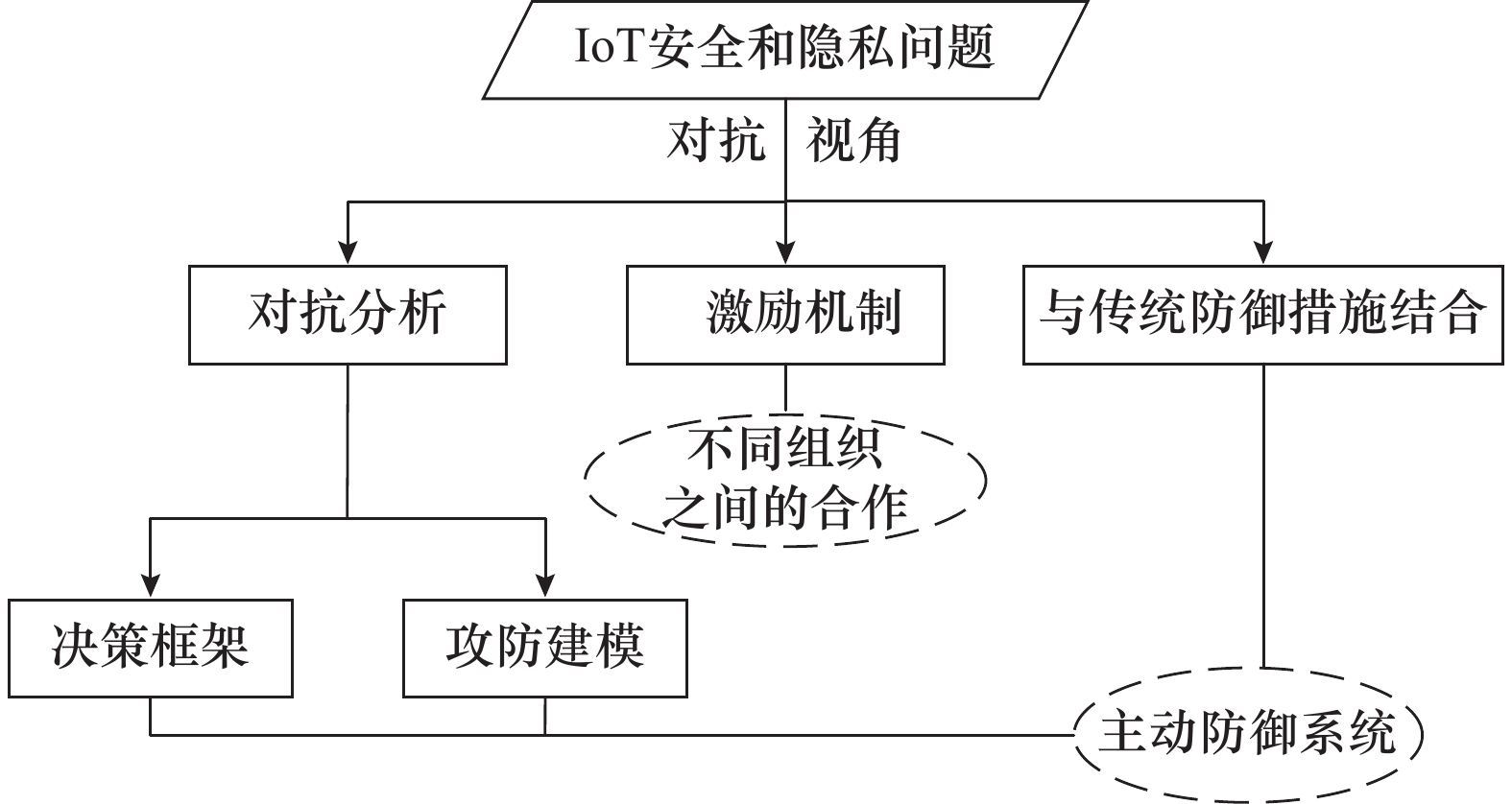
图3
博弈论在IoT安全和隐私问题中的应用"
| 45 | 赵芷若, 曹雷, 陈希亮, 等. 基于多智能体博弈强化学习的无人机智能攻击策略生成模型[J]. 系统工程与电子技术, 2023, 45 (10): 3165- 3171. |
| ZHAO Z R, CAO L, CHEN X L, et al. Intelligent attack strategy generation model for UAV based on multi-agent game reinforcement learning[J]. Systems Engineering and Electronics, 2023, 45 (10): 3165- 3171. | |
| 46 |
HE Y, ZHANG J M, SHUAI L, et al. A personalized secure publishing mechanism of the sensing location data in crowdsensing location-based services[J]. IEEE Sensors Journal, 2021, 21 (12): 13628- 13637.
doi: 10.1109/JSEN.2021.3070645 |
| 47 |
REN Y B, LI X H, MIAO Y B, et al. Towards privacy-preserving spatial distribution crowdsensing: a game theoretic approach[J]. IEEE Trans. on Information Forensics and Security, 2022, 17, 804- 818.
doi: 10.1109/TIFS.2022.3152409 |
| 48 | JIANG H B, LI J, ZHAO P, et al. Location privacy-preserving mechanisms in location-based services: a comprehensive survey[J]. ACM Computing Surveys, 2022, 54 (1): 1- 36. |
| 49 | ZHANG L F, ZHU T Q, XIONG P, et al. More than privacy: adopting differential privacy in game-theoretic mechanism design[J]. ACM Computing Surveys, 2022, 54 (7): 1- 37. |
| 50 |
GAO Y, CHEN L Q, HAN J G, et al. IoT privacy-preserving data mining with dynamic incentive mechanism[J]. IEEE Internet of Things Journal, 2024, 11 (1): 777- 790.
doi: 10.1109/JIOT.2023.3285894 |
| 51 |
XU Y, XIAO M J, TAN H S, et al. Incentive mechanism for differentially private federated learning in industrial Internet of Things[J]. IEEE Trans. on Industrial Informatics, 2022, 18 (10): 6927- 6939.
doi: 10.1109/TII.2021.3134257 |
| 52 |
ZHANG Y P, QU Y Y, GAO L X, et al. Privacy-preserving data analytics for smart decision-making energy systems in sustainable smart community[J]. Sustainable Energy Technologies and Assessments, 2023, 57, 103144.
doi: 10.1016/j.seta.2023.103144 |
| 53 |
NIE J T, LUO J, XIONG Z H, et al. A Stackelberg game approach toward socially-aware incentive mechanisms for mobile crowdsensing[J]. IEEE Trans. on Wireless Communications, 2019, 18 (1): 724- 738.
doi: 10.1109/TWC.2018.2885747 |
| 54 |
ZHAO C, YANG S S, MCCANN J A. On the data quality in privacy-preserving mobile crowdsensing systems with untruthful reporting[J]. IEEE Trans. on Mobile Computing, 2021, 20 (2): 647- 661.
doi: 10.1109/TMC.2019.2943468 |
| 55 |
GAO L J, YAN Z, YANG L T. Game theoretical analysis on acceptance of a cloud data access control system based on reputation[J]. IEEE Trans. on Cloud Computing, 2020, 8 (4): 1003- 1017.
doi: 10.1109/TCC.2016.2632110 |
| 56 |
RIAHI SFAR A, CHALLAL Y, MOYAL P, et al. A game theoretic approach for privacy preserving model in iot-based transportation[J]. IEEE Trans. on Intelligent Transportation Systems, 2019, 20 (12): 4405- 4414.
doi: 10.1109/TITS.2018.2885054 |
| 57 |
YI Z N, JIAO Y T, DAI W T, et al. A Stackelberg incentive mechanism for wireless federated learning with differential privacy[J]. IEEE Wireless Communications Letters, 2022, 11 (9): 1805- 1809.
doi: 10.1109/LWC.2022.3181509 |
| 58 |
ZHANG L F, ZHU T Q, XIONG P, et al. A robust game-theoretical federated learning framework with joint differential privacy[J]. IEEE Trans. on Knowledge and Data Engineering, 2023, 35 (4): 3333- 3346.
doi: 10.1109/TKDE.2021.3140131 |
| 59 |
PAN Q Q, WU J, BASHIR A K, et al. Joint protection of energy security and information privacy for energy harvesting: an incentive federated learning approach[J]. IEEE Trans. on Industrial Informatics, 2022, 18 (5): 3473- 3483.
doi: 10.1109/TII.2021.3105492 |
| 60 |
MOORE A D, MARTIN S. Privacy, transparency, and the prisoner’s dilemma[J]. Ethics and Information Technology, 2020, 22 (3): 211- 222.
doi: 10.1007/s10676-020-09530-6 |
| 61 |
RIAHI SFAR A, NATALIZIO E, MAZLOUT S, et al. Privacy preservation using game theory in e-health application[J]. Journal of Information Security and Applications, 2022, 66, 103158.
doi: 10.1016/j.jisa.2022.103158 |
| 62 | 杨少杰, 张辉, 彭英杰, 等. 基于博弈论的个性化LBS用户位置隐私保护方案[J]. 计算机应用与软件, 2023, 40(5): 312−349. |
| YANG S J, ZHANG H, PENG Y J, et al. Personalized user location privacy protection scheme based on game theory[J]. Computer Applications and Software, 2023, 40(5): 312−349. | |
| 63 |
XIONG J B, MA R, CHEN L, et al. A personalized privacy protection framework for mobile crowdsensing in IIoT[J]. IEEE Trans. on Industrial Informatics, 2020, 16 (6): 4231- 4241.
doi: 10.1109/TII.2019.2948068 |
| 64 |
LI K Y, TIAN L, LI W, et al. Incorporating social interaction into three-party game towards privacy protection in IoT[J]. Computer Networks, 2019, 150, 90- 101.
doi: 10.1016/j.comnet.2018.11.036 |
| 65 |
MENGIBAEV U, JIA X D, MA Y Q. The impact of interactive dependence on privacy protection behavior based on evolutionary game[J]. Applied Mathematics and Computation, 2020, 379, 125231.
doi: 10.1016/j.amc.2020.125231 |
| 66 | 韩普, 顾亮, 张嘉明. 隐私保护视角下医疗数据共享意愿研究——基于三方演化博弈分析[J]. 现代情报, 2021, 41 (3): 148- 158. |
| 1 |
SHA K, WEI W, YANG T A, et al. On security challenges and open issues in Internet of Things[J]. Future Generation Computer Systems, 2018, 83, 326- 337.
doi: 10.1016/j.future.2018.01.059 |
| 2 | 钱志鸿, 王义君. 面向物联网的无线传感器网络综述[J]. 电子与信息学报, 2013, 35(1), 215- 227. |
| QIAN Z H, WANG Y J. A survey of wireless sensor networks for Internet of Things[J]. Journal of Electronics and Information Technology, 2013, 35(1), 215- 227. | |
| 3 |
李玉强, 陈鋆昊, 李琦, 等. 基于差分隐私下包外估计的随机森林算法[J]. 哈尔滨工业大学学报, 2021, 53, 146- 154.
doi: 10.11918/201912140 |
|
LI Y Q, CHEN J H, LI Q, et al. Random forest algorithm based on out-of-bag estimation under differential privacy[J]. Journal of Harbin Institute of Technology, 2021, 53, 146- 154.
doi: 10.11918/201912140 |
|
| 4 |
SERROR M, HACK S, HENZE M, et al. Challenges and opportunities in securing the industrial Internet of Things[J]. IEEE Trans. on Industrial Informatics, 2021, 17 (5): 2985- 2996.
doi: 10.1109/TII.2020.3023507 |
| 5 |
TEWARI A, GUPTA B B. Security, privacy and trust of different layers in Internet-of-Things (IoTs) framework[J]. Future Generation Computer Systems, 2020, 108, 909- 920.
doi: 10.1016/j.future.2018.04.027 |
| 6 | NOUR B, SHARIF K, LI F, et al. Security and privacy challenges in information-centric wireless Internet of Things networks[J]. IEEE Security & Privacy, 2020, 18 (2): 35- 45. |
| 7 |
KHALID M N A, AL-KADHIMI A, SINGH M M. Recent developments in game-theory approaches for the detection and defense against advanced persistent threats (APTs): a systematic review[J]. Mathematics, 2023, 11 (6): 1353.
doi: 10.3390/math11061353 |
| 8 |
王瑞, 阳长江, 邓向东, 等. 欺骗防御技术发展及其大语言模型应用探索[J]. 计算机研究与发展, 2024, 61, 1230- 1249.
doi: 10.7544/issn1000-1239.202330961 |
|
WANG R, YANG C J, DENG X D, et al. Development of deception defense technologies and its application exploration in large language models[J]. Journal of Computer Research and Development, 2024, 61, 1230- 1249.
doi: 10.7544/issn1000-1239.202330961 |
|
| 9 | MANSHAEI M H, ZHU Q Y, ALPCAN T, et al. Game theory meets network security and privacy[J]. ACM Computing Surveys, 2013, 45 (3): 1- 39. |
| 66 | HAN P, GU L, ZHANG J M. Research on medical data sharing willingness from a privacy protection perspective: based on tripartite evolutionary game analysis[J]. Modern Information, 2021, 41 (3): 148- 158. |
| 67 |
赵东来, 王钢, 郑黎明, 等. 超密集网络中非合作博弈的功率分配算法[J]. 哈尔滨工业大学学报, 2020, 52(5), 30- 34.
doi: 10.11918/201910027 |
|
ZHAO D L, WANG G, ZHENG L M, et al. Non-cooperative game-based power allocation algorithm in ultra-dense networks[J]. Journal of Harbin Institute of Technology, 2020, 52(5), 30- 34.
doi: 10.11918/201910027 |
|
| 68 | 孙益辉, 易灵芝, 夏云芝, 等. 基于强化学习的物联网可信信息覆盖优化算法[J]. 华中科技大学学报(自然科学版), 2023, 51, 32- 38. |
| SUN Y H, YI L Z, XIA Y Z, et al. Reinforcement learning-based trusted information coverage optimization algorithm for Internet of Things[J]. Journal of Huazhong University of Science and Technology (Natural Science Edition), 2023, 51, 32- 38. | |
| 69 | 张光华, 庞少博, 杨耀红, 等. 机会网络中基于博弈论的可信路由模型[J]. 华中科技大学学报(自然科学版), 2018, 46, 11- 16. |
| ZHANG G H, PANG S B, YANG Y H, et al. Game theory-based trusted routing model in opportunistic networks[J]. Journal of Huazhong University of Science and Technology (Natural Science Edition), 2018, 46, 11- 16. | |
| 70 |
LEI Y J, YE D Y, SHEN S, et al. New challenges in reinforcement learning: a survey of security and privacy[J]. Artificial Intelligence Review, 2023, 56 (7): 7195- 7236.
doi: 10.1007/s10462-022-10348-5 |
| 71 | 罗俊仁, 张万鹏, 苏炯铭, 等. 多智能体博弈学习研究进展[J]. 系统工程与电子技术, 2024, 46 (5): 1628- 1655. |
| LUO J R, ZHANG W P, SU J M, et al. Research advances in multi-agent game learning[J]. Systems Engineering and Electronics, 2024, 46 (5): 1628- 1655. | |
| 10 | LIANG X N, XIAO Y. Game theory for network security[J]. IEEE Communications Surveys & Tutorials, 2013, 15 (1): 472- 486. |
| 11 | DO C T, TRAN N H, HONG C, et al. Game theory for cyber security and privacy[J]. ACM Computing Surveys, 2018, 50 (2): 1- 37. |
| 12 |
TUSHAR W, YUEN C, SAHA T K, et al. A survey of cyber-physical systems from a game-theoretic perspective[J]. IEEE Access, 2023, 11, 9799- 9834.
doi: 10.1109/ACCESS.2023.3239834 |
| 13 |
MESSABIH H, KERRACHE C A, CHERIGUENE Y, et al. An overview of game theory approaches for mobile Ad-Hoc network’s security[J]. IEEE Access, 2023, 11, 107581- 107604.
doi: 10.1109/ACCESS.2023.3321082 |
| 14 |
SHEN Y Z, SHEPHERD C, AHMED C M, et al. Game-theoretic analytics for privacy preservation in Internet of Things networks: a survey[J]. Engineering Applications of Artificial Intelligence, 2024, 133, 108449.
doi: 10.1016/j.engappai.2024.108449 |
| 15 | TANGE K, DE DONNO M, FAFOUTIS X, et al. A systematic survey of industrial Internet of Things security: requirements and fog computing opportunities[J]. IEEE Communications Surveys & Tutorials, 2020, 22 (4): 2489- 2520. |
| 16 |
OGIE R I. Adopting incentive mechanisms for large-scale participation in mobile crowdsensing: from literature review to a conceptual framework[J]. Human-centric Computing and Information Sciences, 2016, 6 (1): 24.
doi: 10.1186/s13673-016-0080-3 |
| 17 |
熊金波, 毕仁万, 田有亮, 等. 移动群智感知安全与隐私: 模型、进展与趋势[J]. 计算机学报, 2021, 44(9), 1949- 1966.
doi: 10.11897/SP.J.1016.2021.01949 |
|
XIONG J B, BI R W, TIAN Y L, et al. Security and privacy in mobile crowd sensing: models, advances, and trends[J]. Chinese Journal of Computers, 2021, 44(9), 1949- 1966.
doi: 10.11897/SP.J.1016.2021.01949 |
|
| 18 | 殷晨旭, 孙永辉, 谢东亮, 等. 博弈视角下电-气互联综合能源系统多目标协同优化[J]. 电力系统自动化, 2024, 48(11): 173−183. |
| YIN C X, SUN Y H, XIE D L, et al. Multi-objective collaborative optimization of electricity-gas interconnected integrated energy system from a game-theoretic perspective[J]. Automation of Electric Power Systems, 2024, 48(11):173−183. | |
| 19 |
LI J, KENDALL G, JOHN R. Computing Nash equilibria and evolutionarily stable states of evolutionary games[J]. IEEE Trans. on Evolutionary Computation, 2016, 20 (3): 460- 469.
doi: 10.1109/TEVC.2015.2490076 |
| 20 | ZHU M, ANWAR A H, WAN Z L, et al. A survey of defensive deception: approaches using game theory and machine learning[J]. IEEE Communications Surveys & Tutorials, 2021, 23 (4): 2460- 2493. |
| 21 | 王先甲, 全吉, 刘伟兵. 有限理性下的演化博弈与合作机制研究[J]. 系统工程理论与实践, 2011, 31, 82- 93. |
| WANG X J, QUAN J, LIU W B. Research on evolutionary games and cooperation mechanisms under bounded rationality[J]. Systems Engineering - Theory & Practice, 2011, 31, 82- 93. | |
| 22 | 盛磊, 时满红, 亓迎川, 等. 基于态势演化博弈的无人机集群动态攻防[J]. 系统工程与电子技术, 2023, 45 (8): 2332- 2342. |
| SHENG L, SHI M H, QI Y C, et al. Dynamic attack and defense of UAV swarm based on situational evolutionary game[J]. Systems Engineering and Electronics, 2023, 45 (8): 2332- 2342. | |
| 23 | 石乐义, 贾春福, 吕述望. 服务跳变抗DoS机制的博弈理论分析[J]. 电子与信息学报, 2009, 31 (1): 228- 232. |
| SHI L Y, JIA C F, LYU S W. Game-theoretic analysis of anti-DoS mechanism based on service hopping[J]. Journal of Electronics & Information Technology, 2009, 31 (1): 228- 232. | |
| 24 |
李民政, 苗春伟. D2D通信中基于帕累托占优的非合作博弈功率控制算法[J]. 系统工程与电子技术, 2019, 41 (6): 1408- 1413.
doi: 10.3969/j.issn.1001506X.2019.06.31 |
|
LI M Z, MIAO C W. Pareto dominance-based non-cooperative game power control algorithm in D2D communication[J]. Systems Engineering and Electronics, 2019, 41 (6): 1408- 1413.
doi: 10.3969/j.issn.1001506X.2019.06.31 |
|
| 25 |
J H, WANG X, SHEN S G. A Bayesian Q-learning game for dependable task offloading against DDoS attacks in sensor edge cloud[J]. IEEE Internet of Things Journal, 2021, 8 (9): 7546- 7561.
doi: 10.1109/JIOT.2020.3038554 |
| 26 |
HE Q, WANG C, CUI G M, et al. A game-theoretical approach for mitigating edge DDoS attack[J]. IEEE Trans. on Dependable and Secure Computing, 2022, 19 (4): 2333- 2348.
doi: 10.1109/TDSC.2021.3055559 |
| 27 |
LIU H. SINR-based multi-channel power schedule under DoS attacks: a Stackelberg game approach with incomplete information[J]. Automatica, 2019, 100, 274- 280.
doi: 10.1016/j.automatica.2018.11.034 |
| 28 |
LIAN J, JIA P L, WU F Y, et al. A Stackelberg game approach to the stability of networked switched systems under DoS attacks[J]. IEEE Trans. on Network Science and Engineering, 2023, 10 (4): 2086- 2097.
doi: 10.1109/TNSE.2023.3240687 |
| 29 |
QIAN C, DING L. Fully distributed attack-resilient Nash equilibrium seeking for networked games subject to DoS attacks[J]. Information Sciences, 2023, 641, 119080.
doi: 10.1016/j.ins.2023.119080 |
| 30 |
YU Y, LIU G P, HUANG Y, et al. Optimal resilient tracking control for networked systems with multichannels under attacks[J]. IEEE Trans. on Industrial Electronics, 2024, 71 (3): 3001- 3011.
doi: 10.1109/TIE.2023.3269465 |
| 31 | 金丹, 吴麒, 陈博, 等. DoS攻击下信息物理系统的无模型H_∞控制[J]. 控制与决策, 2022, 37 (10): 2565- 2574. |
| JIN D, WU Q, CHEN B, et al. Model-free H_∞ control for cyber-physical systems under DoS attacks[J]. Control and Decision, 2022, 37 (10): 2565- 2574. | |
| 32 |
LIAN J, HUANG X. Resilient control of networked switched systems against DoS attack[J]. IEEE Trans. on Industrial Informatics, 2022, 18 (4): 2354- 2363.
doi: 10.1109/TII.2021.3097722 |
| 33 | ZHANG J H, SUN J T. A game theoretic approach to multi-channel transmission scheduling for multiple linear systems under DoS attacks[J]. Systems & Control Letters, 2019, 133, 104546. |
| 34 | 徐鑫, 王慧敏. DoS攻击下多线性系统多信道传输调度问题[J]. 控制与决策, 2023, 38 (9): 2606- 2613. |
| XU X, WANG H M. Multi-channel transmission scheduling for multi-linear systems under DoS attacks[J]. Control and Decision, 2023, 38 (9): 2606- 2613. | |
| 35 | ZHANG J H, SUN J T, ZHANG C C. Stochastic game in linear quadratic Gaussian control for wireless networked control systems under DoS attacks[J]. IEEE Trans. on Systems, Man, and Cybernetics: Systems, 2022, 52 (2): 902- 910. |
| 36 |
HUANG Y B, ZHAO J. Cyber-physical systems with multiple denial-of-service attackers: a game-theoretic framework[J]. IEEE Trans. on Circuits and Systems I: Regular Papers, 2021, 68 (10): 4349- 4359.
doi: 10.1109/TCSI.2021.3098335 |
| 37 |
ZHOU Y Y, CHENG G, YU S. An SDN-enabled proactive defense framework for DDoS mitigation in IoT Networks[J]. IEEE Trans. on Information Forensics and Security, 2021, 16, 5366- 5380.
doi: 10.1109/TIFS.2021.3127009 |
| 38 | TIAN W, JI X P, LIU W W, et al. Defense strategies against network attacks in cyber-physical systems with analysis cost constraint based on honeypot game model[J]. Computers, Materials & Continua, 2019, 60(1): 193−211. |
| 39 |
TIAN W, JI X P, LIU W W, et al. Prospect theoretic study of honeypot defense against advanced persistent threats in power grid[J]. IEEE Access, 2020, 8, 64075- 64085.
doi: 10.1109/ACCESS.2020.2984795 |
| 40 |
DIAMANTOULAKIS P, DALAMAGKAS C, RADOGLOU-GRAMMATIKIS P, et al. Game theoretic honeypot deployment in smart grid[J]. Sensors, 2020, 20 (15): 4199.
doi: 10.3390/s20154199 |
| 41 |
TIAN W, DU M, JI X P, et al. Honeypot detection strategy against advanced persistent threats in industrial internet of things: a prospect theoretic game[J]. IEEE Internet of Things Journal, 2021, 8 (24): 17372- 17381.
doi: 10.1109/JIOT.2021.3080527 |
| 42 | GILL K S, SAXENA S, SHARMA A. GTM-CSec: game theoretic model for cloud security based on IDS and honeypot[J]. Computers & Security, 2020, 92, 101732. |
| 43 |
宋丽华, 张津威, 张少勇. 基于博弈论对手建模的物联网SSH自适应蜜罐策略[J]. 信息网络安全, 2023, 23, 38- 47.
doi: 10.3969/j.issn.1671-1122.2023.12.005 |
|
SONG L H, ZHANG J W, ZHANG S Y. Adaptive SSH honeypot strategy for IoT based on game-theoretic opponent modeling[J]. Netinfo Security, 2023, 23, 38- 47.
doi: 10.3969/j.issn.1671-1122.2023.12.005 |
|
| 44 |
宋丽华, 姜洋洋, 邢长友, 等. 带有欺骗证据的蜜罐博弈攻防策略优化机制[J]. 通信学报, 2022, 43, 104- 116.
doi: 10.11959/j.issn.1000-436x.2022008 |
|
SONG L H, JIANG Y Y, XING C Y, et al. Optimization mechanism of honeypot game attack-defense strategy with deception evidence[J]. Journal on Communications, 2022, 43, 104- 116.
doi: 10.11959/j.issn.1000-436x.2022008 |
| [1] | 杨鹏程, 杨清清, 高盈盈, 杨志伟, 杨克巍, 艾波. 基于强化学习的海上移动目标搜索路径规划[J]. 系统工程与电子技术, 2026, 48(2): 515-523. |
| [2] | 王旭, 蔡光斌, 余晓亚, 叶子绮, 单斌. 基于双动态PPO算法的高超声速飞行器姿态控制[J]. 系统工程与电子技术, 2026, 48(2): 694-704. |
| [3] | 林志康, 刘甲磊, 马佳智, 施龙飞, 徐进宝. 利用分布式辐射源闪烁诱偏的抗反辐射方法[J]. 系统工程与电子技术, 2026, 48(1): 1-11. |
| [4] | 薛锦妍, 张雅声, 陶雪峰, 杨茗棋, 赵帅龙. GEO航天器轨道机动控制研究进展[J]. 系统工程与电子技术, 2026, 48(1): 290-300. |
| [5] | 宋传龙, 张倩武, 何健, 周文骏, 王辉, 孔巍巍, 田文波. 基于MADDPG算法的星地协同边缘计算任务卸载方法[J]. 系统工程与电子技术, 2026, 48(1): 350-360. |
| [6] | 姚鹏, 韩美玉, 王德川, 高志诚. 基于对抗进化强化学习的多无人艇追捕方法[J]. 系统工程与电子技术, 2025, 47(9): 2960-2970. |
| [7] | 魏潇龙, 吴亚荣, 姚登凯, 赵顾颢. 基于深度强化学习的无人机空战机动分层决策算法[J]. 系统工程与电子技术, 2025, 47(9): 2993-3003. |
| [8] | 杨大鹏, 龚资浩, 王小也, 郭正玉, 罗德林. 基于多智能体强化学习的无人机协同截击机动决策研究[J]. 系统工程与电子技术, 2025, 47(9): 3076-3085. |
| [9] | 符小卫, 王辛夷, 乔哲. 基于APIQ算法的多无人机攻防对抗策略[J]. 系统工程与电子技术, 2025, 47(7): 2205-2215. |
| [10] | 柳佳豪, 徐任杰, 孙茂桐, 姜九瑶, 李际超, 杨克巍. 基于强化学习的装备体系韧性优化方法[J]. 系统工程与电子技术, 2025, 47(7): 2216-2223. |
| [11] | 朱运豆, 孙海权, 胡笑旋. 基于指针网络架构的多星协同成像任务规划方法[J]. 系统工程与电子技术, 2025, 47(7): 2246-2255. |
| [12] | 符小卫, 王辛夷, 乔哲. 基于ASDDPG算法的多无人机对抗策略[J]. 系统工程与电子技术, 2025, 47(6): 1867-1879. |
| [13] | 孟麟芝, 孙小涓, 胡玉新, 高斌, 孙国庆, 牟文浩. 面向卫星在轨处理的强化学习任务调度算法[J]. 系统工程与电子技术, 2025, 47(6): 1917-1929. |
| [14] | 郑康洁, 张新宇, 王伟菘, 刘震生. DQN与规则结合的智能船舶动态自主避障决策[J]. 系统工程与电子技术, 2025, 47(6): 1994-2001. |
| [15] | 刘书含, 李彤, 李富强, 杨春刚. 意图态势双驱动的数据链抗干扰通信机制[J]. 系统工程与电子技术, 2025, 47(6): 2055-2064. |
| 阅读次数 | ||||||
|
全文 |
|
|||||
|
摘要 |
|
|||||
