

系统工程与电子技术 ›› 2026, Vol. 48 ›› Issue (1): 290-300.doi: 10.12305/j.issn.1001-506X.2026.01.26
薛锦妍1, 张雅声2,*, 陶雪峰2, 杨茗棋1, 赵帅龙1
收稿日期:2024-08-05
出版日期:2026-01-25
发布日期:2026-02-11
通讯作者:
张雅声
作者简介:薛锦妍(1998—),女,博士研究生,主要研究方向为轨道动力学Jinyan XUE1, Yasheng ZHANG2,*, Xuefeng TAO2, Mingqi YANG1, Shuailong ZHAO1
Received:2024-08-05
Online:2026-01-25
Published:2026-02-11
Contact:
Yasheng ZHANG
摘要:
随着卫星机动能力的不断提升,地球静止轨道(geostationary Earth orbit,GEO)航天器执行空间任务时的安全问题不容忽视。首先,针对目前编队航天器轨道机动中常用的脉冲推力模型和连续推力模型进行综述,并按照机动过程中的航天器数量区分“一对一航天器轨道机动”和“多航天器轨道机动”;其次,分析了微分对策理论、人工智能算法和生物群体智能算法在解决编队航天器轨道机动问题中的异同优劣;最后,从动力学模型、航天器数量类型和求解方法的视角就编队航天器轨道机动问题的特点进行对比分析。未来的研究重点在于提高算法效率及鲁棒性、增强模型适应性,以实现更加精确和高效的太空管理,保障GEO航天器在轨运行的稳定性和安全性。
中图分类号:
薛锦妍, 张雅声, 陶雪峰, 杨茗棋, 赵帅龙. GEO航天器轨道机动控制研究进展[J]. 系统工程与电子技术, 2026, 48(1): 290-300.
Jinyan XUE, Yasheng ZHANG, Xuefeng TAO, Mingqi YANG, Shuailong ZHAO. Advances in orbital maneuver control for GEO spacecraft[J]. Systems Engineering and Electronics, 2026, 48(1): 290-300.
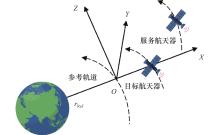
图1
虚拟动点LVLH坐标系"
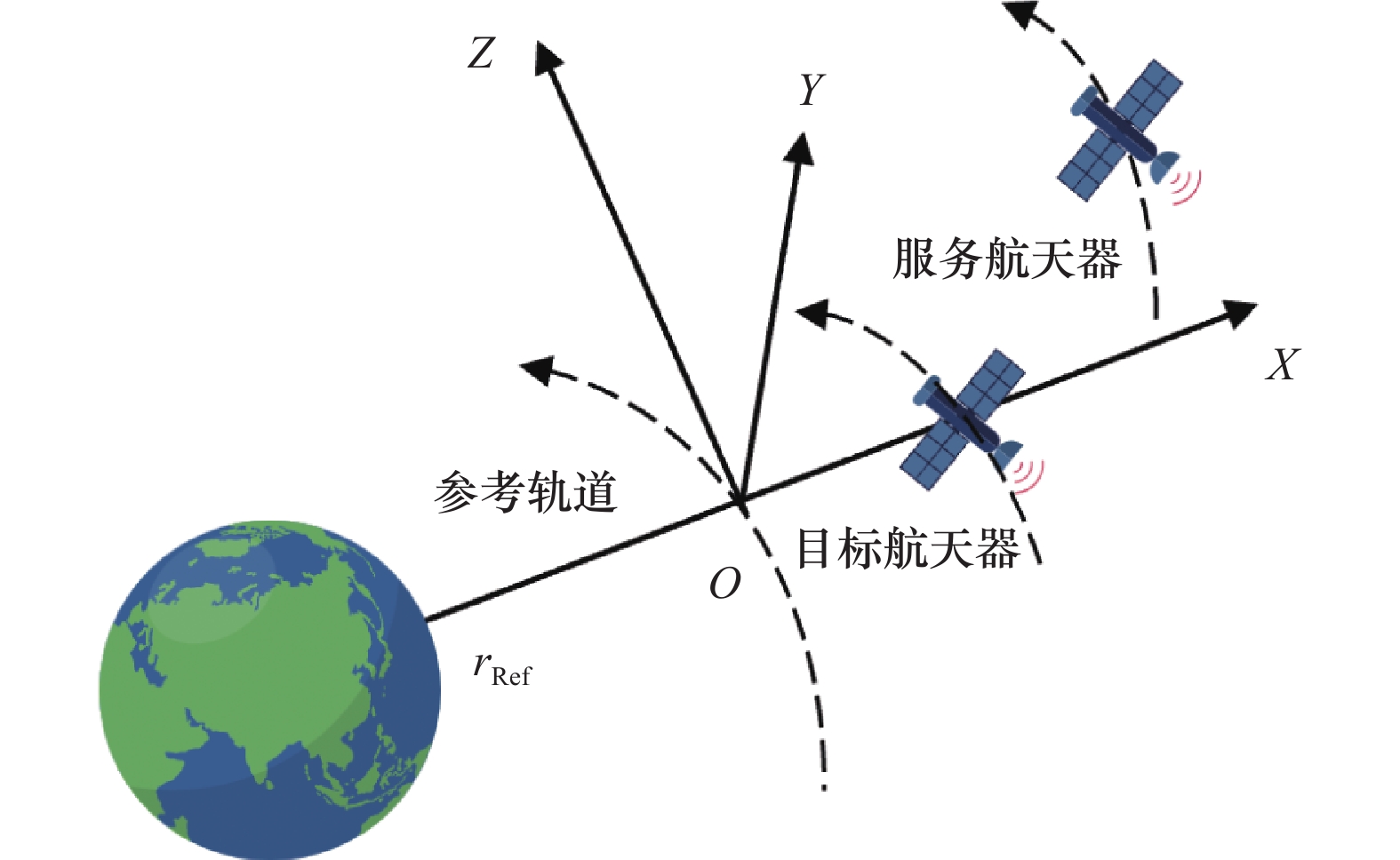
表1
动力学模型对比"
| 模型 | 适用场景 | 优点 | 缺点 |
| 脉冲 推力 | 操控性较强的 场景 | 燃料利用率高, 适合快速变轨 | 描述和求 解过程更 加复杂 |
| 连续 推力 | 信息不对称 及操控性稍 弱的场景 | 可以在较长时 间内对轨道和 速度进行精细 调整 | 不适用于 需要快速 响应的任务 |
表2
数量类型对比"
| 控制类型 | 适用场景 | 优点 | 缺点 |
| 一对一 | 简单的空间任务场景 | 模型简单,易于分析,可以得到最优解 | 对模型误差的适应性较差,难以实时决策 |
| 多航天器 | 高动态、大范围的机动控制场景 | 机动性强,具有快速响应能力,灵活度高,系统弹性强 | 模型复杂,计算量大,对算法设计和优化要求高 |
表3
不同求解方法对比"
| 方法 | 说明 | 优势 | 缺点 |
| 微分对策法 | 通过对机动控制问题数学建模,用微分方程表达对策规律,最后通过解析法或数值法对方程进行求解,得到双方最优控制率 | (1)具有数学理论支撑,有一定可解释性 (2)在适用的场景下能够精确地求解出最优策略 | (1)对成本函数的设计有一定的约束,过于复杂的成本函数无法利用传统的方法进行求解 (2)需要系统的模型才能使用 |
| 人工智能 方法 | 以MADDPG、深度Q学习算法(deep Q-learning,DQN)、自适应动态规划(adaptive/approximate dynamic programming,ADP)为代表,对机动控制双方控制策略进行实时求解 | (1)网络可学习智能体策略行为,不受模型影响 (2)能够利用复杂的成本函数对任务需求进行更为贴切的描述 (3)应用场景更广泛 | (1)需要一定的数据样本 (2)训练耗时较长 (3)相较微分对策法而言,可解释性较差 |
| 生物群体智能算法 | 以蚁群、蜂群、狼群为代表,分析双方遵循的规则,侧重于建模个体行为以及局部存在的规则 | (1)具有良好的并行和全局搜索能力 (2)对于问题的初始条件和参数设置不敏感,鲁棒性较好 | (1)参数选择困难 (2)收敛速度慢 (3)可能陷入局部最优解 |
| 1 |
朱彦伟, 张乘铭, 杨傅云翔, 等. 航天器轨道追逃动力学与控制问题研究综述[J]. 国防科技大学学报, 2024, 46 (3): 1- 11.
doi: 10.11887/j.cn.202403001 |
|
ZHU Y W, ZHANG C M, YANG F Y X, et al. Survey on dynamics and control problem research in spacecraft orbital pursuit-evasion game[J]. Journal of National University of Defense Technology, 2024, 46 (3): 1- 11.
doi: 10.11887/j.cn.202403001 |
|
| 2 | 李兆航, 温昶煊, 乔栋, 等. 基于可达集的航天器多对一轨道博弈几何求解[J]. 航空学报, 2024, 45 (S1): 730803. |
| LI Z H, WEN C X, QIAO D, et al. Research on multiple-pursuer/one-evader orbital pursuit-evasion game based on reachable set theory[J]. Acta Aeronautica et Astronautica Sinica, 2024, 45 (S1): 730803. | |
| 3 | STUPIK J, PONTANI M, CONWAY B. Optimal pursuit/evasion spacecraft trajectoriesin the hill reference frame [C]// Proc. of the AIAA/AAS Astrodynamics Specialist Conference, 2012: 4882. |
| 4 |
LIAO T, LI S L, CHEN X L, et al. Numerical solution of spacecraft pursuit-Evasion-Capture game based on progressive shooting method[J]. Proceedings of the Institution of Mechanical Engineers, Part G: Journal of Aerospace Engineering, 2023, 237 (12): 2874- 2886.
doi: 10.1177/09544100231164269 |
| 5 |
张秋华, 孙松涛, 谌颖, 等. 时间固定的两航天器追逃策略及数值求解[J]. 宇航学报, 2014, 35 (5): 537- 544.
doi: 10.3873/j.issn.1000-1328.2014.05.007 |
|
ZHANG Q H, SUN S T, CHEN Y, et al. Strategy and numerical solution of pursuit-evasion with fixed duration for two spacecraft[J]. Journal of Astronautics, 2014, 35 (5): 537- 544.
doi: 10.3873/j.issn.1000-1328.2014.05.007 |
|
| 6 | JAGAT A, SINCLAIR A J. Optimization of spacecraft pursuit-evasion game trajectories in the Euler-Hill reference frame [C]// Proc. of the AIAA/AAS Astrodynamics Specialist Conference, 2014: 4131. |
| 7 |
JAGAT A, SINCLAIR A J. Nonlinear control for spacecraft pursuit-evasion game using the state-dependent Riccati equation method[J]. IEEE Trans. on Aerospace and Electronic Systems, 2017, 53 (6): 3032- 3042.
doi: 10.1109/TAES.2017.2725498 |
| 8 | LI Z Y, ZHU H, YANG Z, et al. A dimension-reduction solution of free-time differential games for spacecraft pursuit-evasion[J]. Acta Astronautica, 2019, 163 (1): 201- 210. |
| 9 | KELLEY H J, CLIFF E M, LUTZE F H. Pursuit evasion in orbit[J]. Journal of the Astronautical Sciences, 1981, 29 (3): 277- 288. |
| 10 | BURK R C, WIDHALML J W. Minimum impulse orbital evasive maneuvers[J]. Journal of Guidance, Control, and Dynamics, 1989, 12 (1): 121- 123. |
| 11 | YU D T, WANG H, GUO S, et al. Analytical approach for orbital evasion with space geometry considered [J]. International Journal of Aerospace Engineering, 2017(1): 4164260. |
| 12 | VENIGALLA C, SCHEERES D J. Space rendezvous and pursuit/evasion analysis using reachable sets [C]// Proc. of the Space Flight Mechanics Meeting, 2018. |
| 13 |
ZHAO L R, ZHANG Y L, DANG Z H. PRD-MADDPG: an efficient learning-based algorithm for orbital pursuit-evasion game with impulsive maneuvers[J]. Advances in Space Research, 2023, 72 (2): 211- 230.
doi: 10.1016/j.asr.2023.03.014 |
| 14 |
WANG H B, ZHANG Y, LIU H, et al. Impulsive thrust strategy for orbital pursuit-evasion games based on impulse-like constraint[J]. Chinese Journal of Aeronautics, 2025, 38 (1): 103180.
doi: 10.1016/j.cja.2024.08.011 |
| 15 |
HAN H Y, DANG Z H. Optimal delta-V-based strategies in orbital pursuit-evasion games[J]. Advances in Space Research, 2023, 72 (2): 243- 256.
doi: 10.1016/j.asr.2023.03.028 |
| 16 |
王强, 叶东, 范宁军, 等. 含有J2项摄动的卫星追逃轨道优化[J]. 北京理工大学学报, 2017, 37 (4): 418- 423.
doi: 10.15918/j.tbit1001-0645.2017.04.017 |
|
WANG Q, YE D, FAN N J, et al. Pursuit evasion game with J2 perturbation[J]. Transactions of Beijing Institute of Technology, 2017, 37 (4): 418- 423.
doi: 10.15918/j.tbit1001-0645.2017.04.017 |
|
| 17 | PRINCE E R, HESS J A, COBB R G, et al. Elliptical orbit proximity operations differential games[J]. Journal of Guidance, Control, and Dynamics, 2019, 42 (7): 1458- 1472. |
| 18 | STUPIK J. Optimal pursuit/evasion spacecraft trajectories in the hill reference frame [D]. Champaign-Urbana: University of Illinois at Urbana-Champaign, 2013. |
| 19 | PONTANI M, CONWAY B. Particle swarm optimization applied to space trajectories[J]. Journal of Guidance, Control, and Dynamics, 2010, 33 (5): 1429- 1441. |
| 20 | HAFER W T, REED H L, TURNER J D, et al. Sensitivity methods applied to orbital pursuit evasion[J]. Journal of Guidance, Control, and Dynamics, 2015, 38 (6): 1118- 1126. |
| 21 |
XU Y M, QI N M, LI Z, et al. Research on proximity strategies for pursuit-evasion game with non-cooperative targets in space[J]. Aerospace Science and Technology, 2025, 158, 109899.
doi: 10.1016/j.ast.2024.109899 |
| 22 |
SUN S T, ZHANG Q H, LOXTON R, et al. Numerical solution of a pursuit-evasion differential game involving two spacecraft in low earth orbit[J]. Journal of Industrial and Management Optimization, 2015, 11 (4): 1127- 1147.
doi: 10.3934/jimo.2015.11.1127 |
| 23 | LI Z Y, ZHU H, YANG Z, et al. Saddle point of orbital pursuit-evasion game under J2-perturbed dynamics[J]. Journal of Guidance, Control, and Dynamics, 2020, 43 (9): 1733- 1739. |
| 24 |
张秋华, 赵小津, 孙毅. 空间飞行器在视线坐标系中的追逃界栅[J]. 航天控制, 2007, 25 (1): 26- 30.
doi: 10.3969/j.issn.1006-3242.2007.01.007 |
|
ZHANG Q H, ZHAO X Z, SUN Y. Pursuit-evasion barrier of two spacecrafts based on the sightline coordinate system[J]. Aerospace Control, 2007, 25 (1): 26- 30.
doi: 10.3969/j.issn.1006-3242.2007.01.007 |
|
| 25 |
SHI M M, YE D, SUN Z W, et al. Spacecraft orbital pursuit-evasion games with J2 perturbations and direction-constrained thrust[J]. Acta Astronautica, 2023, 202, 139- 150.
doi: 10.1016/j.actaastro.2022.10.004 |
| 26 |
YE D, SHI M M, SUN Z W. Satellite proximate pursuit-evasion game with different thrust configurations[J]. Aerospace Science and Technology, 2020, 99, 105715.
doi: 10.1016/j.ast.2020.105715 |
| 27 | HAN H Y, DANG Z H. Models and strategies for J2-perturbed orbital pursuit-evasion games[J]. Space: Science & Technology, 2024, 4 (1): 39- 51. |
| 28 | LIU Y C, LI C Y, JIANG J, et al. A model predictive Stackelberg solution to orbital pursuit-evasion game[J]. Chinese Journal of Aeronautics, 2025, 38 (2): 103198. |
| 29 |
WU J F, WEI C L, ZHANG H B, et al. Learning-based spacecraft reactive anti-hostile-rendezvous maneuver control in complex space environments[J]. Advances in Space Research, 2023, 72 (10): 4531- 4552.
doi: 10.1016/j.asr.2023.08.043 |
| 30 |
QU Q Y, LIU K X, WANG W, et al. Spacecraft proximity maneuvering and rendezvous with collision avoidance based on reinforcement learning[J]. IEEE Trans. on Aerospace and Electronic Systems, 2022, 58 (6): 5823.
doi: 10.1109/TAES.2022.3180271 |
| 31 |
LI Z Y, LUO Y Z. Deep reinforcement learning for Nash equilibrium of differential games[J]. IEEE Trans. on Neural Networks and Learning Systems, 2025, 36 (2): 2747- 2761.
doi: 10.1109/TNNLS.2024.3351631 |
| 32 |
WAN K F, WU D W, ZHAI Y W, et al. An improved approach towards multi-agent pursuit evasion game decision-making using deep reinforcement learning[J]. Entropy, 2021, 23 (11): 1433.
doi: 10.3390/e23111433 |
| 33 |
NI W L, LIU J Q, LI Z, et al. Cooperative guidance strategy for active spacecraft protection from a homing interceptor via deep reinforcement learning[J]. Mathematics, 2023, 11 (19): 4211.
doi: 10.3390/math11194211 |
| 34 |
GONG X P, CHEN W C, CHEN Z Y. Intelligent game strategies in target-missile-defender engagement using curriculum-based deep reinforcement learning[J]. Aerospace, 2023, 10 (2): 133.
doi: 10.3390/aerospace10020133 |
| 35 | 陈木生. 基于微分对策及协同进化算法的三航天器追逃策略求解[D]. 哈尔滨: 哈尔滨工业大学, 2021. |
| CHEN M S. Solving the pursuit-evasion strategies of three spacecrafts based on differential game and coevolution algorithm[D]. Harbin: Harbin Institute of Technology, 2021. | |
| 36 |
LI Z Y. Orbital pursuit-evasion-defense linear-quadratic differential game[J]. Aerospace, 2024, 11 (6): 443.
doi: 10.3390/aerospace11060443 |
| 37 |
刘坤, 郑晓帅, 林业茗, 等. 基于微分博弈的追逃问题最优策略设计[J]. 自动化学报, 2021, 47 (8): 1840- 1854.
doi: 10.16383/j.aas.c200979 |
|
LIU K, ZHENG X S, LIN Y M, et al. Design of optimal strategies for the pursuit-evasion problem based on differential game[J]. Acta Automatica Sinica, 2021, 47 (8): 1840- 1854.
doi: 10.16383/j.aas.c200979 |
|
| 38 | TANG X, YE D, LOW K S, et al. Multi-spacecraft pursuit-evasion-defense strategy based on game theory for on-orbit spacecraft servicing[C]//Proc. of the IEEE Aerospace Conference, 2023. |
| 39 |
LI Y F, LIANG X, DANG Z H. Nash-equilibrium strategies of orbital target-attacker-defender game with a non-maneuvering target[J]. Chinese Journal of Aeronautics, 2024, 37 (10): 365- 379.
doi: 10.1016/j.cja.2024.06.002 |
| 40 | WU B L, CHEN K Y, WANG D W, et al. Spacecraft attitude takeover control by multiple microsatellites using differential game[J]. IEEE Trans. on Control of Network Systems, 2023, 11 (1): 1- 12. |
| 41 |
CHAI Y, LUO J J, MA W H. Data-driven game-based control of microsatellites for attitude takeover of target spacecraft with disturbance.[J]. ISA Transactions, 2022, 119, 93- 105.
doi: 10.1016/j.isatra.2021.02.037 |
| 42 | LACHNER R, BREITNER M H, PESCH H J. Three-dimensional air combat: numerical solution of complex differential games [M]. Birkhäuser Boston: Springer, 1995. |
| 43 |
RAIVIO T, EHTAMO H. Visual aircraft identification as a pursuit-evasion game[J]. Journal of Guidance, Control, and Dynamics, 2000, 23 (4): 701- 708.
doi: 10.2514/2.4586 |
| 44 |
EHTAMO H, RAIVIO T. On applied nonlinear and bi-level programming for pursuit-evasion games[J]. Journal of Optimization Theory and Applications, 2001, 108, 65- 96.
doi: 10.1023/A:1026461805159 |
| 45 | SHEN H X, CASALINO L. Revisit of the three-dimensional orbital pursuit-evasion game[J]. Journal of Guidance, Control, and Dynamics, 2018, 41 (8): 1823- 1831. |
| 46 |
ANDERSON G M, GRAZIER V W. Barrier in pursuit-evasion problems between two low-thrust orbital spacecraft[J]. AIAA Journal, 1976, 14 (2): 158- 163.
doi: 10.2514/3.61350 |
| 47 | MENON P K A, CALISE A J. Guidance laws for spacecraft pursuit-evasion and rendezvous [C]// Proc. of the AIAA Guidance, Navigation, and Control Conference, 1988: 668−697. |
| 48 | HAFER W T. Sensitivity methods applied to orbital pursuit-evasion [D]. Texas: Texas A&M University, 2017. |
| 49 |
LI Z Y, ZHU H, YANG Z, et al. A dimension-reduction solution of free-time differential games for spacecraft pursuit-evasion[J]. Acta Astronautica, 2019, 163, 201- 210.
doi: 10.1016/j.actaastro.2019.01.011 |
| 50 |
WANG Q S, LI P, LEI T, et al. A dimension-reduction method for the finite-horizon spacecraft pursuit-evasion game.[J]. Journal of Industrial and Management Optimization, 2023, 19 (3): 1983- 1998.
doi: 10.3934/jimo.2022028 |
| 51 |
FU S Y, GONG S P, SHI P. Analytical pursuit-evasion game strategy in arbitrary Keplerian reference orbits[J]. Aerospace Science and Technology, 2025, 158, 109946.
doi: 10.1016/j.ast.2025.109946 |
| 52 | CRUCK E, QUINCAMPOIX M, SAINT-PIERRE P. Pursuit-evasion games with impulsive dynamics[J]. Advances in Dynamic Game Theory, 2007, 9, 223- 247. |
| 53 | GARCIA E, MURANO D A. State estimation for a class of nonlinear differential games using differential neural networks [C]// Proc. of the American Control Conference, 2011: 2486−2491. |
| 54 |
TAHK M J, SUN B C. Co-evolutionary augmented Lagrangian methods for constrained optimization[J]. IEEE Trans. on Evolutionary Computation, 2000, 4 (2): 114- 124.
doi: 10.1109/4235.850652 |
| 55 | 吴其昌, 张洪波. 基于生存型微分对策的航天器追逃策略及数值求解[J]. 控制与信息技术, 2019, (4): 39- 43. |
| WU Q C, ZHANG H B. Spacecraft pursuit strategy and numerical solution based on survival differential strategy[J]. Control and Information Technology, 2019, (4): 39- 43. | |
| 56 |
WANG C G, CHEN D H, LIAO W H. Interactive multiple-model learning filter for spacecraft pursuit-evasion game strategy switch based on long short-term memory network[J]. Aerospace, 2024, 11 (11): 894.
doi: 10.3390/aerospace11110894 |
| 57 | FANG H, XIAO H W, LV Y Y, et al. L2-gain stabilized attitude control for combined spacecraft[C]// Proc. of the 37th Chinese Control and Decision Conference, 2020. |
| 58 |
ZHENG Z X, ZHANG P, YUAN J P. Nonzero-sum pursuit-evasion game control for spacecraft systems: a Q-learning method[J]. IEEE Trans. on Aerospace and Electronic Systems, 2023, 59 (4): 3971- 3981.
doi: 10.1109/TAES.2023.3235873 |
| 59 | ZHANG C M, ZHU Y W, YANG L P, et al. An optimal guidance method for free-time orbital pursuit-evasion game[J]. Journal of Systems Engineering and Electronics, 2022, 33 (6): 1294- 1308. |
| 60 | LINVILLE D, BETTINGER R A. An argument against satellite resiliency: simplicity in the face of modern satellite design[J]. Air & Space Power Journal, 2020, 34 (1): 43- 53. |
| 61 |
YANG F Y X, YANG L P, ZHU Y W. An AutoML based trajectory optimization method for long-distance spacecraft pursuit-evasion game[J]. Journal of Systems Engineering and Electronics, 2023, 34 (3): 754- 765.
doi: 10.23919/JSEE.2023.000060 |
| 62 |
SUN Q B, DANG Z H. Deep neural network for non-cooperative space target intention recognition[J]. Aerospace Science and Technology, 2023, 142, 108681.
doi: 10.1016/j.ast.2023.108681 |
| 63 | CAVALIERI K A, MACOMBER B, MOODY C, et al. Laboratory experiments autonomous space debris mitigation [C]// Proc. of the Annual AAS Rocky Mountain Guidance and Control Conference, 2013: 3−16. |
| 64 | WOODBURY T, ARTHURS F, VALASEK J. Flight test results of observer/Kalman filter identification of the pegasus unmanned vehicle [C]// Proc. of the AIAA Atmospheric Flight Mechanics Conference, 2015. |
| 65 |
袁斐然, 刘春生, 陈必露. 基于自适应动态规划的多对一追逃博弈策略[J]. 电光与控制, 2022, 29 (1): 1- 6.
doi: 10.3969/j.issn.1671-637X.2022.01.001 |
|
YUAN F R, LIU C S, CHEN B L. Many-to-one pursuit-evasion game strategy based on adaptive dynamic programming[J]. Electronics Optics & Control, 2022, 29 (1): 1- 6.
doi: 10.3969/j.issn.1671-637X.2022.01.001 |
|
| 66 |
许旭升, 党朝辉, 宋斌, 等. 基于多智能体强化学习的轨道追逃博弈方法[J]. 上海航天, 2022, 39 (2): 24- 31.
doi: 10.19328/j.cnki.2096?8655.2022.02.004 |
|
XU X S, DANG Z H, SONG B, et al. Method for cluster satellite orbit pursuit-evasion game based on multi-agent deep deterministic policy gradient algorithm[J]. Aerospace Shanghai (Chinese & English), 2022, 39 (2): 24- 31.
doi: 10.19328/j.cnki.2096?8655.2022.02.004 |
|
| 67 |
ZHANG J R, ZHANG K P, ZHANG Y, et al. Near-optimal interception strategy for orbital pursuit-evasion using deep reinforcement learning[J]. Acta Astronautica, 2022, 198, 9- 25.
doi: 10.1016/j.actaastro.2022.05.057 |
| 68 |
LIU Y F, QI N M, TANG Z W. Effects of divert-thrusters on homing performance of endoatmospheric interceptors[J]. Journal of Optimization Theory and Applications, 2013, 156 (2): 345- 364.
doi: 10.1007/s10957-012-0119-1 |
| 69 | REYNOLDS C W. Flocks, herds and schools: a distributed behavioral model[C]. ACM SIGGRAPH Computer Graphics, 1987, 21(4): 25−34. |
| 70 |
华冰, 刘睿鹏, 孙胜刚, 等. 一种基于自适应种群变异鸽群优化的航天器集群轨道规划方法[J]. 中国科学(技术科学), 2020, 50 (4): 453- 460.
doi: 10.1360/SST-2019-0285 |
|
HUA B, LIU R P, SUN S G, et al. Spacecraft cluster orbit planning method based on adaptive population mutated pigeon group optimization[J]. Scientia Sinica (Technologica), 2020, 50 (4): 453- 460.
doi: 10.1360/SST-2019-0285 |
|
| 71 |
郭延宁, 李高健, 于永彬. 基于改进蜣螂优化的GEO轨道多脉冲追逃博弈[J]. 中国空间科学技术, 2024, 44 (4): 1- 10.
doi: 10.16708/j.cnki.1000-758X.2024.0052 |
|
GUO Y N, LI G J, YU Y B. Multi-impulse pursuit-evasion game in GEO based on improved dung beetle optimization[J]. Chinese Space Science and Technology, 2024, 44 (4): 1- 10.
doi: 10.16708/j.cnki.1000-758X.2024.0052 |
|
| 72 |
刘彦昊, 佘浩平, 蒙波, 等. 基于狼群优化的卫星集群对空间目标围捕方法[J]. 北京航空航天大学学报, 2024, 50 (12): 3863- 3871.
doi: 10.13700/j.bh.1001-5965.2022.0877 |
|
LIU Y H, SHE H P, MENG B, et al. Round-up method of space target by satellites swarm based on wolf pack optimization[J]. Journal of Beijing University of Aeronautics and Astronautics, 2024, 50 (12): 3863- 3871.
doi: 10.13700/j.bh.1001-5965.2022.0877 |
|
| 73 | XIA C J, JIA Q X, CHEN G. Fine manipulation simulation of AMMA300 7-DOF robot[C]//Proc. of the 12th IEEE Conference on Industrial Electronics and Application, 2018: 1327−1331. |
| 74 | 孙本. 无人机集群目标定位与跟踪最优机动轨迹研究[D]. 南京: 南京理工大学, 2021. |
| SUN B. Research on the optimal maneuvering trajectory of UAV cluster target localization and tracking[D]. Nanjing: Nanjing University of Science & Technology, 2021. | |
| 75 | 张震, 方群, 宋金丰, 等. 基于协同粒子群算法的航天器集群动态路径规划算法研究[J]. 西北工业大学学报, 2021, 39(6): 1222−1232. |
| ZHANG Z, FANG Q, SONG J F, et al. research on dynamic path planning algorithm of spacecraft cluster based on cooperative particle swarm algorithm[J]. Journal of Northwestern Polytechnical University, 2021, 39(6): 1222−1232. | |
| 76 |
WU W N, CHEN J, LIU J. A hybrid optimisation method for intercepting satellite trajectory based on differential game[J]. The Aeronautical Journal, 2023, 127 (1312): 900- 922.
doi: 10.1017/aer.2022.102 |
| 77 |
ZHANG Z X, ZHANG K, XIE X P, et al. Fixed-time zero-sum pursuit-evasion game control of multi-satellite via adaptive dynamic programming[J]. IEEE Trans. on Aerospace and Electronic Systems, 2024, 60 (2): 2224- 2235.
doi: 10.1109/TAES.2024.3351810 |
| 78 | GUO Y N, LI G J, YU Y B. Multi-impulse pursuit-evasion game in GEO based on improved dung beetle optimization[J]. Chinese Space Science and Technology, 2024, 44 (4): 1- 10. |
| [1] | 宋传龙, 张倩武, 何健, 周文骏, 王辉, 孔巍巍, 田文波. 基于MADDPG算法的星地协同边缘计算任务卸载方法[J]. 系统工程与电子技术, 2026, 48(1): 350-360. |
| [2] | 魏潇龙, 吴亚荣, 姚登凯, 赵顾颢. 基于深度强化学习的无人机空战机动分层决策算法[J]. 系统工程与电子技术, 2025, 47(9): 2993-3003. |
| [3] | 朱运豆, 孙海权, 胡笑旋. 基于指针网络架构的多星协同成像任务规划方法[J]. 系统工程与电子技术, 2025, 47(7): 2246-2255. |
| [4] | 孟麟芝, 孙小涓, 胡玉新, 高斌, 孙国庆, 牟文浩. 面向卫星在轨处理的强化学习任务调度算法[J]. 系统工程与电子技术, 2025, 47(6): 1917-1929. |
| [5] | 郑康洁, 张新宇, 王伟菘, 刘震生. DQN与规则结合的智能船舶动态自主避障决策[J]. 系统工程与电子技术, 2025, 47(6): 1994-2001. |
| [6] | 刘书含, 李彤, 李富强, 杨春刚. 意图态势双驱动的数据链抗干扰通信机制[J]. 系统工程与电子技术, 2025, 47(6): 2055-2064. |
| [7] | 熊威, 张栋, 任智, 杨书恒. 面向有人/无人机协同打击的智能决策方法研究[J]. 系统工程与电子技术, 2025, 47(4): 1285-1299. |
| [8] | 马鹏, 蒋睿, 王斌, 徐盟飞, 侯长波. 基于隐式对手建模的策略重构抗智能干扰方法[J]. 系统工程与电子技术, 2025, 47(4): 1355-1363. |
| [9] | 唐开强, 傅汇乔, 刘佳生, 邓归洲, 陈春林. 基于深度强化学习的带约束车辆路径分层优化研究[J]. 系统工程与电子技术, 2025, 47(3): 827-841. |
| [10] | 陈夏瑢, 李际超, 陈刚, 刘鹏, 姜江. 基于异质网络的装备体系组合发展规划问题[J]. 系统工程与电子技术, 2025, 47(3): 855-861. |
| [11] | 刘洋, 孟凡一, 陈刚. 基于强化学习的变形飞行器抗扰补偿控制方法[J]. 系统工程与电子技术, 2025, 47(12): 4130-4142. |
| [12] | 张耀中, 吴卓然, 张建东, 杨啟明, 史国庆, 徐自祥. 基于ME-DDPG算法的无人机多对一追逃博弈[J]. 系统工程与电子技术, 2025, 47(10): 3288-3299. |
| [13] | 隋东, 蔡向嵘. 智能飞行冲突解脱算法的持续学习机制[J]. 系统工程与电子技术, 2025, 47(10): 3300-3312. |
| [14] | 张庭瑜, 曾颖, 李楠, 黄洪钟. 基于深度强化学习的航天器功率-信号复合网络优化算法[J]. 系统工程与电子技术, 2024, 46(9): 3060-3069. |
| [15] | 夏雨奇, 黄炎焱, 陈恰. 基于深度Q网络的无人车侦察路径规划[J]. 系统工程与电子技术, 2024, 46(9): 3070-3081. |
| 阅读次数 | ||||||
|
全文 |
|
|||||
|
摘要 |
|
|||||
