Systems Engineering and Electronics ›› 2025, Vol. 47 ›› Issue (12): 4110-4116.doi: 10.12305/j.issn.1001-506X.2025.12.13
• Sensors and Signal Processing • Previous Articles
Joint power allocation and node selection algorithm for precision-preserving tracking in active-passive radar network
Wenlan LIU, Dewu WANG, Jinhui DAI, Qiang AN, Songyao DOU
- Beijing Institute of Radio Measurement,Beijing 100854,China
-
Received:2024-12-20Revised:2025-02-27Online:2025-03-25Published:2025-03-25 -
Contact:Dewu WANG

CLC Number:
Cite this article
Wenlan LIU, Dewu WANG, Jinhui DAI, Qiang AN, Songyao DOU. Joint power allocation and node selection algorithm for precision-preserving tracking in active-passive radar network[J]. Systems Engineering and Electronics, 2025, 47(12): 4110-4116.
share this article
Fig.1
Block diagram of closed-loop tracking work for an active-passive radar network"
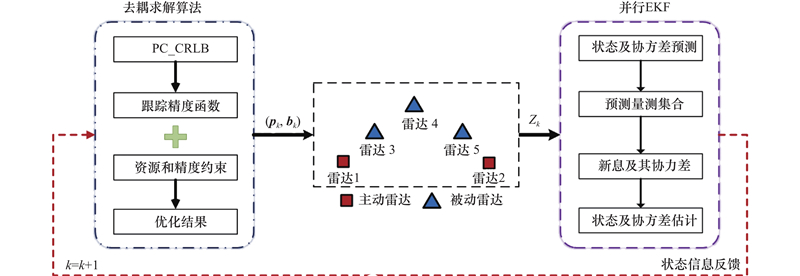
Fig.2
Spatial distribution of active-passive radar network and target movements"
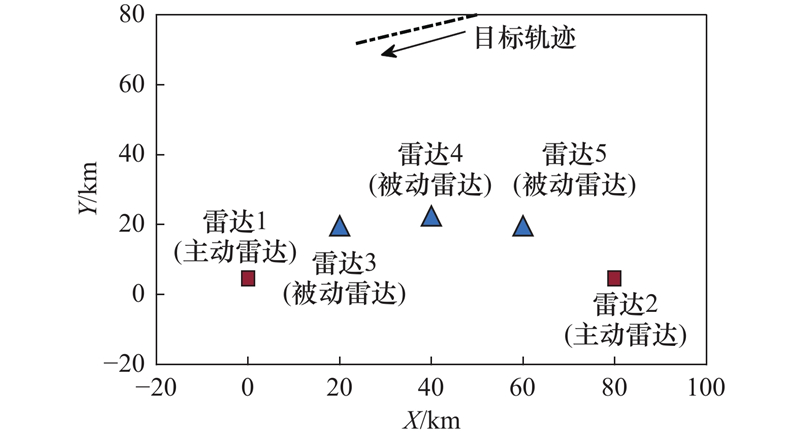
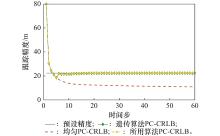
Fig.3
Comparison of tracking accuracy of different algorithms"
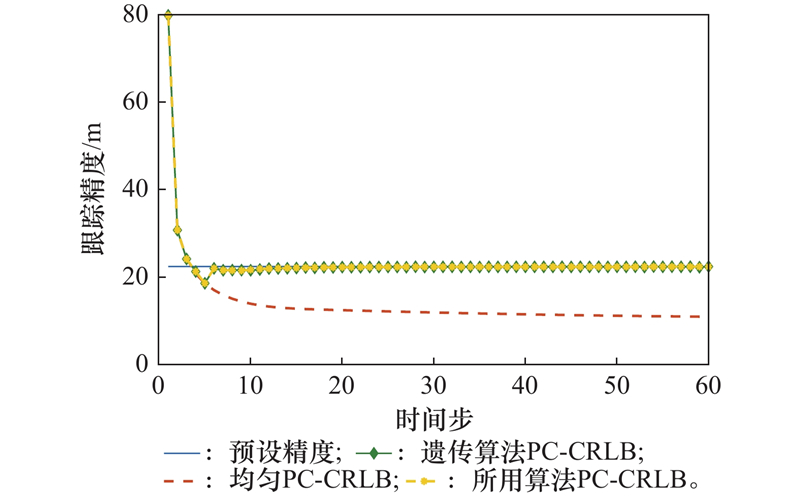
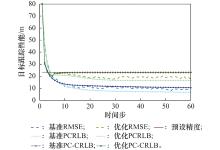
Fig.4
Comparison of RMSE, PC-CRLB, and PCRLB for different schemes"
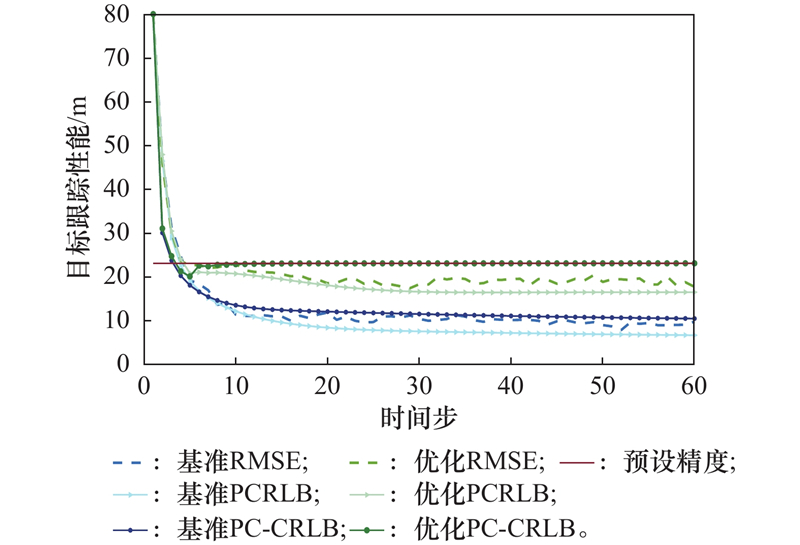
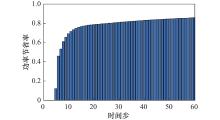
Fig.5
Power saving rate"
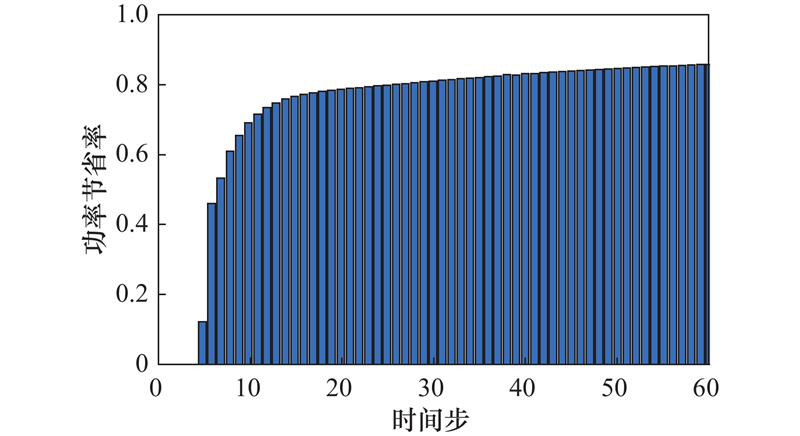
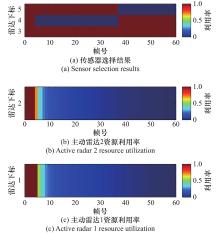
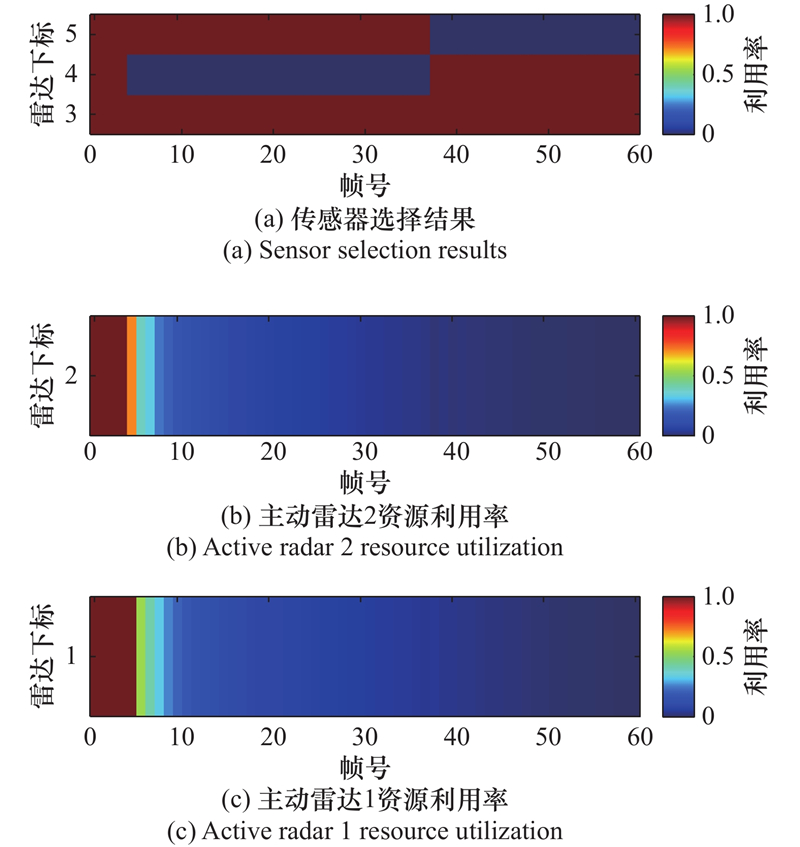
Fig.6
Resource utilization"
| 1 |
SIMON H, AMIN Z, XUE Y B, et al. Control theoretic approach to tracking radar: first step towards cognition[J]. Digital Signal Processing, 2011, 21 (5): 576- 585.
doi: 10.1016/j.dsp.2011.01.004 |
| 2 |
ZHANG H W, LIU W J, FEI T Y, et al. An efficient radar-target assignment and power allocation strategy for low-angle tracking in the MIMO-multisite radar system[J]. Signal Processing, 2022, 200, 108645.
doi: 10.1016/j.sigpro.2022.108645 |
| 3 |
MOHAMMAD A D, MOHAMMAD R K M, MARYAM N. An effective PSO-based power allocation for target tracking in MIMO radar with widely separated antennas[J]. Physical Communication, 2022, 51, 101544.
doi: 10.1016/j.phycom.2021.101544 |
| 4 | 张欣睿, 时晨光, 周建江. 面向协同探测的多机雷达功率时间联合优化分配算法[J]. 指挥控制与仿真, 2024, 46 (1): 118- 130. |
| ZHANG X R, SHI C G, ZHOU J J. Joint power and time allocation algorithm in multi-radar system for cooperative target detection[J]. Command Control and Simulation, 2024, 46 (1): 118- 130. | |
| 5 | 宋晓程, 李陟, 任海伟, 等. 目标动态威胁度驱动的分布式组网相控阵雷达资源优化分配算法[J]. 雷达学报, 2023, 12 (3): 629- 641. |
| SONG X C, LI Z, REN H W, et al. Threat-driven resource allocation algorithm for distributed netted phased array radars[J]. Journal of Radars, 2023, 12 (3): 629- 641. | |
| 6 | 汤建龙, 解佳龙, 陈弘凯. 无需先验测量误差的定位节点选择方法[J]. 系统工程与电子技术, 2024, 46 (1): 35- 41. |
| TANG J L, XIE J L, CHEN H K. Selection method for localization node without priori measurement error[J]. Systems Engineering and Electronics, 2024, 46 (1): 35- 41. | |
| 7 |
ZHANG W W, SHI C G, SALOUS S, et al. Convex optimization-based power allocation strategies for target localization in distributed hybrid non-coherent active-passive radar networks[J]. IEEE Trans. on Signal Processing, 2022, 70, 2476- 2488.
doi: 10.1109/TSP.2022.3173756 |
| 8 | SHI C G, TANG Z C, DING L T, et al. Joint optimization of transmit power and dwell time for asynchronous multi-target tracking in heterogeneous multiple radar networks with imperfect detection[J]. Journal of Radars, 2023, 12 (3): 563- 575. |
| 9 | DAI J H, YAN J K, LV J D, et al. Composed resource optimization for multitarget tracking in active and passive radar network[J]. IEEE Trans. on Geoscience and Remote Sensing, 2022, 60, 5119215. |
| 10 | 易伟, 袁野, 刘光宏, 等. 多雷达协同探测技术研究进展: 认知跟踪与资源调度算法[J]. 雷达学报, 2023, 12 (3): 471- 499. |
| YI W, YUAN Y, LIU G H, et al. Recent advances in multi-radar collaborative surveillance: cognitive tracking and resource scheduling algorithms[J]. Journal of Radars, 2023, 12 (3): 471- 499. | |
| 11 | STONE L D, STREIT R L, CORWIN T L, et al. Bayesian multiple target tracking[M]. 2nd ed. Norwood, MA: Artech House, 2013. |
| 12 | RICHARDS A M. Fundamentals of radar signal processing[J]. London: McGraw-Hill, 2013. |
| 13 |
YUAN Y, YI W, VARSHNEY P K. Exponential mixture density based approximation to posterior Cramér-Rao lower bound for distributed target tracking[J]. IEEE Trans. on Signal Processing, 2022, 70, 862- 877.
doi: 10.1109/TSP.2022.3148540 |
| 14 | 李正杰, 谢军伟, 张浩为, 等. 一种低截获背景下的集中式MIMO雷达快速功率分配算法[J]. 雷达学报, 2023, 12 (3): 602- 615. |
| LI Z J, XIE J W, ZHANG H W, et al. A fast power allocation algorithm in a collocated MIMO radar under low interception backgrounds[J]. Journal of Radars, 2023, 12 (3): 602- 615. | |
| 15 | WILLNER D, CHANG C B, DUNN K P. Kalman filter algorithms for a multi-sensor system[C]//Proc. of the IEEE Conference on Decision and Control including the 15th Symposium on Adaptive Processes, 1976: 570−574. |
| 16 |
HU J, ZUO L, VARSHNEY P K, et al. Resource allocation for distributed multitarget tracking in radar networks with missing data[J]. IEEE Trans. on Signal Processing, 2024, 72, 718- 734.
doi: 10.1109/TSP.2024.3352915 |
| 17 |
SADEGHI M, BEHNIA F, AMIRI R, et al. Target localization geometry gain in distributed MIMO radar[J]. IEEE Trans. on Signal Processing, 2021, 69, 1642- 1652.
doi: 10.1109/TSP.2021.3062197 |
| 18 |
ACHTERBERG T, BIXBY R E, GU Z H, et al. Presolve reductions in mixed integer programming[J]. INFORMS Journal on Computing, 2020, 32 (2): 473- 506.
doi: 10.1287/ijoc.2018.0857 |
| 19 | GLOROT X, BORDES A, BENGIO Y. Deep sparse rectifier neural networks[C]//Proc. of the 14th International Conference on Artificial Intelligence and Statistics, 2011, 15: 315−323. |
| 20 | 马国栋, 唐子萱, 简金宝, 等. 非线性极大极小问题基于指数罚函数的带重启步谱共轭梯度法[EB/OL]. [2024-11-20]. https://doi. org/10.12341/jssms240269. |
| MA G D, TANG Z X, JIAN J B, et al. An EPF-based spectral conjugate gradient method with restart procedures for nonlinear minimax problems[EB/OL]. [2024-11-20]. https: //doi.org/10.12341/jssms240269. | |
| 21 | 戴金辉, 严俊坤, 王鹏辉, 等. 基于目标容量的网络化雷达功率分配方案[J]. 电子与信息学报, 2021, 43 (9): 2688- 2694. |
| DAI J H, YAN J K, WANG P H, et al. Target capacity based power allocation scheme in radar network[J]. Journal of Electronics & Information Technology, 2021, 43 (9): 2688- 2694. | |
| 22 |
YANG Q W, TIANG L B, ZHENG S Y, et al. Joint power and bandwidth allocation with RCS fluctuation characteristic for space target tracking[J]. Remote Sensing, 2023, 15 (16): 3971.
doi: 10.3390/rs15163971 |
| 23 |
BARTON D K. Radar system analysis and modeling[J]. IEEE Aerospace and Electronic Systems Magazine, 2005, 20 (4): 23- 25.
doi: 10.1109/MAES.2005.1423386 |
| 24 |
刘明明, 崔春风, 童小娇, 等. 混合整数非线性规划的算法软件及最新进展[J]. 中国科学: 数学, 2016, 46 (1): 1- 20.
doi: 10.1360/N012014-00278 |
|
LIU M M, CUI C F, TONG X J, et al. Algorithm software and recent advances of mixed integer nonlinear programming[J]. SCIENTIA SINICA Mathematica, 2016, 46 (1): 1- 20.
doi: 10.1360/N012014-00278 |
|
| 25 |
DAKIN R J. A tree-search algorithm for mixed integer programming problems[J]. The Computer Journal, 1965, 8 (3): 250- 255.
doi: 10.1093/comjnl/8.3.250 |
| 26 | 汤洪, 徐旺. 基于改进遗传算法的资源优化调度方法[J]. 现代电子技术, 2024, 47 (9): 169- 172. |
| TONG H, XU W. A resource optimisation scheduling method based on improved genetic algorithm[J]. Modern Electronic Technology, 2024, 47 (9): 169- 172. |
| [1] | Cuiyun LI, Zeyu ZHAO, Shuangwu ZHANG. Adaptive TPMBM filter in heavy-tailed noise environment [J]. Systems Engineering and Electronics, 2025, 47(9): 2808-2817. |
| [2] | Jiazheng FU, Yuxia GUO, Boxiang ZHANG, Lei CHAI, Wei YI, Lingjiang KONG. Distributed multi-target tracking method based on TPHD and TCPHD filters [J]. Systems Engineering and Electronics, 2025, 47(9): 2828-2838. |
| [3] | Xiaomeng MA, Dongming DENG, Yongjian SHEN, Jinshan DING, Guoqing HAO. Multi-target tracking method based on single observer passive motion location [J]. Systems Engineering and Electronics, 2025, 47(8): 2549-2557. |
| [4] | Xiao ZHOU, Xingang MOU, Wen KE, Ying SU, Li WANG. Adaptive IMM-UKF maneuvering target tracking algorithm [J]. Systems Engineering and Electronics, 2025, 47(8): 2686-2695. |
| [5] | Yixin SUN, Yuyuan FANG, Lei ZHANG. Tactical maneuver priori assisted interactive multiple model target tracking method [J]. Systems Engineering and Electronics, 2025, 47(7): 2086-2097. |
| [6] | Hongyuan ZHANG, Baichun GONG, Fei HAN, Yue SUN, Xin NING. Space-based passive cooperative multi-target initial orbit determination method in complex environments [J]. Systems Engineering and Electronics, 2025, 47(5): 1404-1413. |
| [7] | Yongqi YAN, Qi WANG, Fan YI. Algorithm for countering velocity gate pull-off jamming based on interacting multiple model probability data association [J]. Systems Engineering and Electronics, 2025, 47(5): 1507-1515. |
| [8] | Lina SHANG, Mei DONG, Baixiao CHEN. Low-altitude multi-target tracking algorithm in non-uniform clutter environment [J]. Systems Engineering and Electronics, 2025, 47(10): 3218-3227. |
| [9] | Jingyuan SHAN, Yu LU, Hanyu LING. Robust adaptive multi-target tracking algorithm for airborne passive bistatic radar [J]. Systems Engineering and Electronics, 2024, 46(9): 2902-2915. |
| [10] | Fei GAO, Jiang WU, Jun MA, Jia LIU, Xuanmin ZHANG, Bin LI, Jidong MENG, Wenbo NIU, Hongxing DANG. Research on the overall technology of space-based distributed radar sea surface target tracking application [J]. Systems Engineering and Electronics, 2024, 46(8): 2667-2675. |
| [11] | Linhai JIANG, Baichun GONG, Chuankai LIU, Yang YANG, Renyong ZHANG. Space multi-target tracking method for space-based distributedpassive detection [J]. Systems Engineering and Electronics, 2024, 46(8): 2789-2797. |
| [12] | Siyi YAO, Wanchun LI, Lin GAO, Huaguo ZHANG, Hangwei HU. Multi-sensor multi-target tracking based on distributed PMHT [J]. Systems Engineering and Electronics, 2024, 46(7): 2184-2190. |
| [13] | Shuangwu ZHANG, Cuiyun LI, Jingzhe ZHAO, Bowen HENG. TPMBM tracking algorithm suitable for point-group coexistence scenarios [J]. Systems Engineering and Electronics, 2024, 46(7): 2201-2210. |
| [14] | Yaling ZHUO, Xiang LI, Lei ZUO, Juan HU. Power allocation algorithm with random data packet loss in netted radar [J]. Systems Engineering and Electronics, 2024, 46(6): 1957-1966. |
| [15] | Meibin QI, Shuo ZHUANG, Jingjing HU, Yanfang YANG, Yuankui HU. Resolvable group target tracking based on joint GLMB filter [J]. Systems Engineering and Electronics, 2024, 46(4): 1212-1219. |
| Viewed | ||||||
|
Full text |
|
|||||
|
Abstract |
|
|||||