Systems Engineering and Electronics ›› 2026, Vol. 48 ›› Issue (4): 1331-1339.doi: 10.12305/j.issn.1001-506X.2026.04.21
• Systems Engineering • Previous Articles
Fast planning method for space multi-target rendezvous sequence based on CUDA texture interpolation
Hao LIU( ), Zipeng HE, Guangde XU
- Beijing Institute of Spacecraft System Engineering,Beijing 100094,China
-
Received:2024-12-04Revised:2025-02-06Online:2025-05-20Published:2025-05-20 -
Contact:Hao LIU E-mail:liuh188@qq.com

CLC Number:
Cite this article
Hao LIU, Zipeng HE, Guangde XU. Fast planning method for space multi-target rendezvous sequence based on CUDA texture interpolation[J]. Systems Engineering and Electronics, 2026, 48(4): 1331-1339.
share this article
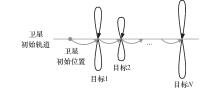
Fig.1
Schematic diagram of rendezvous problem between multiple noncoplanar targets"
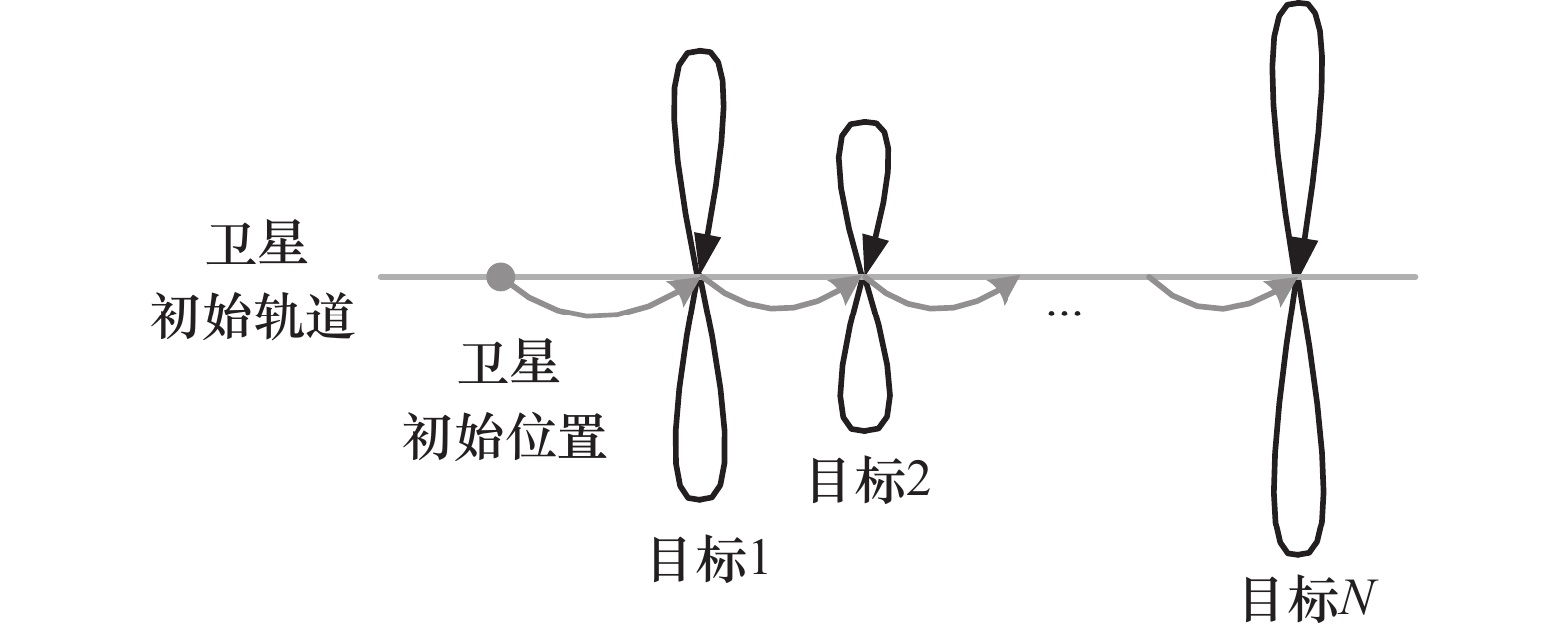
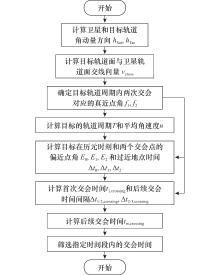
Fig.2
Method for calculating the time when the target crosses the orbital plane of satellite"
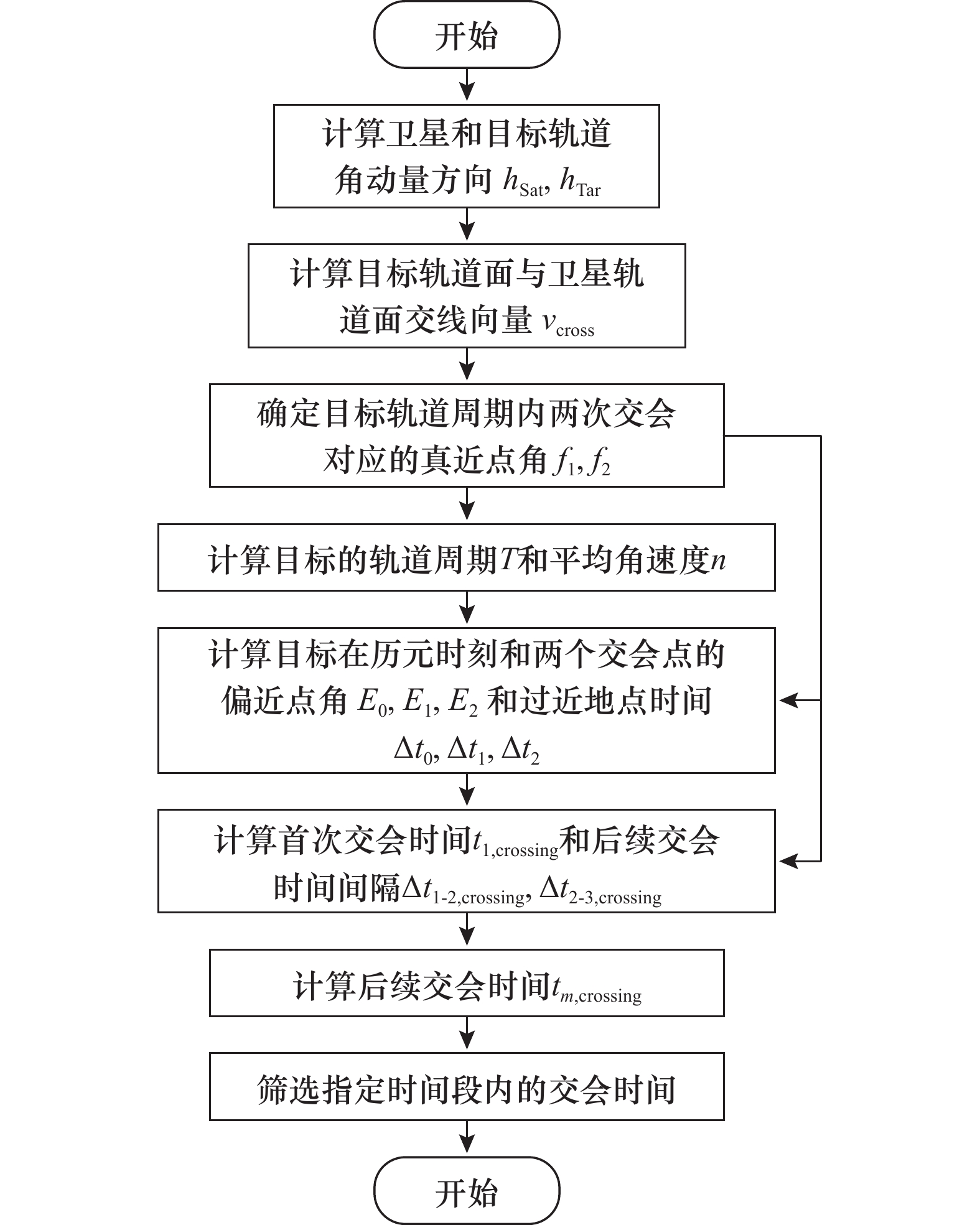
Fig.3
Schematic diagram of the timing of multiple targets crossing the satellite orbital plane"
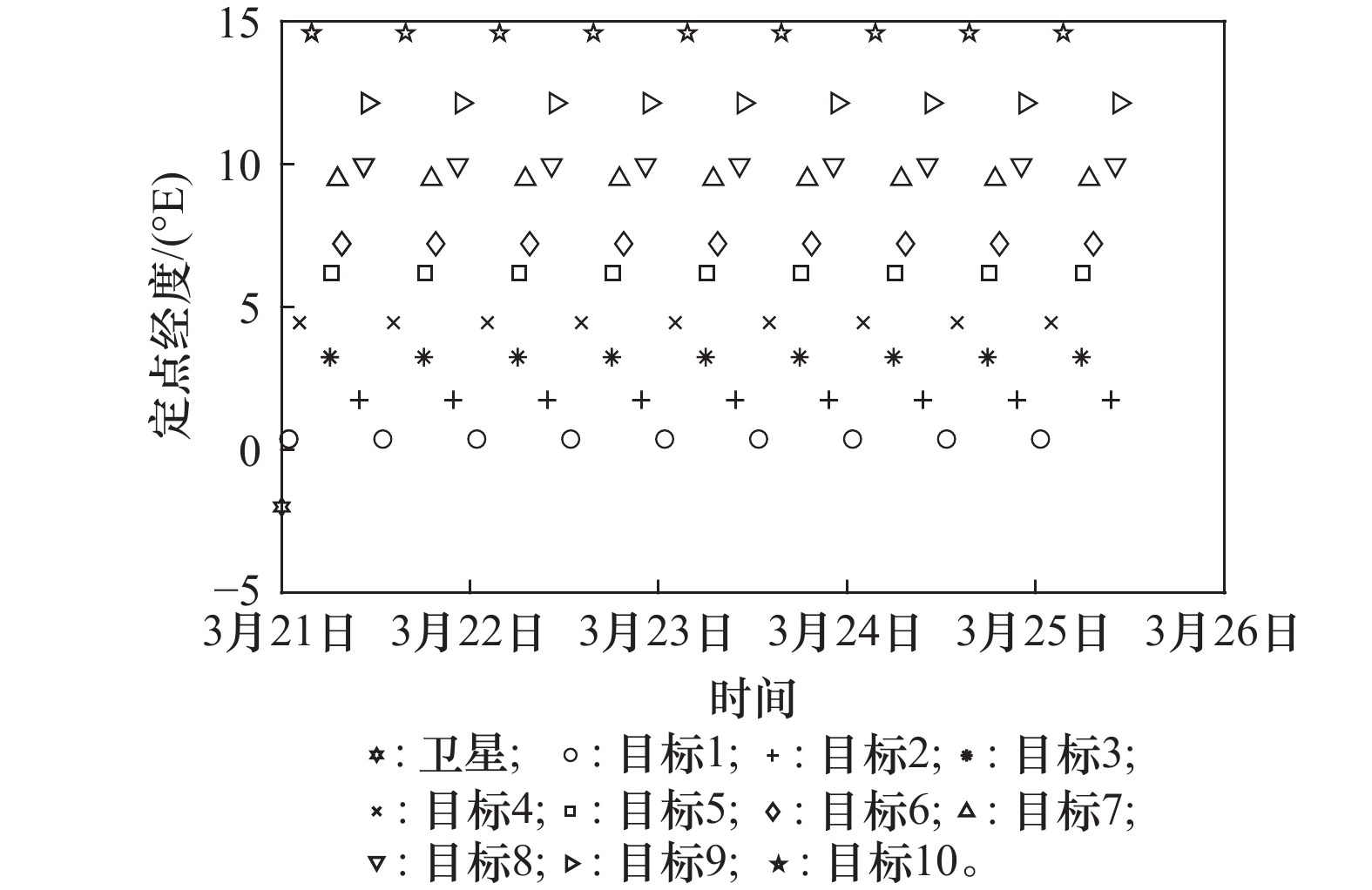
Fig.4
Schematic diagram of transfer between targets in a rendezvous sequence"
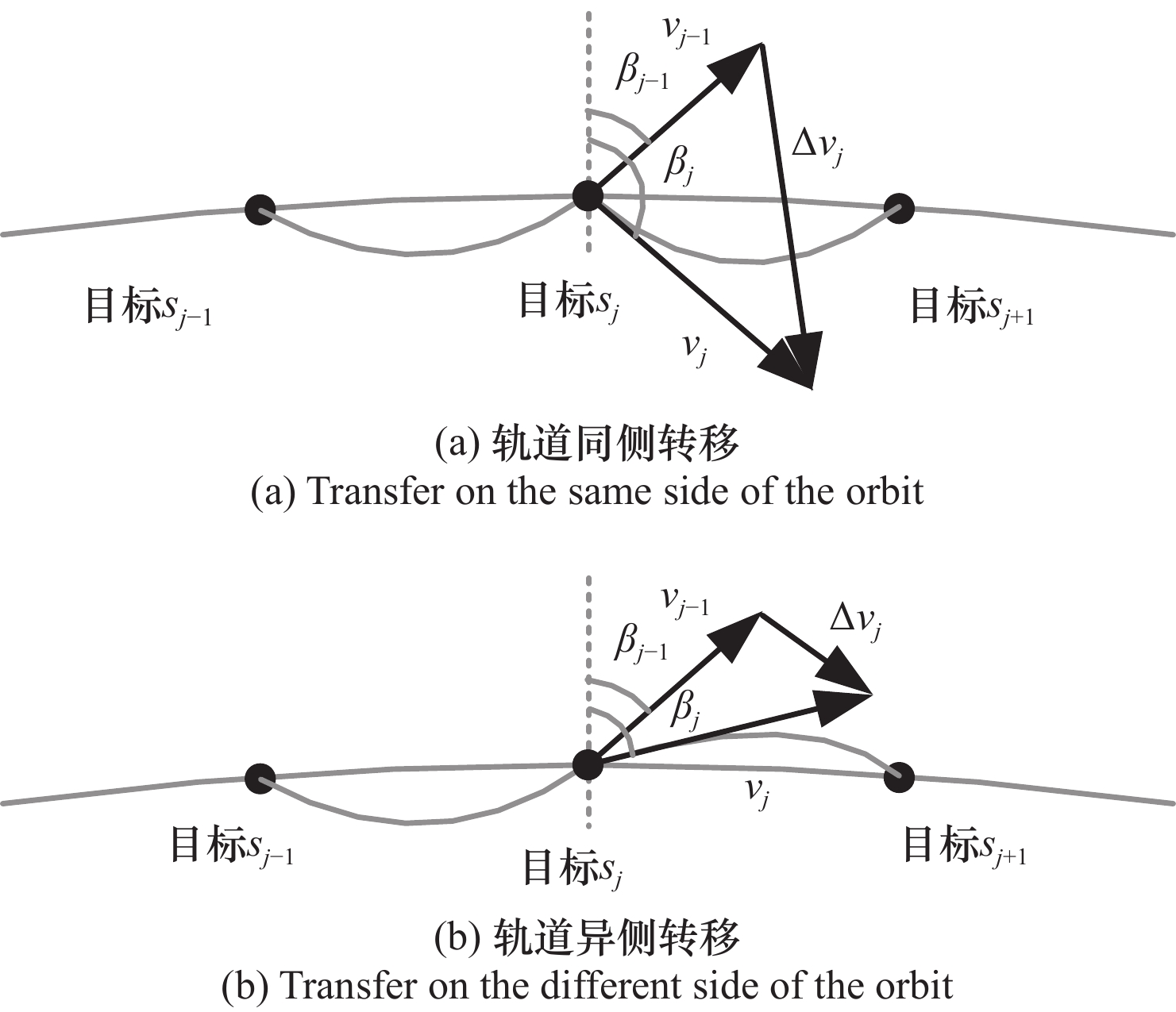
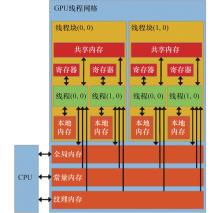
Fig.5
Schematic diagram of thread structure and memory architecture of CUDA"
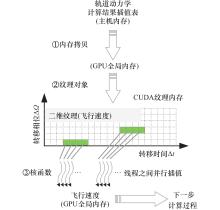
Fig.6
Calculation process of velocity increment based on hardware interpolation in texture memory"
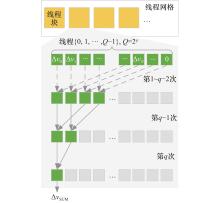
Fig.7
Parallel reduction within thread blocks to achieve velocity increment and accumulation"
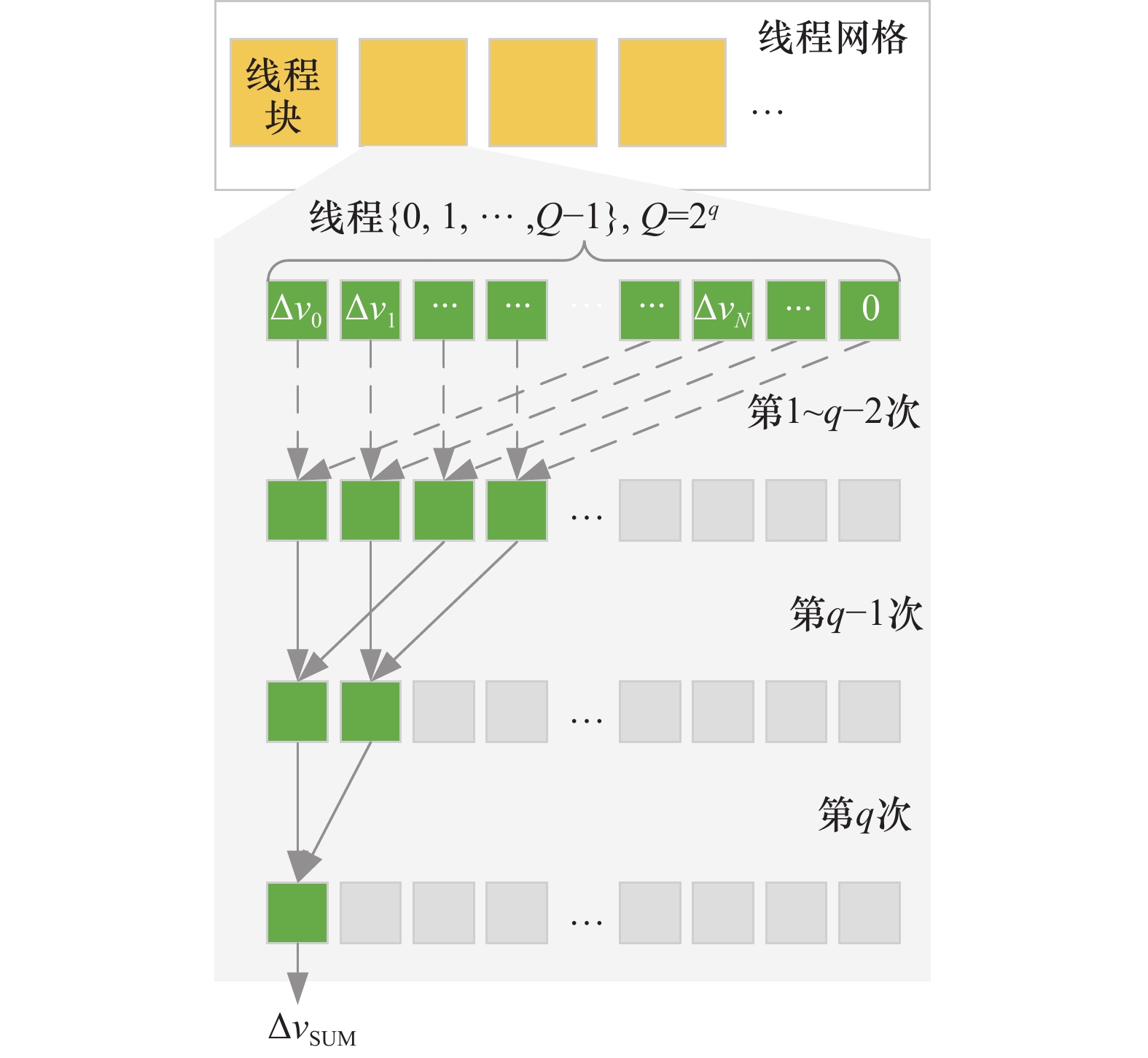
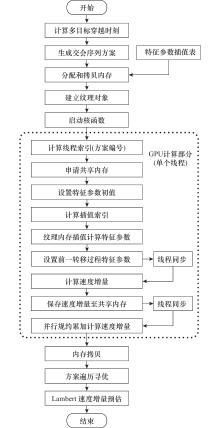
Fig.8
Process of fast planning algorithm for space multi-target rendezvous sequence"
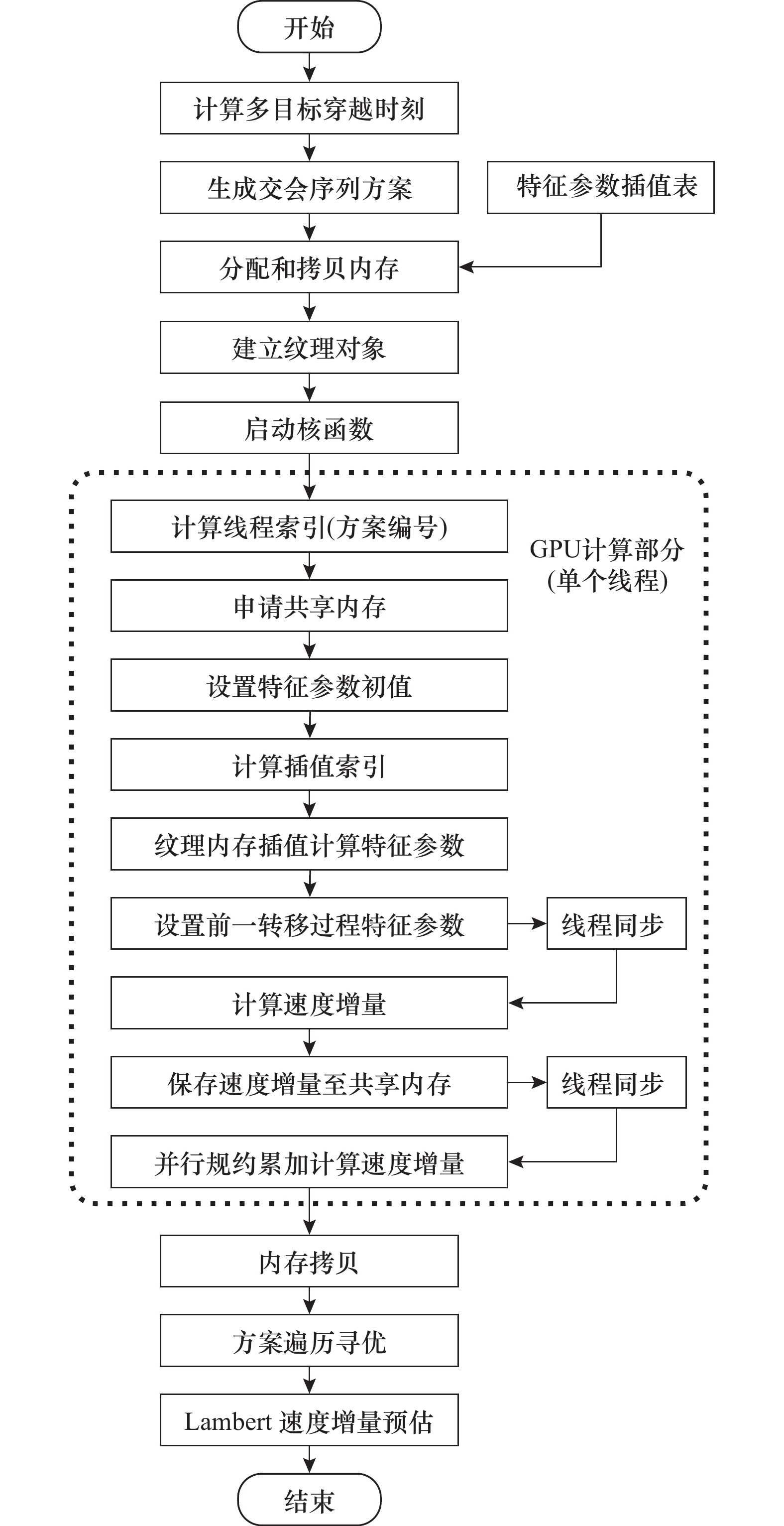
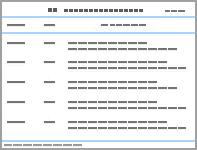
Table 1
Orbital parameter settings for satellites and targets in simulation scenarios"
| 名称 | 倾角/( | 定点经度/(°E) | 真近点角/( |
| 卫星 | 5.0 | −1.96 | 0 |
| 目标1 | 7.1 | 0.22 | 155.31 |
| 目标2 | 2.8 | 1.75 | 327.83 |
| 目标3 | 13.2 | 3.83 | 65.46 |
| 目标4 | 4.2 | 4.44 | 94.97 |
| 目标5 | 8.9 | 6.53 | 52.39 |
| 目标6 | 14.6 | 8.21 | 48.98 |
| 目标7 | 5.1 | 9.38 | 312.95 |
| 目标8 | 9.3 | 10.30 | 208.69 |
| 目标9 | 2.7 | 12.17 | 197.95 |
| 目标10 | 5.3 | 14.70 | 52.18 |
Table 2
Comparison of velocity increment calculation errors in different simulation scenarios m/s"
| 交会序列 | 4天 | 4.5天 | 5天 |
| 本文最优序列 | 648.56 | 487.11 | 369.08 |
| Lambert最优序列 | 666.24 | 493.04 | 374.82 |
| Lambert顺序序列 | 1 313.54 | 723.26 | 520.44 |
Table 3
Comparison of multi-target rendezvous time and velocity increment calculation results for optimal rendezvous sequence"
| 序号 | 交会目标 | 交会时间 | 本文速度增量/(m/s) | Lambert速度增量/(m/s) | 误差/% |
| 1 | 目标5 | 2027年3月21日 18:14:25.080 | 41.23 | 42.98 | 4.07 |
| 2 | 目标4 | 2027年3月22日 02:12:13.283 | 18.35 | 18.52 | 0.92 |
| 3 | 目标7 | 2027年3月22日 19:00:50.072 | 28.24 | 27.90 | 1.22 |
| 4 | 目标8 | 2027年3月22日 22:20:54.968 | 93.05 | 92.27 | 0.85 |
| 5 | 目标6 | 2027年3月23日 07:31:46.070 | 55.67 | 55.58 | 0.16 |
| 6 | 目标2 | 2027年3月23日 21:43:02.576 | 99.87 | 101.94 | 2.03 |
| 7 | 目标3 | 2027年3月24日 05:57:01.641 | 9.72 | 9.88 | 1.62 |
| 8 | 目标1 | 2027年3月24日 12:41:03.313 | 84.11 | 86.51 | 2.77 |
| 9 | 目标10 | 2027年3月25日 03:33:10.517 | 20.57 | 21.85 | 5.86 |
| 10 | 目标9 | 2027年3月25日 10:40:54.521 | 36.30 | 35.61 | 1.94 |
| 交会序列总速度增量/(m/s) | 487.11 | 493.04 | 1.20 | ||
Table 4
Comparison of algorithm running time in different simulation scenarios s"
| 算法名称 | 步骤 | 4天 | 4.5天 | 5天 |
| CPU串行算法 | - | 221.50 | 867.95 | |
| 本文算法 | 步骤1(CPU至GPU内存拷贝) | 0.37 | 0.54 | 0.59 |
| 步骤2(使核函数并行计算) | 8.77 | 31.59 | 105.46 | |
| 步骤3(GPU至CPU内存拷贝) | 0.16 | 0.19 | 0.22 | |
| 全流程 | 9.3 | 32.32 | 144.27 | |
| 加速比/% | 23.82 | 26.85 | 27.39 | |
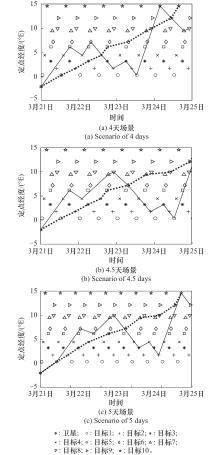
Fig.9
Schematic diagram of the optimal and ordinal rendezvous sequence in different simulation scenarios"
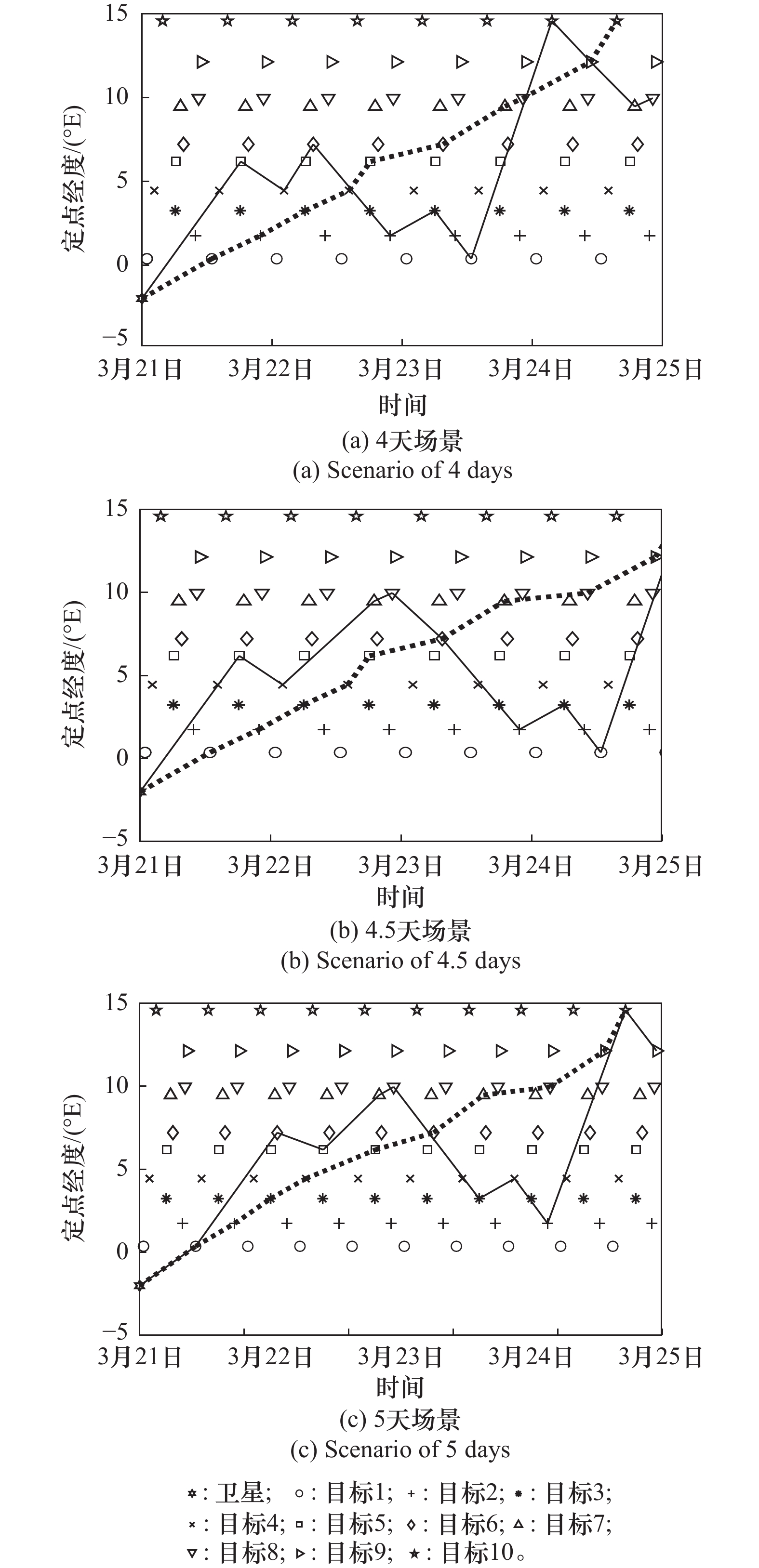
Fig.10
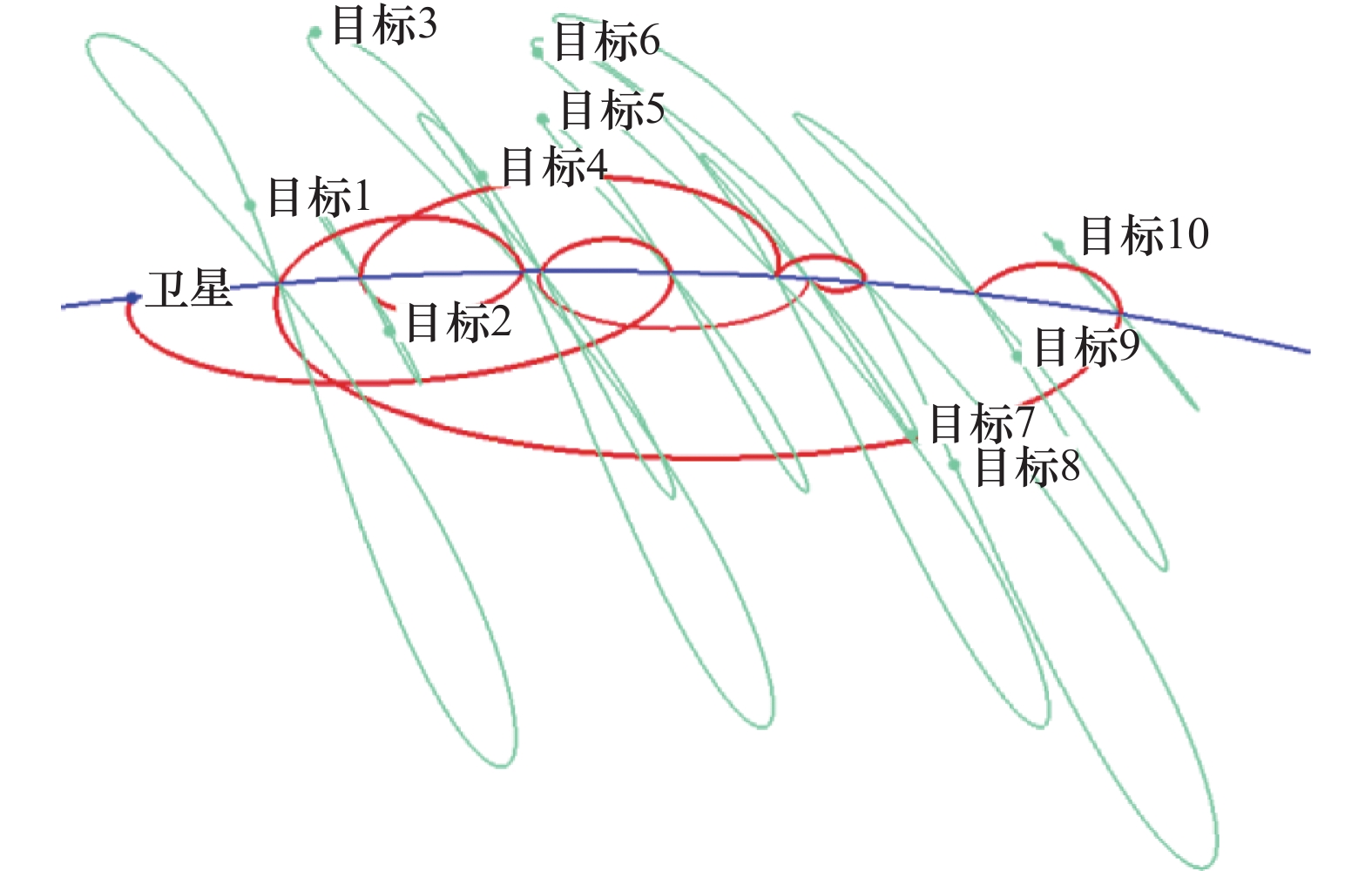
Relative transfer trajectory of the satellite corresponding to the optimal rendezvous sequence"
| 19 | RAKHIMOV M, ZARIPOVA D, JAVLIEV S. Deep learning parallel approach using CUDA technology[C]// Proc. of the Internative Scientific Conference on Modern Problems of Applied Science and Engineering, 2024. |
| 20 | ABDULKADIR G, OKAN O, CENK G. CNN-LSTM based deep learning application on Jetson Nano: estimating electrical energy consumption for future smart homes[J]. Internet of Things, 2024, 26, 101- 148. |
| 21 |
DIPTARUP S, KARAN D, NARENDRA P, et al. Implementation of image enhancement algorithms and recursive ray tracing using CUDA[J]. Procedia Computer Science., 2016, 79, 516- 524.
doi: 10.1016/j.procs.2016.03.066 |
| 22 |
ZHAO S W, LAI Z S, ZHAO J D. Leveraging ray tracing cores for particle-based simulations on GPUs[J]. International Journal for Numerical Methods in Engineering, 2023, 124 (3): 696- 713.
doi: 10.1002/nme.7139 |
| 23 | TAN H, XIAO H, LIU Y, et al. LASSO approximation and application to image super-resolution with CUDA acceleration [C]// Proc. of the 2nd International Conference on Image, Vision and Computing, 2017: 483−488. |
| 24 |
DAWA C L, BHAWNA G, AYUSH D, et al. Image super-resolution: a comprehensive review, recent trends, challenges and applications[J]. Information Fusion, 2023, 91, 230- 260.
doi: 10.1016/j.inffus.2022.10.007 |
| 25 | LIU H, HE J R, MAO H X, et al. A CUDA based infrared image simulation method of rocket plumes observed by satellite [C]// Proc. of the 7th Asia Pacific Conference on Optics Manufacture and 2021 International Forum of Young Scientists on Advanced Optical Manufacturing, 2022: 487−492. |
| 26 |
ALESSANDRO M, CAMILLA C, ARNAUD B. GPU-based high-precision orbital propagation of large sets of initial conditions through Picard–Chebyshev augmentation[J]. Acta Astronautica, 2023, 204, 239- 252.
doi: 10.1016/j.actaastro.2022.12.037 |
| 27 | NITIN A, RYAN P R, VIVEK V. Parallel computation of multiple space trajectories using GPUs and interpolated gravity models[J]. Journal of Guidance Control, and Dynamic, 2015, 38 (8): 1457- 1470. |
| 28 |
UEDA S, OGAWA H. Multi-fidelity approach for global trajectory optimization using GPU-based highly parallel architecture[J]. Aerospace Science and Technology, 2021, 116, 106829.
doi: 10.1016/j.ast.2021.106829 |
| 29 | GIACOMO A, ATILIM G B, DARIO I. Closing the gap between SGP4 and high-precision propagation via differentiable programming[J]. Acta Astronautica, 2025, 226 (1): 694- 701. |
| 30 | KIM Y, SHRIVASTAVA A. Memory performance estimation of CUDA programs[J]. ACM Transactions on Embedded Computing Systems, 2013, 13 (2): 21. |
| 31 |
LUCAS P, MARK P, WOUTER E, et al. A fast three-dimensional gamma evaluation using a GPU utilizing texture memory for on-the-fly interpolations[J]. Medical Physics., 2011, 38 (7): 4032- 4035.
doi: 10.1118/1.3595114 |
| 32 | JOSHUA H, USMAN A. FastSpline: automatic generation of interpolants for lattice samplings[J]. ACM Transactions on Mathematical Software, 2023, 49 (2): 12. |
| 1 |
XU Y J, LIU X L, HE R J, et al. Active debris removal mission planning method based on machine learning[J]. Mathematics, 2023, 11 (6): 1419.
doi: 10.3390/math11061419 |
| 2 |
DANESHJOU K, MOHAMMADI -DEHABADI A A, BAKHTIARI M. Mission planning for on-orbit servicing through multiple servicing satellites: a new approach[J]. Advances in Space Research., 2017, 60 (6): 1148- 1162.
doi: 10.1016/j.asr.2017.05.037 |
| 3 |
ANDREY A B, DMITRIY A G. Review of path planning in prospective multi-target active debris removal missions in low earth orbits[J]. Progress in Aerospace Sciences, 2024, 145, 100982.
doi: 10.1016/j.paerosci.2024.100982 |
| 4 |
SARAH J M, CIARA N M, OLIVIER L D. Optimization of multispacecraft maneuvers for mobile target tracking from low earth orbit[J]. Journal of Spacecraft and Rockets, 2023, 60 (2): 581- 590.
doi: 10.2514/1.A35457 |
| 5 | HAO Y T, LIU Z Y, XU S H. Minimal delta-v-based orbital rendezvous for approaching a non-cooperative target on GEO[C]// Proc. of the Chinese Conference on Swarm Intelligence and Cooperative Control, 2023: 567–579. |
| 6 |
BAI S Z, WANG Y, LIU H Y, et al. Finite-thrust Lambert transfer based on multistage constant-vector thrust control[J]. IEEE Trans. on Aerospace and Electronic Systems, 2023, 59 (5): 4947- 4967.
doi: 10.1109/TAES.2023.3249148 |
| 7 | AVANZINI G, PALMAS A, VELLUTINI E. Solution of low-thrust Lambert problem with perturbative expansions of equinoctial elements[J]. Journal of Guidance, Control, and Dynamics, 2015, 38 (9): 1585- 1601. |
| 8 | AVANZINI G. A simple Lambert algorithm[J]. Journal of Guidance, Control, and Dynamics., 2008, 31 (6): 1587- 1594. |
| 9 | DAVIS J, AVENDANO M, MORTARI D. A closed-form solution to the minimum Δv2TOT Lambert’s problem[J]. Advances in the Astronautical Sciences, 2010, 135, 1037- 1052. |
| 10 | 徐利民, 张涛, 陶佳伟. 能量最优与燃料最优Lambert交会问题[J]. 北京航空航天大学学报, 2018, 44 (9): 1888- 1893. |
| XU L M, ZHANG T, TAO J W. Energy-optimal and fuel-optimal problems for Lambert rendezvous[J]. Journal of Beijing University of Aeronautics and Astronautics, 2018, 44 (9): 1888- 1893. | |
| 11 | 黄勇, 李小将, 张东来, 等. 混合遗传算法在最优Lambert轨道转移设计中的应用[J]. 飞行力学, 2013, 31 (3): 269- 272. |
| HUANG Y, LI X J, ZHANG D L, et al. Application of hybrid genetic algorithm in optimal Lambert orbital transfer design[J]. Flighgt Dynamics, 2013, 31 (3): 269- 272. | |
| 12 | JACKSON B. Minimum energy maneuvering strategies for multiple satellite inspection missions[C]// Proc. of the 2005 IEEE Aerospace Conference, 2005: 4306−4313. |
| 13 |
PENG C Y, ZHANG J, YAN B, et al. Multisatellite flyby inspection trajectory optimization based on constraint repairing[J]. Aerospace, 2021, 8 (9): 274.
doi: 10.3390/aerospace8090274 |
| 14 | GATTO G, CASALINO L. Fast evaluation and optimization of low-thrust transfers to multiple targets[J]. Journal of Guidance, Control, and Dynamics, 2015, 38 (8): 1525- 1530. |
| 15 | ZHU Y H, LUO Y Z. Fast evaluation of low-thrust transfers via multilayer perceptions[J]. Journal of Guidance, Control, and Dynamics, 2019, 42 (12): 2627- 2637. |
| 16 | BANDO M, YAMAKAWA H. Orbital design for multiple flyby missions[J]. Transactions of the Japan Society for Aeronautical and Space Sciences, Aerospace Technology Japan, 2010, 8 (27): 9- 13. |
| 17 |
KONG L J, ZHOU Y. Optimal planning of multiple geosynchronous spacecraft flyby inspection mission with multiple servicing space robots[J]. International Journal of Aeronautical and Space Sciences, 2024, 25, 1178- 1193.
doi: 10.1007/s42405-024-00718-4 |
| 18 |
ZHOU Y, YAN Y, HUANG X, et al. Mission planning optimization for multiple geosynchronous satellites refueling[J]. Advances in Space Research, 2015, 56 (11): 2612- 2625.
doi: 10.1016/j.asr.2015.09.033 |
| [1] | Jianbo YUAN, Yonghao DU, Yingguo CHEN, Yongming HE. Research on imaging satellite mission planning model and algorithm for point-cluster and large-region targets [J]. Systems Engineering and Electronics, 2025, 47(9): 2939-2950. |
| [2] | Xuejian LI, Yongqiang CHEN, Hong MA, Yang LIU, Yuxin WANG, Yiwen JIAO. Design of PCAL signal phase real-time extraction system based on parallel computing [J]. Systems Engineering and Electronics, 2025, 47(2): 376-389. |
| [3] | Dali WANG, Lei DONG, Huawang LI, Zhenzhen ZHENG, Haiying HU. Multi-satellite task scheduling method for repeated observation of space debris [J]. Systems Engineering and Electronics, 2025, 47(11): 3685-3698. |
| [4] | Jianguo XU, Zhimou YANG, Qing YANG, Yu HE, Jiang JIANG. Research on electronic countermeasures mission planning under the background of joint sea attack [J]. Systems Engineering and Electronics, 2024, 46(11): 3736-3743. |
| [5] | Hongbo TAO, Dongsheng ZHANG, Yong HUANG. Three-dimensional fast factorized back projection SAS imaging algorithm accelerated by GPU [J]. Systems Engineering and Electronics, 2024, 46(10): 3247-3256. |
| [6] | Jianfeng WANG, Gaowei JIA, Zheng GUO, Zhongxi HOU. Review of research on multi-UAV collaborative mission planning method [J]. Systems Engineering and Electronics, 2024, 46(10): 3437-3450. |
| [7] | Feilong MAO, Yiwen JIAO, Hong MA, Jiujiang HAN, Zefu GAO, Chao LI, Dong LI. Time delay compensation method of antenna array signal based on GPU [J]. Systems Engineering and Electronics, 2023, 45(8): 2383-2394. |
| [8] | Qidi WEN, Zhiyu KANG, Guoning WEI, Yanbo HE, Bin WU, Ruiyi ZHOU. Research on the approach observation mission flow planning method of parent-child spacecraft [J]. Systems Engineering and Electronics, 2023, 45(12): 3941-3948. |
| [9] | Zenan ZHONG, Shenming QUAN, Tao CHAO, Songyan WANG, Ming YANG. An active space debris removal mission planning method [J]. Systems Engineering and Electronics, 2023, 45(12): 3958-3966. |
| [10] | Jing YU, Enmi YONG, Hanyang CHEN, Dong HAO, Xiancai ZHANG. Bi-level mission planning method for multi-cooperative UAV air-to-ground attack [J]. Systems Engineering and Electronics, 2022, 44(9): 2849-2857. |
| [11] | Man LIU, Hongjun ZHANG, Youwei XU, Xinliang FENG, Yufang FENG. Research on behavior decision-making of multi entities in group-level wargame [J]. Systems Engineering and Electronics, 2022, 44(8): 2562-2569. |
| [12] | Dong LI, Yiwen JIAO, Zefu GAO, Wenge YANG, Feilong MAO, Fei TENG. FX phase identification algorithm for GPU-based phase interferometer [J]. Systems Engineering and Electronics, 2022, 44(11): 3320-3329. |
| [13] | Peng JIN, Kang LI. Distributed satellite resource scheduling based on improved contract network protocol [J]. Systems Engineering and Electronics, 2022, 44(10): 3164-3173. |
| [14] | Shengyu ZHANG, Yukun SUN, Zhencai ZHU, Haiying HU. Heuristic optimized forward-backward chains combination method for on-board multi-targets observation planning [J]. Systems Engineering and Electronics, 2021, 43(5): 1262-1269. |
| [15] | Kai CHENG, Gang CHEN, Xiaohan YU, Man LIU, Tianhao SHAO. Knowledge traction and data-driven wargame AI design and key technologies [J]. Systems Engineering and Electronics, 2021, 43(10): 2911-2917. |
| Viewed | ||||||
|
Full text |
|
|||||
|
Abstract |
|
|||||