Systems Engineering and Electronics ›› 2025, Vol. 47 ›› Issue (11): 3685-3698.doi: 10.12305/j.issn.1001-506X.2025.11.17
• Systems Engineering • Previous Articles
Multi-satellite task scheduling method for repeated observation of space debris
Dali WANG1,2( ), Lei DONG1,2,*, Huawang LI1,2, Zhenzhen ZHENG1,2, Haiying HU1,2
- 1. Innovation Academy for Microsatellites of Chinese Academy of Sciences,Shanghai 201304,China
2. University of Chinese Academy of Sciences,Beijing 100049,China
-
Received:2025-03-12Online:2025-11-25Published:2025-12-08 -
Contact:Lei DONG E-mail:wang61254@163.com

CLC Number:
Cite this article
Dali WANG, Lei DONG, Huawang LI, Zhenzhen ZHENG, Haiying HU. Multi-satellite task scheduling method for repeated observation of space debris[J]. Systems Engineering and Electronics, 2025, 47(11): 3685-3698.
share this article
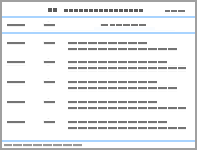
Table 1
Symbol definition"
| 符号 | 定义 |
| 卫星集合, | |
| 目标集合, | |
| 卫星、目标的轨道数据 | |
| 卫星、目标的数量 | |
| 卫星进行任务切换所需要的时间 | |
| 整体规划区间, | |
| 每个目标的实际观测时间, | |
| 卫星负载, | |
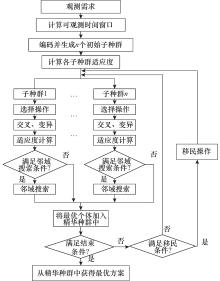
Fig.1
Flowchart of MPGNSA"


Fig.2
No conflicts in tasks"


Fig.3
Conflicts in tasks"

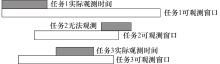
Fig.4
Observation conflict"

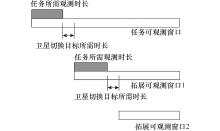
Fig.5
OWE"
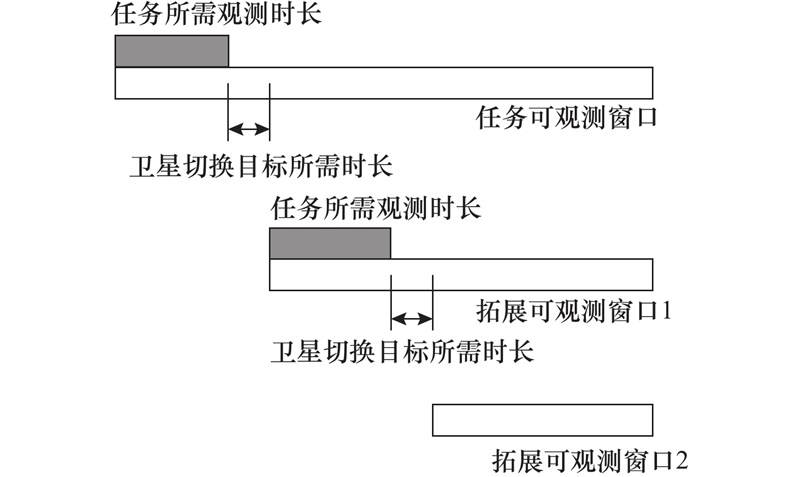
Fig.6
Application of OWE"
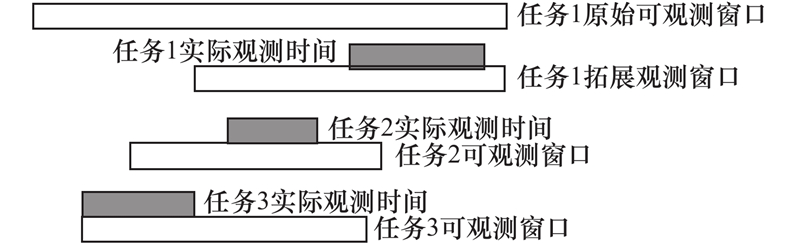
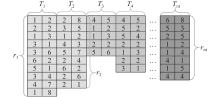
Fig.7
Encoding method"
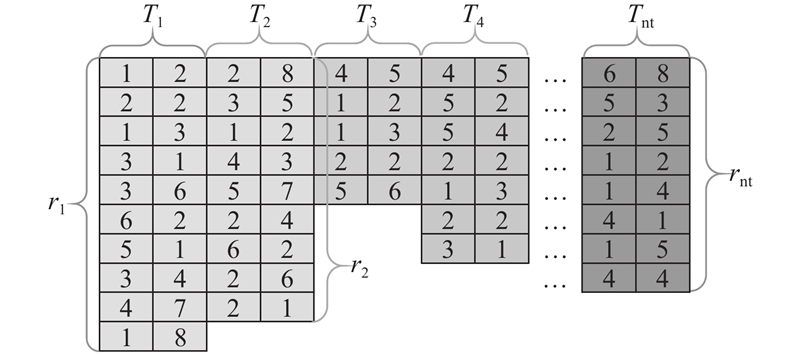

Fig.8
Crossover mode"
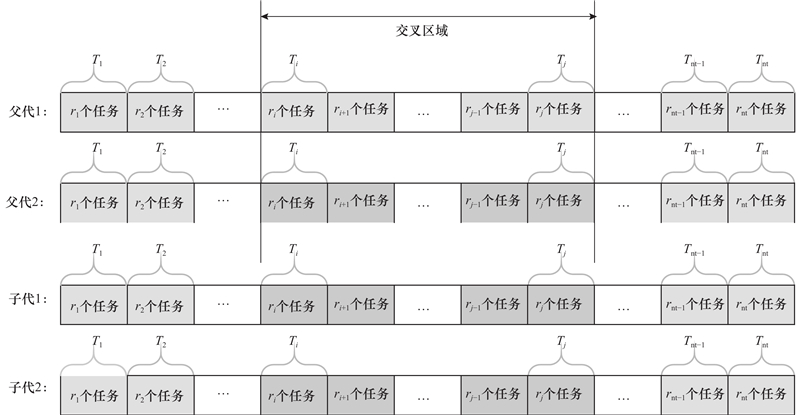

Fig.9
Mutation mode"
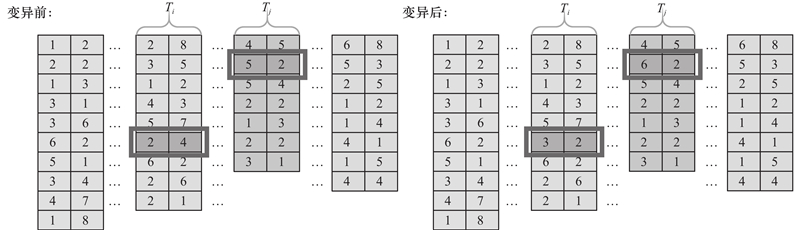
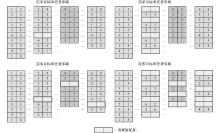
Fig.10
Methods for generating neighborhoods"
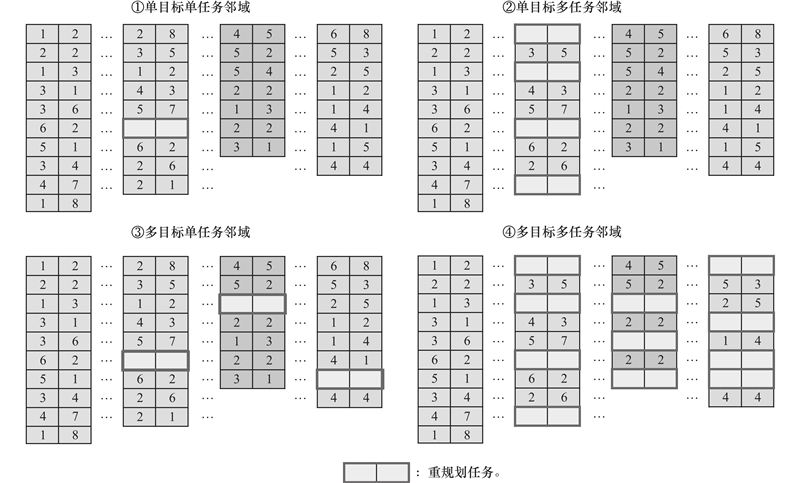
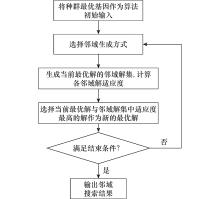
Fig.11
Neighborhood search process"
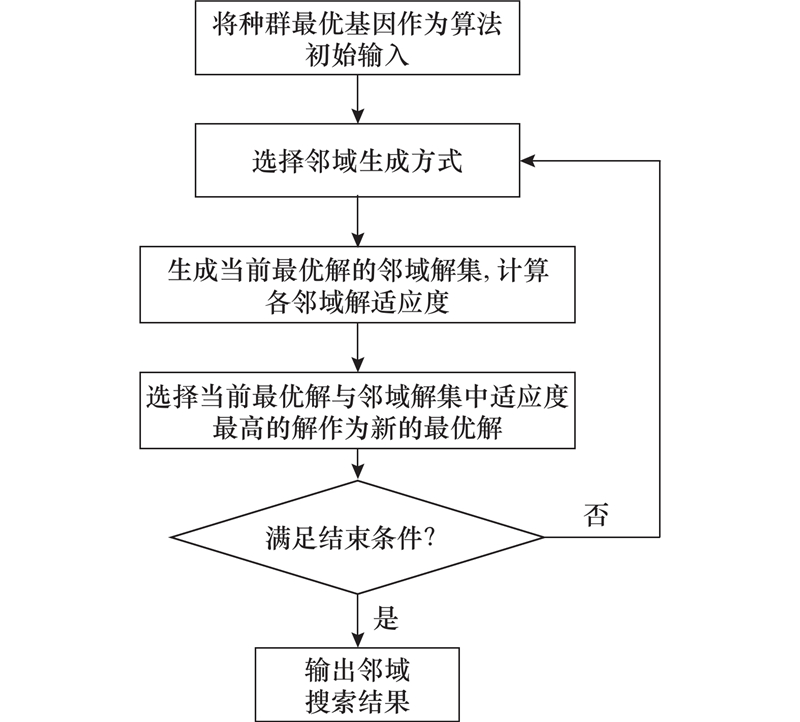
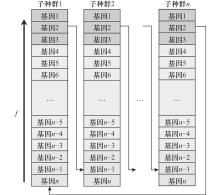
Fig.12
Immigration operations"

Table 2
Satellite orbit parameters"
| 卫星编号 | a/km | e | i/(°) | ω/(°) | Ω/(°) | M/(°) |
| Sat1 | 0 | 99.5 | 0 | 10.9 | 0 | |
| Sat2 | 0 | 99.5 | 0 | 10.9 | 60 | |
| Sat3 | 0 | 99.5 | 0 | 10.9 | 120 | |
| Sat4 | 0 | 99.5 | 0 | 10.9 | 180 | |
| Sat5 | 0 | 99.5 | 0 | 10.9 | 240 | |
| Sat6 | 0 | 99.5 | 0 | 10.9 | 300 |
Table 3
Orbital parameters of the target"
| 编号 | a/km | e | i/(°) | ω/(°) | Ω/(°) | M/(°) |
| Tar1 | 0 | 143.4 | 57.09 | 62.9 | 6.4 | |
| Tar2 | 0 | 98.13 | 100.47 | 90 | 311.22 | |
| Tar3 | 0.04 | 63.42 | 358.84 | 98.61 | 34.45 | |
| Tar4 | 0.01 | 57.01 | 130.38 | 57.49 | 340.77 | |
| Tar5 | 0.01 | 96.88 | 191.12 | 14.87 | 14.34 | |
| | | | | | | |
Table 4
Observation demand of targets"
| 目标编号 | 观测次数/次 | 每次观测时间/s |
| 1 | 10 | 240 |
| 2 | 8 | 300 |
| 3 | 6 | 480 |
| 4 | 8 | 480 |
| 5 | 7 | 300 |
| 6 | 7 | 300 |
| 7 | 6 | 420 |
| 8 | 10 | 420 |
| 9 | 6 | 420 |
| 10 | 8 | 420 |
| | | |

Fig.13
Algorithm fitness"
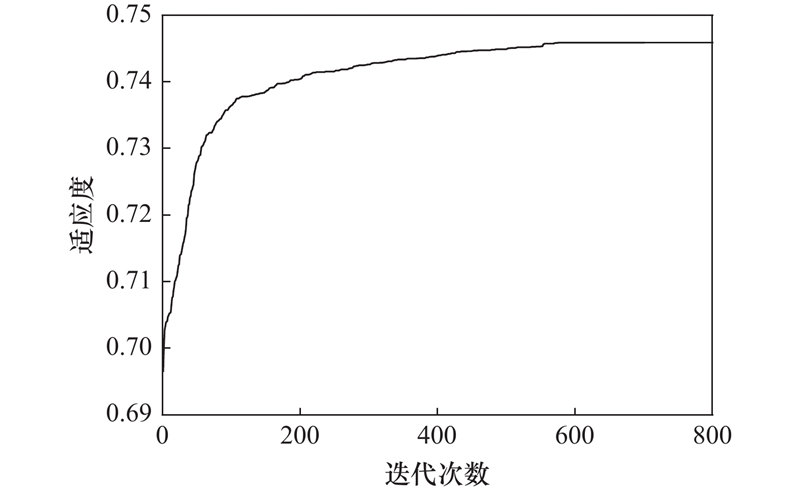

Fig.14
Fitness curve of each indicator"
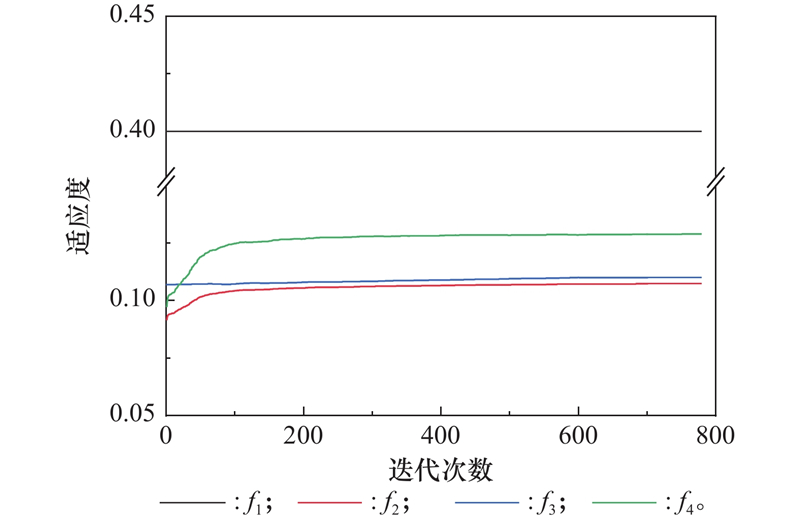
Table 5
Satellite load"
| 卫星编号 | 任务数量/个 | 任务总时长/h | 负载率/% |
| Sat1 | 82 | 7.825 | 65.21 |
| Sat2 | 89 | 7.875 | 65.63 |
| Sat3 | 89 | 7.85 | 65.42 |
| Sat4 | 87 | 7.85 | 65.42 |
| Sat5 | 83 | 7.808 | 65.07 |
| Sat6 | 88 | 7.867 | 65.56 |
| 合计 | 516 | — | — |
Fig.15
Gantt chart of the task planning scenario"
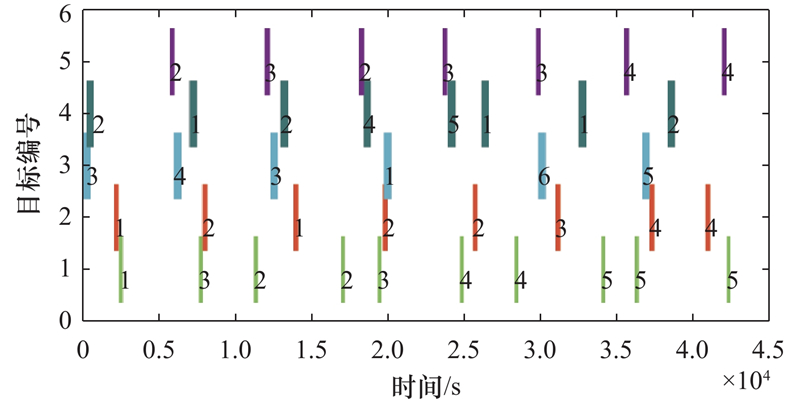
Table 6
Target observation arrangement"
| 目标 编号 | 观测次数/次 | 观测时长/s | 观测方案 | ||
| 卫星 | 开始时刻 | 结束时刻 | |||
| 目标1 | 10 | 240 | 1 | 0:39:09 | 0:43:09 |
| 3 | 2:06:29 | 2:10:29 | |||
| 2 | 3:06:42 | 3:10:42 | |||
| 2 | 4:41:54 | 4:45:54 | |||
| 3 | 5:21:45 | 5:25:45 | |||
| 4 | 6:51:45 | 6:55:45 | |||
| 4 | 7:51:33 | 7:55:33 | |||
| 5 | 9:26:08 | 9:30:08 | |||
| 5 | 10:02:45 | 10:06:45 | |||
| 5 | 11:43:35 | 11:47:35 | |||
| 目标2 | 8 | 300 | 1 | 0:33:39 | 0:38:39 |
| 2 | 2:10:28 | 2:15:28 | |||
| 1 | 3:49:47 | 3:54:47 | |||
| 2 | 5:27:28 | 5:32:28 | |||
| 2 | 7:05:46 | 7:10:46 | |||
| 3 | 8:36:12 | 8:41:12 | |||
| 4 | 10:18:57 | 10:23:57 | |||
| 4 | 11:20:02 | 11:25:02 | |||
| 目标3 | 6 | 480 | 3 | 0:00:01 | 0:08:01 |
| 4 | 1:39:11 | 1:47:11 | |||
| 3 | 3:24:31 | 3:32:31 | |||
| 1 | 5:28:44 | 5:36:44 | |||
| 6 | 8:17:12 | 8:25:12 | |||
| 5 | 10:10:59 | 10:18:59 | |||
| 目标4 | 8 | 480 | 2 | 0:03:31 | 0:11:31 |
| 1 | 1:56:10 | 2:04:10 | |||
| 2 | 3:35:47 | 3:43:47 | |||
| 4 | 5:06:20 | 5:14:20 | |||
| 5 | 6:38:32 | 6:46:32 | |||
| 1 | 7:15:13 | 7:23:13 | |||
| 1 | 9:01:22 | 9:09:22 | |||
| 2 | 1038:44 | 10:46:44 | |||
| 目标5 | 7 | 300 | 2 | 1:34:43 | 1:39:43 |
| 3 | 3:18:34 | 3:23:34 | |||
| 2 | 5:01:35 | 5:06:35 | |||
| 3 | 6:32:45 | 6:37:45 | |||
| 3 | 8:14:56 | 8:19:56 | |||
| 4 | 9:51:12 | 9:56:12 | |||
| 4 | 11:38:08 | 11:43:08 | |||
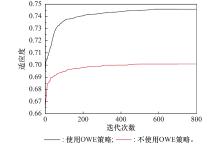
Fig.16
Comparison of algorithmic fitness curves"
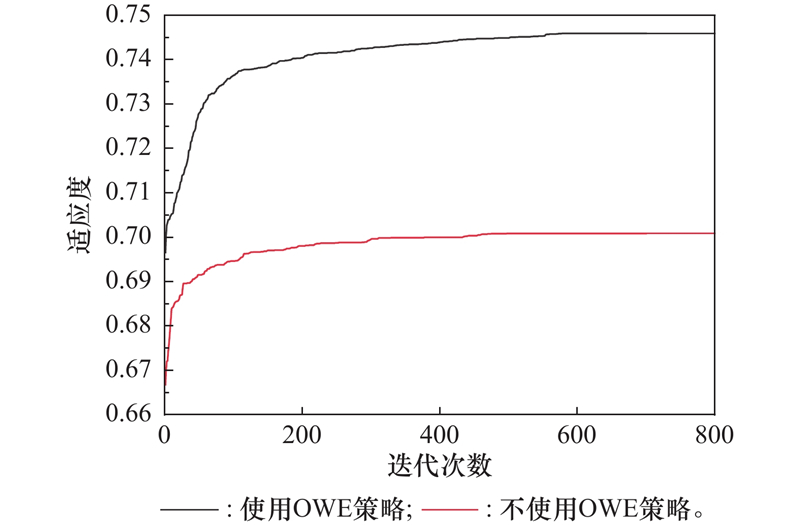
Table 7
Satellite load without OWE strategy"
| 卫星编号 | 任务数量/个 | 任务总时长/h | 负载率/% |
| Sat1 | 77 | 7.333 | 61.11 |
| Sat2 | 83 | 7.383 | 61.53 |
| Sat3 | 82 | 7.358 | 61.32 |
| Sat4 | 82 | 7.358 | 61.32 |
| Sat5 | 80 | 7.317 | 60.97 |
| Sat6 | 79 | 7.367 | 61.39 |
| 合计 | 483 | — | — |
Table 8
Cases for testing"
| 场景编号 | 目标数量 | 任务数量 | 描述 |
| 场景1 | 30 | 265 | 负载较低 |
| 场景2 | 45 | 384 | 负载适中 |
| 场景3 | 60 | 516 | 负载较高 |
Table 9
Solution results of various algorithms in different scenarios"
| 场景 | 指标 | GA | GNSA | MPGA | MPGNSA |
| 场景1 | 最大适应度值 | ||||
| 平均适应度值 | |||||
| 最小适应度值 | |||||
| 任务完成数 | 265 | 265 | 265 | 265 | |
| 任务完成率/% | 100 | 100 | 100 | 100 | |
| 场景2 | 最大适应度值 | ||||
| 平均适应度值 | |||||
| 最小适应度值 | |||||
| 任务完成数 | 384 | 384 | 384 | 384 | |
| 任务完成率/% | 100 | 100 | 100 | 100 | |
| 场景3 | 最大适应度值 | ||||
| 平均适应度值 | |||||
| 最小适应度值 | |||||
| 任务完成数 | 516 | 516 | 516 | 516 | |
| 任务完成率/% | 100 | 100 | 100 | 100 |

Fig.17
Iteration curves of each algorithm"
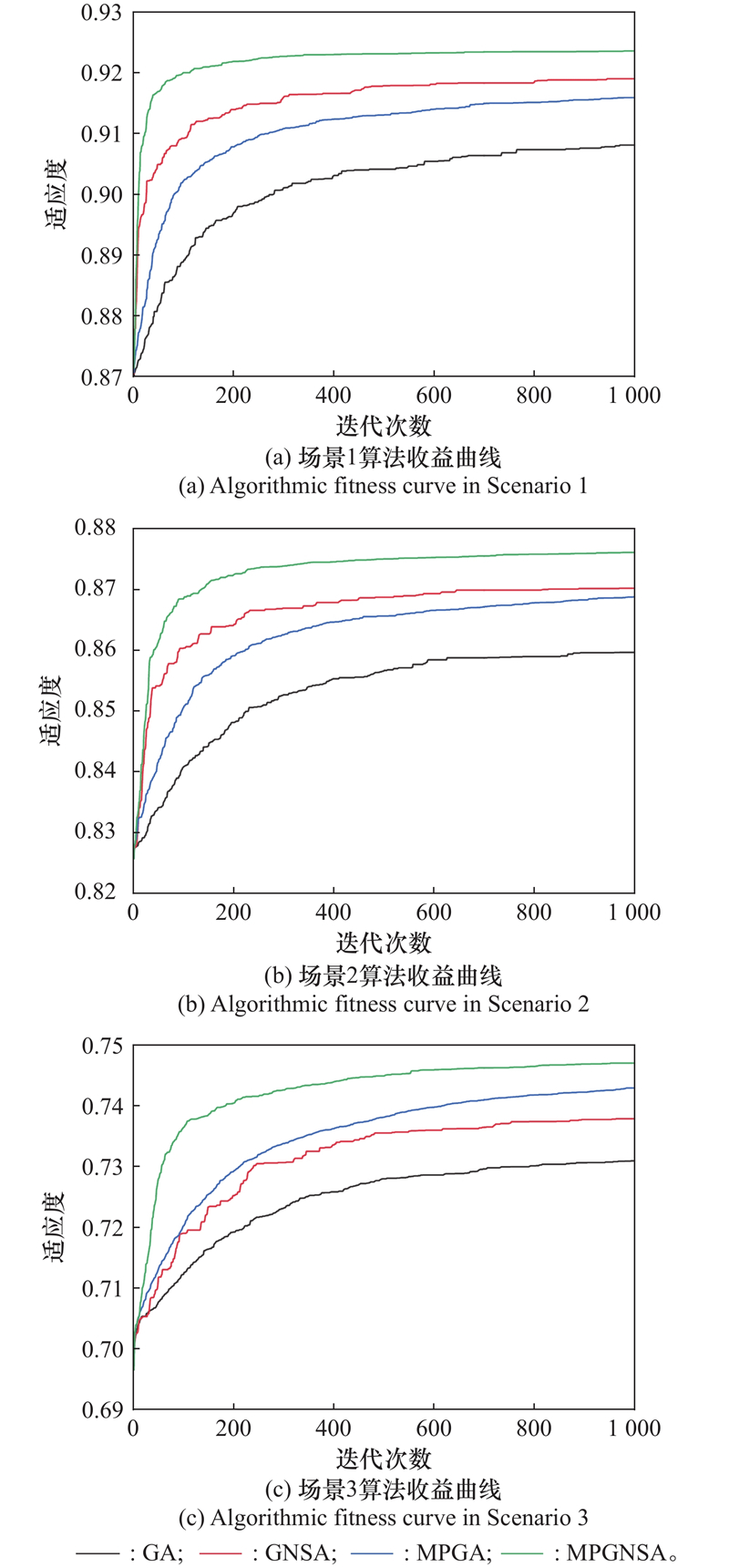
Table 10
Comparison of algorithm running time s"
| 场景 | ||||
| 场景1 | 27.1 | 32.4 | 47.4 | 51.7 |
| 场景2 | 43.5 | 52.3 | 69.3 | 76.3 |
| 场景3 | 63.7 | 71.6 | 98.6 | 107.3 |

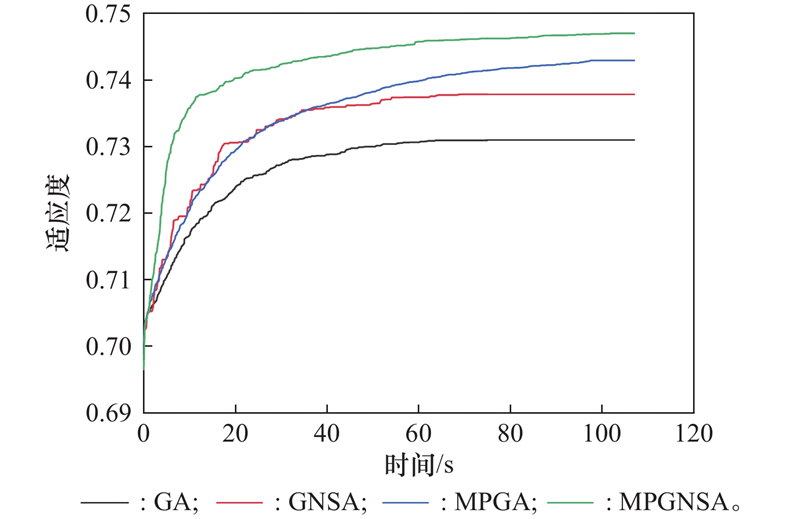
Fig.18
Fitness curve over time"
| 1 | LEDKOV A, ASLANOV V. Review of contact and contactless active space debris removal approaches[J]. Progress in Aerospace Sciences, 2022, 134: 100858. |
| 2 |
YANG K, WU Y L. Improving international governance of space debris in the era of large constellations of small satellites and China’s response[J]. Advances in Space Research, 2023, 72 (7): 2607- 2615.
doi: 10.1016/j.asr.2022.06.061 |
| 3 |
LI G Q, LIU J, JIANG H, et al. Research on the efficient space debris observation method based on optical satellite constellations[J]. Applied Sciences, 2023, 13 (7): 4127.
doi: 10.3390/app13074127 |
| 4 |
郑珍珍, 朱振才, 康一舟. 天基空间碎片可见光观测系统与关键技术发展概述[J]. 光学学报, 2022, 42 (17): 1712002.
doi: 10.3788/AOS202242.1712002 |
|
ZHENG Z Z, ZHU Z C, KANG Y Z. Overview of space-based optical observation systems for space debris and development of key technologies[J]. Acta Optica Sinica, 2022, 42 (17): 1712002.
doi: 10.3788/AOS202242.1712002 |
|
| 5 | ZHANG G H, LI X H, HU G X, et al. Mission planning issues of imaging satellites: summary, discussion, and prospects[J]. International Journal of Aerospace Engineering, 2021, 2021 (1): 7819105. |
| 6 | HE L L, LIU X, LAPORTE G, et al. An improved adaptive large neighborhood search algorithm for multiple agile satellites scheduling[J]. Computers & Operations Research, 2018, 100(1): 12–25. |
| 7 | HE Y M, CHEN Y M, LU J M, et al. Scheduling multiple agile earth observation satellites with an edge computing framework and a constructive heuristic algorithm[J]. Journal of Systems Architecture, 2019, 95(1): 55–66. |
| 8 |
SHE Y C, LI S B, ZHAO Y B. Onboard mission planning for agile satellite using modified mixed-integer linear programming[J]. Aerospace Science and Technology, 2018, 72, 204- 216.
doi: 10.1016/j.ast.2017.11.009 |
| 9 | LEE K, KIM D J, CHUNG D W, et al. Optimal mission planning for multiple agile satellites using modified dynamic programming[J]. Aerospace, 2024, 21, 279- 289. |
| 10 |
张淳, 张强, 赵阳, 等. 一种面向成像卫星的启发式分层任务规划方法[J]. 航天控制, 2021, 39 (2): 45- 50.
doi: 10.3969/j.issn.1006-3242.2021.02.007 |
|
ZHANG C, ZHANG Q, ZHAO Y, et al. A heuristic layering mission planning algorithm for earth observation satellite[J]. Aerospace Control, 2021, 39 (2): 45- 50.
doi: 10.3969/j.issn.1006-3242.2021.02.007 |
|
| 11 |
LONG J, WU S M, HAN X D, et al. Autonomous task planning method for multi-satellite system based on a hybrid genetic algorithm[J]. Aerospace, 2023, 10 (1): 70.
doi: 10.3390/aerospace10010070 |
| 12 |
FEI H X, ZHANG X, LONG J, et al. Towards multi-satellite collaborative computing via task scheduling based on genetic algorithm[J]. Aerospace, 2023, 10 (2): 95.
doi: 10.3390/aerospace10020095 |
| 13 |
CHEN Y X, SHEN X, ZHANG G, et al. Multi-objective multi-satellite imaging mission planning algorithm for regional mapping based on deep reinforcement learning[J]. Remote Sensing, 2023, 15 (16): 3932.
doi: 10.3390/rs15163932 |
| 14 |
HUANG W Q, WANG H, YI D B, et al. A multiple agile satellite staring observation mission planning method for dense regions[J]. Remote Sensing, 2023, 15 (22): 5317.
doi: 10.3390/rs15225317 |
| 15 | ZHOU Z B, CHEN E M, WU F, et al. Multi-satellite scheduling problem with marginal decreasing imaging duration: an improved adaptive ant colony algorithm[J]. Computers & Industrial Engineering, 2023, 176, 108890. |
| 16 |
LU Z Z, SHEN X, LI D R, et al. Multiple super-agile satellite collaborative mission planning for area target imaging[J]. International Journal of Applied Earth Observation and Geoinformation, 2023, 117, 103211.
doi: 10.1016/j.jag.2023.103211 |
| 17 | 樊慧晶, 章文毅, 田妙苗, 等. 基于粒子群算法的卫星任务地面站资源调度方法[J]. 中国科学院大学学报, 2022, 39 (6): 801- 808. |
| FAN H J, ZHANG W Y, TIAN M M, et al. A resource scheduling method for satellite mission ground station based on particle swarm optimization algorithm[J]. Journal of University of Chinese Academy of Sciences, 2022, 39 (6): 801- 808. | |
| 18 |
彭双, 伍江江, 陈浩, 等. 基于注意力神经网络的对地观测卫星星上自主任务规划方法[J]. 计算机科学, 2022, 49 (7): 242- 247.
doi: 10.11896/jsjkx.210500093 |
|
PENG S, WU J J, CHEN H, et al. Satellite onboard observation task planning based on attention neural network[J]. Computer Science, 2022, 49 (7): 242- 247.
doi: 10.11896/jsjkx.210500093 |
|
| 19 |
LI D L, WANG H J, YANG Z, et al. An online distributed satellite cooperative observation scheduling algorithm based on multiagent deep reinforcement learning[J]. IEEE Geoscience and Remote Sensing Letters, 2021, 18 (11): 1901- 1905.
doi: 10.1109/LGRS.2020.3009823 |
| 20 | 冯朝. 天基空间目标光学定轨方法研究[D]. 长春: 中国科学院长春光学精密机械与物理研究所, 2023. |
| FENG Z. Study on space-based optical orbit determination method for space targets[D]. Changchun: Changchun Institute of Optics, Fine Mechanics and Physics, Chinese Academy of Sciences, 2023. | |
| 21 | 李彬, 陈俊宇, 桑吉章, 等. 天基光学观测条件下的空间目标轨道编目[C]//第2届中国空天安全会议, 2017. |
| LI B, CHEN J Y, SANG J Z, et al. Orbit catalog of space objects using space-based optical observations[C]//Proc. of the 2nd Chinese Aerospace Safety Symposium, 2017. | |
| 22 | LI J H, SUN G, WU Q Q, et al. Collaborative ground-space communications via evolutionary multi-objective deep reinforcement learning[J]. IEEE Journal on Selected Areas in Communications, 2024, 24 (12): 3395- 3411. |
| 23 |
BHADOURIA V S, CHAKRABORTY S, BUCH S D, et al. Base station location generation algorithm for satellite-terrestrial co-existence studies[J]. International Journal of Satellite Communications and Networking, 2024, 42 (1): 86- 96.
doi: 10.1002/sat.1501 |
| 24 | QI J T, GUO J J, WANG M M, et al. A cooperative autonomous scheduling approach for multiple earth observation satellites with intensive missions[J]. IEEE Access, 2021, 9(1): 61646–61661. |
| 25 |
LU C, SHI J F, LI B L, et al. Dynamic resource allocation for low earth orbit satellite networks[J]. Physical Communication, 2024, 67, 102498.
doi: 10.1016/j.phycom.2024.102498 |
| 26 |
ZHOU Z, NING Y L, ZHOU X Y, et al. Improved artificial bee colony algorithm-based channel allocation scheme in low earth orbit satellite downlinks[J]. Computers and Electrical Engineering, 2023, 110, 108838.
doi: 10.1016/j.compeleceng.2023.108838 |
| 27 |
KRIGMAN S, GRINSHPOUN T, DERY L, et al. Scheduling of earth observing satellites using distributed constraint optimization[J]. Journal of Scheduling, 2024, 27 (5): 507- 524.
doi: 10.1007/s10951-024-00816-x |
| 28 |
XIE D D, HUANG Y W, YAN C X, et al. Determination of field of view of a dawn–dusk sun-synchronous orbit satellite based on improved observation mode[J]. Applied Sciences, 2022, 12 (15): 7475.
doi: 10.3390/app12157475 |
| 29 |
ROEVA O, ZOTEVA D, ROEVA G, et al. An effective hybrid metaheuristic approach based on the genetic algorithm[J]. Mathematics, 2024, 12 (23): 3815.
doi: 10.3390/math12233815 |
| 30 | HAMLAOUI O, HAJJI M K, HADDA H. A simulated annealing metaheuristic approach to hybrid flow shop scheduling problem[J]. Advances in Industrial and Manufacturing Engineering, 2024, 9 (1): 100144. |
| 31 |
PHAN T, HUANG T, DILKINA B, et al. Adaptive anytime multi-agent path finding using bandit-based large neighborhood search[J]. 38th AAAI Conference on Artificial Intelligence, 2024, 38 (16): 17514- 17522.
doi: 10.1609/aaai.v38i16.29701 |
| [1] | Jianbo YUAN, Yonghao DU, Yingguo CHEN, Yongming HE. Research on imaging satellite mission planning model and algorithm for point-cluster and large-region targets [J]. Systems Engineering and Electronics, 2025, 47(9): 2939-2950. |
| [2] | Liufang FU, Linzhou XU, Ming ZHOU, Xiaoming DONG, Zhu KOU. Deployment method for T-Rn type multistatic sonar based on twice optization [J]. Systems Engineering and Electronics, 2025, 47(5): 1600-1608. |
| [3] | Zhengyang SUN, Ye DU. Satellite network routing optimization method based on improved firefly algorithm [J]. Systems Engineering and Electronics, 2025, 47(4): 1346-1354. |
| [4] | Dawang WANG, Zhifeng LU, Guohua WU. Research on resource scheduling of fire control radar networking based on adaptive variable neighborhood search [J]. Systems Engineering and Electronics, 2025, 47(2): 496-507. |
| [5] | Haonan WU, Wei HAN, Zishuang PAN, Fang GUO, Xichao SU. Multi-layer coding genetic algorithm-based approach to force action planning for carrier aircraft fleets [J]. Systems Engineering and Electronics, 2025, 47(2): 555-567. |
| [6] | Xinyu QI, Zhi ZHANG, Xiaobing SHANG, Yiqiong ZHANG, Lichao JIANG, Yuexin ZHOU. Robust trajectory planning for ship collision avoidance based on polynomial chaotic expansion [J]. Systems Engineering and Electronics, 2025, 47(2): 621-632. |
| [7] | Qin LEI, Yanbing GAO, Yufeng ZHOU, Zhibin WU. Multi-delivery option path planning based on improved ALNS algorithm [J]. Systems Engineering and Electronics, 2025, 47(1): 173-181. |
| [8] | Peiqi WANG, Rusheng JU, Miao ZHANG, Wei DUAN. Data collection strategy of HLA simulation system based on non-dominated genetic algorithm [J]. Systems Engineering and Electronics, 2024, 46(9): 3103-3111. |
| [9] | Xin XI, Gaogao LIU, Qiang LIU, Dongjie HUANG. Distributed jamming optimal array method for sidelobe cancellation [J]. Systems Engineering and Electronics, 2024, 46(8): 2623-2628. |
| [10] | Qiangqiang XU, Hua CHAI. Optimization of task dispatch plan for vehicular optical observation equipment based on NSGA-Ⅱ [J]. Systems Engineering and Electronics, 2024, 46(7): 2393-2400. |
| [11] | Yangyang LI, Junren LUO, Wanpeng ZHANG, Fengtao XIANG. Genetic-evolutionary bi-level mission planning algorithm for multi-satellite cooperative observation [J]. Systems Engineering and Electronics, 2024, 46(6): 2044-2053. |
| [12] | Yiming CAI, Li MA, Hengyang LU, Wie FANG. Full process parallel genetic algorithm for Bayesian network structure learning [J]. Systems Engineering and Electronics, 2024, 46(5): 1703-1711. |
| [13] | Zekun YAO, Chao WANG, Qingzhan SHI, Shaoqing ZHANG, Naichang YUAN. Cooperative jamming resource allocation model for radar network based on improved discrete simulated annealing genetic algorithm [J]. Systems Engineering and Electronics, 2024, 46(3): 824-830. |
| [14] | Shuai YIN, Jianhui YU, Bin SONG, Yanning GUO, Chuanjiang LI, Yueyong LYU. GEO target servicing mission scheduling based on multi-group chaotic genetic algorithm [J]. Systems Engineering and Electronics, 2024, 46(3): 914-921. |
| [15] | Yuting ZHANG, Jingyu YANG. Capability-based defense resource allocation method [J]. Systems Engineering and Electronics, 2024, 46(2): 599-604. |
| Viewed | ||||||
|
Full text |
|
|||||
|
Abstract |
|
|||||