Systems Engineering and Electronics ›› 2026, Vol. 48 ›› Issue (1): 290-300.doi: 10.12305/j.issn.1001-506X.2026.01.26
• Guidance, Navigation and Control • Previous Articles Next Articles
Advances in orbital maneuver control for GEO spacecraft
Jinyan XUE1, Yasheng ZHANG2,*, Xuefeng TAO2, Mingqi YANG1, Shuailong ZHAO1
- 1. Graduate School,Space Engineering University,Beijing 101416,China
2. Space Engineering University,Beijing 101416,China
-
Received:2024-08-05Online:2026-01-25Published:2026-02-11 -
Contact:Yasheng ZHANG

CLC Number:
Cite this article
Jinyan XUE, Yasheng ZHANG, Xuefeng TAO, Mingqi YANG, Shuailong ZHAO. Advances in orbital maneuver control for GEO spacecraft[J]. Systems Engineering and Electronics, 2026, 48(1): 290-300.
share this article
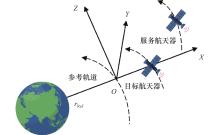
Fig.1
Virtual moving point LVLH coordinate system"
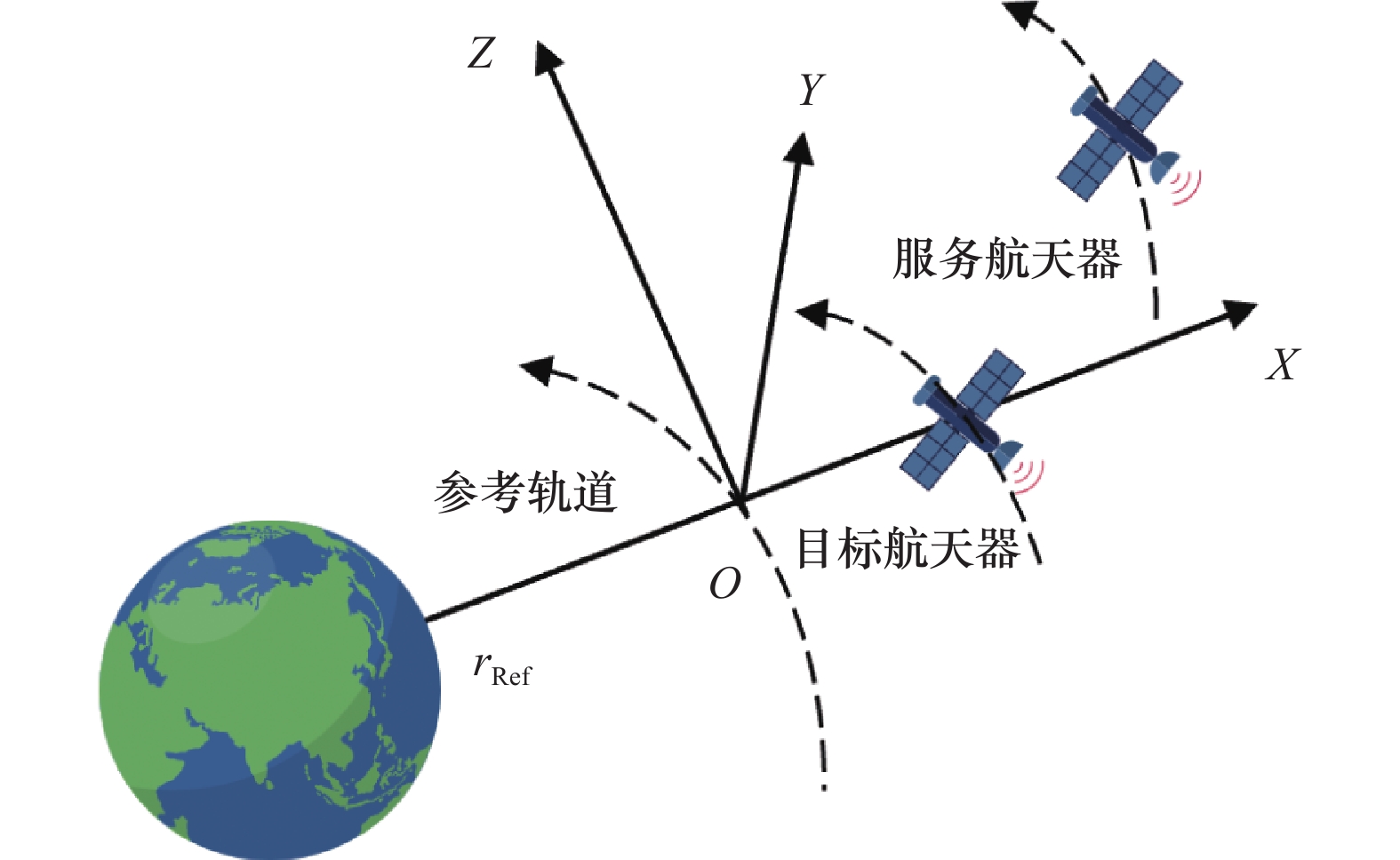
Table 1
Comparison of dynamical models"
| 模型 | 适用场景 | 优点 | 缺点 |
| 脉冲 推力 | 操控性较强的 场景 | 燃料利用率高, 适合快速变轨 | 描述和求 解过程更 加复杂 |
| 连续 推力 | 信息不对称 及操控性稍 弱的场景 | 可以在较长时 间内对轨道和 速度进行精细 调整 | 不适用于 需要快速 响应的任务 |
Table 2
Comparison of volume types"
| 控制类型 | 适用场景 | 优点 | 缺点 |
| 一对一 | 简单的空间任务场景 | 模型简单,易于分析,可以得到最优解 | 对模型误差的适应性较差,难以实时决策 |
| 多航天器 | 高动态、大范围的机动控制场景 | 机动性强,具有快速响应能力,灵活度高,系统弹性强 | 模型复杂,计算量大,对算法设计和优化要求高 |
Table 3
Comparison of different solution methods"
| 方法 | 说明 | 优势 | 缺点 |
| 微分对策法 | 通过对机动控制问题数学建模,用微分方程表达对策规律,最后通过解析法或数值法对方程进行求解,得到双方最优控制率 | (1)具有数学理论支撑,有一定可解释性 (2)在适用的场景下能够精确地求解出最优策略 | (1)对成本函数的设计有一定的约束,过于复杂的成本函数无法利用传统的方法进行求解 (2)需要系统的模型才能使用 |
| 人工智能 方法 | 以MADDPG、深度Q学习算法(deep Q-learning,DQN)、自适应动态规划(adaptive/approximate dynamic programming,ADP)为代表,对机动控制双方控制策略进行实时求解 | (1)网络可学习智能体策略行为,不受模型影响 (2)能够利用复杂的成本函数对任务需求进行更为贴切的描述 (3)应用场景更广泛 | (1)需要一定的数据样本 (2)训练耗时较长 (3)相较微分对策法而言,可解释性较差 |
| 生物群体智能算法 | 以蚁群、蜂群、狼群为代表,分析双方遵循的规则,侧重于建模个体行为以及局部存在的规则 | (1)具有良好的并行和全局搜索能力 (2)对于问题的初始条件和参数设置不敏感,鲁棒性较好 | (1)参数选择困难 (2)收敛速度慢 (3)可能陷入局部最优解 |
| 1 |
朱彦伟, 张乘铭, 杨傅云翔, 等. 航天器轨道追逃动力学与控制问题研究综述[J]. 国防科技大学学报, 2024, 46 (3): 1- 11.
doi: 10.11887/j.cn.202403001 |
|
ZHU Y W, ZHANG C M, YANG F Y X, et al. Survey on dynamics and control problem research in spacecraft orbital pursuit-evasion game[J]. Journal of National University of Defense Technology, 2024, 46 (3): 1- 11.
doi: 10.11887/j.cn.202403001 |
|
| 2 | 李兆航, 温昶煊, 乔栋, 等. 基于可达集的航天器多对一轨道博弈几何求解[J]. 航空学报, 2024, 45 (S1): 730803. |
| LI Z H, WEN C X, QIAO D, et al. Research on multiple-pursuer/one-evader orbital pursuit-evasion game based on reachable set theory[J]. Acta Aeronautica et Astronautica Sinica, 2024, 45 (S1): 730803. | |
| 3 | STUPIK J, PONTANI M, CONWAY B. Optimal pursuit/evasion spacecraft trajectoriesin the hill reference frame [C]// Proc. of the AIAA/AAS Astrodynamics Specialist Conference, 2012: 4882. |
| 4 |
LIAO T, LI S L, CHEN X L, et al. Numerical solution of spacecraft pursuit-Evasion-Capture game based on progressive shooting method[J]. Proceedings of the Institution of Mechanical Engineers, Part G: Journal of Aerospace Engineering, 2023, 237 (12): 2874- 2886.
doi: 10.1177/09544100231164269 |
| 5 |
张秋华, 孙松涛, 谌颖, 等. 时间固定的两航天器追逃策略及数值求解[J]. 宇航学报, 2014, 35 (5): 537- 544.
doi: 10.3873/j.issn.1000-1328.2014.05.007 |
|
ZHANG Q H, SUN S T, CHEN Y, et al. Strategy and numerical solution of pursuit-evasion with fixed duration for two spacecraft[J]. Journal of Astronautics, 2014, 35 (5): 537- 544.
doi: 10.3873/j.issn.1000-1328.2014.05.007 |
|
| 6 | JAGAT A, SINCLAIR A J. Optimization of spacecraft pursuit-evasion game trajectories in the Euler-Hill reference frame [C]// Proc. of the AIAA/AAS Astrodynamics Specialist Conference, 2014: 4131. |
| 7 |
JAGAT A, SINCLAIR A J. Nonlinear control for spacecraft pursuit-evasion game using the state-dependent Riccati equation method[J]. IEEE Trans. on Aerospace and Electronic Systems, 2017, 53 (6): 3032- 3042.
doi: 10.1109/TAES.2017.2725498 |
| 8 | LI Z Y, ZHU H, YANG Z, et al. A dimension-reduction solution of free-time differential games for spacecraft pursuit-evasion[J]. Acta Astronautica, 2019, 163 (1): 201- 210. |
| 9 | KELLEY H J, CLIFF E M, LUTZE F H. Pursuit evasion in orbit[J]. Journal of the Astronautical Sciences, 1981, 29 (3): 277- 288. |
| 10 | BURK R C, WIDHALML J W. Minimum impulse orbital evasive maneuvers[J]. Journal of Guidance, Control, and Dynamics, 1989, 12 (1): 121- 123. |
| 11 | YU D T, WANG H, GUO S, et al. Analytical approach for orbital evasion with space geometry considered [J]. International Journal of Aerospace Engineering, 2017(1): 4164260. |
| 12 | VENIGALLA C, SCHEERES D J. Space rendezvous and pursuit/evasion analysis using reachable sets [C]// Proc. of the Space Flight Mechanics Meeting, 2018. |
| 13 |
ZHAO L R, ZHANG Y L, DANG Z H. PRD-MADDPG: an efficient learning-based algorithm for orbital pursuit-evasion game with impulsive maneuvers[J]. Advances in Space Research, 2023, 72 (2): 211- 230.
doi: 10.1016/j.asr.2023.03.014 |
| 14 |
WANG H B, ZHANG Y, LIU H, et al. Impulsive thrust strategy for orbital pursuit-evasion games based on impulse-like constraint[J]. Chinese Journal of Aeronautics, 2025, 38 (1): 103180.
doi: 10.1016/j.cja.2024.08.011 |
| 15 |
HAN H Y, DANG Z H. Optimal delta-V-based strategies in orbital pursuit-evasion games[J]. Advances in Space Research, 2023, 72 (2): 243- 256.
doi: 10.1016/j.asr.2023.03.028 |
| 16 |
王强, 叶东, 范宁军, 等. 含有J2项摄动的卫星追逃轨道优化[J]. 北京理工大学学报, 2017, 37 (4): 418- 423.
doi: 10.15918/j.tbit1001-0645.2017.04.017 |
|
WANG Q, YE D, FAN N J, et al. Pursuit evasion game with J2 perturbation[J]. Transactions of Beijing Institute of Technology, 2017, 37 (4): 418- 423.
doi: 10.15918/j.tbit1001-0645.2017.04.017 |
|
| 17 | PRINCE E R, HESS J A, COBB R G, et al. Elliptical orbit proximity operations differential games[J]. Journal of Guidance, Control, and Dynamics, 2019, 42 (7): 1458- 1472. |
| 18 | STUPIK J. Optimal pursuit/evasion spacecraft trajectories in the hill reference frame [D]. Champaign-Urbana: University of Illinois at Urbana-Champaign, 2013. |
| 19 | PONTANI M, CONWAY B. Particle swarm optimization applied to space trajectories[J]. Journal of Guidance, Control, and Dynamics, 2010, 33 (5): 1429- 1441. |
| 20 | HAFER W T, REED H L, TURNER J D, et al. Sensitivity methods applied to orbital pursuit evasion[J]. Journal of Guidance, Control, and Dynamics, 2015, 38 (6): 1118- 1126. |
| 21 |
XU Y M, QI N M, LI Z, et al. Research on proximity strategies for pursuit-evasion game with non-cooperative targets in space[J]. Aerospace Science and Technology, 2025, 158, 109899.
doi: 10.1016/j.ast.2024.109899 |
| 22 |
SUN S T, ZHANG Q H, LOXTON R, et al. Numerical solution of a pursuit-evasion differential game involving two spacecraft in low earth orbit[J]. Journal of Industrial and Management Optimization, 2015, 11 (4): 1127- 1147.
doi: 10.3934/jimo.2015.11.1127 |
| 23 | LI Z Y, ZHU H, YANG Z, et al. Saddle point of orbital pursuit-evasion game under J2-perturbed dynamics[J]. Journal of Guidance, Control, and Dynamics, 2020, 43 (9): 1733- 1739. |
| 24 |
张秋华, 赵小津, 孙毅. 空间飞行器在视线坐标系中的追逃界栅[J]. 航天控制, 2007, 25 (1): 26- 30.
doi: 10.3969/j.issn.1006-3242.2007.01.007 |
|
ZHANG Q H, ZHAO X Z, SUN Y. Pursuit-evasion barrier of two spacecrafts based on the sightline coordinate system[J]. Aerospace Control, 2007, 25 (1): 26- 30.
doi: 10.3969/j.issn.1006-3242.2007.01.007 |
|
| 25 |
SHI M M, YE D, SUN Z W, et al. Spacecraft orbital pursuit-evasion games with J2 perturbations and direction-constrained thrust[J]. Acta Astronautica, 2023, 202, 139- 150.
doi: 10.1016/j.actaastro.2022.10.004 |
| 26 |
YE D, SHI M M, SUN Z W. Satellite proximate pursuit-evasion game with different thrust configurations[J]. Aerospace Science and Technology, 2020, 99, 105715.
doi: 10.1016/j.ast.2020.105715 |
| 27 | HAN H Y, DANG Z H. Models and strategies for J2-perturbed orbital pursuit-evasion games[J]. Space: Science & Technology, 2024, 4 (1): 39- 51. |
| 28 | LIU Y C, LI C Y, JIANG J, et al. A model predictive Stackelberg solution to orbital pursuit-evasion game[J]. Chinese Journal of Aeronautics, 2025, 38 (2): 103198. |
| 29 |
WU J F, WEI C L, ZHANG H B, et al. Learning-based spacecraft reactive anti-hostile-rendezvous maneuver control in complex space environments[J]. Advances in Space Research, 2023, 72 (10): 4531- 4552.
doi: 10.1016/j.asr.2023.08.043 |
| 30 |
QU Q Y, LIU K X, WANG W, et al. Spacecraft proximity maneuvering and rendezvous with collision avoidance based on reinforcement learning[J]. IEEE Trans. on Aerospace and Electronic Systems, 2022, 58 (6): 5823.
doi: 10.1109/TAES.2022.3180271 |
| 31 |
LI Z Y, LUO Y Z. Deep reinforcement learning for Nash equilibrium of differential games[J]. IEEE Trans. on Neural Networks and Learning Systems, 2025, 36 (2): 2747- 2761.
doi: 10.1109/TNNLS.2024.3351631 |
| 32 |
WAN K F, WU D W, ZHAI Y W, et al. An improved approach towards multi-agent pursuit evasion game decision-making using deep reinforcement learning[J]. Entropy, 2021, 23 (11): 1433.
doi: 10.3390/e23111433 |
| 33 |
NI W L, LIU J Q, LI Z, et al. Cooperative guidance strategy for active spacecraft protection from a homing interceptor via deep reinforcement learning[J]. Mathematics, 2023, 11 (19): 4211.
doi: 10.3390/math11194211 |
| 34 |
GONG X P, CHEN W C, CHEN Z Y. Intelligent game strategies in target-missile-defender engagement using curriculum-based deep reinforcement learning[J]. Aerospace, 2023, 10 (2): 133.
doi: 10.3390/aerospace10020133 |
| 35 | 陈木生. 基于微分对策及协同进化算法的三航天器追逃策略求解[D]. 哈尔滨: 哈尔滨工业大学, 2021. |
| CHEN M S. Solving the pursuit-evasion strategies of three spacecrafts based on differential game and coevolution algorithm[D]. Harbin: Harbin Institute of Technology, 2021. | |
| 36 |
LI Z Y. Orbital pursuit-evasion-defense linear-quadratic differential game[J]. Aerospace, 2024, 11 (6): 443.
doi: 10.3390/aerospace11060443 |
| 37 |
刘坤, 郑晓帅, 林业茗, 等. 基于微分博弈的追逃问题最优策略设计[J]. 自动化学报, 2021, 47 (8): 1840- 1854.
doi: 10.16383/j.aas.c200979 |
|
LIU K, ZHENG X S, LIN Y M, et al. Design of optimal strategies for the pursuit-evasion problem based on differential game[J]. Acta Automatica Sinica, 2021, 47 (8): 1840- 1854.
doi: 10.16383/j.aas.c200979 |
|
| 38 | TANG X, YE D, LOW K S, et al. Multi-spacecraft pursuit-evasion-defense strategy based on game theory for on-orbit spacecraft servicing[C]//Proc. of the IEEE Aerospace Conference, 2023. |
| 39 |
LI Y F, LIANG X, DANG Z H. Nash-equilibrium strategies of orbital target-attacker-defender game with a non-maneuvering target[J]. Chinese Journal of Aeronautics, 2024, 37 (10): 365- 379.
doi: 10.1016/j.cja.2024.06.002 |
| 40 | WU B L, CHEN K Y, WANG D W, et al. Spacecraft attitude takeover control by multiple microsatellites using differential game[J]. IEEE Trans. on Control of Network Systems, 2023, 11 (1): 1- 12. |
| 41 |
CHAI Y, LUO J J, MA W H. Data-driven game-based control of microsatellites for attitude takeover of target spacecraft with disturbance.[J]. ISA Transactions, 2022, 119, 93- 105.
doi: 10.1016/j.isatra.2021.02.037 |
| 42 | LACHNER R, BREITNER M H, PESCH H J. Three-dimensional air combat: numerical solution of complex differential games [M]. Birkhäuser Boston: Springer, 1995. |
| 43 |
RAIVIO T, EHTAMO H. Visual aircraft identification as a pursuit-evasion game[J]. Journal of Guidance, Control, and Dynamics, 2000, 23 (4): 701- 708.
doi: 10.2514/2.4586 |
| 44 |
EHTAMO H, RAIVIO T. On applied nonlinear and bi-level programming for pursuit-evasion games[J]. Journal of Optimization Theory and Applications, 2001, 108, 65- 96.
doi: 10.1023/A:1026461805159 |
| 45 | SHEN H X, CASALINO L. Revisit of the three-dimensional orbital pursuit-evasion game[J]. Journal of Guidance, Control, and Dynamics, 2018, 41 (8): 1823- 1831. |
| 46 |
ANDERSON G M, GRAZIER V W. Barrier in pursuit-evasion problems between two low-thrust orbital spacecraft[J]. AIAA Journal, 1976, 14 (2): 158- 163.
doi: 10.2514/3.61350 |
| 47 | MENON P K A, CALISE A J. Guidance laws for spacecraft pursuit-evasion and rendezvous [C]// Proc. of the AIAA Guidance, Navigation, and Control Conference, 1988: 668−697. |
| 48 | HAFER W T. Sensitivity methods applied to orbital pursuit-evasion [D]. Texas: Texas A&M University, 2017. |
| 49 |
LI Z Y, ZHU H, YANG Z, et al. A dimension-reduction solution of free-time differential games for spacecraft pursuit-evasion[J]. Acta Astronautica, 2019, 163, 201- 210.
doi: 10.1016/j.actaastro.2019.01.011 |
| 50 |
WANG Q S, LI P, LEI T, et al. A dimension-reduction method for the finite-horizon spacecraft pursuit-evasion game.[J]. Journal of Industrial and Management Optimization, 2023, 19 (3): 1983- 1998.
doi: 10.3934/jimo.2022028 |
| 51 |
FU S Y, GONG S P, SHI P. Analytical pursuit-evasion game strategy in arbitrary Keplerian reference orbits[J]. Aerospace Science and Technology, 2025, 158, 109946.
doi: 10.1016/j.ast.2025.109946 |
| 52 | CRUCK E, QUINCAMPOIX M, SAINT-PIERRE P. Pursuit-evasion games with impulsive dynamics[J]. Advances in Dynamic Game Theory, 2007, 9, 223- 247. |
| 53 | GARCIA E, MURANO D A. State estimation for a class of nonlinear differential games using differential neural networks [C]// Proc. of the American Control Conference, 2011: 2486−2491. |
| 54 |
TAHK M J, SUN B C. Co-evolutionary augmented Lagrangian methods for constrained optimization[J]. IEEE Trans. on Evolutionary Computation, 2000, 4 (2): 114- 124.
doi: 10.1109/4235.850652 |
| 55 | 吴其昌, 张洪波. 基于生存型微分对策的航天器追逃策略及数值求解[J]. 控制与信息技术, 2019, (4): 39- 43. |
| WU Q C, ZHANG H B. Spacecraft pursuit strategy and numerical solution based on survival differential strategy[J]. Control and Information Technology, 2019, (4): 39- 43. | |
| 56 |
WANG C G, CHEN D H, LIAO W H. Interactive multiple-model learning filter for spacecraft pursuit-evasion game strategy switch based on long short-term memory network[J]. Aerospace, 2024, 11 (11): 894.
doi: 10.3390/aerospace11110894 |
| 57 | FANG H, XIAO H W, LV Y Y, et al. L2-gain stabilized attitude control for combined spacecraft[C]// Proc. of the 37th Chinese Control and Decision Conference, 2020. |
| 58 |
ZHENG Z X, ZHANG P, YUAN J P. Nonzero-sum pursuit-evasion game control for spacecraft systems: a Q-learning method[J]. IEEE Trans. on Aerospace and Electronic Systems, 2023, 59 (4): 3971- 3981.
doi: 10.1109/TAES.2023.3235873 |
| 59 | ZHANG C M, ZHU Y W, YANG L P, et al. An optimal guidance method for free-time orbital pursuit-evasion game[J]. Journal of Systems Engineering and Electronics, 2022, 33 (6): 1294- 1308. |
| 60 | LINVILLE D, BETTINGER R A. An argument against satellite resiliency: simplicity in the face of modern satellite design[J]. Air & Space Power Journal, 2020, 34 (1): 43- 53. |
| 61 |
YANG F Y X, YANG L P, ZHU Y W. An AutoML based trajectory optimization method for long-distance spacecraft pursuit-evasion game[J]. Journal of Systems Engineering and Electronics, 2023, 34 (3): 754- 765.
doi: 10.23919/JSEE.2023.000060 |
| 62 |
SUN Q B, DANG Z H. Deep neural network for non-cooperative space target intention recognition[J]. Aerospace Science and Technology, 2023, 142, 108681.
doi: 10.1016/j.ast.2023.108681 |
| 63 | CAVALIERI K A, MACOMBER B, MOODY C, et al. Laboratory experiments autonomous space debris mitigation [C]// Proc. of the Annual AAS Rocky Mountain Guidance and Control Conference, 2013: 3−16. |
| 64 | WOODBURY T, ARTHURS F, VALASEK J. Flight test results of observer/Kalman filter identification of the pegasus unmanned vehicle [C]// Proc. of the AIAA Atmospheric Flight Mechanics Conference, 2015. |
| 65 |
袁斐然, 刘春生, 陈必露. 基于自适应动态规划的多对一追逃博弈策略[J]. 电光与控制, 2022, 29 (1): 1- 6.
doi: 10.3969/j.issn.1671-637X.2022.01.001 |
|
YUAN F R, LIU C S, CHEN B L. Many-to-one pursuit-evasion game strategy based on adaptive dynamic programming[J]. Electronics Optics & Control, 2022, 29 (1): 1- 6.
doi: 10.3969/j.issn.1671-637X.2022.01.001 |
|
| 66 |
许旭升, 党朝辉, 宋斌, 等. 基于多智能体强化学习的轨道追逃博弈方法[J]. 上海航天, 2022, 39 (2): 24- 31.
doi: 10.19328/j.cnki.2096?8655.2022.02.004 |
|
XU X S, DANG Z H, SONG B, et al. Method for cluster satellite orbit pursuit-evasion game based on multi-agent deep deterministic policy gradient algorithm[J]. Aerospace Shanghai (Chinese & English), 2022, 39 (2): 24- 31.
doi: 10.19328/j.cnki.2096?8655.2022.02.004 |
|
| 67 |
ZHANG J R, ZHANG K P, ZHANG Y, et al. Near-optimal interception strategy for orbital pursuit-evasion using deep reinforcement learning[J]. Acta Astronautica, 2022, 198, 9- 25.
doi: 10.1016/j.actaastro.2022.05.057 |
| 68 |
LIU Y F, QI N M, TANG Z W. Effects of divert-thrusters on homing performance of endoatmospheric interceptors[J]. Journal of Optimization Theory and Applications, 2013, 156 (2): 345- 364.
doi: 10.1007/s10957-012-0119-1 |
| 69 | REYNOLDS C W. Flocks, herds and schools: a distributed behavioral model[C]. ACM SIGGRAPH Computer Graphics, 1987, 21(4): 25−34. |
| 70 |
华冰, 刘睿鹏, 孙胜刚, 等. 一种基于自适应种群变异鸽群优化的航天器集群轨道规划方法[J]. 中国科学(技术科学), 2020, 50 (4): 453- 460.
doi: 10.1360/SST-2019-0285 |
|
HUA B, LIU R P, SUN S G, et al. Spacecraft cluster orbit planning method based on adaptive population mutated pigeon group optimization[J]. Scientia Sinica (Technologica), 2020, 50 (4): 453- 460.
doi: 10.1360/SST-2019-0285 |
|
| 71 |
郭延宁, 李高健, 于永彬. 基于改进蜣螂优化的GEO轨道多脉冲追逃博弈[J]. 中国空间科学技术, 2024, 44 (4): 1- 10.
doi: 10.16708/j.cnki.1000-758X.2024.0052 |
|
GUO Y N, LI G J, YU Y B. Multi-impulse pursuit-evasion game in GEO based on improved dung beetle optimization[J]. Chinese Space Science and Technology, 2024, 44 (4): 1- 10.
doi: 10.16708/j.cnki.1000-758X.2024.0052 |
|
| 72 |
刘彦昊, 佘浩平, 蒙波, 等. 基于狼群优化的卫星集群对空间目标围捕方法[J]. 北京航空航天大学学报, 2024, 50 (12): 3863- 3871.
doi: 10.13700/j.bh.1001-5965.2022.0877 |
|
LIU Y H, SHE H P, MENG B, et al. Round-up method of space target by satellites swarm based on wolf pack optimization[J]. Journal of Beijing University of Aeronautics and Astronautics, 2024, 50 (12): 3863- 3871.
doi: 10.13700/j.bh.1001-5965.2022.0877 |
|
| 73 | XIA C J, JIA Q X, CHEN G. Fine manipulation simulation of AMMA300 7-DOF robot[C]//Proc. of the 12th IEEE Conference on Industrial Electronics and Application, 2018: 1327−1331. |
| 74 | 孙本. 无人机集群目标定位与跟踪最优机动轨迹研究[D]. 南京: 南京理工大学, 2021. |
| SUN B. Research on the optimal maneuvering trajectory of UAV cluster target localization and tracking[D]. Nanjing: Nanjing University of Science & Technology, 2021. | |
| 75 | 张震, 方群, 宋金丰, 等. 基于协同粒子群算法的航天器集群动态路径规划算法研究[J]. 西北工业大学学报, 2021, 39(6): 1222−1232. |
| ZHANG Z, FANG Q, SONG J F, et al. research on dynamic path planning algorithm of spacecraft cluster based on cooperative particle swarm algorithm[J]. Journal of Northwestern Polytechnical University, 2021, 39(6): 1222−1232. | |
| 76 |
WU W N, CHEN J, LIU J. A hybrid optimisation method for intercepting satellite trajectory based on differential game[J]. The Aeronautical Journal, 2023, 127 (1312): 900- 922.
doi: 10.1017/aer.2022.102 |
| 77 |
ZHANG Z X, ZHANG K, XIE X P, et al. Fixed-time zero-sum pursuit-evasion game control of multi-satellite via adaptive dynamic programming[J]. IEEE Trans. on Aerospace and Electronic Systems, 2024, 60 (2): 2224- 2235.
doi: 10.1109/TAES.2024.3351810 |
| 78 | GUO Y N, LI G J, YU Y B. Multi-impulse pursuit-evasion game in GEO based on improved dung beetle optimization[J]. Chinese Space Science and Technology, 2024, 44 (4): 1- 10. |
| [1] | Chuanlong SONG, Qianwu ZHANG, Jian HE, Wenjun ZHOU, Hui WANG, Weiwei KONG, Wenbo TIAN. Edge computing task offloading method of satellite-ground collaborative based on MADDPG algorithm [J]. Systems Engineering and Electronics, 2026, 48(1): 350-360. |
| [2] | Xiaolong WEI, Yarong WU, Dengkai YAO, Guhao ZHAO. Hierarchical decision-making algorithm for UAV air combat maneuvering based on deep reinforcement learning [J]. Systems Engineering and Electronics, 2025, 47(9): 2993-3003. |
| [3] | Zhimu YANG, Shaojie ZHANG, Chaoyuan ZHANG, Haoyu WANG, Maomao ZHAO. Design of missile anti-collision cooperative guidance law based on differential game [J]. Systems Engineering and Electronics, 2025, 47(8): 2667-2675. |
| [4] | Yundou ZHU, Haiquan SUN, Xiaoxuan HU. Multi-satellite cooperative imaging task planning method based on pointer network architecture [J]. Systems Engineering and Electronics, 2025, 47(7): 2246-2255. |
| [5] | Linzhi MENG, Xiaojuan SUN, Yuxin HU, Bin GAO, Guoqing SUN, Wenhao MU. Reinforcement learning task scheduling algorithm for satellite on-orbit processing [J]. Systems Engineering and Electronics, 2025, 47(6): 1917-1929. |
| [6] | Kangjie ZHENG, Xinyu ZHANG, Weisong WANG, Zhensheng LIU. Intelligent ship dynamic autonomous obstacle avoidance decision based on DQN and rule [J]. Systems Engineering and Electronics, 2025, 47(6): 1994-2001. |
| [7] | Shuhan LIU, Tong LI, Fuqiang LI, Chungang YANG. Intent and situation-dual driven anti-jamming communication mechanism for data link [J]. Systems Engineering and Electronics, 2025, 47(6): 2055-2064. |
| [8] | Wei XIONG, Dong ZHANG, Zhi REN, Shuheng YANG. Research on intelligent decision-making methods for coordinated attack by manned aerial vehicles and unmanned aerial vehicles [J]. Systems Engineering and Electronics, 2025, 47(4): 1285-1299. |
| [9] | Peng MA, Rui JIANG, Bin WANG, Mengfei XU, Changbo HOU. Strategy reconstruction for resilience against intelligence jamming based on implicit opponent modeling [J]. Systems Engineering and Electronics, 2025, 47(4): 1355-1363. |
| [10] | Kaiqiang TANG, Huiqiao FU, Jiasheng LIU, Guizhou DENG, Chunlin CHEN. Hierarchical optimization research of constrained vehicle routing based on deep reinforcement learning [J]. Systems Engineering and Electronics, 2025, 47(3): 827-841. |
| [11] | Xiarong CHEN, Jichao LI, Gang CHEN, Peng LIU, Jiang JIANG. Portfolio of weapon system-of-systems based on heterogeneous information networks [J]. Systems Engineering and Electronics, 2025, 47(3): 855-861. |
| [12] | Yang LIU, Fanyi MENG, Gang CHEN. Reinforcement learning based disturbance rejection compensation control method for morphing aircraft [J]. Systems Engineering and Electronics, 2025, 47(12): 4130-4142. |
| [13] | Yaozhong ZHANG, Zhuoran WU, Jiandong ZHANG, Qiming YANG, Guoqing SHI, Zixiang XU. UAV many-to-one pursuit-evasion game based on ME-DDPG algorithm [J]. Systems Engineering and Electronics, 2025, 47(10): 3288-3299. |
| [14] | Dong SUI, Xiangrong CAI. Continual learning mechanism for intelligent flight conflict resolution algorithm [J]. Systems Engineering and Electronics, 2025, 47(10): 3300-3312. |
| [15] | Tingyu ZHANG, Ying ZENG, Nan LI, Hongzhong HUANG. Spacecraft power-signal composite network optimization algorithm based on DRL [J]. Systems Engineering and Electronics, 2024, 46(9): 3060-3069. |
| Viewed | ||||||
|
Full text |
|
|||||
|
Abstract |
|
|||||