Systems Engineering and Electronics ›› 2026, Vol. 48 ›› Issue (7): 2293-2306.doi: 10.12305/j.issn.1001-506X.2026.07.15
• Systems Engineering • Previous Articles
A satellite and UAV joint mission planning method based on a reinforcement hybrid genetic algorithm
Tianran YIN1, He LUO1,2,3, Yue SHI1, Xiaodie QIANG1, Guoqiang WANG1,2,3
- 1. School of Management,Hefei University of Technology,Hefei 230009,China
2. Key Laboratory of Process Optimization and Intelligent Decision-Making,Ministry of Education,Hefei 230009,China
3. Engineering Research Center for Intelligent Management of Aerospace System,Hefei 230009,China
-
Received:2025-06-30Revised:2025-09-09Online:2026-01-27Published:2026-01-27 -
Contact:Guoqiang WANG

CLC Number:
Cite this article
Tianran YIN, He LUO, Yue SHI, Xiaodie QIANG, Guoqiang WANG. A satellite and UAV joint mission planning method based on a reinforcement hybrid genetic algorithm[J]. Systems Engineering and Electronics, 2026, 48(7): 2293-2306.
share this article
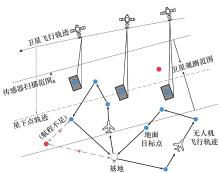
Fig.1
Schematic diagram of joint mission planning process for satellite and unmanned aerial vehicle"
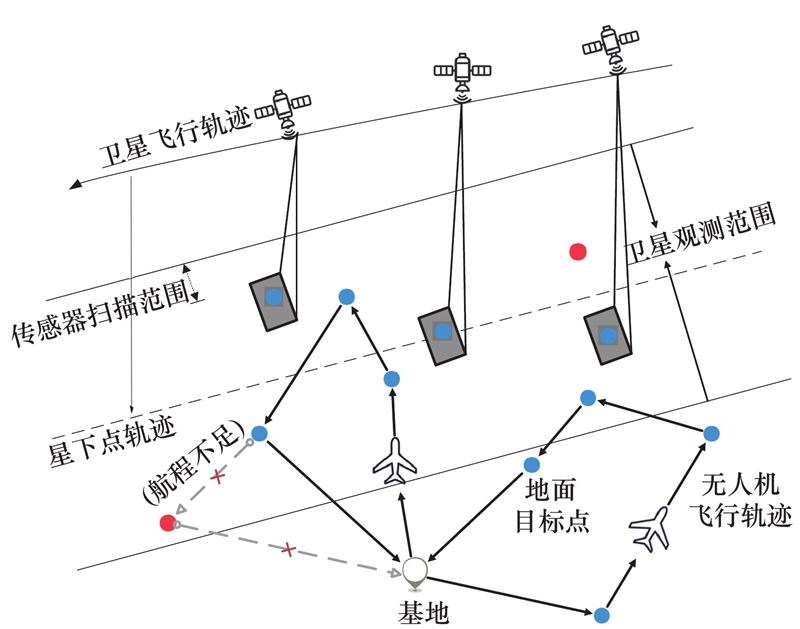
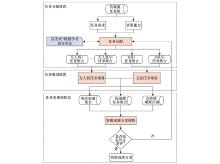
Fig.2
Framework diagram of satellite and unmanned aerial vehicle joint mission planning"
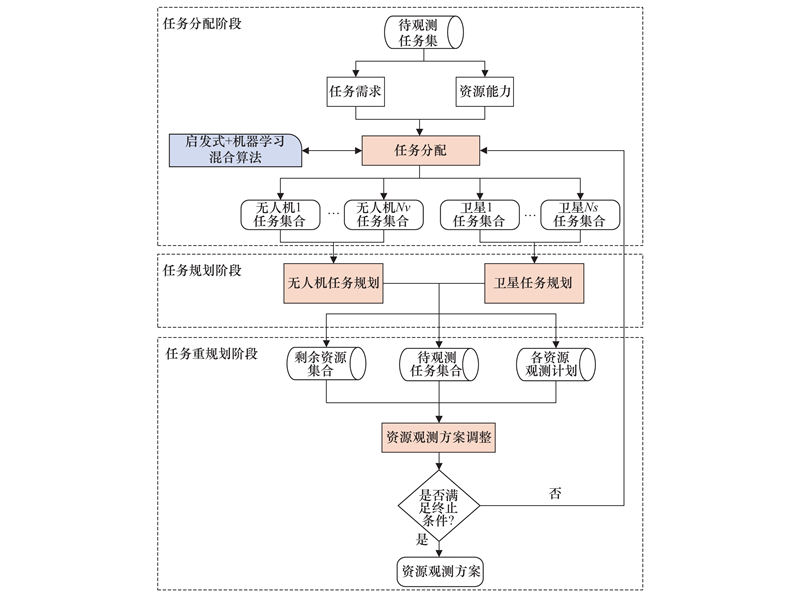
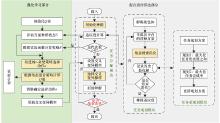
Fig.3
Schematic diagram of RHGA framework"
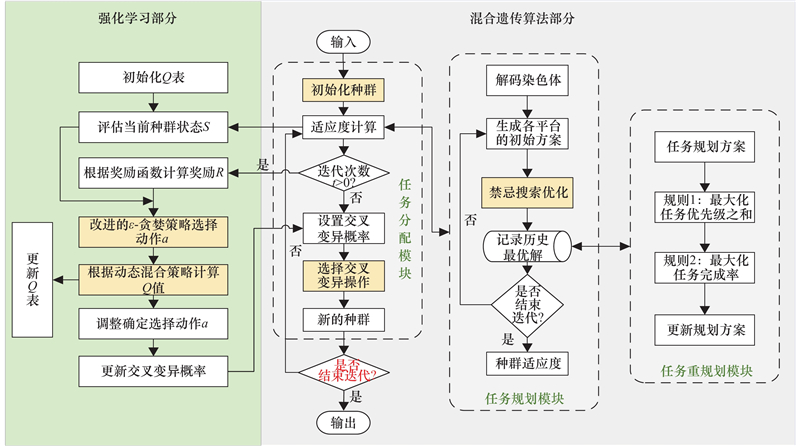
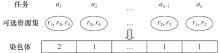
Fig.4
Chromosome coding diagram"
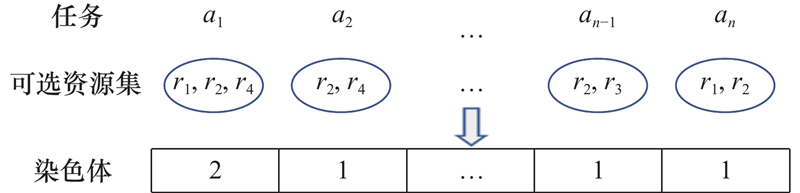
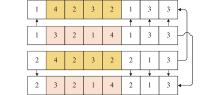
Fig.5
Schematic diagram of chromosome crossover"
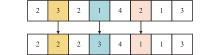
Fig.6
Schematic diagram of chromosome mutation"
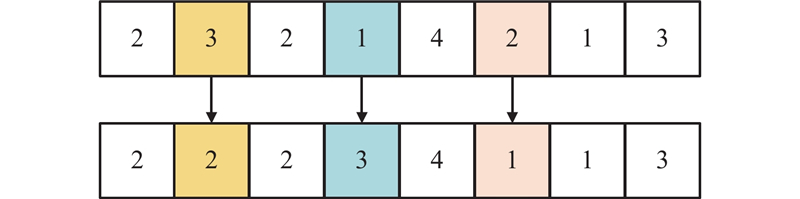
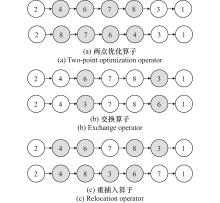
Fig.7
Unmanned aerial vehicle neighborhood search operator"
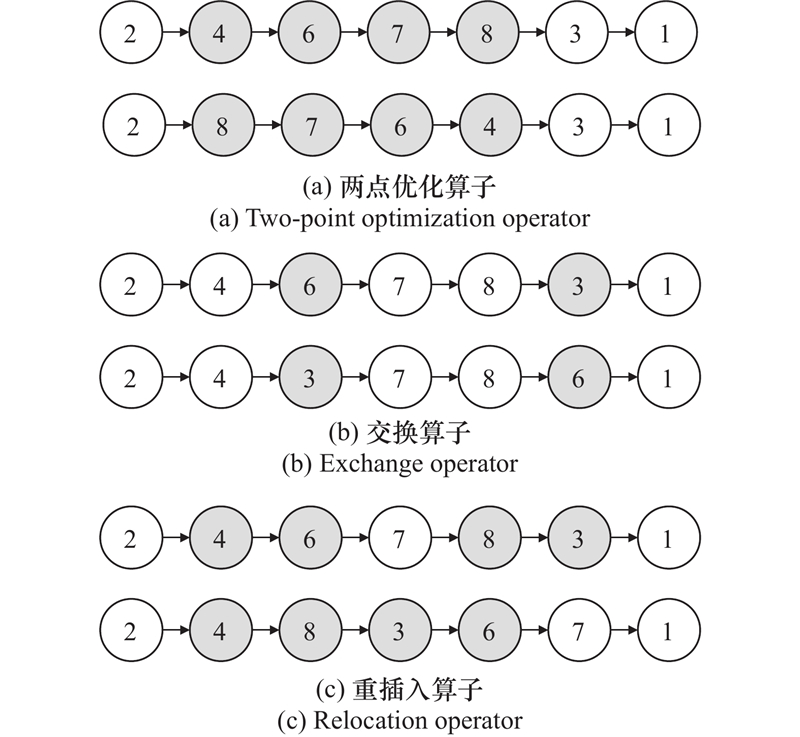
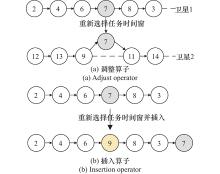
Fig.8
Satellite neighborhood search operator"
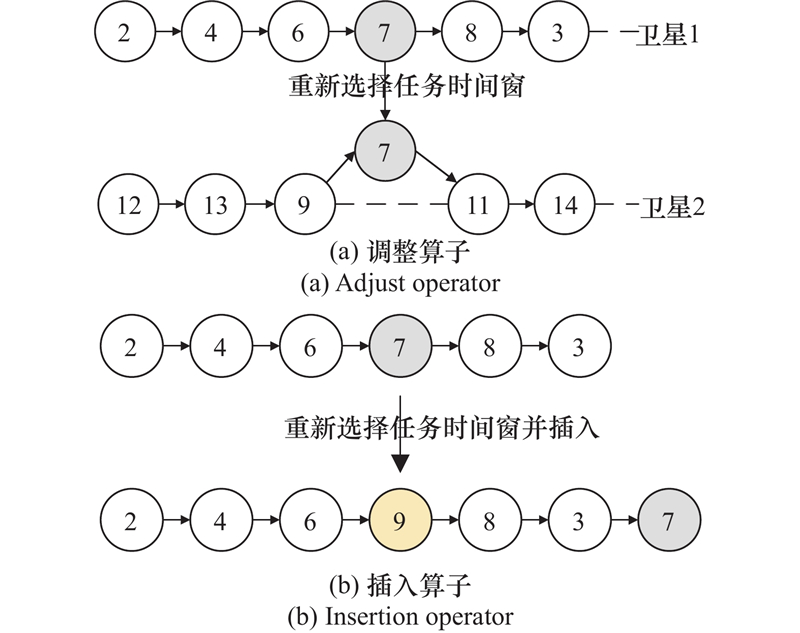
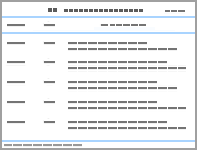
Table 1
Table of resource-related parameters for mission planning"
| 参数名称 | 符号 | 设置 |
| 任务点数量 | m | [50,400] |
| 任务点优先级 | [1,10] | |
| 任务所需观测时间/s | [10,60] | |
| 无人机基地坐标 | (25°,119°) | |
| 无人机、卫星数量组合 | − | {(5,4),(10,8)} |
| 无人机平均飞行速度/(km/h) | 200 | |
| 无人机最大巡航距离/km | ||
| 卫星侧摆单位角度电量消耗/(Wh/°) | 0.6 | |
| 卫星调度周期的最大电量/Wh | ||
| 任务图像分辨率需求/(m/pixel) | [1,3] | |
| 资源图像分辨率/(m/pixel) | {0.5,1,2,3} | |
| 任务的可见时间窗长度/h | − | 12 |
Table 2
Orthogonal experimental table of RHGA"
| 参数 | 范围 | 水平1 | 水平2 | 水平3 |
| 种群规模N | 30~50 | 30 | 40 | 50 |
| 遗传迭代次数It1 | 200~300 | 200 | 250 | 300 |
| 禁忌迭代次数It2 | 600~800 | 600 | 700 | 800 |
| 禁忌表长度L | 20~40 | 20 | 30 | 40 |
| 学习率α | 0.1~0.2 | 0.1 | 0.15 | 0.2 |
| 折扣率γ | 0.85~0.95 | 0.85 | 0.9 | 0.95 |
| 勘探速率ε | 0.85~0.95 | 0.85 | 0.9 | 0.95 |
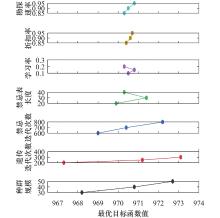
Fig.9
Main effects diagram of the RHGA under large-scale scenario"
Table 3
Parameter combinations of each algorithm in the solving performance comparison experiments"
| 算例规模 | 算法名称 | 交叉概率 | 变异概率 | 种群规模 | 分配迭代次数 | 禁忌迭代次数 | 禁忌表长 | 学习率 | 折扣率 | 勘探速率 |
| 小规模 | RHGA | − | − | 50 | 300 | 800 | 30 | 0.1 | 0.9 | 0.9 |
| HGPT | 0.7 | 0.3 | 50 | 500 | 2 000 | 30 | − | − | − | |
| GA | 0.85 | 0.3 | 200 | − | − | − | − | − | ||
| EGA | 0.9 | 0.3 | 200 | 800 | 20 | − | − | − | ||
| RTS | − | − | − | 300 | 800 | 20 | 0.15 | 0.9 | 0.9 | |
| 大规模 | RHGA | − | − | 50 | 300 | 800 | 30 | 0.15 | 0.95 | 0.95 |
| HGPT | 0.7 | 0.3 | 30 | 500 | 2 000 | 40 | − | − | − | |
| GA | 0.8 | 0.3 | 200 | − | − | − | − | − | ||
| EGA | 0.8 | 0.5 | 100 | 800 | 30 | − | − | − | ||
| RTS | − | − | − | 300 | 40 | 0.1 | 0.95 | 0.95 |
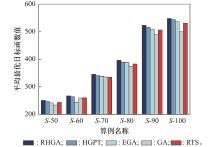
Fig.10
Comparison diagram of solution under small-scale scenario"
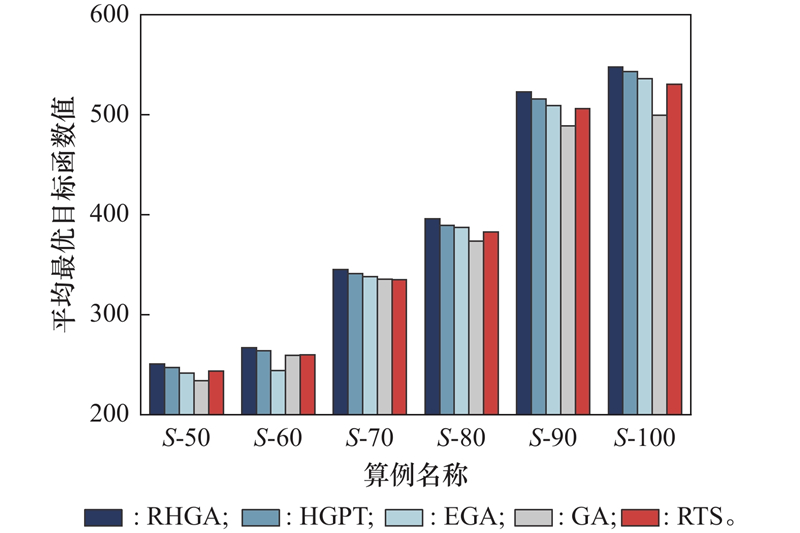
Fig.11
Comparison diagram of solution under large-scale scenario"
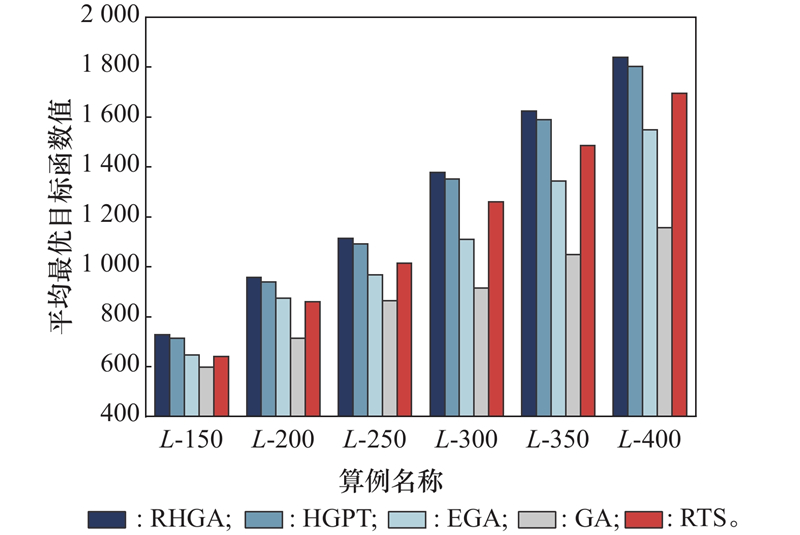
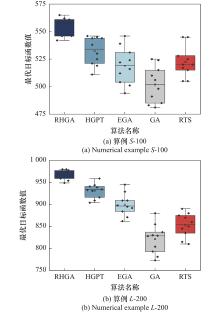
Fig.12
Distribution of objective function values solved by different algorithms"
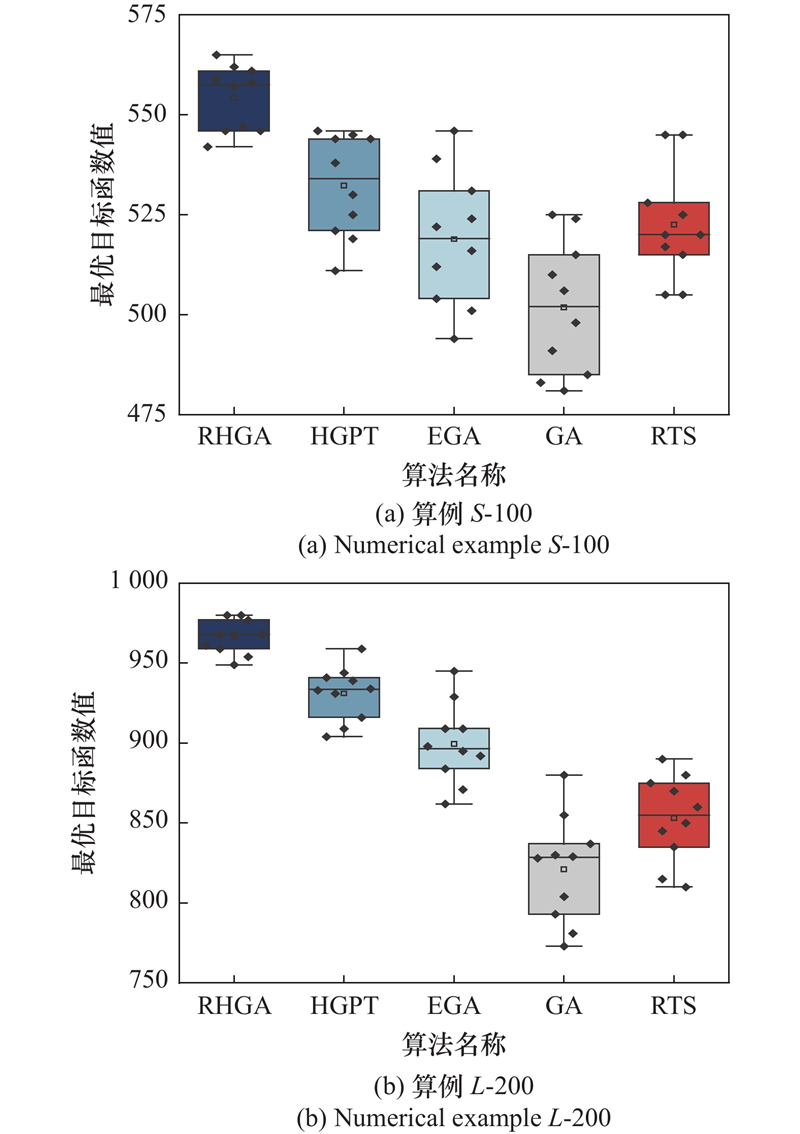
Fig.13
Iterative convergence curve of RHGA"
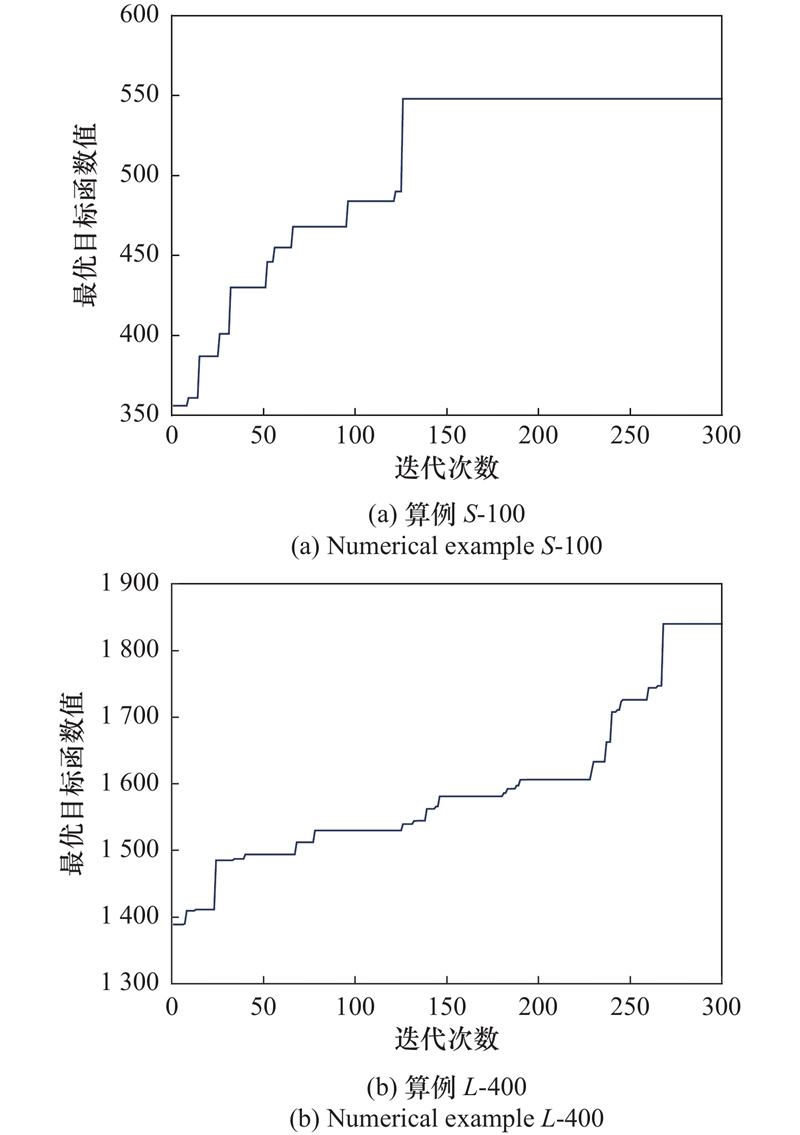
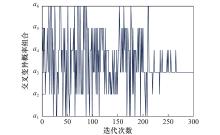
Fig.14
Variation curve of reinforcement learning parameter combination"
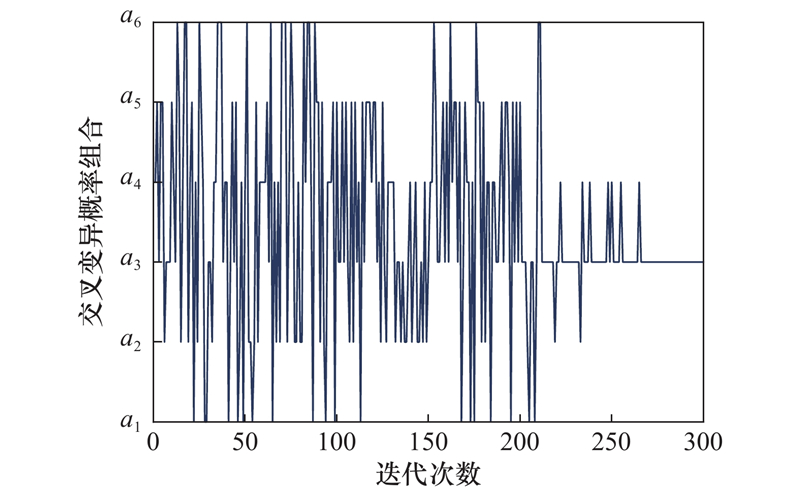
Table 4
Setting of ablation experiment"
| 算法名称 | 实验方法 |
| 移除强化学习模块 | 移除融合强化学习参数调优模块, 选用Taguchi正交实验获得的参数 |
| 移除IM模块 | 移除基于最小负荷法的种群初始化机制, 选用随机方式生成初始种群 |
| 移除CM模块 | 移除基于禁忌表搜索的局部优化策略,采用GA优化 |
| 移除强化学习、IM、 CM模块 | 移除3种改进机制,分别采用对应移除方法替换 |
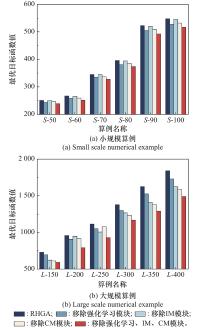
Fig.15
Comparison diagram of ablation experiment results on the optimal objective function value"
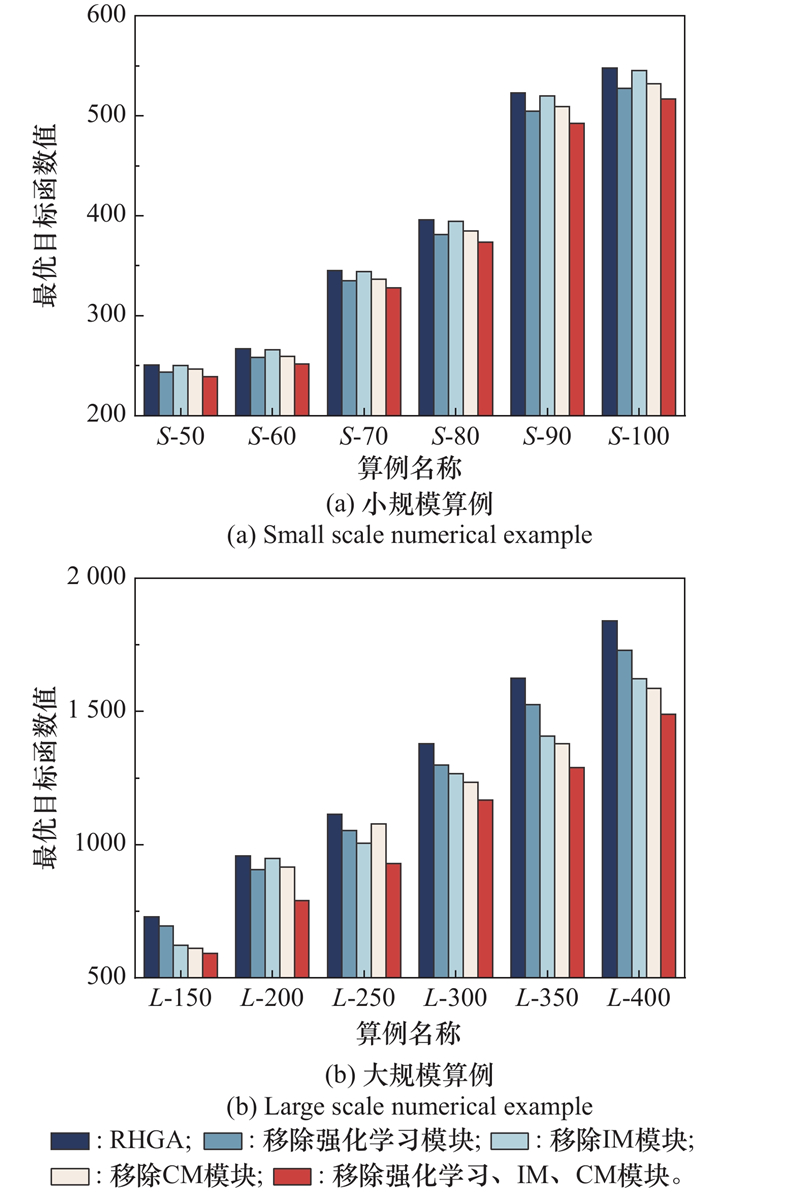
Table 5
Results comparison of the ablation experiment"
| 算例 | RHGA | 移除强化学习模块 | 移除IM模块 | 移除CM模块 | 移除强化学习、IM、CM模块 | ||||||||
| 平均值 | 平均值 | Gap/% | 平均值 | Gap/% | 平均值 | Gap/% | 平均值 | Gap/% | |||||
| S-50 | 250.9 | 243.7 | −2.87 | 250.1 | −0.32 | 246.5 | −1.75 | 238.9 | −4.78 | ||||
| S-60 | 266.8 | 258.4 | −3.15 | 265.7 | −0.41 | 259.2 | −2.85 | 251.6 | −5.69 | ||||
| S-70 | 345.2 | 334.8 | −3.01 | 344.1 | −0.32 | 336.5 | −2.52 | 327.9 | −4.95 | ||||
| S-80 | 395.8 | 381.4 | −3.63 | 394.2 | −0.40 | 384.6 | −2.83 | 373.5 | −5.63 | ||||
| S-90 | 522.7 | 504.9 | −3.40 | 520.1 | −0.49 | 509.2 | −2.58 | 492.5 | −5.78 | ||||
| S-100 | 548.0 | 527.6 | −3.72 | 545.2 | −0.51 | 532.4 | −2.85 | 516.7 | −5.71 | ||||
| L-150 | 728.2 | 695.4 | −4.50 | 622.8 | −14.47 | 610.3 | −16.18 | 591.1 | −18.84 | ||||
| L-200 | 957.4 | 906.7 | −5.29 | 948.3 | −1.01 | 915.6 | −4.36 | 789.4 | −17.54 | ||||
| L-250 | −5.43 | −9.75 | −3.13 | 929.5 | −16.51 | ||||||||
| L-300 | −5.86 | −8.27 | −3.25 | −15.34 | |||||||||
| L-350 | −6.09 | −13.30 | −15.12 | −20.59 | |||||||||
| L-400 | −6.08 | −11.89 | −13.82 | −18.97 | |||||||||
| 平均值 | − | − | −4.25 | − | −5.08 | − | −6.10 | − | −12.87 | ||||
| 1 |
HUANG G, HU M, YANG X Y, et al. A review of constrained multi-objective evolutionary algorithm-based unmanned aerial vehicle mission planning: key techniques and challenges[J]. Drones, 2024, 8 (7): 316.
doi: 10.3390/drones8070316 |
| 2 |
WANG G, LV X, CUI L Z, et al. The methods of task pre-allocation and reallocation for multi-UAV cooperative reconnaissance mission[J]. IET Collaborative Intelligent Manufacturing, 2023, 5 (4): e12090.
doi: 10.1049/cim2.12090 |
| 3 |
YANG X Y, HU M, HUANG G, et al. A hybrid local replanning strategy for multi-satellite imaging mission planning in uncertain environments[J]. IEEE Access, 2023, 11, 120780- 120804.
doi: 10.1109/ACCESS.2023.3327343 |
| 4 |
LUO Y L, JIANG X Q, ZHONG S C, et al. Air-to-ground reconnaissance-attack task allocation for heterogeneous UAV swarm[J]. Journal of Systems Engineering and Electronics, 2025, 36 (1): 155- 175.
doi: 10.23919/JSEE.2025.000012 |
| 5 |
ZHANG J, DU X, DONG Q C, et al. Distributed collaborative complete coverage path planning based on hybrid strategy[J]. Journal of Systems Engineering and Electronics, 2024, 35 (2): 463- 472.
doi: 10.23919/JSEE.2023.000118 |
| 6 |
LU Z Z, SHEN X, LI D R, et al. Multiple super-agile satellite collaborative mission planning for area target imaging[J]. International Journal of Applied Earth Observation and Geoinformation, 2023, 117, 103211.
doi: 10.1016/j.jag.2023.103211 |
| 7 |
YANG X Y, HU M, ZHANG R, et al. A unified model for multi-satellite imaging mission planning in various scenarios[J]. IEEE Access, 2023, 11, 46144- 46163.
doi: 10.1109/ACCESS.2023.3275016 |
| 8 | MENG S S, ZHU Q, XIA F, et al. Research on parameter optimisation of dynamic priority scheduling algorithm based on improved reinforcement learning[J]. IET Generation, Transmission & Distribution, 2020, 14 (16): 3171- 3178. |
| 9 | MORRIS R A, DUNGAN J L, BRESINA J L. Challenges in coordinating remote sensing systems[C]//Proc. of the AAAI Spring Symposium-Technical Report, 2006: 65−72. |
| 10 | HEROLD T M. Asynchronous, distributed optimization for the coordinated planning of air and space assets[D]. Cambridge: Massachusetts Institute of Technology, 2010. |
| 11 | 李夏苗, 廖文昆, 伍国华, 等. 基于两阶段迭代优化的空天观测资源协同任务规划方法[J]. 控制与决策, 2021, 36 (5): 1147- 1156. |
| LI X M, LIAO W K, WU G H, et al. A two-stage iterative optimization method for the coordinated task planning of space and air observation resources[J]. Control and Decision, 2021, 36 (5): 1147- 1156. | |
| 12 | 梁星星, 修保新, 范长俊, 等. 面向海上移动目标的空天协同连续观测模型[J]. 系统工程理论与实践, 2018, 38 (1): 229- 240. |
| LIANG X X, XIU B X, FAN C J, et al. The aerospace cooperative planning model for maritime moving target continuation observation[J]. Systems Engineering - Theory & Practice, 2018, 38 (1): 229- 240. | |
| 13 | DENG M, LIU B J, LI S M, et al. A two-phase coordinated planning approach for heterogeneous earth-observation resources to monitor area targets[J]. IEEE Trans. on Systems, Man, and Cybernetics: Systems, 2021, 51 (10): 6388- 6403. |
| 14 |
WU G H, MAO X, CHEN Y G, et al. Coordinated scheduling of air and space observation resources via divide-and-conquer framework and iterative optimization[J]. IEEE Trans. on Aerospace and Electronic Systems, 2023, 59 (4): 3631- 3642.
doi: 10.1109/TAES.2022.3228832 |
| 15 | 王慧林, 伍国华, 马满好. 多类异构对地观测平台协同任务规划方法[J]. 航空学报, 2016, 37 (3): 997- 1014. |
| WANG H L, WU G H, MA M H. Coordinated task planning method for multiple heterogeneous earth observation platforms[J]. Chinese Journal of Aeronautics, 2016, 37 (3): 997- 1014. | |
| 16 |
LIU J M, CHEN Y G, WANG R, et al. Complex task planning method of space-aeronautics cooperative observation based on multi-layer interaction[J]. Journal of Systems Engineering and Electronics, 2023, 34 (6): 1550- 1564.
doi: 10.23919/JSEE.2022.000098 |
| 17 | SHANG X, WANG L, XING L N, et al. Knowledge-based memetic algorithm for joint task planning of multi-platform earth observation system[J]. Computers & Industrial Engineering, 2021, 160, 107559. |
| 18 |
LIANG Z Y, LIU M, ZHONG P S, et al. Application research of a new neighbourhood structure with adaptive genetic algorithm for job shop scheduling problem[J]. International Journal of Production Research, 2023, 61 (2): 362- 381.
doi: 10.1080/00207543.2021.2007310 |
| 19 |
CUI Y B, HU W, RAHMANI A. A reinforcement learning based artificial bee colony algorithm with application in robot path planning[J]. Expert Systems with Applications, 2022, 203, 117389.
doi: 10.1016/j.eswa.2022.117389 |
| 20 |
LI T H, YIN Y C, YANG B, et al. A self-learning bee colony and genetic algorithm hybrid for cloud manufacturing services[J]. Computing, 2022, 104 (9): 1977- 2003.
doi: 10.1007/s00607-022-01079-0 |
| 21 | 姜一啸, 吉卫喜, 何鑫, 等. 基于改进非支配排序遗传算法的多目标柔性作业车间低碳调度[J]. 中国机械工程, 2022, 33 (21): 2564- 2577. |
| JIANG Y X, JI W X, HE X, et al. Low-carbon scheduling of multi-objective flexible job-shop based on improved NSGA-II[J]. China Mechanical Engineering, 2022, 33 (21): 2564- 2577. | |
| 22 | 张长泽, 李引珍, 尹胜男, 等. 多目标模糊柔性作业车间调度问题优化[J]. 科学技术与工程, 2020, 20 (3): 1099- 1106. |
| ZHANG C Z, LI Y Z, YIN S N, et al. Optimization of multi-objective fuzzy flexible job shop scheduling problem[J]. Science Technology and Engineering, 2020, 20 (3): 1099- 1106. | |
| 23 |
WANG T, FU L Y, WEI Z X, et al. Unmanned ground weapon target assignment based on deep Q-learning network with an improved multi-objective artificial bee colony algorithm[J]. Engineering Applications of Artificial Intelligence, 2023, 117, 105612.
doi: 10.1016/j.engappai.2022.105612 |
| 24 |
LI R, GONG W Y, LU C. A reinforcement learning based RMOEA/D for bi-objective fuzzy flexible job shop scheduling[J]. Expert Systems with Applications, 2022, 203, 117380.
doi: 10.1016/j.eswa.2022.117380 |
| 25 | CHEN R H, YANG B, LI S, et al. A self-learning genetic algorithm based on reinforcement learning for flexible job-shop scheduling problem[J]. Computers & Industrial Engineering, 2020, 149, 106778. |
| 26 |
SONG Y J, OU J W, SUGANTHAN P N, et al. Learning adaptive genetic algorithm for earth electromagnetic satellite scheduling[J]. IEEE Trans. on Aerospace and Electronic Systems, 2023, 59 (6): 9010- 9025.
doi: 10.1109/TAES.2023.3312626 |
| 27 | 赵慧敏, 罗贺, 阴酉龙, 等. 面向集合任务的多无人机电力巡检任务分配方法研究[J]. 系统工程理论与实践, 2025, 45 (2): 666- 684. |
| ZHAO H M, LUO H, YIN Y L, et al. Research on task allocation method for multiple drones power inspection for collective tasks[J]. Systems Engineering - Theory & Practice, 2025, 45 (2): 666- 684. | |
| 28 | SHAHRABI J, ADIBI M A, MAHOOTCHI M. A reinforcement learning approach to parameter estimation in dynamic job shop scheduling[J]. Computers & Industrial Engineering, 2017, 110, 75- 82. |
| 29 | UZUNOGLU A, GAHM C, WAHL S, et al. Learning-augmented heuristics for scheduling parallel serial-batch processing machines[J]. Computers & Operations Research, 2023, 151, 106122. |
| 30 |
SONG Y J, WEI L N, YANG Q, et al. RL-GA: a reinforcement learning-based genetic algorithm for electromagnetic detection satellite scheduling problem[J]. Swarm and Evolutionary Computation, 2023, 77, 101236.
doi: 10.1016/j.swevo.2023.101236 |
| 31 |
FALLAHI A, AMANI B E, NIAKI S T A. A constrained multi-item EOQ inventory model for reusable items: reinforcement learning-based differential evolution and particle swarm optimization[J]. Expert Systems with Applications, 2022, 207, 118018.
doi: 10.1016/j.eswa.2022.118018 |
| 32 | LI R F, ZHANG X Y, JIANG L L, et al. An adaptive heuristic algorithm based on reinforcement learning for ship scheduling optimization problem[J]. Ocean & Coastal Management, 2022, 230, 106375. |
| 33 |
CAO Z C, LIN C R, ZHOU M C. A knowledge-based cuckoo search algorithm to schedule a flexible job shop with sequencing flexibility[J]. IEEE Trans. on Automation Science and Engineering, 2021, 18 (1): 56- 69.
doi: 10.1109/TASE.2019.2945717 |
| 34 |
GUO W Q, ZHANG X Y, LI Y K, et al. Collaborative optimization of vessel scheduling and tugboat allocation in seaports using a multi-action deep reinforcement learning framework[J]. Engineering Applications of Artificial Intelligence, 2025, 156, 111239.
doi: 10.1016/j.engappai.2025.111239 |
| 35 |
CHEN M K, CHANG C L, LIN C J, et al. Vehicle detection on express roads using YOLOv7 with Taguchi parameter optimization method[J]. Sensors and Materials, 2024, 36 (4): 1605- 1625.
doi: 10.18494/SAM4718 |
| 36 | CHANG D L, SHI H B, LIU C, et al. Scheduling optimization of flexible flow shop with buffer capacity limitation based on an improved discrete particle swarm optimization algorithm[J]. Engineering Optimization, 2024, 57 (2): 571- 597. |
| 37 |
LU F X, DAI Q Y, YANG G, et al. Online task planning method of anti-ship missile based on rolling optimization[J]. Journal of Systems Engineering and Electronics, 2024, 35 (3): 720- 731.
doi: 10.23919/JSEE.2024.000059 |
| [1] | Zan MA, Yubin LIU, Jie BAI, Yong CHEN, Shuguang SUN. Intelligent avoidance airworthiness safety risk assessment of unmanned aerial vehicle based on hierarchical STPA-MC [J]. Systems Engineering and Electronics, 2026, 48(6): 2000-2013. |
| [2] | Wei HAN, Jingyu CONG, Yiyang CHENG, Xiaohua HAN, Fang GUO, Changjiu LI, Xichao SU. Dynamic scheduling methodology for shipboard helicopter missions under stochastic disturbance events [J]. Systems Engineering and Electronics, 2026, 48(6): 2014-2030. |
| [3] | Zhenshuai JIA, Bing XIAO, Hanyu QIAN, Zheyu ZHANG. Spacecraft on-orbit observation maneuver decision-making method based on multi-policy learning [J]. Systems Engineering and Electronics, 2026, 48(5): 1590-1598. |
| [4] | Huaqing ZHANG, Xiaofei ZHANG, Mingrui HAO, Jixiang JIANG, Shan LI. Robust multi-agent cooperative confrontation policy offline reinforcement learning [J]. Systems Engineering and Electronics, 2026, 48(5): 1670-1681. |
| [5] | Shaohui ZHANG, Lulu LI, Yafei LI, Qingshun WU, Guanfeng LI, Mingliang XU. Research on the planning methods of ammunition support operations for carrier-based aircraft: a survey [J]. Systems Engineering and Electronics, 2026, 48(4): 1303-1321. |
| [6] | Hao LIU, Zipeng HE, Guangde XU. Fast planning method for space multi-target rendezvous sequence based on CUDA texture interpolation [J]. Systems Engineering and Electronics, 2026, 48(4): 1331-1339. |
| [7] | Jingxian LUO, Guanghui ZHOU, Jinyue YU, Yang ZHANG. Research on multiple agile earth observation satellite scheduling based on Q-learning memetic algorithm considering task clustering [J]. Systems Engineering and Electronics, 2026, 48(4): 1349-1359. |
| [8] | Zhigang JIN, Zepei LIU, Xiaodong WU. Survey of game theory applications in Internet of Things security and privacy [J]. Systems Engineering and Electronics, 2026, 48(3): 1072-1082. |
| [9] | Pengcheng YANG, Qingqing YANG, Yingying GAO, Zhiwei YANG, Kewei YANG, Bo AI. Path planning for maritime moving targets search based on reinforcement learning [J]. Systems Engineering and Electronics, 2026, 48(2): 515-523. |
| [10] | Xu WANG, Guangbin CAI, Xiaoya YU, Ziqi YE, Bin SHAN. Attitude control of hypersonic vehicle based on dual-dynamic PPO algorithm [J]. Systems Engineering and Electronics, 2026, 48(2): 694-704. |
| [11] | Zhikang LIN, Jialei LIU, Jiazhi MA, Longfei SHI, Jinbao XU. Counter-anti-radiation method method using distributed radiation source blinking decoy [J]. Systems Engineering and Electronics, 2026, 48(1): 1-11. |
| [12] | Jinyan XUE, Yasheng ZHANG, Xuefeng TAO, Mingqi YANG, Shuailong ZHAO. Advances in orbital maneuver control for GEO spacecraft [J]. Systems Engineering and Electronics, 2026, 48(1): 290-300. |
| [13] | Chuanlong SONG, Qianwu ZHANG, Jian HE, Wenjun ZHOU, Hui WANG, Weiwei KONG, Wenbo TIAN. Edge computing task offloading method of satellite-ground collaborative based on MADDPG algorithm [J]. Systems Engineering and Electronics, 2026, 48(1): 350-360. |
| [14] | Jianbo YUAN, Yonghao DU, Yingguo CHEN, Yongming HE. Research on imaging satellite mission planning model and algorithm for point-cluster and large-region targets [J]. Systems Engineering and Electronics, 2025, 47(9): 2939-2950. |
| [15] | Peng YAO, Meiyu HAN, Dechuan WANG, Zhicheng GAO. Multiple unmanned surface vehicles pursuit method based on adversarial evolutionary reinforcement learning [J]. Systems Engineering and Electronics, 2025, 47(9): 2960-2970. |
| Viewed | ||||||
|
Full text |
|
|||||
|
Abstract |
|
|||||