Systems Engineering and Electronics ›› 2026, Vol. 48 ›› Issue (3): 1031-1038.doi: 10.12305/j.issn.1001-506X.2026.03.27
• Guidance, Navigation and Control • Previous Articles
CPPA-A* algorithm for low-altitude airspace in plateau environment
Rui ZHU1,2, Chuanpeng SHEN2, Yuying LIANG2, Jiadi WU2, Jingwei LU2, Zhirong LIU1,2,*
- 1. School of Aerospace Engineering,Xiamen University,Xiamen 361102,China
2. School of Information Engineering,Xizang Minzu University,Xianyang 712082,China
-
Received:2025-01-21Online:2026-03-25Published:2026-04-13 -
Contact:Zhirong LIU

CLC Number:
Cite this article
Rui ZHU, Chuanpeng SHEN, Yuying LIANG, Jiadi WU, Jingwei LU, Zhirong LIU. CPPA-A* algorithm for low-altitude airspace in plateau environment[J]. Systems Engineering and Electronics, 2026, 48(3): 1031-1038.
share this article
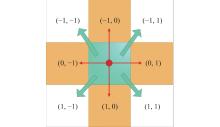
Fig.1
Octave graph"
Fig.2
Improved A* flowcharts"
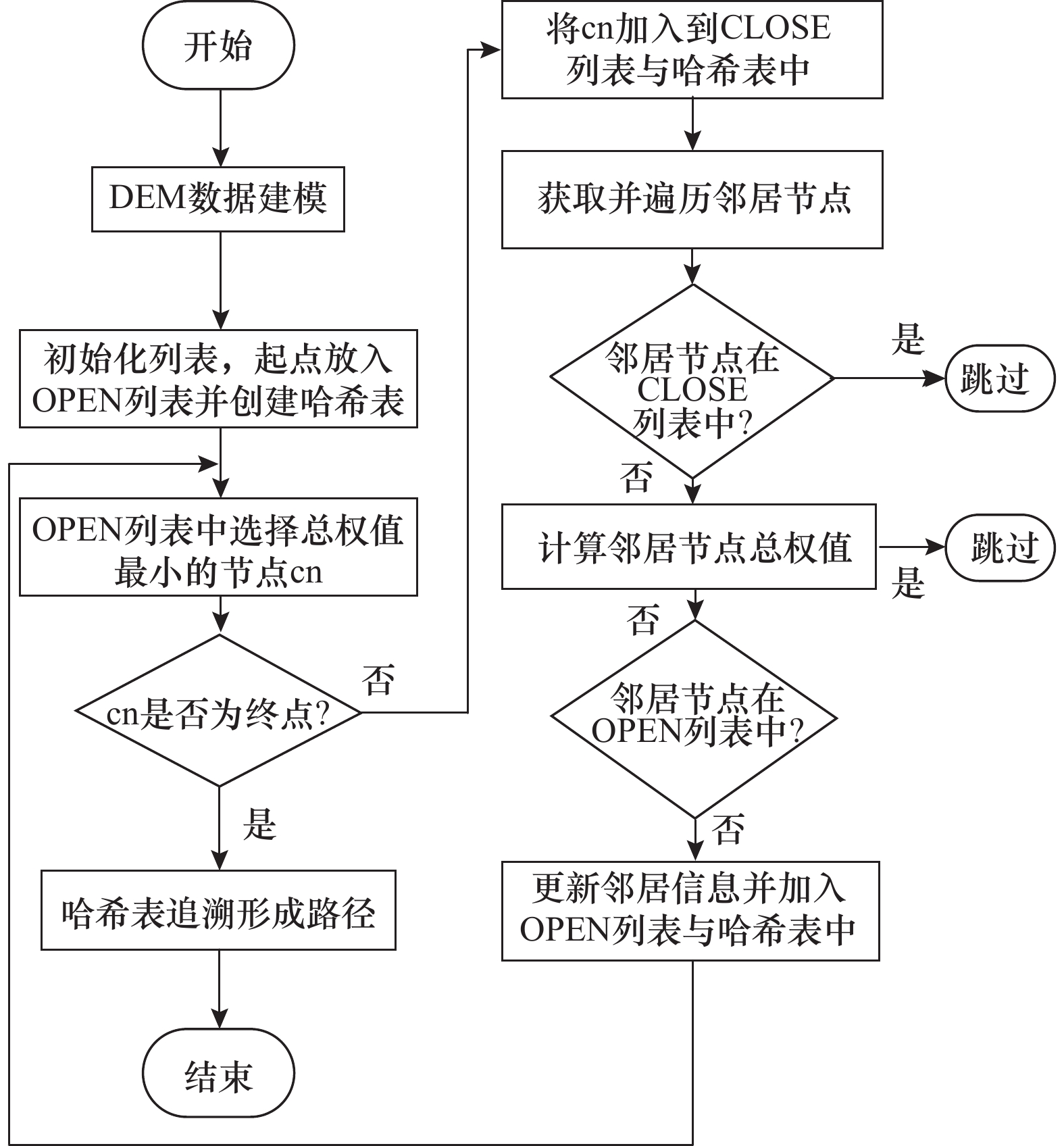

Fig.3
Schematic diagram of two-level security envelope"
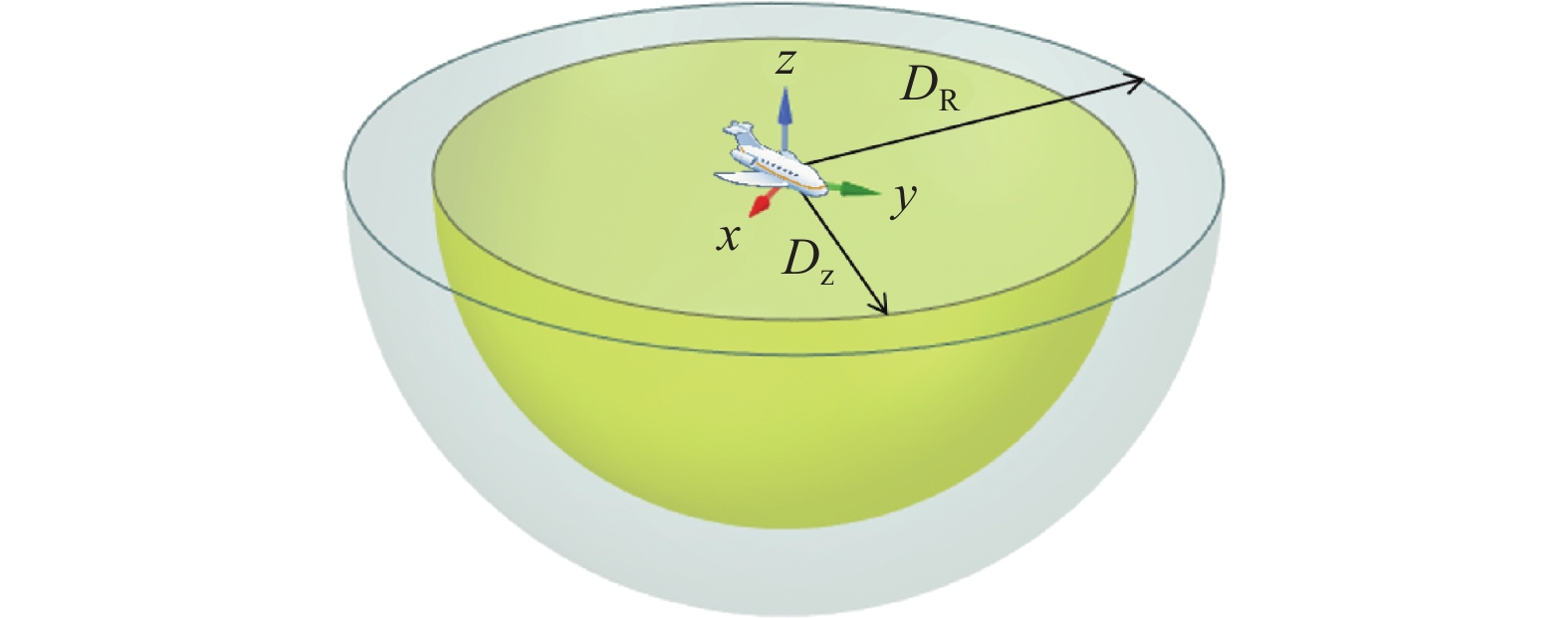
Fig.4
Schematic diagram of collision avoidance"
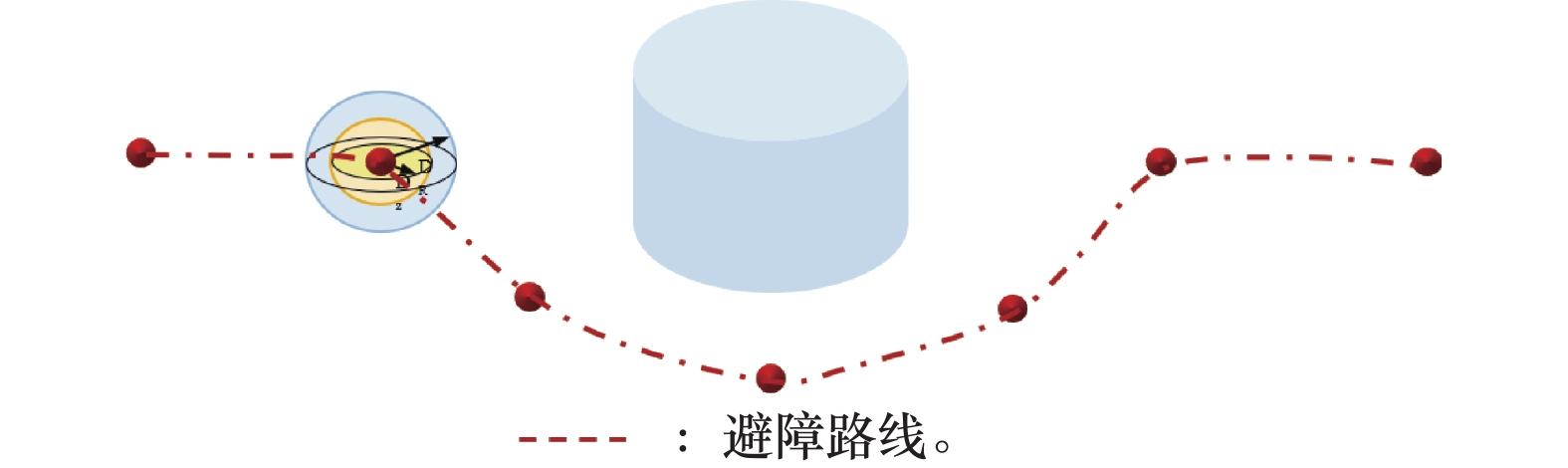
Fig.5
Improved repulsion field diagram"
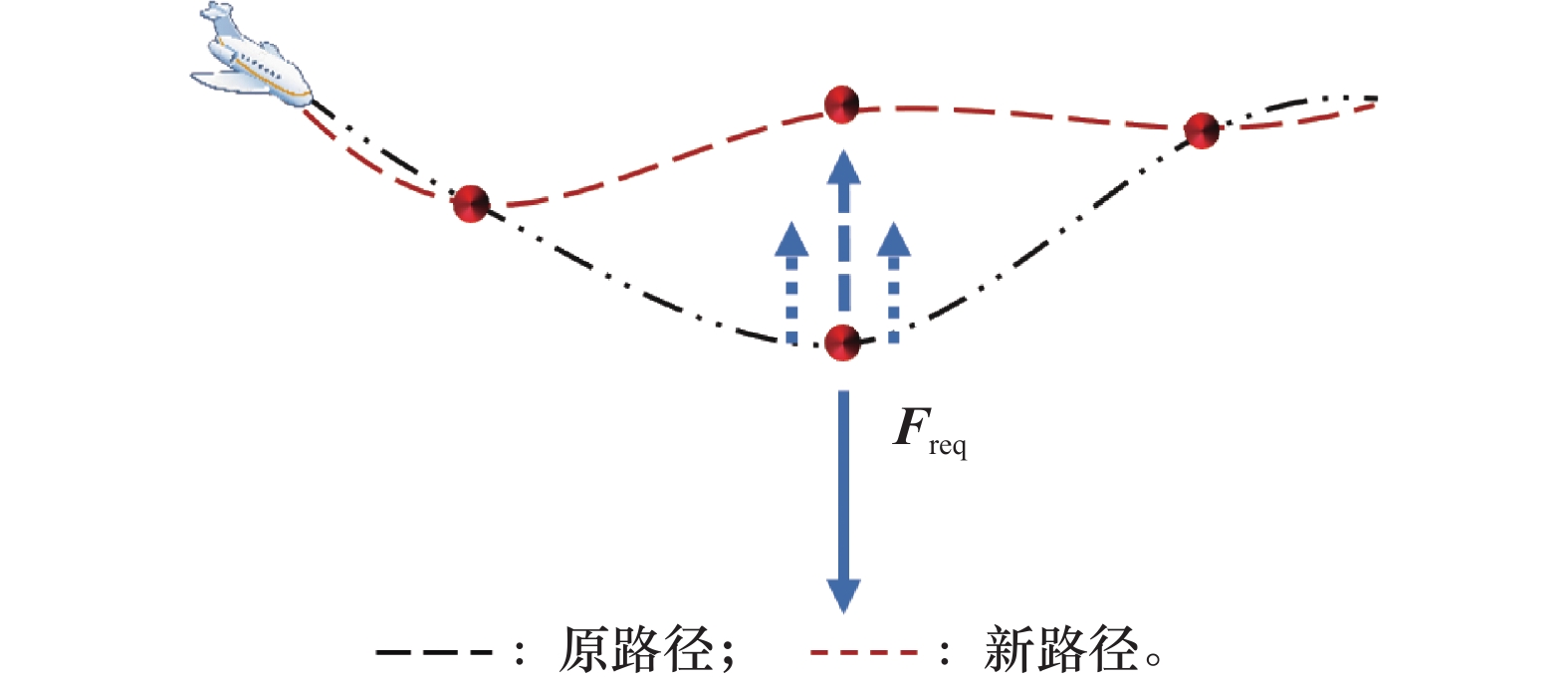
Fig.6
Two-level smoothing processing diagram"
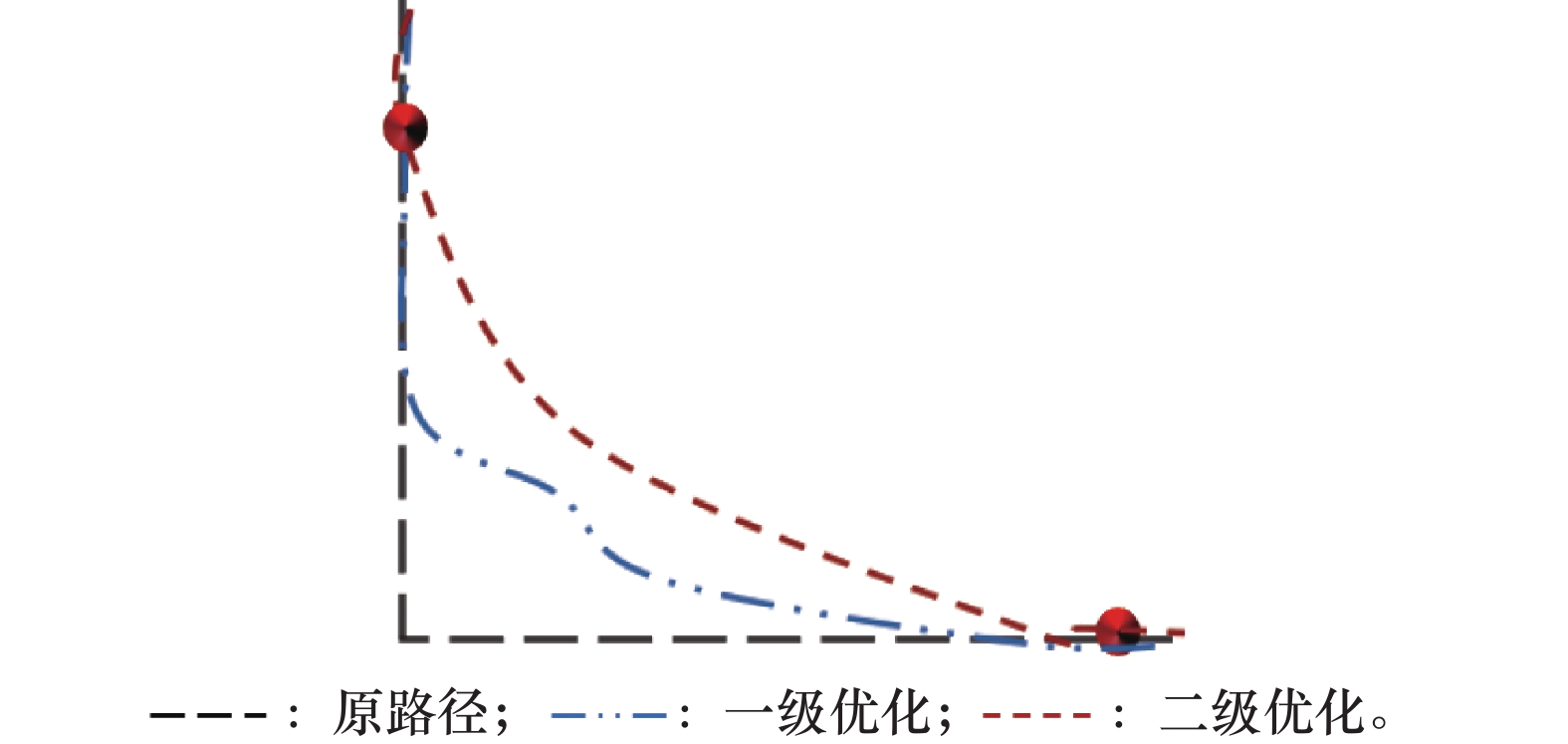

Fig.7
Schematic map of part of the plateau area of Tibet"
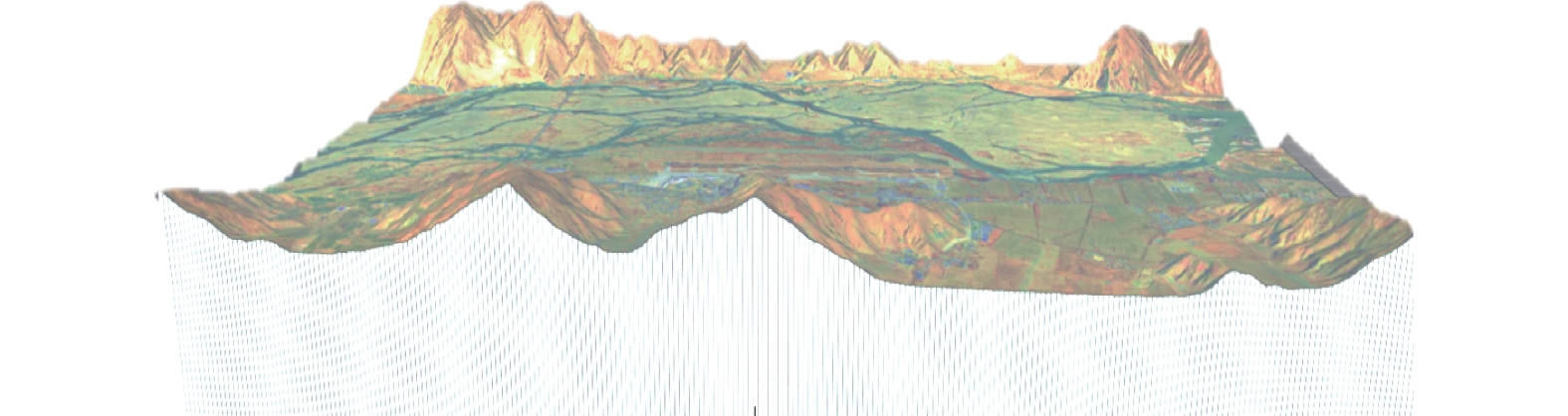
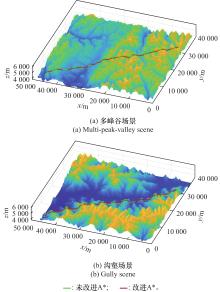
Fig.8
Applications in different scenarios"
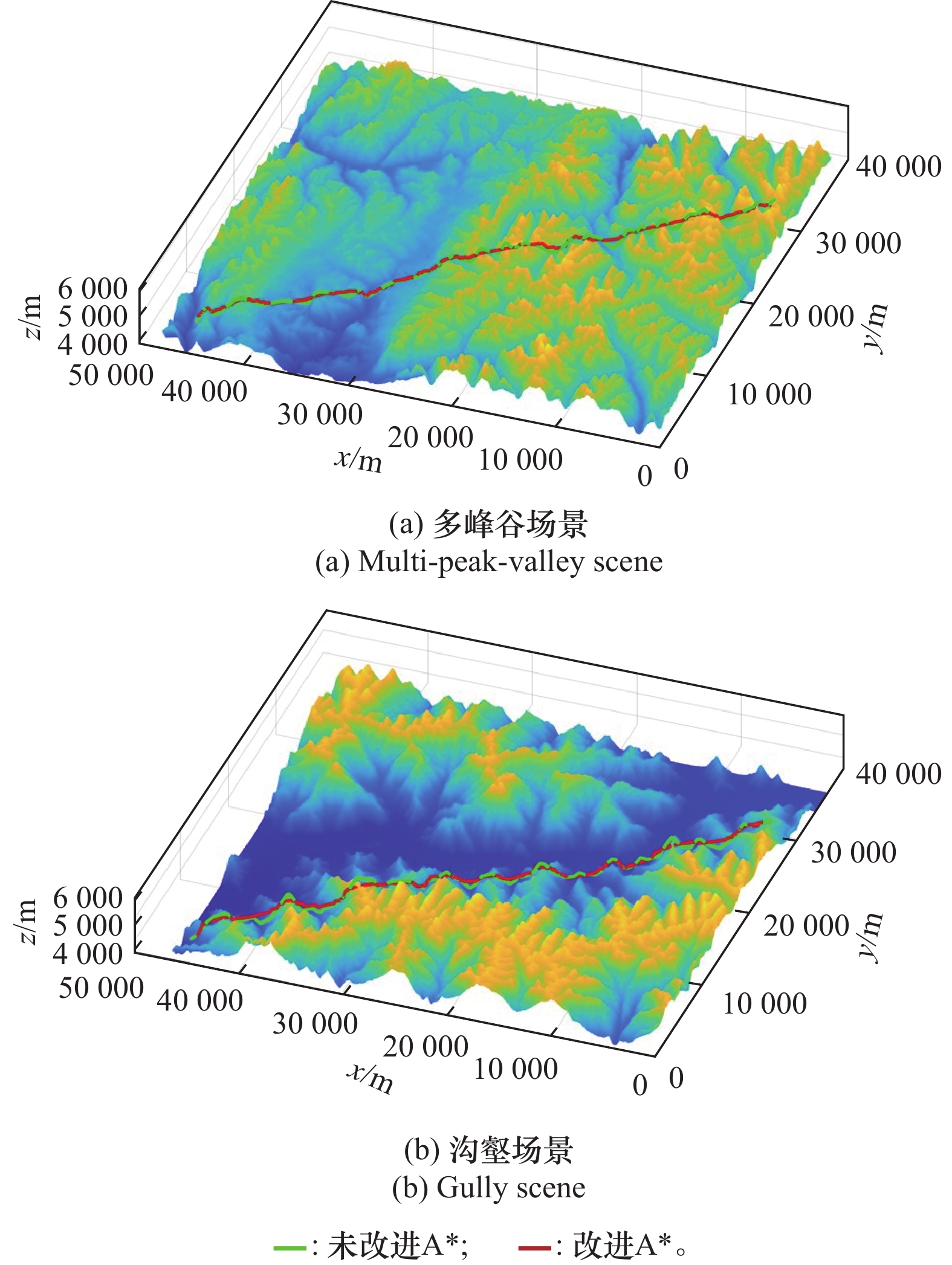
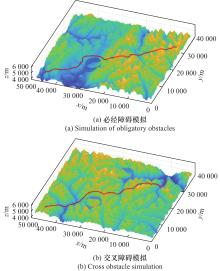
Fig.9
CPPA-A* three-dimensional view"
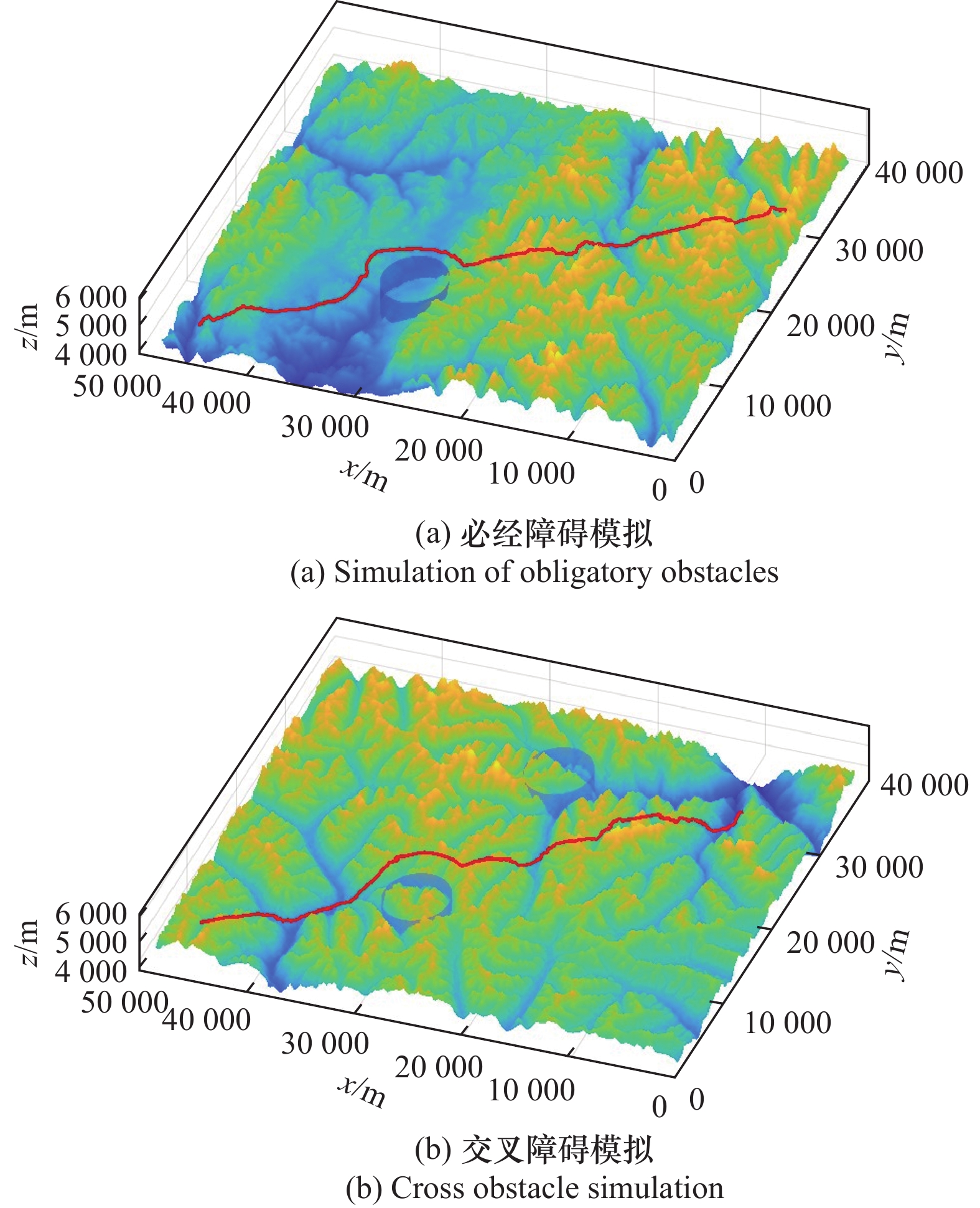
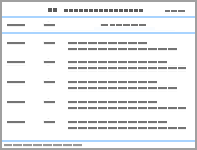
Table 1
Compare datas with different algorithms"
| 算法 | 直达路径 时间/s | 直达路径 长度/m | 避障路径 时间/s | 避障路径 长度/m |
| RRT算法 | 76.835 | 82 471.71 | 93.217 | 79 204.58 |
| 三维A*算法 | 94.264 | 69 105.38 | 127.359 | 74 469.28 |
| CPPA-A*算法 | 71.021 | 56 292.84 | 76.565 | 65 137.66 |
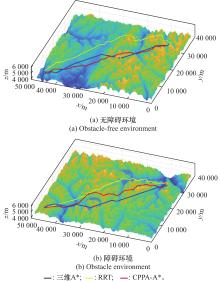
Fig.10
Algorithm comparison chart"
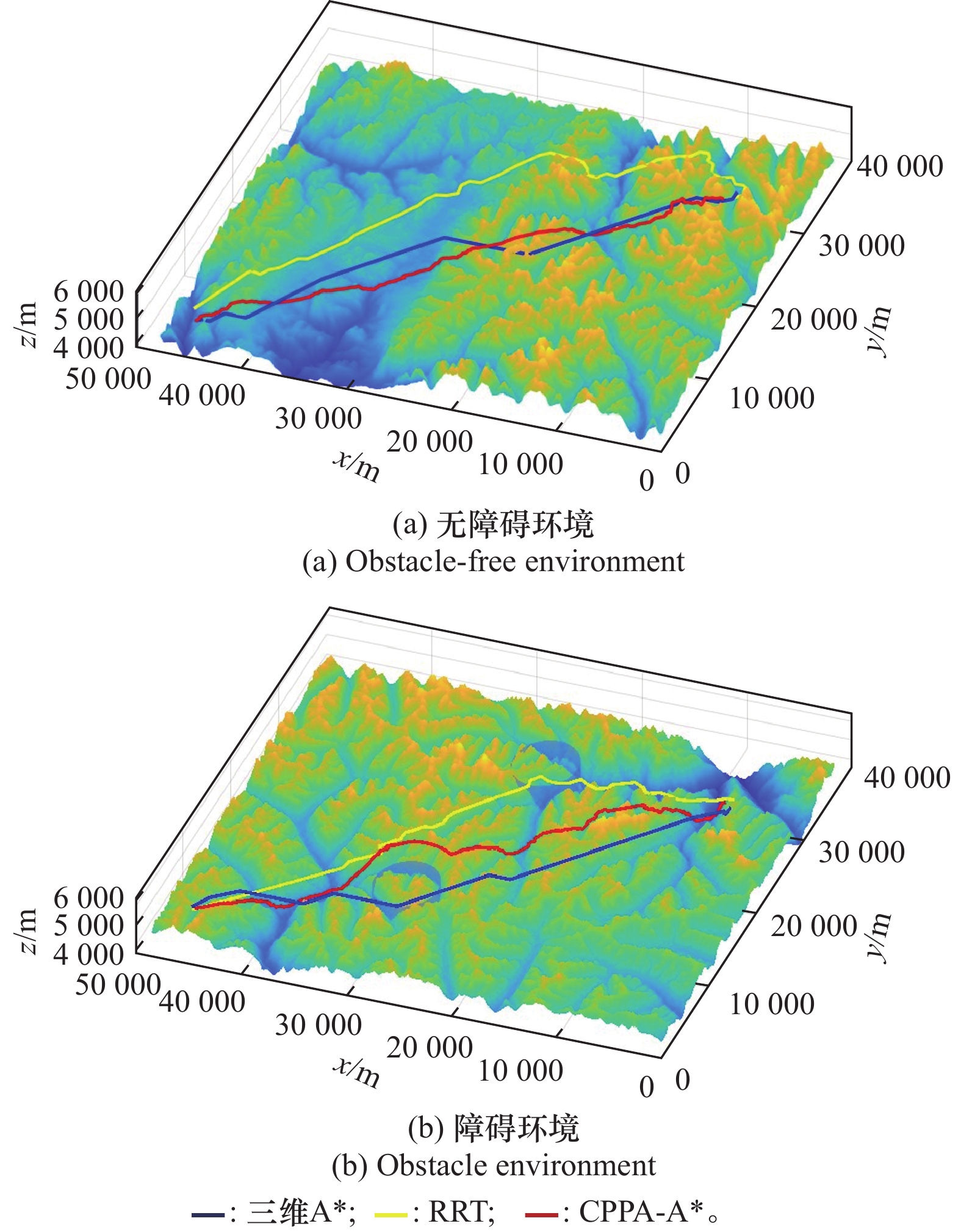
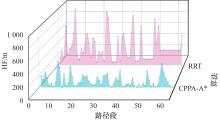
Fig.11
Altitude fluctuation comparison chart"
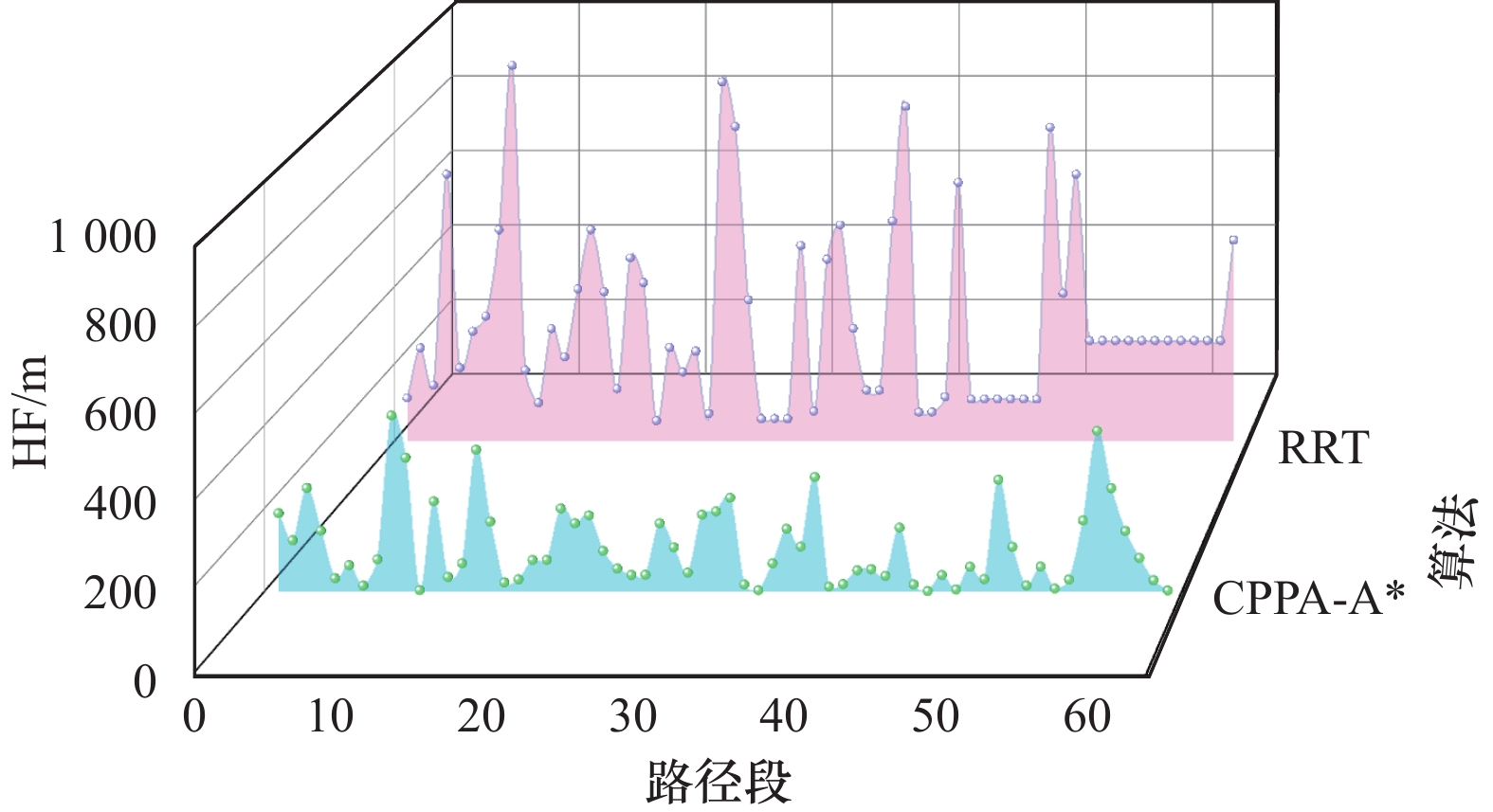
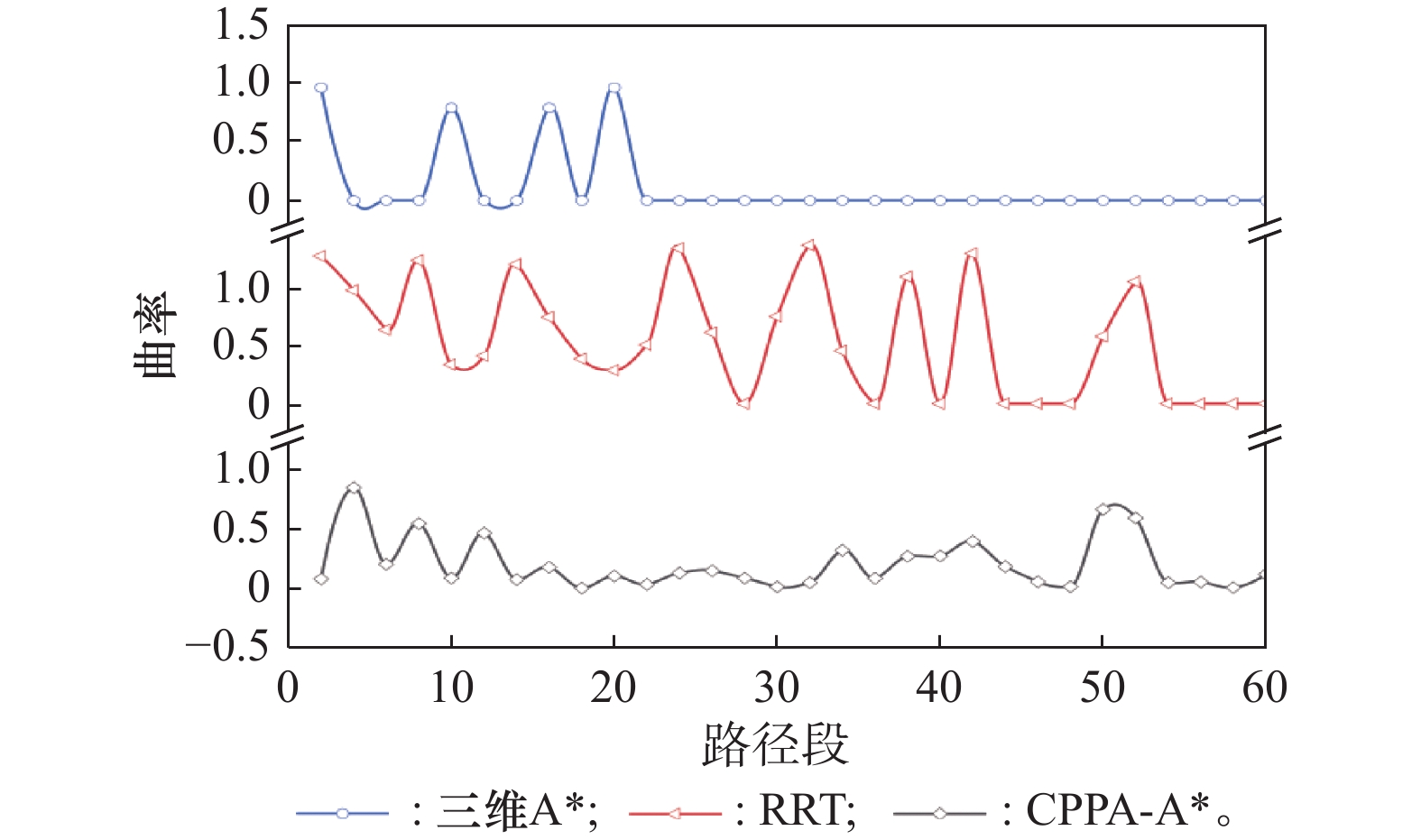
Fig.12
Curvature comparison chart"
| 1 |
LI Y G, JIN R C, XU X R, et al. A mobile robot path planning algorithm based on improved A* algorithm and dynamic window approach[J]. IEEE Access, 2022, 10, 57736- 57747.
doi: 10.1109/ACCESS.2022.3179397 |
| 2 | DU Y W. Multi-UAV search and rescue with enhanced A* algorithm path planning in 3D environment[J]. International Journal of Aerospace Engineering. DOI: 10.1155/2023/8614117. |
| 3 |
CAI C, CHEN J. An AUV path planner for large-scale search and rescue based on A* algorithm[J]. Journal of Physics: Conference Series, 2021, 2050, 012017.
doi: 10.1088/1742-6596/2050/1/012017 |
| 4 |
LIU G Y, SHU C, LIANG Z W, et al. A modified sparrow search algorithm with application in 3D route planning for UAV[J]. Sensors, 2021, 21 (4): 12- 24.
doi: 10.3390/s21041224 |
| 5 |
YAN J F, DENG T, XU B H. Three dimensional path planning for flying car based on improved A* algorithm and Bezier curve fusion[J]. Journal of Automobile Engineering, 2024, 9 (4): 241- 257.
doi: 10.1177/09544070241227094 |
| 6 |
ZHAO J S, MA X, YANG B, et al. Global path planning of unmanned vehicle based on fusion of A* algorithm and Voronoi field[J]. Journal of Intelligent and Connected Vehicles, 2022, 5 (3): 250- 259.
doi: 10.1108/JICV-01-2022-0001 |
| 7 | DENG L Z, YUAN H Y, HUANG L D, et al. Post-earthquake search via an autonomous UAV: hybrid algorithm and 3D path planning[C]//Proc. of the IEEE 14th International Conference on Natural Computation, Fuzzy Systems and Knowledge Discovery, 2018: 1329−1334. |
| 8 |
HAN J H. An efficient approach to 3D path planning[J]. Information Sciences, 2019, 478, 318- 330.
doi: 10.1016/j.ins.2018.11.045 |
| 9 |
GUO Y C, LIU X X, LIU X H, et al. FC-RRT*: an improved path planning algorithm for UAV in 3D complex environment[J]. ISPRS International Journal of Geo-Information, 2022, 11 (2): 112- 121.
doi: 10.3390/ijgi11020112 |
| 10 | REN T Z, ZHOU R, XIA J, et al. Three-dimensional path planning of UAV based on an improved A* algorithm[C]//Proc. of the IEEE Chinese Guidance, Navigation and Control Conference, 2016: 140−145. |
| 11 | BAI X, JIANG H K, CUI J J, et al. UAV path planning based on improved A* and DWA algorithms[J]. International Journal of Aerospace Engineering, 2021, 2021 (4): 4511252. |
| 12 |
PU X C, XIONG C W, JI L H, et al. 3D path planning for a robot based on improved ant colony algorithm[J]. Evolutionary Intelligence, 2024, 17, 55- 65.
doi: 10.1007/s12065-020-00397-6 |
| 13 |
LI K, LI L Y, TANG C Y, et al. Three-dimensional path planning based on six-direction search scheme[J]. Sensors, 2024, 24 (4): 1193.
doi: 10.3390/s24041193 |
| 14 | 卞强, 孙齐, 童余德. 一种新的改进A*算法无人机三维路径规划[J]. 武汉理工大学学报, 2022, 44 (7): 80- 88. |
| BIAN Q, SUN Q, TONG Y D. A new improved A* algorithm for UAV 3D path planning[J]. Journal of Wuhan University of Technology, 2022, 44 (7): 80- 88. | |
| 15 | ZHANG W L, HOU Y H, LIU H S, et al. Path planning for submersible surface ships in a three-dimensional environment considering safety distance[EB/OL]. [2024-12-20]. https://doi.org/10.1080/20464177.2024.2424534. |
| 16 |
LI Z Y, FEI Y H, SHI R L. UAV 3D trajectory planning and optimization using A* algorithm based on free space method[J]. Unmanned Systems, 2024, 12 (3): 457- 476.
doi: 10.1142/S2301385024420032 |
| 17 | MILLER B, STEPANYAN K, MILLER A, et al. 3D path planning in a threat environment[C]//Proc. of the IEEE 50th Conference on Decision and Control and European Control Conference, 2011: 6864−6869. |
| 18 |
RICE C R, GAN H, WANNG Z. Three-dimensional path planning and collision-free flight control for drone-assisted autonomous pollination systems[J]. Drone Systems and Applications, 2024, 12 (1): 1- 15.
doi: 10.1139/dsa-2023-0105 |
| 19 |
SUN M X, XIAO X T, LUAN T T, et al. The path planning algorithm for UUV based on the fusion of grid obstacles of artificial potential field[J]. Ocean Engineering, 2024, 306 (1): 118- 143.
doi: 10.2139/ssrn.4682925 |
| 20 |
TU B B, WANG F, HAN X W, et al. Q-learning guided grey wolf optimizer for UAV 3D path planning[J]. International Journal of Advanced Computer Science & Applications, 2024, 15 (7): 12- 17.
doi: 10.14569/ijacsa.2024.0150747 |
| 21 | LANICCI J, HALPERIN D, SHAPPELL S, et al. General aviation weather encounter case studies[R]. Oklahoma City: Civil Aerospace Medical Institute, 2012: 42−58. |
| 22 |
QIN H W, SHAO S L, WANG T, et al. Review of autonomous path planning algorithms for mobile robots[J]. Drones, 2023, 7 (3): 211.
doi: 10.3390/drones7030211 |
| 23 |
LUO J H, TIAN Y X, WANG Z Y. Research on unmanned aerial vehicle path planning[J]. Drones, 2024, 8 (2): 51.
doi: 10.3390/drones8020051 |
| 24 |
MANDLOI D, ARYA R, VERMA A K. Unmanned aerial vehicle path planning based on A* algorithm and its variants in 3D environment[J]. International Journal of System Assurance Engineering and Management, 2021, 12 (5): 990- 1000.
doi: 10.1007/s13198-021-01186-9 |
| 25 |
EMAD A L B A. Path-planning dynamic 3D space using modified A* algorithm[J]. Materials Science and Engineering, 2020, 928 (3): 32- 46.
doi: 10.1088/1757-899x/928/3/032016 |
| 26 |
TULLU A, ENDALE B, WONDOSEN A, et al. Machine learning approach to real-time 3D path planning for autonomous navigation of unmanned aerial vehicle[J]. Applied Sciences, 2021, 11 (10): 42- 66.
doi: 10.3390/app11104706 |
| 27 | LI M C, ZHANG H J. AUV 3D path planning based on A* algorithm[C]//Proc. of the Chinese Automation Congress, 2020: 11−16. |
| 28 | International Civil Aviation Organization. Annex 11 to the convention on international civil aviation: air traffic services[M]. 15th ed. Montreal: International Civil Aviation Organization, 2016. |
| 29 | 中国民用航空局. 中华人民共和国飞行基本规则[EB/OL]. [2024-12-29]. https://www.caac.gov.cn/XXGK/XXGK/FLFG/201510/t20151029_2792.html. |
| Civil Aviation Administration of China. Basic rules of flight of the People's Republic of China [EB/OL]. [2024-12-29]. https://www.caac.gov.cn/XXGK/XXGK/FLFG/201510/t20151029_2792.html. | |
| 30 | WANG J T, ZHAO Z Y, QU J Y, et al. APPA-3D: an autonomous 3D path planning algorithm for UAVs in unknown complex environments[J]. Scientific Reports, 2024, 14 (1): 121- 137. |
| 31 |
YANG W L, WU P, ZHOU X Q, et al. Improved artificial potential field and dynamic window method for amphibious robot fish path planning[J]. Applied Sciences, 2021, 11 (5): 24- 31.
doi: 10.3390/app11052114 |
| 32 |
YU W Q, LU Y G. UAV 3D environment obstacle avoidance trajectory planning based on improved artificial potential field method[J]. Journal of the Physics: Conference Series, 2021, 1885 (2): 22- 43.
doi: 10.1088/1742-6596/1885/2/022020 |
| 33 |
WANG L F, KAN J M, GUO J, et al. 3D path planning for the ground robot with improved ant colony optimization[J]. Sensors, 2019, 19 (4): 815.
doi: 10.3390/s19040815 |
| 34 | 中国民用航空局. 国家空域基础分类方法[M]. 北京: 民航出版社, 2022. |
| Civil Aviation Administration of China. National airspace basic classification method[M]. Beijing: China Civil Aviation Press, 2022. | |
| 35 | 西藏自治区发展和改革委员会. 西藏自治区通用航空发展规划(2021—2035年)[EB/OL]. [2024-12-29]. http://drc.xizang.gov.cn/zwgk_1941/202302/P020230206583216441572.pdf. |
| Development And Reform Commission of Xizang Autonomous Region. General aviation development plan of tibet autonomous region (2021–2035)[EB/OL]. [2024-12-29]. http://drc.xizang.gov.cn/zwgk_1941/202302/P020230206583216441572.pdf. | |
| 36 | LUNA M A, MOLINA M, DA-SILVA-GOMEZ R, et al. A multi-UAV system for coverage path planning applications with inflight replanning capabilities[J]. Journal of Field Robotics, 2024, 41 (5): 1480- 1497. |
| 37 |
KANG J Y, LEE B S. Optimisation of pipeline route in the presence of obstacles based on a least cost path algorithm and Laplacian smoothing[J]. International Journal of Naval Architecture and Ocean Engineering, 2017, 9 (5): 492- 498.
doi: 10.1016/j.ijnaoe.2017.02.001 |
| [1] | Jiapeng LI, Shuhui BU, Zhenyu XIA, Juboxi WANG, Kun LI, Xuan JIA. Drogue detection and localization methodology for UAV autonomous aerial refueling [J]. Systems Engineering and Electronics, 2026, 48(3): 1018-1030. |
| [2] | Zhixing ZHUANG, Baichun GONG, Mingrui HAO, Ziwen WANG. Cooperative relative navigation method for aircraft formation in under-measurement conditions [J]. Systems Engineering and Electronics, 2026, 48(1): 265-277. |
| [3] | Zeyu LU, Yao WANG, Weinan WU, Yiming SUN, Chunlin GONG. Two-layered path planning for unmanned aerial vehicle swarm in three-dimensional dynamic environment [J]. Systems Engineering and Electronics, 2026, 48(1): 132-143. |
| [4] | Yang LIU, Fanyi MENG, Gang CHEN. Reinforcement learning based disturbance rejection compensation control method for morphing aircraft [J]. Systems Engineering and Electronics, 2025, 47(12): 4130-4142. |
| [5] | Yitao QIAO, Shuang LI. Fixed-time event-triggered formation containment control for air-ground heterogeneous unmanned system [J]. Systems Engineering and Electronics, 2026, 48(2): 669-683. |
| [6] | CHEN Nanyu, HUANG Jun, ZHOU Yaoming, ZHAO Wenlong. Trajectory robust tracking control of unmanned helicopter based on extended state observer [J]. Systems Engineering and Electronics, 2018, 40(2): 368-374. |
| [7] | WANG Chao, ZHANG Shengxiu, SONG Zibiao, YANG Jianye, WU Xiaolu. Aircraft anti-windup of robust adaptive nonlinear predictive control [J]. Systems Engineering and Electronics, 2018, 40(2): 393-400. |
| [8] | LIU Yi-nan,ZHANG Sheng-xiu,CAO Li-jia,ZHANG Chao. Nonlinear robust adaptive flight controller design based on LS-SVM [J]. Journal of Systems Engineering and Electronics, 2012, 34(12): 2541-2547. |
| [9] | CHENG Jian-feng,DONG Xin-min,CHEN Ai-hua,DONG Zhi. T-S model-based constraint guaranteed cost robust flight control law design [J]. Journal of Systems Engineering and Electronics, 2012, 34(12): 2548-2553. |
| [10] | CA Hong-ming, ANG Hai-song, DENG Shuang-hou. Adaptive inverse control for ducted fan micro air vehicle [J]. Journal of Systems Engineering and Electronics, 2012, 34(3): 568-571. |
| [11] | XIE Qiang, XU Lu-ping, ZHANG Hua, SUN Jing-rong. Cycle ambiguity resolution using matching search for X-ray pulsar navigation systems [J]. Journal of Systems Engineering and Electronics, 2011, 33(11): 2496-2500. |
| [12] | GAO Wei, ZHANG Xin, YU Fei, FENG Jin. Fast alignment method of SINS using measurement augmentation [J]. Journal of Systems Engineering and Electronics, 2011, 33(11): 2492-2495. |
| [13] | ZHANG Min-hu, REN Zhang, HUA Chun-hong. Fast acquisition of high-dynamic and weak GPS signals aided by inertial information [J]. Journal of Systems Engineering and Electronics, 2011, 33(2): 366-369. |
| [14] | YANG Zhi-feng, LEI Hu-min, LI Qing-liang, LI Jiong, SONG Long. Longitudinal dynamic inversion control for missiles based on robust adaptive control theory [J]. Journal of Systems Engineering and Electronics, 2011, 33(2): 362-365. |
| Viewed | ||||||
|
Full text |
|
|||||
|
Abstract |
|
|||||