Systems Engineering and Electronics ›› 2026, Vol. 48 ›› Issue (6): 1893-1904.doi: 10.12305/j.issn.1001-506X.2026.06.11
• Sensors and Signal Processing • Previous Articles Next Articles
Multi-objective adaptive trajectory-oriented estimation algorithm based on trajectory random finite set
Zewei LIU( ), Peng ZHUANG, Daikun ZHENG(), Junquan YUAN, Xiaoyan MA
- Air Force Early Warning Academy,Wuhan 430019,China
-
Received:2025-02-25Revised:2025-04-30Accepted:2026-04-15Online:2026-06-25Published:2025-07-03 -
Contact:Daikun ZHENG E-mail:2657640181@qq.com;zheng_af@163.com

CLC Number:
Cite this article
Zewei LIU, Peng ZHUANG, Daikun ZHENG, Junquan YUAN, Xiaoyan MA. Multi-objective adaptive trajectory-oriented estimation algorithm based on trajectory random finite set[J]. Systems Engineering and Electronics, 2026, 48(6): 1893-1904.
share this article
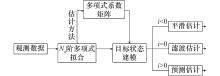
Fig.1
Block diagram of TOE based on polynomial time series"
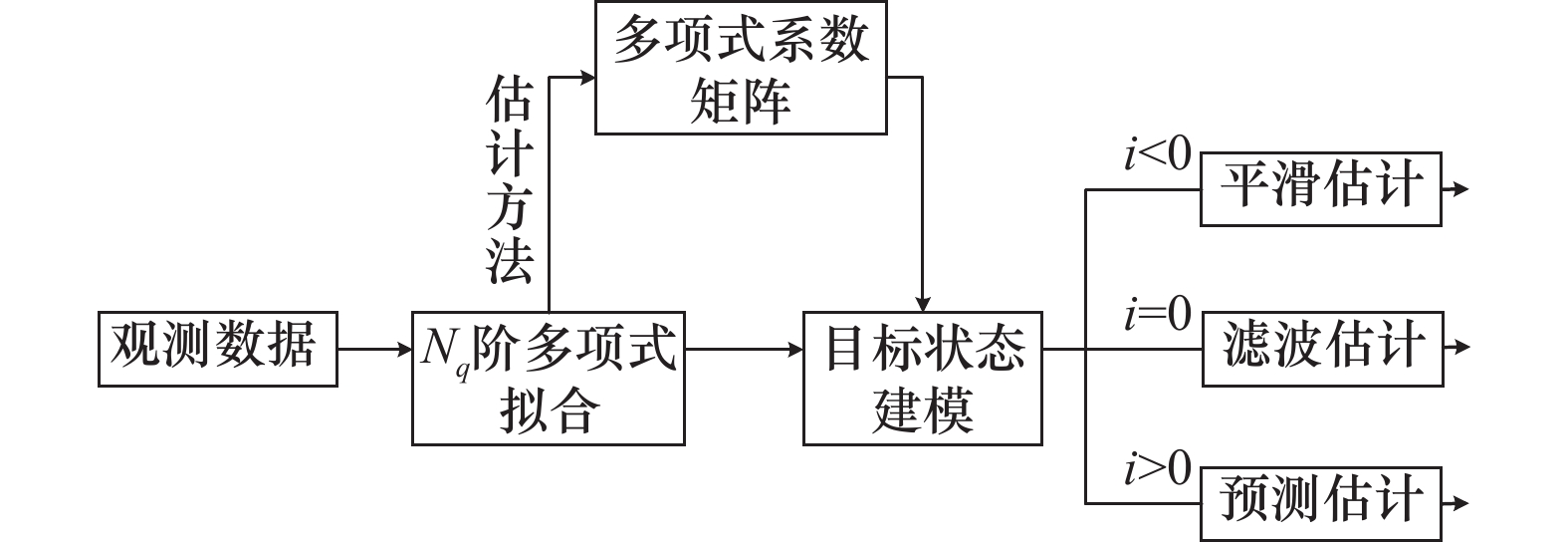
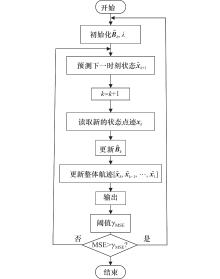
Fig.2
Algorithm flow block diagram based on RMSE analysis"
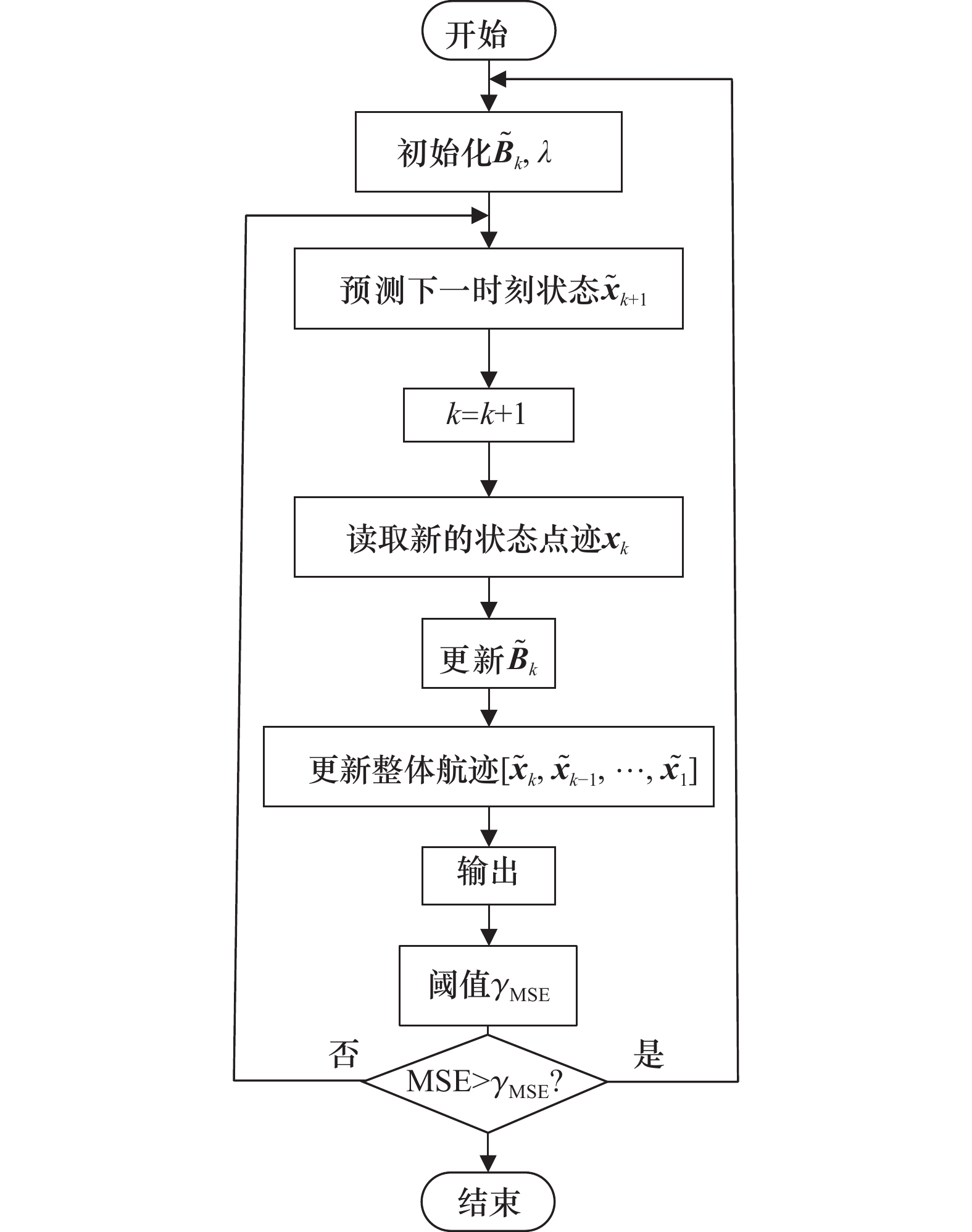
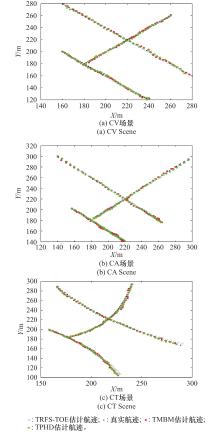
Fig.3
Comparison of tracking effect of algorithms in different motion scenarios"
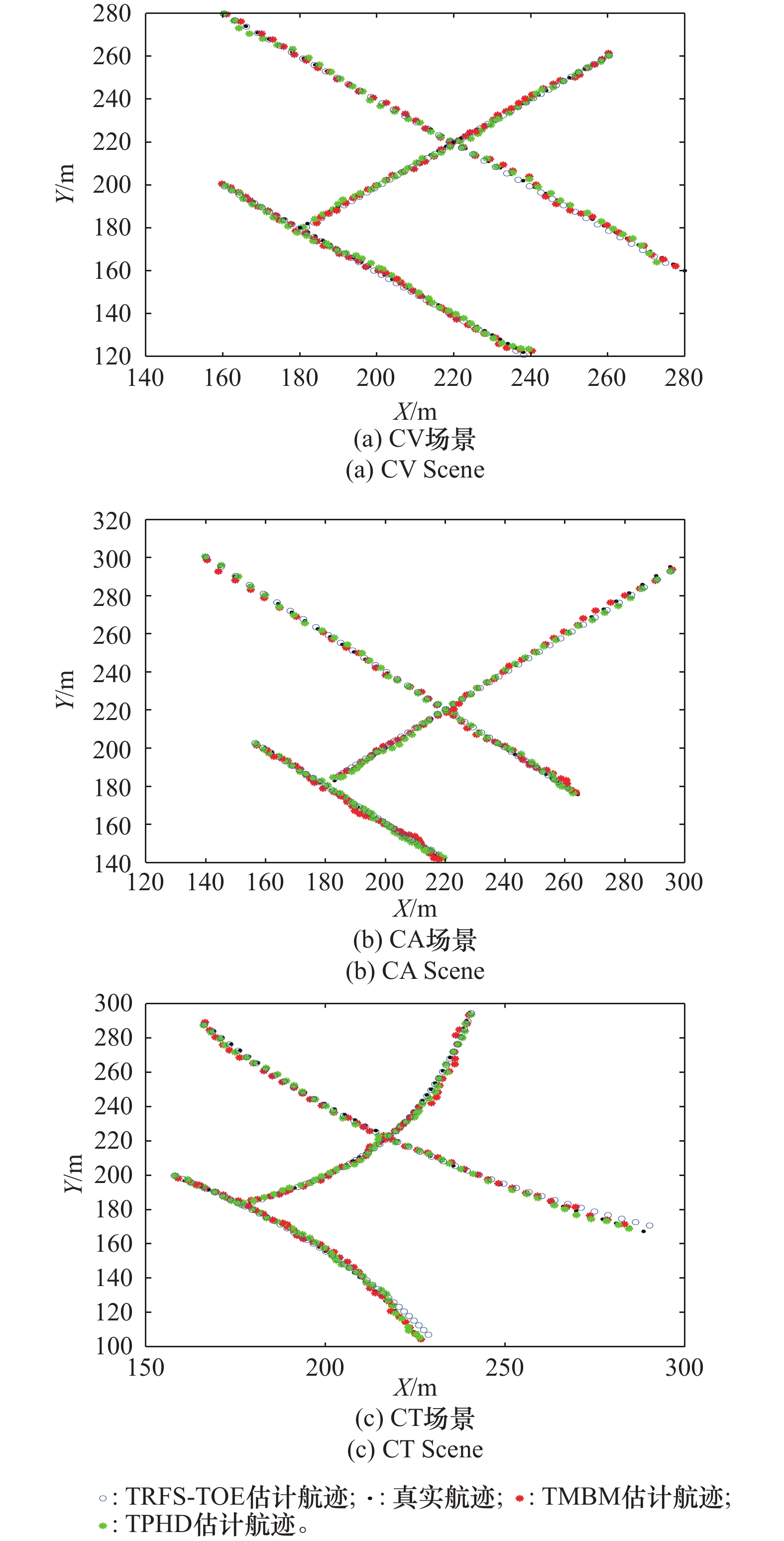
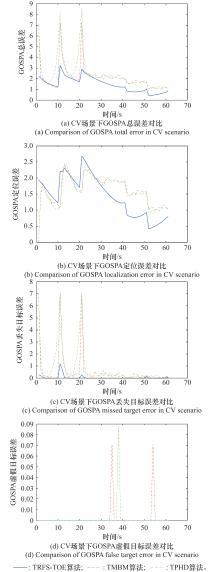
Fig.4
Comparison of GOSPA distance error in CV scenario"
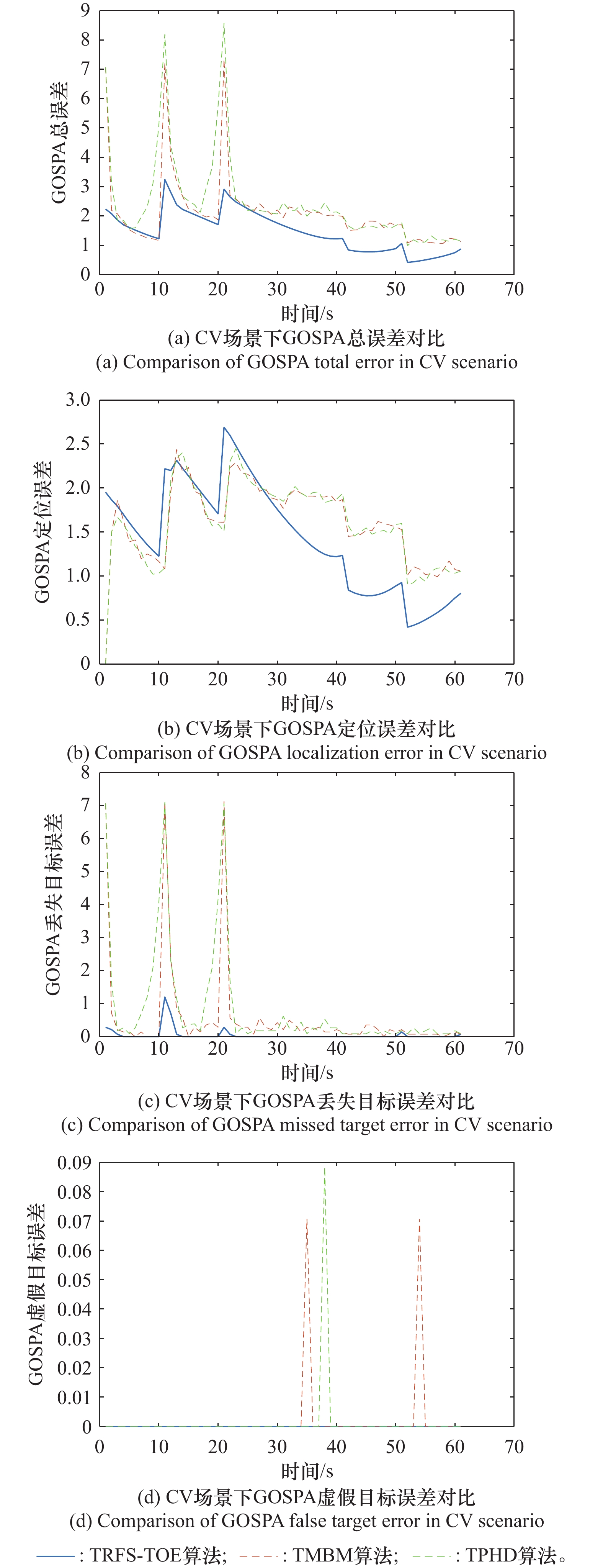
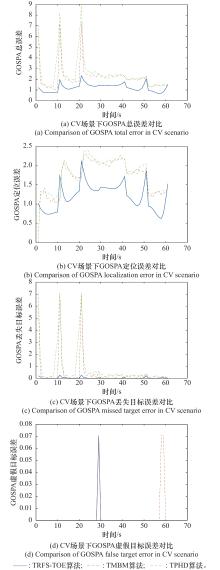
Fig.5
Comparison of GOSPA distance error in CA scenario"
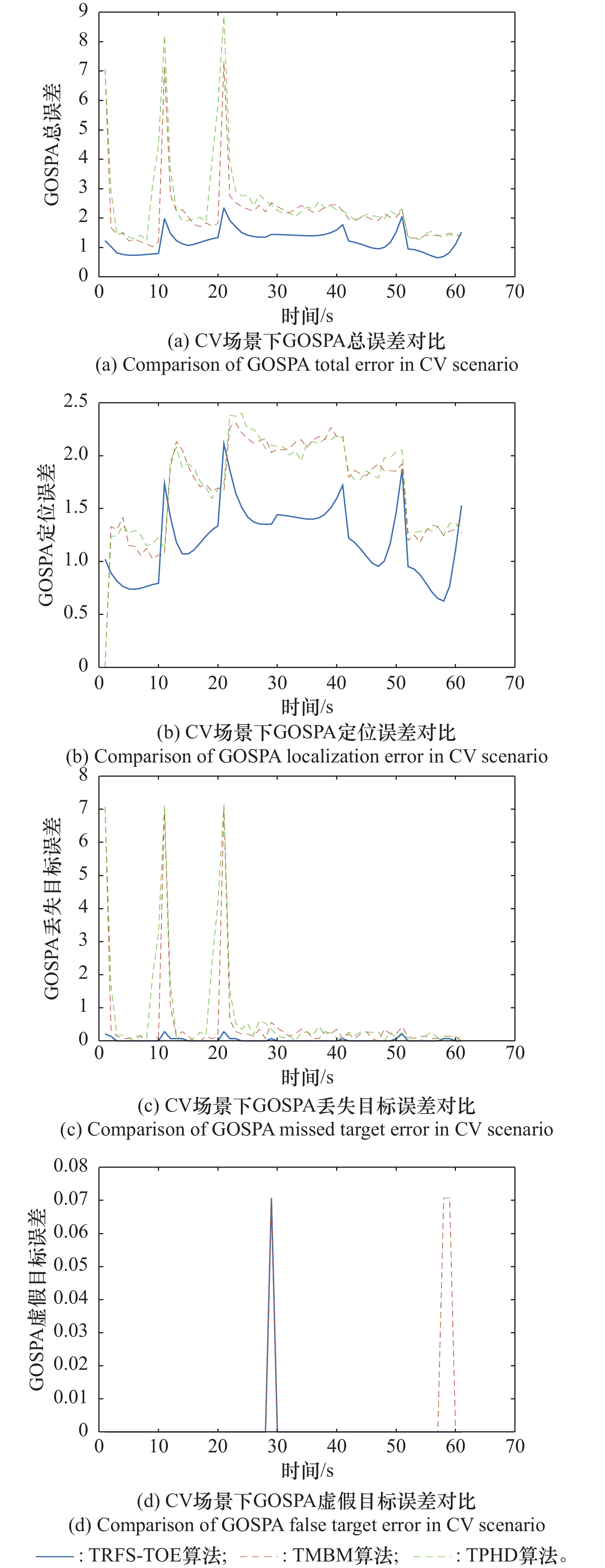
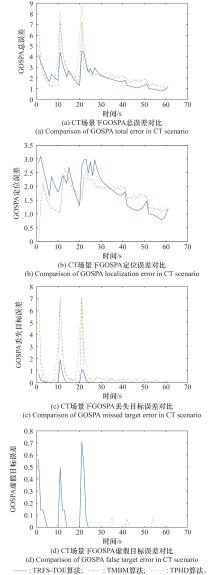
Fig.6
Comparison of GOSPA distance error in CT scenario"
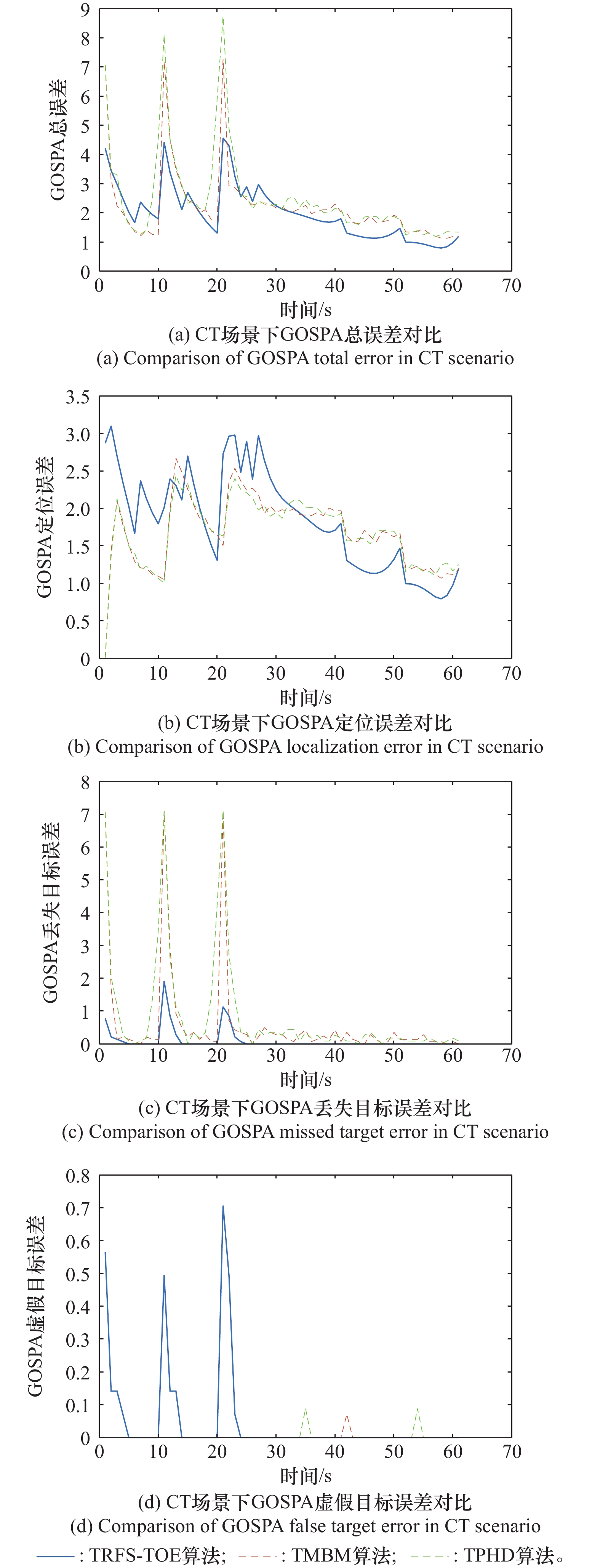

Table 1
Comparison of mean GOSPA distance error of different algorithms in CV scenario"
| 跟踪方法 | CV场景下GOSPA距离误差均值 | |||
| GOSPA总误差 | 定位误差 | 丢失目标误差 | 虚假目标误差 | |
| TRFS-TOE算法 | 1.48 | 1.44 | 0.05 | 0 |
| TMBM算法 | 2.19 | 1.61 | 0.59 | 0.01 |
| TPHD算法 | 2.46 | 1.60 | 0.86 | 0.01 |
Table 2
Comparison of mean GOSPA distance error of different algorithms in CA scenario"
| 跟踪方法 | CA场景下GOSPA距离误差均值 | |||
| GOSPA总误差 | 定位误差 | 丢失目标误差 | 虚假目标误差 | |
| TRFS-TOE算法 | 1.23 | 1.20 | 0.03 | 0.01 |
| TMBM算法 | 2.24 | 1.71 | 0.53 | 0.01 |
| TPHD算法 | 2.51 | 1.73 | 0.78 | 0.01 |
Table 3
Comparison of mean GOSPA distance error of different algorithms in CT scenario"
| 跟踪方法 | CT场景下GOSPA距离误差均值 | |||
| GOSPA总误差 | 定位误差 | 丢失目标误差 | 虚假目标误差 | |
| TRFS-TOE算法 | 1.99 | 1.84 | 0.11 | 0.05 |
| TMBM算法 | 2.30 | 1.69 | 0.61 | 0.01 |
| TPHD算法 | 2.54 | 1.68 | 0.85 | 0.01 |
| 1 | FURGALE P, BARFOOT T D, SIBLEY G. Continuous-time batch estimation using temporal basis functions[C]// Proc. of the IEEE International Conference on Robotics and Automation, 2012: 2088−2095. |
| 2 |
SINGPURWALLA N D, POLSON N G, SOYER R. From least squares to signal processing and particle filtering[J]. Technometrics, 2018, 60 (2): 146- 160.
doi: 10.1080/00401706.2017.1341341 |
| 3 | FAN J, YAO Q. Nonlinear time series: nonparametric and parametric methods[M]. New York: Springer, 2003. |
| 4 |
DELONG A, OSOKIN A, ISACK H N, et al. Fast approximate energy minimization with label costs[J]. International Journal of Computer Vision, 2012, 96 (1): 1- 27.
doi: 10.1109/cvpr.2010.5539897 |
| 5 |
EI-HAWARY F, JING Y. Robust regression-based EKF for tracking underwater targets[J]. IEEE Journal of Oceanic Engineering, 1995, 20 (1): 31- 41.
doi: 10.1109/48.380248 |
| 6 |
DIMATTEO I, GENOVESE C R, KASS R E. Bayesian curve-fitting with free-knot splines[J]. Biometrika, 2001, 88 (4): 1055- 1071.
doi: 10.1093/biomet/88.4.1055 |
| 7 |
MILAN A, SCHINDLER K, ROTH S. Multi-target tracking by discrete-continuous energy minimization[J]. IEEE Trans. on Pattern Analysis and Machine Intelligence, 2016, 38 (10): 2054- 2068.
doi: 10.1109/TPAMI.2015.2505309 |
| 8 | WANG X, HAN C Z. Turn rate estimation based on curve fitting in maneuvering target tracking[C]. Proc. of the 42nd Southeastern Symposium on System Theory, 2010: 194−196. |
| 9 | LIU Y, SUO J, KARIMI H R, et al. A Filtering algorithm for maneuvering target tracking based on smoothing spline fitting[J]. Abstract and Applied Analysis, 2014: 1−6. |
| 10 | ABUTALEB A S. Trajectory estimation of manoeuvring re-entry vehicles and non-linear filtering[J]. International Journal of Control, 1987, 46 (5): 1653- 1670. |
| 11 |
王正明, 朱炬波. 弹道跟踪数据的节省参数模型及应用[J]. 中国科学E辑, 1999, 29 (2): 146- 154.
doi: 10.3969/j.issn.1674-7259.1999.02.008 |
|
WANG Z M, ZHU J B. Saving parameter model and its application for ballistic tracking data[J]. Science in China Series E: Technological Sciences, 1999, 29 (2): 146- 154.
doi: 10.3969/j.issn.1674-7259.1999.02.008 |
|
| 12 |
ANDERSON-SPRECHER R, LENTH R V. Spline estimation of paths using bearings-only tracking data[J]. Journal of the American Statistical Association, 1996, 91 (433): 276- 283.
doi: 10.1080/01621459.1996.10476686 |
| 13 |
朱炬波, 贺明科, 冉承其, 等. 自由节点样条函数平滑滤波技术[J]. 电子学报, 2004 (1): 135- 138.
doi: 10.3321/j.issn:0372-2112.2004.01.032 |
|
ZHU J B, HE M K, RAN C Q, et al. Smoothing filter technique of free-node spline function[J]. Acta Electronica Sinica, 2004 (1): 135- 138.
doi: 10.3321/j.issn:0372-2112.2004.01.032 |
|
| 14 |
LIU J L, ZHU J B, XIE M H. Trajectory estimation with multi-range-rate system based on sparse representation and spline model optimization[J]. Chinese Journal of Aeronautics, 2010, 23 (1): 84- 90.
doi: 10.1016/S1000-9361(09)60191-6 |
| 15 | LI T C, CORCHADO J M, CHEN H M, et al. Track a smoothly maneuvering target based on trajectory estimation[C]// Proc. of the 20th International Conference on Information Fusion, 2017. |
| 16 |
LI T C. Single-road-constrained positioning based on deterministic trajectory geometry[J]. IEEE Communications Letters, 2019, 23 (1): 80- 83.
doi: 10.1109/LCOMM.2018.2879478 |
| 17 | ZHUANG P. An improved nearest neighbor algorithm based on trajectory-oriented estimation[C]// Proc. of the 4th International Conference on Electronic Information Engineering and Computer, 2024: 983−986. |
| 18 | LI T C, WANG X X, LIANG Y, et al. A track-oriented approach to target tracking with random finite set observations[C]// Proc. of the International Conference on Control, Automation and Information Sciences, 2019. |
| 19 |
LI T C, CHEN H M, SUN S D, et al. Joint smoothing and tracking based on continuous-time target trajectory function fitting[J]. IEEE Trans. on Automation Science and Engineering, 2019, 16 (3): 1476- 1483.
doi: 10.1109/TASE.2018.2882641 |
| 20 |
LI T C, SONG Y, FAN H Q. From target tracking to targeting track: a data-driven yet analytical approach to joint target detection and tracking[J]. Signal Processing, 2023, 205, 108883.
doi: 10.1016/j.sigpro.2022.108883 |
| 21 |
庄鹏, 郑岱堃, 袁俊泉, 等. 面向时变机动目标的自适应航迹整体估计方法[J]. 空天预警研究学报, 2024, 38 (4): 241- 248.
doi: 10.3969/j.issn.2097-180X.2024.034.002 |
|
ZHUANG P, ZHENG D K, YUAN J Q, et al. Adaptive integrated trajectory estimation method for time-varying maneuvering targets[J]. Journal of Aerospace Early Warning Research, 2024, 38 (4): 241- 248.
doi: 10.3969/j.issn.2097-180X.2024.034.002 |
|
| 22 |
GARCÍA-FERNÁNDEZ Á F, SVENSSON L, MORELANDE M R. Multiple target tracking based on sets of trajectories[J]. IEEE Trans. on Aerospace and Electronic Systems, 2020, 56 (3): 1685- 1707.
doi: 10.1109/TAES.2019.2921210 |
| 23 |
GARCÍA-FERNÁNDEZ Á F, SVENSSON L. Trajectory PHD and CPHD filters[J]. IEEE Trans. on Signal Processing, 2019, 67 (22): 5702- 5714.
doi: 10.1109/TSP.2019.2943234 |
| 24 | GARCÍA-FERNÁNDEZ Á F, RALPH J, HORRIDGE P, et al. Gaussian trajectory PMBM filter with nonlinear measurements based on posterior linearisation[C]// Proc. of the 25th International Conference on Information Fusion, 2022. |
| 25 |
GARCÍA-FERNÁNDEZ Á F, SVENSSON L, WILLIAMS J L, et al. Trajectory Poisson multi-Bernoulli filters[J]. IEEE Trans. on Signal Processing, 2020, 68, 4933- 4945.
doi: 10.1109/TSP.2020.3017046 |
| 26 | XIA Y X, GRANSTRÖM K, SVENSSON L, et al. Multi-scan implementation of the trajectory Poisson multi-Bernoulli mixture filter[C]// Proc. of the 22nd International Conference on Information Fusion, 2019, 14(2): 213−235. |
| 27 |
GARCÍA-FERNÁNDEZ Á F, WILLIAMS J L, GRANSTRÖM K, et al. Poisson multi-Bernoulli mixture filter: direct derivation and implementation[J]. IEEE Trans. on Aerospace and Electronic Systems, 2018, 54 (4): 1883- 1901.
doi: 10.1109/TAES.2018.2805153 |
| 28 |
AKHTAR S, SETOODEH P, AHMED R, et al. A new strategy for combining nonlinear kalman filters with smooth variable structure filters[J]. IEEE Access, 2023, 11, 146262- 146281.
doi: 10.1109/ACCESS.2023.3346433 |
| 29 |
TIAN M C, CHEN Z M, WANG H F, et al. An intelligent particle filter for infrared dim small target detection and tracking[J]. IEEE Trans. on Aerospace and Electronic Systems, 2022, 58 (6): 5318- 5333.
doi: 10.1109/TAES.2022.3169447 |
| 30 | MAO H, ZHANG B, YANG J, et al. Labeled probability hypothesis density filtering for track-before-detect strategy[C]// Proc. of the 26th International Conference on Information Fusion, 2023. |
| 31 | 朱双磊, 陈华友, 张琦, 等. 加权几何平均组合预测方法对数均方误差的分解[J]. 北京航空航天大学学报, 2023, 3, 1- 20. |
| ZHU S L, CHEN H Y, ZHANG Q, et al. Decomposition of logarithmic mean square error for weighted geometric average combination forecasting method[J]. Journal of Beijing University of Aeronautics and Astronautics, 2023, 3, 1- 20. | |
| 32 | RU J, JILKOV V P, LI R X, et al. Sequential detection of target maneuvers[C]// Proc. of the 7th International Conference on Information Fusion, 2005. |
| 33 |
FU J B, SUN J P, LU S T, et al. Multiple hypothesis tracking based on the Shiryayev sequential probability ratio test[J]. Science China Information Sciences, 2016, 59 (12): 122306.
doi: 10.1007/s11432-016-5570-4 |
| 34 |
RU J F, JIKOV V P, LI R, et al. Detection of target maneuver onset[J]. IEEE Trans. on Aerospace and Electronic Systems, 2009, 45 (2): 536- 554.
doi: 10.1109/TAES.2009.5089540 |
| 35 | RU J, LI X R, JILKOV V P. Multiple-model detection of target maneuvers[C]// Proc. of the Conference on Optics & Photonics, 2005. |
| 36 | 张倩昀, 陈华友, 江立辉. 加权算术平均组合预测方法均方误差的分解[J]. 合肥学院学报(综合版), 2020, 37 (2): 7- 13. |
| ZHANG Q Y, CHEN H Y, JIANG L H. Decomposition of mean square error of weighted arithmetic mean combined forecasting method[J]. Journal of Hefei University(Comprehensive Ed), 2020, 37 (2): 7- 13. | |
| 37 | RAHMATHULLAH A S, GARCÍA-FERNÁNDEZ Á F, SVENSSON L. Generalized optimal sub-pattern assignment metric[C]// Proc. of the 20th International Conference on Information Fusion, 2017. |
| [1] | Jiazheng FU, Yuxia GUO, Boxiang ZHANG, Lei CHAI, Wei YI, Lingjiang KONG. Distributed multi-target tracking method based on TPHD and TCPHD filters [J]. Systems Engineering and Electronics, 2025, 47(9): 2828-2838. |
| [2] | Zilin HOU, Ting CHENG, Han PENG. GMPHD based on measurement conversion sequential filtering for maneuvering target tracking [J]. Systems Engineering and Electronics, 2022, 44(8): 2474-2482. |
| [3] | SONG Xiyu, ZHENG Na’e, SUN Yang. Minimal antenna selection algorithm in distributed MIMO radar system for multiple targets tracking [J]. Systems Engineering and Electronics, 2017, 39(10): 2228-2233. |
| [4] | DONG Peng, JING Zhong-liang, LEI Ming, PAN Han. Association based adaptive target birth intensity CPHD filter [J]. Systems Engineering and Electronics, 2016, 38(4): 725-731. |
| [5] | LI Cui-yun, CAO Xiao-nan, LIAO Liang-xiong, JIANG Zhou. Track before detect using Gaussian particle probability hypothesis density [J]. Systems Engineering and Electronics, 2015, 37(4): 740-745. |
| [6] | XIU Jian-juan, WANG Wang-song, HE You. Multiple target tracking in clutter based on distance speed and course [J]. Systems Engineering and Electronics, 2014, 36(9): 1702-1706. |
| [7] | JING Pei-liang, XU Shi-you, LI Xian, CHEN Zeng-ping. Performance evaluation of multiple target tracking:a survey [J]. Systems Engineering and Electronics, 2014, 36(11): 2127-2132. |
| [8] | WANG Lin,KOU Yingxin,YANG Haiyan,YU Lei. Multiple target tracking method based on metaheuristic data association [J]. Journal of Systems Engineering and Electronics, 2010, 32(10): 2176-2180. |
| Viewed | ||||||
|
Full text |
|
|||||
|
Abstract |
|
|||||