Systems Engineering and Electronics ›› 2026, Vol. 48 ›› Issue (8): 2782-2789.doi: 10.12305/j.issn.1001-506X.2026.08.23
• Systems Engineering • Previous Articles
Research on command and control logic chain optimization based on multi-agent coalition updates in adversarial scenarios
Jie ZHANG1,2( ), Chao WANG1, Yu LIU1, Dong LI1, Zhiqun CHEN1, Tianqi LU1
- 1. The 28th Research Institute of China Electronics Technology Group Corporation,Nanjing 210007,China
2. School of Computer Science,Nanjing University,Nanjing 210023,China
-
Received:2025-01-07Revised:2025-05-30Online:2026-03-20Published:2026-03-20 -
Contact:Jie ZHANG E-mail:guyuexiao95@gmail.com

CLC Number:
Cite this article
Jie ZHANG, Chao WANG, Yu LIU, Dong LI, Zhiqun CHEN, Tianqi LU. Research on command and control logic chain optimization based on multi-agent coalition updates in adversarial scenarios[J]. Systems Engineering and Electronics, 2026, 48(8): 2782-2789.
share this article
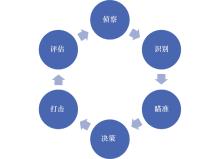
Fig.1
Logical chain framework diagram"
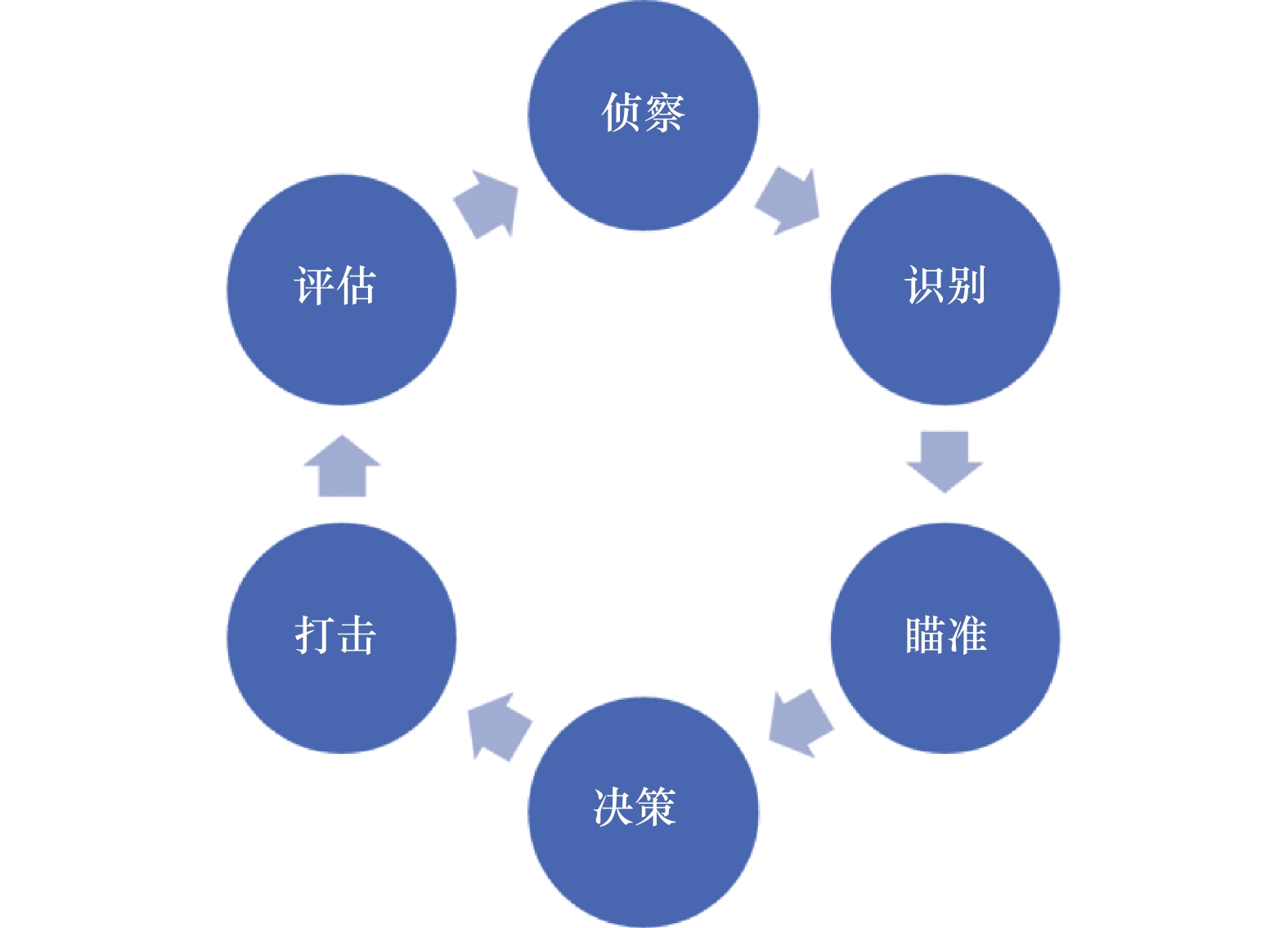
Table 1
Experimental parameter setting"
| 参数 | 数值 |
| 智能体数量 | 50 |
| 作战区域/m | |
| 学习率α | 0.1 |
| 折扣因子γ | 0.9 |
| 训练轮数 | |
| 每次仿真任务轮数 | 200 |
Table 2
Iteration efficiency comparison for two algorithms"
| 算法 | 限制时间/s | 迭代次数 | 平均目标函数值 |
| 本文算法 | 1 | 20 | 8.33 |
| 2 | 50 | 7.118 | |
| 5 | 100 | 7.089 | |
| 未改进的DQN算法 | 1 | 20 | 18.353 |
| 2 | 50 | 10.108 | |
| 5 | 100 | 9.089 |
Table 3
Comparison of comprehensive performance of four algorithms"
| 方法 | 任务完成 率/% | 资源利用 率/% | 协同效能 (分数) | 抗干扰鲁棒性 (分数) |
| 静态联盟策略 | 70.5 | 55 | 3.81 | 4.55 |
| 拍卖机制任务分配 | 65.66 | 60.8 | 5.68 | 5.69 |
| 强化学习协作模型 | 85 | 80.5 | 8.45 | 7.88 |
| 本文算法 | 98.1 | 92.7 | 10.88 | 9.65 |
| 1 | 刘祥雨, 王刚, 郭相科, 等. 面向区域防空场景的杀伤链设计方法[J]. 系统工程与电子技术, 2025, 47 (5): 1582- 1599. |
| LIU X Y, WANG G, GUO X K, et al. Design method of kill chain for regional air defense scenarios[J]. Systems Engineering and Electronics, 2025, 47 (5): 1582- 1599. | |
| 2 | 钱林方, 张龙, 佟明昊, 等. 面向信息化智能打击的现代火炮技术发展与展望[J]. 陆军工程大学学报, 2025, 4 (2): 1- 8. |
| QIAN L F, ZHANG L, TONG M H, et al. Development and prospect of modern artillery technology for information-based intelligent strike[J]. Journal of Army Engineering University, 2025, 4 (2): 1- 8. | |
| 3 | 张昊, 邓大松. 未来无人反无人杀伤链展望分析[J]. 战术导弹技术, 2024, 1 (5): 160- 167. |
| ZHANG H, DENG D S. Prospective analysis of future unmanned counter-unmanned kill chain[J]. Tactical Missile Technology, 2024, 1 (5): 160- 167. | |
| 4 | JOHNSON B, GREEN J M, BURNS G, et al. Mapping artificial intelligence to the naval tactical kill chain[J]. Naval Engineers Journal, 2023, 135 (1): 155- 166. |
| 5 | 王耀祖, 尚柏林, 宋笔锋, 等. 基于杀伤链的作战体系网络关键节点识别方法[J]. 系统工程与电子技术, 2023, 45 (3): 736- 744. |
| WANG Y Z, SHANG B L, SONG B F, et al. Key node identification method of combat system network based on kill chain[J]. Systems Engineering and Electronics, 2023, 45 (3): 736- 744. | |
| 6 | ZHANG Z L, TIAN S P, KONG L T. Application for over-the-air computation in command and control data link systems[J]. Command Information System and Technology, 2022, 13 (6): 55- 62. |
| 7 | XU C T, ZHOU F, CHEN H H, et al. Autonomous adaptive capability evaluation method for intelligent command and control system[J]. Command Information System and Technology, 2023, 14 (6): 29- 38. |
| 8 |
ZHANG J L, HAN K, ZHANG P, et al. A survey on joint-operation application for unmanned swarm formations under a complex confrontation environment[J]. Journal of Systems Engineering and Electronics, 2023, 34 (6): 1432- 1446.
doi: 10.23919/JSEE.2023.000162 |
| 9 | 徐成涛, 周芳, 陈洪辉, 等. 智能化指挥控制系统自主适变能力评估方法[J]. 指挥信息系统与技术, 2023, 14 (6): 29- 38. |
| XU C T, ZHOU F, CHEN H H, et al. Assessment method for autonomous adaptive capability of intelligent command and control system[J]. Command Information System and Technology, 2023, 14 (6): 29- 38. | |
| 10 | 张福林, 孔凡照, 黄凯. 基于智能调度策略的火力规划技术[J]. 指挥信息系统与技术, 2024, 15 (4): 46- 49,62. |
| ZHANG F L, KONG F Z, HUANG K. Firepower planning technology based on intelligent scheduling strategy[J]. Command Information System and Technology, 2024, 15 (4): 46- 49,62. | |
| 11 | GAO X L, WANG R, LIU Z H, et al. A land-based war-gaming simulation method based on multi-agent proximal policy optimization[C]//Proc. of the IEEE 24th International Conference on Software Quality, Reliability, and Security Companion, 2024: 611–618. |
| 12 | BLACK K, JANNER M, DU Y, et al. Training diffusion models with reinforcement learning [EB/OL]. [2025-07-01]. https://arxiv.org/abs/2305.13301. |
| 13 | KORKMAZ E. Adversarial robust deep reinforcement learning requires redefining robustness[C]//Proc. of the AAAI Conference on Artificial Intelligence, 2023: 8369–8377. |
| 14 | CHEN Y J, ZHENG Z C, GONG X L. Marnet: backdoor attacks against cooperative multi-agent reinforcement learning[J]. IEEE Trans. on Dependable and Secure Computing, 2022, 20 (5): 4188- 4198. |
| 15 | XU Z W, BAI Y P, ZHANG B, et al. Haven: hierarchical cooperative multi-agent reinforcement learning with dual coordination mechanism[C]// Proc. of the AAAI Conference on Artificial Intelligence, 2023: 11735–11743. |
| 16 | WU Z F, YU C, CHEN C, et al. Models as agents: optimizing multi-step predictions of interactive local models in model-based multi-agent reinforcement learning[C]// Proc. of the AAAI Conference on Artificial Intelligence, 2023: 10435–10443. |
| 17 | BOGGESS K, KRAUS S, FENG L. Explainable multi-agent reinforcement learning for temporal queries[C]// Proc. of the 32nd International Joint Conference on Artificial Intelligence, 2023: 55–63. |
| 18 | CHEN L, LU K, RAJESWARAN A, et al. Decision transformer: Reinforcement learning via sequence modeling[J]. Advances in Neural Information Processing Systems, 2021, 34 (1): 15084- 15097. |
| 19 | CHRISTIANOS F, PAPOUDAKIS G, RAHMAN M A, et al. Scaling multi-agent reinforcement learning with selective parameter sharing[C]//Proc. of the International Conference on Machine Learning, 2021: 1989–1998. |
| 20 | LIU I J, JAIN U, YEH R A, et al. Cooperative exploration for multi-agent deep reinforcement learning[C]//Proc. of the International Conference on Machine Learning, 2021: 6826–6836. |
| 21 | 文永明, 李博研, 张宁宁, 等. 基于深度强化学习的多智能体编队协同控制[J]. 指挥信息系统与技术, 2023, 14 (5): 75- 79. |
| WEN Y M, LI B Y, ZHANG N N, et al. Multi-agent formation cooperative control based on deep reinforcement learning[J]. Command Information System and Technology, 2023, 14 (5): 75- 79. | |
| 22 | 唐志一, 蔡颖, 王会. 基于自适应加权算法的多传感器数据融合方法[J]. 指挥信息系统与技术, 2022, 13 (5): 66- 70. |
| TANG Z Y, CAI Y, WANG H. Multi-sensor data fusion method based on adaptive weighted algorithm[J]. Command Information System and Technology, 2022, 13 (5): 66- 70. | |
| 23 | KOLPACZKI P, BENGS V, MUSCHALIK M, et al. Approximating the shapley value without marginal contributions[C]//Proc. of the AAAI Conference on Artificial Intelligence, 2024: 13246–13255. |
| 24 | LIU L, HU Y J, GAO Y, et al. Value function transfer for deep multi-agent reinforcement learning based on N-step returns[C]//Proc. of the 28th International Joint Conference on Artificial Intelligence, 2019: 457–463. |
| 25 | JIN C, KRISHNAMURTHY A, SIMCHOWITZ M, et al. Reward-free exploration for reinforcement learning[C]//Proc. of the International Conference on Machine Learning, 2020: 4870–4879. |
| 26 | ZANETTE A, WAINWRIGHT M. Stabilizing Q-learning with linear architectures for provable efficient learning[C]//Proc. of the International Conference on Machine Learning, 2022: 25920–25954. |
| 27 | WANG J, ZHANG Y, KIM T K, et al. Shapley Q-value: a local reward approach to solve global reward games[C]//Proc. of the AAAI Conference on Artificial Intelligence, 2020: 7285–7292. |
| 28 |
OLSEN L H B, GLAD I K, JULLUM M, et al. A comparative study of methods for estimating model-agnostic Shapley value explanations[J]. Data Mining and Knowledge Discovery, 2024, 38 (4): 1782- 1829.
doi: 10.1007/s10618-024-01016-z |
| 29 | LITTMAN M L. Markov games as a framework for multi-agent reinforcement learning[C]//Proc. of the 11th International Conference on Machine Learning, 1994: 157–163. |
| 30 | VASANKARI L, SAASTAMOINEN K. Strategizing the shallows: leveraging multi-agent reinforcement learning for enhanced tactical decision-making in Littoral Naval Warfare[C]//Proc. of the International Conference on Artificial Intelligence Applications and Innovations, 2024: 129–141. |
| 31 | ZHANG K, KAKADE S, BASAR T, et al. Model-based multi-agent RL in zero-sum Markov games with near-optimal sample complexity[J]. Advances in Neural Information Processing Systems, 2020, 33 (1): 1166- 1178. |
| 32 |
KURNIAWATI H. Partially observable markov decision processes and robotics[J]. Annual Review of Control, Robotics, and Autonomous Systems, 2022, 5 (1): 253- 277.
doi: 10.1146/annurev-control-042920-092451 |
| 33 | MOGHADDAM A R, KEBRIAEI H. Multiagent reinforcement learning for Nash equilibrium seeking in general-sum Markov games[J]. IEEE Trans. on Systems, Man, and Cybernetics: Systems, 2025, 55(1): 221–227. |
| 34 | DA-COSTA A R, PARIS D M, LUJAK M, et al. Dynamic and cooperative multi-agent task allocation: enhancing Nash equilibrium through learning[C]//Proc. of the IEEE International Conference on Systems, Man, and Cybernetics, 2024: 1860–1866. |
| [1] | Tianran YIN, He LUO, Yue SHI, Xiaodie QIANG, Guoqiang WANG. A satellite and UAV joint mission planning method based on a reinforcement hybrid genetic algorithm [J]. Systems Engineering and Electronics, 2026, 48(7): 2293-2306. |
| [2] | Jingli YANG, Ying WANG, Tianyu GAO, Xiaotong FANG. Dynamic reconfiguration method for shipboard electronic information systems for fault propagation risk suppression [J]. Systems Engineering and Electronics, 2026, 48(7): 2307-2318. |
| [3] | Qiang LI, Di ZHOU, Siyuan LI, Yurong LIN. Adaptive guidance for missile based on meta-learning and predictive control [J]. Systems Engineering and Electronics, 2026, 48(7): 2424-2433. |
| [4] | Zan MA, Yubin LIU, Jie BAI, Yong CHEN, Shuguang SUN. Intelligent avoidance airworthiness safety risk assessment of unmanned aerial vehicle based on hierarchical STPA-MC [J]. Systems Engineering and Electronics, 2026, 48(6): 2000-2013. |
| [5] | Zhenshuai JIA, Bing XIAO, Hanyu QIAN, Zheyu ZHANG. Spacecraft on-orbit observation maneuver decision-making method based on multi-policy learning [J]. Systems Engineering and Electronics, 2026, 48(5): 1590-1598. |
| [6] | Huaqing ZHANG, Xiaofei ZHANG, Mingrui HAO, Jixiang JIANG, Shan LI. Robust multi-agent cooperative confrontation policy offline reinforcement learning [J]. Systems Engineering and Electronics, 2026, 48(5): 1670-1681. |
| [7] | Shaohui ZHANG, Lulu LI, Yafei LI, Qingshun WU, Guanfeng LI, Mingliang XU. Research on the planning methods of ammunition support operations for carrier-based aircraft: a survey [J]. Systems Engineering and Electronics, 2026, 48(4): 1303-1321. |
| [8] | Zhigang JIN, Zepei LIU, Xiaodong WU. Survey of game theory applications in Internet of Things security and privacy [J]. Systems Engineering and Electronics, 2026, 48(3): 1072-1082. |
| [9] | Pengcheng YANG, Qingqing YANG, Yingying GAO, Zhiwei YANG, Kewei YANG, Bo AI. Path planning for maritime moving targets search based on reinforcement learning [J]. Systems Engineering and Electronics, 2026, 48(2): 515-523. |
| [10] | Jiahui FANG, Kebo LI, Yangang LIANG. Reachability analysis of space proximity behavior patterns based on optimal impulse [J]. Systems Engineering and Electronics, 2026, 48(2): 652-659. |
| [11] | Xu WANG, Guangbin CAI, Xiaoya YU, Ziqi YE, Bin SHAN. Attitude control of hypersonic vehicle based on dual-dynamic PPO algorithm [J]. Systems Engineering and Electronics, 2026, 48(2): 694-704. |
| [12] | Zhikang LIN, Jialei LIU, Jiazhi MA, Longfei SHI, Jinbao XU. Counter-anti-radiation method method using distributed radiation source blinking decoy [J]. Systems Engineering and Electronics, 2026, 48(1): 1-11. |
| [13] | Jinyan XUE, Yasheng ZHANG, Xuefeng TAO, Mingqi YANG, Shuailong ZHAO. Advances in orbital maneuver control for GEO spacecraft [J]. Systems Engineering and Electronics, 2026, 48(1): 290-300. |
| [14] | Chuanlong SONG, Qianwu ZHANG, Jian HE, Wenjun ZHOU, Hui WANG, Weiwei KONG, Wenbo TIAN. Edge computing task offloading method of satellite-ground collaborative based on MADDPG algorithm [J]. Systems Engineering and Electronics, 2026, 48(1): 350-360. |
| [15] | Peng YAO, Meiyu HAN, Dechuan WANG, Zhicheng GAO. Multiple unmanned surface vehicles pursuit method based on adversarial evolutionary reinforcement learning [J]. Systems Engineering and Electronics, 2025, 47(9): 2960-2970. |
| Viewed | ||||||
|
Full text |
|
|||||
|
Abstract |
|
|||||