Systems Engineering and Electronics ›› 2026, Vol. 48 ›› Issue (6): 1980-1990.doi: 10.12305/j.issn.1001-506X.2026.06.19
• Systems Engineering • Previous Articles Next Articles
Online reconstruction method for strike chain in dynamic confrontation scenarios
Yuyang XUE1,2,3( ), Tao WANG1,2,3,*, Xin LIAO4, Yuannan XU4, Minghao LIN1,2,3, Anqi WU1,2,3
- 1. School of Intelligent Systems Engineering,Sun Yat-sen University,Shenzhen 517108,China
2. Southern Marine Science and Engineering Guangdong Laboratory,Zhuhai 519000,China
3. Center for Swarm Intelligence,Institute of Artificial Intelligence,Sun Yat-sen University,Guangzhou 510275,China
4. Research and Development Center,China Academy of Launch Vehicle Technology,Beijing 100076,China
-
Received:2025-08-18Revised:2025-11-04Accepted:2025-12-16Online:2026-06-25Published:2026-03-20 -
Contact:Tao WANG E-mail:xueyy7@mail2.sysu.edu.cn

CLC Number:
Cite this article
Yuyang XUE, Tao WANG, Xin LIAO, Yuannan XU, Minghao LIN, Anqi WU. Online reconstruction method for strike chain in dynamic confrontation scenarios[J]. Systems Engineering and Electronics, 2026, 48(6): 1980-1990.
share this article
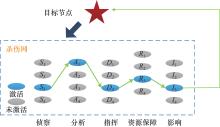
Fig.1
strike chain workflow based on kill network"
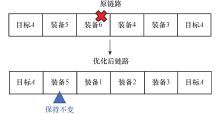
Fig.2
Example of comparison before and after link reconstruction"
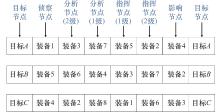
Fig.3
Schematic diagram of strike chain encoding"
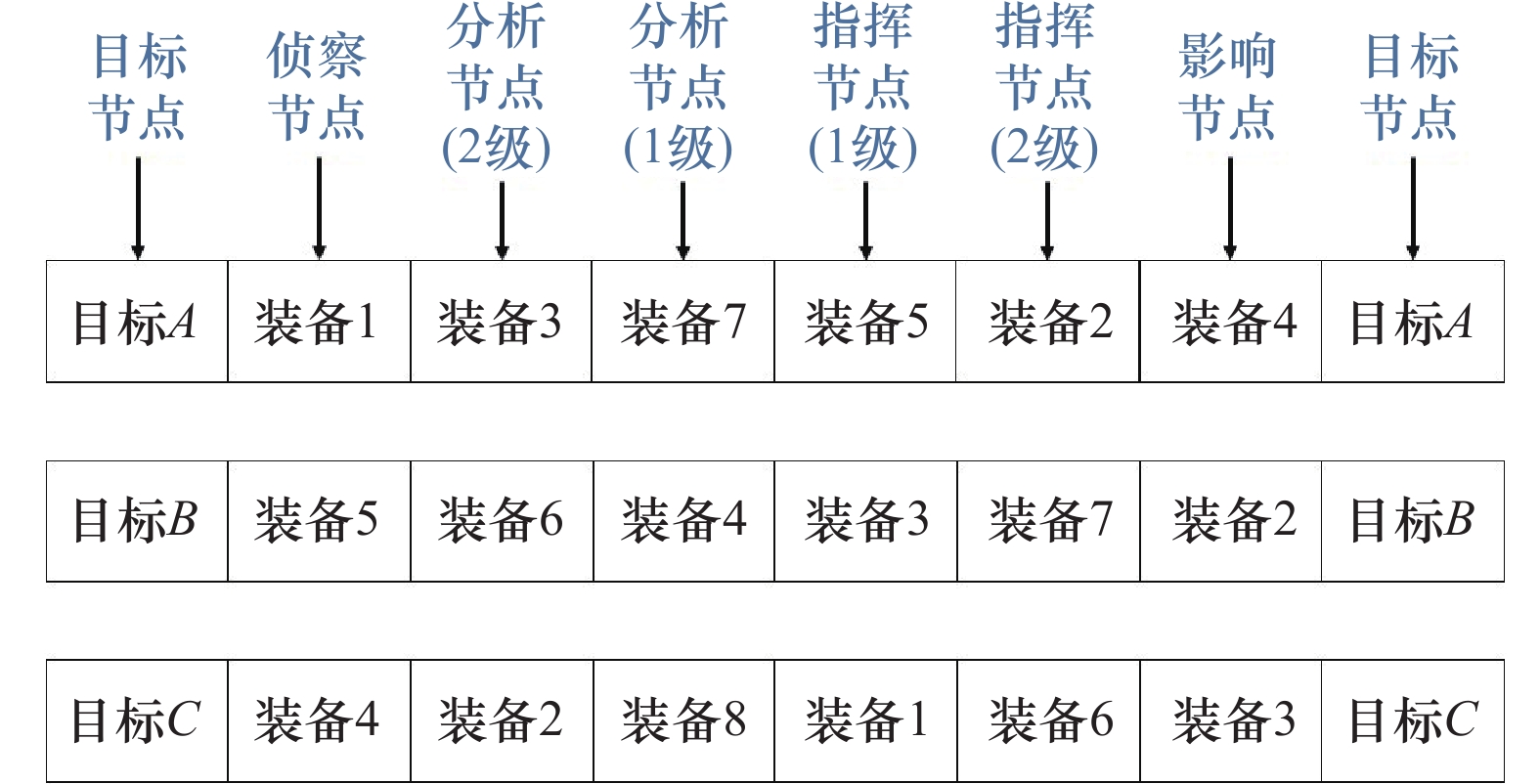
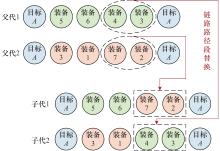
Fig.4
Schematic diagram of crossover operation"
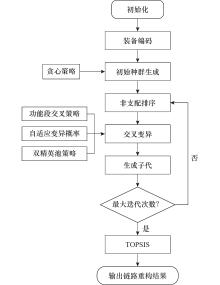
Fig.5
Reconstruction process based on improved NSGA-II algorithm"
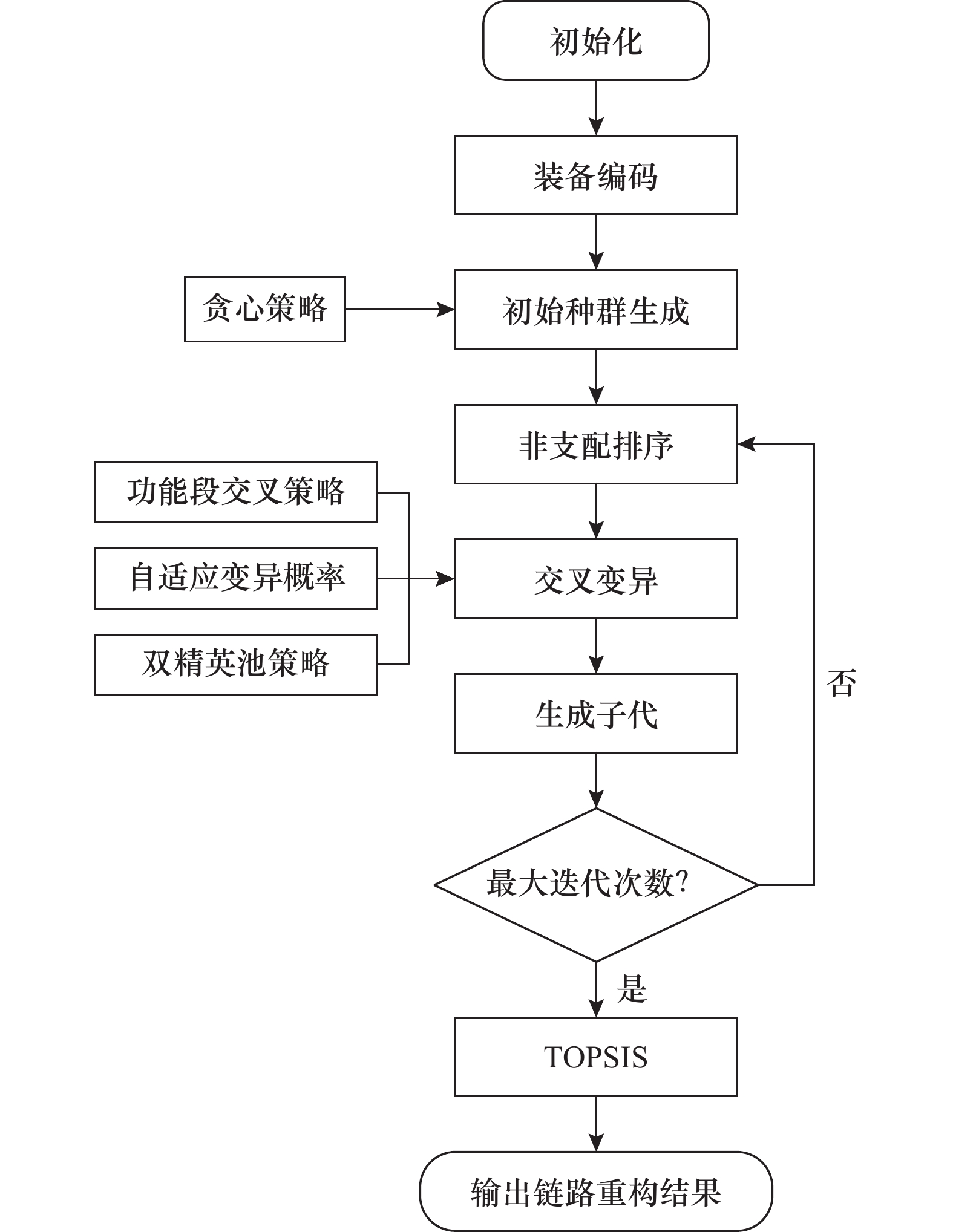

Table 1
Simulation conditions"
| 名称 | 配置/型号 |
| CPU | Intel i7 12700H(16 G) |
| 显卡 | NVIDIA GeForce RTX 3060(12 GB) |
| 系统 | Windows 11 |
| 软件环境 | Python 3.10 |
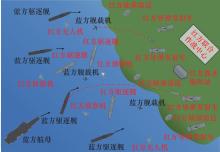
Fig.6
Schematic diagram of simulation scenario"
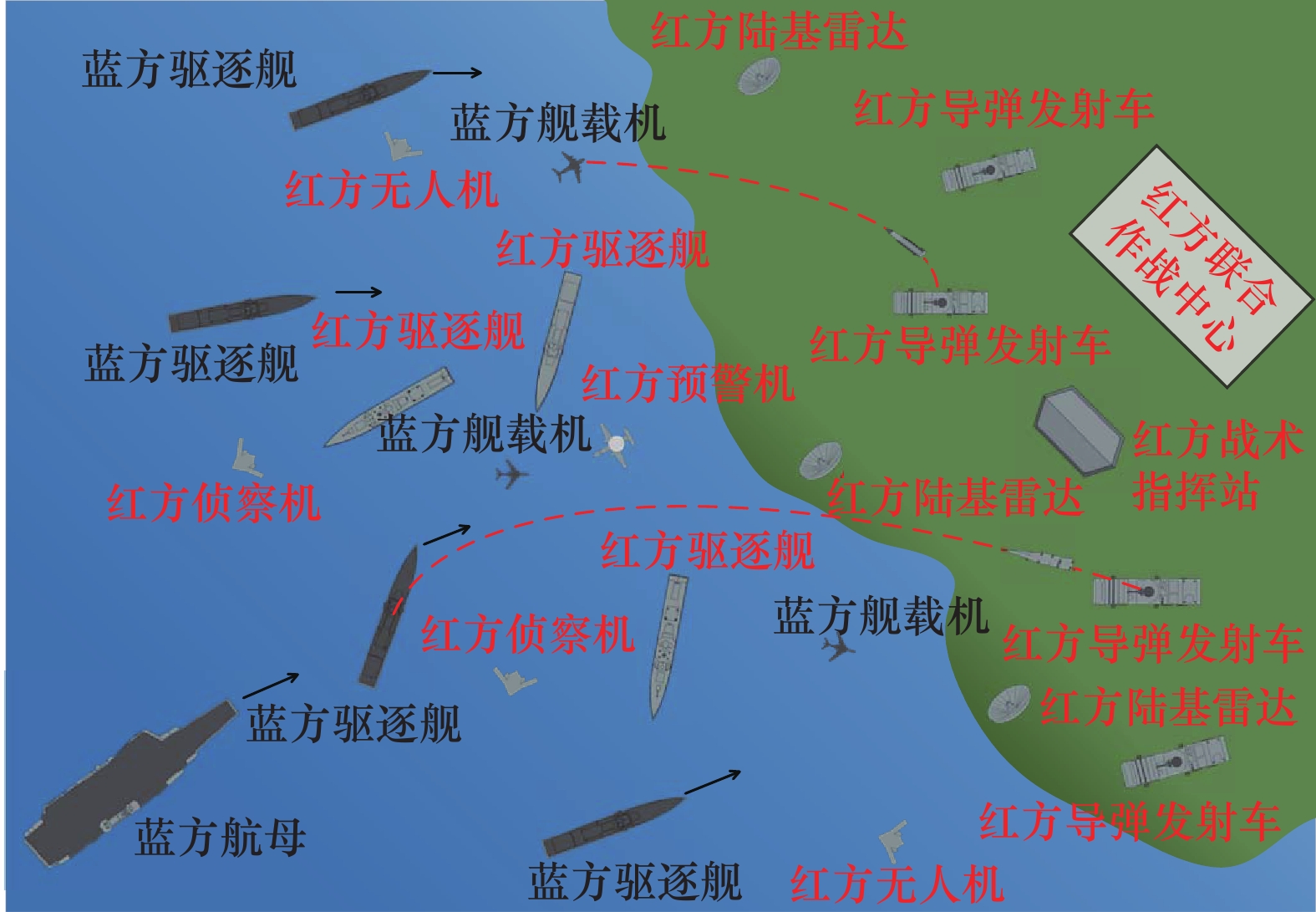
Table 2
Target node configuration"
| 名称 | 伪装 能力 | 拦截 能力 | 防护 能力 |
| 航母1 | 0.2 | 0.3 | 0.5 |
| 航母2 | 0.2 | 0.3 | 0.5 |
| 驱逐舰1 | 0.2 | 0.3 | 0.5 |
| 驱逐舰2 | 0.2 | 0.3 | 0.5 |
| 轰炸机1 | 0.2 | 0.3 | 0.5 |
| 轰炸机2 | 0.2 | 0.3 | 0.5 |
| 舰载战斗机1 | 0.2 | 0.3 | 0.5 |
| 舰载战斗机2 | 0.2 | 0.3 | 0.5 |
| 补给舰 | 0.2 | 0.3 | 0.5 |
Table 3
Reconnaissance node configuration"
| 名称 | 探测 半径/units | 精度/% | 扫描 速率/(°/s) | 雷达 数量 |
| 驱逐舰1 | 400 | 99.5 | 12 | 1 |
| 驱逐舰2 | 800 | 95 | 12 | 1 |
| 预警机1 | 600 | 80 | 10 | 1 |
| 预警机2 | 600 | 80 | 10 | 1 |
| 无人机1 | 200 | 88 | 6 | 1 |
| 无人机2 | 200 | 88 | 6 | 1 |
| 无人机3 | 200 | 88 | 6 | 1 |
| 侦察机1 | 300 | 88 | 6 | 1 |
| 侦察机2 | 300 | 88 | 6 | 1 |
| 侦察机3 | 300 | 88 | 6 | 1 |
| 陆基雷达1 | 800 | 99.5 | 20 | 4 |
| 陆基雷达2 | 800 | 99.5 | 20 | 4 |
| 陆基雷达3 | 800 | 99.5 | 20 | 4 |
| 陆基雷达4 | 800 | 99.5 | 20 | 4 |
Table 4
Intelligence analysis node configuration"
| 名称 | 处理 速度 | 分析 水平 | 分析 级别 |
| 驱逐舰1 | 0.8 | 0.5 | 2 |
| 驱逐舰2 | 0.8 | 0.5 | 2 |
| 预警机1 | 0.3 | 0.6 | 2 |
| 预警机2 | 0.3 | 0.6 | 2 |
| 战役情报中心1 | 0.8 | 0.5 | 1 |
| 战役情报中心2 | 0.8 | 0.5 | 1 |
| 战术情报中心1 | 0.8 | 0.5 | 2 |
| 战术情报中心2 | 0.8 | 0.5 | 2 |
| 战术情报中心3 | 0.8 | 0.5 | 2 |
| 战术情报中心4 | 0.8 | 0.5 | 2 |
Table 5
Command node configuration"
| 名称 | 响应 系数 | 知识库水平 | 自动化程度 | 指挥 级别 |
| 驱逐舰1 | 0.8 | 0.6 | 0.5 | 3 |
| 驱逐舰2 | 0.8 | 0.6 | 0.5 | 3 |
| 预警机1 | 0.85 | 0.7 | 0.4 | 2 |
| 预警机2 | 0.85 | 0.7 | 0.4 | 1 |
| 联合作战中心 | 0.85 | 0.7 | 0.4 | 2 |
| 战术指挥站1 | 0.85 | 0.7 | 0.4 | 2 |
| 战术指挥站2 | 0.85 | 0.7 | 0.4 | 3 |
Table 6
Influence node configuration"
| 名称 | 覆盖半径/units | 弹药类型 | 单发成本 |
| 驱逐舰1 | 800 | 反舰、防空 | |
| 驱逐舰2 | 750 | 反舰、防空 | 500 |
| 发射车1 | 反舰 | ||
| 发射车2 | 600 | 反舰 | |
| 发射车3 | 反舰 | ||
| 发射车4 | 防空 | ||
| 发射车5 | 600 | 反舰 | |
| 发射车6 | 600 | 防空 | |
| 发射车7 | 600 | 防空 | |
| 发射车8 | 防空 |
Fig.7
Partial distribution of combat nodes"
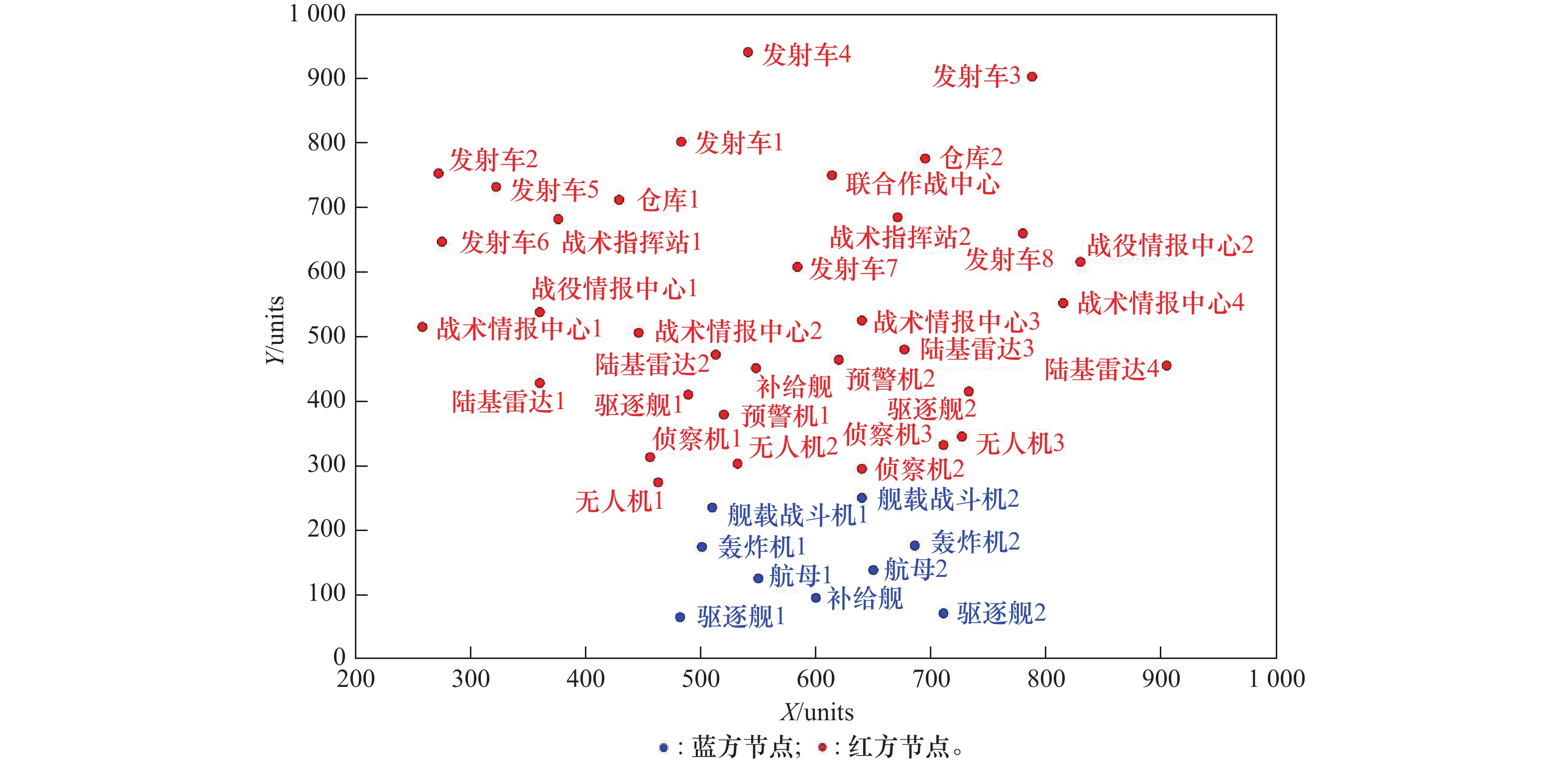
Fig.8
Results before strike chain reconstruction"
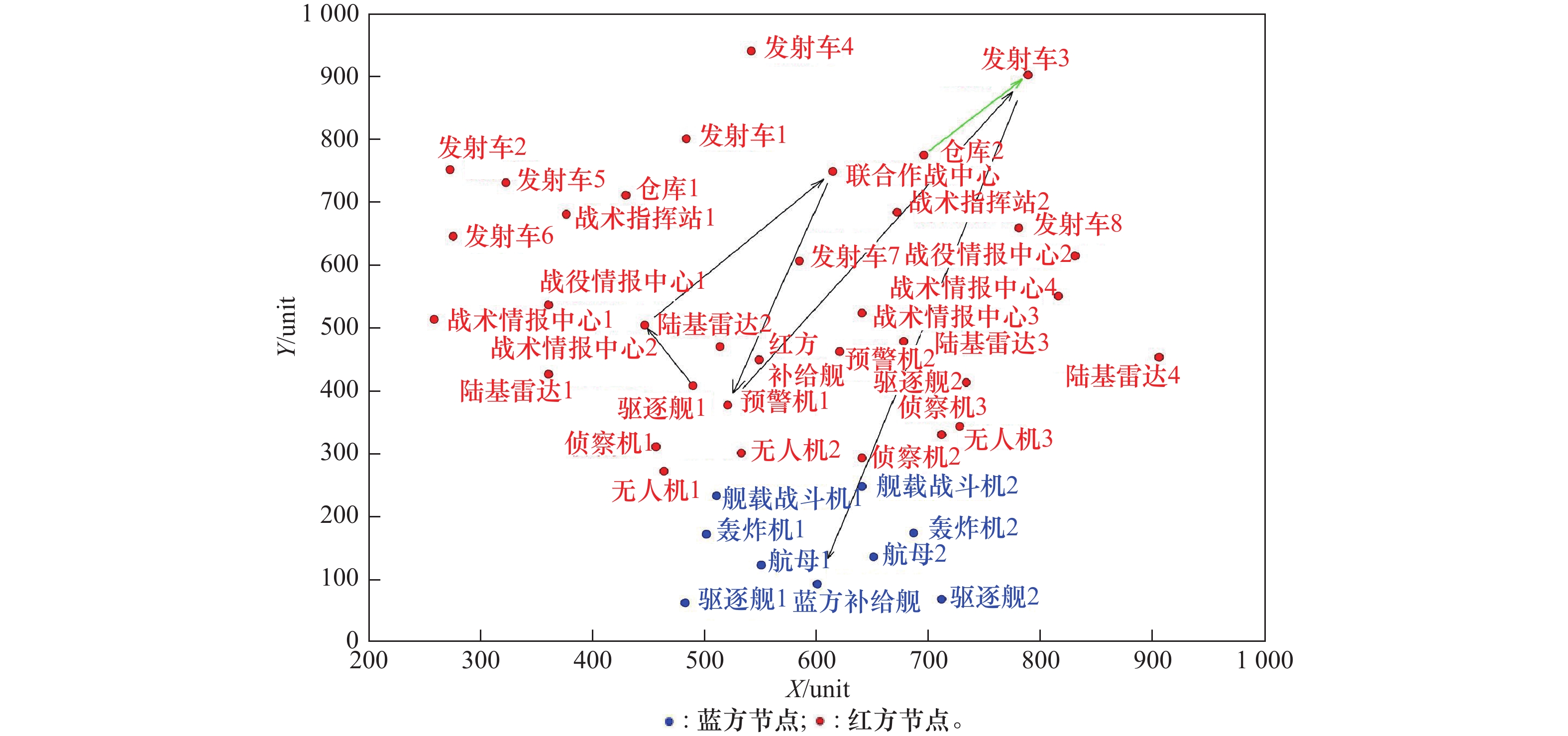
Table 7
Before strike chain reconstruction"
| 节点类型 | 实际装备 |
| 侦察节点 | 驱逐舰1 |
| 情报分析节点 | 战术情报中心2 |
| 1级指挥节点 | 联合作战中心 |
| 2级指挥节点 | 预警机1 |
| 影响节点 | 发射车3 |
| 保障节点 | 仓库2 |
| 目标节点 | 蓝方补给舰 |
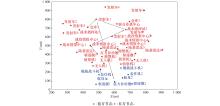
Fig.9
Results after strike chain reconstruction"
Table 8
After strike chain reconstruction"
| 节点类型 | 实际装备 |
| 侦察节点 | 驱逐舰1 |
| 情报分析节点 | 战术信息中心2 |
| 指挥节点 | 战术指挥站2 |
| 影响节点 | 发射车1 |
| 保障节点 | 仓库1 |
| 目标节点 | 蓝方补给舰 |
Table 9
Performance comparison"
| 指标 | 改进NSGA-II | BF | 提升率/% |
| f1/ms | 87±5 | 230±12 | 62 |
| f2 | 0.83±0.02 | 0.79±0.03 | 5.1 |
| f3/千美元 | 2.7±0.1 | 3.2±0.2 | 16 |
| RT/ms | 87±4 | 215±10 | 60 |
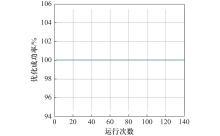
Fig.10
Reconstruction success rate variation"
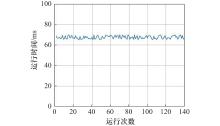
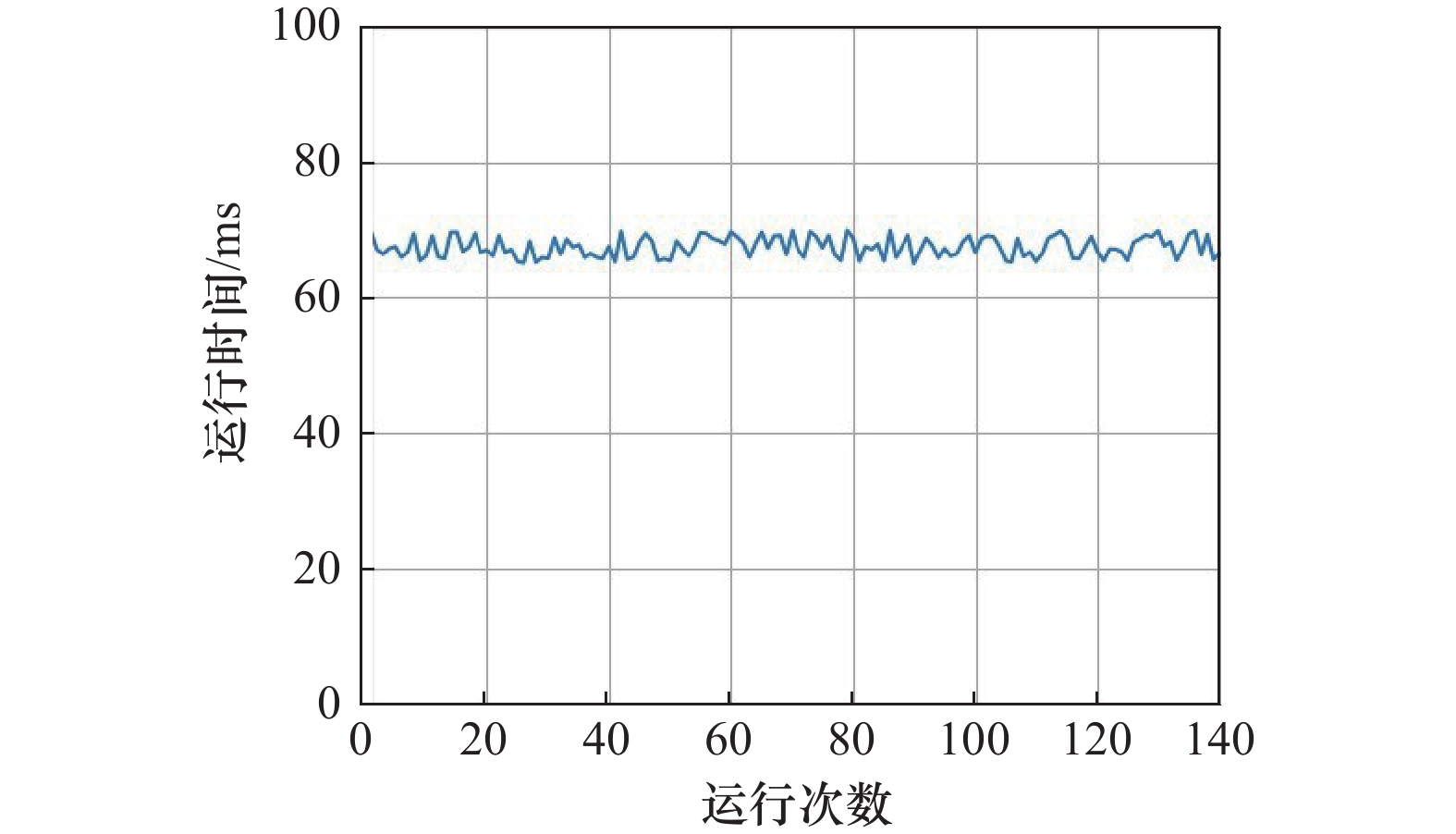
Fig.11
Reconstruction algorithm RT"
| 1 |
ZHANG J L, HAN K, ZHANG P, et al. A survey on joint-operation application for unmanned swarm formations under a complex confrontation environment[J]. Journal of Systems Engineering and Electronics, 2023, 34 (6): 1432- 1446.
doi: 10.23919/JSEE.2023.000162 |
| 2 |
JIA Z Y, YOU J H, DONG C, et al. Cooperative cognitive dynamic system in UAV swarms: reconfigurable mechanism and framework[J]. IEEE Vehicular Technology Magazine, 2024, 19 (3): 90- 101.
doi: 10.1109/MVT.2024.3404391 |
| 3 |
CHEN H, DOU Y J, CHEN Z Y, et al. A hybrid genetic algorithm to the program optimization model based on a heterogeneous network[J]. Journal of Systems Engineering and Electronics, 2025, 36 (4): 994- 1005.
doi: 10.23919/JSEE.2025.000063 |
| 4 |
DESTA H, DANDA B R. Neuro-symbolic AI for military applications[J]. IEEE Trans. on Artificial Intelligence, 2024, 5 (12): 6012- 6026.
doi: 10.1109/TAI.2024.3444746 |
| 5 |
WANG Y, TAO J Y, ZHANG X K, et al. Mission-oriented capability evaluation for combat network based on operation loops[J]. Defence Technology, 2024, 42, 156- 175.
doi: 10.1016/j.dt.2024.07.002 |
| 6 |
GUO J H, ZHANG J D, WANG Z H, et al. Formation cooperative intelligent tactical decision making based on Bayesian network model[J]. Drones, 2024, 8 (9): 427.
doi: 10.3390/drones8090427 |
| 7 |
CHEN Z W, ZHOU Z M, ZHANG L G, et al. Mission reliability modeling and evaluation for reconfigurable unmanned weapon system-of-systems based on effective operation loop[J]. Journal of Systems Engineering and Electronics, 2023, 34 (3): 588- 597.
doi: 10.23919/JSEE.2023.000082 |
| 8 |
XU R J, LIU J H, LI J C, et al. Link-centric research on the capability resilience of heterogeneous information combat networks[J]. IEEE Trans. on Network Science and Engineering, 2025, 12 (4): 2921- 2931.
doi: 10.1109/TNSE.2025.3555384 |
| 9 | 丁冬, 何兵, 陈明, 等. 美国导弹预警系统作战效能评估指标体系设计研究[J]. 中国电子科学研究院学报, 2022, 17 (9): 883- 891. |
| DING D, HE B, CHEN M, et al. Research on design of operational effectiveness evaluation index system for american missile early warning system[J]. Journal of China Electronics Science Research Institute, 2022, 17 (9): 883- 891. | |
| 10 |
QI H, BO P, SEN L, et al. Evaluation method and optimization strategies of resilience for air & space defense system of systems based on kill network theory and improved self-information quantity[J]. Defence Technology, 2023, 21, 219- 239.
doi: 10.1016/j.dt.2023.01.005 |
| 11 |
DANG Y H, WANG H X, YIN Z M, et al. Resilience analysis of coupling combat network: considering multiple destruction-recovery processes[J]. IEEE Access, 2025, 13, 100261- 100270.
doi: 10.1109/ACCESS.2025.3577347 |
| 12 |
YE H J, GAO W. A method of kill chains fusion based on granulated rules and matrix computation[J]. IEEE Access, 2024, 12, 198224- 198236.
doi: 10.1109/ACCESS.2024.3518435 |
| 13 |
LI B, WANG J M, SONG C, et al. Multi-UAV roundup strategy method based on deep reinforcement learning CEL-MADDPG algorithm[J]. Expert Systems with Applications, 2024, 245, 123018.
doi: 10.1016/j.eswa.2023.123018 |
| 14 |
LI Y Y, CHEN W Y, FU B, et al. A distributed cooperative dynamic target search method for multi-UAV systems in complex adversarial environments[J]. IEEE Internet of Things Journal, 2025, 12 (18): 38155- 38171.
doi: 10.1109/JIOT.2025.3585158 |
| 15 |
PEIYANG Z, GUODONG L. A cooperative dynamic target search approach for multi-UAV systems utilizing the MAPPO algorithm[J]. Discover Artificial Intelligence, 2025, 5, 153.
doi: 10.1007/s44163-025-00411-9 |
| 16 |
李小波, 王蒙一, 廖咏一, 等. 智能化空天防御作战体系架构设计方法研究[J]. 现代防御技术, 2024, 52 (2): 1- 12.
doi: 10.3969/j.issn.1009-086x.2024.02.001 |
|
LI X B, WANG M Y, LIAO Y Y, et al. Research on architecture design method of intelligent air-space defense combat system[J]. Modern Defence Technology, 2024, 52 (2): 1- 12.
doi: 10.3969/j.issn.1009-086x.2024.02.001 |
|
| 17 | LYU T Q, LIU Y, WANG C, et al. Construction of an intelligent kill web operational effectiveness model considering uncertainty factors[C]//Proc. of the International Symposium on AI and Cybersecurity, 2025: 71−75. |
| 18 | ZHONG Y F, LI H X, SUN Q, et al. A kill chain optimization method for improving the resilience of unmanned combat system-of-systems [J]. Chaos, Solitons & Fractals, 2024, 181: 114685. |
| 19 |
ZHANG H H, LI B, HUANG J Y, et al. A parallel multi-demonstrations generative adversarial imitation learning approach on UAV target tracking decision[J]. Chinese Journal of Electronics, 2025, 34 (4): 1185- 1198.
doi: 10.23919/cje.2024.00.082 |
| 20 |
LIU W L, PAN Z S, HAN W, et al. Construction of kill webs with heterogeneous UAV swarms in dynamic contested environments[J]. Complex Intelligent Systems, 2025, 11, 8.
doi: 10.1007/s40747-024-01644-4 |
| 21 |
YANG K W, XIA B Y, CHEN G, et al. Multi-objective optimization of operation loop recommendation for kill web[J]. Journal of Systems Engineering and Electronics, 2022, 33 (4): 969- 985.
doi: 10.23919/JSEE.2022.000094 |
| 22 |
YOU Y Q, ZHANG X, HE H F, et al. Kill chain search and evaluation of weapon system of systems based on GAT-DFS[J]. Systems, 2025, 13 (8): 703.
doi: 10.3390/systems13080703 |
| 23 |
雷洪涛, 孙立健, 朱先强, 等. 杀伤链分析构建与韧性优化方法[J]. 指挥与控制学报, 2024, 10 (6): 720- 731.
doi: 10.3969/j.issn.2096-0204.2024.06.0720 |
|
LEI H T, SUN L J, ZHU X Q, et al. Kill chain analysis construction and resilience optimization method[J]. Journal of Command and Control, 2024, 10 (6): 720- 731.
doi: 10.3969/j.issn.2096-0204.2024.06.0720 |
|
| 24 | 孙利娜, 陈永禄, 陈志伟. 基于杀伤链的动态重构作战网络抗毁性分析[J]. 火力与指挥控制, 2023, 48 (2): 12- 18. |
| SUN L N, CHEN Y L, CHEN Z W. Resilience analysis of dynamically reconfigured combat networks based on the kill chain[J]. Firepower & Command Control, 2023, 48 (2): 12- 18. | |
| 25 | KOUR R, KARIM R, DERSIN P. Game theory and cyber kill chain: a strategic approach to cybersecurity[C]//Proc. of the International Congress and Workshop on Industrial AI and eMaintenance , 2024: 451−463. |
| 26 |
KIKONG K. DAESUNG M, JUNHO H, et al. Attack graph generation with machine learning for network security[J]. Electronics, 2022, 11 (9): 1332.
doi: 10.3390/electronics11091332 |
| 27 | NADIA A, THIAGO V, ALI A. Integrated genetic algorithm and deep learning approach for effective cyber-attack detection and classification in industrial internet of things (IIoT) environments [J]. Arabian Journal for Science and Engineering, 2024, 49. |
| 28 | WU S Y, KANG P Q, LI J R, et al. A research on kill net generation technology of cooperative combat system based on SG-DPSO algorithm[C]//Proc. of the 4th International Conference on Autonomous Unmanned Systems , 2025: 128−138. |
| 29 | NATHAN G, W. Explainable AI in the military domain[J]. AI & Society, 2024, 26, 29. |
| 30 |
LI R Z, YUAN H, REN B B, et al. Optimal unmanned combat system-of-systems reconstruction strategy with heterogeneous cost via deep reinforcement learning[J]. Mathematics, 2024, 12 (10): 1476.
doi: 10.3390/math12101476 |
| 31 | PENG Z, LU Z F, MAO X, et al. Multi-ship dynamic weapon-target assignment via cooperative distributional reinforcement learning with dynamic reward[J]. IEEE Trans. on Emerging Topics in Computational Intelligence, 2025, 9 (2): 1843- 1859. |
| [1] | Luyao LIU, Xiao JIN, Jinliang CAI, Wucai ZHANG. Multi-objective optimization of antenna placement using integrated ANN and improved MOPSO [J]. Systems Engineering and Electronics, 2026, 48(5): 1607-1614. |
| [2] | Wenqi JIANG, Rui TAO. Improved TOPSIS method based on hesitant fuzzy multi-attribute association [J]. Systems Engineering and Electronics, 2026, 48(5): 1615-1621. |
| [3] | Yusi XIE, Qin LEI, Zhibin WU. Multi-objective pickup and delivery routing planning with consideration of workload balance [J]. Systems Engineering and Electronics, 2026, 48(4): 1254-1263. |
| [4] | Qi SONG, Zhenyu HUANG, Huanyu LI, Anxin GUO, Rennong YANG. Modeling and simulation study of “agile combat employment” base construction [J]. Systems Engineering and Electronics, 2026, 48(1): 218-234. |
| [5] | Tao HONG, Fan WANG, Zhi LI, Zhiwei ZHONG, Xiaojin DING, Ziwei LIU, Gengxin ZHANG. Business-driven terminal mode switching method for low Earth orbit satellite-based Internet of Things [J]. Systems Engineering and Electronics, 2024, 46(8): 2867-2876. |
| [6] | Qiangqiang XU, Hua CHAI. Optimization of task dispatch plan for vehicular optical observation equipment based on NSGA-Ⅱ [J]. Systems Engineering and Electronics, 2024, 46(7): 2393-2400. |
| [7] | Hao CHEN, Gang SUN, Shuang PENG, Jiangjiang WU. Dynamic rescheduling method for TT&C and data transmission resources based on multi-objective optimization [J]. Systems Engineering and Electronics, 2024, 46(11): 3744-3753. |
| [8] | Zelun GAO, Shaoqiu ZHENG, Rupeng LIANG, Yanyan HUANG. Model of strike target preference under super-network system operation [J]. Systems Engineering and Electronics, 2024, 46(1): 182-189. |
| [9] | Liyao WANG, Jin ZHANG, Hongxi ZHOU, Kemao WANG. Planning of multi-station accessing multi-satellite based on physical planning [J]. Systems Engineering and Electronics, 2023, 45(8): 2514-2520. |
| [10] | Qian SU, Yuanfu ZHONG, Zhiqin CAO, Yingchao ZHANG. Target threat assessment model based on operational situation and improved CRITIC-TOPSIS [J]. Systems Engineering and Electronics, 2023, 45(8): 2343-2352. |
| [11] | Hongzhou ZHAI, Hua ZHANG, Linna WU, Hequn BU, Kaixiang GONG. Optimization algorithm for reliability redundancy design based on collaborative balance [J]. Systems Engineering and Electronics, 2023, 45(12): 4084-4089. |
| [12] | Shiying YAN, Kefei YAN, Wei FANG, Hengyang LU. Large-scale multi-objective algorithm based on neighborhood adaptive of differential evolution [J]. Systems Engineering and Electronics, 2022, 44(7): 2112-2124. |
| [13] | Qian LIU, Yunjun LU, Kebin CHEN, Mengyao HAN, Liang GUO. Combat task decomposition EVA method based on binary constraints of task subject [J]. Systems Engineering and Electronics, 2022, 44(7): 2201-2210. |
| [14] | Rongwei CUI, Wei HAN, Xichao SU, Liguo WANG, Yujie LIU. Integrated optimization of carrier-based aircraft flight deck operations scheduling and resource configuration for pre-flight preparation stage [J]. Systems Engineering and Electronics, 2021, 43(7): 1884-1893. |
| [15] | Boyuan XIA, Kewei YANG, Zhiwei YANG, Xiaoke ZHANG, Danling ZHAO. Multi-objective optimization of equipment portfolio based on kill-web evaluation [J]. Systems Engineering and Electronics, 2021, 43(2): 399-409. |
| Viewed | ||||||
|
Full text |
|
|||||
|
Abstract |
|
|||||