Systems Engineering and Electronics ›› 2026, Vol. 48 ›› Issue (1): 209-217.doi: 10.12305/j.issn.1001-506X.2026.01.19
• Systems Engineering • Previous Articles Next Articles
Performance evaluation method for autonomous intelligent system using feedback-based attribute extraction and anti-causality
Chenhao YU1,2( ), Leilei CHANG1,2, Yu ZHOU2,*, Jianbin SUN3
- 1. School of Automation,Hangzhou Dianzi University, Hangzhou 310018, China
2. Key Laboratory of Collaborative Intelligence Systems, Ministry of Education,Xidian University, Xi’an 710126 China
3. College of Systems Engineering,National University of Defense Technology, Changsha 410073, China
-
Received:2024-10-08Online:2026-01-25Published:2026-02-11 -
Contact:Yu ZHOU E-mail:231060041@hdu.edu.cn

CLC Number:
Cite this article
Chenhao YU, Leilei CHANG, Yu ZHOU, Jianbin SUN. Performance evaluation method for autonomous intelligent system using feedback-based attribute extraction and anti-causality[J]. Systems Engineering and Electronics, 2026, 48(1): 209-217.
share this article
Fig.1
Steps of close-loop feedback-based attribute extraction"
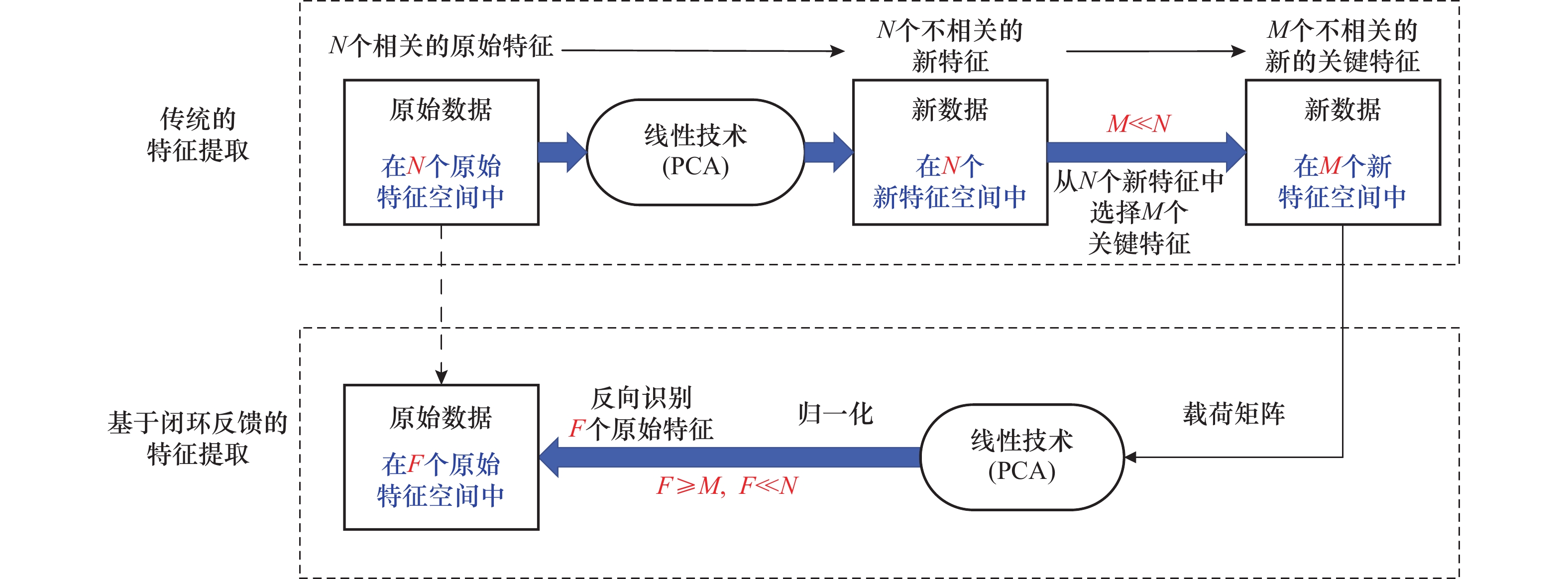
Fig.2
Steps of causality consistency-based anti-causality data identification"
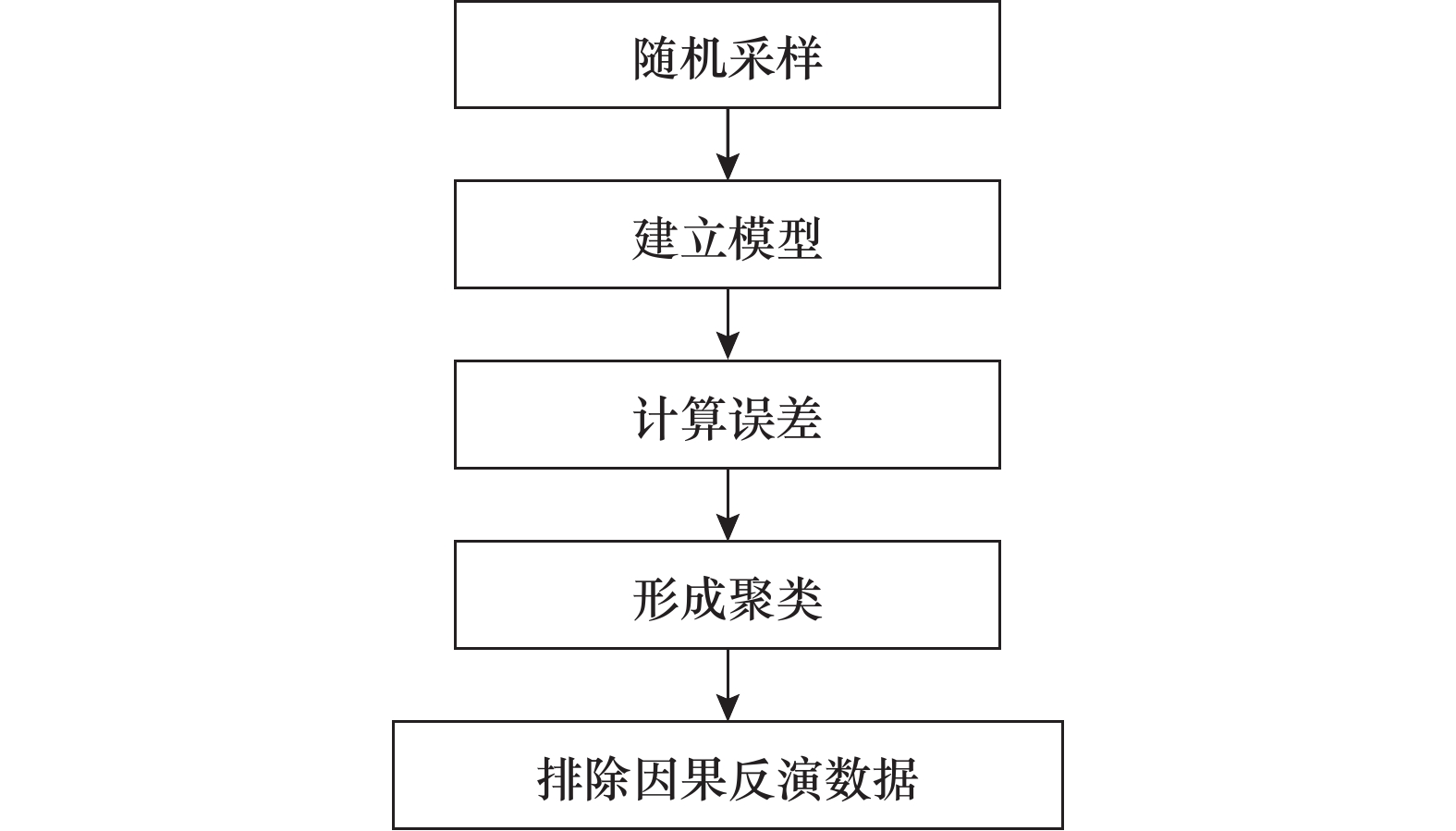
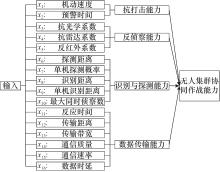
Fig.3
Evaluation index system"
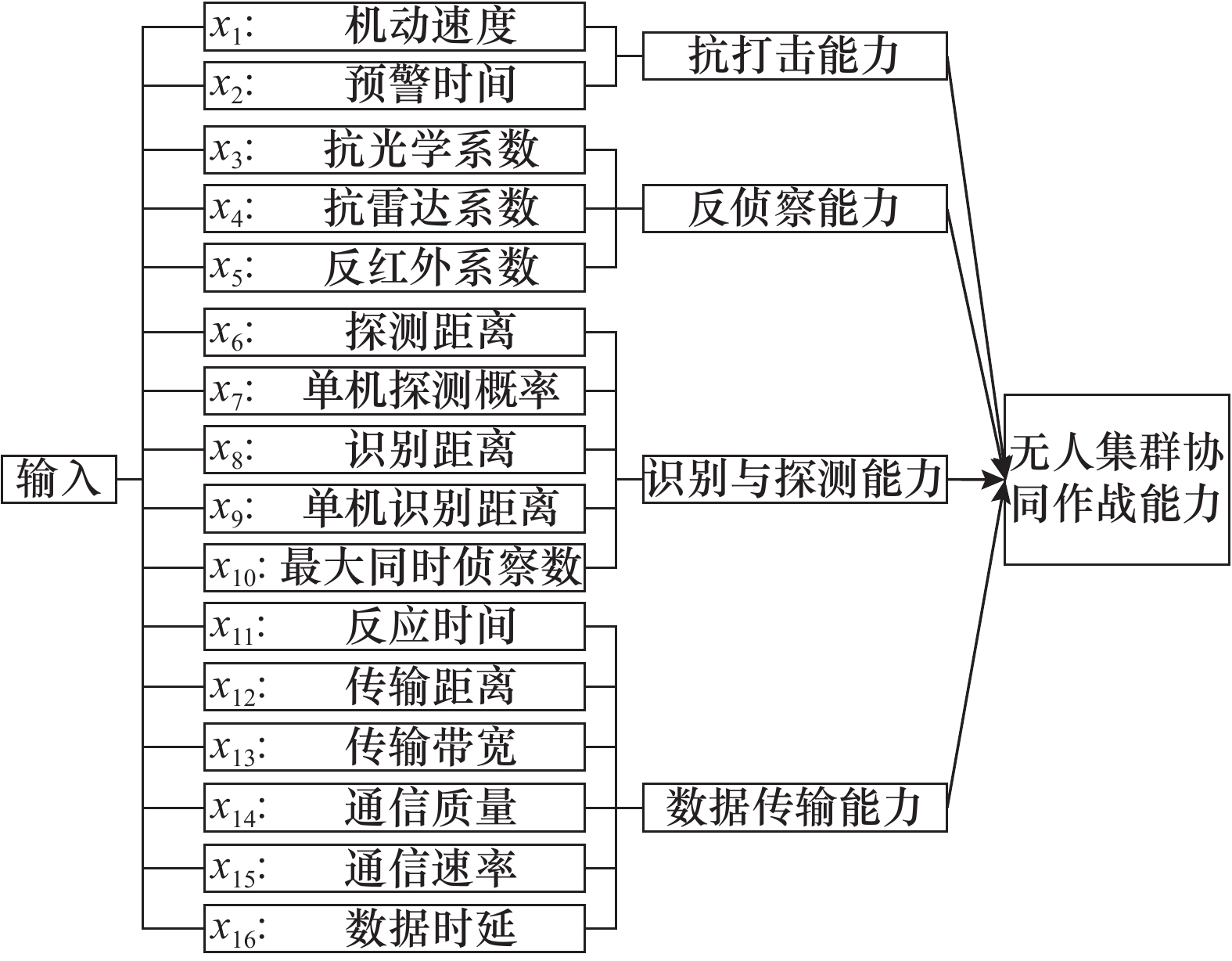
Fig.4
Results of anti-causality data identification"
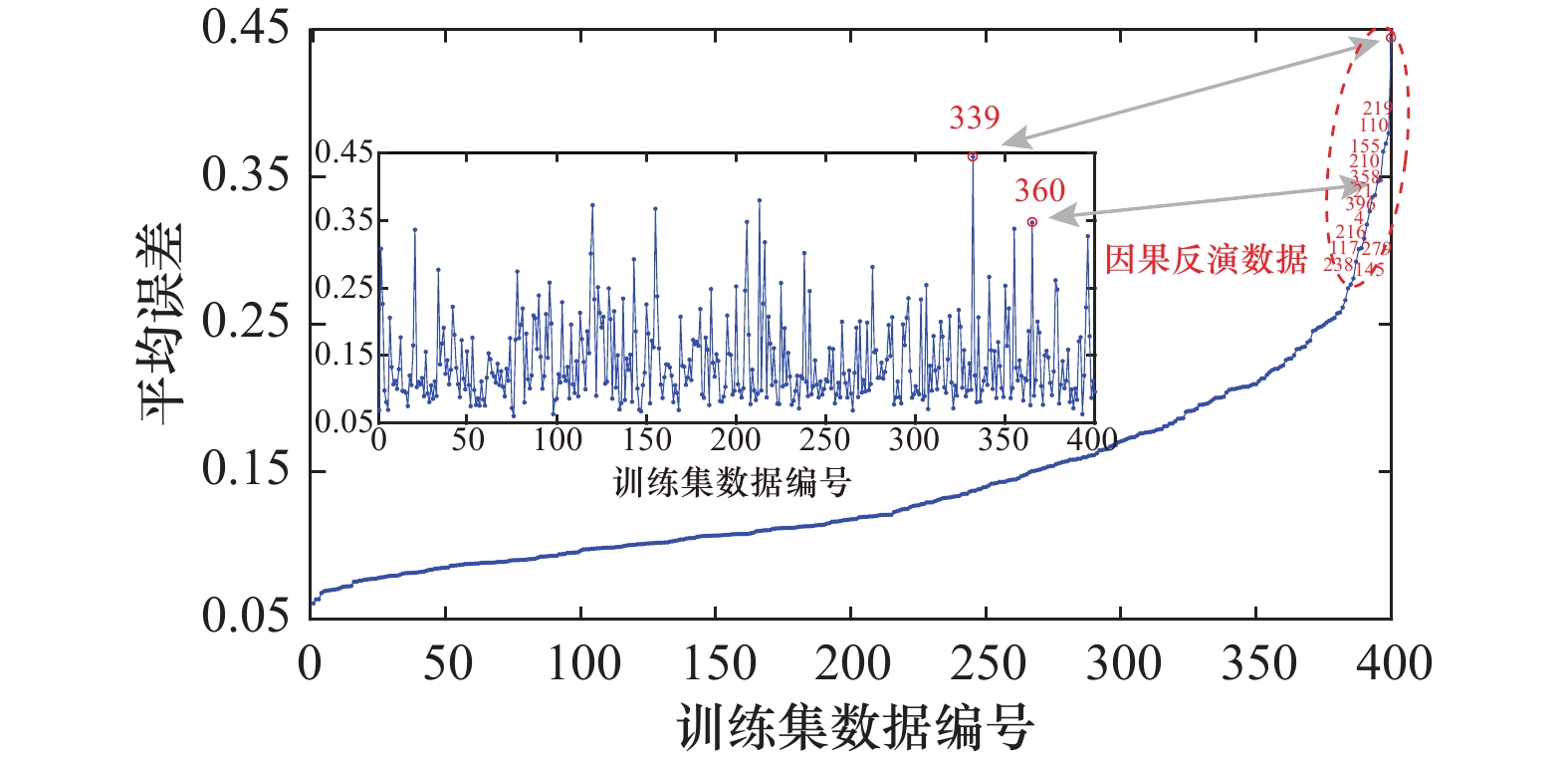
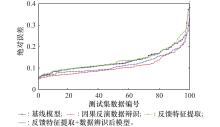
Fig.5
Comprehensive comparison results of test set in example study"
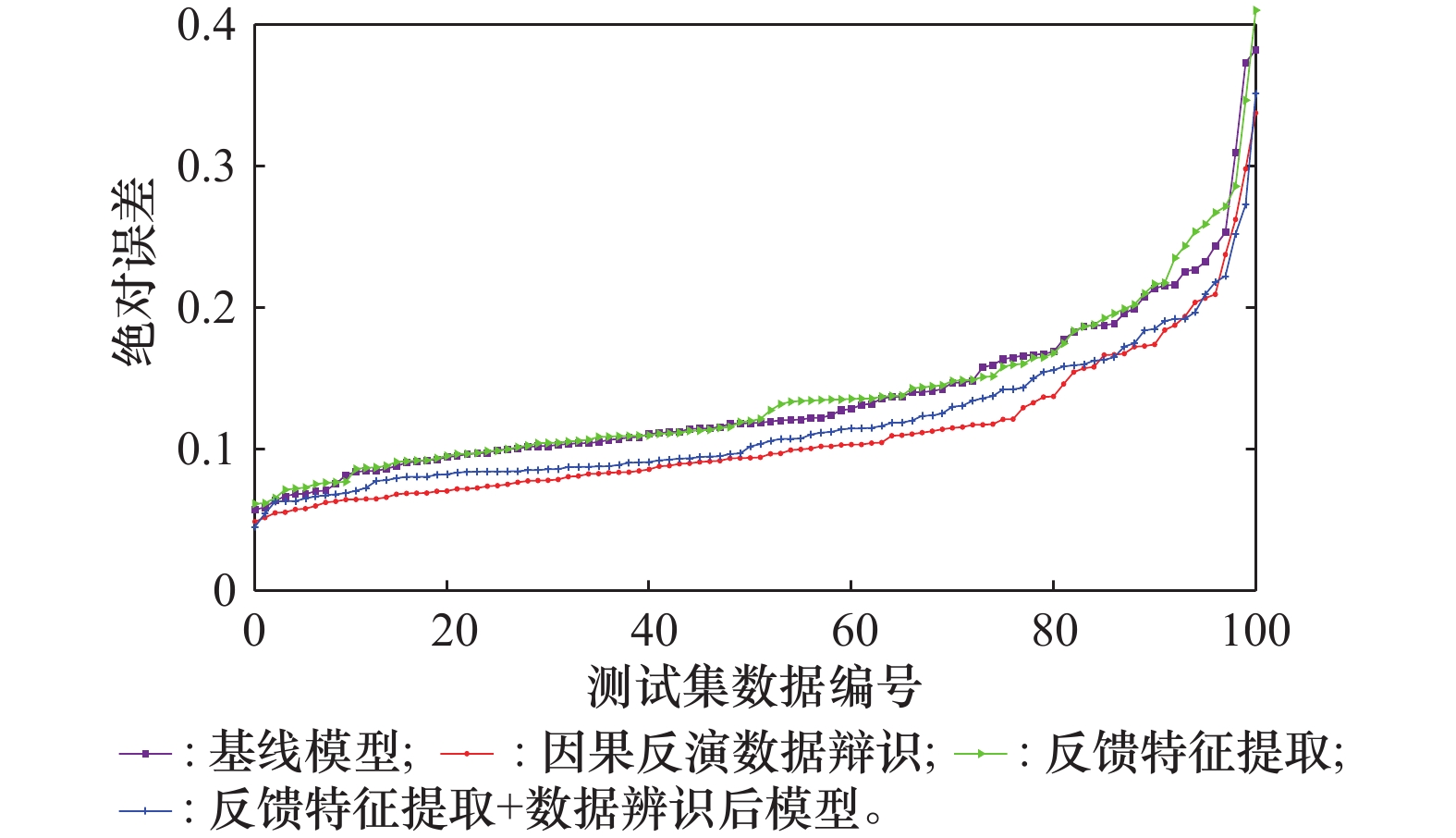

Table 1
Results obtained by different methods using BPNN"
| 模型 | 模型输入(训练集) | 测试集结果MAE | ||||
| 特征数量 | 数据量 | 输入信息百分比/% | ||||
| 基准模型 | 16 (100%) | 400 (100%) | 100 | 范围 | [ | |
| 均值 | ||||||
| 方差 | 1.2416E-03 | |||||
| 特征提取后模型 | 9 (56.25%) | 400 (100%) | 56.25 | 范围 | [ | |
| 均值 | ||||||
| 方差 | 1.3285E-03 | |||||
| 数据辨识后模型 | 16 (100%) | 385 (96.25%) | 96.25 | 范围 | [ | |
| 均值 | ||||||
| 方差 | 7.9503E-04 | |||||
| 特征提取+数据辨识后模型 | 9 (56.25%) | 385 (96.25%) | 54.14 | 范围 | [ | |
| 均值 | ||||||
| 方差 | 4.9817E-04 | |||||
Table 2
Comparison results with existing attribute selection and data identification methods"
| 不同方法 | 训练集输入 | 测试集结果(MAE) | |||
| 特征数量 | 数据量 | ||||
| 基准模型 | 16 | 400 | 均值 | ||
| 特征选择信息熵 | 9 | 400 | 均值 | ||
| 特征选择Isomap | 9 | 400 | 均值 | ||
| 数据辨识(排除5组) | 16 | 395 | 均值 | ||
| 数据辨识(排除15组) | 16 | 385 | 均值 | ||
| 数据辨识(排除30组) | 16 | 370 | 均值 | ||
| 数据辨识(KRCC) | 16 | 380 | 均值 | ||
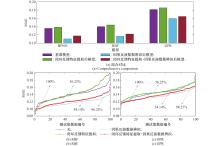
Fig.6
Verification results of independence of different models"
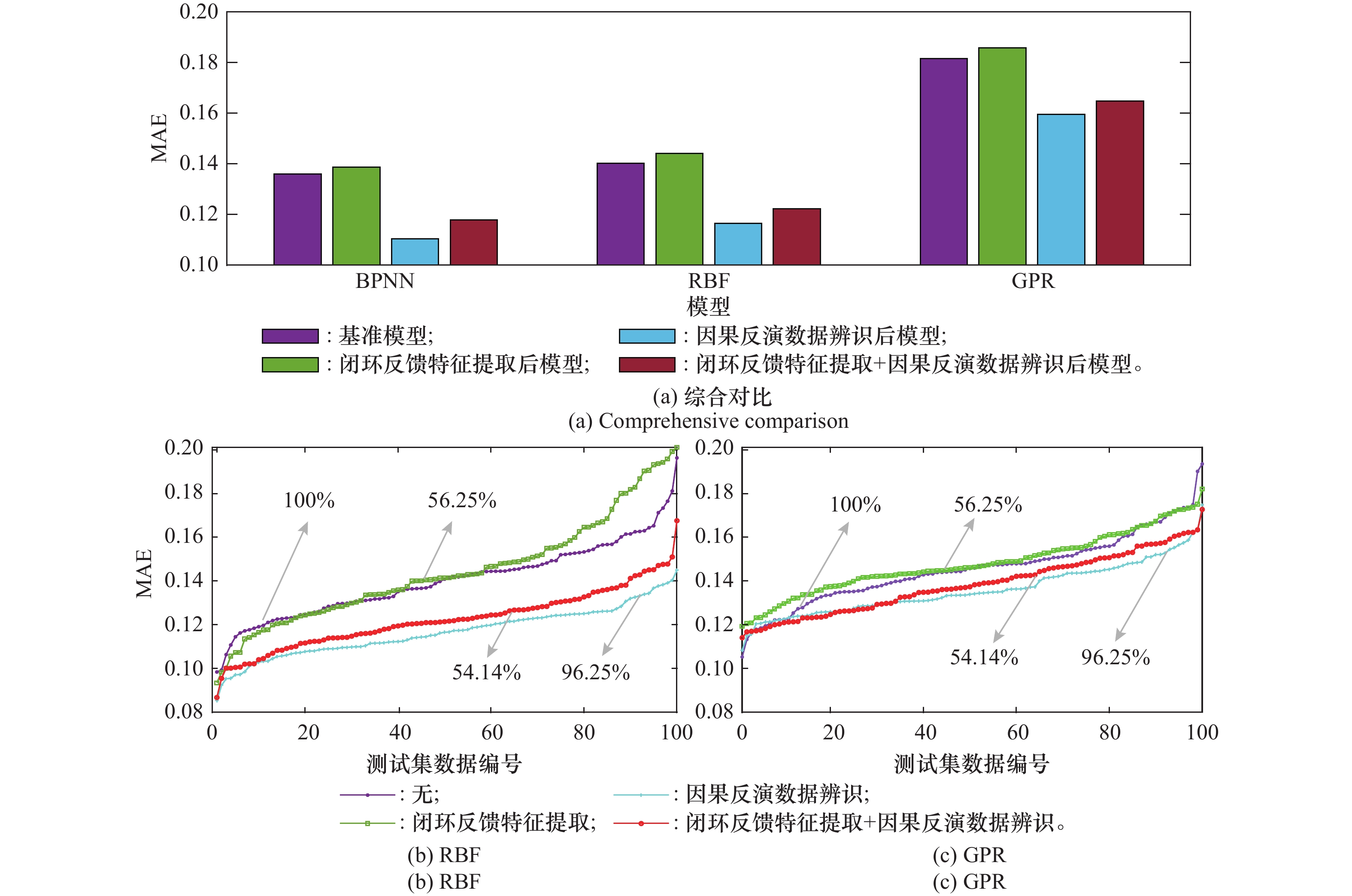
Table 3
Statistics of validation of attribute/quantity reduction on the BTR prediction case using different baseline models."
| 基准模型 | 模型 | 模型的输入 (训练集) | 测试集MAE | ||||||
| 特征数量 | 数据量 | 百分比/% | 均值 | 范围 | 方差 | 变化/% | |||
| BPNN | Baseline | 16 | 400 | 100 | [ | 1.2416E-03 | — | ||
| Modelatt | 9 | 400 | 56.25 | [ | 1.3285E-03 | 2.06 | |||
| Modelquan | 16 | 385 | 96.25 | [ | 7.9503E-04 | −18.38 | |||
| Modelboth | 9 | 385 | 54.14 | [ | 4.9817E-04 | −12.43 | |||
| RBF | Baseline | 16 | 400 | 100 | [ | 1.0032E-03 | — | ||
| Modelatt | 9 | 400 | 56.25 | [ | 4.3198E-04 | 2.71 | |||
| Modelquan | 16 | 385 | 96.25 | [ | 8.3103E-04 | −16.54 | |||
| Modelboth | 9 | 385 | 54.14 | [ | 5.9187E-04 | −12.55 | |||
| GPR | Baseline | 16 | 400 | 100 | [ | 5.0565E-04 | — | ||
| Modelatt | 9 | 400 | 56.25 | [ | 7.0347E-04 | 2.31 | |||
| Modelquan | 16 | 385 | 96.25 | [ | 5.4856E-04 | −11.73 | |||
| Modelboth | 9 | 385 | 54.14 | [ | 3.9483E-04 | −8.87 | |||
| 1 |
CHEN J, SUN J, WANG G. From unmanned systems to autonomous intelligent systems[J]. Engineering, 2022, 12, 16- 19.
doi: 10.1016/j.eng.2021.10.007 |
| 2 |
TAN Y W, WANG J D, LIU J J, et al. Unmanned systems security: models, challenges, and future directions[J]. IEEE Network, 2020, 34 (4): 291- 297.
doi: 10.1109/MNET.001.1900546 |
| 3 |
MOHSAN S A H, KHAN M A, NOOR F, et al. Towards the unmanned aerial vehicles (UAVs): a comprehensive review[J]. Drones, 2022, 6 (6): 147.
doi: 10.3390/drones6060147 |
| 4 | WANG H F, CHENG H J, HAO H Y. The use of unmanned aerial vehicle in military operations[C]//Proc. of the International Conference on Man-Machine-Environment System Engineerin, 2020. |
| 5 |
HYLAND S L, FALTYS M, HUSER M, et al. Early prediction of circulatory failure in the intensive care unit using machine learning[J]. Nature Medicine, 2020, 26, 364- 373.
doi: 10.1038/s41591-020-0789-4 |
| 6 | BAKKER B, ZABłOCKI B, BAKER A, et al. A multi-stage, multi-feature machine learning approach to detect driver sleepiness in naturalistic road driving conditions[J]. IEEE Trans. on Intelligent Transportation Systems, 2021, 23 (5): 4791- 4800. |
| 7 | FU S X, LI H X, LIU Y, et al. Social media overload, exhaustion, and use discontinuance: examining the effects of information overload, system feature overload, and social overload[J]. Information Processing & Management, 2020, 57 (6): 102307. |
| 8 |
YANG M J, LIM S Y, PARK H J, et al. Solving the data overload: device-to-device bearer control architecture for cellular data offloading[J]. IEEE Vehicular Technology Magazine, 2013, 8 (1): 31- 39.
doi: 10.1109/MVT.2012.2234052 |
| 9 | PAWLOWSKI N, CASTRO D C, GLOCKER B. Deep structural causal models for tractable counterfactual inference[J]. Advances in Neural Information Processing Systems, 2020, 33, 857- 869. |
| 10 | ANOGUEIR A R, GAMA J, FERREIRA C A. Causal discovery in machine learning: theories and applications[J]. Journal of Dynamics & Games, 2021, 8 (3): 203- 231. |
| 11 |
PROSPERI M, GUO Y, SPERRIN M, et al. Causal inference and counterfactual prediction in machine learning for actionable healthcare[J]. Nature Machine Intelligence, 2020, 2, 369- 375.
doi: 10.1038/s42256-020-0197-y |
| 12 |
POPESCU D C, DUMITRACHE I. Knowledge representation and reasoning using interconnected uncertain rules for describing workflows in complex systems[J]. Information Fusion, 2023, 93, 412- 428.
doi: 10.1016/j.inffus.2023.01.007 |
| 13 |
WANG J R, LIU Y, LI P G, et al. Overview of data quality: examining the dimensions, antecedents, and impacts of data quality[J]. Journal of the Knowledge Economy, 2024, 15, 1159- 1178.
doi: 10.1007/s13132-022-01096-6 |
| 14 |
HERNAN M A, WANG W, LEAF D E. Target trial emulation: a framework for causal inference from observational data[J]. JAMA, 2022, 328 (24): 2446- 2447.
doi: 10.1001/jama.2022.21383 |
| 15 |
CHANG L L, ZHOU Z J, YOU Y, et al. Belief rule based expert system for classification problems with new rule activation and weight calculation procedures[J]. Information Sciences, 2016, 336, 75- 91.
doi: 10.1016/j.ins.2015.12.009 |
| 16 |
HOU Z Q, MARTINEZ-GARCIA M, ZHANG Y, et al. Entropy measures in machine fault diagnosis: Insights and applications[J]. IEEE Trans. on Instrumentation and Measurement, 2020, 69 (6): 2607- 2620.
doi: 10.1109/TIM.2020.2981220 |
| 17 | SANG B B, CHEN H M, YANG L, et al. Incremental feature selection using a conditional entropy based on fuzzy dominance neighborhood rough sets[J]. IEEE Trans. on Fuzzy Systems, 2021, 30 (6): 1683- 1697. |
| 18 |
BEIRANVAND F, MEHRDAD V, DOWLATSHAHI M B. Unsupervised feature selection for image classification: a bipartite matching-based principal component analysis approach[J]. Knowledge-Based Systems, 2022, 250, 109085.
doi: 10.1016/j.knosys.2022.109085 |
| 19 |
ANOWAR F, SADAOUI S, SELIM B. Conceptual and empirical comparison of dimensionality reduction algorithms (PCA, KPCA, LDA, MDS, SVD, LLE, ISOMAP, LE, ICA, t-SNE)[J]. Computer Science Review, 2021, 40, 100378.
doi: 10.1016/j.cosrev.2021.100378 |
| 20 | LIANG X P, TANG Z J, WU J L, et al. Robust image hashing with isomap and saliency map for copy detection[J]. IEEE Trans. on Multimedia, 2021, 25, 1085- 1097. |
| 21 | WU X, HONG D F, CHANUSSOT J. Convolutional neural networks for multimodal remote sensing data classification[J]. IEEE Trans. on Geoscience and Remote Sensing, 2021, 60 |
| 22 | 张效康. 地理国情监测数据可靠性分析与控制方法研究[D]. 武汉: 武汉大学, 2017. |
| ZHANG X K. Reliability analysis and controlling methods for national geographic state monitoring data [D]. Wuhan: Wuhan University, 2017. | |
| 23 |
YU C H, CHANG L L, XU X B, et al. Compatible multi-model output fusion for complex systems modeling via set operation-based focus data identification[J]. Journal of Computational Science, 2024, 82, 102423.
doi: 10.1016/j.jocs.2024.102423 |
| 24 |
YU C H, ZHU J Y, CHANG L L, et al. A novel data credibility-centric multi-model-based complex systems modeling approach for UAV capability evaluation[J]. International Journal of Machine Learning and Cybernetics, 2025, 16, 2687- 2704.
doi: 10.1007/s13042-024-02415-w |
| 25 |
JAVED S, HASSAN A, AHMAD R, et al. State-of-the-art and future research challenges in uav swarms[J]. IEEE Internet of Things Journal, 2024, 11 (11): 19023- 19045.
doi: 10.1109/JIOT.2024.3364230 |
| 26 | 陈士涛, 张海林. 基于作战网络模型的异构无人机集群作战能力评估[J]. 军事运筹与系统工程, 2019, 33 (1): 38- 43. |
| CHEN S T, ZHANG H L. Evaluation of heterogeneous UAV cluster combat capability based on combat network model[J]. Military Operations Research and Systems Engineering, 2019, 33 (1): 38- 43. | |
| 27 | 赵蕊蕊, 于海跃, 游雅倩, 等. 无人集群试验评估现状及技术方法综述[J]. 系统工程与电子技术, 2024, 46 (2): 570- 585. |
| ZHAO R R, YU H Y, YOU Y Q, et al. Review on current status and technology method of unmanned swarm test evaluation[J]. Systems Engineering and Electronics, 2024, 46 (2): 570- 585. | |
| 28 | 范波, 钟季龙, 徐丽霞, 等. 基于因果熵的无人集群对抗评估指标分配方法[J]. 系统工程与电子技术, 2024, 46 (6): 2034- 2043. |
| FAN B, ZHONG J L, XU L X, et al. Index allocation method for unmanned swarm confrontation evaluation based on causal entropy[J]. Systems Engineering and Electronics, 2024, 46 (6): 2034- 2043. | |
| 29 |
SUN C R, FONTANESI G, CANBERK B, et al. Advancing UAV communications: a comprehensive survey of cutting-edge machine learning techniques[J]. IEEE Open Journal of Vehicular Technology, 2024, 5, 825- 854.
doi: 10.1109/OJVT.2024.3401024 |
| 30 |
BAI L, LIANG J Y. K-relations-based consensus clustering with entropy-norm regularizers[J]. IEEE Trans. on Neural Networks and Learning Systems, 2024, 35 (12): 17662- 17673.
doi: 10.1109/TNNLS.2023.3307158 |
| [1] | Fei GAO, Jiang WU, Jun MA, Jia LIU, Xuanmin ZHANG, Bin LI, Jidong MENG, Wenbo NIU, Hongxing DANG. Research on the overall technology of space-based distributed radar sea surface target tracking application [J]. Systems Engineering and Electronics, 2024, 46(8): 2667-2675. |
| [2] | Mingfei ZHAO, Rui XUE. Comprehensive evaluation method based on weighted processing for data transmission performance of UAV group [J]. Systems Engineering and Electronics, 2024, 46(12): 4248-4258. |
| [3] | Changxiao ZHAO, Ershuai LI, Feng HE, Peng WANG. Bandwidth allocation and optimization of time-sensitive traffic in TSN [J]. Systems Engineering and Electronics, 2022, 44(6): 2027-2034. |
| [4] | Yuting ZHANG, Miao XIAO, Liang ZHANG, Huaian ZHOU, Zheng LYU. EMC performance evaluation of mobile communication satellites based on near-field scanning [J]. Systems Engineering and Electronics, 2020, 42(9): 1897-1902. |
| [5] | Leiyu CHEN, Zhijie ZHOU, Shuaiwen TANG, You CAO. Weapon equipment performance evaluation method with multi-information fusion [J]. Systems Engineering and Electronics, 2020, 42(7): 1527-1533. |
| [6] | Dangfei PAN, Wenxue LIU, Jian GE, Hong YUAN, Chao YUAN. Phase noise estimation method for RF front-end circuit of GNSS receiver [J]. Systems Engineering and Electronics, 2020, 42(3): 536-543. |
| [7] | HE Huafeng, HE Yaomin, XU Yongzhuang. High performance evaluation of seeker measurement based on improved BP neural network [J]. Systems Engineering and Electronics, 2019, 41(7): 1544-1550. |
| [8] | ZHANG Denghui, MA Ping, CHAO Tao, WANG Songyan. Performance evaluation of guidance and control system for hypersonic vehicle [J]. Systems Engineering and Electronics, 2018, 40(8): 1811-1816. |
| [9] | QIN Maosen, ZHAO Danling, YANG Kewei. Effectiveness evaluation of anti-submarine activities based on combat network [J]. Systems Engineering and Electronics, 2018, 40(7): 1513-1520. |
| [10] | HE Weikun, GAO Li, WANG Xiaoliang, WU Renbiao. Wind farm clutters suppression for weather radar based on improved MAP method [J]. Systems Engineering and Electronics, 2018, 40(5): 1018-1025. |
| [11] | HE Zhaoyang, WANG Qianzhe, SONG Bowen, PENG Weidong, WANG Jinjiang. RF stealth performance evaluation method for radar signal waveform [J]. Systems Engineering and Electronics, 2017, 39(10): 2234-2238. |
| [12] | TAN Wei-kai,GUO Ai-huang, QIAN Ye-qing. Performance evaluation method for small cells based on FAHP [J]. Systems Engineering and Electronics, 2014, 36(8): 1651-1655. |
| [13] | JING Pei-liang, XU Shi-you, LI Xian, CHEN Zeng-ping. Performance evaluation of multiple target tracking:a survey [J]. Systems Engineering and Electronics, 2014, 36(11): 2127-2132. |
| [14] | YANG Wei,FU Yao-wen, LI Xiang. Performance evaluation of multi-object filter system based on the optimal assignment [J]. Systems Engineering and Electronics, 2013, 35(9): 1809-1814. |
| [15] | ZHOU Pu-cheng, WANG Feng, CUI Xunxue, XUE Mo-gen. Performance evaluation approach to image fusion based on ordering approximate to ideal solution [J]. Journal of Systems Engineering and Electronics, 2011, 33(3): 681-684. |
| Viewed | ||||||
|
Full text |
|
|||||
|
Abstract |
|
|||||