

系统工程与电子技术 ›› 2026, Vol. 48 ›› Issue (7): 2378-2393.doi: 10.12305/j.issn.1001-506X.2026.07.22
• 系统工程 • 上一篇
陈禧龙1,2( ), 张臻3, 于冬梅1, 赵河明2, 张楚雷1
收稿日期:2025-08-27
修回日期:2025-11-11
接受日期:2025-12-16
出版日期:2026-03-20
发布日期:2026-03-20
通讯作者:
于冬梅
E-mail:bg20230116@st.nuc.edu.cn
Xilong CHEN1,2(), Zhen ZHANG3, Dongmei YU1, Heming ZHAO2, Chulei ZHANG1
Received:2025-08-27
Revised:2025-11-11
Accepted:2025-12-16
Online:2026-03-20
Published:2026-03-20
Contact:
Dongmei YU
E-mail:bg20230116@st.nuc.edu.cn
摘要:
随着人工智能与无人装备技术的飞速发展,现代化作战不再局限于装备和技术的线性叠加,而是演变为由有/无人系统协同配合、深度耦合与持续演进的复杂作战体系。为实现该复杂体系的正向设计,提出一种结合国防部体系结构框架(Department of Defense Architecture Framework, DoDAF)和特定域建模(domain specific modeling, DSM)手段的有/无人协同作战体系建模与仿真方法。首先从“场景?能力?系统?活动”4个维度对该作战体系进行分析,设计体系建模框架和流程;结合DSM手段对作战领域概念与知识进行抽象,构建人机协同作战领域元模型;运用模型驱动技术,实现架构模型动态行为逻辑仿真验证;最后以A市作战演习为例,运用该方法对有/无人协同作战体系进行建模与仿真。结果表明相较于传统的DoDAF,所提方法有效提高模型的表达效果和建模效率,为未来智能化作战顶层设计提供了参考依据。
中图分类号:
陈禧龙, 张臻, 于冬梅, 赵河明, 张楚雷. 基于DoDAF-DSM的有/无人协同作战体系设计方法[J]. 系统工程与电子技术, 2026, 48(7): 2378-2393.
Xilong CHEN, Zhen ZHANG, Dongmei YU, Heming ZHAO, Chulei ZHANG. DoDAF-DSM based design method for manned/unmanned collaborative combat system[J]. Systems Engineering and Electronics, 2026, 48(7): 2378-2393.
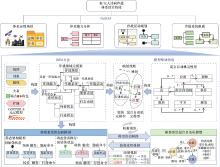
图1
基于DoDAF-DSM的有/无人协同作战体系设计方法框架"
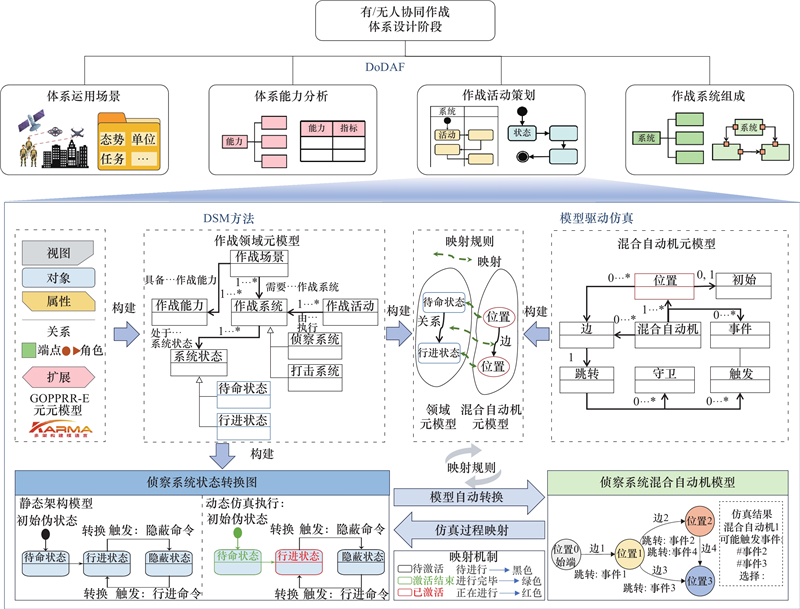
表1
模型框架"
| 视角类型 | 视图模型 | 概念要素 | 具体内容 |
| 全景视角 | AV-1概要信息 | 全局概述 | 使命任务、现场态势、红蓝方兵力等信息 |
| AV-2综合词典 | 作战术语 | 作战行动中涉及到的术语定义 | |
| 能力视角 | CV-1能力构想 | 能力需求 | 能力需求/技术缺口、能力列项 |
| CV-2能力分类 | 能力特征 | 作战能力分类、能力需求指标细化 | |
| CV-6能力-活动映射 | 能力与作战活动的关联映射关系 | ||
| 作战视角 | OV-1高级作战概念图 | 作战规划 | 战场环境、作战部署和预期效果 |
| OV-2作战资源流描述 | 资源交互 | 各系统间资源交互关系 | |
| OV-3作战资源流矩阵 | 资源交互方式、交互内容及相关属性 | ||
| OV-4组织关系图 | 系统组成 | 系统的种类、数量和比例关系以及编配信息 | |
| OV-5a作战活动分解 | 作战流程 | 系统完成规定任务需进行的作战活动 | |
| OV-5b作战活动模型 | 系统执行作战活动的顺序关系 | ||
| OV-6a作战规则模型 | 作战中的战术战法规则 | ||
| OV-6b状态转换模型 | 作战节点 | 作战中相关系统的状态转换关系 | |
| OV-6c事件跟踪描述 | 作战相关系统的事件响应时序 | ||
| 系统视角 | SV-4系统功能描述 | 系统功能 | 作战系统现已具备的功能 |
| SV-5b活动-系统跟踪 | 映射关系 | 作战系统与作战活动的跟踪映射关系 | |
| 标准视角 | StdV-2标准预测 | 关键技术 | 系统功能开发所需的关键技术 |
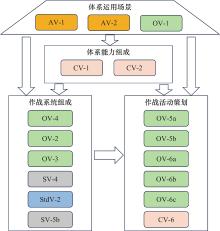
图2
有/无人协同作战体系建模步骤"
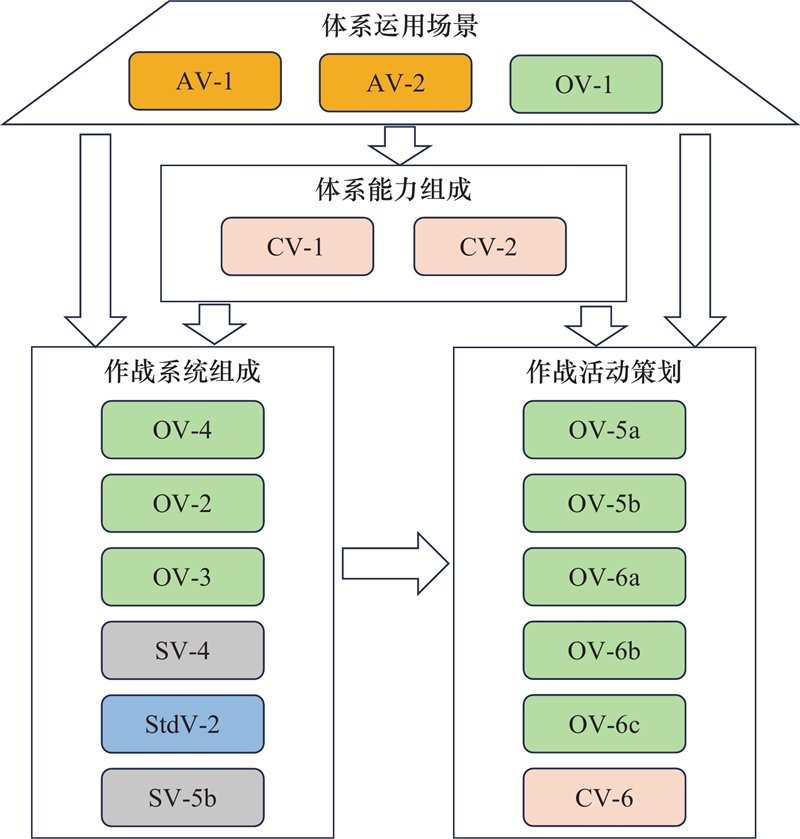
图3
MOF框架下的领域元模型构建方法"
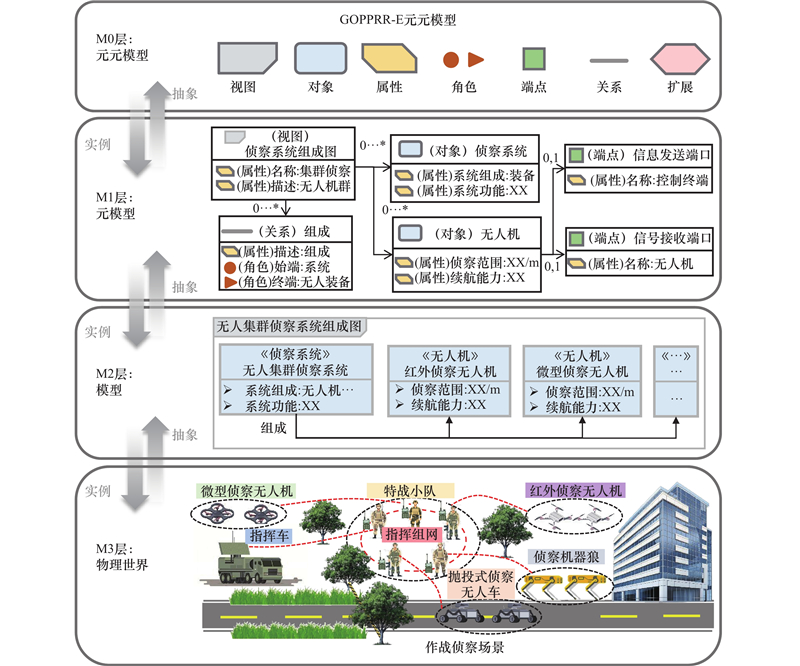
图4
Arch与HA元模型映射规则示意图"
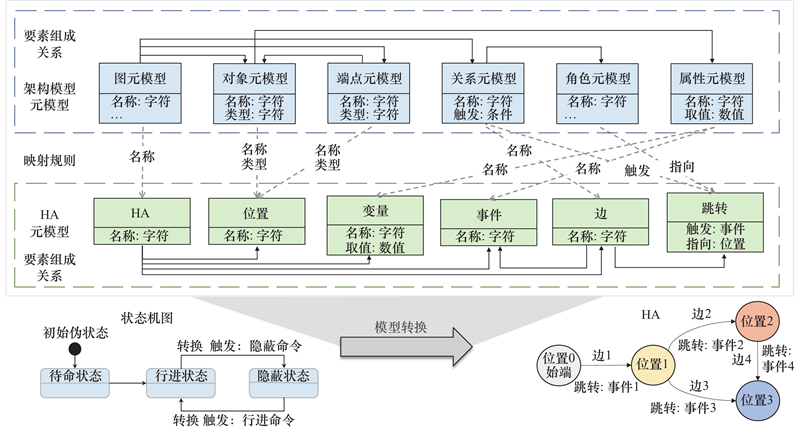
图5
体系建模框架和流程"
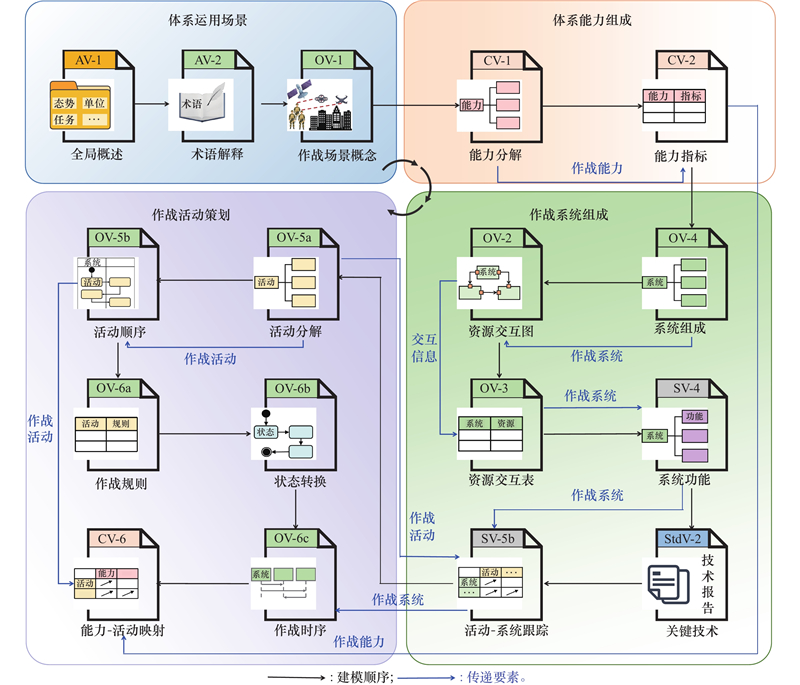
表2
领域元模型(部分)"
| 阶段 | 视图 | 领域元模型 | 描述 | |
| 名称 | 类型 | |||
| 体系运用场景 | AV-1 | 现场态势 | 对象 | 对作战现场态势、战场环境等信息进行初步分析 |
| 作战时间 | 对象 | 作战行动的具体时间 | ||
| 使命任务 | 对象 | 作战行动核心原则和要达成的最终目标 | ||
| 红蓝方兵力 | 对象 | 红蓝双方武装情况、人员组成情况 | ||
| 内容 | 属性 | 各个领域元模型的细化描述 | ||
| OV-1 | 作战场景 | 对象 | 战场地形地势环境 | |
| 作战部署 | 对象 | 执行作战任务的相关方角色或交互的作战系统部署情况 | ||
| 体系能力组成 | CV-1 | 封锁控制能力 | 对象 | 对现场封锁控制、电磁干扰、阻断蓝方通讯等能力 |
| 态势感知能力 | 对象 | 对战场红外扫描侦察、雷达穿透侦察、空地协同侦察等能力 | ||
| 指挥决策能力 | 对象 | 侦察信息融合、威胁效能评估、作战任务规划等能力 | ||
| 通信导航能力 | 对象 | 指令传达、情报实时共享、态势回传等能力 | ||
| 火力打击能力 | 对象 | 精准狙击能力、空中火力覆盖、地面火力压制等能力 | ||
| 破拆排爆能力 | 对象 | 建筑快速破拆、爆炸物精准拆除等能力 | ||
| 综合保障能力 | 对象 | 作战过程中的弹药运输保障、医疗救援保障等能力 | ||
| 组成 | 关系 | 体系作战能力间的组合关系 | ||
| 作战系统组成 | OV-4 | 封控系统 | 对象 | 完成现场封锁、阻断通讯等任务的作战人员和作战装备的集合 |
| 侦察系统 | 对象 | 完成情报侦察、情报回传等任务的作战人员和作战装备的集合 | ||
| 指挥系统 | 对象 | 完成态势研判、战术决策等任务的作战人员和作战装备的集合 | ||
| 通信系统 | 对象 | 完成指令下达、情报传输共享等任务的作战人员和作战装备的集合 | ||
| 打击系统 | 对象 | 完成火力覆盖、精准打击等任务的作战人员和作战装备的集合 | ||
| 排爆系统 | 对象 | 完成爆炸物拆除或转移任务的作战人员和作战装备的集合 | ||
| 保障系统 | 对象 | 完成弹药运输补给、救援保障等任务的作战人员和作战装备的集合 | ||
| 无人机 | 对象 | 参与作战的各种类型无人机的集合 | ||
| 组成 | 关系 | 各作战系统间的编配组合关系 | ||
| OV-2 | 作战系统 | 对象 | 参与作战的各类型的作战系统 | |
| 指挥控制 | 关系 | 各作战系统之间的指挥控制关系 | ||
| 协同配合 | 关系 | 各作战系统之间的协同配合关系 | ||
| 支援保障 | 关系 | 各作战系统之间的支援保障关系 | ||
| 作战活动策划 | OV-5b | 作战活动 | 对象 | 完成指定作战任务各需要进行的作战活动 |
| 战略决策 | 对象 | 指挥系统进行战术布局、活动策划的动作 | ||
| 隐蔽侦察 | 对象 | 侦察系统进行观察环境态势、兵力部署的动作 | ||
| 火力打击 | 对象 | 打击系统进行火力压制、精准打击的动作 | ||
| OV-6b | 待命状态 | 对象 | 系统处于原地部署等候指令的状态 | |
| 行进状态 | 对象 | 系统处于机动行进向目标进发的状态 | ||
| 侦察状态 | 对象 | 系统处于观测现场态势信息的状态 | ||
| 隐蔽状态 | 对象 | 系统处于隐蔽潜藏的状态 | ||
| 转换 | 关系 | 状态之间的转换关系,可具备一定的条件 | ||
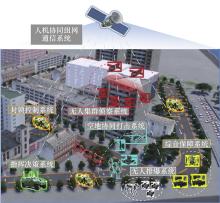
图6
作战场景概述图(OV-1)"
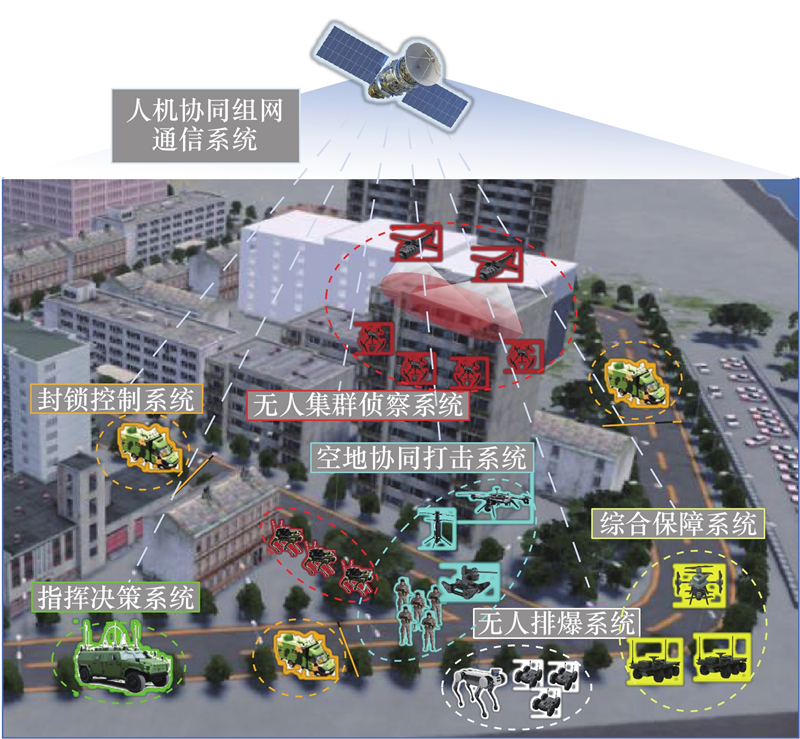
图7
体系能力分解视图(CV-1)"
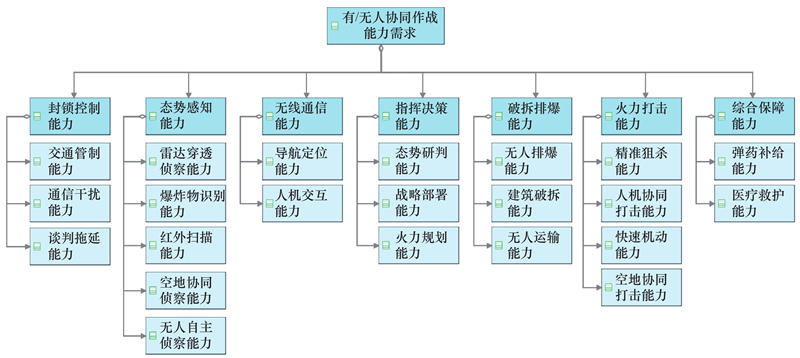
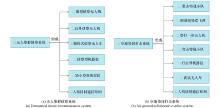
图8
部分作战系统组成视图(OV-4)"
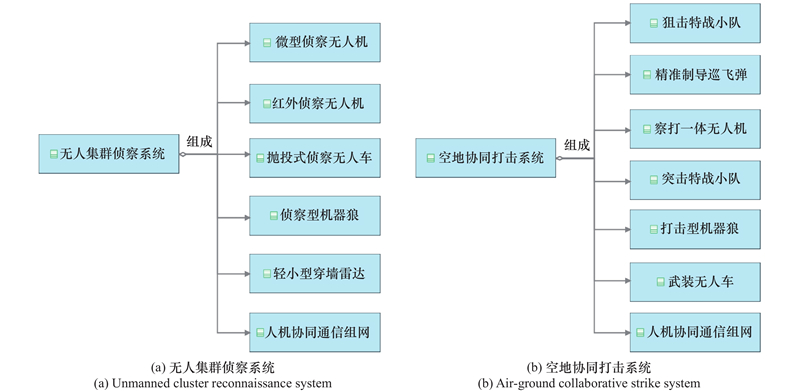
图9
作战系统资源交互图(OV-2)"
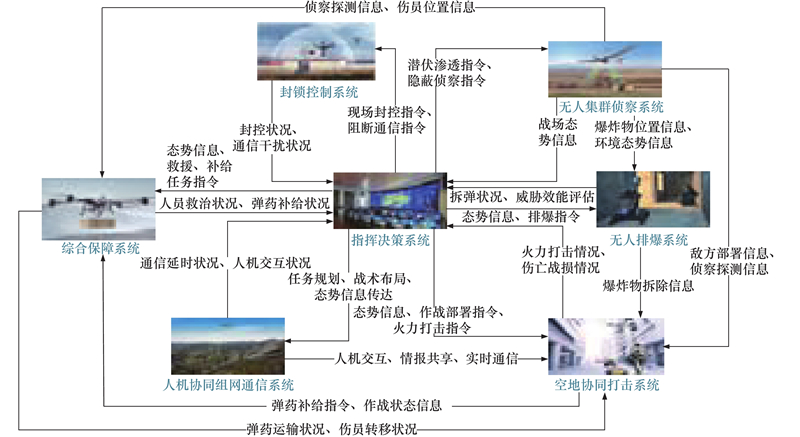
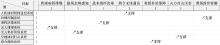
图10
作战活动?系统跟踪追溯矩阵(SV-5b)"
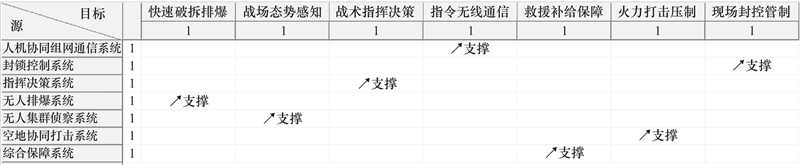
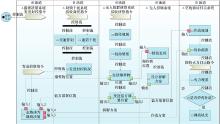
图11
部分作战活动模型(OV-5b)"
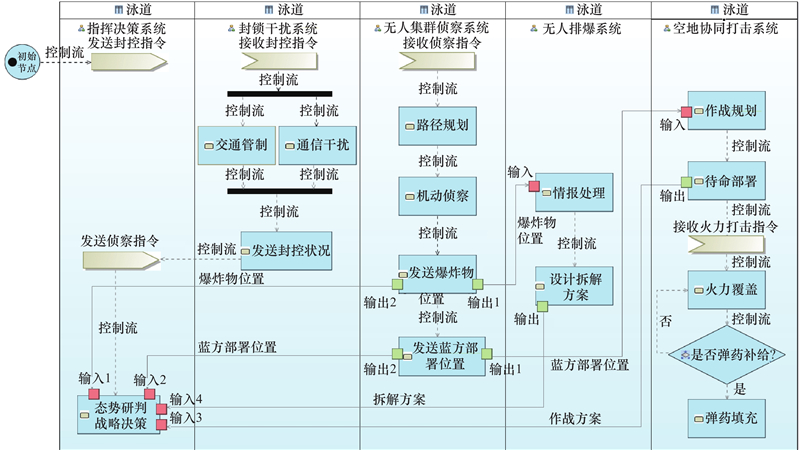
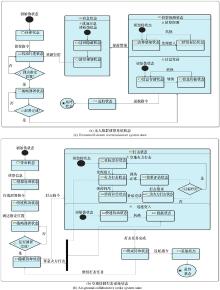
图12
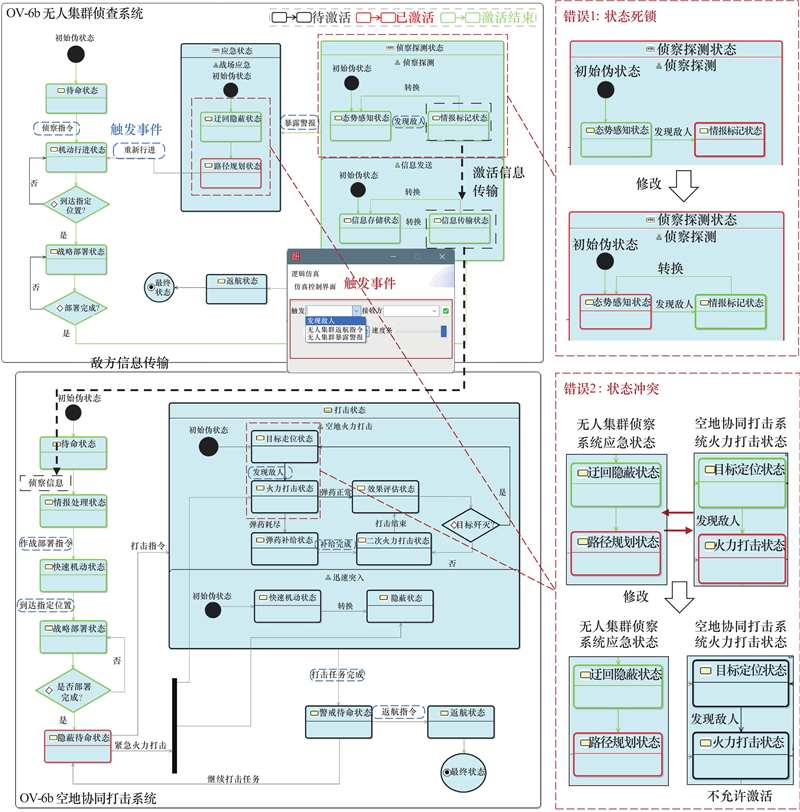
系统状态转换模型(OV-6b)"
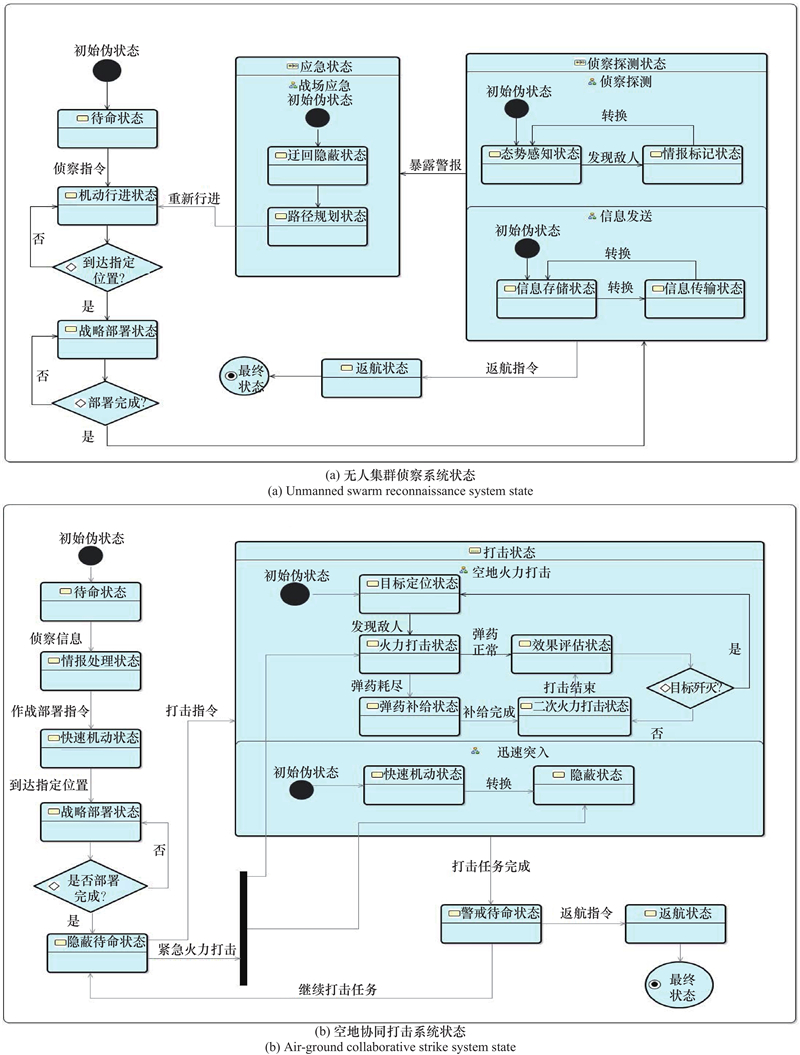
图13
作战活动逻辑仿真"
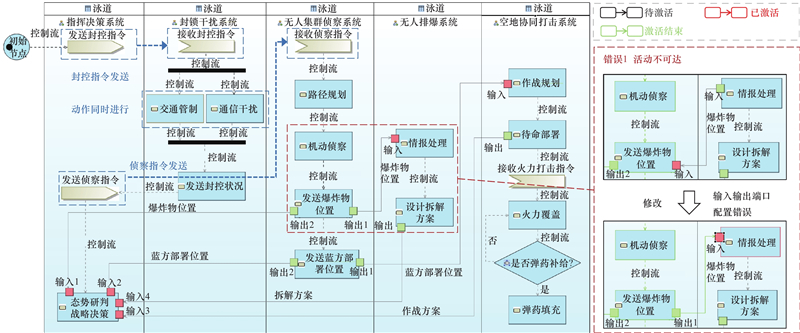
图14
系统状态转换逻辑仿真"
| 1 | 王方博, 郭健, 杜承烈, 等. 基于MBSE的有无人协同作战能力系统设计与验证[EB/OL]. [2025-08-20]. https: //doi. org/10.16182/j. issn1004731x. joss. 25-0007. |
| WANG F B, GUO J, DU C L, et al. MBSE-based design and verification of manned-unmanned teaming capability system[EB/OL]. [2025-08-20]. https://doi.org/10.16182/j.issn1004731x.joss.25-0007. | |
| 2 |
CHEN W, LI W, ZHANG T. Complex network-based resilience capability assessment for a combat system of systems[J]. Systems, 2024, 12 (1): 31.
doi: 10.3390/systems12010031 |
| 3 | 王灿, 纪浩然, 郭齐胜, 等. 基于DoDAF的陆上智能突击系统作战概念系统开发[J]. 系统仿真学报, 2023, 35 (11): 2397- 2409. |
| WANG C, JI H R, GUO Q S, et al. Development of combat concept of intelligent land assault system based on DoDAF[J]. Journal of System Simulation, 2023, 35 (11): 2397- 2409. | |
| 4 | XIAO J, CHEN F, CAO S, et al. Modeling and simulation of manned and unmanned cooperative reconnaissance and surveillance scenario based on DoDAF[C]//Proc. of the IEEE 19th Conference on Industrial Electronics and Applications, 2024. |
| 5 | U. S. Department of Defense. The DoDAF architecture framework version 2.02[R]. Washington, DC: U. S. Department of Defense, 2010: 1−114. |
| 6 | FANG Z M. System-of-systems architecture selection: a survey of issues, methods, and opportunities[J]. IEEE Systems Journal, 2021, 16 (3): 4768- 4779. |
| 7 |
唐召胜. 基于DoDAF的反无人机装备体系结构建模[J]. 兵工自动化, 2024, 43 (8): 55- 59.
doi: 10.7690/bgzdh.2024.08.013 |
|
TANG Z S. Architecture modeling of anti-UAV equipment based on DoDAF[J]. Ordnance Industry Automation, 2024, 43 (8): 55- 59.
doi: 10.7690/bgzdh.2024.08.013 |
|
| 8 | CHEN C, ZHANG X R, YANG Z Y, et al. Modeling and analysis approach for actual combat requirements of warships based on DoDAF[J]. Systems Engineering & Electronics, 2025, 47 (10): 3389- 3403. |
| 9 |
李玉豪, 杜波, 刘元意. 基于DoDAF的无人化作战概念体系化描述方法研究[J]. 指挥控制与仿真, 2025, 47 (3): 12- 21.
doi: 10.3969/j.issn.1673-3819.2025.03.002 |
|
LI Y H, DU B, LIU Y Y. Research on systematic description method of unmanned combat concept based on DoDAF[J]. Command Control and Simulation, 2025, 47 (3): 12- 21.
doi: 10.3969/j.issn.1673-3819.2025.03.002 |
|
| 10 | 刘遵飞, 邹波, 陈续麟, 等. 有人与无人联合作战模式下的装备体系结构建模与效能评估[J]. 兵工学报, 2022, 43 (S1): 155- 161. |
| LIU Z F, ZOU B, CHEN X L, et al. Architecture modeling and effectiveness evaluation of equipment system under manned and unmanned joint operation mode[J]. Acta Armamentarii, 2022, 43 (S1): 155- 161. | |
| 11 |
王新尧, 曹云峰, 孙厚俊, 等. 基于DoDAF的有人/无人机协同作战体系结构建模[J]. 系统工程与电子技术, 2020, 42 (10): 2265- 2274.
doi: 10.3969/j.issn.1001-506X.2020.10.15 |
|
WANG X Y, CAO Y F, SUN H J, et al. Modeling for cooperative combat system architecture of manned/unmanned aerial vehicle based on DoDAF[J]. Systems Engineering and Electronics, 2020, 42 (10): 2265- 2274.
doi: 10.3969/j.issn.1001-506X.2020.10.15 |
|
| 12 | 张宇, 郭齐胜. 基于DoDAF的地面无人作战系统作战概念设计方法[J]. 火力与指挥控制, 2021, 46 (5): 52- 57,63. |
| ZHANG Y, GUO Q S. Operational concept design method based on DoDAF for ground unmanned combat system[J]. Fire Control & Command Control, 2021, 46 (5): 52- 57,63. | |
| 13 | ZHANG C R, YANG C W, YU B. Modeling and simulation of urban block unmanned combat system based on DoDAF[C]//Proc. of the IEEE International Conference on Unmanned Systems, 2024: 213−218. |
| 14 | 赵拓, 刘玉乔, 马远, 等. 基于DoDAF的靶弹目标特性体系结构建模及仿真[EB/OL]. [2025-08-20]. https: //doi. org/10.16182/j. issn1004731x. joss. 23-0266. |
| ZHAO T, LIU Y Q, MA Y, et al. DoDAF-based architecture modeling and simulation of target missile characteristics[EB/OL]. [2025-08-20]. https://doi.org/10.16182/j.issn1004731x.joss.23-0266. | |
| 15 | LUO T S, YOU H, LU Y B, et al. System-of-system combat efficiency evaluation methods based on DoDAF-GERT[C]//Proc. of the IEEE 26th China Conference on System Simulation Technology and its Applications, 2025: 137−140. |
| 16 |
TAN C S, VAN BOSSUYT D L, HALE B. System analysis of counter-unmanned aerial systems kill chain in an operational environment[J]. Systems, 2021, 9 (4): 79.
doi: 10.3390/systems9040079 |
| 17 |
YUE Z, JIANG J, KEWEI Y, et al. Intelligent modeling method for OV models in DoDAF2.0 based on knowledge graph[J]. Journal of Systems Engineering and Electronics, 2025, 36 (1): 139- 154.
doi: 10.23919/JSEE.2024.000034 |
| 18 | 王丹, 袁家骏, 肖楚琬. 基于模型的作战体系架构开发本体和元模型研究[EB/OL]. [2025-08-20]. https://link. cnki. net/urlid/11.2422. tn. 20250708.1847. 016. |
| WANG D, YUAN J J, XIAO C W. Research on ontology and metamodel for model-based combat system architecture development[EB/OL]. [2025-08-20]. https://link.cnki.net/urlid/11.2422.tn.20250708.1847.016. | |
| 19 | 赵凯旋, 罗明强, 鲁金直, 等. MBSE标准体系模型构建方法研究及应用验证[J]. 计算机集成制造系统, 2026, 32 (4): 1187- 1204. |
| ZHAO K X, LUO M Q, LU J Z, et al. MBSE standard system modelconstruction method and application validation[J]. ComputerIntegrated Manufacturing Systems, 2026, 32 (4): 1187- 1204. | |
| 20 | 吴绶玄, 王国新, 梁赞, 等. 基于特定域建模的起落架系统多架构设计方法[J]. 机械工程学报, 2025, 61 (19): 273- 289. |
| WU S X, WANG G X, LIANG Z, et al. Domain-specific modeling-based multi-architecture design method for landing gear systems[J]. Journal of Mechanical Engineering, 2025, 61 (19): 273- 289. | |
| 21 |
WU S X, WANG G X, LU J Z, et al. Design ontology for cognitive thread supporting traceability management in model-based systems engineering[J]. Journal of Industrial Information Integration, 2024, 40, 100619.
doi: 10.1016/j.jii.2024.100619 |
| 22 |
ZHANG J, YANG S Q. Recommendations for the model-based systems engineering modeling process based on the SysML model and domain knowledge[J]. Applied Sciences, 2024, 14 (10): 4010.
doi: 10.3390/app14104010 |
| 23 | FERRARI A, ABUALHAIJA S, ARORA C. Model generation with LLMs: from requirements to UML sequence diagrams[C]//Proc. of the IEEE 32nd International Requirements Engineering Conference Workshops, 2024: 291−300. |
| 24 |
ZHENG X C, HU X D, LU J Z, et al. An aircraft assembly process formalism and verification method based on semantic modeling and MBSE[J]. Advanced Engineering Informatics, 2024, 60, 102412.
doi: 10.1016/j.aei.2024.102412 |
| 25 |
GIACHETTI R E. Evaluation of the DoDAF meta-model’s support of systems engineering[J]. Procedia Computer Science, 2015, 61, 254- 260.
doi: 10.1016/j.procs.2015.09.208 |
| 26 | OMG. Meta object facility (MOF) core specification (Version 2.0) [S]. Needham, MA: Object Management Group, 2006. |
| 27 |
ARISTA R, ZHENG X, LU J, et al. An ontology-based engineering system to support aircraft manufacturing system design[J]. Journal of Manufacturing Systems, 2023, 68, 270- 288.
doi: 10.1016/j.jmsy.2023.02.012 |
| 28 | CEDERBLADH J, CICCHETTI A, SURYADEVARA J. Early validation and verification of system behaviour in model-based systems engineering: a systematic literature review[J]. ACM Transactions on Software Engineering and Methodology, 2024, 33 (3): 1- 67. |
| 29 | DING J, RENIERS M, LU J, et al. Integration of modeling and verification for system model based on KARMA language [C]//Proc. of the 18th ACM SIGPLAN International Workshop on Domain-Specific Modeling, 2021: 41−50. |
| 30 | FREHSE G. An introduction to hybrid automata, numerical simulation and reachability analysis [M]. Wiesbaden: Springer Fachmedien Wiesbaden, 2015: 50−81. |
| 31 | LU J Z, MA J D, ZHENG X C, et al. Design ontology supporting model-based systems engineering formalisms[J]. IEEE Systems Journal, 2021, 16 (4): 5465- 5476. |
| 32 |
VILLALÓN-HUERTA A, GISBERT H M, RIPOLL-RIPOLL I. SOC critical path: a defensive kill chain model[J]. IEEE Access, 2022, 10, 13570- 13581.
doi: 10.1109/ACCESS.2022.3145029 |
| 33 |
AGHAMOHAMMADPOUR A, MAHDIPOUR E, ATTARZADEH I. Architecting threat hunting system based on the DODAF framework[J]. The Journal of Supercomputing, 2023, 79 (4): 4215- 4242.
doi: 10.1007/s11227-022-04808-6 |
| 34 |
MA J D, WANG G X, LU J Z, et al. Application of multi architecture modelling method in intelligent electric-vehicle design[J]. International Journal of Production Research, 2025, 63 (15): 5493- 5511.
doi: 10.1080/00207543.2025.2453835 |
| [1] | 张进富, 曹云峰, 郭邦君, 王浩宇. 面向有人/无人机协同作战的体系架构正向建模方法[J]. 系统工程与电子技术, 2025, 47(12): 3935-3951. |
| [2] | 陈成, 张祥瑞, 杨中源, 周华伟, 何秦, 韩灿. 基于DoDAF的舰船实战化需求建模与分析方法[J]. 系统工程与电子技术, 2025, 47(10): 3389-3400. |
| [3] | 张堃, 华帅, 袁斌林, 杜睿怡. 基于Multi-Agent的无人机集群体系自主作战系统设计[J]. 系统工程与电子技术, 2024, 46(4): 1273-1286. |
| [4] | 岳程斐, 薛正华, 姚蔚然, 曹喜滨. 基于机群关系特征的多机协同作战任务分配[J]. 系统工程与电子技术, 2022, 44(6): 1897-1906. |
| [5] | 刘家义, 岳韶华, 王刚, 张杰, 姚小强. 多平台分布式协同作战下基于MPC-MAS的指挥控制模型设计[J]. 系统工程与电子技术, 2020, 42(7): 1582-1589. |
| [6] | 王新尧, 曹云峰, 孙厚俊, 韦彩色, 陶江. 基于DoDAF的有人/无人机协同作战体系结构建模[J]. 系统工程与电子技术, 2020, 42(10): 2265-2274. |
| [7] | 李大喜, 张强, 李小喜, 许勇, 杨建军. 基于DoDAF的空基反导装备体系结构建模[J]. 系统工程与电子技术, 2017, 39(5): 1036-1041. |
| [8] | 王杰, 管恩义, 朱付涛, 胡晓光, 丁祝顺, 吴云洁. 用WSN建立数据链的主从弹协同作战模型[J]. 系统工程与电子技术, 2016, 38(6): 1306-1313. |
| [9] | 李志淮,谭贤四,王红,李桂祥. 基于DM2的体系结构数据一致性验证方法[J]. Journal of Systems Engineering and Electronics, 2013, 35(2): 357-361. |
| [10] | 韦常柱,郭继峰,赵彪. 导弹协同作战编队飞行控制系统研究[J]. Journal of Systems Engineering and Electronics, 2010, 32(9): 1968-1972. |
| [11] | 倪枫,王明哲,周丰,杨翠蓉. 可执行体系结构的HCPN建模方法[J]. Journal of Systems Engineering and Electronics, 2010, 32(5): 959-965. |
| 阅读次数 | ||||||
|
全文 |
|
|||||
|
摘要 |
|
|||||
