Systems Engineering and Electronics ›› 2026, Vol. 48 ›› Issue (7): 2195-2205.doi: 10.12305/j.issn.1001-506X.2026.07.07
• Sensors and Signal Processing • Previous Articles
Trajectory deception error analysis based on multi-UAV collaboration
Honghui BAN, Jifei PAN, Zheng WANG, Rui CUI
- College of Electronic Engineering,National University of Defense Technology,Hefei 230037,China
-
Received:2025-01-22Revised:2025-04-28Accepted:2025-07-18Online:2025-06-11Published:2025-06-11 -
Contact:Jifei PAN

CLC Number:
Cite this article
Honghui BAN, Jifei PAN, Zheng WANG, Rui CUI. Trajectory deception error analysis based on multi-UAV collaboration[J]. Systems Engineering and Electronics, 2026, 48(7): 2195-2205.
share this article
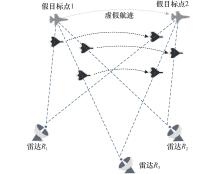
Fig.1
Cooperative trajectory deception of multi-unmanned aerial vehicles network radar"
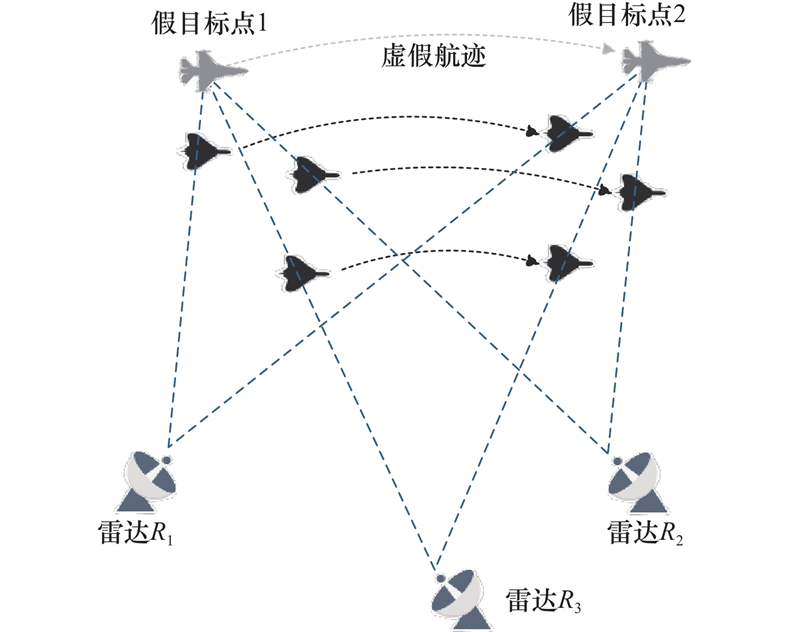
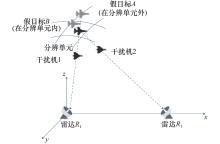
Fig.2
Schematic diagram of the spatial resolution unit"
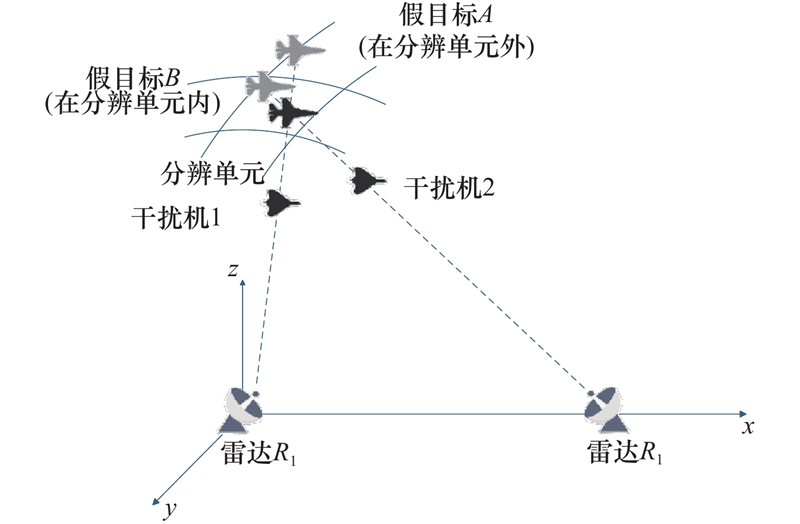
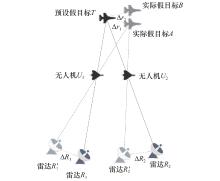
Fig.3
False target spliting caused by radar prior position error"
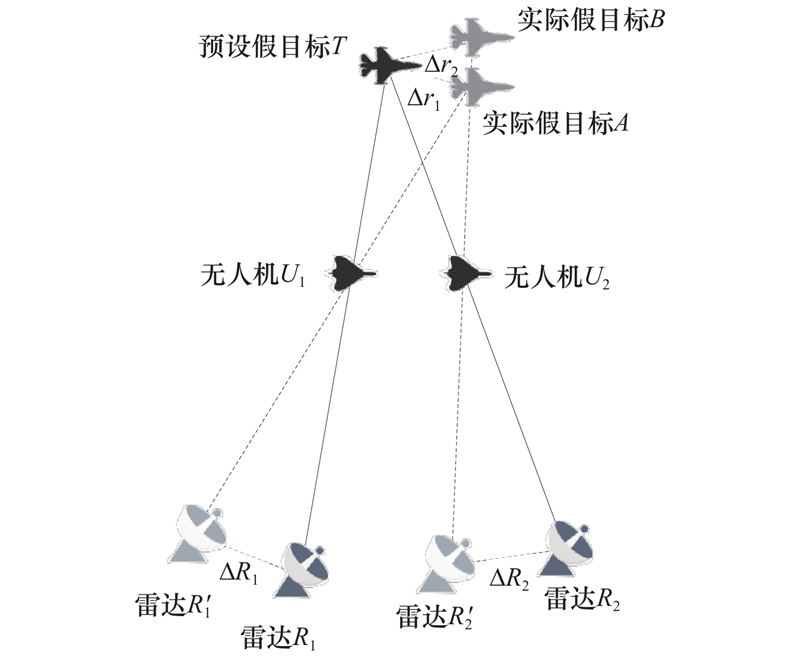
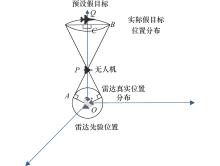
Fig.4
False target distribution of radar prior position error"
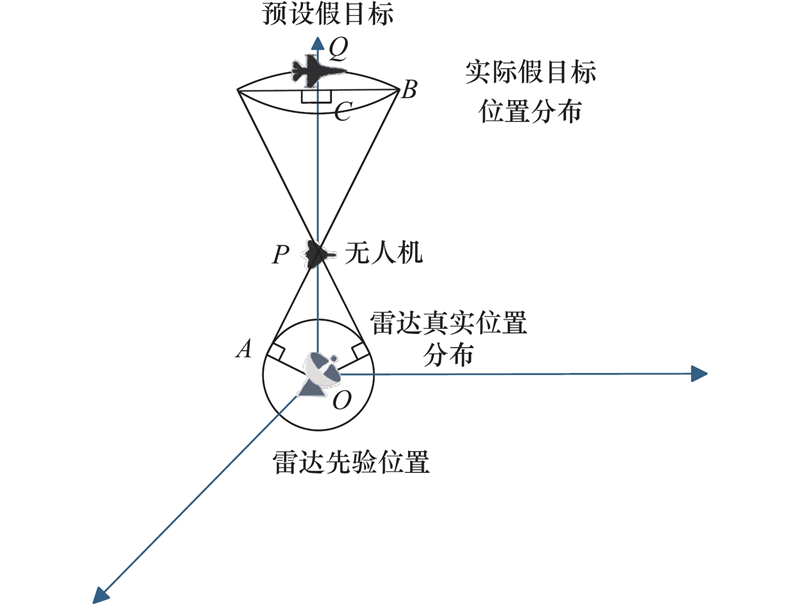
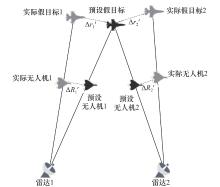
Fig.5
False target spliting caused by error of unmanned aerial vehicles position"
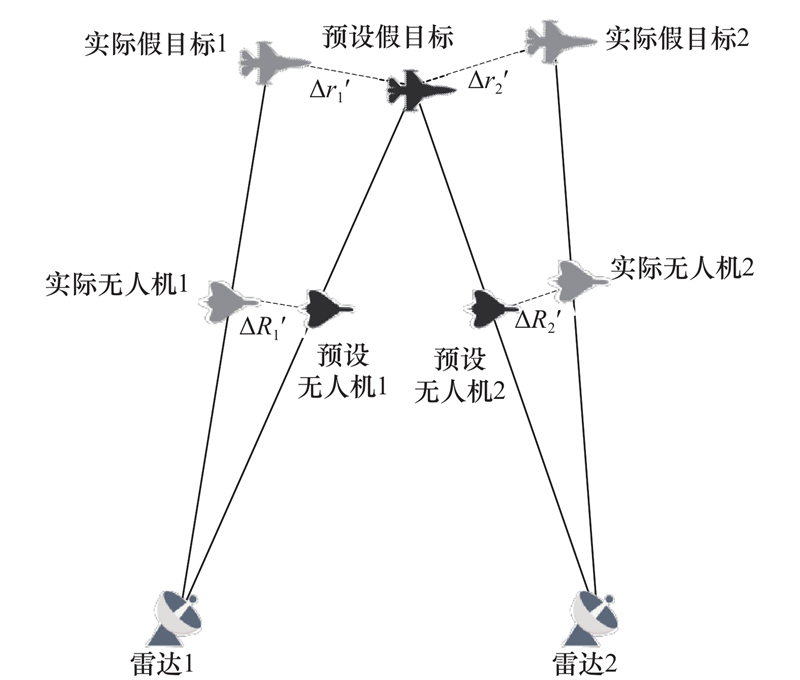
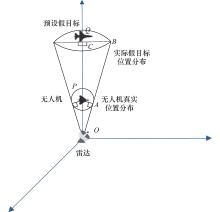
Fig.6
Unmanned aerial vehicles position error distribution map"
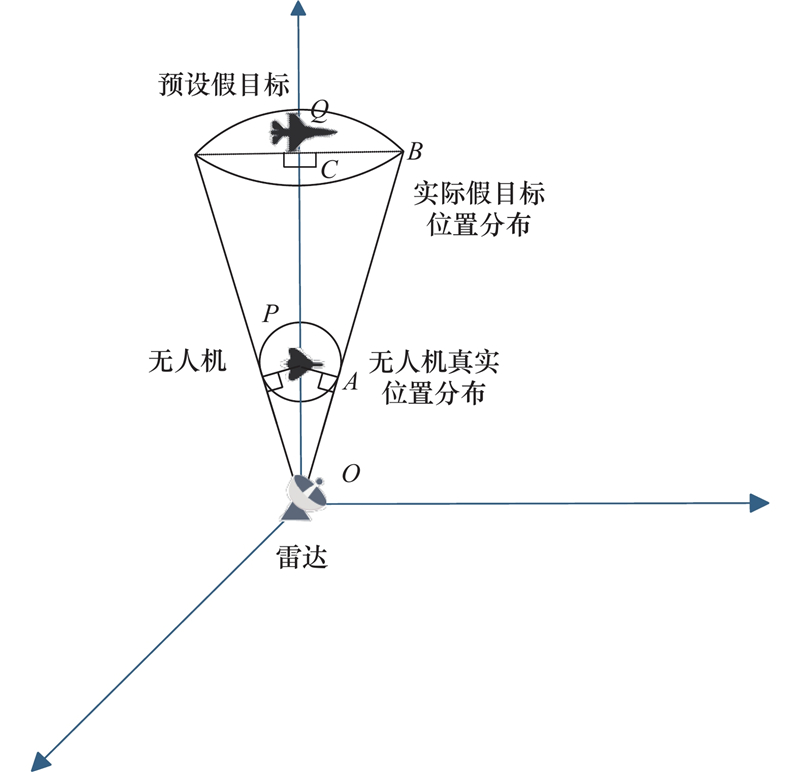
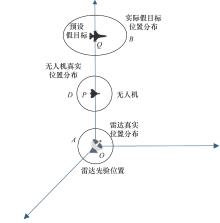
Fig.7
False target distribution of synthetic error"
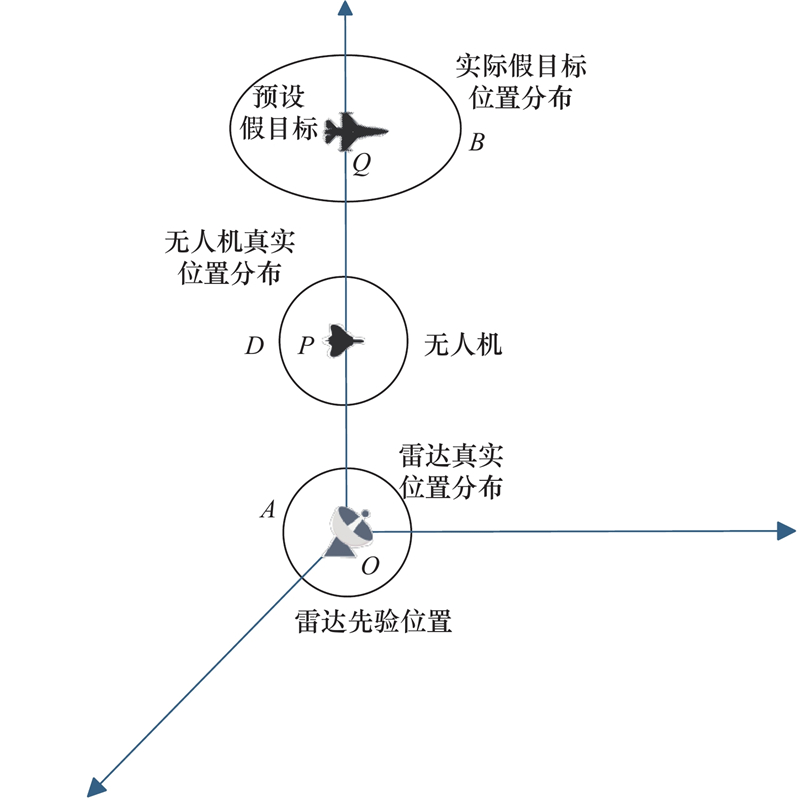
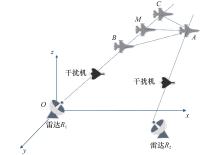
Fig.8
Ribbon track compensation method"
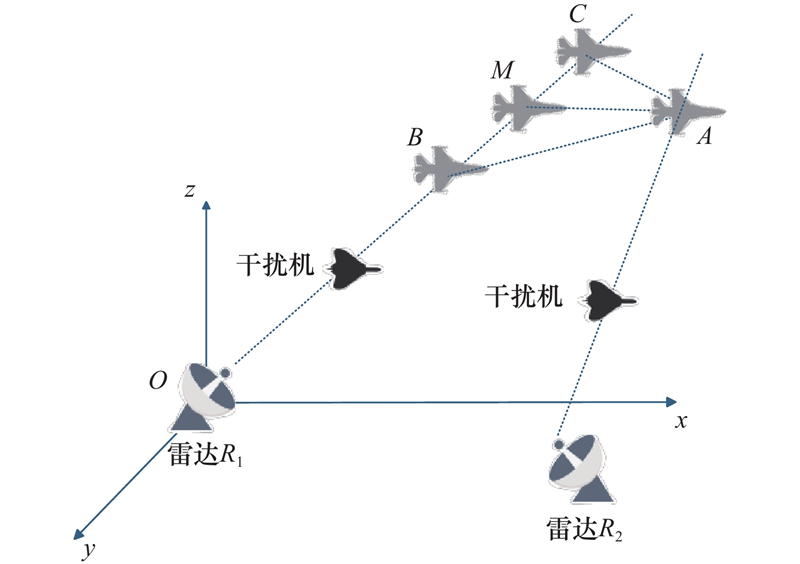
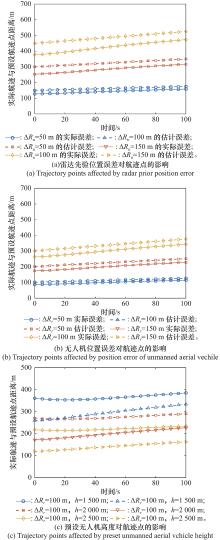
Fig.9
Simulation experiment of influence factors of trajectory point offset"
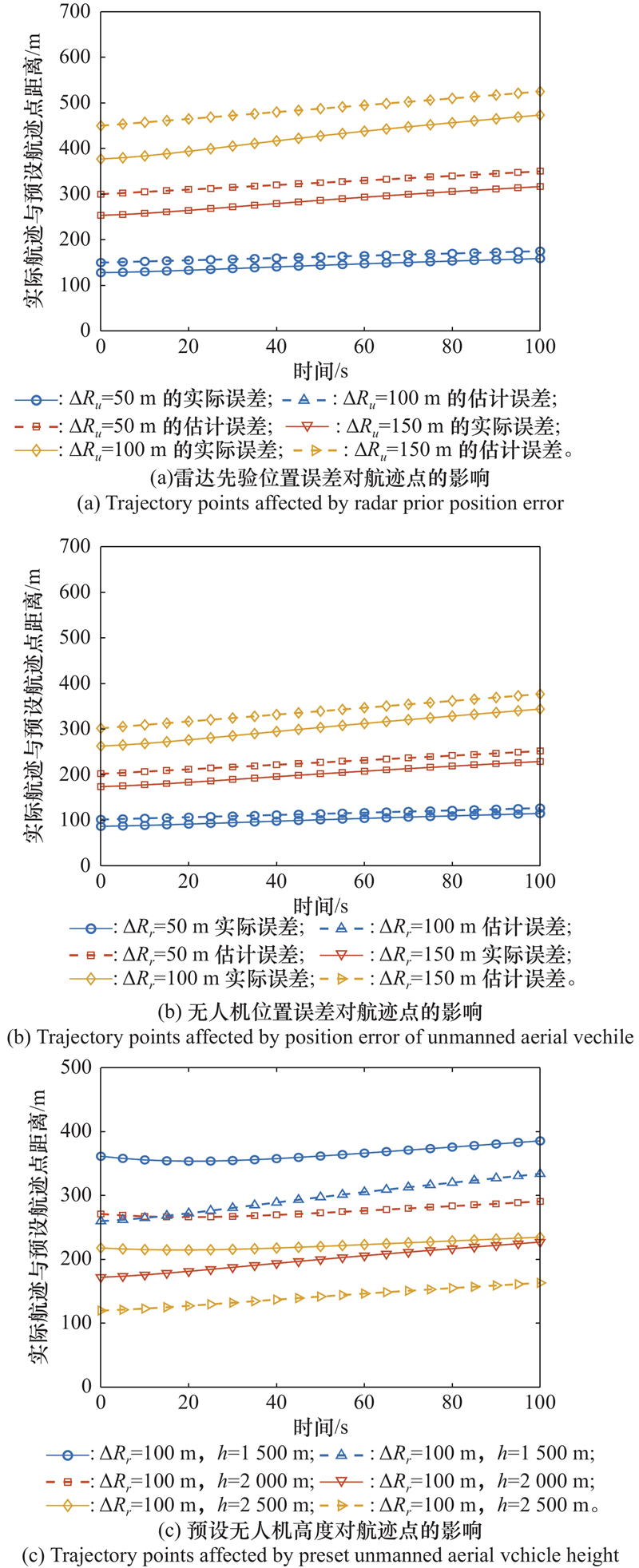
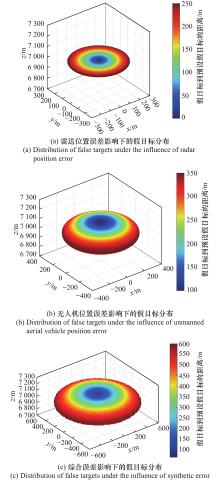
Fig.10
Monte Carlo simulation experiment of spatial position error"
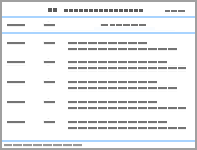
Table 1
Error condition parameter setting m"
| 分图 | 参数 | |||
| 100 | 0 | 0 | 250 | |
| 0 | 100 | 0 | 349.8 | |
| 100 | 100 | 3 | 612.1 | |
Table 2
Coordinates and error parameters"
| 名称 | 坐标或数值 |
| 雷达R1/km | (0, 0, 0) |
| 雷达R2/km | (30, 6, 0 ) |
| 雷达R3/km | (70, 3, 0) |
| 100 | |
| 100 | |
| 0.1 | |
| 500 | |
| 40 dBi | |
| 30 dBi | |
| 10 | |
| 10 |
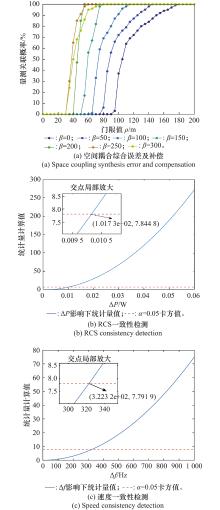
Fig.11
Synthetic error analysis experiments"
| 28 |
RAO B, XIAO S P, WANG X S, et al. Maximum likelihood approach to the estimation and discrimination of exoatmospheric active phantom tracks using motion features[J]. IEEE Trans. on Aerospace and Electronic Systems, 2012, 48 (1): 794- 819.
doi: 10.1109/TAES.2012.6129671 |
| 29 |
HAN X F, HE H F, ZHANG Q, et al. Suppression of deception-false-target jamming for active/passive netted radar based on position error[J]. IEEE Sensors Journal, 2022, 22 (8): 7902- 7912.
doi: 10.1109/JSEN.2022.3149057 |
| 30 |
LIU X, LI D S. A three-dimensional phantom track generation for radar network deception[J]. IEEE Access, 2019, 7, 27288- 27301.
doi: 10.1109/ACCESS.2019.2894409 |
| 1 | MEIR P, PHILLIP C, REID L, et al. Concepts for generating coherent radar phantom tracks using cooperating vehicles[C]//Proc. of the AIAA Guidance, Navigation, and Control Conference and Exhibit, 2004. |
| 2 | DIYOGU H A, MAITHRIPAL A. Radar deception through phantom track generation[C]//Proc. of the American Control Conference, 2005: 4102−4106. |
| 3 |
PURVIS K B, CHANDLER P R, PACHTER M. Feasible flight paths for cooperative generation of a phantom radar track[J]. Journal of Guidance, Control and Dynamics, 2006, 29 (3): 653- 661.
doi: 10.2514/6.2004-5335 |
| 4 | KEITH B P, KARL J A, MUSTAFA K, et al. Online control strategies for highly coupled cooperative UAVs[C]//Proc. of the American Control Conference, 2007. |
| 5 | IL-HYOUNG L, HYOCHOONG B. Cooperative control of multiple electronic combat air vehicles for electronic attack[C]//Proc. of the International Conference on Instrumentation, Control and Information Technology, 2008. |
| 6 |
GARETH B, XU Y J. Virtual motion camouflage based phantom track generation through cooperative electronic combat air vehicles[J]. Automatica, 2010, 46 (9): 1454- 1461.
doi: 10.1016/j.automatica.2010.05.027 |
| 7 |
OUYANG Z P, XU C, FENG J Q, et al. Research on method of phantom track generation based on cooperative control of UAVs in uniform linear motion[J]. IOP Conference Series: Materials Science and Engineering, 2019, 685 (1): 012018.
doi: 10.1088/1757-899x/685/1/012018 |
| 8 | FAN Z, GAO X J, JIN Y, et al. Research on route planning of group UAV cooperation for deception jamming to radar network[C]//Proc. of the IEEE 4th Information Technology, Networking, Electronic and Automation Control Conference, 2020. |
| 9 |
RATNOO A, SHIMA T. Formation-flying guidance for cooperative radar deception[J]. Journal of Guidance, Control, and Dynamics, 2012, 35 (6): 1730- 1739.
doi: 10.2514/1.57112 |
| 10 | ZHANG Y R, GAO M G, LI Y J, et al. Phantom track generation using coherent dual moving sources for monopulse radar[C]//Proc. of the IEEE Conference on Industrial Electronics and Applications, 2014. |
| 11 |
RAO B, GU Z Y, NIE Y P. Deception approach to track-to-track radar fusion using noncoherent dual-source jamming[J]. IEEE Access, 2020, 8, 50843- 50858.
doi: 10.1109/ACCESS.2020.2980010 |
| 12 |
LI Q, ZHANG L R, ZHOU Y, et al. Discrimination of active false targets based on hermitian distance for distributed multiple-radar architectures[J]. IEEE Access, 2019, 7, 71872- 71883.
doi: 10.1109/ACCESS.2019.2920365 |
| 13 |
YANG C Q, FENG L, ZHANG H, et al. A novel data fusion algorithm to combat false data injection attacks in networked radar systems[J]. IEEE Trans. on Signal and Information Processing over Networks, 2018, 4 (1): 125- 136.
doi: 10.1109/TSIPN.2018.2790361 |
| 14 |
ZHOU H P, DONG C C, WU R W, et al. Feature fusion based on Bayesian decision theory for radar deception jamming recognition[J]. IEEE Access, 2021, 9, 16296- 16304.
doi: 10.1109/ACCESS.2021.3052506 |
| 15 |
ZHANG S Y, ZHOU Y, ZHANG L R, et al. Target detection for multistatic radar in the presence of deception jamming[J]. IEEE Sensors Journal, 2021, 21 (6): 8130- 8141.
doi: 10.1109/JSEN.2021.3050008 |
| 16 |
YANG Y, DA K, ZHU Y F, et al. Consensus based target tracking against deception jamming in distributed radar networks[J]. IET Radar, Sonar & Navigation, 2023, 17 (4): 683- 700.
doi: 10.1049/rsn2.12371 |
| 17 |
ZHANG L, LUO Y, WANG H, et al. Detection of false targets in a full polarization radar network under deception jamming[J]. IEEE Sensors Journal, 2023, 24 (3): 3368- 3379.
doi: 10.1109/jsen.2023.3341961 |
| 18 | LI J T, LIU K, ZHANG T X. Multi-agent deep reinforcement learning for dynamic motion control allocation in UAV swarm cooperative jamming to netted radar[C]//Proc. of the International Conference on Autonomous Unmanned Systems, 2023. |
| 19 |
GUO X Y, TIAN T, TAN H Y, et al. A deceptive jamming technology against SAR based on optical-to-SAR template translation[J]. IEEE Trans. on Aerospace and Electronic Systems, 2024, 60 (5): 5715- 5729.
doi: 10.1109/TAES.2024.3399195 |
| 20 |
SUN J, YUAN Y, GRECO M S, et al. Anti-deception jamming resource scheduling for multi-target tracking in distributed radar networks[J]. IEEE Trans. on Aerospace and Electronic Systems, 2024, 60 (6): 9111- 9128.
doi: 10.1109/TAES.2024.3438097 |
| 21 |
ZHANG Z H, ZHU J H, LIU N, et al. Signal fusion method for networked radar motivated by data fusion[J]. IEEE Sensors Journal, 2025, 25 (1): 951- 961.
doi: 10.1109/JSEN.2024.3492137 |
| 22 |
TAN H Y, ZHANG Z X, LI Y, et al. PASS-Net: a pseudo classes and stochastic classifiers based network for few-shot class-incremental automatic modulation classification[J]. IEEE Trans. on Wireless Communications, 2024, 23 (12): 17987- 18003.
doi: 10.1109/TWC.2024.3458980 |
| 23 |
李小波, 孙琳, 周青松, 等. 多机协同的组网雷达欺骗干扰航迹优化[J]. 现代防御技术, 2016, 44 (6): 43- 49.
doi: 10.3969/j.issn.1009-086x.2016.06.008 |
|
LI X B, SUN L, ZHOU Q S, et al. Optimization of spoofing and jamming track for multi-aircraft cooperative networked radar[J]. Modern Defense Technology, 2016, 44 (6): 43- 49.
doi: 10.3969/j.issn.1009-086x.2016.06.008 |
|
| 24 | DHANANJAY N, KUDUVALLI A, GHOSE D. Realistic coherent phantom track generation by a group of electronic combat aerial vehicles[C]//Proc. of the American Control Conference, 2013. |
| 25 | LIU X, LI D X. The technology of deviation compensation for radar phantom tracks[C]//Proc. of the IEEE 17th International Conference on Communication Technology, 2017. |
| 26 | 柏鹏, 王玉冰, 梁晓龙, 等. 无人机对雷达组网航迹欺骗综述[J]. 航空学报, 2020, 41 (10): 23912. |
| BAI P, WANG Y B, LIANG X L, et al. Review on track spoofing of radar network by UAV[J]. Acta Aeronautica et Astronautica Sinica, 2020, 41 (10): 23912. | |
| 27 |
ZHAO S S, ZHANG L R, ZHOU Y, et al. Signal fusion-based algorithms to discriminate between radar targets and deception jamming in distributed multiple-radar architectures[J]. IEEE Sensors Journal, 2015, 11, 6697- 6706.
doi: 10.1109/jsen.2015.2440769 |
| [1] | Wenbin LIN, Chenguang SHI, Mu YAN, Fei WANG, Jianjiang ZHOU. Robust trajectory planning algorithm for UAVs swarm facing deceptive jamming networked radar [J]. Systems Engineering and Electronics, 2026, 48(5): 1551-1563. |
| [2] | Jie HU, Ruifeng CHU, Yixian ZHU, Ping CHEN, Fan BAO. Three-dimensional trajectory planning of UAV based on VPPSO algorithm [J]. Systems Engineering and Electronics, 2026, 48(5): 1738-1751. |
| [3] | Zhi YANG, Feng YU, Siying LIN, Zijun ZHOU. Swarm autonomous navigation technology based on visual collaboration [J]. Systems Engineering and Electronics, 2026, 48(4): 1396-1403. |
| [4] | Xuping GU, Xianjun SHI. Reconfigurability analysis and design of UAV based on structural analysis and tree-seed optimization algorithm [J]. Systems Engineering and Electronics, 2026, 48(3): 932-945. |
| [5] | Sen ZHANG, Yan PANG, Fuliang ZHOU. Three-dimensional path planning for UAV based on improved Informed-RRT* algorithm [J]. Systems Engineering and Electronics, 2026, 48(2): 660-668. |
| [6] | Xuxin YANG, Wei JI. Optimization strategy for energy consumption in unmanned aerial vehicle assisted safe MEC systems [J]. Systems Engineering and Electronics, 2026, 48(2): 719-726. |
| [7] | Zeyu LU, Yao WANG, Weinan WU, Yiming SUN, Chunlin GONG. Two-layered path planning for unmanned aerial vehicle swarm in three-dimensional dynamic environment [J]. Systems Engineering and Electronics, 2026, 48(1): 132-143. |
| [8] | Qichen XU, Zhaohui ZHANG, Jing LI. Distributed adaptive multi-UAV collaborative path planning in unknown denial environments [J]. Systems Engineering and Electronics, 2026, 48(1): 172-184. |
| [9] | Xiaolong WEI, Yarong WU, Dengkai YAO, Guhao ZHAO. Hierarchical decision-making algorithm for UAV air combat maneuvering based on deep reinforcement learning [J]. Systems Engineering and Electronics, 2025, 47(9): 2993-3003. |
| [10] | Dapeng YANG, Zihao GONG, Xiaoye WANG, Zhengyu GUO, Delin LUO. Research on UAV cooperative interception maneuver decision-making based on multi-agent reinforcement learning [J]. Systems Engineering and Electronics, 2025, 47(9): 3076-3085. |
| [11] | Zhao YANG, Jinbiao HU, Yan WANG, Hongbiao QI. UAV coverage path planning for mountain patrol considering different takeoff and landing nests [J]. Systems Engineering and Electronics, 2025, 47(8): 2622-2631. |
| [12] | Xiaowei YAN, Chong LING, Shengbin SHI. Design and implementation of a rapid detection system for surface unexploded submunitions [J]. Systems Engineering and Electronics, 2025, 47(8): 2639-2645. |
| [13] | Xiaowei FU, Xinyi WANG, Zhe QIAO. Attack-defense confrontation strategy of multi-UAV based on APIQ algorithm [J]. Systems Engineering and Electronics, 2025, 47(7): 2205-2215. |
| [14] | Siying LIN, Feng YU, Zhi XIONG, Fang WU, Zijun ZHOU. Low-cost UAV navigation method based on AHRS for GNSS intermittent denial [J]. Systems Engineering and Electronics, 2025, 47(7): 2329-2338. |
| [15] | Junchao TANG, Chunhe HU. Complete coverage path planning for UAVs in 3D terrain and wind field environment [J]. Systems Engineering and Electronics, 2025, 47(7): 2349-2356. |
| Viewed | ||||||
|
Full text |
|
|||||
|
Abstract |
|
|||||