Systems Engineering and Electronics ›› 2026, Vol. 48 ›› Issue (4): 1370-1377.doi: 10.12305/j.issn.1001-506X.2026.04.25
• Guidance, Navigation and Control • Previous Articles
Survey of SO(3)-based spacecraft attitude error description methods
Zhongzhong ZHENG1, Jie GUO1,*, Yangyang WAN1, Yulin WANG2, Shengjing TANG1
- 1. School of Aerospace Engineering,Beijing Institute of Technology,Beijing 100081,China
2. National Key Laboratory of Space Intelligent Control,Beijing Institute of Control Engineering,Beijing 100094,China
-
Received:2025-03-25Revised:2025-05-06Online:2025-12-08Published:2025-12-08 -
Contact:Jie GUO

CLC Number:
Cite this article
Zhongzhong ZHENG, Jie GUO, Yangyang WAN, Yulin WANG, Shengjing TANG. Survey of SO(3)-based spacecraft attitude error description methods[J]. Systems Engineering and Electronics, 2026, 48(4): 1370-1377.
share this article
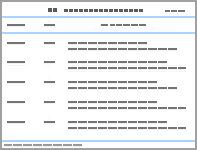
Table 1
Characteristics of attitude description methods for spacecraft"
| 姿态描述方法 | 优势 | 不足 |
| SO(3) | 无奇异,能全局描述姿态,无超越函数运算,可用于连续旋转 | 6个冗余,不直观,计算量大,数学意义复杂,传感器无法直接获取 |
| 欧拉角 | 无冗余参数,物理意义明确,传感器获取方便 | 在 |
| 罗格里斯参数 | 无冗余,较少的超越函数运算,可用于连续旋转 | 在 |
| 修正罗格里斯参数 | 无冗余,较少的超越函数运算,可用于连续旋转 | 在 |
| 四元数 | 无奇异,无超越函数运算,可用于连续旋转表示 | 在 |
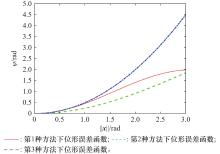
Fig.1
Curve of configuration error function $ \psi $ changing with $ \left\| {\boldsymbol{x}} \right\| $"
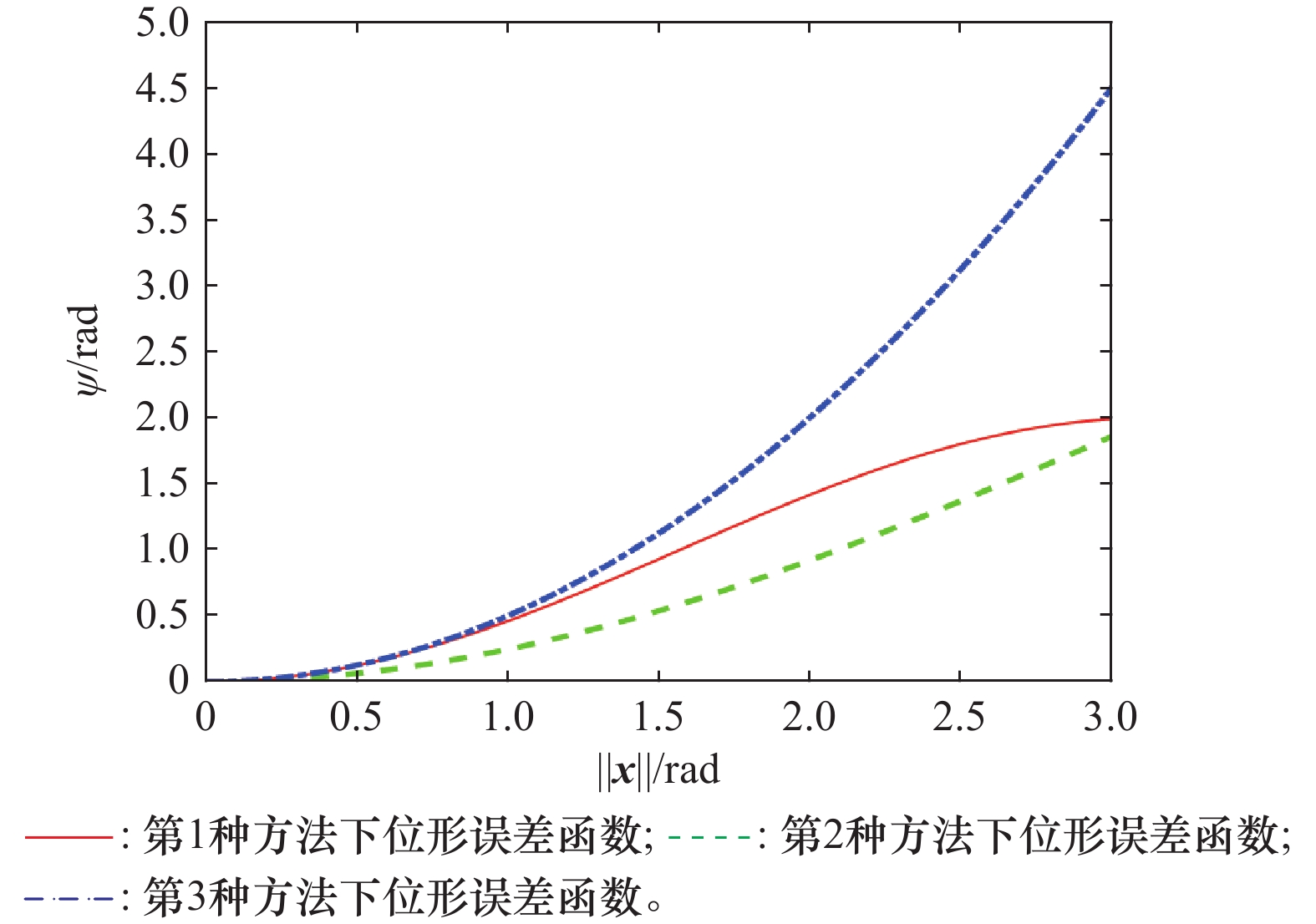
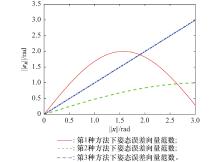
Fig.2
Curve of attitude error vector norm $ \left\| {{{\boldsymbol{e}}_{\boldsymbol{R}}}} \right\| $ changing with $ \left\| {\boldsymbol{x}} \right\| $"
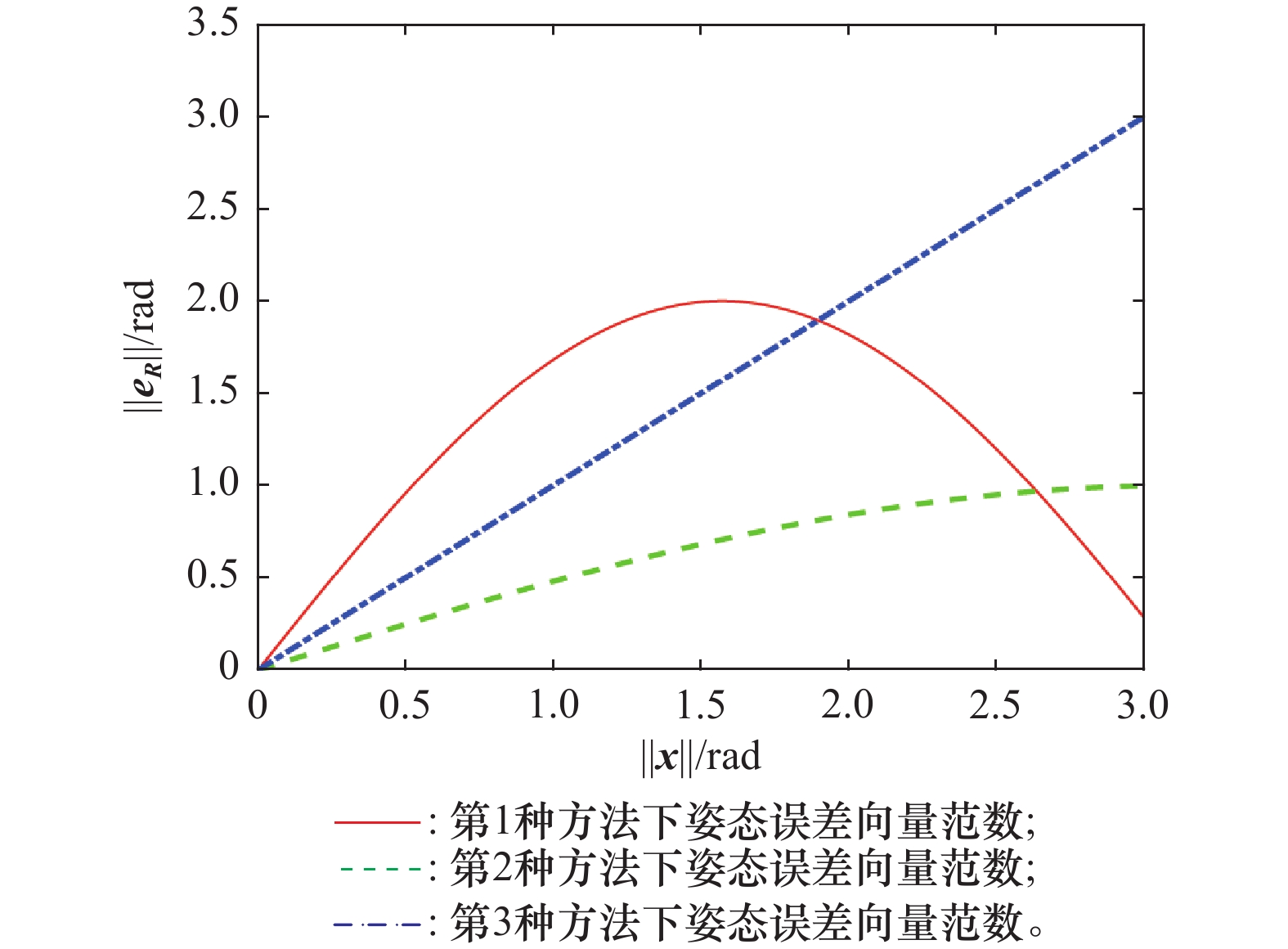
Table 2
Initial and desired states"
| 状态 | 姿态/rad | 角速度/(rad/s) |
| 初始 | ||
| 期望 |
Fig.3
Curve of configuration error function $ \psi $ changing with time"
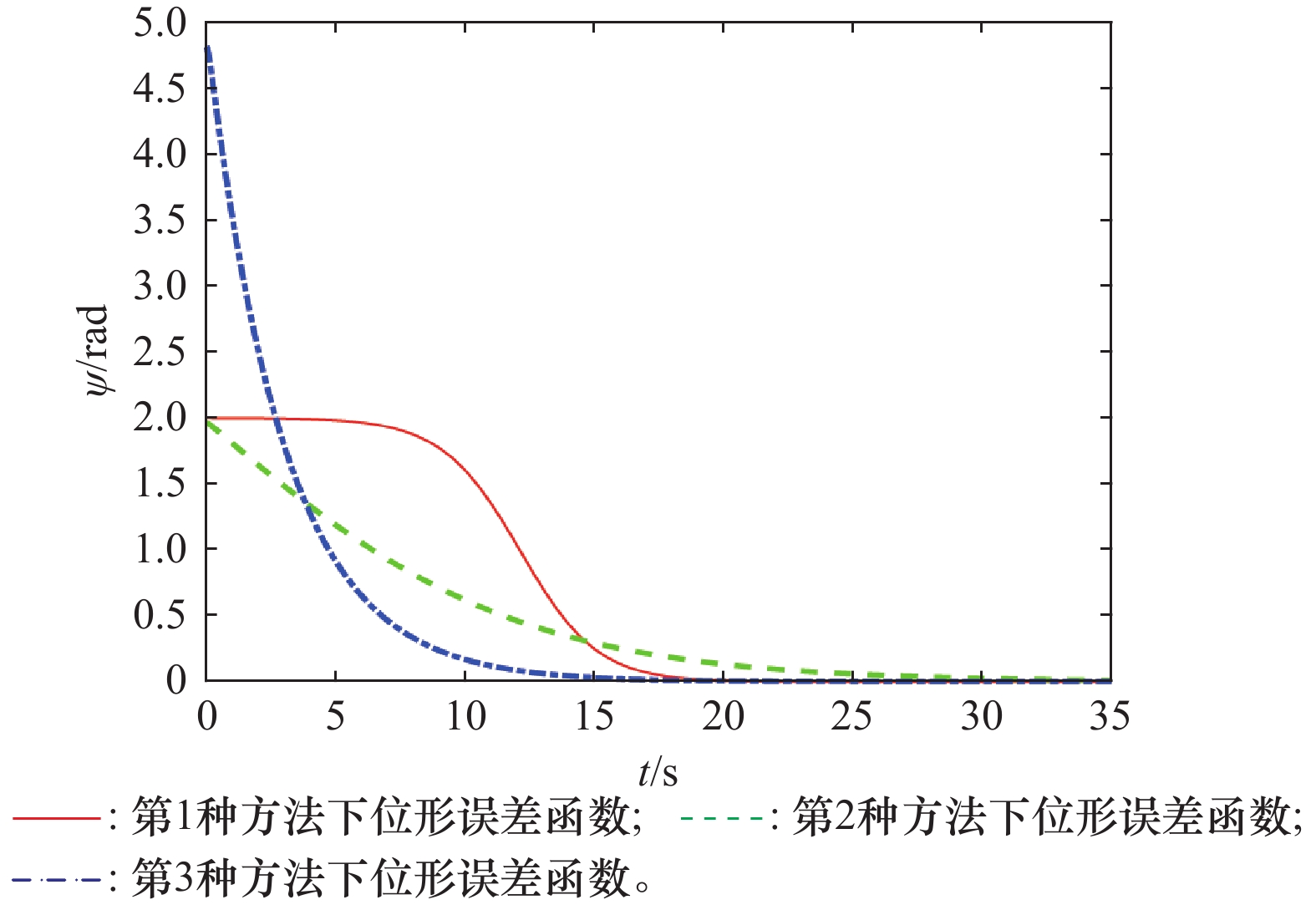
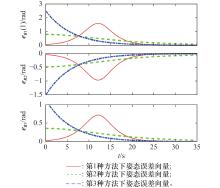
Fig.4
Curve of attitude error vector $ {{\boldsymbol{e}}_{\boldsymbol{R}}} $ changing with time"
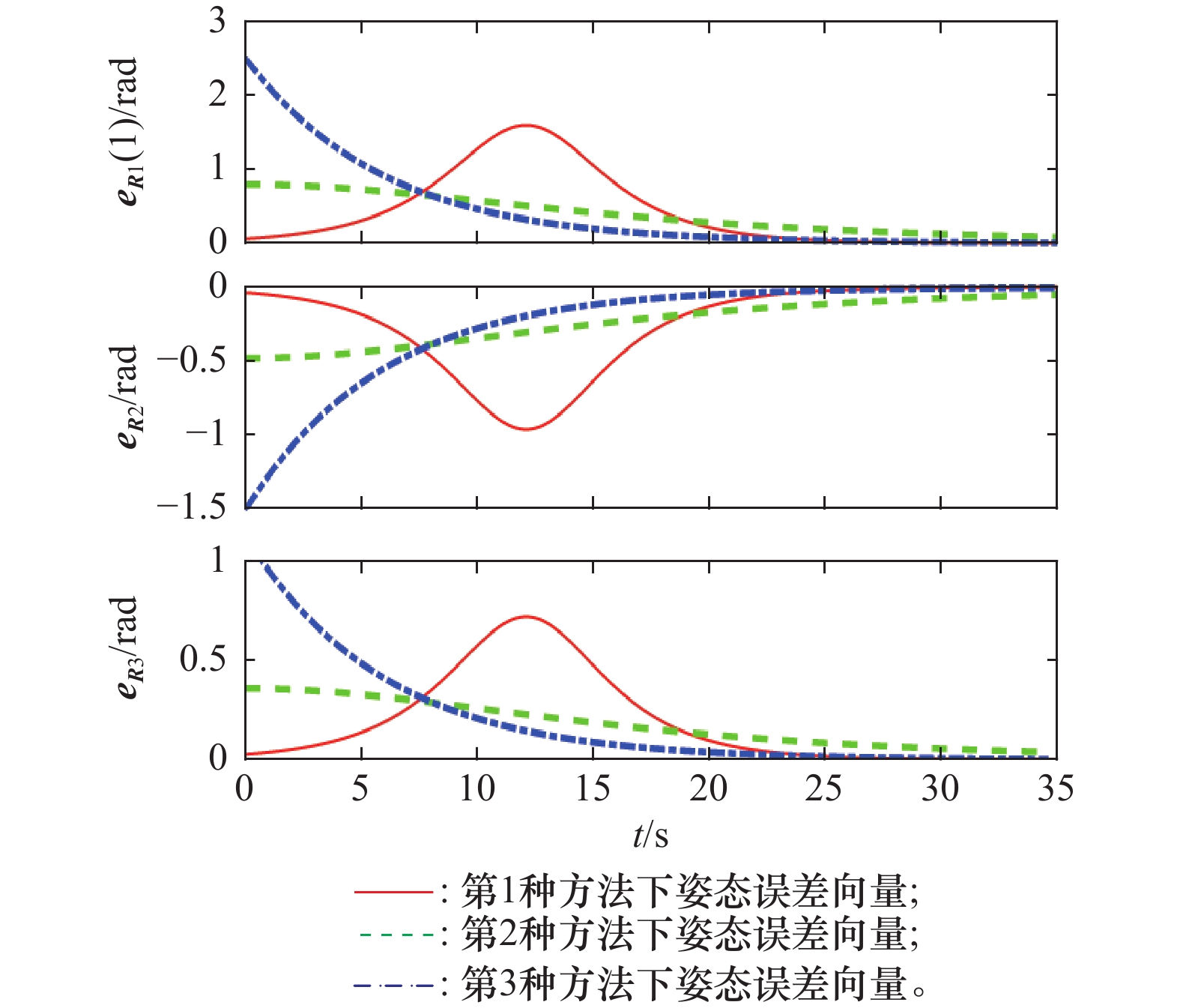
Fig.5
Angular velocity error $ {{\boldsymbol{e}}_{\boldsymbol{\varOmega }}} $ changing with time"
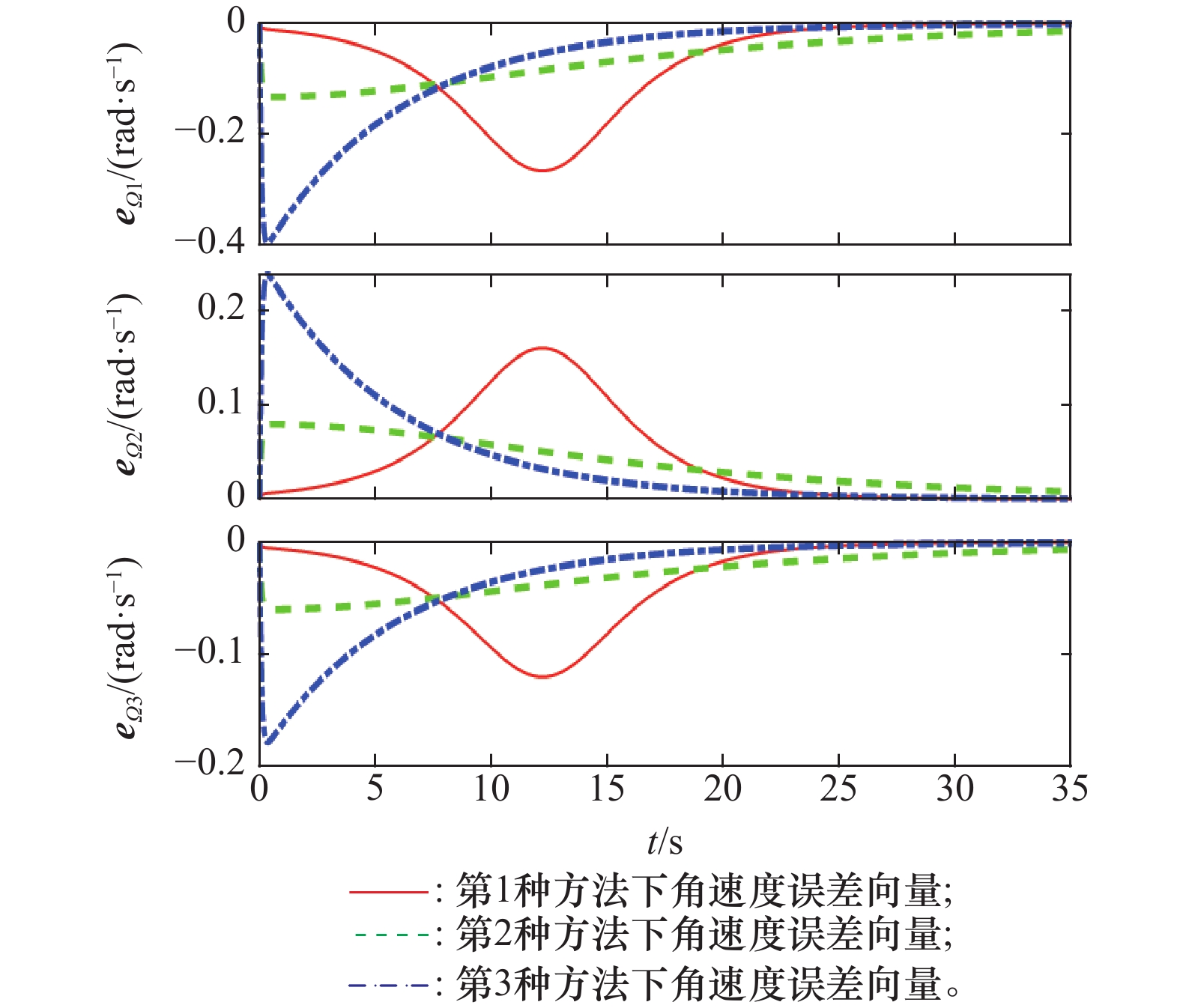
Fig.6
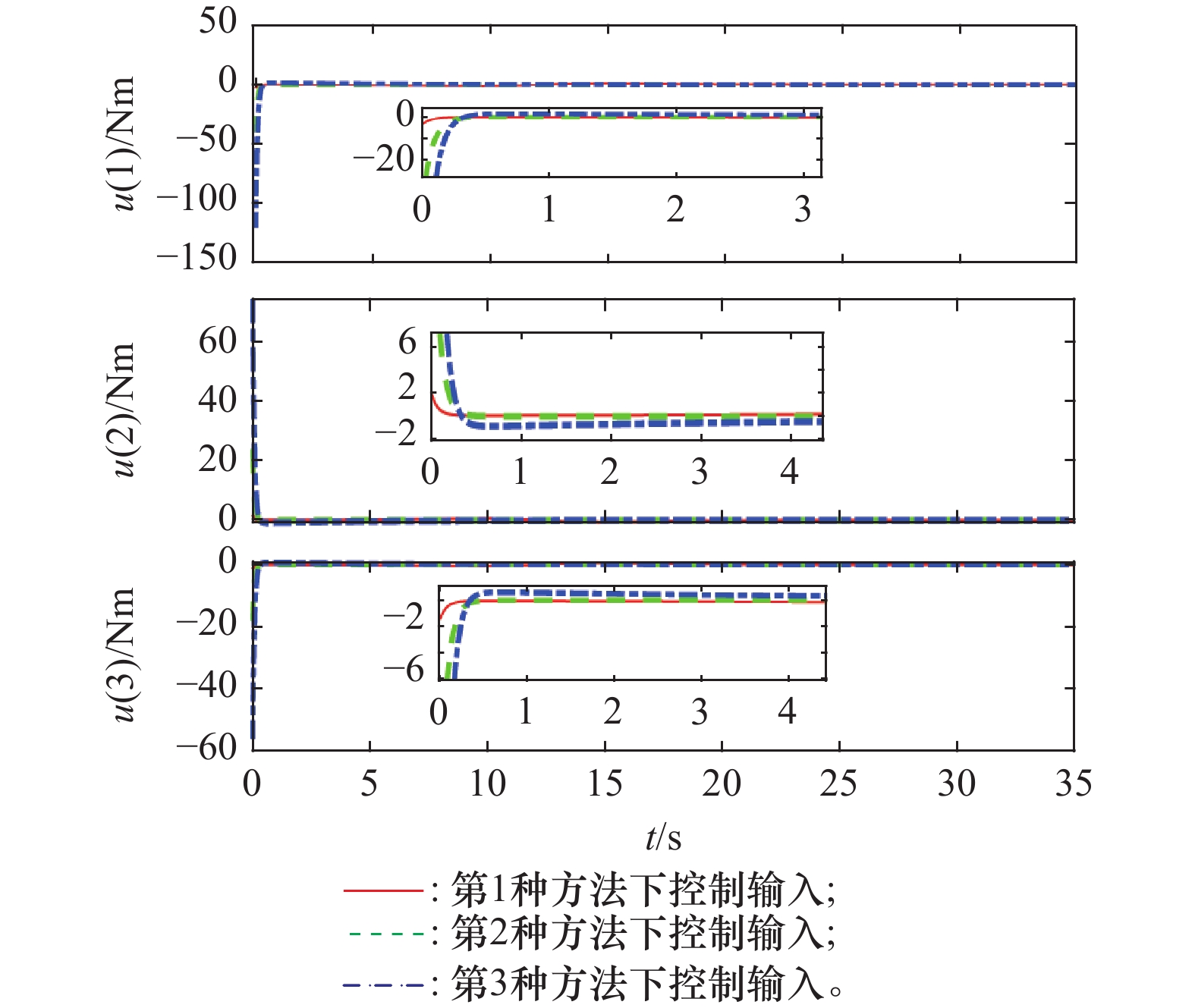
Control input $ {\boldsymbol{u}} $ changing with time"
| 1 |
WANG Y L, TANG S J, GUO J, et al. Fuzzy-logic-based fixed-time geometric backstepping control on SO(3) for spacecraft attitude tracking[J]. IEEE Trans. on Aerospace and Electronic Systems, 2019, 55 (6): 2938- 2950.
doi: 10.1109/TAES.2019.2896873 |
| 2 |
WANG Y L, HONG H C, TANG S J. Geometric control with model predictive static programming on SO(3)[J]. Acta Astronautica, 2019, 159, 471- 479.
doi: 10.1016/j.actaastro.2019.01.023 |
| 3 | 吴雨瑶, 李雪芳, 刘万泉. 全驱刚体航天器的预定时间姿态跟踪控制[J]. 控制与决策, 2025, 40 (2): 469- 478. |
| WU Y Y, LI X F, LIU W Q. Predefined-time attitude tracking control for fully actuated rigid spacecraft[J]. Control and Decision, 2025, 40 (2): 469- 478. | |
| 4 | 孟中杰, 卢俊杰. 欠驱动航天器模糊自适应增强耦合姿态控制[J]. 中国空间科学技术(中英文), 2024, 44 (4): 11- 19. |
| MENG Z J, LU J J. Fuzzy gain-adapting coupling attitude control for under-actuated spacecraft[J]. Chinese Space Science and Technology, 2024, 44 (4): 11- 19. | |
| 5 | LEE T. Exponential stability of an attitude tracking control system on SO(3) for large-angle rotational maneuvers[J]. Systems & Control Letters, 2012, 61 (1): 231- 237. |
| 6 | 肖冰, 张海朝. 航天器姿态稳定强化学习鲁棒最优控制方法[J]. 航空学报, 2024, 45 (1): 58- 72. |
| XIAO B, ZHANG H C. Reinforcement learning robust optimal control for spacecraft attitude stabilization[J]. Acta Aeronautica et Astronautica Sinica, 2024, 45 (1): 58- 72. | |
| 7 | BOOTHBY W M. An introduction to differentiable manifolds and Riemannian geometry[M]. Pittsburgh: Academic Press, 1986. |
| 8 | BULLO F, LEWIS A D. Geometric control of mechanical systems: modeling, analysis, and design for simple mechanical control systems[M]. Berlin: Springer, 2019. |
| 9 | BULLO F, MURRAY R M. Proportional derivative (PD) control on the Euclidean group[C]// Proc. of the 5th European Control Conference, 1995. |
| 10 |
BULLO F, MURRAY R M. Tracking for fully actuated mechanical systems: a geometric framework[J]. Automatica, 1999, 35 (1): 17- 34.
doi: 10.1016/S0005-1098(98)00119-8 |
| 11 | LEE T. Computational geometric mechanics and control of rigid bodies[D]. Michigan: The University of Michigan, 2008. |
| 12 | LEE T. Robust global exponential attitude tracking controls on SO(3)[C]// Proc. of the American Control Conference, 2013: 2103−2108. |
| 13 | MURRAY R M, SASTRY S S, LI Z. A mathematical introduction to robotic manipulation[M]. Boca Raton: CRC Press, 1994. |
| 14 | KODITSCHEK D E. Application of a new Lyapunov function to global adaptive attitude tracking[C]// Proc. of the IEEE 27th Conference on Decision and Control, 1988: 63−68. |
| 15 | KODITSCHEK D E. The application of total energy as a Lyapunov function for mechanical control systems[J]. Contemporary mathematics, 1989, 97, 131- 157. |
| 16 |
BERKANE S, ABDESSAMEUD A, TAYEBI A. Hybrid output feedback for attitude tracking on SO(3)[J]. IEEE Trans. on Automatic Control, 2018, 63 (11): 3956- 3963.
doi: 10.1109/TAC.2018.2808445 |
| 17 |
BERKANE S, ABDESSAMEUD A, TAYEBI A. Hybrid attitude and gyro-bias observer design on SO(3)[J]. IEEE Trans. on Automatic Control, 2017, 62 (11): 6044- 6050.
doi: 10.1109/TAC.2017.2705558 |
| 18 |
PENG X H, SUN Z Y, CHEN M, et al. Robust noncooperative attitude tracking control for rigid bodies on rotation matrices subject to input saturation constraint[J]. International Journal of Robust Nonlinear Control, 2022, 32 (3): 1583- 1603.
doi: 10.1002/rnc.5892 |
| 19 |
MAITHRIPALA D S, BERG J M. An intrinsic PID controller for mechanical systems on Lie groups[J]. Automatica, 2015, 54, 189- 200.
doi: 10.1016/j.automatica.2015.01.005 |
| 20 | GRAY A. A treatise on gyrostatics and rotational motion[M]. New York: Macmillan, 1918. |
| 21 | SCHAUB H, JUNKINS J L. Stereographic orientation parameters for attitude dynamics: a generalization of the Rodrigues parameters[J]. Journal of the Astronautical Sciences, 1996, 44 (1): 1- 19. |
| 22 |
LANG X Y, LIU X D, CHEN Z. Negative-imaginary-based spacecraft attitude tracking control using modified Rodrigues parameters[J]. Aerospace Science and Technology, 2024, 147, 109057.
doi: 10.1016/j.ast.2024.109057 |
| 23 |
YE D, ZOU A M, SUN S, et al. A predefined-time extended-state observer-based approach for velocity-free attitude control of spacecraft[J]. IEEE Trans. on Aerospace and Electronic Systems, 2023, 59 (6): 8051- 8061.
doi: 10.1109/TAES.2023.3297566 |
| 24 |
XIAO F Z, CHEN L Q. Fully actuated systems in terms of quaternions for spacecraft attitude control[J]. Acta Astronautica, 2023, 209, 1- 5.
doi: 10.1016/j.actaastro.2023.04.031 |
| 25 |
KANG Z Y, SHEN Q, WU S F, et al. Attitude control of multi-spacecraft systems on SO(3) with stochastic links failure[J]. Chinese Journal of Aeronautics, 2024, 37 (3): 320- 331.
doi: 10.1016/j.cja.2023.12.019 |
| 26 | 董瑞琦. 刚体航天器的抗退绕滑模姿态控制[D]. 哈尔滨: 哈尔滨工业大学, 2021. |
| DONG R Q. Anti-unwinding sliding mode attitude control for rigid spacecraft[D]. Harbin: Harbin Institute of Technology, 2021. | |
| 27 | BHAT S P, BERNSTEIN D S. A topological obstruction to continuous global stabilization of rotational motion and the unwinding phenomenon[J]. Systems & Control Letters, 2000, 39 (1): 63- 70. |
| 28 | SHUSTER M D. A survey of attitude representations[J]. Navigation, 1993, 8 (9): 439- 517. |
| 29 |
CHATURVEDI N A, MCCLAMROCH N H, BERNSTEIN D S. Asymptotic smooth stabilization of the inverted 3-D pendulum[J]. IEEE Trans. on Automatic Control, 2009, 54 (6): 1204- 1215.
doi: 10.1109/TAC.2009.2019792 |
| 30 |
ZHUANG M L, SONG S M. Fixed-time Coordinated attitude tracking control for spacecraft formation flying considering input amplitude constraint[J]. International Journal of Control Automation and Systems., 2022, 20 (7): 2129- 2147.
doi: 10.1007/s12555-021-0366-8 |
| 31 |
GUO Y, SONG S M. Adaptive finite-time backstepping control for attitude tracking of spacecraft based on rotation matrix[J]. Chinese Journal of Aeronautics, 2014, 27 (2): 375- 382.
doi: 10.1016/j.cja.2014.02.017 |
| 32 |
SHI X N, ZHANG Y A, ZHOU D. A geometric approach for quadrotor trajectory tracking control[J]. International Journal of Control, 2015, 88 (11): 2217- 2227.
doi: 10.1080/00207179.2015.1039593 |
| 33 | 刘锦涛, 吴文海, 李静, 等. 四旋翼无人机SO(3)滑模变结构姿态控制器设计[J]. 控制与决策, 2016, 31 (6): 1057- 1064. |
| LIU J T, WU W H, LI J, et al. Sliding mode variable structure attitude controller design of quadrotor UAVs on SO(3)[J]. Control and Decision, 2016, 31 (6): 1057- 1064. |
| [1] | Zhengliang LU, Jiatong LI, Yuandong HU, Wenhe LIAO. Attitude dynamics and aerodynamic compensation control of low-orbit mass moment spacecraft [J]. Systems Engineering and Electronics, 2025, 47(6): 1975-1984. |
| [2] | Shuaihao YAN, Mingying WEI, Yongbin ZHENG. Attitude control method of air defense missile based on large command change rate [J]. Systems Engineering and Electronics, 2024, 46(7): 2465-2474. |
| [3] | Yanling LI, Feizhou LUO, Zhilei GE. Robust observer-based deep reinforcement learning for attitude stabilization of vertical takeoff and landing vehicle [J]. Systems Engineering and Electronics, 2024, 46(3): 1038-1047. |
| [4] | Yang GUI, Bochao ZHENG, Peng GAO. Sliding mode attitude control of quadrotor UAV based on NESO-LFDC [J]. Systems Engineering and Electronics, 2024, 46(3): 1075-1083. |
| [5] | Yuyu ZHAO, Chao SUO, Yuxiao WANG. Differential flatness-based tracking control method for hypersonic vehicle [J]. Systems Engineering and Electronics, 2024, 46(3): 1084-1092. |
| [6] | Tiangao ZHU, Yong LIU, Kailong LI, Renjie ZHAO. Analysis and comparison of Euler angles based-error model based on Lie groups of the strapdown inertial navigation system [J]. Systems Engineering and Electronics, 2023, 45(10): 3265-3273. |
| [7] | Dan WANG, Jinzhi LIU, Zhiqiang MEI, Jiamin LIANG. Channel capacity optimization based on IRS-aided multi-user communication system [J]. Systems Engineering and Electronics, 2022, 44(12): 3871-3879. |
| [8] | Xiaorong JING, Zhenyuan SONG, Yue LUO, Yudan MA. Design of physical layer safety scheme aided with IRS and artificial noise for MIMO communication systems [J]. Systems Engineering and Electronics, 2022, 44(10): 3266-3274. |
| [9] | Shuangshuang WANG, Chuntao LI, Zhen WANG, Zikang SU, Fei DAI. Design of carrier landing controller based on adaptive dynamic inversion [J]. Systems Engineering and Electronics, 2022, 44(1): 218-225. |
| [10] | Yang XU, Mingren HAN, Jiang SHAO, Delin LUO. Attitude antagonistic consensus control of satellite swarm system based on MRPs [J]. Systems Engineering and Electronics, 2021, 43(7): 1904-1911. |
| [11] | Zongxing LI, Rui ZHANG. Missile adaptive attitude control based on Riccati equation [J]. Systems Engineering and Electronics, 2020, 42(6): 1358-1365. |
| [12] | SHU Shi, FANG Jiancheng, ZHANG Wei, LIU Gang, QIAN Yong, ZHANG Jian, CUI Peiling. Composite compensation method to improve the image registration based on MSCMG [J]. Systems Engineering and Electronics, 2019, 41(12): 2827-2834. |
| [13] | JIA Qingxian, ZHANG Chengxi, LI Huayi, ZHANG Yingchun. A novel learning observer-based fault reconstruction for satellite actuators [J]. Systems Engineering and Electronics, 2019, 41(12): 2835-2841. |
| [14] | DONG Chaoyang, MA Mingyu, WANG Qing, ZHOU Min. Attitude cooperative control of multiple spacecraft on SO(3) with communication time-delay [J]. Systems Engineering and Electronics, 2018, 40(9): 2032-2039. |
| [15] | LYU Zheng, JIN Guang, YANG Tianshe, WU Guan, LAN Xinzhang. Multi-level health evaluation method for on orbit satellites based on reconfigurable degree#br# [J]. Systems Engineering and Electronics, 2018, 40(8): 1769-1776. |
| Viewed | ||||||
|
Full text |
|
|||||
|
Abstract |
|
|||||