Systems Engineering and Electronics ›› 2025, Vol. 47 ›› Issue (11): 3612-3625.doi: 10.12305/j.issn.1001-506X.2025.11.10
• Sensors and Signal Processing • Previous Articles
MIAA based three-dimensional millimeter-wave imaging algorithm with sparse trajectory scanning
Ruixiang FANG1,2( ), Xiaojin SHI1,*, Yunhua ZHANG1,2
- 1. National Space Science Center,Chinese Academy of Sciences,Beijing 100190,China
2. School of Electronic,Electrical and Communication Engineering,University of Chinese Academy of Sciences,Beijing 100049,China
-
Received:2025-05-12Accepted:2025-07-07Online:2025-11-25Published:2025-12-08 -
Contact:Xiaojin SHI E-mail:fangruixiang24@mails.ucas.ac.cn

CLC Number:
Cite this article
Ruixiang FANG, Xiaojin SHI, Yunhua ZHANG. MIAA based three-dimensional millimeter-wave imaging algorithm with sparse trajectory scanning[J]. Systems Engineering and Electronics, 2025, 47(11): 3612-3625.
share this article
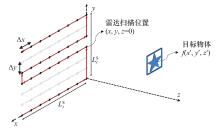
Fig.1
Geometric model of millimeter wave three-dimensional imaging with sparse trajectory scanning"
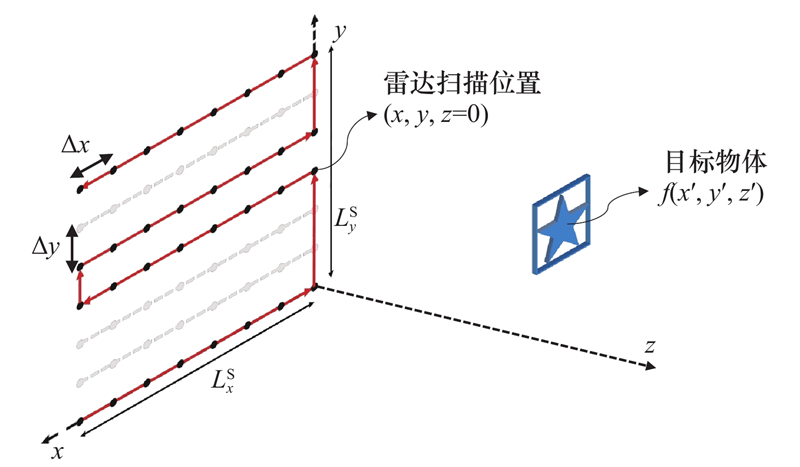
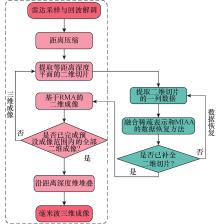
Fig.2
Flow of sparse three-dimensional imaging algorithm of FSR-MIAA"
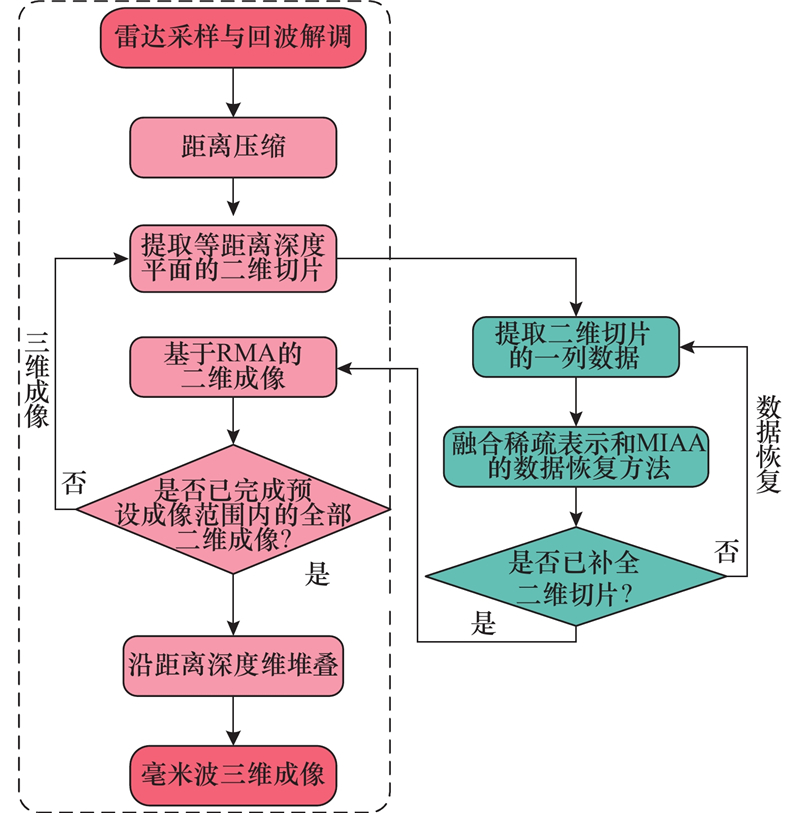
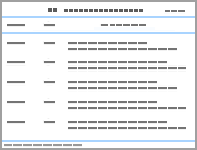
Table 1
Simulation parameters"
| 参数名称 | 数值 |
| 载波频率/GHz | 77 |
| 信号带宽/GHz | 4 |
| 水平向合成孔径/mm | 200 |
| 垂直向合成孔径/mm | 200 |
| 水平向采样间隔/mm | 2 |
| 垂直向采样间隔/mm | 2 |
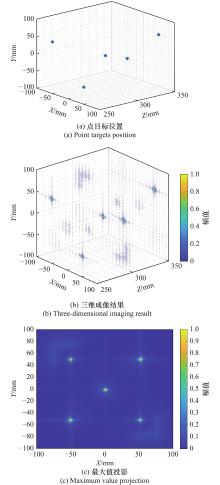
Fig.3
Simulation point targets position and imaging result at full sampling"
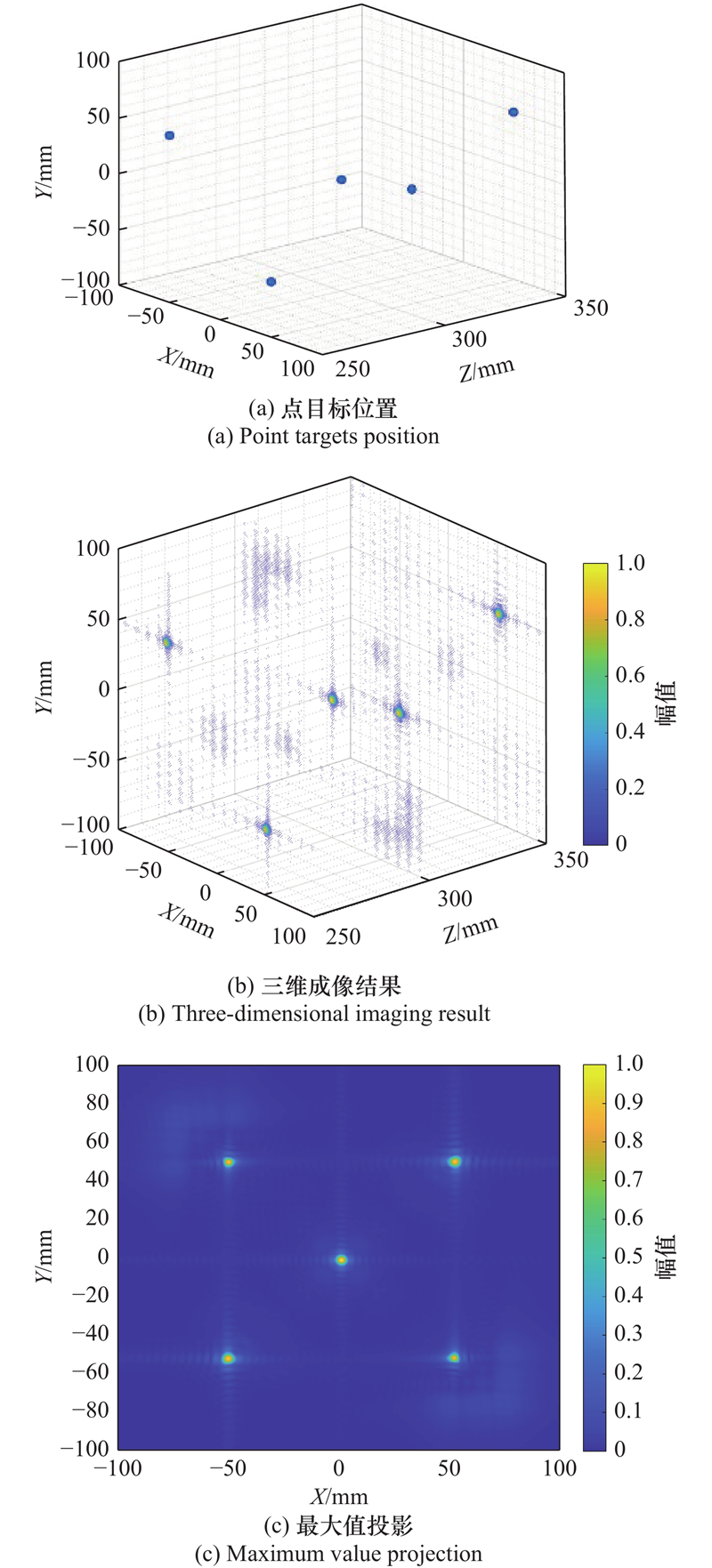
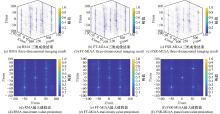
Fig.4
Point targets imaging results of different algorithms at VSSR = 30%"
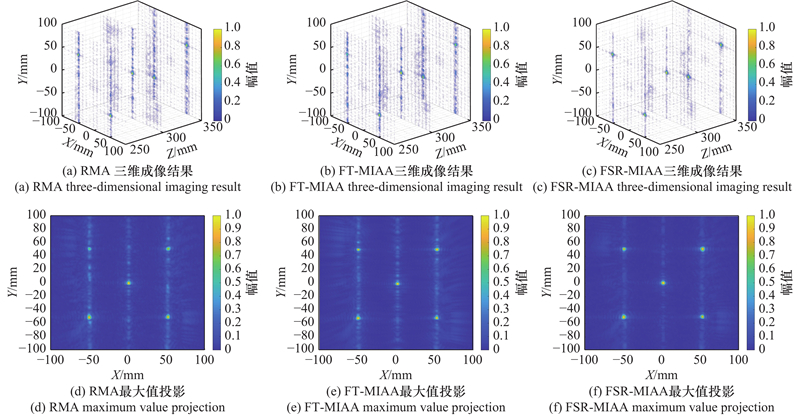
Fig.5
Vertical profile of point targets imaging at VSSR = 30%"
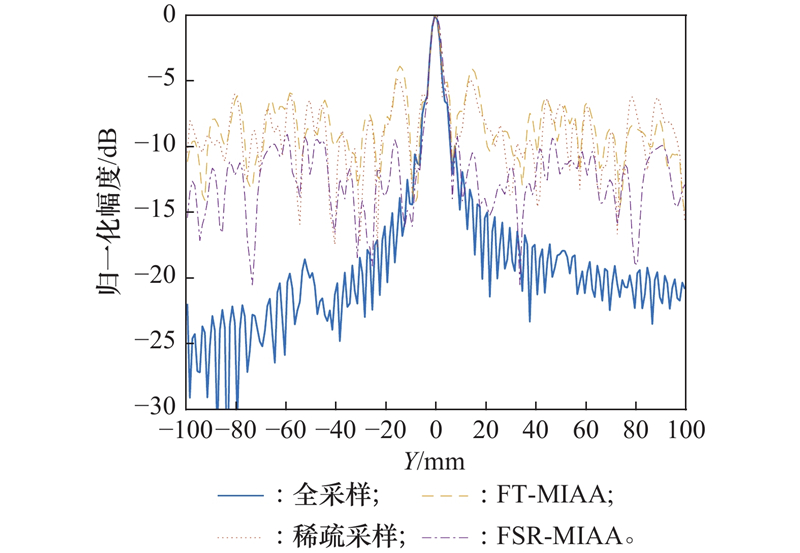
Table 2
PSLR and ISLR of point targets imaging vertical profile dB"
| 成像方法 | PSLR | ISLR |
| 全采样-RMA | −9.950 | −17.188 |
| 稀疏采样-RMA | −5.071 | 1.369 |
| FT-MIAA | −5.090 | 1.373 |
| FSR-MIAA | −9.187 | −6.901 |
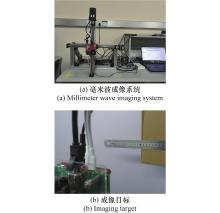
Fig.6
Millimeter wave imaging system and imaging target"
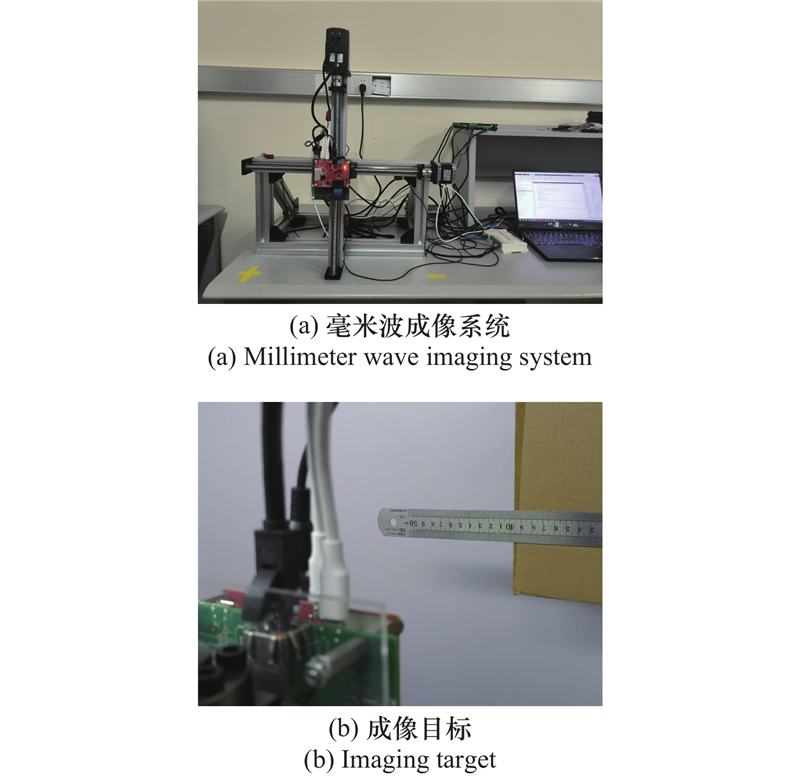
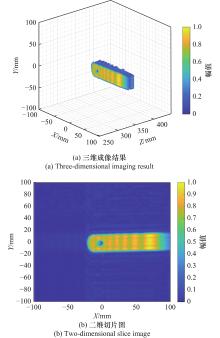
Fig.7
Imaging result of the steel ruler at full sampling"
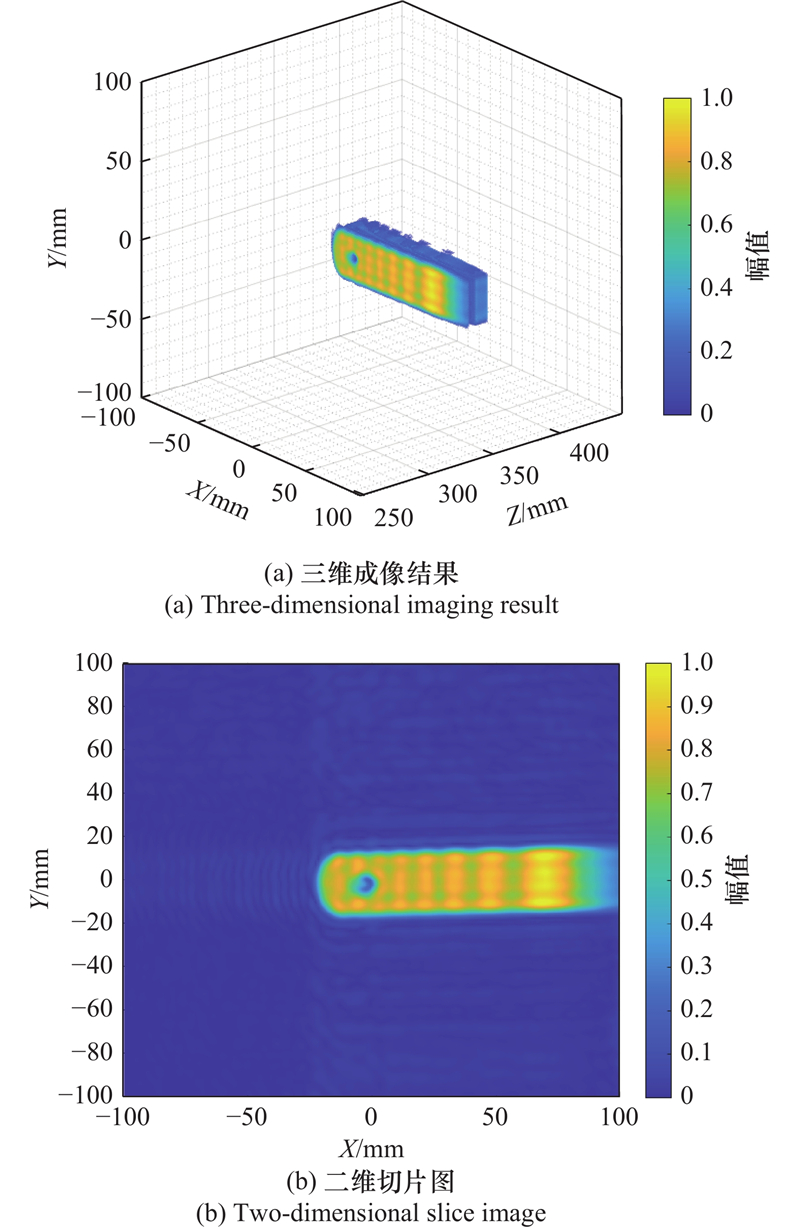
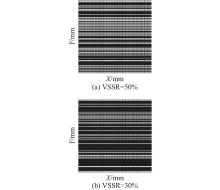
Fig.8
Sparse scanning trajectories at different VSSRs"
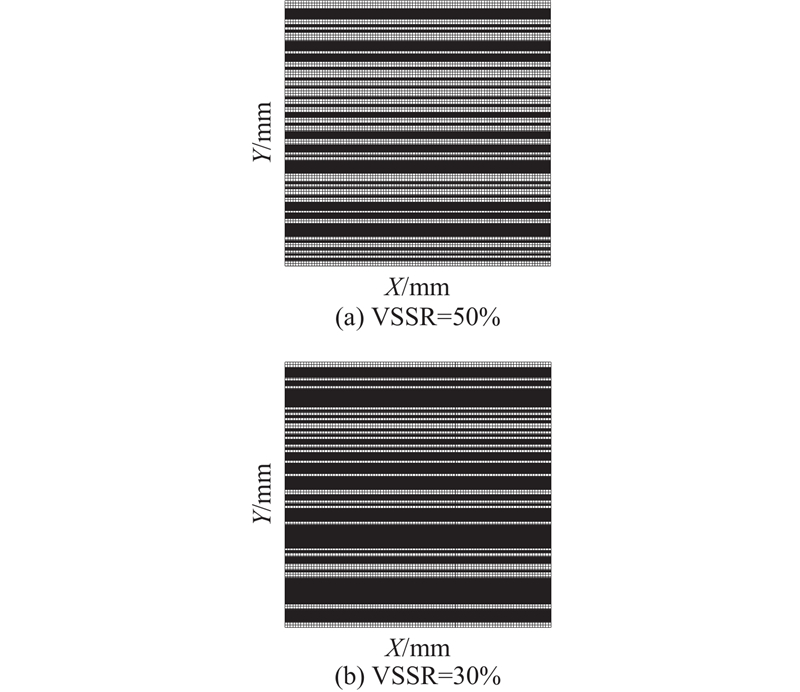
Fig.9
Imaging results of the steel ruler by different algorithms at VSSR = 50%"
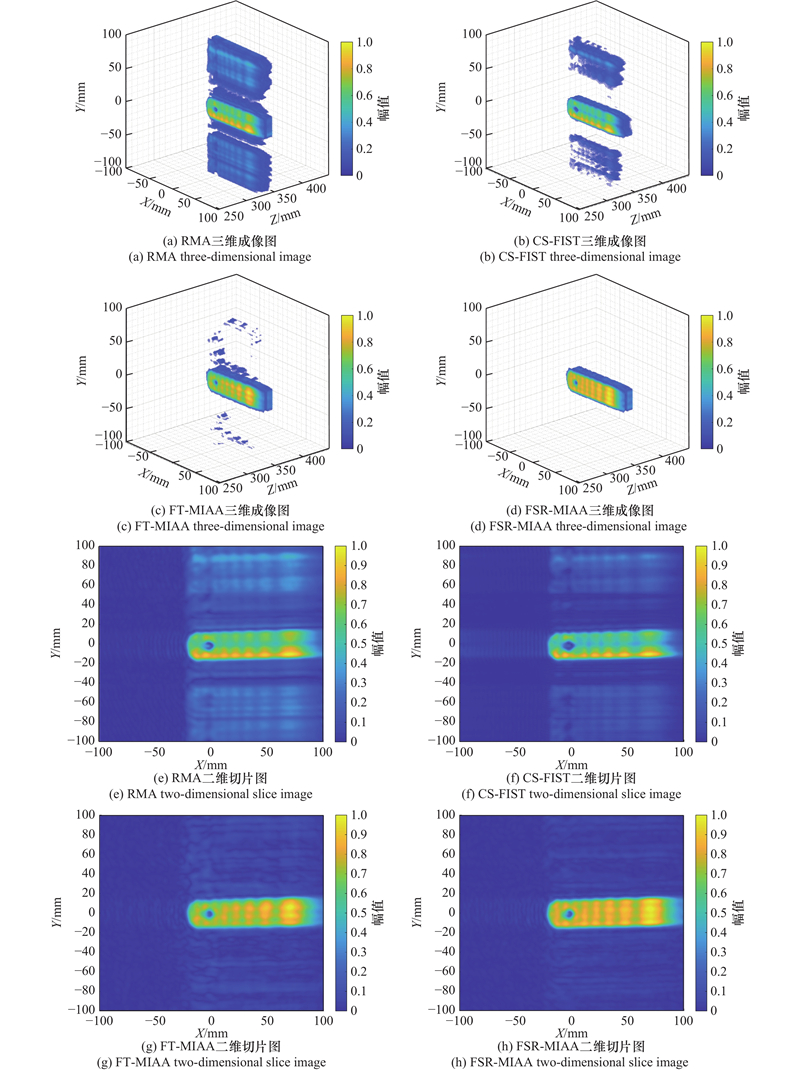
Fig.10
Imaging results of the steel ruler by different algorithms at VSSR = 30%"
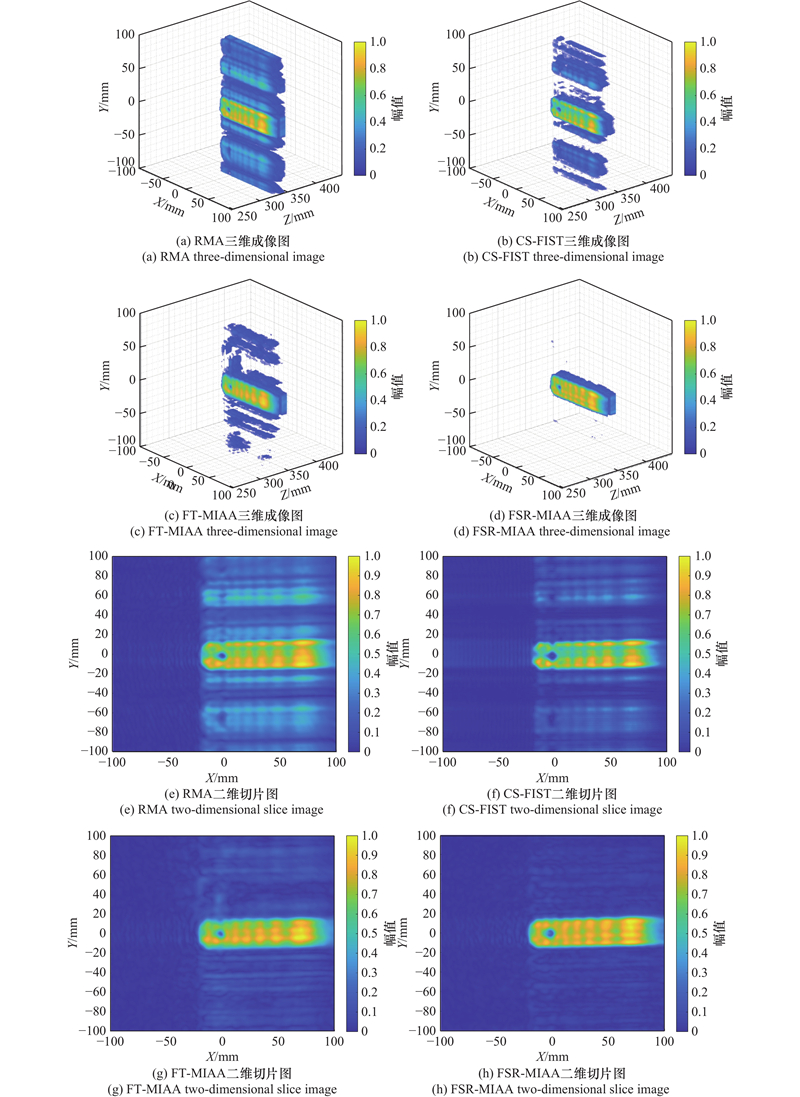
Table 3
Imaging quality indicators of the steel ruler by different algorithms"
| VSSR | 算法 | PSNR/dB | SSIM |
| 50% | RMA | 17.128 | 0.532 |
| CS-FISTA | 20.830 | 0.654 | |
| FT-MIAA | 28.287 | 0.727 | |
| FSR-MIAA | 31.493 | 0.847 | |
| 30% | RMA | 15.180 | 0.474 |
| CS-FISTA | 20.506 | 0.589 | |
| FT-MIAA | 23.741 | 0.598 | |
| FSR-MIAA | 27.695 | 0.796 |
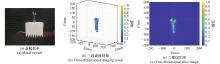
Fig.11
Imaging results of the metal wrench at full sampling"
Fig.12
Imaging results of the metal dagger at full sampling"
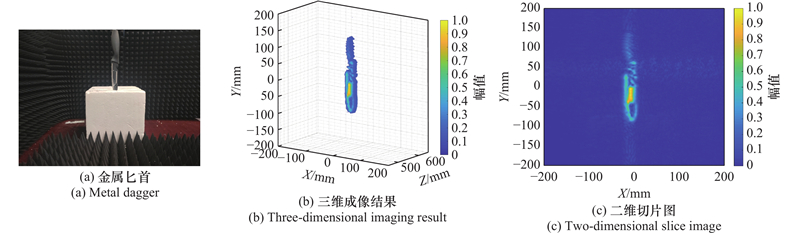
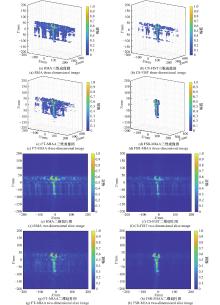
Fig.13
Imaging results of the metal wrench by different algorithms at HSSR = 30%"
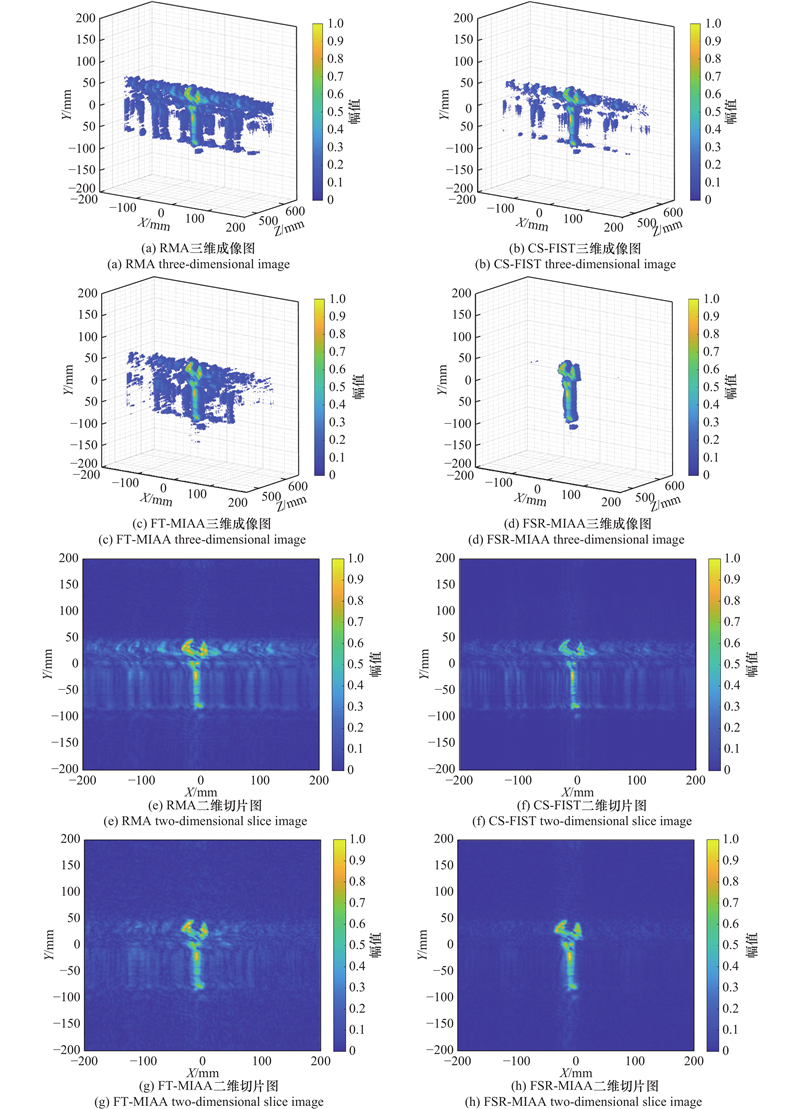
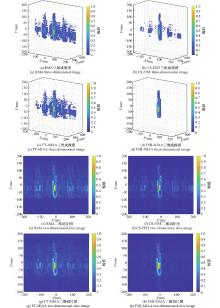
Fig.14
Imaging results of the metal dagger by different algorithms at HSSR = 30%"
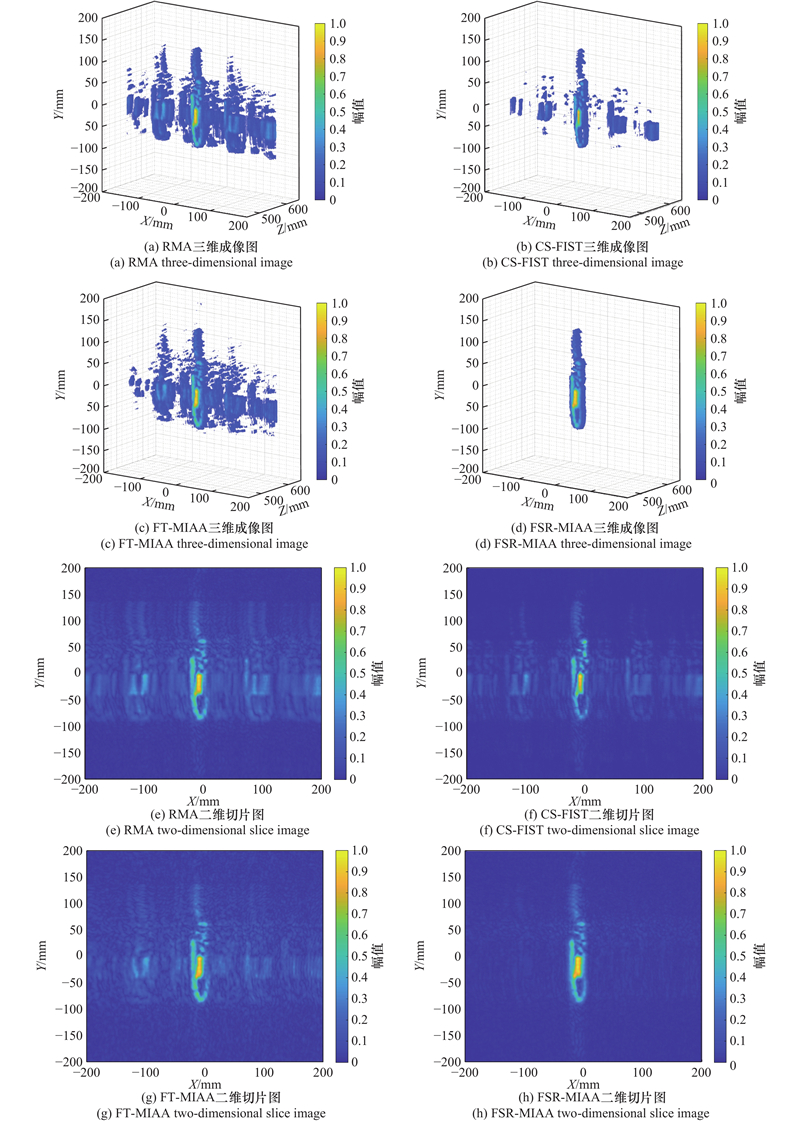
Table 4
Imaging quality indicators of different algorithms at HSSR = 30%"
| 目标 | 算法 | PSNR/dB | SSIM |
| 扳手 | RMA | 22.861 | 0.564 |
| CS-FISTA | 27.149 | 0.721 | |
| FT-MIAA | 25.375 | 0.432 | |
| FSR-MIAA | 34.776 | 0.844 | |
| 匕首 | RMA | 23.386 | 0.521 |
| CS-FISTA | 27.547 | 0.751 | |
| FT-MIAA | 24.204 | 0.406 | |
| FSR-MIAA | 35.646 | 0.834 |
| 1 | JIANG M J, XU G, PEI H, et al. 4D high-resolution imagery of point clouds for automotive mmWave radar[J]. IEEE Trans. on Intelligent Transportation Systems, 2024, 25 (1): 998- 1012. |
| 2 | 黄岩, 张慧, 兰吕鸿康, 等. 汽车毫米波雷达信号处理技术综述[J]. 雷达学报, 2023, 12 (5): 923- 970. |
| HUANG Y, ZHANG H, LAN L H K, et al. Overview of signal processing techniques for automotive millimeter-wave radar[J]. Journal of Radars, 2023, 12 (5): 923- 970. | |
| 3 | ZHANG F L, ZHANG Z B, KANG L, et al. mmTAA: a contact-less thoracoabdominal asynchrony measurement system based on mmWave sensing[J]. IEEE Trans. on Mobile Computing, 2025, 24 (2): 627- 641. |
| 4 | MUPPALA A V, SARABANDI K. Low-cost 3-D millimeter-wave concealed weapons detection using single transceiver affine synthetic arrays[J]. IEEE Trans. on Microwave Theory and Techniques, 2023, 71 (12): 5445- 5456. |
| 5 | LI S C, WU S Y. Low-cost millimeter wave frequency scanning based synthesis aperture imaging system for concealed weapon detection[J]. IEEE Trans. on Microwave Theory and Techniques, 2022, 70 (7): 3688- 3699. |
| 6 | WINGREN N, SJÖBERG D. Nondestructive testing using mm-wave sparse imaging verified for singly curved composite panels[J]. IEEE Trans. on Antennas and Propagation, 2023, 71 (1): 1185- 1189. |
| 7 | OCH A, HÖLZL P A, SCHUSTER S, et al. High-resolution millimeter-wave tomography system for nondestructive testing of low-permittivity materials[J]. IEEE Trans. on Microwave Theory and Techniques, 2021, 69 (1): 1105- 1113. |
| 8 | BEVACQUA M T, DI MEO S, CROCCO L, et al. Millimeter-waves breast cancer imaging via inverse scattering techniques[J]. IEEE Journal of Electromagnetics, RF and Microwaves in Medicine and Biology, 2021, 5 (3): 246- 253. |
| 9 | VAKALIS S, CHEN D, NANZER J A. Millimeter-wave imaging at 652 frames per second[J]. IEEE Journal of Microwaves, 2021, 1 (3): 738- 746. |
| 10 | WANG S G, LI S Y, HOORFAR A, et al. Compressive sensing-based sparse MIMO array synthesis for wideband near-field millimeter-wave imaging[J]. IEEE Trans. on Aerospace and Electronic Systems, 2023, 59 (6): 7681- 7697. |
| 11 | LIN B, LI C, JI Y C, et al. Efficient scaling techniques for 2-D sparse MIMO array far-field imaging[J]. IEEE Sensors Journal, 2024, 24 (8): 12604- 12615. |
| 12 | TU H, YU L B, WANG Z L, et al. 3-D millimeter-wave imaging for sparse MIMO array with range migration and l2-norm-reinforced sparse bayesian learning[J]. IEEE Trans. on Instrumentation and Measurement, 2025, 74 |
| 13 | YANIK M E, WANG D, TORLAK M. Development and demonstration of MIMO-SAR mmWave imaging testbeds[J]. IEEE Access, 2020, 8, 126019- 126038. |
| 14 | CHEN X, YANG Q, WANG H Q, et al. Adaptive ADMM-based high-quality fast imaging algorithm for short-range MMW MIMO-SAR systems[J]. IEEE Trans. on Antennas and Propagation, 2023, 71 (11): 8925- 8935. |
| 15 | LI Y D, ZHANG D H, GENG R X, et al. IFNet: deep imaging and focusing for handheld SAR with millimeter-wave signals[J]. IEEE Trans. on Mobile Computing, 2025, 24 (3): 2166- 2180. |
| 16 | LAVIADA J, ÁLVAREZ-NARCIANDI G, LAS-HERAS F. Artifact mitigation for high-resolution near-field SAR images by means of conditional generative adversarial networks[J]. IEEE Trans. on Instrumentation and Measurement, 2022, 71 |
| 17 | 杨磊, 霍鑫, 申瑞阳, 等. 可信推断近场稀疏综合阵列三维毫米波成像[J]. 雷达学报, 2024, 13 (5): 1092- 1108. |
| YANG L, HUO X, SHEN R Y, et al. Credible inference of near-field sparse array synthesis for three-dimensional millimeter-wave imagery[J]. Journal of Radars, 2024, 13 (5): 1092- 1108. | |
| 18 | DONOHO D L. Compressed sensing[J]. IEEE Trans. on Information Theory, 2006, 52 (4): 1289- 1306. |
| 19 | LI S Y, ZHAO G Q, SUN H J, et al. Compressive sensing imaging of 3-D object by a holographic algorithm[J]. IEEE Trans. on Antennas and Propagation, 2018, 66 (12): 7295- 7304. |
| 20 | 王谋, 韦顺军, 沈蓉, 等. 基于自学习稀疏先验的三维SAR成像方法[J]. 雷达学报, 2023, 12 (1): 36- 52. |
| WANG M, WEI S J, SHEN R, et al. 3D SAR imaging method based on learned sparse prior[J]. Journal of Radars, 2023, 12 (1): 36- 52. | |
| 21 | CANDES E J, WAKIN M B. An introduction to compressive sampling[J]. IEEE Signal Processing Magazine, 2008, 25 (2): 21- 30. |
| 22 | YARDIBI T, LI J, STOICA P, et al. Source localization and sensing: a nonparametric iterative adaptive approach based on weighted least squares[J]. IEEE Trans. on Aerospace and Electronic Systems, 2010, 46 (1): 425- 443. |
| 23 | STOICA P, LI J, LING J, et al. Missing data recovery via a nonparametric iterative adaptive approach[C]//Proc. of the IEEE International Conference on Acoustics, Speech and Signal Processing, 2009: 3369−3372. |
| 24 | WANG X Y, WANG R, DENG Y K, et al. SAR signal recovery and reconstruction in staggered mode with low oversampling factors[J]. IEEE Geoscience and Remote Sensing Letters, 2018, 15 (5): 704- 708. |
| 25 | SHEEN D M, MCMAKIN D L, HALL T E. Three-dimensional millimeter-wave imaging for concealed weapon detection[J]. IEEE Trans. on Microwave Theory and Techniques, 2001, 49 (9): 1581- 1592. |
| 26 | MENG Y, LIN C, QING A Y, et al. Accelerated holographic imaging with range stacking for linear frequency modulation radar[J]. IEEE Trans. on Microwave Theory and Techniques, 2022, 70 (3): 1630- 1638. |
| 27 | CUMMING I G, WONG F. 合成孔径雷达成像算法与实现[M]. 洪文, 胡东辉, 韩冰, 译. 北京: 电子工业出版社, 2019. |
| CUMMING I G, WONG F. Digital processing of synthetic aperture radar data: algorithms and implementation[M]. HONG W, HU D H, HAN B, trans. Beijing: Publishing House of Electronics Industry, 2019. | |
| 28 | YANIK M E, TORLAK M. Near-field MIMO-SAR millimeter-wave imaging with sparsely sampled aperture data[J]. IEEE Access, 2019, 7, 31801- 31819. |
| 29 | 保铮, 邢孟道, 王彤. 雷达成像技术[M]. 北京: 电子工业出版社, 2005. |
| BAO Z, XING M D, WANG T. Radar imaging technology[M]. Beijing: Publishing House of Electronics Industry, 2005. | |
| 30 | BECK A, TEBOULLE M. A fast iterative shrinkage-thresholding algorithm for linear inverse problems[J]. SIAM Journal on Imaging Sciences, 2009, 2 (1): 183- 202. |
| 31 | WEI S J, ZHOU Z C, WANG M, et al. 3DRIED: a high-resolution 3-D millimeter-wave radar dataset dedicated to imaging and evaluation[J]. Remote Sensing, 2021, 13 (17): 3366. |
| [1] | Qi WANG, Ziyao WANG, Junfeng ZHENG. Simulation model for radar system considering multi-source noise and signal transmission [J]. Systems Engineering and Electronics, 2025, 47(3): 768-778. |
| [2] | Chunjie ZHANG, Guanbo WANG, Qi CHEN, Zhi'an DENG. Gesture recognition based on millimeter-wave radar with pure self-attention mechanism [J]. Systems Engineering and Electronics, 2024, 46(3): 859-867. |
| [3] | Jiayi CAI, Ping CHU, Luntao ZHUANG, Zhaocheng YANG. Millimeter-wave radar body interference recognition based on spatial attribute features [J]. Systems Engineering and Electronics, 2024, 46(10): 3365-3374. |
| [4] | Hongbo TAO, Dongsheng ZHANG, Yong HUANG. Three-dimensional fast factorized back projection SAS imaging algorithm accelerated by GPU [J]. Systems Engineering and Electronics, 2024, 46(10): 3247-3256. |
| [5] | Jingyue ZHENG, Peilun WU, Jiahui CHEN, Shisheng GUO, Guolong CUI. Multipath false target analysis and elimination method for automotive millimeter wave radar [J]. Systems Engineering and Electronics, 2024, 46(1): 88-96. |
| [6] | Lei YANG, Yabo XIA, Xianhua LIAO, Xinyao MAO, Yuchen DOU, Huan YANG. Super-resolution ISAR imagery algorithm based on bi-sparsity Bayesian learning [J]. Systems Engineering and Electronics, 2023, 45(5): 1371-1379. |
| [7] | Yangliang WAN, Xingdong LIANG, Yanlei LI. Interference suppression method based on azimuth frequency domain filtering for airport millimeter-wave radar [J]. Systems Engineering and Electronics, 2022, 44(11): 3357-3363. |
| [8] | Feng RUAN, Liang GUO, Yachao LI, Ran XU. Phased array radar forward-looking imaging based on correlated imaging [J]. Systems Engineering and Electronics, 2021, 43(9): 2457-2462. |
| [9] | Yan ZHANG, Baoping WANG, Yang FANG, Zuxun SONG. Microwave 3D imaging method based on orthogonal spectrum reconstruction [J]. Systems Engineering and Electronics, 2021, 43(8): 2090-2098. |
| [10] | Jianfeng ZHANG, Yaowen FU, Wenpeng ZHANG, Wei YANG, Tao LI. Review of CSAR imaging techniques [J]. Systems Engineering and Electronics, 2020, 42(12): 2716-2734. |
| [11] | TAO Fuyu, WANG Tong, XIA Yueming. Angle Doppler compensation method and improvement approaches of non sidelooking array based on IAA [J]. Systems Engineering and Electronics, 2019, 41(2): 291-297. |
| [12] | ZHAO Yujiao, CHENG Binbin, LIU Jie, JIANG Jiqun, YU Yang. Two-dimensional sparse array topology for millimeter-wave near-field imaging [J]. Systems Engineering and Electronics, 2018, 40(9): 1926-1930. |
| [13] | WANG Jin-wei, FENG Feng, ZHAO Bo, ZHOU Feng, ZHANG Zi-jing, SHENG Qiang-qiang. Circular-SAR deception jamming based on multi-receivers [J]. Systems Engineering and Electronics, 2016, 38(4): 778-784. |
| [14] | WEN Xin, HUANG Pei-kang, NIAN Feng, YANG Yu-jie, FENG Ke-ming. Active millimeter wave near field cylindrical scanning three-dimensional imaging system [J]. Systems Engineering and Electronics, 2014, 36(6): 1044-1049. |
| [15] | WEN Cai, WANG Tong, WU Jian-xin. Direct data domain approach with iterative space-time adaptive processing [J]. Systems Engineering and Electronics, 2014, 36(5): 831-837. |
| Viewed | ||||||
|
Full text |
|
|||||
|
Abstract |
|
|||||