Systems Engineering and Electronics ›› 2026, Vol. 48 ›› Issue (6): 1991-1999.doi: 10.12305/j.issn.1001-506X.2026.06.20
• Systems Engineering • Previous Articles Next Articles
Research on target node importance evaluation based on complex network propagation characteristics
Wei LIANG, Peng SUN, Liang ZHAO
- Information and Navigation College,Air Force Engineering University,Xi’an 710077,China
-
Received:2025-01-06Revised:2025-02-26Online:2026-06-25Published:2025-05-20 -
Contact:Wei LIANG

CLC Number:
Cite this article
Wei LIANG, Peng SUN, Liang ZHAO. Research on target node importance evaluation based on complex network propagation characteristics[J]. Systems Engineering and Electronics, 2026, 48(6): 1991-1999.
share this article
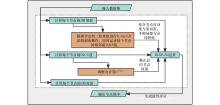
Fig.1
Introduction to the principle component analysis of the IKSP-2D method"
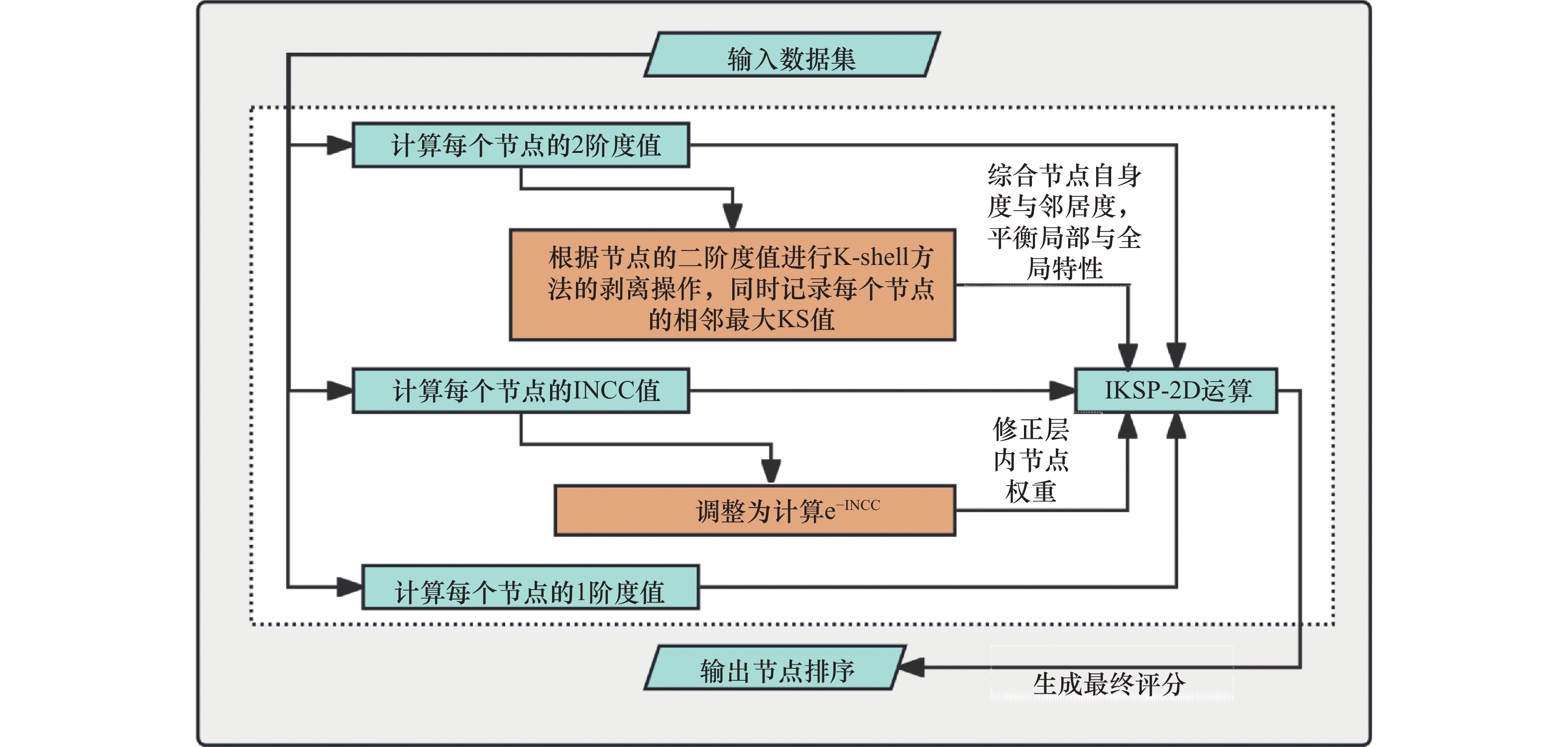
Fig.2
Shows the effect diagram of SIR propagation experiment on BC, CI, and IKSP-2D methods"

Table 1
Distinguishes the propagation mechanisms"
| 维度 | 病毒传播 (SIR模型) | 本文方法(IKSP-2D) |
| 传播驱动力 | 动态感染率(β)与 恢复率(γ) | 静态网络拓扑结构(度、结构洞、 层间差异) |
| 反馈机制 | 无需反馈, 单向传播 | 无动态反馈,依赖结构特征的 间接“反馈”(如INCC修正权重) |
| 适用场景 | 实时传播模拟 (如疫情预测) | 关键节点预筛选(如网络加固、传播 源头控制) |
| 传播驱动力 | 动态感染率(β)与 恢复率(γ) | 静态网络拓扑结构(度、结构洞、 层间差异) |
| 计算复杂度 | 高(需多次仿真, 时间复杂度 | 低(单次结构分析,时间复杂度 |
Table 2
Scale 103-104 Specific parameters of the real network"
| 数据集名称 | 节点 | 边数 | 平均度 | 图密度/% | 聚类系数/% |
| Infect-hyper | 113 | 17.35 | 53.48 | ||
| Infect-dublin | 410 | 1.65 | 45.58 | ||
| DD244 | 291 | 822 | 0.97 | 51.59 | |
| Infect-euroroad | 0.10 | 1.67 | |||
| Mammalia-dophin- florida-social | 151 | 6.86 | 78.82 |
Table 3
Top 10 nodes ranking of the Inf-euroroad network"
| 节点 重要度 | DC | CI | BC | K-shell | HC | CC | IKSP-2D | ISM | CR |
| 1 | 284 | 7 | 402 | 181 | 401 | 401 | 284 | 284 | 157 |
| 2 | 236 | 43 | 284 | 499 | 7 | 402 | 848 | 7 | 950 |
| 3 | 107 | 284 | 277 | 180 | 402 | 403 | 847 | 107 | 544 |
| 4 | 137 | 499 | 453 | 454 | 453 | 432 | 405 | 137 | 187 |
| 5 | 39 | 107 | 452 | 7 | 411 | 404 | 43 | 120 | |
| 6 | 7 | 401 | 403 | 234 | 253 | 253 | 310 | 401 | 541 |
| 7 | 401 | 137 | 401 | 179 | 403 | 452 | 297 | 39 | |
| 8 | 181 | 39 | 404 | 107 | 232 | 404 | 296 | 236 | 673 |
| 9 | 499 | 236 | 837 | 673 | 400 | 232 | 291 | 499 | 700 |
| 10 | 141 | 181 | 836 | 541 | 452 | 284 | 285 | 181 | 121 |
Table 4
Top 10 nodes ranking of the Mammalia-dophin-florida-social network"
| 节点 重要度 | DC | CI | BC | K-shell | HC | CC | IKSP-2D | ISM | CR |
| 1 | 116 | 116 | 111 | 124 | 116 | 116 | 48 | 24 | 4 |
| 2 | 111 | 111 | 116 | 119 | 111 | 111 | 3 | 3 | 101 |
| 3 | 119 | 119 | 3 | 118 | 24 | 119 | 118 | 61 | 66 |
| 4 | 24 | 24 | 43 | 108 | 119 | 24 | 32 | 101 | 40 |
| 5 | 63 | 63 | 119 | 148 | 63 | 63 | 94 | 56 | 111 |
| 6 | 3 | 3 | 23 | 101 | 3 | 3 | 108 | 4 | 3 |
| 7 | 101 | 101 | 146 | 98 | 146 | 146 | 124 | 116 | 2 |
| 8 | 129 | 129 | 48 | 94 | 101 | 61 | 67 | 40 | 99 |
| 9 | 61 | 61 | 32 | 89 | 129 | 101 | 28 | 32 | 70 |
| 10 | 146 | 146 | 24 | 67 | 61 | 129 | 146 | 89 | 63 |
Table 5
Top 10 nodes ranking of the Infect-dublin network"
| 节点 重要度 | DC | CI | BC | K-shell | HC | CC | IKSP-2D | ISM | CR |
| 1 | 157 | 157 | 274 | 410 | 157 | 274 | 183 | 157 | 2 |
| 2 | 304 | 304 | 304 | 380 | 274 | 157 | 12 | 304 | 50 |
| 3 | 372 | 148 | 157 | 362 | 304 | 243 | 200 | 372 | 222 |
| 4 | 148 | 372 | 243 | 343 | 333 | 333 | 7 | 274 | 300 |
| 5 | 314 | 333 | 333 | 291 | 243 | 1 | 193 | 333 | 111 |
| 6 | 217 | 314 | 30 | 286 | 148 | 304 | 148 | 314 | 90 |
| 7 | 282 | 282 | 212 | 283 | 1 | 150 | 372 | 217 | 99 |
| 8 | 60 | 274 | 148 | 239 | 372 | 297 | 270 | 305 | 7 |
| 9 | 286 | 217 | 297 | 235 | 150 | 30 | 74 | 150 | 9 |
| 10 | 333 | 210 | 218 | 182 | 314 | 305 | 201 | 318 | 200 |
Table 6
Top 10 nodes ranking of the Infect-hyper network"
| 节点 重要度 | DC | CI | BC | K-shell | HC | CC | IKSP-2D | ISM | CR |
| 1 | 30 | 30 | 30 | 40 | 30 | 30 | 112 | 30 | 30 |
| 2 | 42 | 42 | 42 | 113 | 42 | 42 | 64 | 102 | 33 |
| 3 | 38 | 38 | 33 | 106 | 38 | 38 | 82 | 38 | 9 |
| 4 | 102 | 102 | 38 | 102 | 102 | 102 | 11 | 42 | 3 |
| 5 | 33 | 33 | 102 | 65 | 33 | 33 | 78 | 33 | 8 |
| 6 | 48 | 48 | 12 | 48 | 48 | 48 | 103 | 48 | 40 |
| 7 | 34 | 34 | 48 | 43 | 34 | 34 | 45 | 106 | 1 |
| 8 | 12 | 12 | 34 | 42 | 12 | 12 | 37 | 34 | 44 |
| 9 | 9 | 9 | 106 | 38 | 9 | 9 | 29 | 93 | 66 |
| 10 | 106 | 106 | 9 | 34 | 106 | 106 | 73 | 1 | 88 |
Table 7
Top 10 nodes ranking of the DD244 network"
| 节点 重要度 | DC | CI | BC | K-shell | HC | CC | IKSP-2D | ISM | CR |
| 1 | 134 | 134 | 208 | 165 | 146 | 206 | 127 | 162 | 7 |
| 2 | 16 | 162 | 210 | 115 | 204 | 204 | 9 | 134 | 5 |
| 3 | 271 | 55 | 286 | 241 | 110 | 144 | 6 | 81 | 77 |
| 4 | 87 | 81 | 259 | 78 | 206 | 146 | 11 | 102 | 8 |
| 5 | 126 | 102 | 244 | 77 | 144 | 259 | 191 | 110 | 4 |
| 6 | 55 | 87 | 110 | 136 | 162 | 110 | 234 | 55 | 66 |
| 7 | 102 | 12 | 60 | 87 | 259 | 203 | 72 | 204 | 3 |
| 8 | 81 | 136 | 38 | 55 | 244 | 205 | 95 | 146 | 70 |
| 9 | 15 | 15 | 206 | 56 | 147 | 244 | 16 | 87 | 99 |
| 10 | 76 | 76 | 204 | 41 | 107 | 286 | 10 | 147 | 100 |
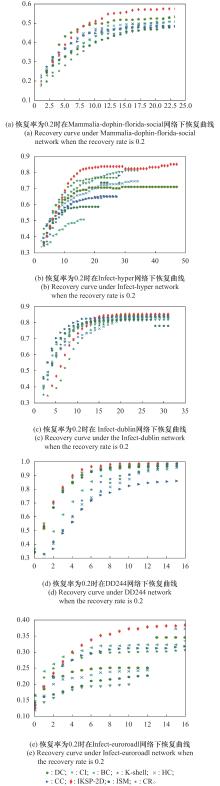
Fig.3
Results of each data when a response rate is 0.2"
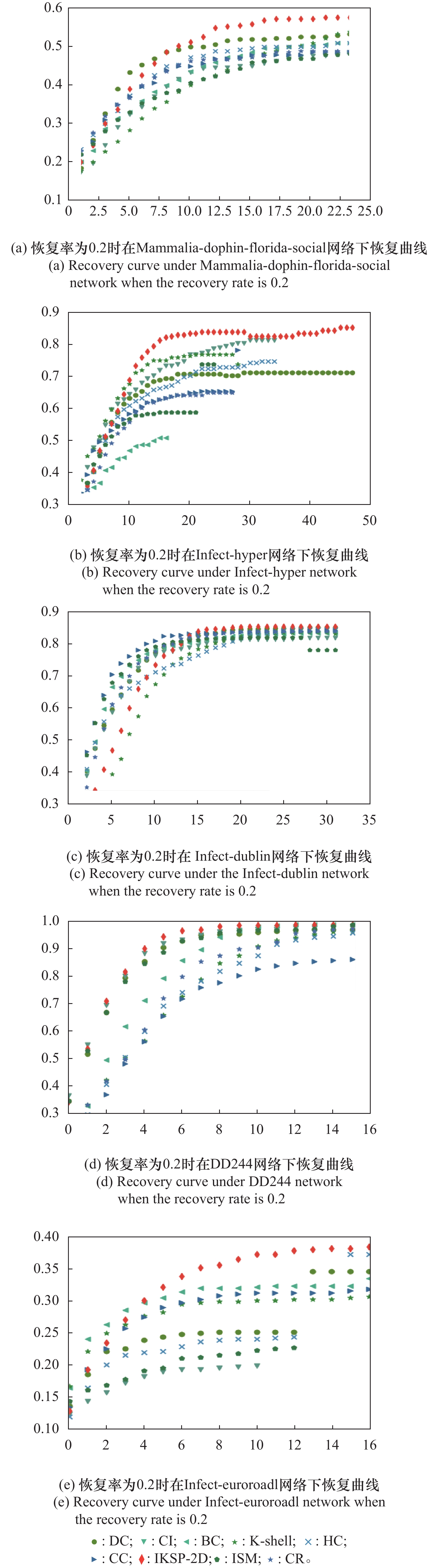
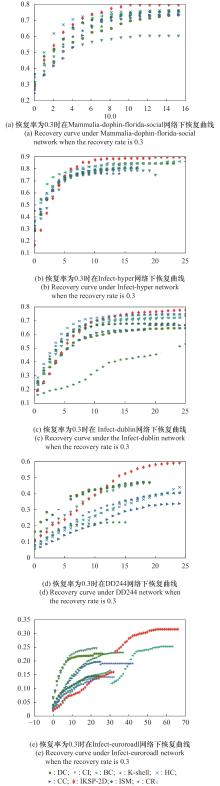
Fig.4
Results of each data with a response rate of 0.3"
| 1 |
ZHANG Y H, LU Y L, YANG G Z, et al. Multi-attribute decision-making method for node importance metric in complex network[J]. Applied Sciences, 2022, 12 (4): 1944- 1957.
doi: 10.3390/app12041944 |
| 2 | KANG R, MOU R L, LI L L, et al. Critical path identification and destructive resistance study of aircraft field taxiing[J]. Journal of Chongqing University of Technology (Natural Science), 2024, 38 (2): 32- 44. |
| 3 |
CAI X N, ZHENG Z T. Evaluation of node importance in complex networks based on improved random walk[J]. Operations Research and Fuzziology, 2023, 13 (1): 329- 340.
doi: 10.12677/ORF.2023.131036 |
| 4 |
YAN H Z, FENG Y, ZHANG W Q, et al. Research on overlapping community detection algorithm of label propagation based on node pair extension[J]. Journal of Physics: Conference Series, 2024, 2898, 012036- 012041.
doi: 10.1088/1742-6596/2898/1/012036 |
| 5 |
ZHAO J, SONG Y T, LIU F, et al. The identification of influential nodes based on structure similarity[J]. Connection Science, 2020, 33 (2): 201- 218.
doi: 10.1080/09540091.2020.1806203 |
| 6 |
WANG B, ZHANG J K, DAI J Y, et al. Influential nodes identification using network local structural properties[J]. Scientific Reports, 2022, 12 (1): 1833- 1845.
doi: 10.1038/s41598-022-05564-6 |
| 7 |
LI Z, HUANG X Y. Identifying influential spreaders by gravity model considering multi-characteristics of nodes[J]. Scientific Reports, 2022, 12 (1): 9879- 9889.
doi: 10.1038/s41598-022-14005-3 |
| 8 |
YANG M, SUN H, GENG S Y. On the quantitative resilience assessment of complex engineered systems[J]. Process Safety and Environmental Protection, 2023, 174, 941- 950.
doi: 10.1016/j.psep.2023.05.019 |
| 9 |
杨琦, 张雅妮, 周雨晴, 等. 复杂网络理论及其在公共交通韧性领域的应用综述[J]. 中国公路学报, 2022, 35 (4): 215- 229.
doi: 10.3969/j.issn.1001-7372.2022.04.018 |
|
YANG Q, ZHANG Y N, ZHOU Y Q, et al. Review of complex network theory and its application in the field of public transport resilience[J]. Highway Journal of China, 2022, 35 (4): 215- 229.
doi: 10.3969/j.issn.1001-7372.2022.04.018 |
|
| 10 | 倪顺江. 基于复杂网络理论的传染病动力学建模与研究[D]. 北京: 清华大学, 2009. |
| NI S J. Modeling and study of infectious disease dynamics based on complex network theory [D]. Beijing: Tsinghua University, 2009. | |
| 11 |
YANG H H, AN S. Robustness evaluation for multi-subnet composited complex network of urban public transport[J]. Alexandria Engineering Journal, 2021, 60 (2): 2065- 2074.
doi: 10.1016/j.aej.2020.12.016 |
| 12 |
SUN J. Combat network link prediction based on embedding learning[J]. Journal of Systems Engineering and Electronics, 2022, 33 (2): 345- 353.
doi: 10.23919/JSEE.2022.000036 |
| 13 |
张嗣瀛. 复杂系统、复杂网络自相似结构的涌现规律[J]. 复杂系统与复杂性科学, 2006, 3 (4): 41- 51.
doi: 10.3969/j.issn.1672-3813.2006.04.006 |
|
ZHANG S Y. The emergence law of the self-similarity structure of complex systems and complex networks[J]. Complex Systems and Complexity Science, 2006, 3 (4): 41- 51.
doi: 10.3969/j.issn.1672-3813.2006.04.006 |
|
| 14 | 卫婧. 基于复杂网络拓扑结构软件系统可靠性研究[D]. 西安: 西安电子科技大学, 2018. |
| WEI J. Study on system reliability of software based on complex network topology structure [D]. Xi’an: Xidian University, 2018. | |
| 15 |
BARABASI A L, GULBAHCE N. Network medicine: a network-based approach to human disease[J]. Nature Reviews Genetics, 2011, 12 (1): 56- 68.
doi: 10.1038/nrg2918 |
| 16 | ZHU P C, ZHI Y, GUO Y M, et al. Analysis of epidemic spreading process in adaptive networks[J]. IEEE Trans. on Circuits and Systems II: Express Briefs, 2019, 66 (7): 1252- 1256. |
| 17 |
CSERMELY P, KORCSMAROS T, KISS H J M, et al. Structure and dynamics of molecular networks: a novel paradigm of drug discovery a comprehensive review[J]. Pharmacology & Therapeutics, 2013, 138 (3): 333- 408.
doi: 10.1016/j.pharmthera.2013.01.016 |
| 18 |
XU W Z, LI T, LIANG W F, et al. Identifying structural hole spanners to maximally block information propagation[J]. Information Sciences, 2019, 505, 100- 126.
doi: 10.1016/j.ins.2019.07.072 |
| 19 | MAO Z F, JIANG S F. Review of engineering change[J]. Light Industry Machinery, 2015, 33 (4): 106- 110. |
| 20 | 周中月. 基于复杂网络的谣言溯源技术研究[D]. 乌鲁木齐: 新疆师范大学, 2021. |
| ZHOU Z Y. Research on rumor traceability technology based on complex network [D]. Wulumuqi: Xinjiang Normal University, 2021. | |
| 21 | 王爱华, 李辉. 网络黑产犯罪的复杂结构识别与精准治理探究—基于复杂网络理论的分析[J]. 中国人民公安大学学报(社会科学版), 2022, 38 (5): 9- 18. |
| WANG A H, LI H. Exploration on the complex structure identification and accurate governance of network black production crime—analysis based on complex network theory[J]. Journal of People’s Public Security University of China (Social Science Edition), 2022, 38 (5): 9- 18. | |
| 22 |
CASTELLANO N G, CERQUETI R, FRANCES B M. Evaluating risks-based communities of Mafia companies: a complex networks perspective[J]. Review of Quantitative Finance and Accounting, 2021, 57 (4): 1463- 1486.
doi: 10.1007/s11156-021-00984-3 |
| 23 |
SPADON G, SCABORA L C, OLIVEIRA P H, et al. Behavioral characterization of criminality spread in cities[J]. Procedia Computer Science, 2017, 108, 2537- 2541.
doi: 10.1016/j.procs.2017.05.118 |
| 24 |
LI Y, WEI L S, LIU J L, et al. Secure state estimation for complex networks with multi-channel oriented round robin protocol[J]. Nonlinear Analysis: Hybrid Systems, 2023, 49, 101371- 101385.
doi: 10.1016/j.nahs.2023.101371 |
| 25 |
ZHANG H W, MI Y, FU Y M, et al. Security defense decision method based on potential differential game for complex networks[J]. Computers & Security, 2023, 129, 103187- 103197.
doi: 10.1016/j.cose.2023.103187 |
| 26 |
WU H Y, LIU Q S. Secure synchronization for multiple coupled complex networks with time-varying delays under DoS attacks[J]. International Journal of Control, 2023, 97 (11): 2526- 2538.
doi: 10.1080/00207179.2023.2284254 |
| 27 | 李柳池. 空管运行复杂安全网络理论模型构建研究[D]. 德阳: 中国民用航空飞行学院, 2023. |
| LI L C. Research on the theoretical model construction of complex safety network in air traffic control operation [D]. Deyang: The Civil Aviation Flight Academy of China, 2023. | |
| 28 |
AMREEN A, TANVIR A, MUSHEER A, et al. A complex network-based approach for security and governance in the smart green city[J]. Expert Systems with Applications, 2022, 214, 119094- 119105.
doi: 10.1016/j.eswa.2022.119094 |
| 29 | MA J L, XIANG T T, ZHAO Y B. Epidemic spreading dynamics on two-layer complex networks[J]. International Journal of Modern Physics C: Computational Physics & Physical Computation, 2024, 35(3): 2450023. |
| 30 | 阮逸润, 老松杨, 汤俊, 等. 基于引力方法的复杂网 络 节 点 重 要 度 评 估 方[J]. 物 理 学报, 2022, 71 (17): 298- 309. |
| RUAN Y R, LAO S Y, TANG J, et al. Assessment of node importance in complex networks based on gravitational methods[J]. Journal of Physics, 2022, 71 (17): 298- 309. | |
| 31 |
尹梦梦, 王磊, 姚昌华, 等. 基于 VIKOR 模型的复杂网络节点重要度评估[J]. 信息网络安全, 2022, 22 (1): 87- 94.
doi: 10.3969/j.issn.1671-1122.2022.01.011 |
|
YIN M M, WANG L, YAO C H, et al. Assessment of node importance in complex networks based on the VIKOR model[J]. Information Network Security, 2022, 22 (1): 87- 94.
doi: 10.3969/j.issn.1671-1122.2022.01.011 |
|
| 32 | 李世魁. 基于复杂网络拓扑结构的重要节点识别方法研究 [D]. 兰州: 兰州交通大学, 2022. |
| LI S K. Research on the important node identification method based on complex network topology [D]. Lanzhou: Lanzhou Jiaotong University, 2022. | |
| 33 |
CAO B W, GUAN G, SHEN S L, et al. Dynamical behaviors of a delayed SIR information propagation model with forced silence function and control measures in complex networks[J]. The European Physical Journal Plus, 2023, 138 (5): 402- 406.
doi: 10.1140/epjp/s13360-023-04005-1 |
| 34 | KIM H S, BEZNOSOV K, YONEKI E. Finding influential neighbors to maximize information diffusion in twitter[C]//Proc. of the 23rd International Conference on World Wide Web, 2014: 701−706. |
| [1] | Xueting HAO, Zhigeng FANG, Ankang JIANG, Jingru ZHANG, Yunke SUN. Method of effectiveness evaluation for anti-missile system of systems based on node importance [J]. Systems Engineering and Electronics, 2026, 48(2): 569-577. |
| [2] | Jintao YU, Qiaolin HU, Bing XIAO, Po GAO, Yanting TAO. Important nodes recognition in the network of air combat system-of-system based on kill chain [J]. Systems Engineering and Electronics, 2026, 48(1): 257-264. |
| [3] | Han ZHANG, Qiang WANG, Guilong MIN. Aviation safety risk early warning model based on mean field theory [J]. Systems Engineering and Electronics, 2025, 47(1): 210-216. |
| [4] | Tingyu ZHANG, Ying ZENG, Nan LI, Hongzhong HUANG. Spacecraft power-signal composite network optimization algorithm based on DRL [J]. Systems Engineering and Electronics, 2024, 46(9): 3060-3069. |
| [5] | Dijiu YUE, Jianhua LI, Zhe WANG. Node importance measurement method of command information system for resilience [J]. Systems Engineering and Electronics, 2024, 46(4): 1320-1329. |
| [6] | Jintao YU, Bing XIAO, Jiajun XIONG. Network damage maximization algorithm based on topology potential [J]. Systems Engineering and Electronics, 2023, 45(9): 2812-2818. |
| [7] | Bingxue ZHANG, Xisheng LI, Jia YOU, Weiren SONG. End-edge collaborative network generation algorithm based on node composite characteristics [J]. Systems Engineering and Electronics, 2023, 45(8): 2588-2596. |
| [8] | Changjiang QIN, Keyu WU, Qing CHENG, Jincai HUANG. Node importance evaluation in dynamic system based on kill-web contribution rate [J]. Systems Engineering and Electronics, 2023, 45(6): 1732-1742. |
| [9] | Tong HUANG, Qinhe GAO, Zhihao LIU, Dong WANG, Dong MA, Lei GAO. Topological properties of launch platform anti-damage network based on complex network theory [J]. Systems Engineering and Electronics, 2023, 45(10): 3157-3164. |
| [10] | Cong WANG, Huiliang SHEN, Yongxiang XIA, Guanghan BAI, Yining FANG. Analysis of critical nodes in equipment support system [J]. Systems Engineering and Electronics, 2022, 44(10): 3134-3142. |
| [11] | Yantao WANG, Zheng YANG. Propagation and control improvement of flight operation risk network [J]. Systems Engineering and Electronics, 2021, 43(9): 2544-2552. |
| [12] | Kexin BI, Minggong WU, Wenbin ZHANG, Xiangxi WEN, Kan DU. Modeling and analysis of flight conflict network based onvelocity obstacle method [J]. Systems Engineering and Electronics, 2021, 43(8): 2163-2173. |
| [13] | Ang LI, Dangmin NIE, Xiangxi WEN, Zekun WANG, Chengxiu YANG. Operation situation assessment of control system based on interdependent network and SVM [J]. Systems Engineering and Electronics, 2021, 43(5): 1287-1294. |
| [14] | Lingfeng GU, Ming HE, Guoyou CHEN, Minhui JI, Jintao LIU. Research on unmanned aerial vehicle swarm system resilience [J]. Systems Engineering and Electronics, 2021, 43(1): 156-162. |
| [15] | LI Jiawei, WU Minggong, WEN Xiangxi, LIU Fei. Identifying key nodes and edges of complex networks based on the minimum connected dominating set [J]. Systems Engineering and Electronics, 2019, 41(11): 2541-2549. |
| Viewed | ||||||
|
Full text |
|
|||||
|
Abstract |
|
|||||