Systems Engineering and Electronics ›› 2025, Vol. 47 ›› Issue (12): 4012-4023.doi: 10.12305/j.issn.1001-506X.2025.12.02
• Electronic Technology • Previous Articles
Constant false alarm rate detection method for self-supervised feature similarity representation
Houhong XIANG1,*, Hongwei MA2, Haijun YU1, Yufeng CHEN3, Fengyu WANG4, Xiaolu ZENG5
- 1. School of Computer and Information,Hefei University of Technology,Hefei 230009,China
2. Beijing Institute of Radio Measurement,Beijing 100854,China
3. Hangzhou Institute of Technology,Xidian University,Hangzhou 311200,China
4. School of Artificial Intelligence,Beijing University of Posts and Telecommunications,Beijing 100876,China
5. School of Information and Electronics,Beijing Institute of Technology,Beijing 100081,China
-
Received:2024-11-13Revised:2025-02-19Online:2025-04-14Published:2025-04-14 -
Contact:Houhong XIANG

CLC Number:
Cite this article
Houhong XIANG, Hongwei MA, Haijun YU, Yufeng CHEN, Fengyu WANG, Xiaolu ZENG. Constant false alarm rate detection method for self-supervised feature similarity representation[J]. Systems Engineering and Electronics, 2025, 47(12): 4012-4023.
share this article
Fig.1
Block diagram of CFAR detection method for self-supervised feature similarity representation"
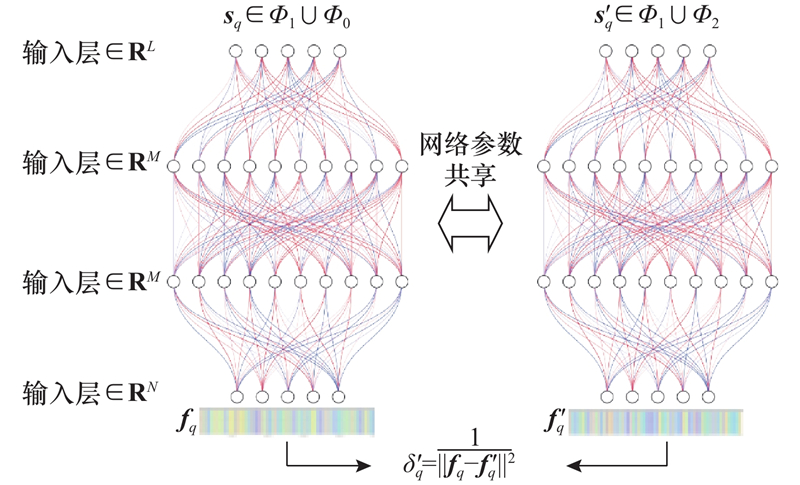
Fig.2
Histogram of the probability and cumulative probability distributions of error parameters for target-free space datas"
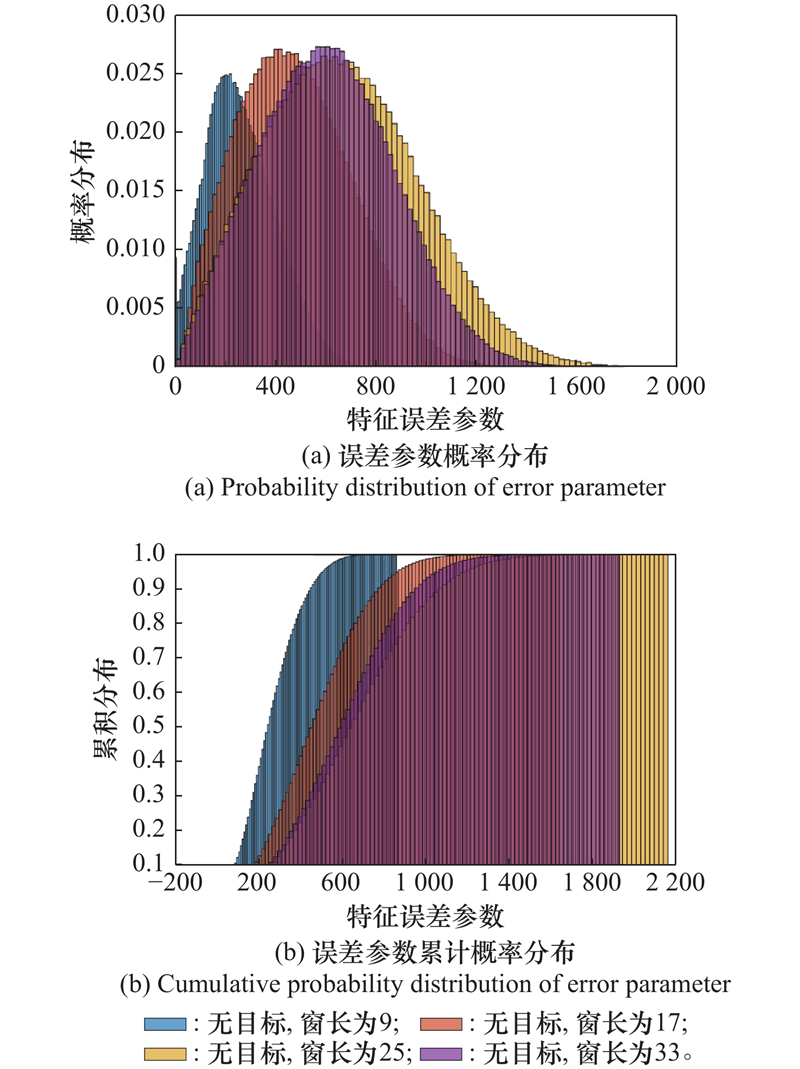
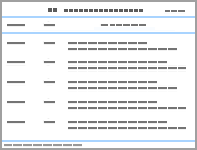
Table 1
CFAR detection threshold of error parameter $ \delta $ with different false alarm probabilities"
| 窗长l0 | pfa | |||||
| 10−1 | 10−2 | 10−3 | 10−4 | 10−5 | 10−6 | |
| 9 | 90.79 | 15.64 | 0.45 | 0.07 | 0.02 | 0.01 |
| 17 | 188.70 | 66.19 | 27.61 | 10.92 | 0.46 | 0.06 |
| 25 | 270.96 | 84.79 | 26.06 | 8.13 | 1.95 | 0.11 |
| 33 | 259.99 | 82.76 | 25.64 | 7.30 | 2.17 | 0.08 |
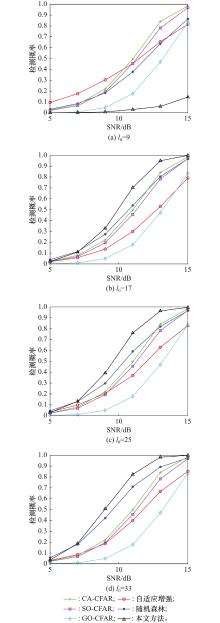
Fig.3
Relationship curve of detection probability versus SNR for different window lengths (pfa = 10?4)"
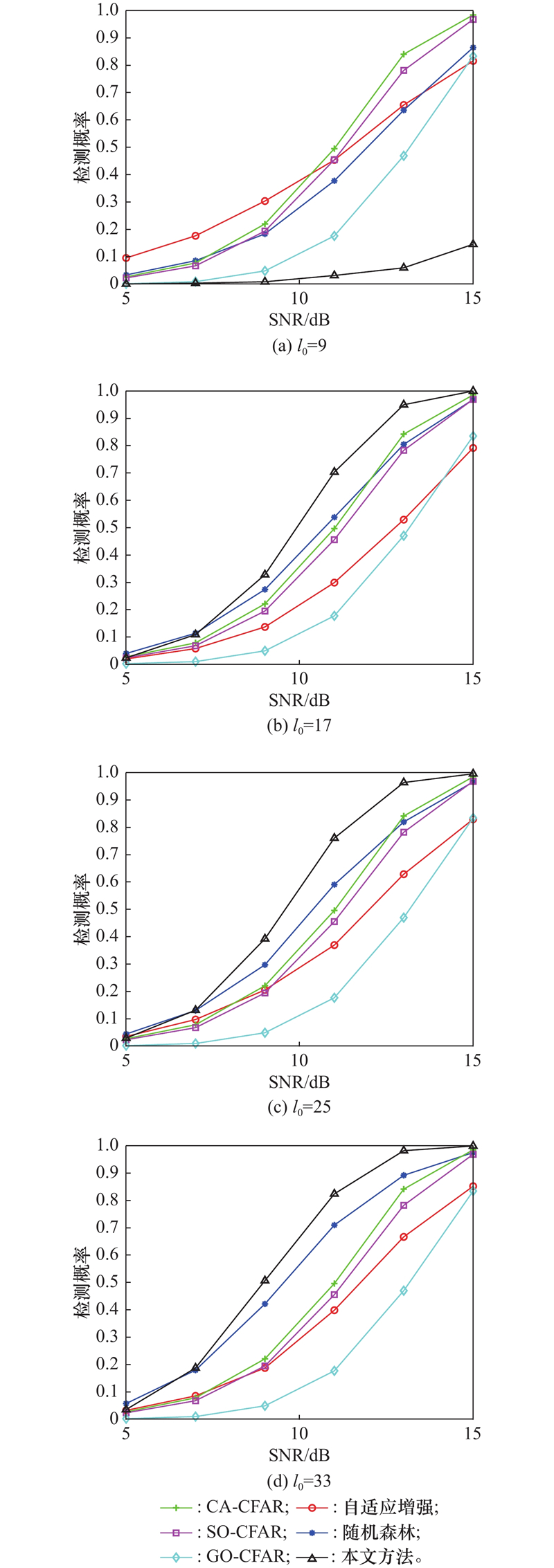

Fig.4
Processing results of l0 = 25 (pfa = 10?6)"

Fig.5
Relationship curve of detection probability versus mismatched SNR for different window lengths (pfa = 10?4)"
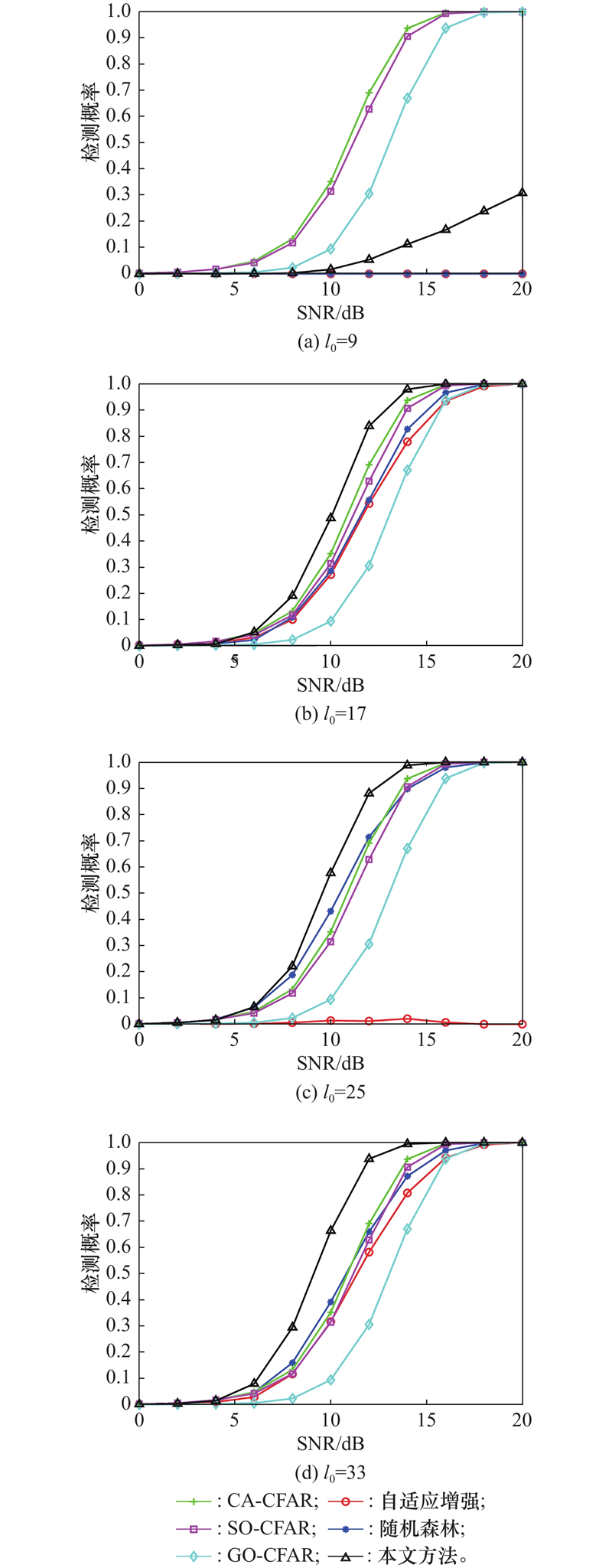
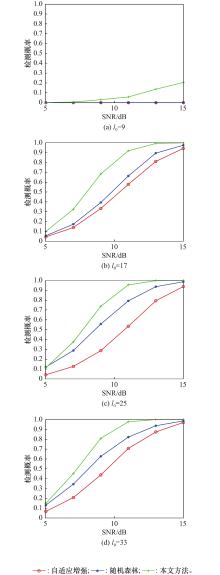
Fig.6
Relationship curve of detection probability versus SNR with unknown noise distribution for different window lengths (pfa = 10?4)"
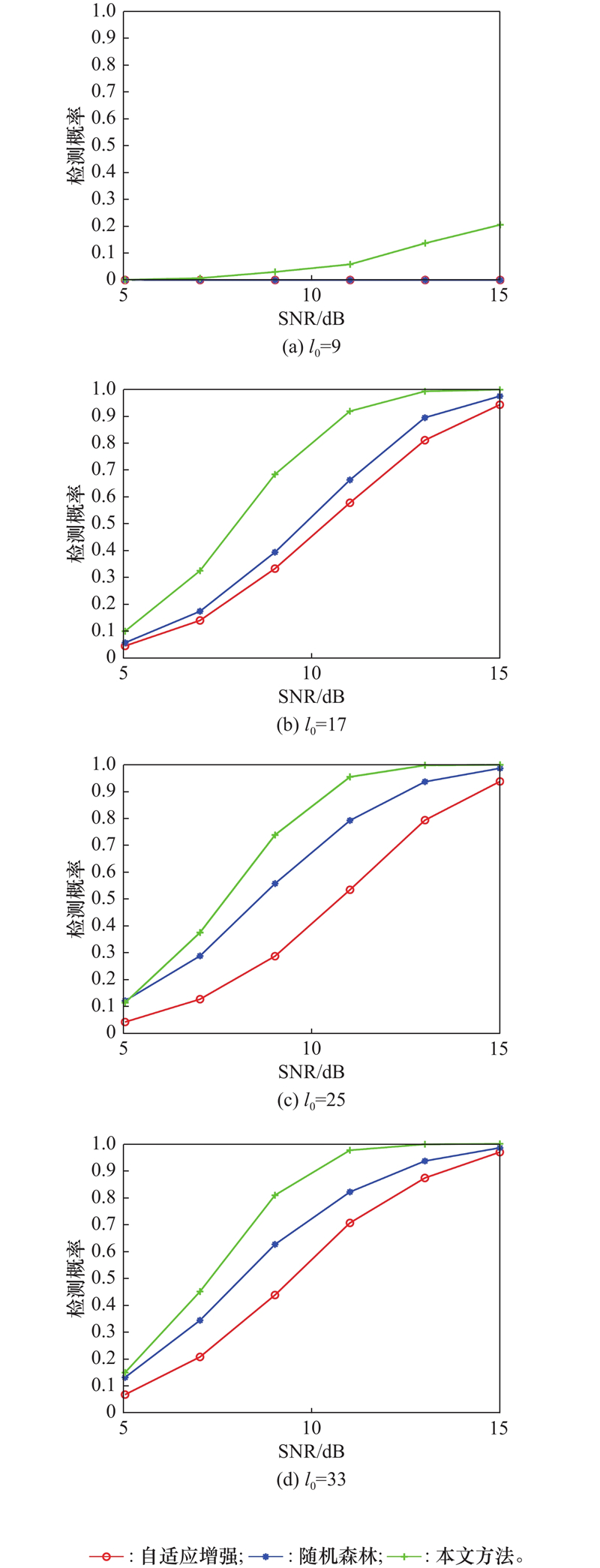
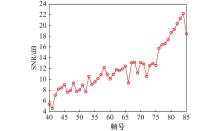
Fig.7
SNR parameter variation curve"
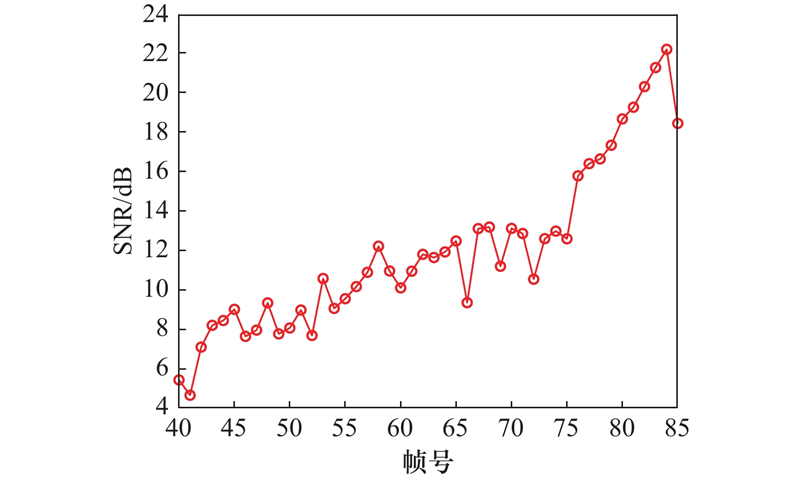
Table 2
CFAR detection threshold of the proposed method for feature error $ \delta $ under the CFAR condition for X-band radar"
| 虚警概率pfa | 检测门限 |
| 10−1 | 55.24 |
| 10−2 | 19.94 |
| 10−3 | 6.26 |
| 10−4 | 1.26 |

Fig.8
Analysis of CFAR processing results for measured X-band radar data"

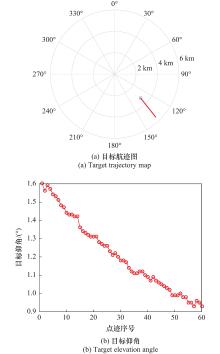
Fig.9
Target trajectory information"
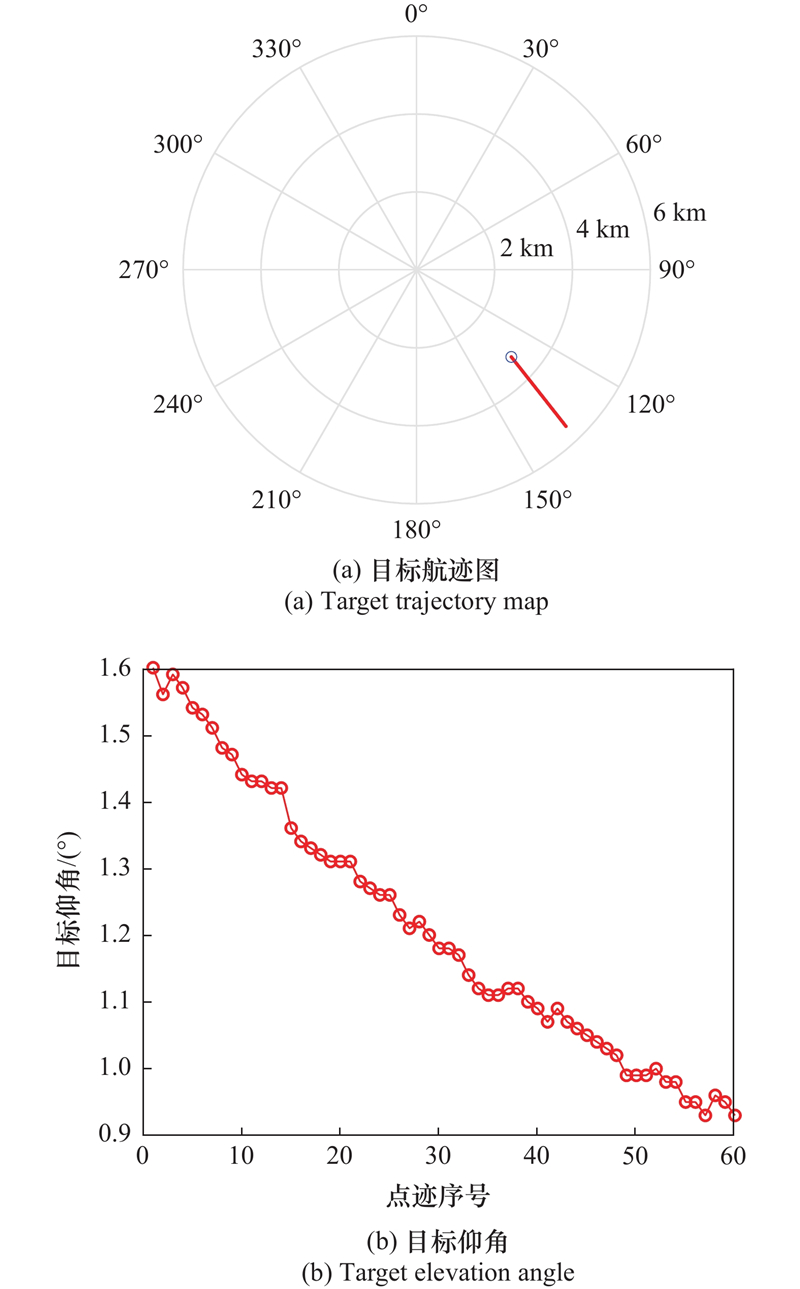
Table 3
CFAR detection threshold of the proposed method for feature error $ \delta $ under the CFAR condition for S-band radar"
| 虚警概率pfa | 检测门限 |
| 10−1 | 50.17 |
| 10−2 | 17.02 |
| 10−3 | 7.15 |
| 10−4 | 3.85 |

Fig.10
Analysis of CFAR processing results for measured S-band radar data"

| 1 |
马越, 缪晨, 张若愚, 等. “低慢小”无人机雷达探测研究与展望[J]. 国防科技, 2023, 44 (5): 60- 66.
doi: 10.13943/j.issn1671-4547.2023.05.08 |
|
MA Y, MIAO C, ZHANG R Y, et al. Current status and future prospects of research on radar detection of “low, slow and small” drones[J]. National Defense Technology, 2023, 44 (5): 60- 66.
doi: 10.13943/j.issn1671-4547.2023.05.08 |
|
| 2 |
胥凤驰, 王伟, 李哲, 等. 水面无人艇系统的设计实现与未来展望[J]. 舰船科学技术, 2019, 41 (12): 39- 43.
doi: 10.3404/j.issn.1672-7649.2019.12.009 |
|
XU F C, WANG W, LI Z, et al. Design and realization of unmanned surface vessel system and its future prospects[J]. Ship Science and Technology, 2019, 41 (12): 39- 43.
doi: 10.3404/j.issn.1672-7649.2019.12.009 |
|
| 3 |
GINI F, GRECO M. Texture modelling estimation and validation using measured sea clutter data[J]. IEE Proceedings-Radar Sonar and Navigation, 2002, 149 (3): 115- 124.
doi: 10.1049/ip-rsn:20020272 |
| 4 | CARRERA E V, LARA F, ORTIZ M, et al. Target detection using radar processors based on machine learning[C]//Proc. of the Technical and Scientific Conference of the Andean Council of the IEEE, 2020. |
| 5 | SHUI P L, LI D C, XU S W. Tri-feature-based detection of floating small targets in sea clutter[J]. IEEE Trans. on Aerospace & Electronic Systems, 2014, 50(2): 1416−1430. |
| 6 |
LI Y Z, XIE P C, TANG Z S, et al. SVM-based sea-surface small target detection: a false-alarm-rate-controllable approach[J]. IEEE Geoscience and Remote Sensing Letters, 2019, 16 (8): 1225- 1229.
doi: 10.1109/LGRS.2019.2894385 |
| 7 |
郭子薰, 水鹏朗, 白晓惠, 等. 海杂波中基于可控虚警K近邻的海面小目标检测[J]. 雷达学报, 2020, 9 (4): 654- 663.
doi: 10.12000/JR20055 |
|
GUO Z X, SHUI P L, BAI X H, et al. Sea-surface small target detection based on KNN with controlled false alarm rate in sea clutter[J]. Journal of Radars, 2020, 9 (4): 654- 663.
doi: 10.12000/JR20055 |
|
| 8 | XU S W, ZHU J A, JIANG J Z, et al. Sea-surface floating small target detection by multifeature detector based on isolation forest[J]. IEEE Journal of Selected Topics in Applied Earth Observations and Remote Sensing, 2020, 14, 704- 715. |
| 9 |
GUO Z X, SHUI P L. Anomaly based sea-surface small target detection using K-nearest neighbor classification[J]. IEEE Trans. on Aerospace and Electronic Systems, 2020, 56 (6): 4947- 4964.
doi: 10.1109/TAES.2020.3011868 |
| 10 |
陈小龙, 饶桂林, 关键, 等. 被动雷达低慢小探测数据集(LSS-PR-1.0)及多域特征提取和分析方法[J]. 雷达学报, 2025, 14 (2): 249- 268.
doi: 10.12000/JR24145 |
|
CHEN X L, RAO G L, GUAN J, et al. Passive radar low slow small detection dataset (LSS-PR-1.0) and multi-domain feature extraction and analysis methods[J]. Journal of Radars, 2025, 14 (2): 249- 268.
doi: 10.12000/JR24145 |
|
| 11 | XU Y Y, JIN L. Sea-surface floating small target detection based on SVM and multidimensional features[C]//Proc. of the IEEE International Conference on Information Technology, Big Data and Artificial Intelligence, 2020: 453−457. |
| 12 |
CHANG J Y, FU X J, ZHAO C X, et al. Distributed radar target detection based on RF-SSA in non-Gaussian noise[J]. Electronics, 2022, 11 (15): 2319.
doi: 10.3390/electronics11152319 |
| 13 |
BHATTACHARYA T K, HAYKIN S. Neural network-based radar detection for an ocean environment[J]. IEEE Trans. on Aerospace and Electronic Systems, 1997, 33 (2): 408- 420.
doi: 10.1109/7.575874 |
| 14 | PERDOCH J, GAZOVOVA S, PACEK M. An improved radar clutter suppression by simple neural network[J]. IET Radar, Sonar & Navigation, 2024, 18(2): 308−326. |
| 15 |
苏宁远, 陈小龙, 关键, 等. 基于卷积神经网络的海上微动目标检测与分类方法[J]. 雷达学报, 2018, 7 (5): 565- 574.
doi: 10.12000/JR18077 |
|
SU N Y, CHEN X L, GUAN J, et al. Detection and classification of maritime target with micro-motion based on CNNs[J]. Journal of Radar, 2018, 7 (5): 565- 574.
doi: 10.12000/JR18077 |
|
| 16 |
苏宁远, 陈小龙, 关键, 等. 基于深度学习的海上目标一维序列信号目标检测方法[J]. 信号处理, 2020, 36 (12): 1987- 1997.
doi: 10.16798/j.issn.1003-0530.2020.12.004 |
|
SU N Y, CHEN X L, GUAN J, et al. One-dimensional sequence signal detection method for marine target based on deep learning[J]. Journal of Signal Processing, 2020, 36 (12): 1987- 1997.
doi: 10.16798/j.issn.1003-0530.2020.12.004 |
|
| 17 |
苏宁远, 陈小龙, 陈宝欣, 等. 雷达海上目标双通道卷积神经网络特征融合智能检测方法[J]. 现代雷达, 2019, 41 (10): 47- 52.
doi: 10.16592/j.cnki.1004-7859.2019.10.009 |
|
SU N Y, CHEN X L, CHEN B X, et al. Dual-channel convolutional neural networks feature fusion method for radar maritime target intelligent detection[J]. Modern Radar, 2019, 41 (10): 47- 52.
doi: 10.16592/j.cnki.1004-7859.2019.10.009 |
|
| 18 |
CHEN X L, SU N Y, HUANG Y, et al. False-alarm-controllable radar detection for marine target based on multi features fusion via CNNs[J]. IEEE Sensors Journal, 2021, 21 (7): 9099- 9111.
doi: 10.1109/JSEN.2021.3054744 |
| 19 | SHI Y L, GUO Y X, YAO T T, et al. Sea-surface small floating target recurrence plots FAC classification based on CNN[J]. IEEE Trans. on Geoscience and Remote Sensing, 2022, 60, 5115713. |
| 20 | WANG J G, LI S B. Maritime radar target detection in sea clutter based on CNN with dual-perspective attention[J]. IEEE Geoscience and Remote Sensing Letters, 2022, 20, 3500405. |
| 21 |
QU Q Z, LIU W J, WANG J X, et al. Enhanced CNN-based small target detection in sea clutter with controllable false alarm[J]. IEEE Sensors Journal, 2023, 23 (9): 10193- 10205.
doi: 10.1109/JSEN.2023.3259953 |
| 22 |
LIANG S Y, CHEN R, DUAN G, et al. Deep learning-based lightweight radar target detection method[J]. Journal of Real-Time Image Processing, 2023, 20 (4): 61- 71.
doi: 10.1007/s11554-023-01316-5 |
| 23 | YAVUZ F. Radar target detection with CNN[C]//Proc. of the 29th European Signal Processing Conference, 2021: 1581−1585. |
| 24 |
CHEN J, DU L, GUO G B, et al. Target-attentional CNN for radar automatic target recognition with HRRP[J]. Signal Processing, 2022, 196, 108497.
doi: 10.1016/j.sigpro.2022.108497 |
| 25 | WANG L, TANG J, LIAO Q M. A study on radar target detection based on deep neural networks[J]. IEEE Sensors Letters, 2019, 3 (3): 7000504. |
| 26 | SHI Y L, CHEN W S. Sea surface target detection using global false alarm controllable adaptive boosting base on correlation features[J]. IEEE Trans. on Geoscience and Remote Sensing, 2023, 61, 5103014. |
| 27 |
WANG J G, LI S B. SALA-LSTM: a novel high-precision maritime radar target detection method based on deep learning[J]. Scientific Reports, 2023, 13 (1): 12125- 12139.
doi: 10.1038/s41598-023-39348-3 |
| 28 |
BAIRD Z, MCDONALD M K, RAJAN S, et al. A CNN-LSTM network for augmenting target detection in real maritime wide area surveillance radar data[J]. IEEE Access, 2020, 8, 179281- 179294.
doi: 10.1109/ACCESS.2020.3025144 |
| 29 |
赵迪, 行鸿彦, 王海峰, 等. 基于SAE-GA-XGBoost算法的海面小目标检测[J]. 雷达科学与技术, 2023, 21 (1): 88- 96.
doi: 10.3969/j.issn.1672-2337.2023.01.011 |
|
ZHAO D, XING H Y, WANG H F, et al. Sea-surface small target detection based on SAE-GA-XGBoost algorithm[J]. Radar Science and Technology, 2023, 21 (1): 88- 96.
doi: 10.3969/j.issn.1672-2337.2023.01.011 |
|
| 30 |
汪翔, 汪育苗, 陈星宇, 等. 基于深度学习的多特征融合海面目标检测方法[J]. 雷达学报, 2024, 13 (3): 554- 564.
doi: 10.12000/JR23105 |
|
WANG X, WANG Y M, CHEN X Y, et al. Deep learning-based marine target detection method with multiple feature fusion[J]. Journal of Radars, 2024, 13 (3): 554- 564.
doi: 10.12000/JR23105 |
| [1] | Yingcong LUO, Lei ZHANG, Shaopeng WEI, Zhichao MENG. Joint design algorithm using chaotic waveform and mismatched filter for low sidelobe near mainlobe region [J]. Systems Engineering and Electronics, 2025, 47(8): 2511-2518. |
| [2] | Xiaoyu REN, Ruiqi LIN, Yunkai DENG, Weiming TIAN, Cheng HU. Slow weak target detection method of ground-based radar based on mode decomposition [J]. Systems Engineering and Electronics, 2025, 47(1): 70-80. |
| [3] | Weiqiang YU, Fei WANG, Ping SUN, Jianjiang ZHOU, Jun CHEN. RF stealth optimization of airborne radar signal parametersunder clutter background [J]. Systems Engineering and Electronics, 2021, 43(11): 3194-3201. |
| [4] | LU Fuxing, LI Yejin, CHEN Xin, CHEN Guilin, RAO Peng. Weak target detection for PM model based on Top-hat transform [J]. Systems Engineering and Electronics, 2018, 40(7): 1417-1422. |
| [5] | . Radar weak target detection based on dynamic programming [J]. Journal of Systems Engineering and Electronics, 2011, 33(7): 1491-1496. |
| [6] | WANG Xin, TANG Zhen-min. Application of improved fractal algorithm in small target detection [J]. Journal of Systems Engineering and Electronics, 2009, 31(9): 2071-2075. |
| Viewed | ||||||
|
Full text |
|
|||||
|
Abstract |
|
|||||