Systems Engineering and Electronics ›› 2026, Vol. 48 ›› Issue (7): 2319-2332.doi: 10.12305/j.issn.1001-506X.2026.07.17
• Systems Engineering • Previous Articles
Actuator fault diagnosis based on multi-scale interactive fusion network
Chengjie HAN, Cong PENG, Sumu SHI, Yu WANG, Jiangnan JI
- College of Automation,Nanjing University of Aeronautics and Astronautics,Nanjing 211106,China
-
Received:2025-06-20Revised:2025-08-08Online:2026-01-09Published:2026-01-09 -
Contact:Cong PENG

CLC Number:
Cite this article
Chengjie HAN, Cong PENG, Sumu SHI, Yu WANG, Jiangnan JI. Actuator fault diagnosis based on multi-scale interactive fusion network[J]. Systems Engineering and Electronics, 2026, 48(7): 2319-2332.
share this article
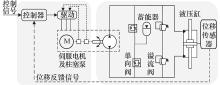
Fig.1
EHA basic structure"
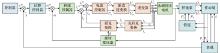
Fig.2
EHA simulation model"
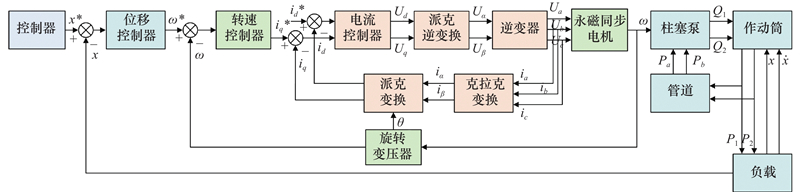
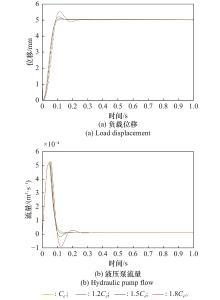
Fig.3
Internal leakage in plunger pump"
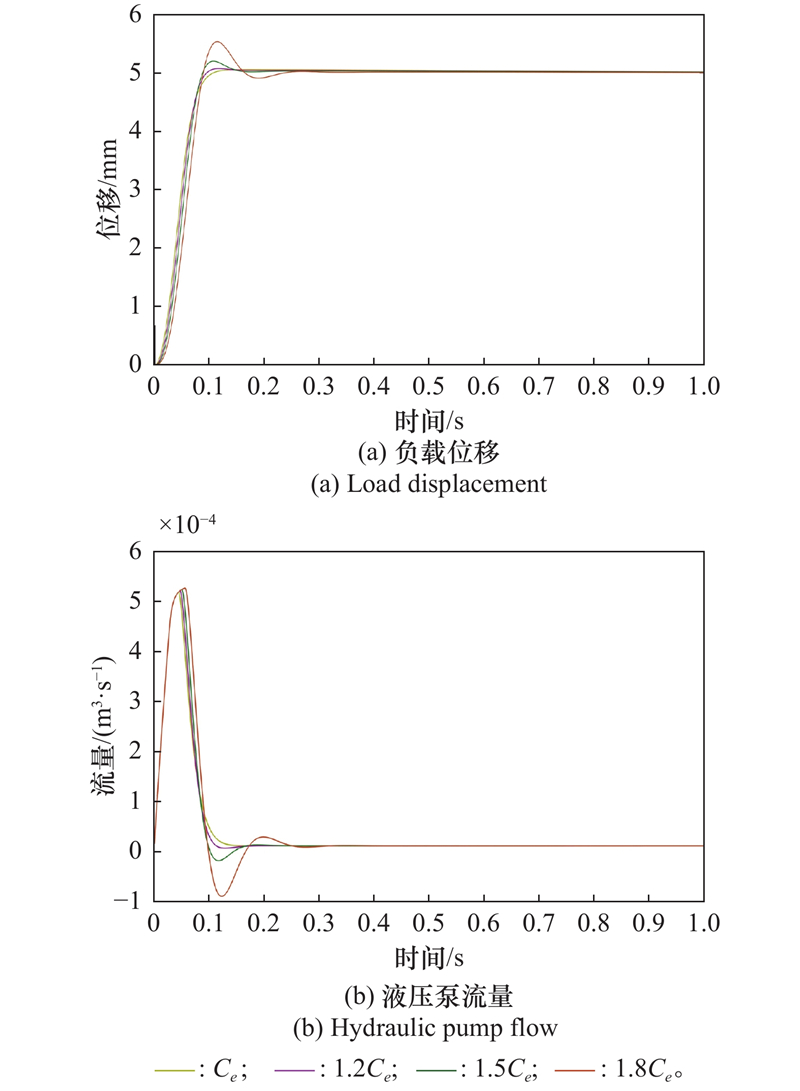
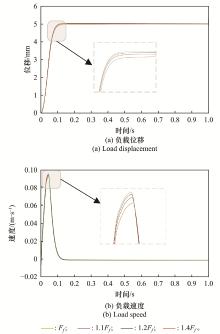
Fig.4
Increased friction between piston and cylinder"
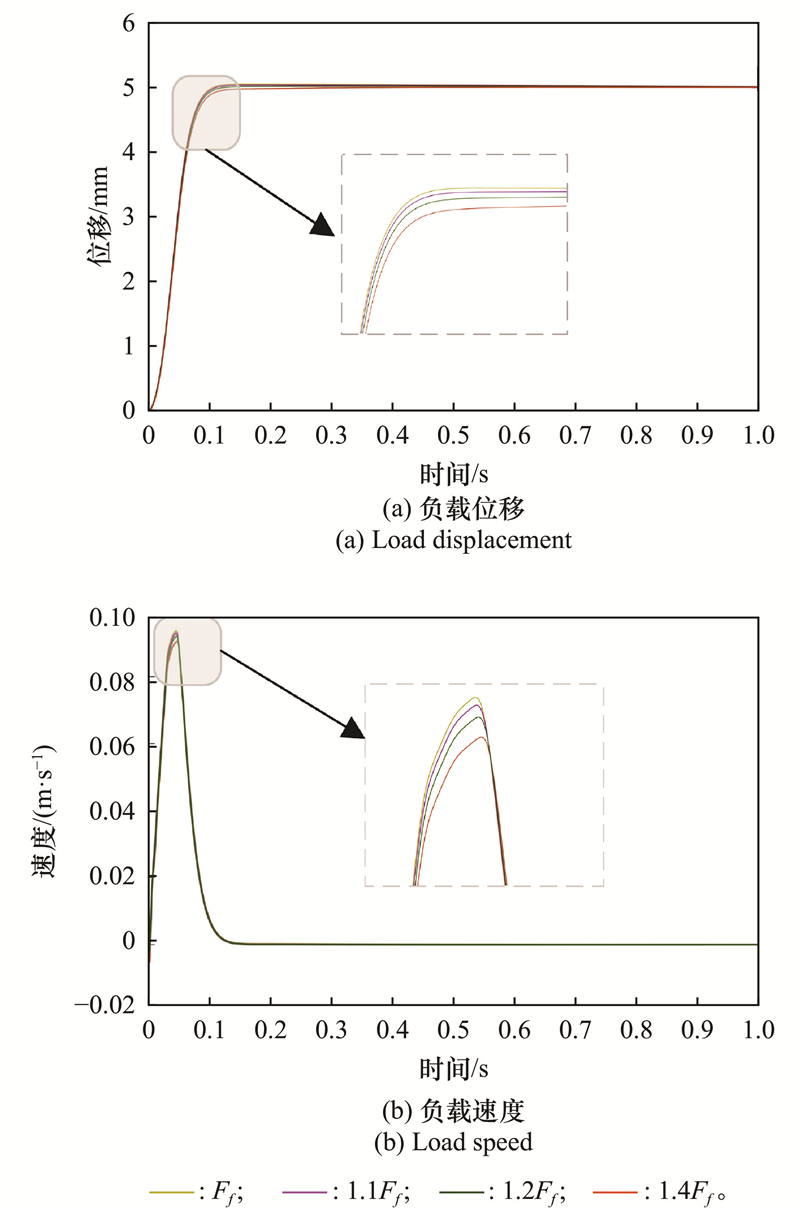
Fig.5
Air mixed into oil"
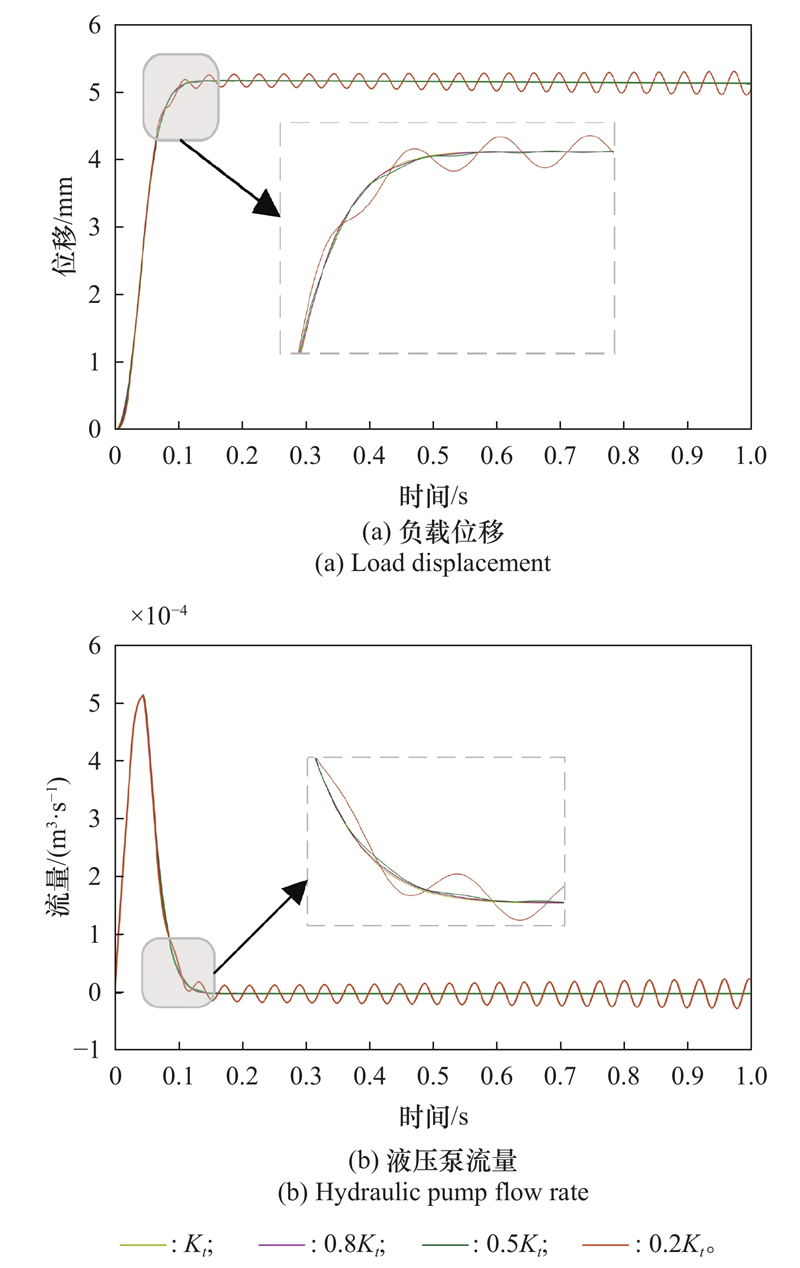
Fig.6
Sensor gain degradation"
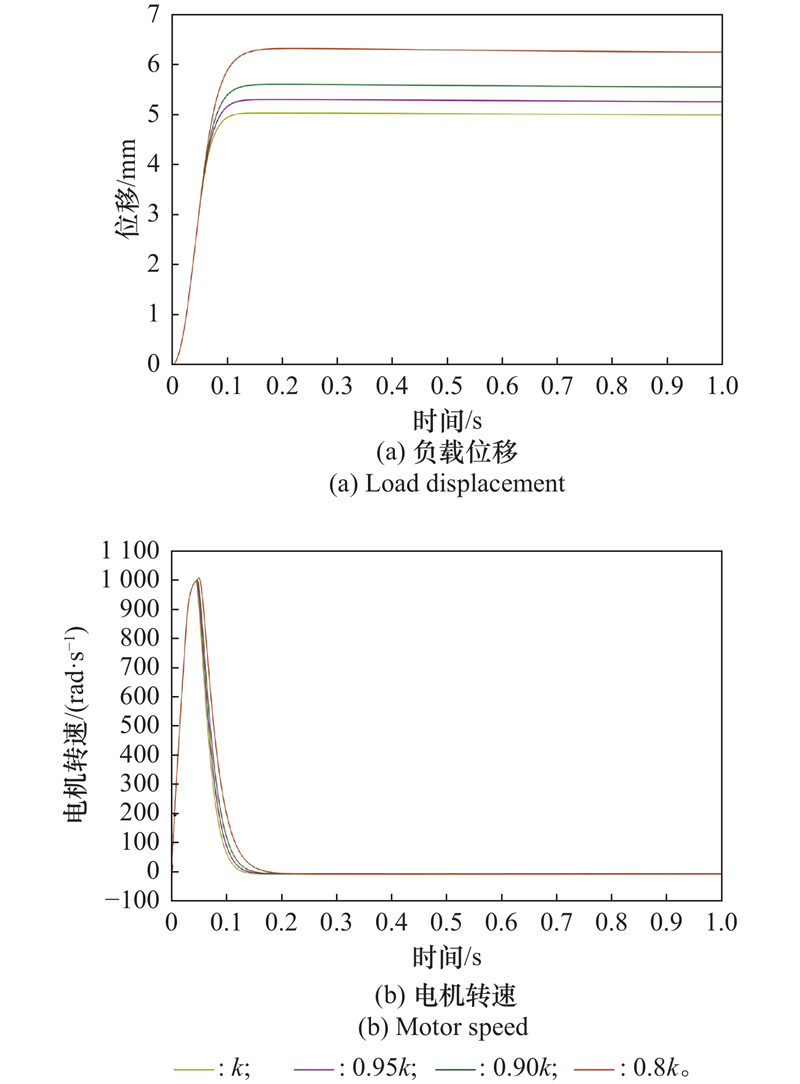
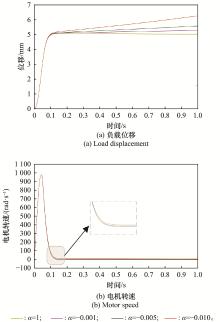
Fig.7
Sensor drift"
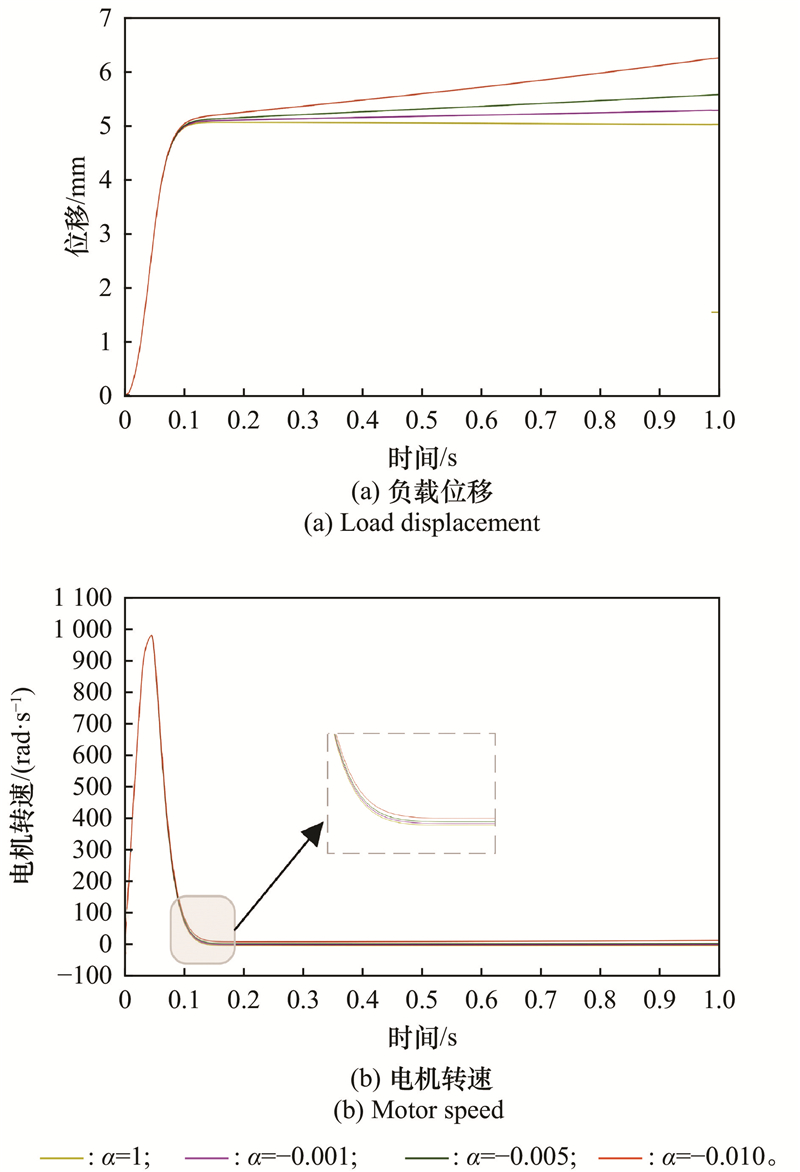
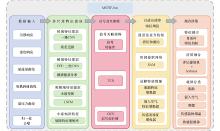
Fig.8
MSTIF-Net architecture"
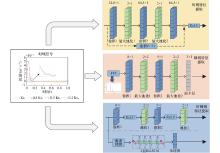
Fig.9
Three types of feature extraction"
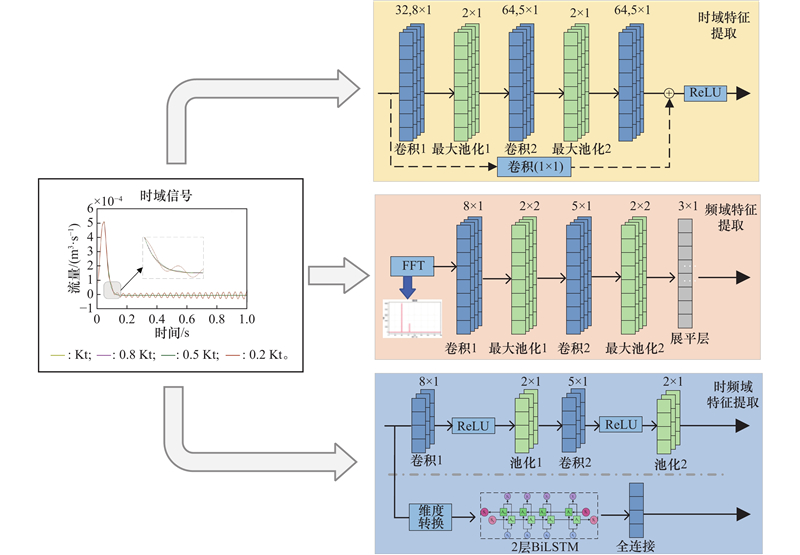
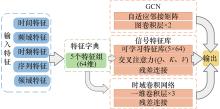
Fig.10
Signal interaction modeling"
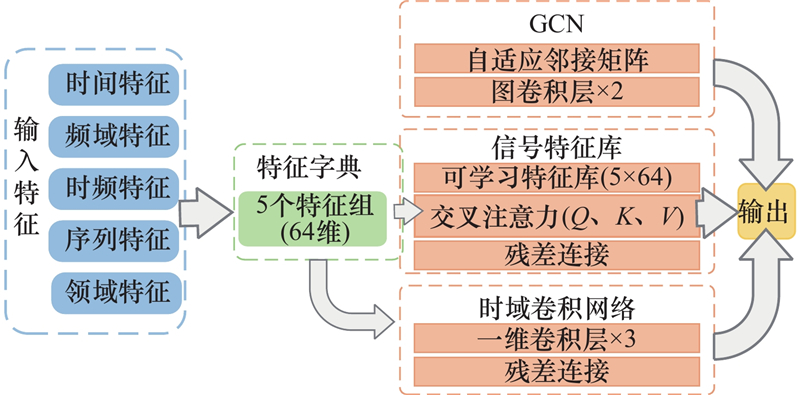
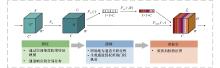
Fig.11
Channel attention mechanism"
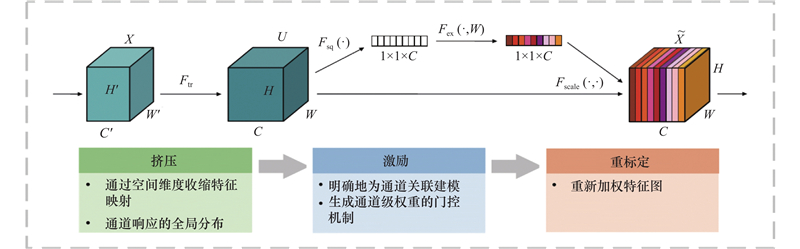
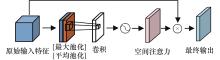
Fig.12
Spatial attention mechanism"
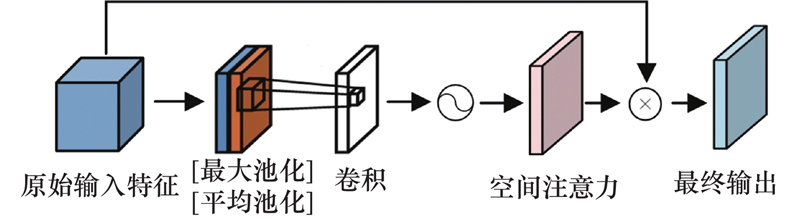
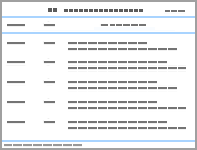
Table 1
Network structure and main parameters"
| 模块名称 | 输入大小 | 输出大小 | 激活函数 |
| 时域特征提取 | [32,5, | [32,64,750] | ReLU+残差连接 |
| 频域特征提取 | [32,5, | [32,64] | ReLU |
| 时频特征提取 | [32,5, | [32,64] | ReLU + Sigmoid |
| 领域知识 特征提取 | [32,5, | [32,64] | ReLU |
| 信号交互建模 | [32,5,64] | [32,5,64] | ReLU + Softmax |
| 自适应增强 | [32,5,64] | [32,5,64] | ReLU + Sigmoid |
| 融合决策 | [32,5,64] | [32,6] | MHA + Softmax |
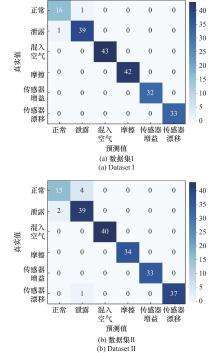
Fig.13
Diagnostic results of different datasets"
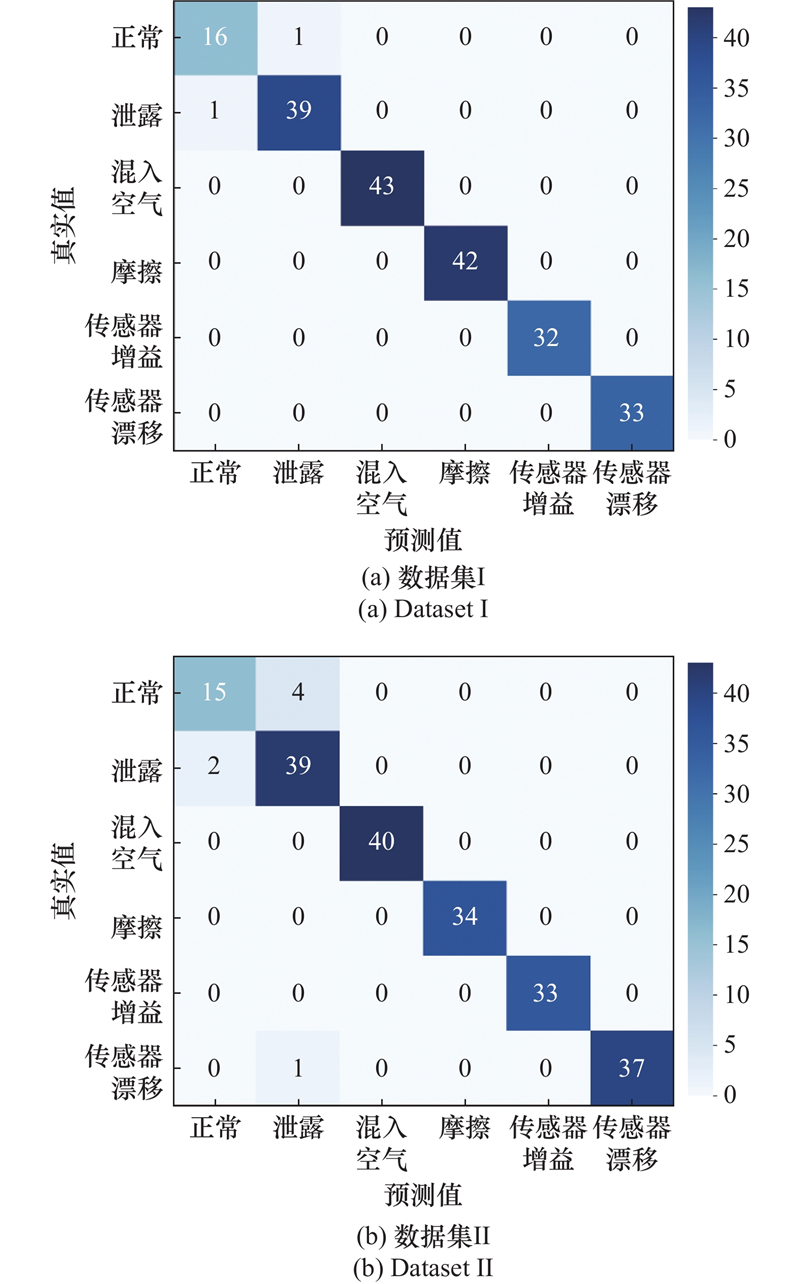
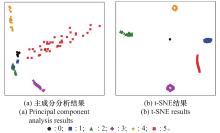
Fig.14
Visualization of classification results"
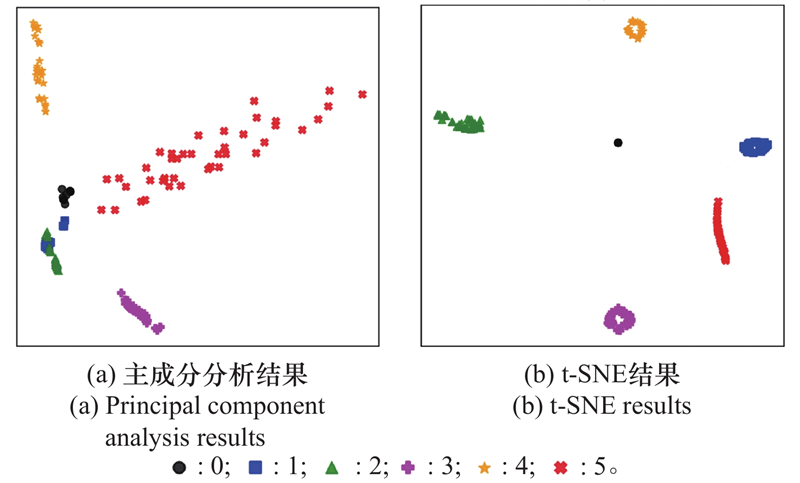
Table 2
Comparison of algorithm results"
| 算法 | 准确率/% | 训练时间/s |
| MSTIF | 99.03 | 2.38 |
| ResNet1D-Attention | 87.92 | 0.60 |
| CNN-BiGRU-Attention | 78.26 | 3.08 |
| DenseNet1D | 92.27 | 2.75 |
| Multi-CNN-Fusion | 81.16 | 0.82 |
| CNN-LSTM-MultiAttention | 76.33 | 4.87 |
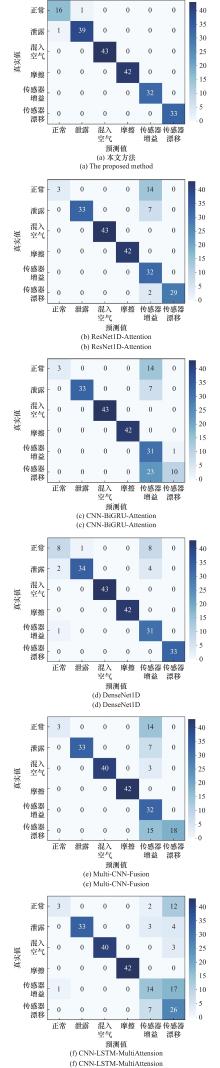
Fig.15
Confusion matrix results of different algorithms"
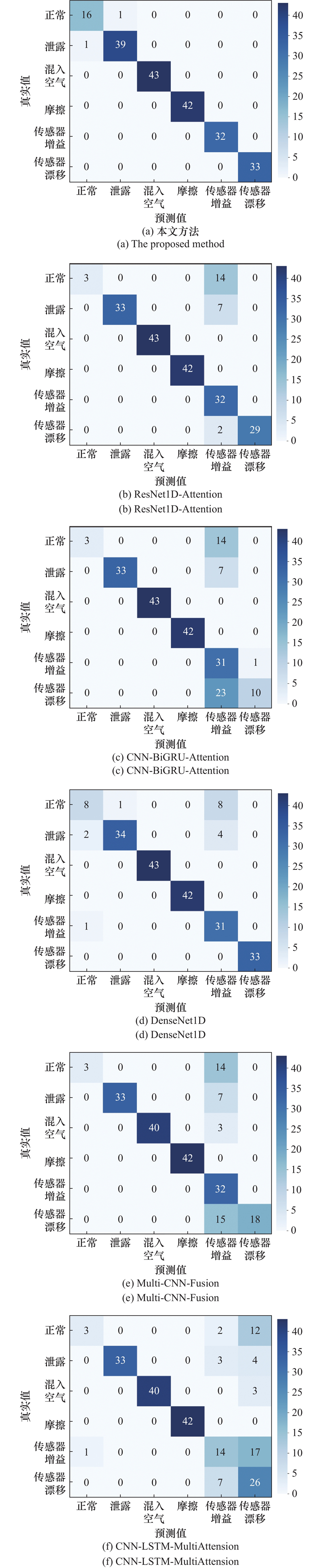
Table 3
Comparison of ablation experiment results %"
| 模型/实验 | 准确率 | F1分数 |
| MSTIF-Net | 99.03 | 98.56 |
| 消融1 | 80.98 | 78.93 |
| 消融2 | 92.68 | 89.23 |
| 消融3 | 93.66 | 90.05 |
| 消融4 | 91.71 | 88.09 |
| 消融5 | 93.66 | 90.05 |
| 消融6 | 95.12 | 93.70 |
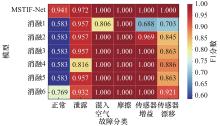
Fig.16
F1 score heatmap"
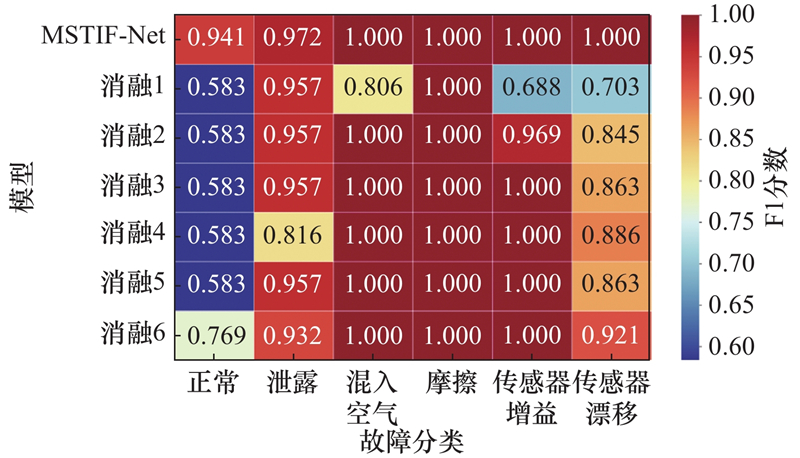
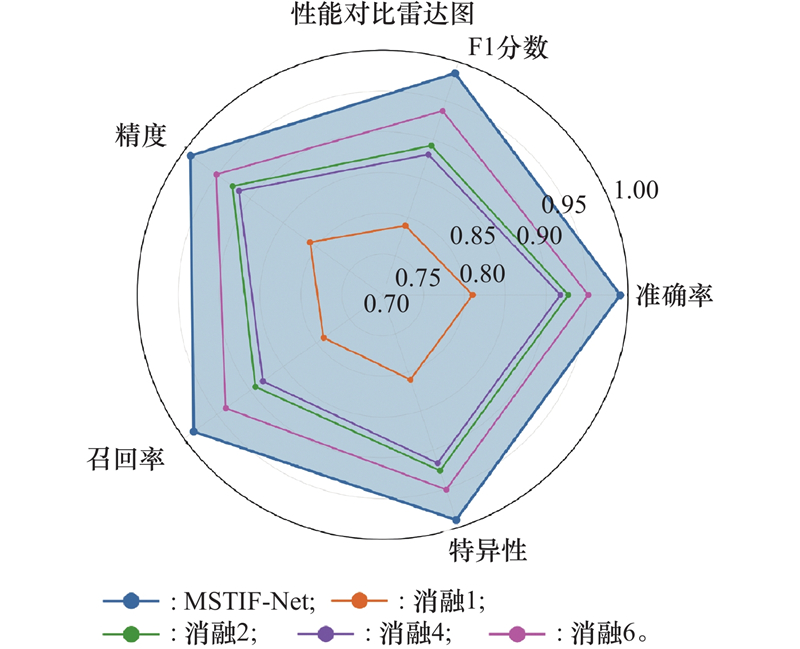
Fig.17
Radar chart of performance comparison"
| 1 |
CHEN H G, MIAO X, MAO W T, et al. Fault diagnosis of EHA with few-shot data augmentation technique[J]. Smart Materials and Structures, 2023, 32 (4): 044005.
doi: 10.1088/1361-665X/acc0ed |
| 2 | 丁卓, 张和生, 汤昳琮, 等. 基于多尺度特征融合卷积神经网络的牵引电机转子断条故障诊断方法[EB/OL]. [2025-07-10]. https://doi.org/10.19595/j.cnki.1000-6753.tces.250208. |
| DING Z, ZHANG H S, TANG Y C, et al. The fault diagnosis method of traction motor broken rotor bar based on multi-scale feature fusion convolutional neural networks[EB/OL]. [2025-07-10]. https://doi.org/10.19595/j.cnki.1000-6753.tces.250208. | |
| 3 | 孔子迁, 邓蕾, 汤宝平, 等. 基于时频融合和注意力机制的深度学习行星齿轮箱故障诊断方法[J]. 仪器仪表学报, 2019, 40 (6): 221- 227. |
| KONG Z Q, DENG L, TANG B P, et al. Fault diagnosis of planetary gearbox based on deep learning with time-frequency fusion and attention mechanism[J]. Chinese Journal of Scientific Instrument, 2019, 40 (6): 221- 227. | |
| 4 | 樊翔翔, 项载毓, 孙瑞雪, 等. 基于小波时频分析和Inception-BiGRU模型的盾构滚刀偏磨故障诊断[J]. 振动与冲击, 2023, 42 (15): 232- 240. |
| FAN X X, XIANG Z Y, SUN R X, et al. Fault diagnosis of TBM hob eccentric wear based on wavelet time-frequency analysis and Inception-BiGRU model[J]. Journal of Vibration and Shock, 2023, 42 (15): 232- 240. | |
| 5 |
HUANG Y F, TAO J, SUN G, et al. A novel digital twin approach based on deep multimodal information fusion for aero-engine fault diagnosis[J]. Energy, 2023, 270, 126894.
doi: 10.1016/j.energy.2023.126894 |
| 6 | CHEN P, CHEN H G, CHEN W H, et al. An improved EKF based on excitation equivalent conversion for EHA multi-factor fault diagnosis[J]. Advances in Mechanical Engineering, 2022, 14 (10) |
| 7 | SHEN H R, WEN R M, ZHU D M. A deep-learning based fault diagnosis method for electrical motor of electro-hydrostatic actuator[C]// Proc. of the 11th International Forum on Electrical Engineering and Automation, 2024: 852–855. |
| 8 |
NAHIAN S A, DINH T Q, DAO H V, et al. An unknown input observer-EFIR combined estimator for electrohydraulic actuator in sensor fault-tolerant control application[J]. IEEE/ASME Trans. on Mechatronics, 2020, 25 (5): 2208- 2219.
doi: 10.1109/TMECH.2020.3013609 |
| 9 |
ZHAO X L, ZHU X J, LIU J H, et al. Model-assisted multi-source fusion hypergraph convolutional neural networks for intelligent few-shot fault diagnosis to electro-hydrostatic actuator[J]. Information Fusion, 2024, 104, 102186.
doi: 10.1016/j.inffus.2023.102186 |
| 10 | HOSSEINPOUR S, KINSNER W, SEPEHRI N. A Bayesian optimized neural network for fault detection in electro-hydrostatic actuators[J]. Journal of Machine Intelligence and Data Science, 2024, 5 (1): 144- 151. |
| 11 |
LI Y, JIA Z, LIU J, et al. An integrated strategy for interpretable fault diagnosis of UAV EHA DC drive circuits under early fault and imbalanced data conditions[J]. Drones, 2025, 9 (3): 189.
doi: 10.3390/drones9030189 |
| 12 | MIAO J G, WANG J Y, WANG D, et al. Experimental investigation on electro-hydraulic actuator fault diagnosis with multi-channel residuals[J]. Measurement, 2021, 180, 109544. |
| 13 | MA D, LIU Z H, GAO Q H, et al. Few-shot fault diagnosis of EHA based on MTF-ResNet-MA and dual-attribute adaptive decision-level fusion[J]. Measurement, 2025, 247, 116787. |
| 14 |
RODRIGUEZ-AGUILAR R, MARMOLEJO -SAUCEDO J A, KOSE U. Development of a digital twin driven by a deep learning model for fault diagnosis of electro-hydrostatic actuators[J]. Mathematics, 2024, 12 (19): 3124.
doi: 10.3390/math12193124 |
| 15 | XING X J, LUO Y M, HAN B, et al. Hybrid data-driven and multisequence feature fusion fault diagnosis method for electro-hydrostatic actuators of transport airplane[J]. IEEE Trans. on Industrial Informatics, 2025, 21 (4): 3306- 3315. |
| 16 |
李旭东, 李艳军, 曹愈远, 等. 基于CNN-SVM的飞机EHA故障诊断算法研究[J]. 西北工业大学学报, 2023, 41 (1): 230- 240.
doi: 10.3969/j.issn.1000-2758.2023.01.027 |
|
LI X D, LI Y J, CAO Y Y, et al. Study on fault diagnosis algorithms of EHA based on CNN-SVM[J]. Journal of Northwestern Polytechnical University, 2023, 41 (1): 230- 240.
doi: 10.3969/j.issn.1000-2758.2023.01.027 |
|
| 17 |
BORRE A, SEMAN L O, CAMPONOGARA E, et al. Machine fault detection using a hybrid CNN-LSTM attention-based model[J]. Sensors, 2023, 23 (9): 4512.
doi: 10.3390/s23094512 |
| 18 |
ZHOU D F, TANG C Y, FU Z J, et al. Multi scale convolutional neural network combining BiLSTM and attention mechanism for bearing fault diagnosis under multiple working conditions[J]. Scientific Reports, 2025, 15 (1): 13035.
doi: 10.1038/s41598-025-96137-w |
| 19 |
SUJON K M, HASSAN R B, TOWSHI Z T, et al. When to use standardization and normalization: empirical evidence from machine learning models and XAI[J]. IEEE Access, 2024, 12, 135300- 135314.
doi: 10.1109/ACCESS.2024.3462434 |
| 20 |
HENRY M. An ultra-precise fast Fourier transform[J]. Measurement, 2023, 220, 113372.
doi: 10.1016/j.measurement.2023.113372 |
| 21 | 户福标, 付宇, 赵艺凡, 等. 高精度伺服倾角传感器信号处理方法研究[J]. 传感器与微系统, 2025, 44 (3): 37- 41,45. |
| HU F B, FU Y, ZHAO Y F, et al. Research on signal processing method for high-precision servo tilt sensor[J]. Transducer and Microsystem Technologies, 2025, 44 (3): 37- 41,45. | |
| 22 | ZHANG L X, PAN M X. Aero-engine dynamic pressure calibration method with deep learning and wavelet transform[C]// Proc. of the International Conference on Advanced Robotics and Mechatronics, 2024: 413−418. |
| 23 |
ADEY B, HABIB A, KARMAKAR C. Exploration of an intrinsically explainable self-attention based model for prototype generation on single-channel EEG sleep stage classification[J]. Scientific Reports, 2024, 14 (1): 27612.
doi: 10.1038/s41598-024-79139-y |
| 24 |
LI Y Y, SONG L D, ZHANG S, et al. A TCN-based hybrid forecasting framework for hours-ahead utility-scale PV forecasting[J]. IEEE Trans. on Smart Grid, 2023, 14 (5): 4073- 4085.
doi: 10.1109/TSG.2023.3236992 |
| 25 | ZHAO L, SONG Y J, ZHANG C, et al. T-GCN: a temporal graph convolutional network for traffic prediction[J]. IEEE Trans. on Intelligent Systems, 2019, 21 (9): 3848- 3858. |
| 26 |
JIN X, XIE Y P, WEI X S, et al. Delving deep into spatial pooling for squeeze-and-excitation networks[J]. Pattern Recognition, 2022, 121, 108159.
doi: 10.1016/j.patcog.2021.108159 |
| 27 | WOO S, PARK J, LEE J Y, et al. CBAM: convolutional block attention module[C]// Proc. of the European Conference on Computer Vision, 2018: 3−19. |
| 28 |
LIANG P F, WANG W H, YUAN X M, et al. Intelligent fault diagnosis of rolling bearing based on wavelet transform and improved ResNet under noisy labels and environment[J]. Engineering Applications of Artificial Intelligence, 2022, 115, 105269.
doi: 10.1016/j.engappai.2022.105269 |
| 29 | LI C, DONG C, FANG T. Bearing fault diagnosis based on FFT-CNN-BiGRU-attention[C]//Proc. of the 4th International Conference on Computer, Artificial Intelligence and Control Engineering, 2025: 880−886. |
| 30 | LIN X S, QIAN C H, JIANG Q S, et al. Adaptive cross-domain fault diagnosis method for rolling bearing based on 1D large-convolution DenseNet[J]. Nonlinear Dynamics, 2025, 133, 22853- 22874. |
| 31 | NITHYA K, KOUSALYA R. IIOT fault detection using multi deep convolutional neural networks[C]//Proc. of the International Conference on Computer Vision and Internet of Things, 2023: 251−257. |
| 32 |
HUANG T, ZHANG Q, TANG X A, et al. A novel fault diagnosis method based on CNN and LSTM and its application in fault diagnosis for complex systems[J]. Artificial Intelligence Review, 2022, 55 (2): 1289- 1315.
doi: 10.1007/s10462-021-09993-z |
| [1] | Qiongdan HUANG, Lulu LIU, Jiejing HAN, Jiapeng WANG, Shilin KANG. Image super-resolution reconstruction based on differential feature back-projection fusion [J]. Systems Engineering and Electronics, 2026, 48(6): 1809-1818. |
| [2] | Shengzhi YUAN, Shaolei WANG, Jing LI, Renkai XIAO, Haotian TAN, Jianwei LAI, Jiangtao XU. Fault diagnosis method based on wavelet packet transform and improved residual neural network [J]. Systems Engineering and Electronics, 2026, 48(6): 2031-2041. |
| [3] | Yuanguang CHEN, Xiaokai LIU, Siyao XIAO, Shunsheng ZHANG, Hongyuan CUI, Xiaoying CHEN, Ying LIU. Radar intelligent target detection method using spatio-temporal feature fusion under low signal-to-noise ratio [J]. Systems Engineering and Electronics, 2026, 48(5): 1523-1531. |
| [4] | Zeying YANG, Zhuo CHEN, Zhiming XU, Xiaofeng AI, Qihua WU, Ling WANG. Forward labeling method for ISAR image components of space targets [J]. Systems Engineering and Electronics, 2026, 48(4): 1165-1173. |
| [5] | Jiong LIN, Peng GAO, Wenxing HONG. Applications and prospects of physics-informed neural networks in aerospace [J]. Systems Engineering and Electronics, 2026, 48(4): 1264-1282. |
| [6] | Kun CHENG, Hongtao LEI, Zhixuan LYU. Lightweight unmanned aerial vehicle tracking method of improved YOLOv8 [J]. Systems Engineering and Electronics, 2026, 48(3): 737-750. |
| [7] | Long ZHANG, Lianhong ZHU, Bo YANG, Zhen LEI, Xuanming FENG. MFA-Net: a multimodal adaptive fusion network for intelligent recognition of anti-ship missiles in complex adversarial environments [J]. Systems Engineering and Electronics, 2026, 48(3): 894-907. |
| [8] | Hongyu TIAN, Songhu GE, Yu GUO, Zhongpu CUI, Xiao LIANG. Communication interference recognition method based on multi-feature fusion under low interference-to-noise ratio conditions [J]. Systems Engineering and Electronics, 2026, 48(3): 1061-1071. |
| [9] | Yugang BAO, Haoxiang JIA, Danfeng ZHAO. Single image raindrop removal model based on high-order recursive network [J]. Systems Engineering and Electronics, 2026, 48(1): 12-21. |
| [10] | Zhenxing ZHANG, Rennong YANG, Yonglin LI, Jialiang ZUO, Liping HU, Shuangyan CHEN. Text-to-image generation based on double-attention generative adversarial network [J]. Systems Engineering and Electronics, 2026, 48(1): 34-43. |
| [11] | Haiqing CHEN, Liuying WANG, Gu LIU, Long WANG, Chaoqun GE, Mengzhou CHEN. Research progress on denoising algorithms for synthetic aperture radar images [J]. Systems Engineering and Electronics, 2026, 48(1): 94-105. |
| [12] | Mingyu JIANG, Shunsheng ZHANG, Siyao XIAO. SAR target recognition based on lightweight cross-attention convolutional neural network [J]. Systems Engineering and Electronics, 2025, 47(9): 2853-2861. |
| [13] | Kaiming LI, Yuanpeng ZHANG, Ying LUO, Xiaonan DAI. Research progress on radar target recognition of ballistic missile [J]. Systems Engineering and Electronics, 2025, 47(9): 2870-2889. |
| [14] | Ce JI, Xiangyu MA, Xiaoyu MU, Jiayi ZHAO. TS-GRU-VTA: vehicle channel estimation scheme based on deep learning [J]. Systems Engineering and Electronics, 2025, 47(9): 3093-3098. |
| [15] | Weihong FU, Wenhong PENG, Naian LIU. SAR image small target detection method with hybrid attention optimization [J]. Systems Engineering and Electronics, 2025, 47(8): 2519-2526. |
| Viewed | ||||||
|
Full text |
|
|||||
|
Abstract |
|
|||||