Systems Engineering and Electronics ›› 2026, Vol. 48 ›› Issue (3): 751-757.doi: 10.12305/j.issn.1001-506X.2026.03.02
• Electronic Technology • Previous Articles
Radiation source tracking algorithm based on unbiased measurement conversion of TDOA/FDOA
Xinchen XIE, Lin GAO, Ping WEI, Wanchun LI
- School of Information and Communication Engineering,University of Electronic Science and Technology of China,Chengdu 611731,China
-
Received:2024-12-27Online:2026-03-25Published:2026-04-13 -
Contact:Lin GAO

CLC Number:
Cite this article
Xinchen XIE, Lin GAO, Ping WEI, Wanchun LI. Radiation source tracking algorithm based on unbiased measurement conversion of TDOA/FDOA[J]. Systems Engineering and Electronics, 2026, 48(3): 751-757.
share this article
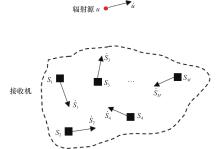
Fig.1
TDOA/FDOA positioning diagram"
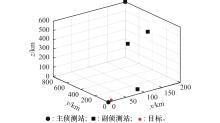
Fig.2
Layout diagram of three-dimensional space"
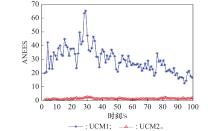
Fig.3
ANEES results with different conversions"
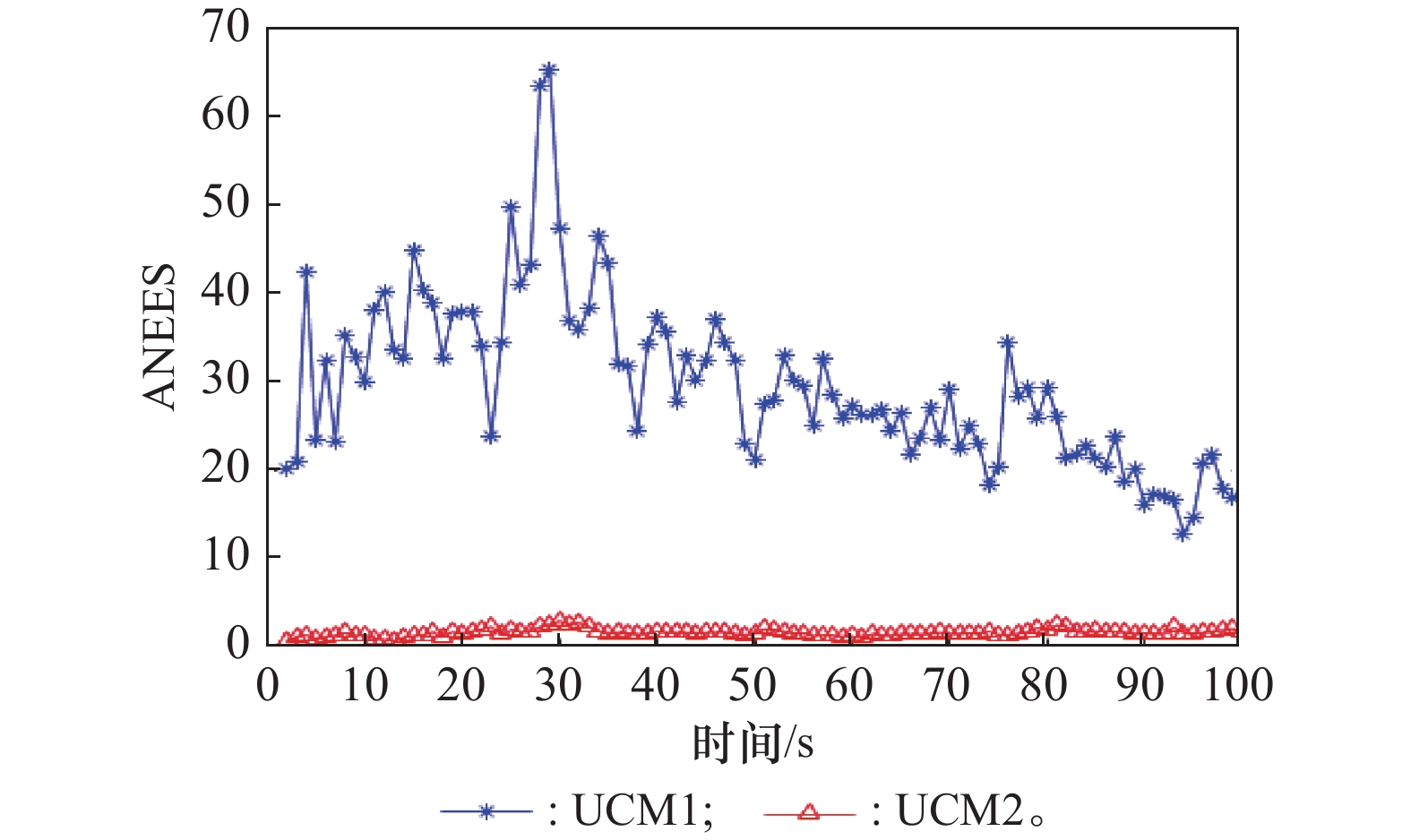
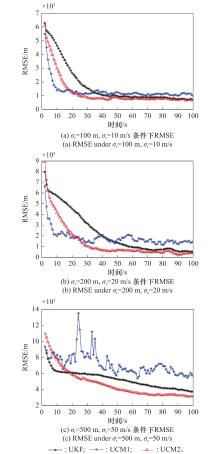
Fig.4
RMSE comparison of different types of conversions"
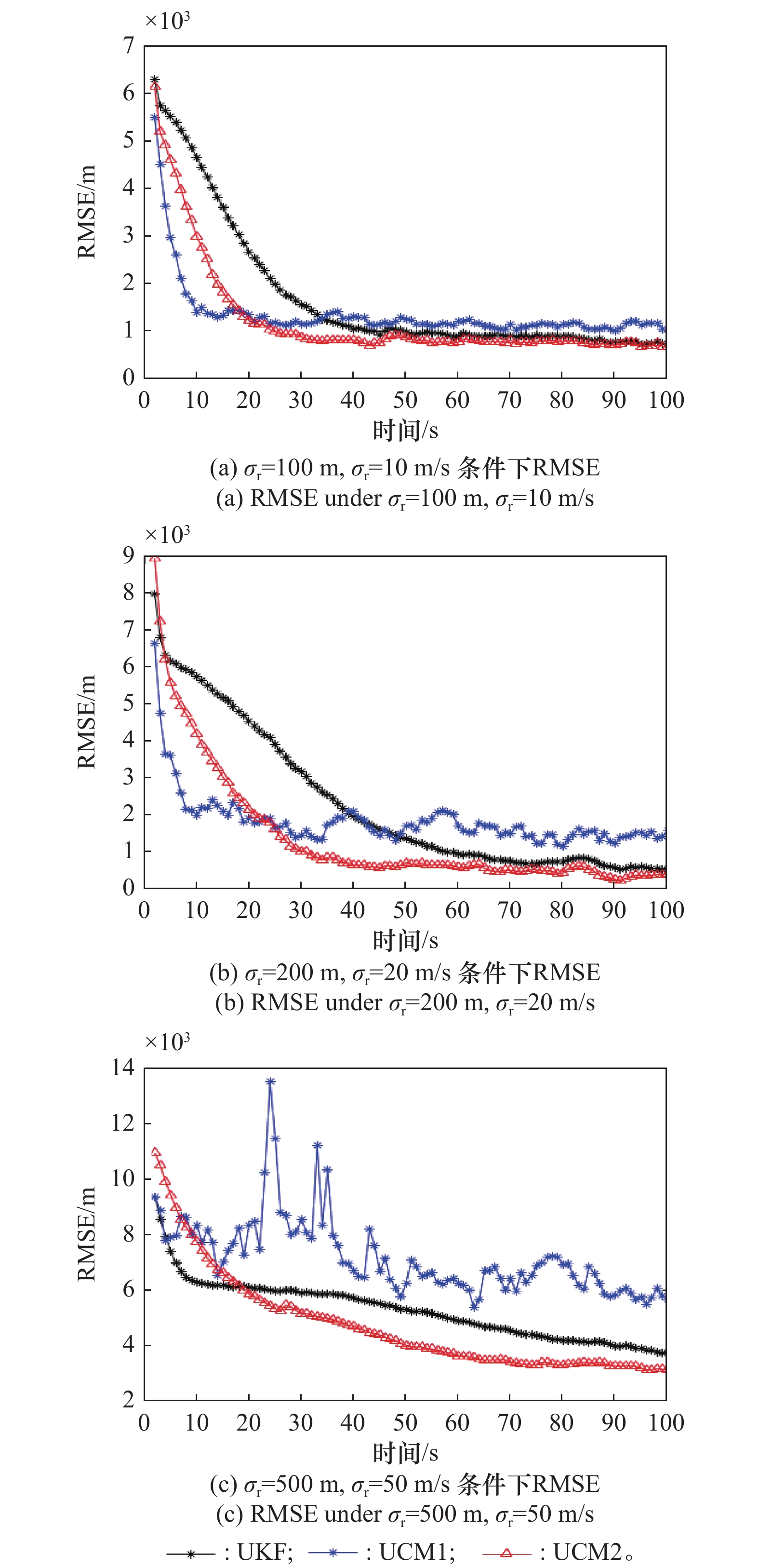
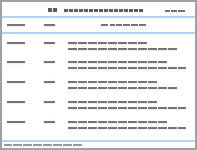
Table 1
Runtime comparison of each algorithm in different measurement noise scenarios ms"
| 量测场景 | UKF | UCM1 | UCM2 |
| 1 | 1.84 | 0.86 | 1.93 |
| 2 | 1.88 | 0.89 | 1.97 |
| 3 | 1.94 | 0.91 | 2.02 |
| 1 |
ZHAO Y, LI Z, CHENG N, et al. Joint UAV position and power optimization for accurate regional localization in space-air intergrated localization network[J]. Internet of Things Journal, 2021, 8 (6): 4841- 4854.
doi: 10.1109/JIOT.2020.3030064 |
| 2 | JIA T Y, HO K C, WANG H Y, et al. Effect of sensor motion on time delay and doppler shift localization: analysis and solution[J]. IEEE Trans. on Signal Processing, 2019, 67 (22): 5881- 5895. |
| 3 | VERHEYDE T, BLAIS A, et al. SmartCoop algorithm: improving smartphones position accuracy and reliability through collaborative positioning[C]//Proc. of the International Conference on Localization and GNSS, 2021. |
| 4 |
SUN N Y, ZHAO J, SHI Q, et al. Moving target tracking by unmanned aerial vehicle: a survey and taxonomy[J]. IEEE Trans. on Industrial Informatics, 2024, 20 (5): 7056- 7068.
doi: 10.1109/TII.2024.3363084 |
| 5 |
HE S, WU P L, LI X X, et al. Adaptive modified unbiased minimum-variance estimation for highly maneuvering target tracking with model mismatch[J]. IEEE Trans. on Instrumentation and Measurement, 2023, 72, 8501216.
doi: 10.1109/tim.2023.3239639 |
| 6 |
NOROOZI A, OVEIS A H, HOSSEINI M R, et al. Improved algebraic solution for source localization from TDOA and FDOA measurements[J]. IEEE Wireless Communications Letters, 2018, 7 (3): 352- 355.
doi: 10.1109/LWC.2017.2777995 |
| 7 | 蒋伊琳, 刘梦楠, 郜丽鹏, 等. 运动多站无源时差/频差联合定位方法[J]. 系统工程与电子技术, 2019, 41 (7): 1441- 1449. |
| JIANG Y L, LIU M N, GAO L P, et al. Multi station passive time difference/frequency difference joint positioning method for sports[J]. Systems Engineering and Electronics, 2019, 41 (7): 1441- 1449. | |
| 8 |
YEREDOR A, ANGEL E. Joint TDOA and FDOA estimation: a conditional bound and its use for optimally weighted localization[J]. IEEE Trans. on Signal Processing, 2011, 59 (4): 1612- 1623.
doi: 10.1109/TSP.2010.2103069 |
| 9 |
HO K C, XU W W. An accurate algebraic solution for moving source location using TDOA and FDOA measurements[J]. IEEE Trans. on Signal Processing, 2004, 52 (9): 2453- 2463.
doi: 10.1109/TSP.2004.831921 |
| 10 |
QIN Q, WANG G, HO K C. Underwater moving object localization by TOA and FOA modeled with isogradient sound speed profile[J]. IEEE Trans. on Aerospace and Electronic Systems, 2025, 61 (2): 4627- 4641.
doi: 10.1109/TAES.2024.3509396 |
| 11 |
PANG D D, WANG G, HO K C. Hybrid AOA-TDOA localization of a moving source by single receiver[J]. IEEE Trans. on Communications, 2025, 73 (6): 4088- 4104.
doi: 10.1109/TCOMM.2024.3511932 |
| 12 | 鲁亮亮. 基于多站TDOA/FDOA的通信辐射源无源定位方法研究[D]. 西安: 西安理工大学, 2023. |
| LU L L. Research on passive localization method of communication radiation sources based on multi station TDOA/FDOA[D]. Xi’an: Xi’an University of Technology, 2023. | |
| 13 | 梁满. 基于TDOA/FDOA的多站无源定位算法研究[D]. 成都: 电子科技大学, 2024. |
| LIANG M. Research on multi station passive location algorithm based on TDOA/FDOA[D]. Chengdu: University of Electronic Science and Technology of China, 2024. | |
| 14 |
WANG G, LI Y N, ANSARI. A semidefinite relaxation method for source localization using TDOA and FDOA measurements[J]. IEEE Trans. on Vehicular Technology, 2013, 62 (2): 853- 862.
doi: 10.1109/TVT.2012.2225074 |
| 15 | QUO F C, HO K C. A quadratic constraint solution method for TDOA and FDOA localization[C]//Proc. of the IEEE International Conference on Acoustics, Speech and Signal Processing, 2011: 2588−2591. |
| 16 |
LEE K, OH J, YOU K. TDOA-/FDOA-based adaptive active target localization using iterated dual-EKF algorithm[J]. IEEE Communications Letters, 2019, 23 (4): 752- 755.
doi: 10.1109/LCOMM.2019.2899615 |
| 17 |
赵侃, 漆德宁. 基于UKF滤波的FDOA和TDOA联合定位跟踪算法[J]. 计算机技术与发展, 2012, 22 (5): 127- 129.
doi: 10.3969/j.issn.1673-629X.2012.05.033 |
|
ZHAO K, QI D L. FDOA and TDOA joint positioning and tracking algorithm based on UKF filtering[J]. Computer Technology and Development, 2012, 22 (5): 127- 129.
doi: 10.3969/j.issn.1673-629X.2012.05.033 |
|
| 18 | CROUSE D. One can do better than the unscented Kalman filter for multistatic tracking[C]//Proc. of the IEEE Aerospace Conference, 2013. |
| 19 |
CROUSE D. Basic tracking using nonlinear 3D monostatic and bistatic measurements[J]. IEEE Aerospace and Electronic Systems Magazine, 2014, 29 (8): 54- 75.
doi: 10.1109/maes.2014.120229 |
| 20 | ZHANG J, ZHANG D, HUANG X M , et al. Continuous passive TDOA location method based on multi-flight-vehicle cooperation[C]//Proc. of the Chinese Control and Decision Conference, 2018: 2972−2976. |
| 21 |
AMAR A, LEUS G, FRIEDLANDER B. Emitter localization given time delay and frequency shift measurements[J]. IEEE Trans. on Aerospace and Electronic Systems, 2012, 48 (2): 1826- 1837.
doi: 10.1109/TAES.2012.6178105 |
| 22 |
ZHANG L, WANG D, WU Y. Performance analysis of TDOA and FDOA location by differential calibration with calibration sources[J]. Journal of Communications, 2014, 9 (6): 483- 490.
doi: 10.12720/jcm.9.6.483-489 |
| 23 |
QU X M, XIE L H, TAN W R. Iterative constrained weighted least squares source localization using TDOA and FDOA measurements[J]. IEEE Trans. on Signal Processing, 2017, 65 (15): 3990- 4003.
doi: 10.1109/TSP.2017.2703667 |
| 24 |
SUN M, HO K C. An asymptotically efficient estimator for TDOA and FDOA positioning of multiple disjoint sources in the presence of sensor location uncertainties[J]. IEEE Trans. on Signal Processing, 2011, 59 (7): 3434- 3440.
doi: 10.1109/TSP.2011.2131135 |
| 25 |
江峰, 张贞凯. 基于泰勒加权最小二乘算法的水下TDOA/FDOA联合定位方法[J]. 信号处理, 2021, 37 (11): 2125- 2133.
doi: 10.16798/j.issn.1003-0530.2021.11.013 |
|
JIANG F, ZHANG Z K. Underwater TDOA/FDOA joint localization method based on Taylor weighted least squares algorithm[J]. Signal Processing, 2021, 37 (11): 2125- 2133.
doi: 10.16798/j.issn.1003-0530.2021.11.013 |
|
| 26 |
程婷, 曹聪冲, 何子述. 基于二阶泰勒展开的量测转换滤波算法[J]. 信号处理, 2024, 40 (11): 2018- 2029.
doi: 10.12466/xhcl.2024.11.007 |
|
CHENG T, CAO C C, HE Z S. Measurement conversion filtering algorithm based on second-order Taylor expansion[J]. Signal Processing, 2024, 40 (11): 2018- 2029.
doi: 10.12466/xhcl.2024.11.007 |
|
| 27 |
MAROM H, BAR-SHALOM Y, MILGROM B. Unbiased conversion of 3-D bistatic radar measurements to cartesian position[J]. IEEE Trans. on Aerospace and Electronic Systems, 2023, 59 (2): 1613- 1623.
doi: 10.1109/TAES.2022.3203958 |
| 28 |
ARASARATNAM I, HAYKIN S. Cubature Kalman filters[J]. IEEE Trans. on Automatic Control, 2009, 54 (6): 1254- 1269.
doi: 10.1109/TAC.2009.2019800 |
| 29 | BAR-SHALOM Y, LI X R, KIRUBARAJAN T. Estimation with applications to tracking and navigation: theory algorithms and software[M]. Hoboken: John Wiley & Sons, 2004. |
| 30 |
YU H G, HUANG G M, GAO J, et al. Practical constrained least-square algorithm for moving source location using TDOA and FDOA measurements[J]. Journal of Systems Engineering and Electronics, 2012, 23 (4): 488- 494.
doi: 10.1109/jsee.2012.00062 |
| [1] | Qinglin ZHU, Fang SUN, Shanfeng YAO, Xinxin OUYANG, Hongguang WANG, Jie HAN, Xiang DONG, Shoubao ZHANG, Zhenwei ZHAO. Refraction correction of TDOA technique for over-the-horizon propagation mechanism [J]. Systems Engineering and Electronics, 2025, 47(7): 2119-2126. |
| [2] | Qiang TANG, Gaoping SHAO, Minglei SUN, Shuai SHAO. tdoa-doa underwater target passive localization algorithm with sensor position errors [J]. Systems Engineering and Electronics, 2024, 46(8): 2572-2580. |
| [3] | Xingsong DEND, Liang QI, Yuanjiang ZHU, Fan YANG, Zhichen JIANG, Zhiyong LIU. Positioning method using time difference measurements from multi-station based on precise distance information of observation stations [J]. Systems Engineering and Electronics, 2024, 46(8): 2592-2599. |
| [4] | Jianlong TANG, Jialong XIE, Hongkai CHEN. Selection method for localization node without priori measurement error [J]. Systems Engineering and Electronics, 2024, 46(1): 35-41. |
| [5] | Chen LI, Chen ZHOU, Junming WANG, Mingjie LYU, Wei QIAO. Theoretical analysis of shortwave TDOA geolocation based on empirical ionospheric model [J]. Systems Engineering and Electronics, 2023, 45(7): 1911-1919. |
| [6] | Yongzhen LI, Yemin LIU, Shiqi XING, Datong HUANG, Zhengwen LU. Study on passive direction-finding and SAR deception jamming method based on multi-receiver cooperation [J]. Systems Engineering and Electronics, 2023, 45(12): 3792-3805. |
| [7] | Yemin LIU, Yongzhen LI, Datong HUANG, Shiqi XING, Xiaowei YU. Research on the method of dual-jammer system against SAR-GMTI based on integration of reconnaissance and jamming [J]. Systems Engineering and Electronics, 2023, 45(10): 3098-3107. |
| [8] | Shengyang HE, Jiepeng DU, Yaqin ZHAO, Baoying WANG, Liang ZHAO, Longwen WU. TDOA-based cooperative single target location using UAV cluster [J]. Systems Engineering and Electronics, 2023, 45(1): 1-8. |
| [9] | Xinxin OUYANG, Shanfeng YAO, Yuxiang YANG, Qing HE, Qun WAN. Coherent and non-coherent integration TDOA/FDOA estimation method of frequency-hopping signals [J]. Systems Engineering and Electronics, 2021, 43(5): 1184-1190. |
| [10] | Chao DING, Weiguo DAI, Sen WANG, Yusheng CHENG. Optimal disposition of vector submerged buoy array based on geometrical dilution of precision [J]. Systems Engineering and Electronics, 2021, 43(11): 3107-3117. |
| [11] | Donghua HUANG, Yongsheng ZHAO, Yongjun ZHAO. Target localization algorithm from DOA-TDOA measurements in passive radar with transmitter and receiver position errors [J]. Systems Engineering and Electronics, 2020, 42(9): 1961-1968. |
| [12] | OUYANG Xinxin, YANG Yuxiang, YAO Shanfeng, HE Qing. TDOA/FDOA estimation algorithm of multi-carrier signals based on CAF coherent integration [J]. Systems Engineering and Electronics, 2019, 41(8): 1881-1886. |
| [13] | WANG Shengliang, LIU Genyou, GAO Ming, WANG Jiachen, WANG Binbin. Application of improved adaptive genetic algorithm in TDOA location [J]. Systems Engineering and Electronics, 2019, 41(2): 254-258. |
| [14] | WANG Xudong, DONG Wenjie, WU Nan. Hybrid TDOA/AOA algorithm based high accuracy indoor visible light positioning [J]. Systems Engineering and Electronics, 2019, 41(10): 2371-2377. |
| [15] | ZHOU Gongqian, YANG Lujing, LIU Zhong. Improved incomplete constrained weighted least squares TDOA/FDOA passive location method#br# [J]. Systems Engineering and Electronics, 2018, 40(8): 1686-1692. |
| Viewed | ||||||
|
Full text |
|
|||||
|
Abstract |
|
|||||