

系统工程与电子技术 ›› 2025, Vol. 47 ›› Issue (11): 3792-3801.doi: 10.12305/j.issn.1001-506X.2025.11.26
• 制导、导航与控制 • 上一篇
张虹1,2,*, 张继海1,2, 袁海波1,2,3, 董绍武1,2,3,4
收稿日期:2024-09-12
出版日期:2025-11-25
发布日期:2025-12-08
通讯作者:
张虹
作者简介:张继海(1988—),男,助理研究员,博士,主要研究方向为高精度时间传递技术基金资助:Hong ZHANG1,2,*, Jihai ZHANG1,2, Haibo YUAN1,2,3, Shaowu DONG1,2,3,4
Received:2024-09-12
Online:2025-11-25
Published:2025-12-08
Contact:
Hong ZHANG
摘要:
为了使用国际权度局(Bureau International des Poids et Mesures,BIPM)播发的导航系统时间与协调世界时(coordinated universal time,UTC)偏差信息评估全球卫星导航系统(global navigation satellite system, GNSS)间时差监测结果,本文利用各GNSS播发的系统时间的溯源偏差数据和以UTC为本地物理实现的GNSS监测数据,基于单站时差监测技术对比分析系统间时差监测结果与系统播发的系统间时差信息、各系统时间与UTC之间的偏差信息,实现GNSS系统间时差的实时监测与评估。对比BIPM播发的GNSS时间与UTC偏差信息可见,GNSS电文播发的系统时间偏差与BIPM发布结果之间的最大偏差低于6 ns,残差标准差低于3 ns,GNSS电文播发的UTC偏差与BIPM发布结果之间的偏差保持在6 ns以内,残差标准差优于2.5 ns,满足了大部分用户对导航系统互操作需求。
中图分类号:
张虹, 张继海, 袁海波, 董绍武. 卫星导航系统时之间偏差监测与评估[J]. 系统工程与电子技术, 2025, 47(11): 3792-3801.
Hong ZHANG, Jihai ZHANG, Haibo YUAN, Shaowu DONG. Monitoring and evaluation of time offsets between satellite navigation systems[J]. Systems Engineering and Electronics, 2025, 47(11): 3792-3801.
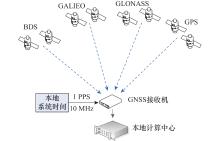
图1
单站法进行GGTO监测示意图"
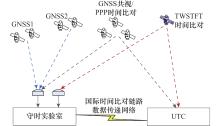
图2
利用比对链路法获得UTCO的原理"
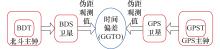
图3
单站法GGTO监测"
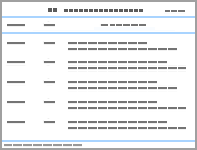
表1
实验室配备的接收机"
| 实验室 | 编号 | 接收机类型 |
| NTSC | NTP3 | POLARX5TR |
| SU | SU31 | JAVAD TRE_G3T |
| USNO | USN9 | NOV OEM6 |
| ORB | BRUX | POLARX5TR |
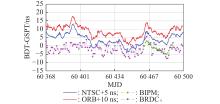
图4
GNSS电文播发的BDT-GPST与监测结果比较"
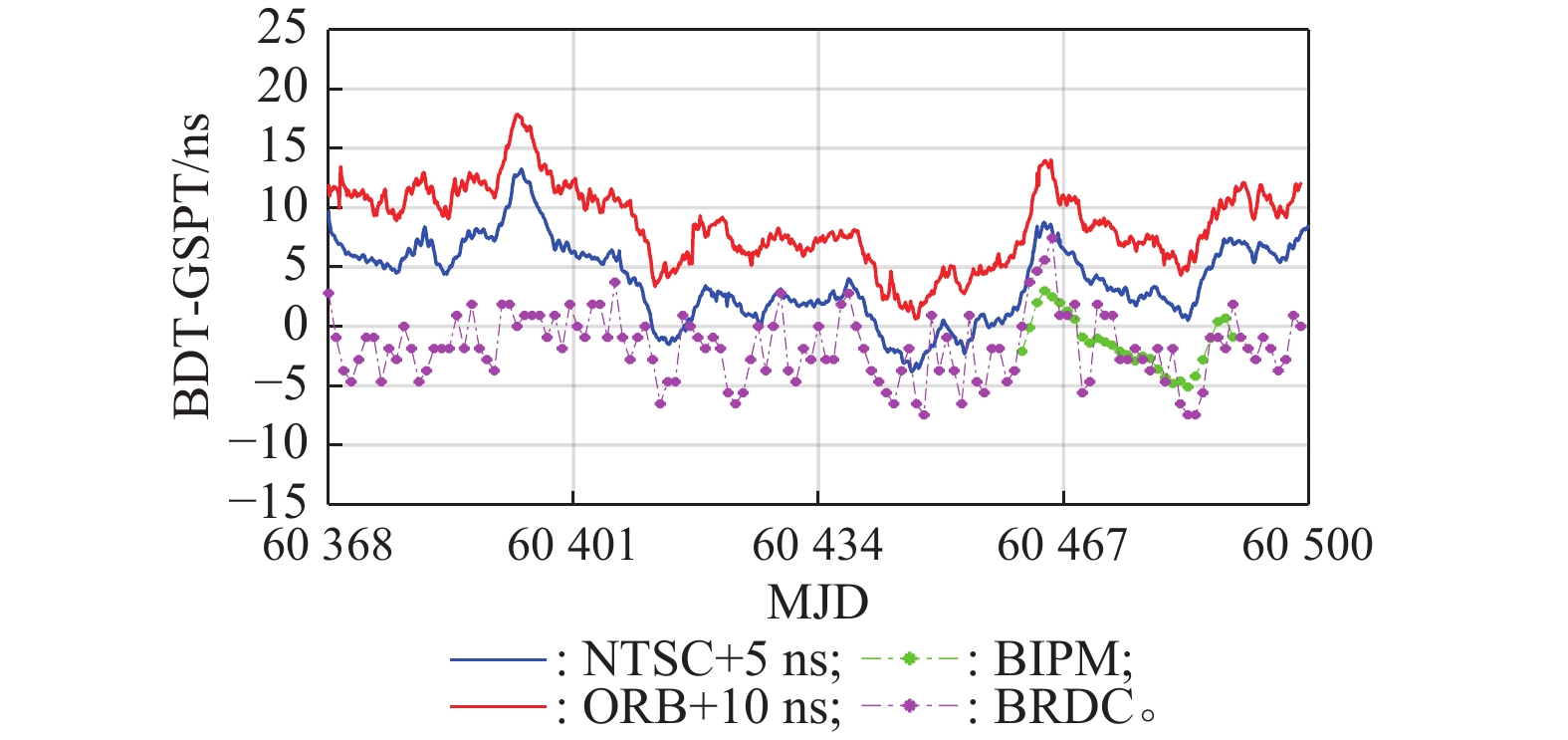
图5
GNSS电文播发的BDT-GST与监测结果比较"
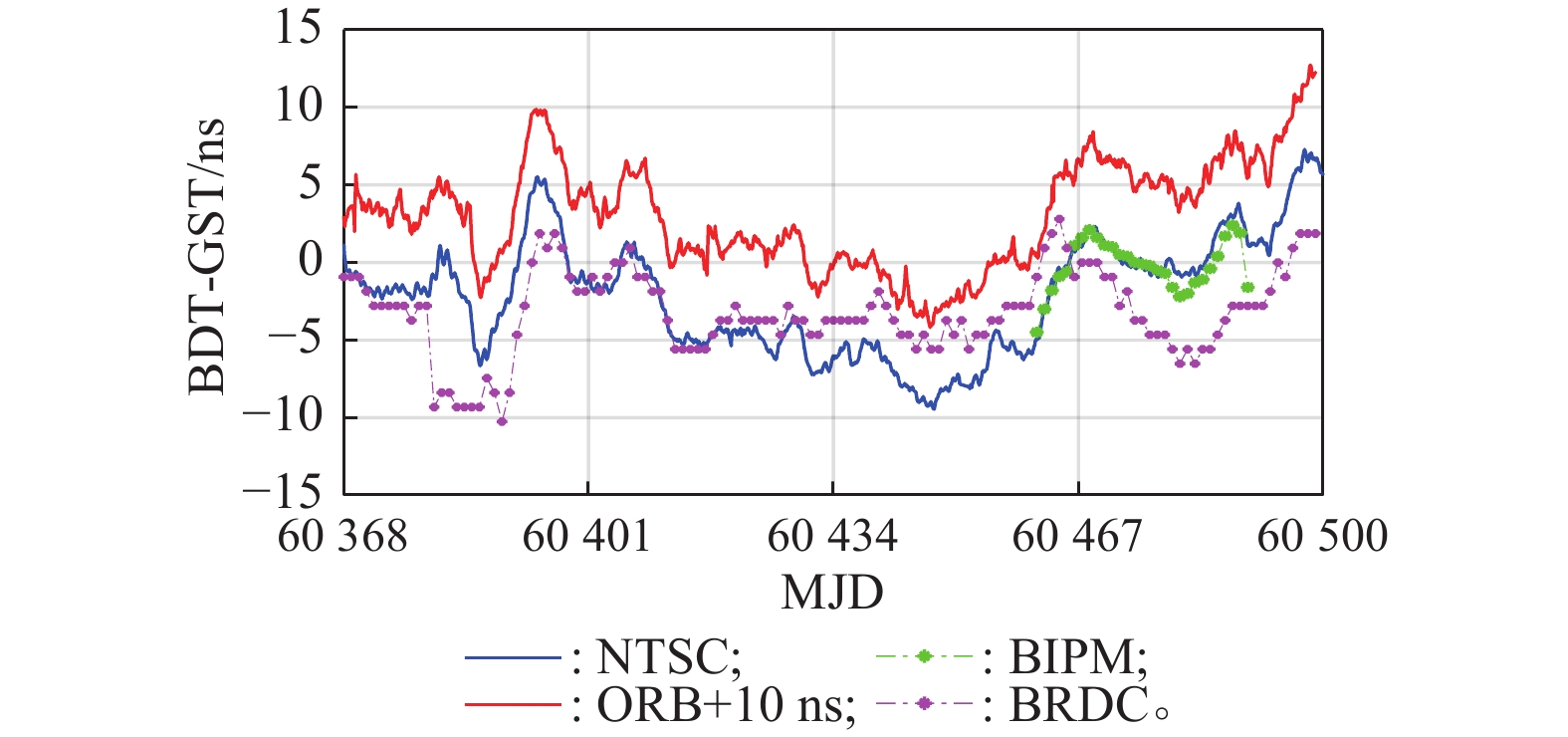
图6
GNSS电文播发的BDT-GLNT与监测结果比较"
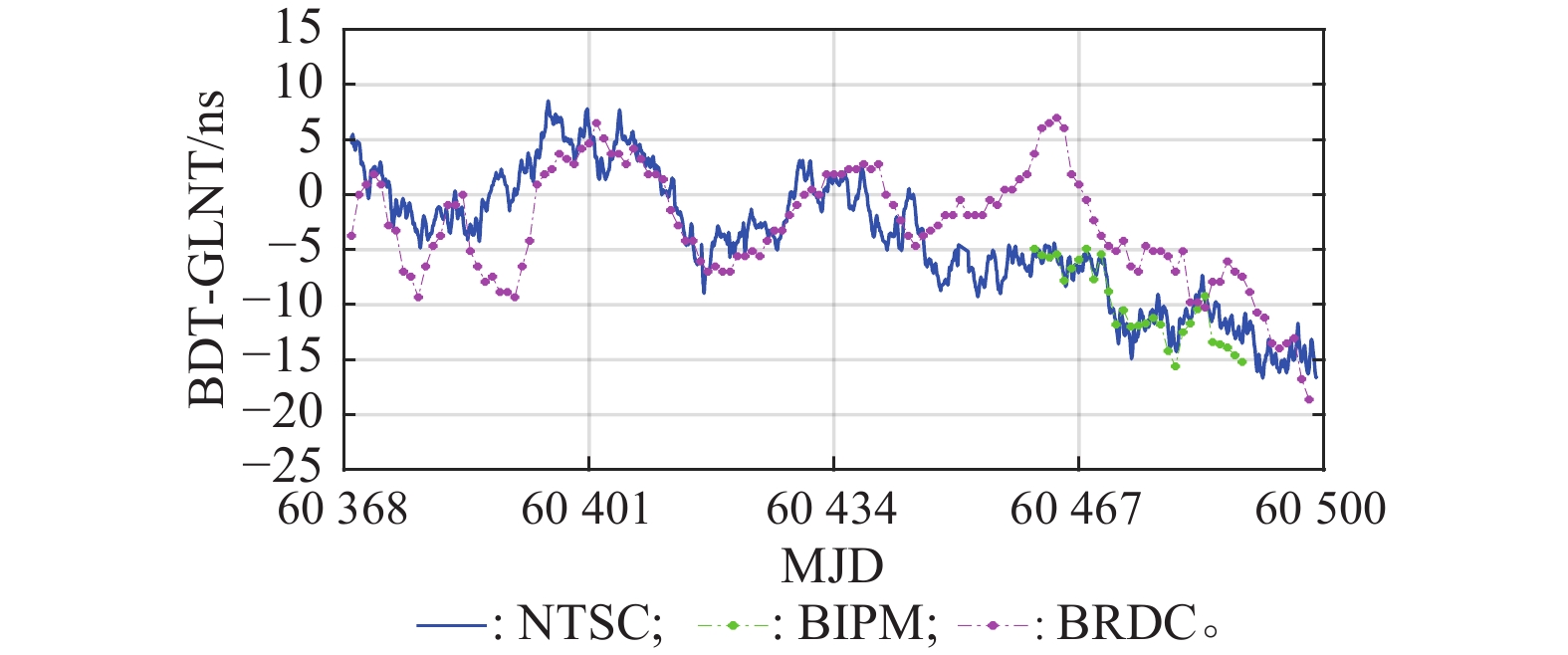
表3
BDT- GST偏差统计"
| 实验室 | 标准差 | 最大偏差 |
| NTSC | 0.79 | 2.32 |
| ORB | 0.67 | 1.54 |
| BRDC | 2.92 | 5.42 |
图7
用户监测、GNSS电文播发与BIPM发布的BDT-GPST的偏差"
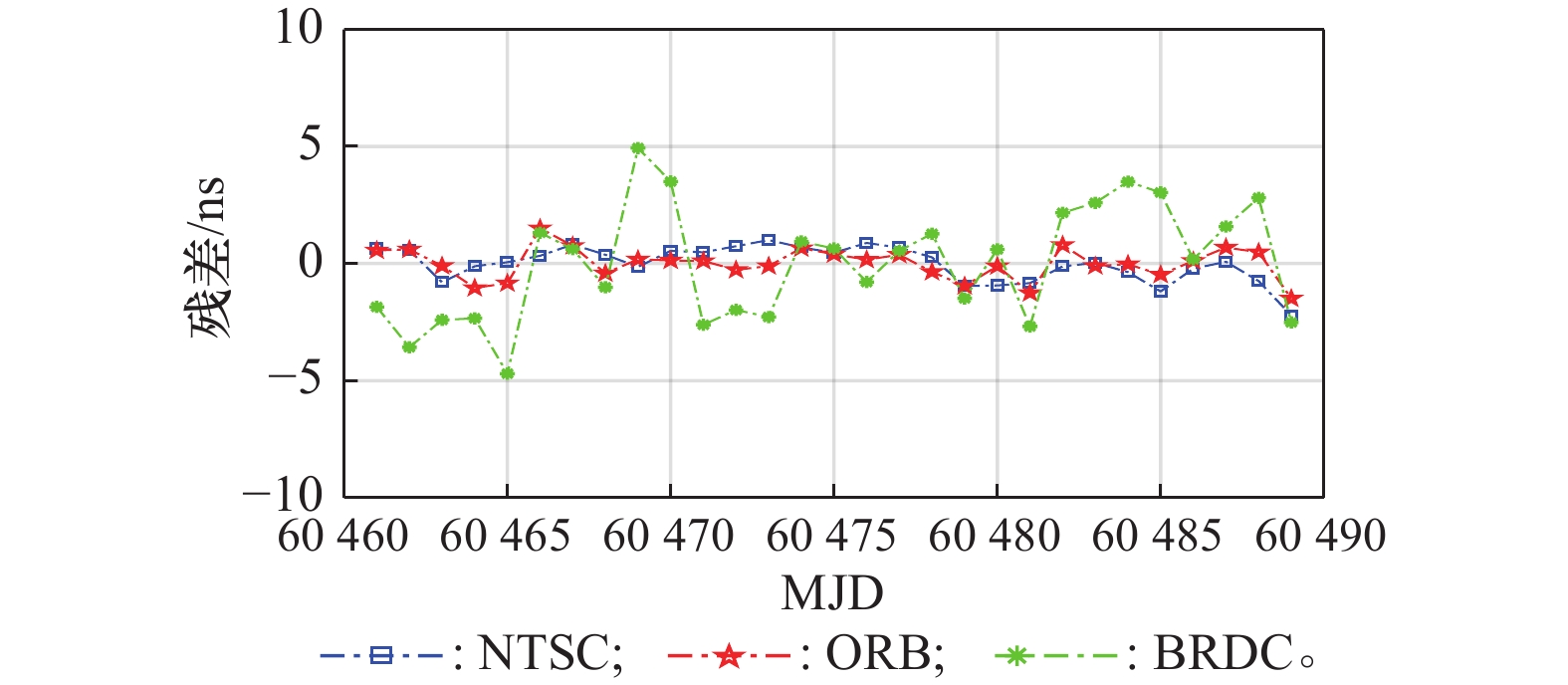
图8
用户监测、GNSS电文播发与BIPM发布的BDT-GST的偏差"
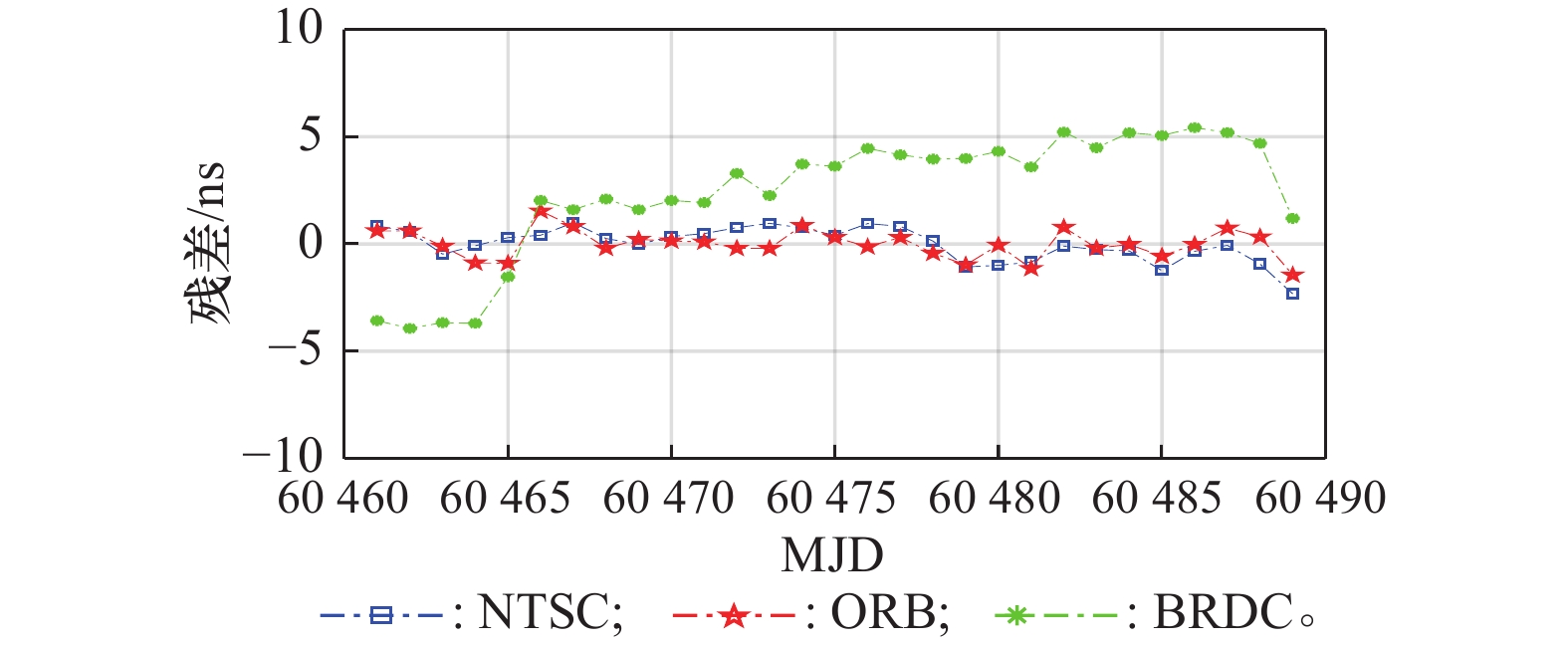
图9
用户监测、GNSS电文播发与BIPM发布的BDT-GLNT的偏差"
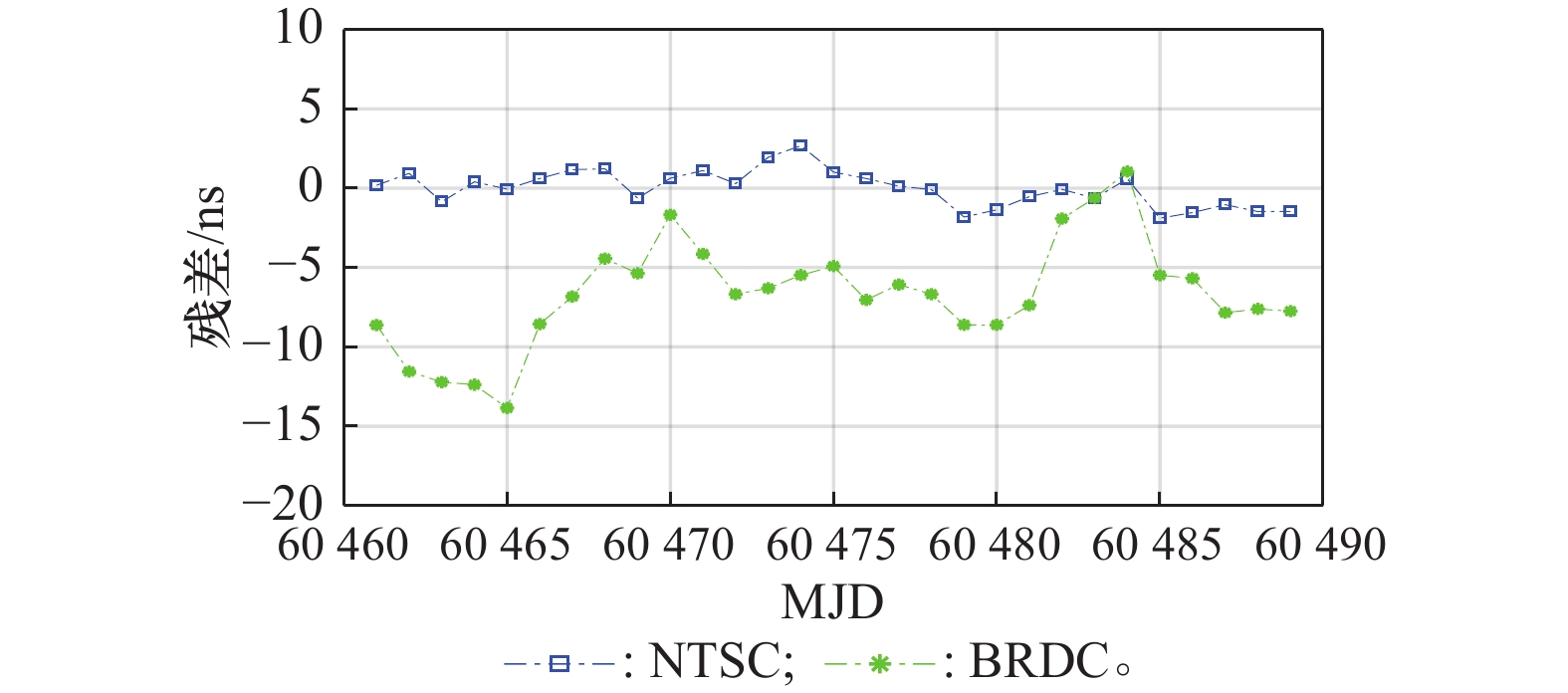
表2
BDT-GPST偏差统计"
| 实验室 | 标准差 | 最大偏差 |
| NTSC | 0.76 | 2.22 |
| ORB | 0.68 | 1.51 |
| BRDC | 2.45 | 4.95 |
表4
BDT- GLNT偏差统计"
| 实验室 | 标准差 | 最大偏差 |
| NTSC | 1.15 | 2.67 |
| BRDC | 3.39 | 13.85 |
图10
UTC(k)相对于UTC的时间偏差"
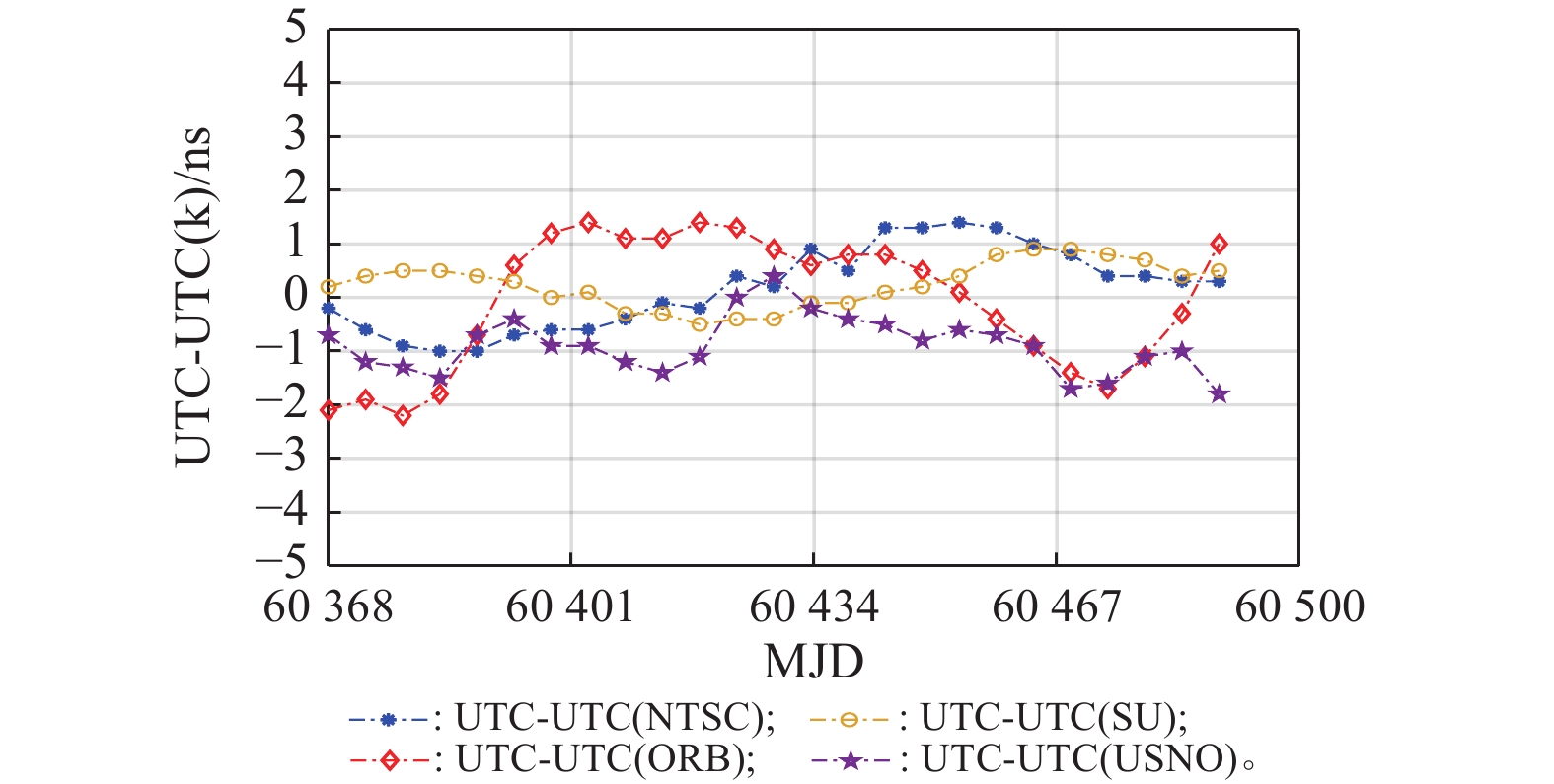
图11
GNSS电文播发的BDUT与监测结果比较"
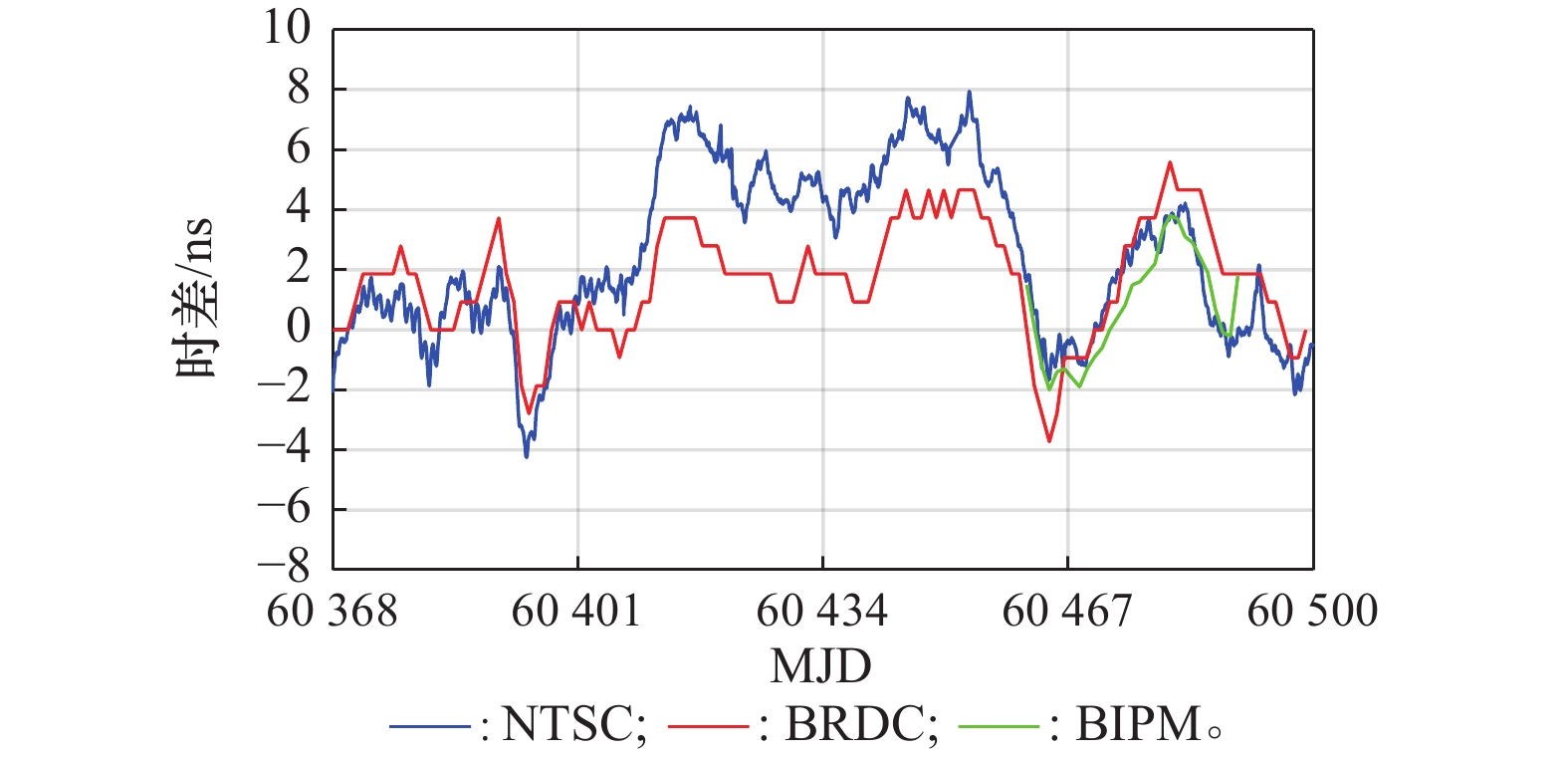
图12
GNSS电文播发的GPUT与监测结果比较"
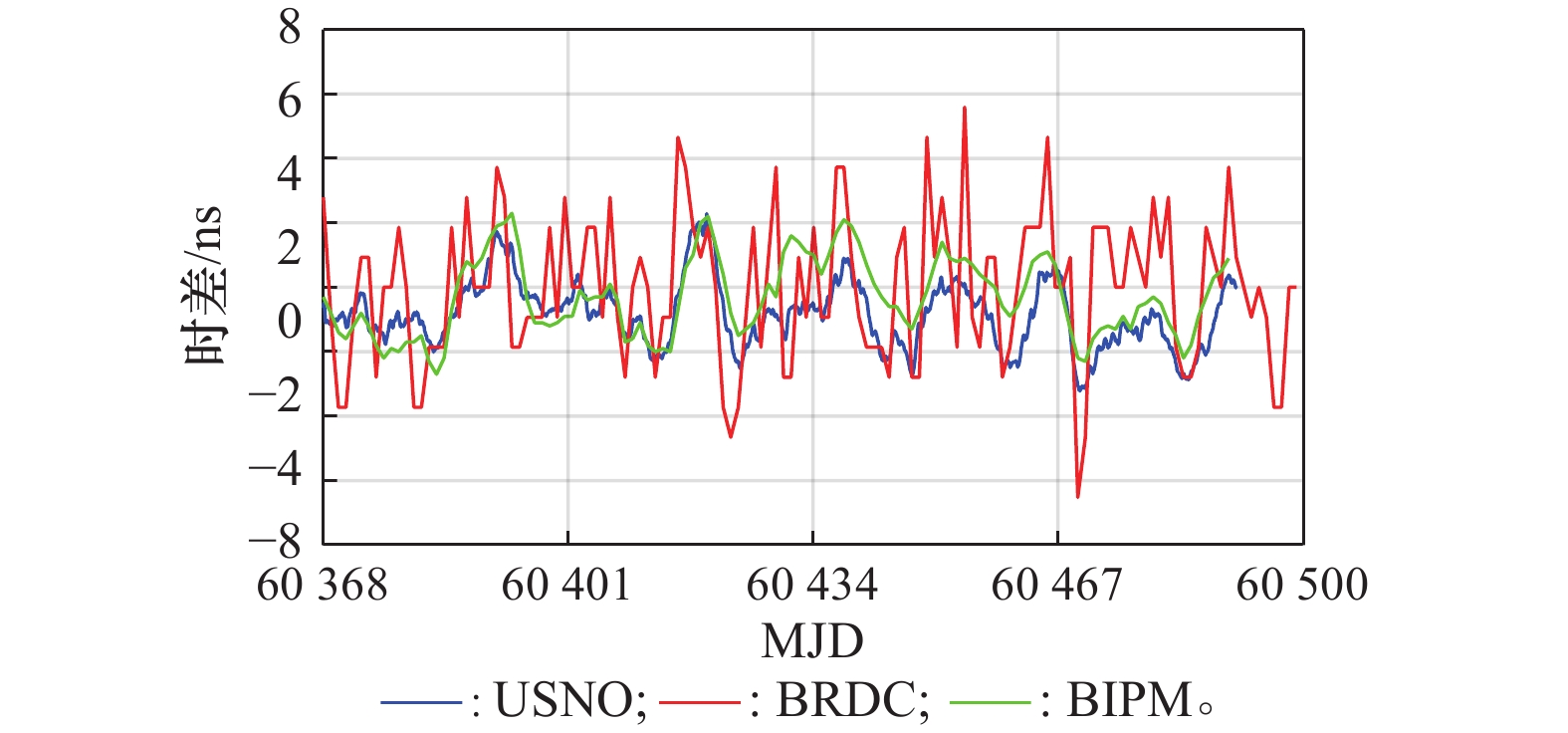
图13
GNSS电文播发的GAUT与监测结果比较"
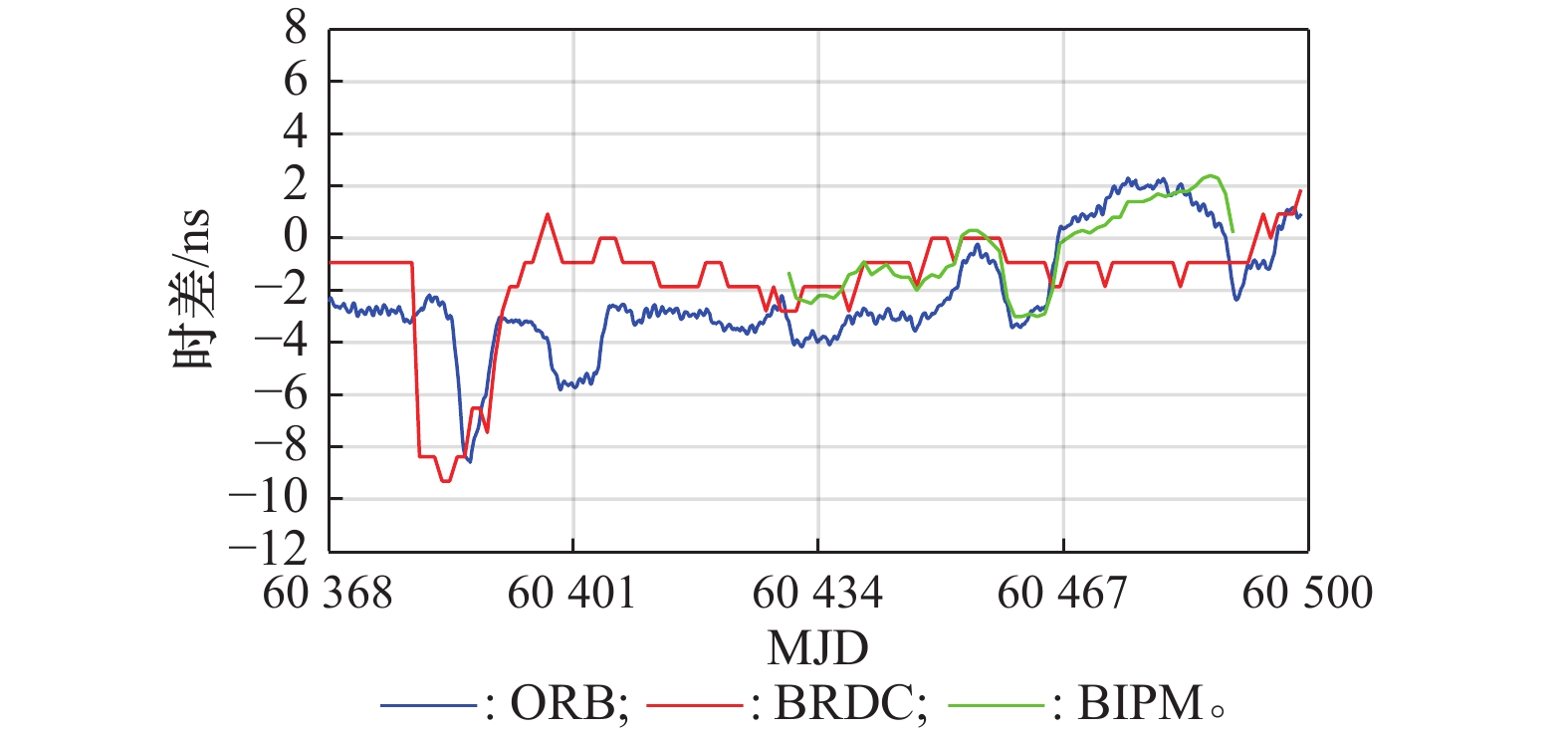
图14
GNSS电文播发的GLUT与监测结果比较"
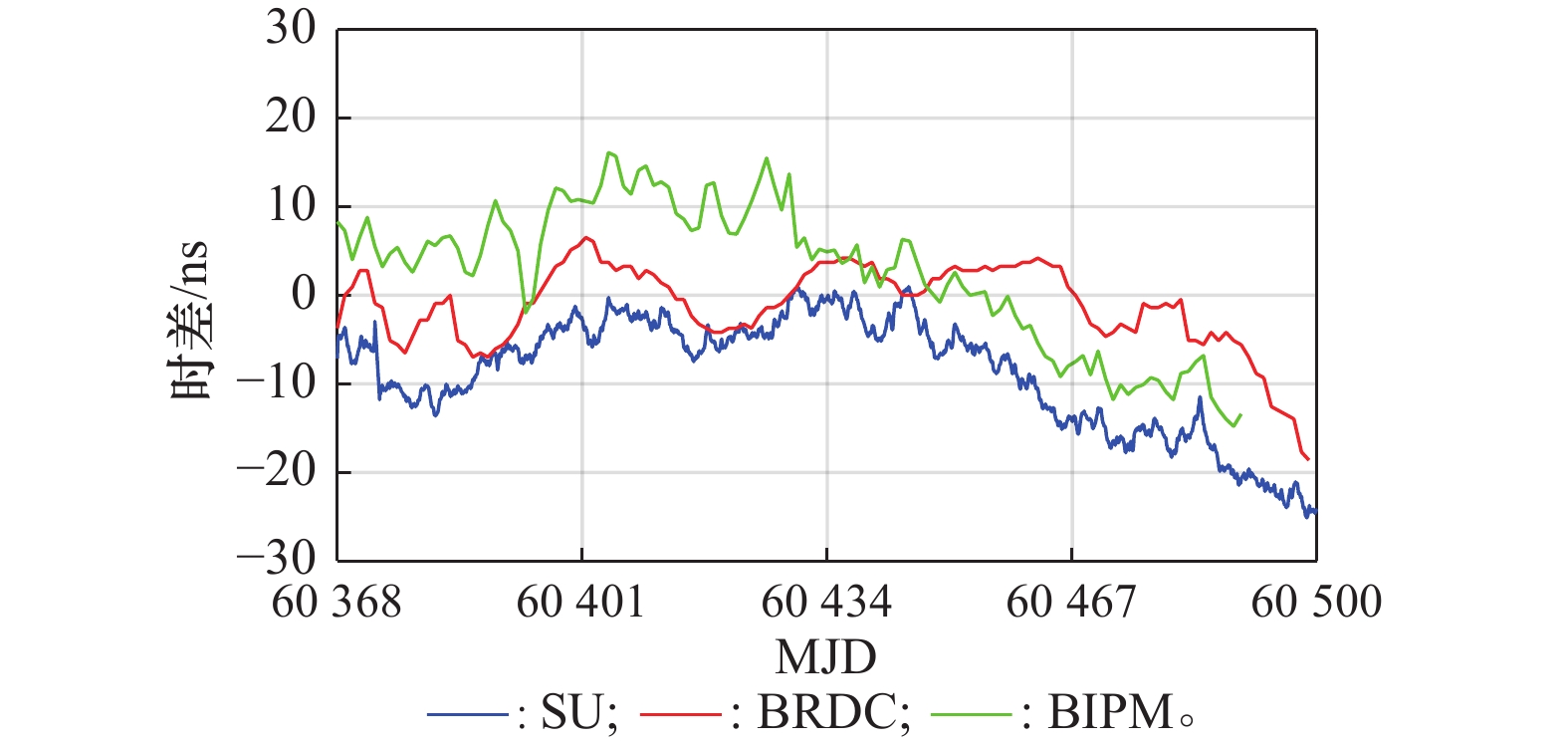
表6
GPUT偏差统计"
| 实验室 | 标准差 | 最大偏差 |
| USNO | 0.79 | 2.51 |
| BRDC | 2.15 | 5.36 |
表7
GAUT偏差统计"
| 实验室 | 标准差 | 最大偏差 |
| ORB | 0.99 | 2.10 |
| BRDC | 1.58 | 3.66 |
图15
NTSC监测/GNSS电文播发的BDUT与BIPM公布结果偏差"
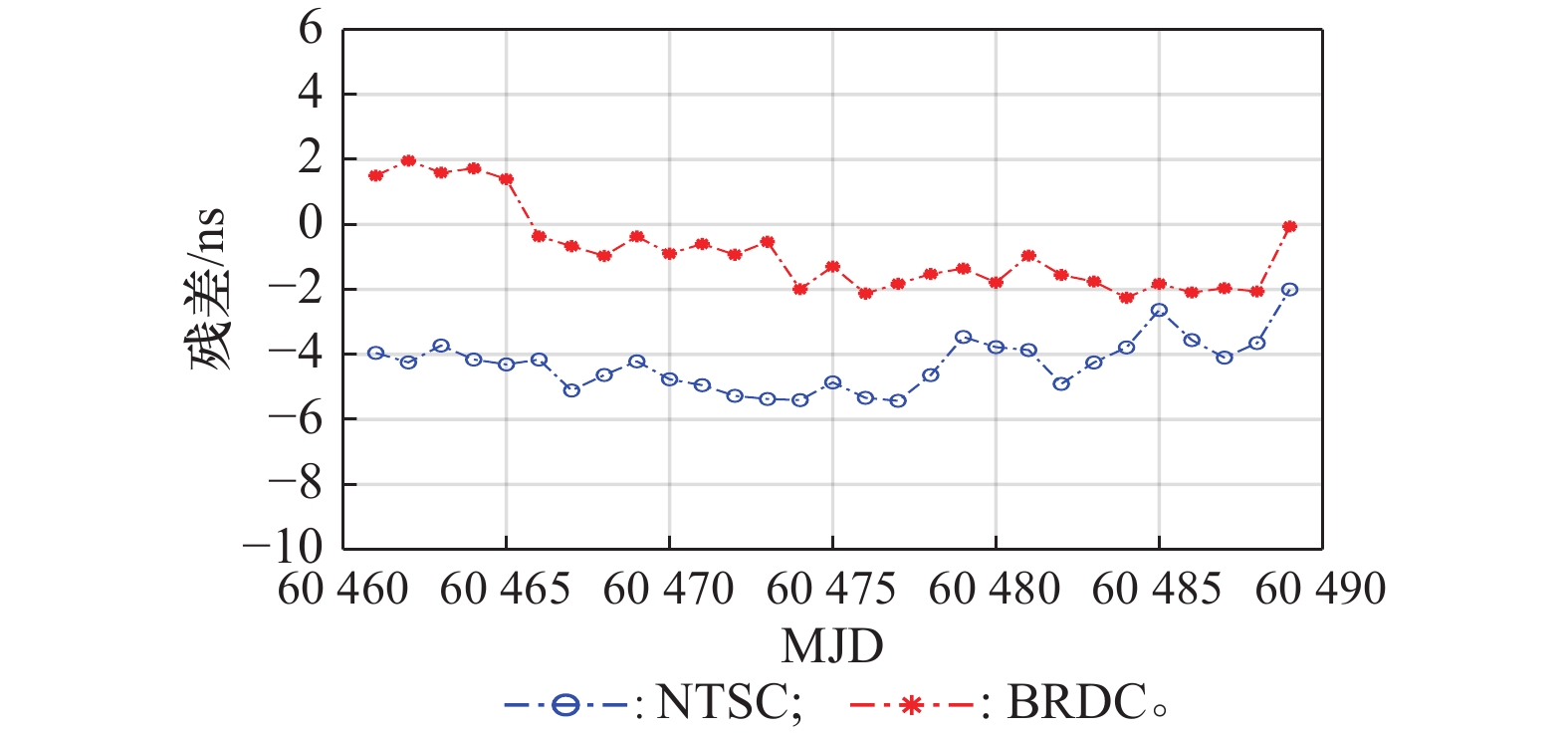
图16
USNO监测/GNSS电文播发的GPUT与BIPM公布结果偏差"
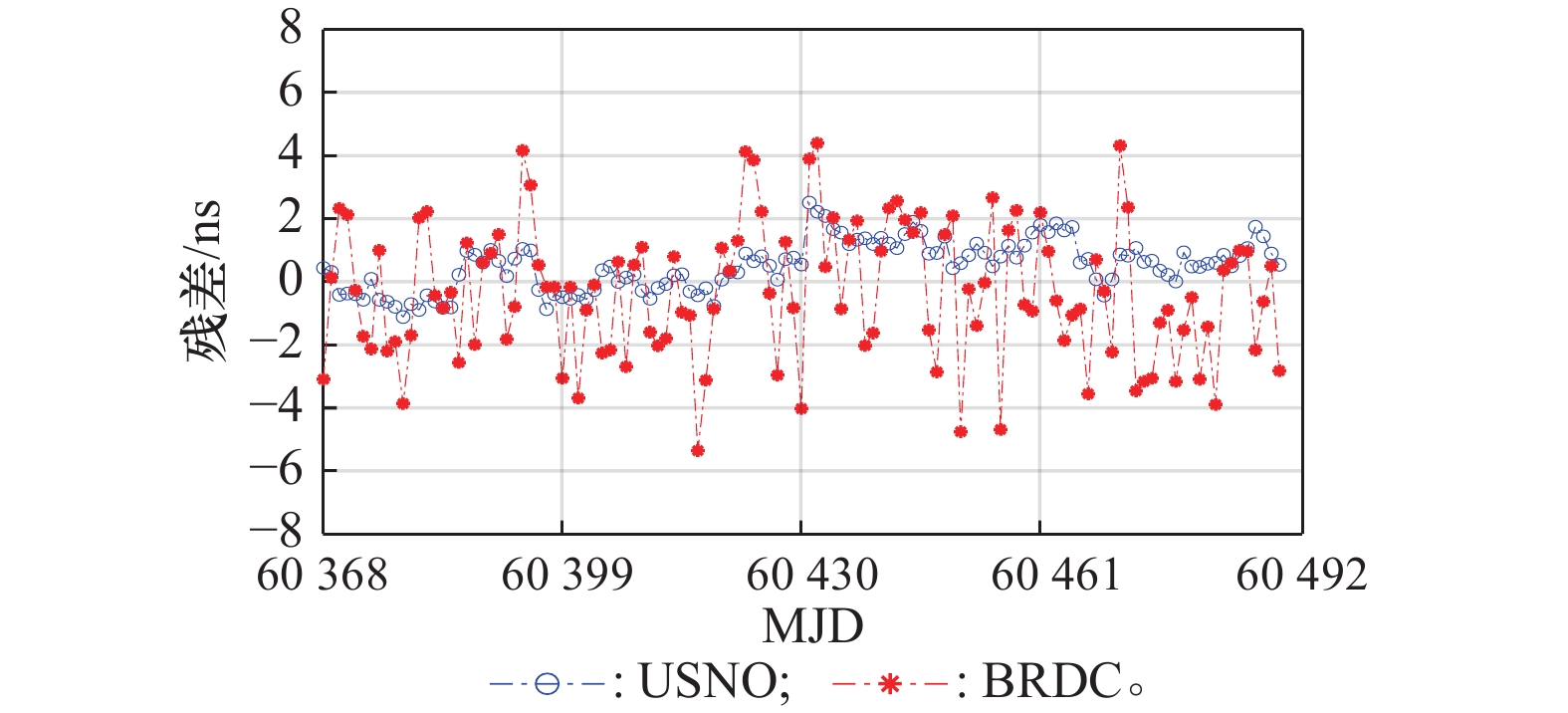
图17
ORB监测/GNSS电文播发的GAUT与BIPM公布结果偏差"
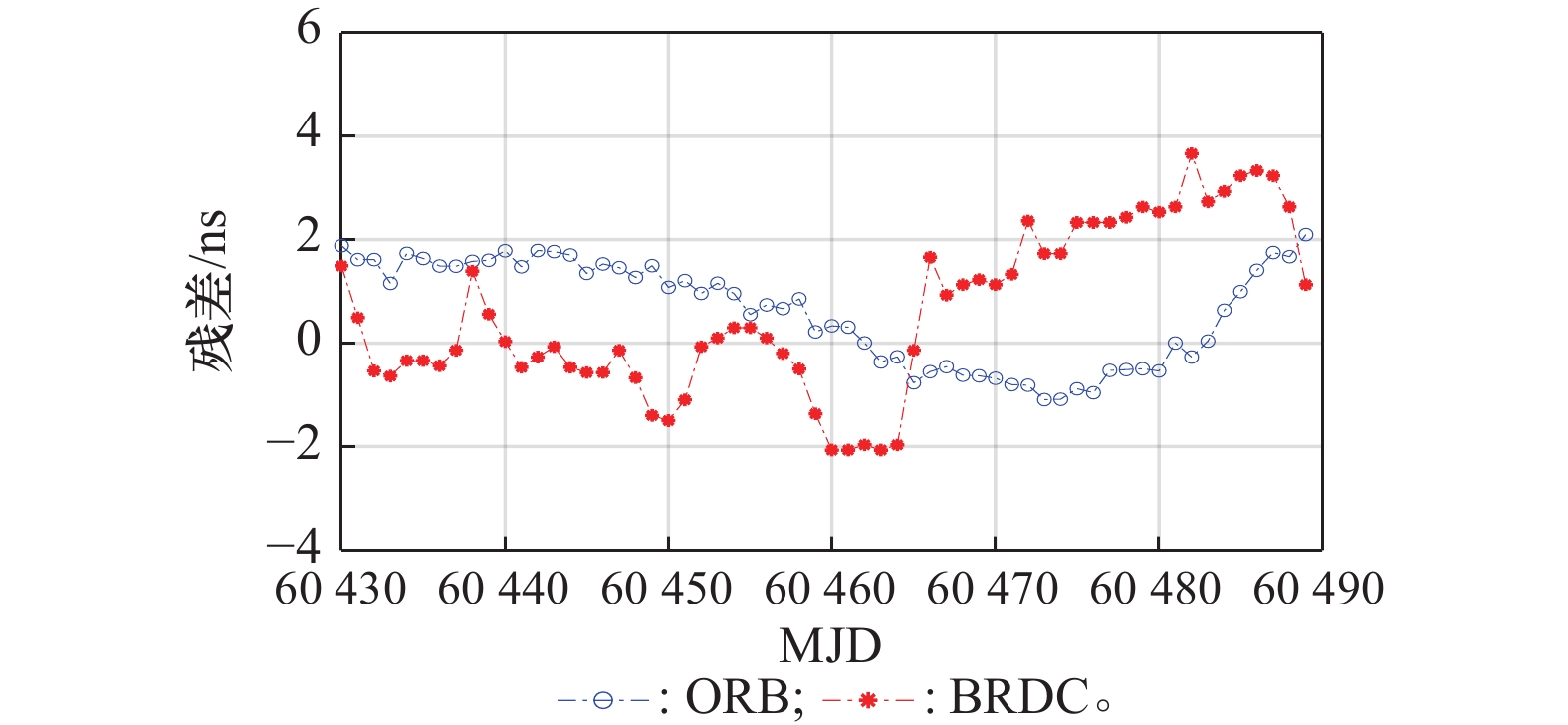
图18
SU监测的/GNSS电文播发的GLUT与BIPM公布结果偏差"
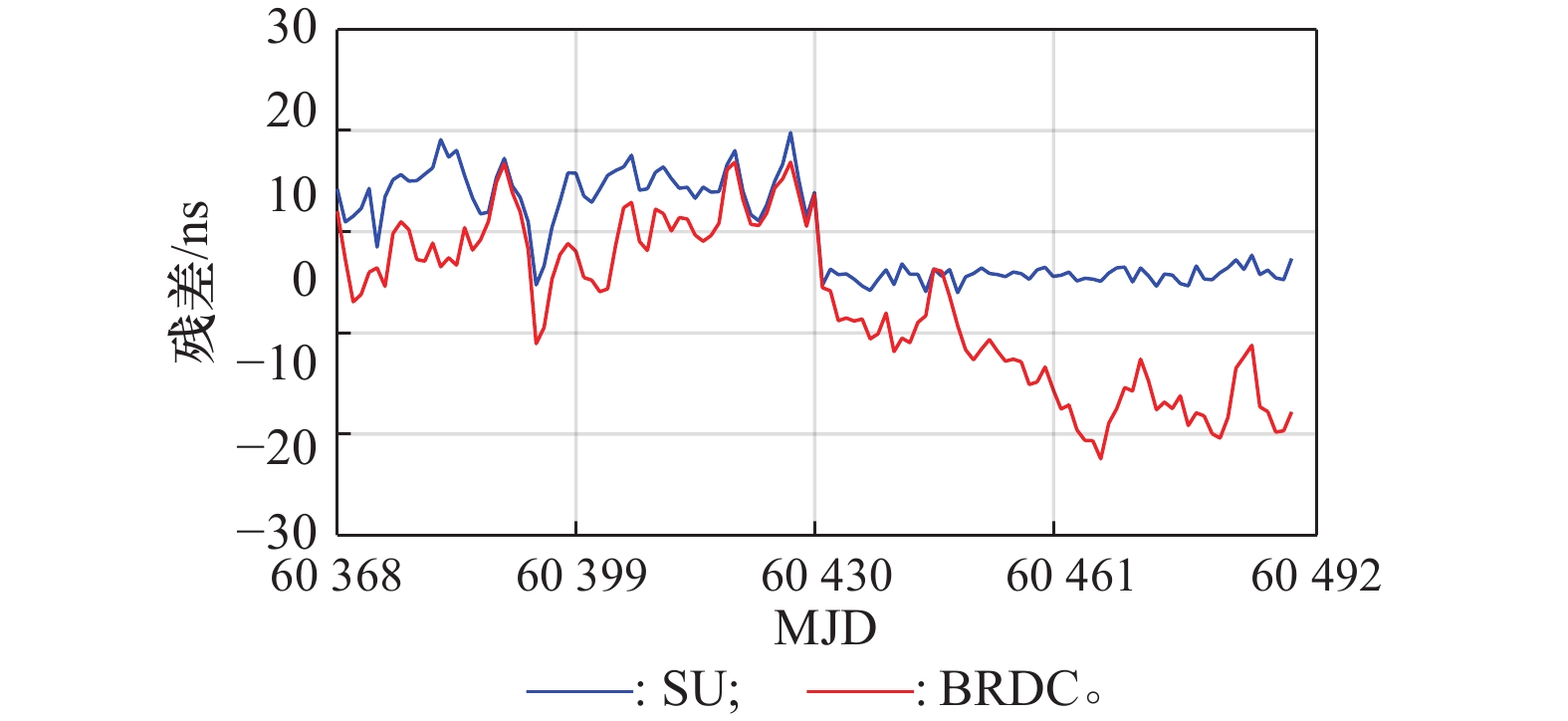
表5
BDUT偏差统计"
| 实验室 | 标准差 | 最大偏差 |
| NTSC | 0.82 | 5.43 |
| BRDC | 1.29 | 2.26 |
表8
GLUT偏差统计"
| 实验室 | 标准差 | 最大偏差 |
| SU | 4.69 | 19.82 |
| BRDC | 7.94 | 16.90 |
图19
USNO监测/GNSS电文播发的GPUT与BIPM公布结果残差分位数图"
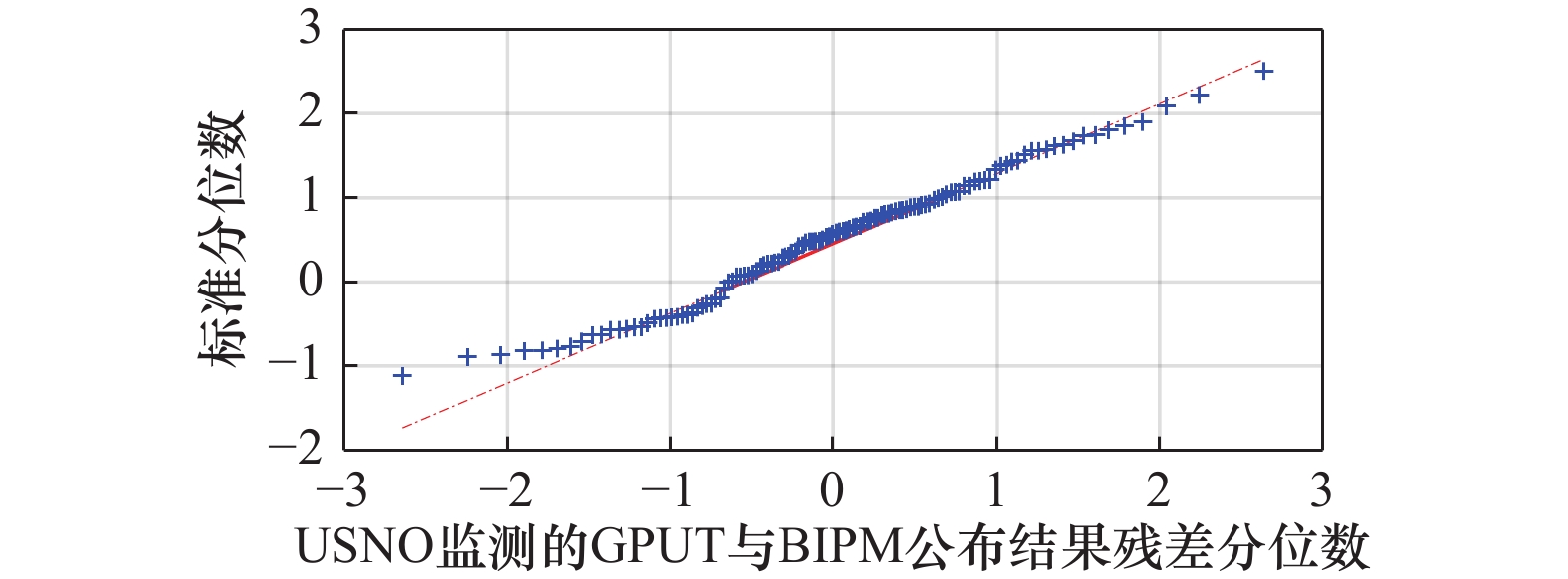
图20
ORB监测/GNSS电文播发的GAUT与BIPM公布结果残差分位数图"
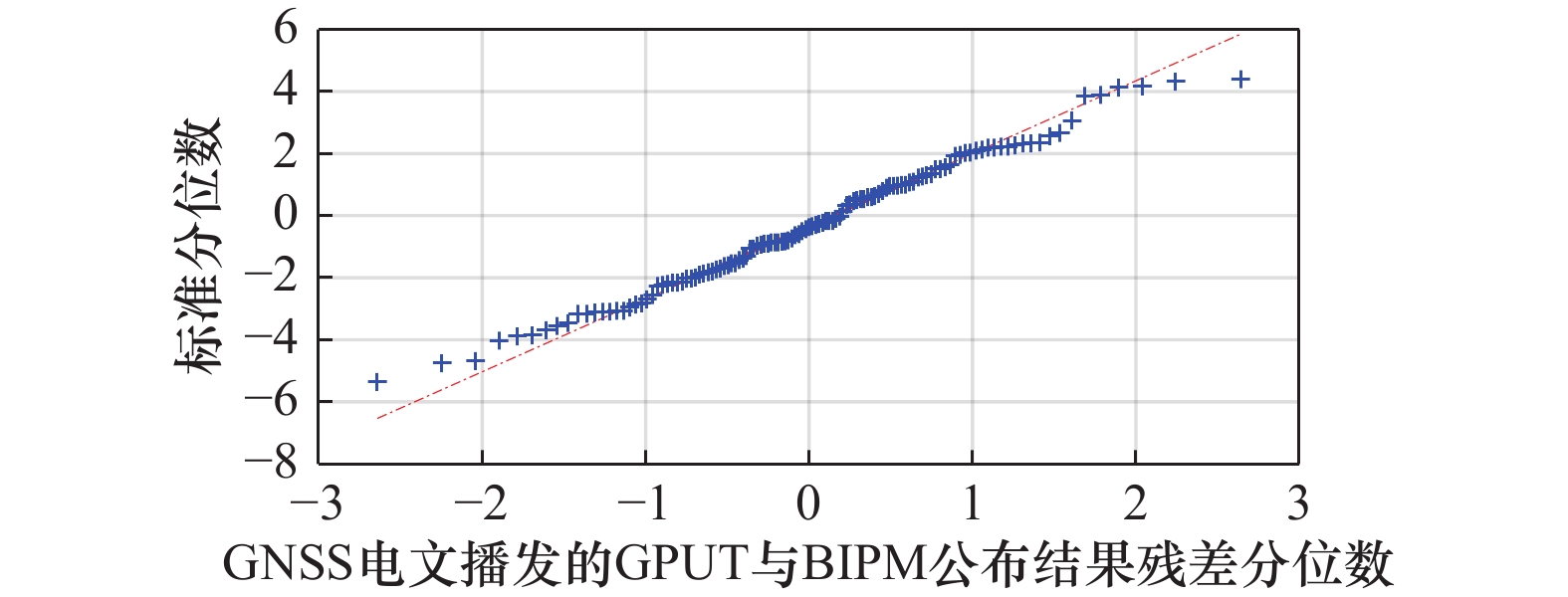
图21
SU监测/GNSS电文播发的GLUT与BIPM公布结果残差分位数图"
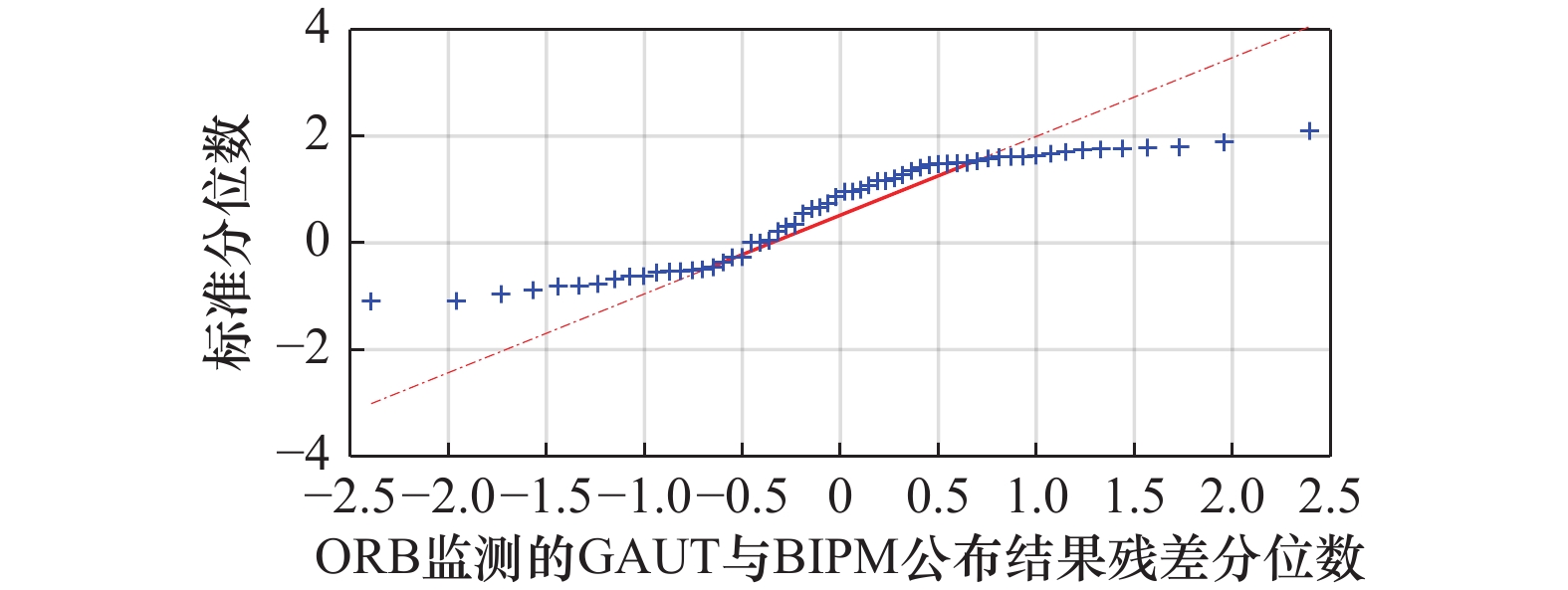
图22
GNSS电文播发的GAUT与BIPM公布结果残差分位数图"
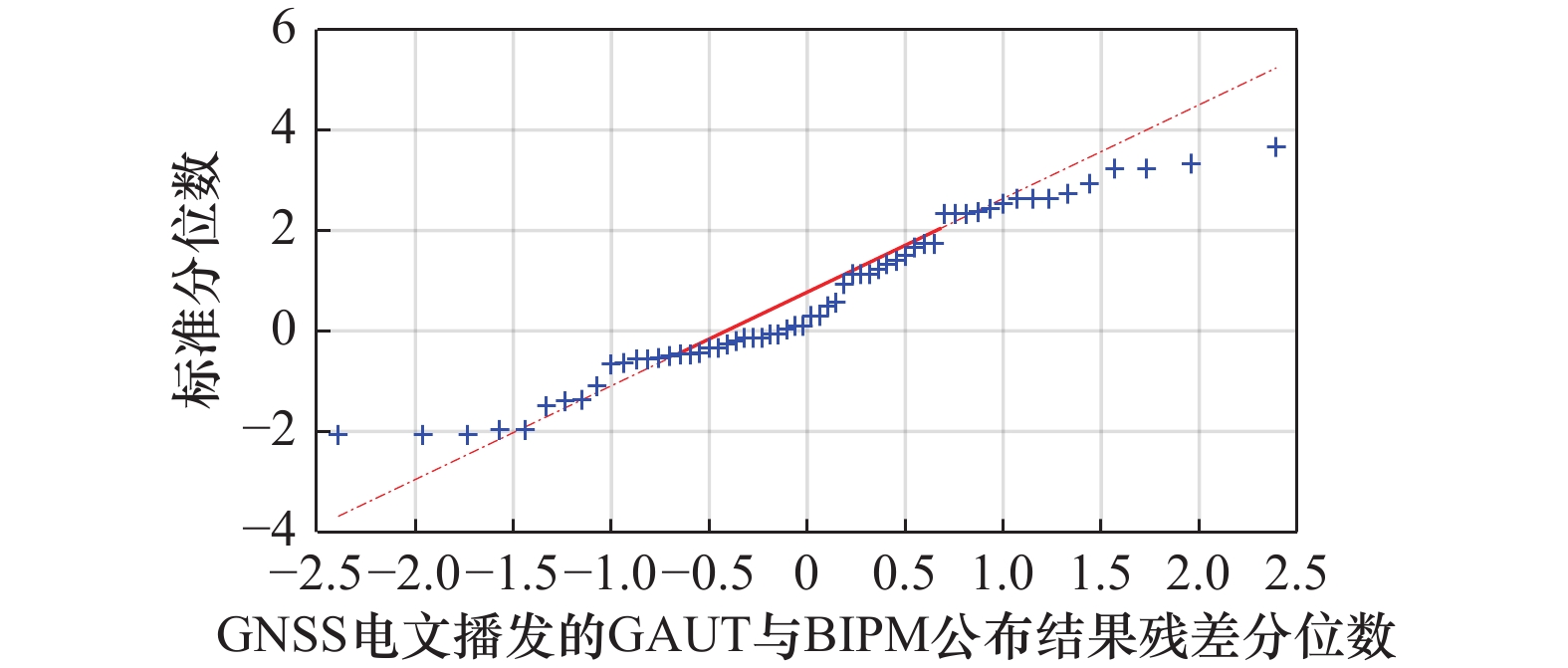
图23
SU监测的GLUT与BIPM公布结果残差分位数图"
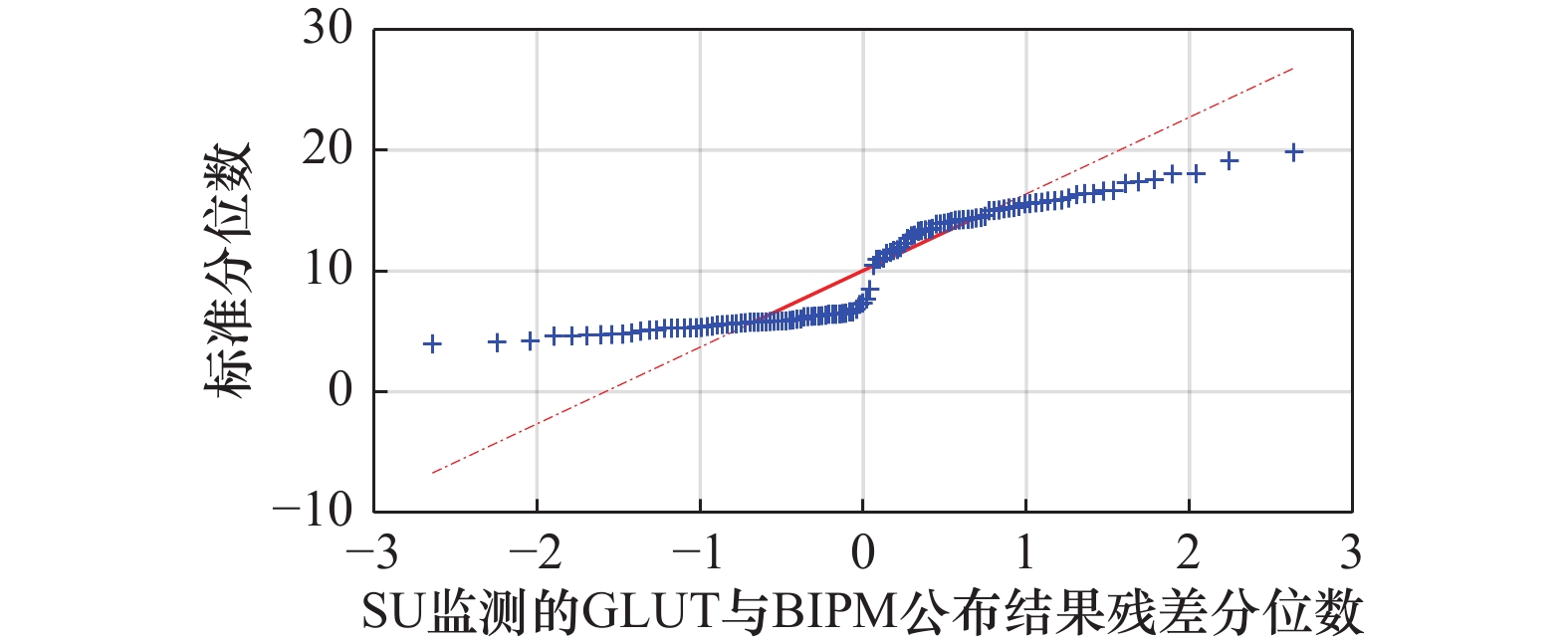
图24
GNSS电文播发的GLUT与BIPM公布结果残差分位数图"

| 1 | 卢鋆, 宿晨庚, 胡敏, 等. 北斗三号系统互操作实现与性能分析[J]. 中国科学: 物理学 力学 天文学, 2021, 51 (1): 1- 14. |
| LU J, SU C G, HU M, et al. Analysis of the Beidou navigation satellite system: interoperability and performance[J]. SCIENTIA SINICA Physica, Mechanica & Astronomica, 2021, 51 (1): 1- 14. | |
| 2 | 朱少林, 岳东杰, 何丽娜, 等. BDS-2/BDS-3 融合三频精密单点定位模型及偏差特性分析[J]. 武汉大学学 报(信息科学版), 2023, 48 (12): 2049- 2059. |
| ZHU S L, YUE D J, HE L N, et al. BDS-2/BDS-3 joint triplefrequency precise point positioning models and bias characteristic analysis[J]. Geomatics and Information Science of Wuhan University, 2023, 48 (12): 2049- 2059. | |
| 3 |
MA J. BDS/GPS deformation analysis of a long-span cablestayed bridge based on colored noise filtering[J]. Geodesy and Geodynamics, 2023, 14 (2): 163- 171.
doi: 10.1016/j.geog.2022.08.005 |
| 4 |
MARCIN M, KAMIL K, TOMASZ H, et al. Stochastic modeling of the receiver clock parameter in Galileo-only and multi-GNSS PPP solutions[J]. GPS Solutions, 2024, 28 (1): 14.
doi: 10.1007/s10291-023-01556-9 |
| 5 | 周锋. 多系统 GNSS 非差非组合精密单点定位相关理论和方法研究[J]. 测绘学报, 2020, 49 (7): 938. |
| ZHOU F. Theory and methodology of multi-GNSS undifferenced and uncombined precise point positioning[J]. Acta Geodaetica and Cartographica Sinica, 2020, 49 (7): 938. | |
| 6 |
WU P D, LOU Y D, ZHANG W X, et al. Evaluation of real-time kinematic positioning performance of the BDS-3 PPP service on B2b signal[J]. GPS Solutions, 2023, 27 (8): 192.
doi: 10.1007/s10291-023-01532-3 |
| 7 | The receiver independent exchange format Version 4.00 [EB/OL]. [2024-08-13]. https://igs.org/formats-and-standards/. |
| 8 |
熊超, 刘宗毅, 卢传芬, 等. 国外卫星导航系统发展现状与趋势[J]. 导航定位学报, 2021, 9 (3): 13- 19.
doi: 10.3969/j.issn.2095-4999.2021.03.003 |
|
XIONG C, LIU Z Y, LU C F, et al. Review and analysis of status and development trend of the foreign satellite navigation systems[J]. Journal of Navigation and Positioning, 2021, 9 (3): 13- 19.
doi: 10.3969/j.issn.2095-4999.2021.03.003 |
|
| 9 |
刘健, 曹冲. 全球卫星导航系统发展现状与趋势[J]. 导航定位学报, 2020, 8 (1): 1- 8.
doi: 10.3969/j.issn.2095-4999.2020.01.001 |
|
LIU J, CAO C. Development status and trend of global navigation satellite system[J]. Journal of Navigation and Positioning, 2020, 8 (1): 1- 8.
doi: 10.3969/j.issn.2095-4999.2020.01.001 |
|
| 10 | KOVACH K, MENDICKI P J, POWERS E, et al, GPS receiver impact from the UTC offset(UTCO) anomaly of 25-26 January 2016[C]// Proc. of the 29th International Technical Meeting of the Satellite Division of the Institute of Navigation, 2016: 2887−2895. |
| 11 | 中国卫星导航系统管理办公室. 北斗卫星导航系统公开服务性能规范(3.0版)[EB/OL]. [2024-08-13]. http://www.beidou.gov.cn/xt/gfxz/202105/P020210526215541444683.pdf. |
| China Satellite Navigation Office. BeiDou navigation satellite system open service performance standard (Version 3.0) [EB/OL]. [2024-08-13]. http://www.beidou.gov.cn/xt/gfxz/202105/P020210526215541444683.pdf. | |
| 12 | 卢鋆, 武建峰, 袁海波, 等. 北斗三号系统时频体系设计与实现[J]. 武汉大学学报(信息科学版), 2023, 48 (8): 1340- 1348. |
| LU J, WU J F, YUAN H B, et al. Design and implementation of time and frequency architecture for BeiDou-3 system[J]. Geomatics and Information Science of Wuhan University, 2023, 48 (8): 1340- 1348. | |
| 13 |
ZHANG Z, SUN B Q, WANG K, et al. Sub-nanosecond UTC dissemination based on BDS-3 PPP-B2b service[J]. Remote Sensing, 2023, 16 (1): 43.
doi: 10.3390/rs16010043 |
| 14 | WU W J, GUANG W, BAUCH A, et al. BeiDou time transfer between PTB and NTSC[C]//Proc. of the 49th Annual Precise Time and Time Interval Systems and Applications Meeting, 2018. |
| 15 | 孙广, 陆华, 沈利荣, 等. 基于BDS、GPS 、GLONASS 系统的时间溯源性能监测评估[C]//第7届中国卫星导航学术年会, 2016. |
| SUN G, LU H, SHEN L R, et al. Evaluation and monitoring on traceability model based on the BDS, GPS and GLONASS[C]//Proc. of the 7th China Navigation Satellite Academic Conference, 2016. | |
| 16 | 张继海, 武文俊, 广伟, 等. 基于北斗共视的国际时间比对研究[J]. 仪器仪表学报, 2018, 39 (6): 96- 103. |
| ZHANG J H, WU W J, GUANG W, et al. Study of international common view time comparison by BeiDou[J]. Chinese Journal of Scientific Instrument, 2018, 39 (6): 96- 103. | |
| 17 |
GUANG W, DONG S W, WU W J, et al. Progress of BeiDou time transfer at NTSC[J]. Metrologia, 2018, 55 (2): 175- 187.
doi: 10.1088/1681-7575/aaa673 |
| 18 | 邵沛涵, 高成发, 张瑞成, 等. 基于北斗多频的单历元基线定位方法[J]. 测绘工程, 2023, 32 (2): 49- 54. |
| SHAO P H, GAO F C, ZHANG R C, et al. Single-epoch baseline positioning method based on BDS multi-frequency[J]. Engineering of Surveying and Mapping, 2023, 32 (2): 49- 54. | |
| 19 | 顾嘉琛, 宋传峰, 田坤俊. 顾及OSB改正的BDS-3新频点精密单点定位精度分析[J]. 大地测量与地球动力学, 2023, 43 (1): 18- 22. |
| GU J C, SONG C F, TIAN K J. Precision single point positioning accuracy analysis of BDS-3 new frequencies based on OSB correction[J]. Journal of Geodesy and Geodynamics, 2023, 43 (1): 18- 22. | |
| 20 |
ZHANG R, TU R, FAN L H, et al. Contribution analysis of intersatellite ranging observation to BDS-2 satellite orbit determination based on regional tracking stations[J]. Acta Astronautica, 2019, 164, 297- 310.
doi: 10.1016/j.actaastro.2019.07.029 |
| 21 |
ZHAO W, CHEN H, GAO Y, et al. Evaluation of inter-system bias between BDS-2 and BDS-3 satellites and its impact on precise point positioning[J]. Remote Sensing, 2020, 12 (14): 2185.
doi: 10.3390/rs12142185 |
| 22 | ZHOU F, DONG D N, LI P, et al. Influence of stochastic modeling for inter-system biases on multi-GNSS undifferenced and uncombined precise point positioning[J]. GPS Solutions, 2019, 23(3): 59. |
| 23 | 袁海波, 张继海, 广伟. 不同GNSS时差监测方法研究[C]//第9届中国卫星导航学术年会论文集, 2018: 94−98. |
| YUAN H B, ZHANG J H, GUANG W. The study on different methods of time offsets monitoring of GNSS[C]//Proc. of the 9th China Navigation Satellite Academic Conference, 2018: 94−98. | |
| 24 | 刘峰宇, 徐金锋, 王宇谱. 卫星导航系统发播时间偏差参数性能分析评估[C]// 第13届中国卫星导航年会, 2022. |
| LIU F Y, XU J F, WANG Y P. Performance analysis and evaluation of satellite navigation system broadcast time offset parameters[C]//Proc. of the 13th China Navigation Satellite Academic Conference, 2022. | |
| 25 |
YU X D, GAO J X. Kinematic precise point positioning using multi-constellation global navigation satellite system (GNSS) observations[J]. ISPRS International Journal of Geo-Information, 2017, 6 (1): 6.
doi: 10.3390/ijgi6010006 |
| 26 | 田力, 陈俊平, 裴宵, 等. GNSS时差及其在多系统组合定位中的应用[J]. 测绘通报, 2012, (10): 45- 47. |
| TIAN L, CHEN J P, PEI X, et al. GNSS time offset and effects on multi-GNSS positioning performance[J]. Bulletin of Surveying and Mapping, 2012, (10): 45- 47. | |
| 27 | 陈柯勋, 李灯熬, 邱伟. 多模GNSS伪距组合定位方法设计与验证[J]. 红外与激光工程, 2021, 50 (6): 190- 200. |
| CHENG K X, LI D A, QIU W. Design and verification of multi-mode GNSS pseudo-range combined positioning method[J]. Infrared and Laser Engineering, 2021, 50 (6): 190- 200. | |
| 28 | 于洋, 何明, 刘博. 基于TL-LSTM的轴承故障声发射信号识别研究[J]. 仪器仪表学报, 2019, 40 (5): 51- 59. |
| YU Y, HE M, LIU B. Research on acoustic emission signal recognition of bearing fault based on TL-LSTM[J]. Chinese Journal of Scientific Instrument, 2019, 40 (5): 51- 59. | |
| 29 |
李玉梅. 数据的正态性检验方法[J]. 怀化学院学报, 2015, 34 (11): 81- 82.
doi: 10.3969/j.issn.1671-9743.2015.11.020 |
|
LI Y M. The methods for testing normal distribution of data[J]. Journal of Huaihua University, 2015, 34 (11): 81- 82.
doi: 10.3969/j.issn.1671-9743.2015.11.020 |
| [1] | 赵正义, 南普龙. 基于短时傅里叶变换的高效空频自适应抗干扰方法[J]. 系统工程与电子技术, 2025, 47(6): 1778-1785. |
| [2] | 周红进, 宋辉, 范文良, 王苏, 谷东亮. 基于贝叶斯神经网络的船用惯导定位修正方法[J]. 系统工程与电子技术, 2024, 46(4): 1393-1400. |
| [3] | 陈林, 靳云迪, 黄杰, 林静然, 张亚乾. 基于副峰叠加的BOC导航信号捕获算法[J]. 系统工程与电子技术, 2023, 45(7): 2211-2219. |
| [4] | 余德荧, 李厚朴, 纪兵, 边少锋. 基于灰狼优化算法的快速选星方法[J]. 系统工程与电子技术, 2023, 45(5): 1489-1495. |
| [5] | 王鹏博, 贺成艳, 杨倩倩, 佟文华. 窄带干扰信号对北斗三号B2信号质量的影响[J]. 系统工程与电子技术, 2022, 44(7): 2286-2292. |
| [6] | 付栋, 彭竞, 马明, 陈飞强, 欧钢. 基于钟差检验的GNSS授时欺骗检测与识别[J]. 系统工程与电子技术, 2022, 44(3): 948-955. |
| [7] | 刘睿, 杨志伟, 陈奇东, 廖桂生, 甄卫民. 基于信号传播修正的GNSS干扰源质心定位方法[J]. 系统工程与电子技术, 2021, 43(8): 2083-2089. |
| [8] | 潘党飞, 刘文学, 葛建, 袁洪, 袁超. GNSS接收机射频前端电路相位噪声评估方法[J]. 系统工程与电子技术, 2020, 42(3): 536-543. |
| [9] | 王海洋, 姚志成, 范志良, 吴瑾颖, 刘光斌. 高速运动环境下GNSS接收机阵列抗干扰算法[J]. 系统工程与电子技术, 2020, 42(11): 2409-2417. |
| [10] | 范宇清, 程二威, 魏明, 张庆龙, 陈亚洲. 高功率微波弹对GNSS接收机毁伤效果分析[J]. 系统工程与电子技术, 2020, 42(1): 37-44. |
| [11] | 葛宝爽, 张海, 晋燕琼. 基于冗余量测的GNSS多路径误差抑制算法[J]. 系统工程与电子技术, 2019, 41(11): 2581-2587. |
| [12] | 李文刚, 王屹伟, 陈睿, 刘猛. BOC调制信号抗多径双环估计方法[J]. 系统工程与电子技术, 2018, 40(5): 1118-1123. |
| [13] | 李文刚, 王屹伟. 高动态下导频辅助的GNSS信号比特同步方法[J]. 系统工程与电子技术, 2018, 40(2): 255-260. |
| [14] | 侯洪涛,周鸿伟,李群,常强,张旺勋. 卫星导航系统接收传感器网络的攻击检测研究[J]. 系统工程与电子技术, 2014, 36(6): 1195-1200. |
| [15] | 侯洪涛,谢菲,张旺勋,王维平,黄丛山. 基于Markov过程的导航系统星座可用性分析[J]. 系统工程与电子技术, 2014, 36(4): 685-690. |
| 阅读次数 | ||||||
|
全文 |
|
|||||
|
摘要 |
|
|||||
