Systems Engineering and Electronics ›› 2026, Vol. 48 ›› Issue (7): 2367-2377.doi: 10.12305/j.issn.1001-506X.2026.07.21
• Systems Engineering • Previous Articles
Research on optimization of decoy quantity ratio based on dynamic Weibull distribution
Zhenghao LI( ), Xinghao LI, Yanxiang JIA, Jian LI, Weiwei BIAN
- Beijing Machinery and Equipment Research Institute,Beijing 100854,China
-
Received:2025-06-19Revised:2025-09-28Online:2026-03-20Published:2026-03-20 -
Contact:Yanxiang JIA E-mail:l15829822006@163.com

CLC Number:
Cite this article
Zhenghao LI, Xinghao LI, Yanxiang JIA, Jian LI, Weiwei BIAN. Research on optimization of decoy quantity ratio based on dynamic Weibull distribution[J]. Systems Engineering and Electronics, 2026, 48(7): 2367-2377.
share this article

Table 1
Two-parameter optional mathematical forms"
| 动态类型 | 适用场景 | 数学形式 | 示例 |
| 分段常数 | 侦察强度变化较大(如增派飞机、卫星) | 红方在 临时调转3颗侦察卫星 | |
| 线性/非线性渐变 | 侦察强度持续增强或衰减 (如延长侦察时间、加大侦察范围) | 红方每小时加大 | |
| 周期性波动 | 红方周期性侦察 | 卫星、侦察机过境时间 侦察强度 | |
| 协变量驱动 | 外部因素影响(如天气、兵力) | 其中 | 云层覆盖率每增加 侦察强度降低 |
| 机器学习预测 | 复杂非线性动态模式 | 长短时记忆等预测模型 | 基于实时情报输入预测未来 |
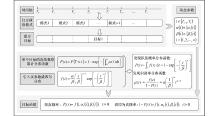
Fig.1
Schematic diagram of detection and identification probability model"
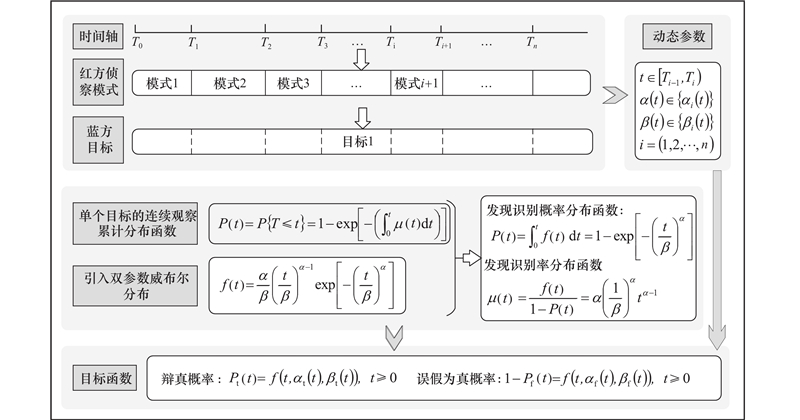
Table 2
Parameter definitions"
| 符号 | 定义 |
| 武器型号数量 | |
| 打击对象的总数量 | |
| 红方攻击使用导弹的数量 | |
| 被分配 | |
| 导弹命中摧毁概率 | |
| 分配 | |
Table 3
Composition analysis of the surface-to-air missile system"
| 系统组成 | 功能定位 | 外形特征 | 重要程度 |
| 指控车 | 指挥中枢,整合雷达、协调发射[ | 方舱结构,多天线 | 很重要 |
| 雷达车 | 探测/制导核心,依赖电磁信号[ | 天线阵面典型特征 | 重要 |
| 发射车 | 导弹存储与发射载体, 依赖雷达信息 | 圆柱筒弹外形 | 重要 |
| 电源车 | 电力供应节点, 现代系统多设计冗余 | 方舱结构, 但热量大 | 一般 |
| 运输车 | 导弹及设备运输,保障快速补给 | 特征一般 | 不重要 |
Table 4
Observed data generation"
| 参数 | 阶段i | ||
| 1 | 2 | 3 | |
| 数据量 | 2 000 | 2 000 | 2 000 |
| 删失比例/% | 5.7 | 0.4 | 0.0 |
Table 5
Relative errors of two-parameter estimation at different stages"
| 参数 | 阶段i | ||
| 1 | 2 | 3 | |
| 1 | 1.5 | 2 | |
| 0.991 6 | 1.470 2 | 1.959 1 | |
| −0.8 | −2.0 | −2.0 | |
| 25 | 20 | 15 | |
| 25.125 0 | 19.678 1 | 14.755 9 | |
| 0.5 | −1.6 | −1.6 | |
Table 6
Phased tow-parameter estimated values"
| 参数 | 阶段i | ||
| 1 | 2 | 3 | |
| 1.490 4 | 2.007 2 | 2.241 4 | |
| 34.785 5 | 29.987 3 | 27.026 3 | |
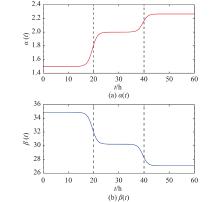
Fig.2
Two-parameter variation curves"
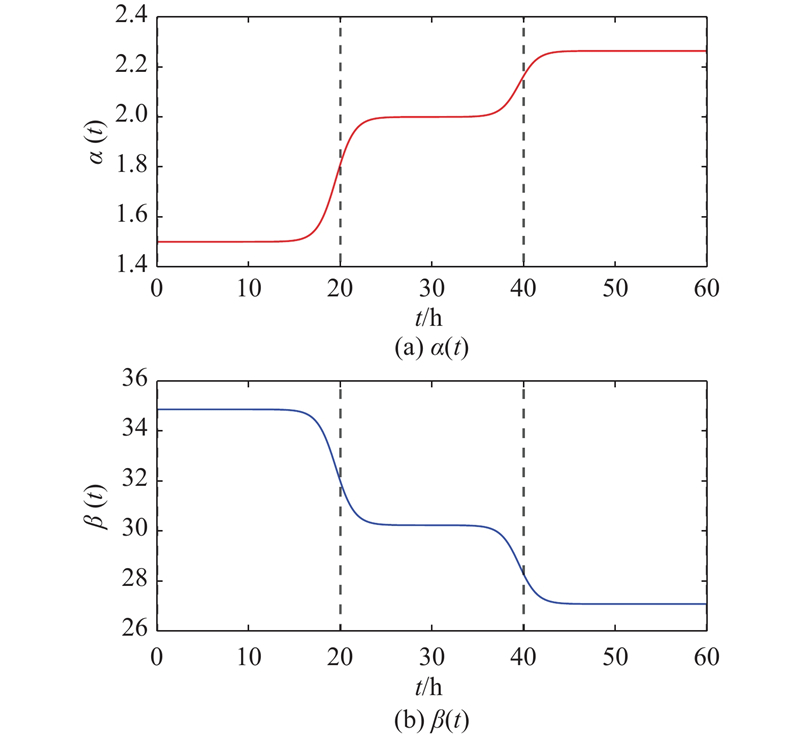
Table 7
Two-parameter values for three distributions"
| 参数 | 动态威布尔 | 静态威布尔 | 指数分布 |
| 1 | |||
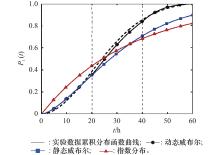
Fig.3
Comparison of the cumulative distribution function curves for three distributions"
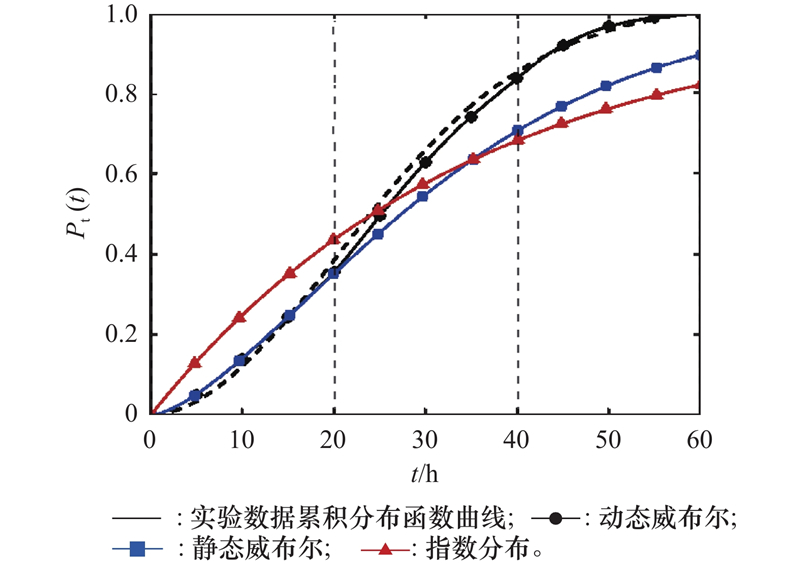
Table 8
Adjustment of the red side firepower input parameter settings"
| 类型 | 参数 | 取值 |
| 定量 | 5 | |
| 0.75 | ||
| 变量 | 17, 21, 25, 50, 100, 170 |
Fig.4
Adjusting the red side firepower and the change in survival probability of each target"
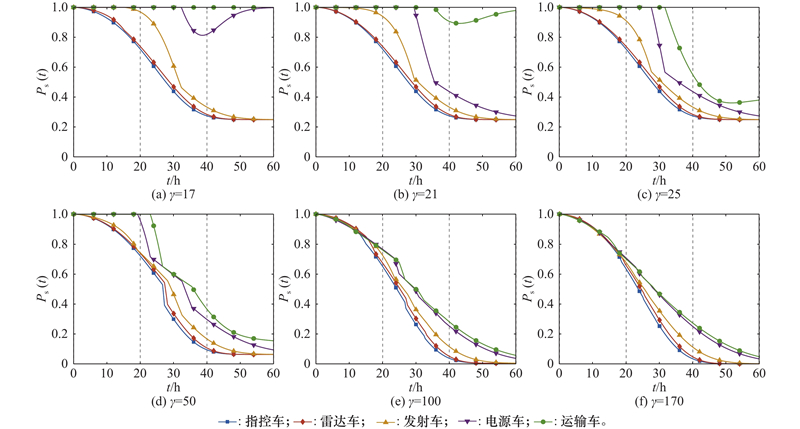
Table 9
Adjustment of decoy quantity input parameter settings"
| 类型 | 参数 | 取值 |
| 定量 | 5 | |
| 0.75 | ||
| 30 | ||
| 变量 | 1:0, 1:1, 1:4, 1:10, 1:20,1:50 |
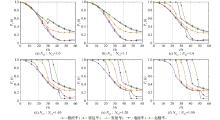
Fig.5
Adjusting the number of decoy and the change in survival probability of each target"
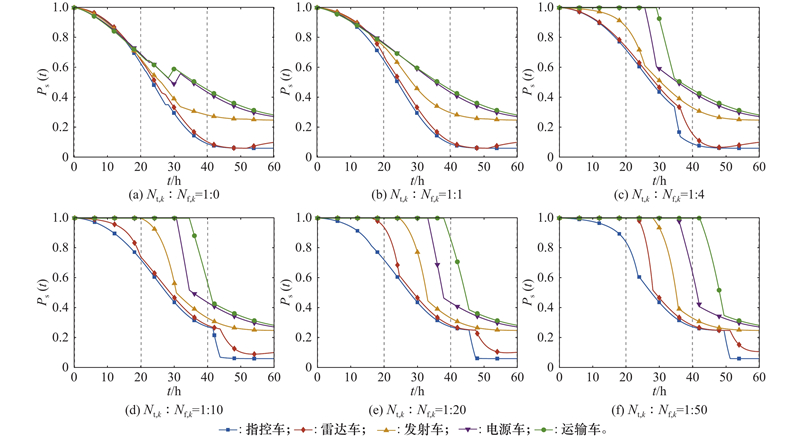
Table 10
Quantity ratio model input parameter settings"
| 参数 | 取值 | 参数 | 取值 | |
| 0.75 | ||||
| 0.2 | ||||
| 21 | ||||
| 1.2 | ||||
| 35 | ||||
| 20 | ||||
| 3 000 |
Table 11
Utility function weighting coefficients"
| 场景 | 权重系数 |
| 场景1 | |
| 场景2 | |
| 场景3 | |
| 场景4 | |
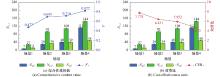
Fig.6
Trends in comprehensive combat value and cost-effectiveness ratio under optimal solutions for four scenarios"
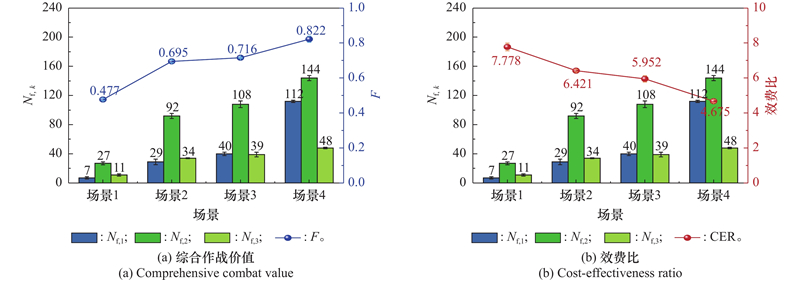
Table 12
Optimization results for different scenarios"
| 场景 | 真假目标数量配比 | 效费比 | 综合作战价值 |
| 初始 | 19:0 | — | 0.380 |
| 场景1 | 19:45 | 7.778 | 0.477 |
| 场景2 | 19:155 | 6.421 | 0.695 |
| 场景3 | 19:187 | 5.952 | 0.716 |
| 场景4 | 19:304 | 4.675 | 0.822 |
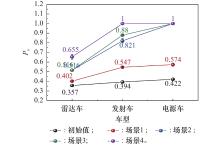
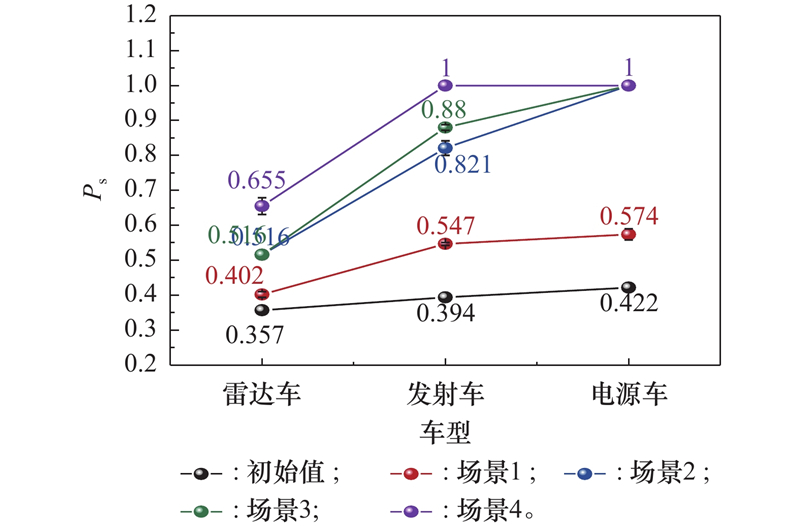
Fig.7
Changes in survival probability of each type vehicle before and after configuration"
| 1 |
SHIMONI M, HAELTERMAN R, PERNEEL C. Hypersectral imaging for military and security applications: combining myriad processing and sensing techniques[J]. IEEE Geoscience and Remote Sensing Magazine, 2019, 7 (2): 101- 117.
doi: 10.1109/MGRS.2019.2902525 |
| 2 | 张华. 2022年国外情报监视侦察装备发展研究[J]. 国防科技工业, 2023(1): 37−40. |
| ZHANG H. Research on the development of foreign intelligence, surveillance and reconnaissance equipment in 2022[J]. Defence Science & Technology Industry, 2023(1): 37−40. | |
| 3 |
WANG F Y, LIU F R, ALI Z, et al. A polarization-insensitive and dynamic-tunable perfect absorber for a compatible infrared-visible multi-band stealth[J]. Optics Communications, 2025, 591, 132142.
doi: 10.1016/j.optcom.2025.132142 |
| 4 |
GAN Y Y, LIU C T, LI H C, et al. An evaluation method of dynamic camouflage effect based on multifeature constraints[J]. IEEE Access, 2020, 8, 193845- 193855.
doi: 10.1109/ACCESS.2020.3025801 |
| 5 | HOSSAIN A. Advancement in UV-visible-IR camouflage textiles for concealment of defence surveillance against multidimensional combat backgrounds[J]. Journal of Materials Science: Materials in Engineering, 2024, 19, 45. |
| 6 |
HE W T, WENG X L, LUO W, et al. Investigation of radar cross-section reduction for dihedral corner reflectors based on camouflage grass[J]. IEEE Antennas and Wireless Propagation Letters, 2021, 20 (12): 2447- 2451.
doi: 10.1109/LAWP.2021.3114302 |
| 7 | ZHANG X X, DING S, GE B F, et al. Resource allocation among multiple targets for a defender-attacker game with false targets consideration[J]. Reliability Engineering & System Safety, 2021, 211, 107617. |
| 8 | LI S Y, JIAO J N, WANG Z. Research on the detection algorithm of camouflage scattered landmines in vegetation environment based on polarization spectral fusion[J]. IEEE Geoscience and Remote Sensing Letters, 2024, 21, 6011305. |
| 9 | 但兵兵, 朱万红, 桑杨阳, 等. 假目标配置数量模型及其效费比分析[J]. 指挥控制与仿真, 2012, 34 (4): 70- 73. |
| DAN B B, ZHU W H, SANG Y Y, et al. Quantity of fault targets model and its effectiveness-cost ratio analysis[J]. Command Control & Simulation, 2012, 34 (4): 70- 73. | |
| 10 | XU F. Research on target detection model of remote sensing image based on dual attention YOLO[C]//Proc. of the IEEE 7th International Conference on Information Systems and Computer Aided Education, 2024: 337−341. |
| 11 | TM D, VERMA R, RAJESH R, et al. Single shot radar target detection and localization using deep neural network[C]//Proc. of the IEEE International Conference on Electronics, Computing and Communication Technologies, 2022. |
| 12 | 汤雪峰, 王可定, 陈徐均. 关于假目标伪装效能指标的计算与分析[J]. 军事运筹与系统工程, 2002 (2): 10- 13. |
| TANG X F, WANG K D, CHEN X J. Calculation and analysis of camouflage effectiveness metrics for decoys[J]. Military Operations Research and Systems Engineering, 2002 (2): 10- 13. | |
| 13 | 宋志华, 张多林, 龚立占. 基于多目标规划的防空导弹假目标布置数量模型[J]. 弹箭与制导学报, 2006 (1): 493- 495. |
| SONG Z H, ZHANG D L, GONG L Z. The number of fault air defense missile model based on multi-objective programming[J]. Journal of Projectiles, Rockets, Missiles and Guidance, 2006 (1): 493- 495. | |
| 14 | YANG Y, SHEN T, FAN B X. Design and test of intelligent diffuse reflector false target jamming system[C]//Proc. of the 2nd International Conference on Networking Systems of AI, 2022: 241−248. |
| 15 | 王亦之, 王斌, 赵禄达. 固定导弹阵地激光诱饵装备作战配置计算[J]. 航天电子对抗, 2021, 37 (1): 19- 24. |
| WANG Y Z, WANG B, ZHAO L D. Operational configuration calculation of laserisco equipment for fixed missile positions[J]. Aerospace Electronic Warfare, 2021, 37 (1): 19- 24. | |
| 16 |
GONG Y H, YU R J, CHEN H Y, et al. Multifunctional metasurface for multispectral compatible camouflage of laser and infrared with thermal management[J]. Optics Letters, 2024, 49 (24): 6908- 6911.
doi: 10.1364/OL.539341 |
| 17 | COOLS K, MAATHUIS C, CUBBER G D, et al. Evaluation techniques for modern military camouflage[C]//Proc. of the International Conference on Military Technologies, 2025. |
| 18 | MASLOVSKIY A, VASILETS V, NECHITAYLO S, et al. The antiradar camouflage method for ground military objects[C]//Proc. of the IEEE 2nd Ukraine Conference on Electrical and Computer Engineering, 2019. |
| 19 | 张最良, 邵国培, 刘湘伟. 军事运筹学[M]. 北京: 解放军出版社, 2000. |
| ZHANG Z L, SHAO G P, LIU X W. Military operations research[M]. Beijing: PLA Press, 2000. | |
| 20 | VALADARES D G D O, QUININO R C, CRUZ F R B, et al. Repairable system analysis using the discrete Weibull distribution [J]. IEEE Trans. on Reliability, 2023, 72(4): 1507−1514. |
| 21 | FENG X F, TANG J Y. Reliability assessment for dual constant-stress accelerated life test based on Weibull distribution with type-II censoring[J]. Quality and Reliability Engineering International, 2024, 41(3): 1025−1040. |
| 22 | 刘新蕊, 王雪欣, 何非. 右删失数据下加权威布尔分布的估计研究[J]. 长春工业大学学报, 2024, 45 (5): 452- 456. |
| LIU X R, WANG X X, HE F. Estimation for weighted Weibull distribution with right censored data[J]. Journal of Changchun University of Technology, 2024, 45 (5): 452- 456. | |
| 23 | KAVITHA J C. , SUBITHA D. Lesion detection and classification in dermoscopic images using optimal threshold based on Newton Raphson iterative method[J]. Journal of Intelligent & Fuzzy Systems, 2024, 46 (1): 753- 767. |
| 24 |
CARVALHO S F, REZENDE R B, SANTOS D P R A, et al. Modeling seed longevity and percentile prediction: a sigmoidal function approach in Soybean, Maize, and Tomato[J]. AgriEngineering, 2024, 7 (1): 5.
doi: 10.3390/agriengineering7010005 |
| 25 |
CHEN B, PANG G M, XIANG Z T, et al. Modeling dual-layer interdependent command and control networks for integrated reconnaissance-strike and OODA-loop capabilities[J]. IEEE Trans. on Network Science and Engineering, 2024, 11 (6): 5744- 5759.
doi: 10.1109/TNSE.2024.3443191 |
| 26 | FARLIK J. Simulation of surface-to-air missile units: cluster design[C]//Proc. of the International Conference on Military Technologies, 2015. |
| 27 | GONG H, FU Y K, ZHANG Y, et al. Research on ground-to-air force deployment based on multi-objective evolutionary algorithm with game mechanism[C]//Proc. of the 2nd International Conference on Artificial Intelligence and Automation Control, 2024: 387−391. |
| 28 | NA H, LEE J I, Optimal arrangement of missile defense systems considering kill probability[J]. IEEE Trans. on Aerospace and Electronic Systems, 2020, 56(2): 972−983. |
| 29 |
BOGDANOWICZ Z R, TOLANO A, PATEL K, et al. Optimization of weapon-target pairings based on kill probabilities[J]. IEEE Trans. on Cybernetics, 2013, 43 (6): 1835- 1844.
doi: 10.1109/TSMCB.2012.2231673 |
| 30 | GUO P S, LI W M, LI L Y, et al. Optimization of the tactical disposition scheme for ground air defense based on fuzzy comprehensive evaluation[C]//Proc. of the 33rd Chinese Control and Decision Conference, 2021: 4000−4004. |
| 31 | WU D L. GNSS signal jamming as observed from radio occultation[J]. IEEE Journal of Selected Topics in Applied Earth Observations and Remote Sensing, 2024, 17: 8642−8645. |
| 32 |
YAN J K, LIU H W, JIU B, et al. Joint detection and tracking processing algorithm for target tracking in multiple radar system[J]. IEEE Sensors Journal, 2015, 15 (11): 6534- 6541.
doi: 10.1109/JSEN.2015.2461435 |
| 33 | PASICHNYK N A, SHVOROV S A, OPRYSHKO O A, et al. Prospective of camouflage ground objects to counter UAVs[C]//Proc. of the IEEE 7th International Conference on Methods and Systems of Navigation and Motion Control, 2023. |
| [1] | Yuyang XUE, Tao WANG, Xin LIAO, Yuannan XU, Minghao LIN, Anqi WU. Online reconstruction method for strike chain in dynamic confrontation scenarios [J]. Systems Engineering and Electronics, 2026, 48(6): 1980-1990. |
| [2] | Luyao LIU, Xiao JIN, Jinliang CAI, Wucai ZHANG. Multi-objective optimization of antenna placement using integrated ANN and improved MOPSO [J]. Systems Engineering and Electronics, 2026, 48(5): 1607-1614. |
| [3] | Yusi XIE, Qin LEI, Zhibin WU. Multi-objective pickup and delivery routing planning with consideration of workload balance [J]. Systems Engineering and Electronics, 2026, 48(4): 1254-1263. |
| [4] | Qi SONG, Zhenyu HUANG, Huanyu LI, Anxin GUO, Rennong YANG. Modeling and simulation study of “agile combat employment” base construction [J]. Systems Engineering and Electronics, 2026, 48(1): 218-234. |
| [5] | Tao HONG, Fan WANG, Zhi LI, Zhiwei ZHONG, Xiaojin DING, Ziwei LIU, Gengxin ZHANG. Business-driven terminal mode switching method for low Earth orbit satellite-based Internet of Things [J]. Systems Engineering and Electronics, 2024, 46(8): 2867-2876. |
| [6] | Qiangqiang XU, Hua CHAI. Optimization of task dispatch plan for vehicular optical observation equipment based on NSGA-Ⅱ [J]. Systems Engineering and Electronics, 2024, 46(7): 2393-2400. |
| [7] | Zhaodong WU, Yasong LUO, Shengliang HU, Zhong LIU, Lingang WU. Combined interference and assessment methods for multiple unmanned boat borne based offboard active decoys [J]. Systems Engineering and Electronics, 2024, 46(6): 1878-1891. |
| [8] | Zhaodong WU, Shengliang HU, Yasong LUO, Zhong LIU, Jiawei XIA. Research on outboard active decoy jamming evaluation method based on probabilistic reasoning [J]. Systems Engineering and Electronics, 2024, 46(2): 605-615. |
| [9] | Hao CHEN, Gang SUN, Shuang PENG, Jiangjiang WU. Dynamic rescheduling method for TT&C and data transmission resources based on multi-objective optimization [J]. Systems Engineering and Electronics, 2024, 46(11): 3744-3753. |
| [10] | Zelun GAO, Shaoqiu ZHENG, Rupeng LIANG, Yanyan HUANG. Model of strike target preference under super-network system operation [J]. Systems Engineering and Electronics, 2024, 46(1): 182-189. |
| [11] | Xiaogang QI, Yutong ZHOU, Lifang LIU. Evaluation of the reliability of UAV swarm for ground combat missions [J]. Systems Engineering and Electronics, 2023, 45(9): 2971-2978. |
| [12] | Liyao WANG, Jin ZHANG, Hongxi ZHOU, Kemao WANG. Planning of multi-station accessing multi-satellite based on physical planning [J]. Systems Engineering and Electronics, 2023, 45(8): 2514-2520. |
| [13] | Hongzhou ZHAI, Hua ZHANG, Linna WU, Hequn BU, Kaixiang GONG. Optimization algorithm for reliability redundancy design based on collaborative balance [J]. Systems Engineering and Electronics, 2023, 45(12): 4084-4089. |
| [14] | Shiying YAN, Kefei YAN, Wei FANG, Hengyang LU. Large-scale multi-objective algorithm based on neighborhood adaptive of differential evolution [J]. Systems Engineering and Electronics, 2022, 44(7): 2112-2124. |
| [15] | Qian LIU, Yunjun LU, Kebin CHEN, Mengyao HAN, Liang GUO. Combat task decomposition EVA method based on binary constraints of task subject [J]. Systems Engineering and Electronics, 2022, 44(7): 2201-2210. |
| Viewed | ||||||
|
Full text |
|
|||||
|
Abstract |
|
|||||