Systems Engineering and Electronics ›› 2026, Vol. 48 ›› Issue (3): 1061-1071.doi: 10.12305/j.issn.1001-506X.2026.03.30
• Communications and Networks • Previous Articles
Communication interference recognition method based on multi-feature fusion under low interference-to-noise ratio conditions
Hongyu TIAN1,2( ), Songhu GE2,*, Yu GUO2, Zhongpu CUI2, Xiao LIANG2
- 1. School of Electronic Information and Communications,Huazhong University of Science and Technology,Wuhan 430074,China
2. National Key Laboratory of Electromagnetic Energy,Naval University of Engineering,Wuhan 430033,China
-
Received:2024-11-15Online:2026-03-25Published:2026-04-13 -
Contact:Songhu GE E-mail:hytian@hust.edu.cn

CLC Number:
Cite this article
Hongyu TIAN, Songhu GE, Yu GUO, Zhongpu CUI, Xiao LIANG. Communication interference recognition method based on multi-feature fusion under low interference-to-noise ratio conditions[J]. Systems Engineering and Electronics, 2026, 48(3): 1061-1071.
share this article
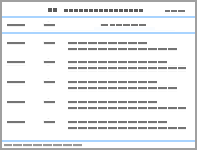
Table 1
Interference signal model"
| 干扰类型 | 数学模型 | 参数 | 参数含义 |
| STJ | 发射的干扰信号功率 | ||
| 干扰信号中心频率 | |||
| 干扰信号初始相位,服从[0,2π)均匀分布 | |||
| MTJ | 单音干扰的数量 | ||
| 发射的干扰信号功率 | |||
| 干扰信号中心频率 | |||
| 干扰信号初始相位,服从[0,2π)均匀分布且互相独立同分布 | |||
| LFM | 线性调频的斜率参数 | ||
| NoiFM | 调频比例常数 | ||
| 带限高斯白噪声 | |||
| NoiAM | 发射的干扰信号功率 | ||
| PBNJ | 带限高斯白噪声 | ||
| BPSK | BPSK调制相位,取值为 | ||
| QPSK | QPSK调制相位,取值为 | ||
| 2ASK | |||
| 2FSK | |||
| 调制信号 | |||
| MSK |
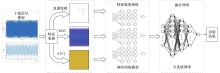
Fig.1
Flowchart of the multi-feature fusion method"
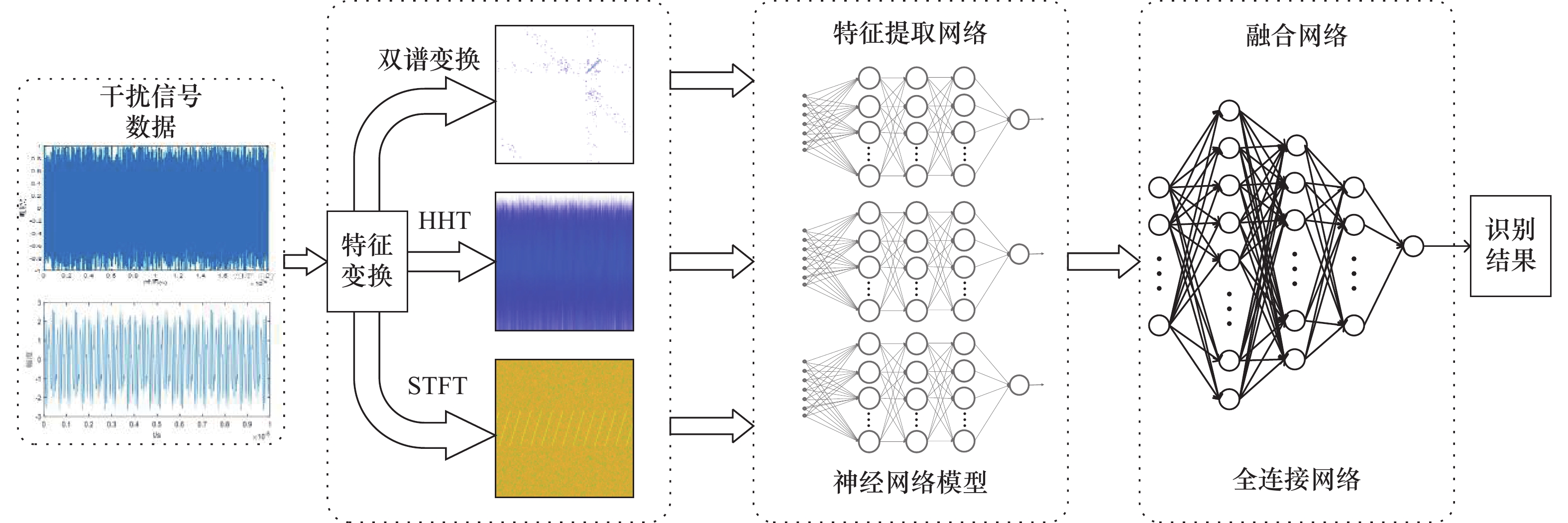
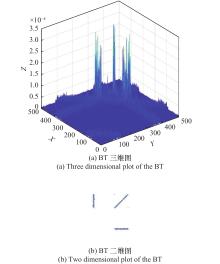
Fig.2
BT feature projection of LFM signal"
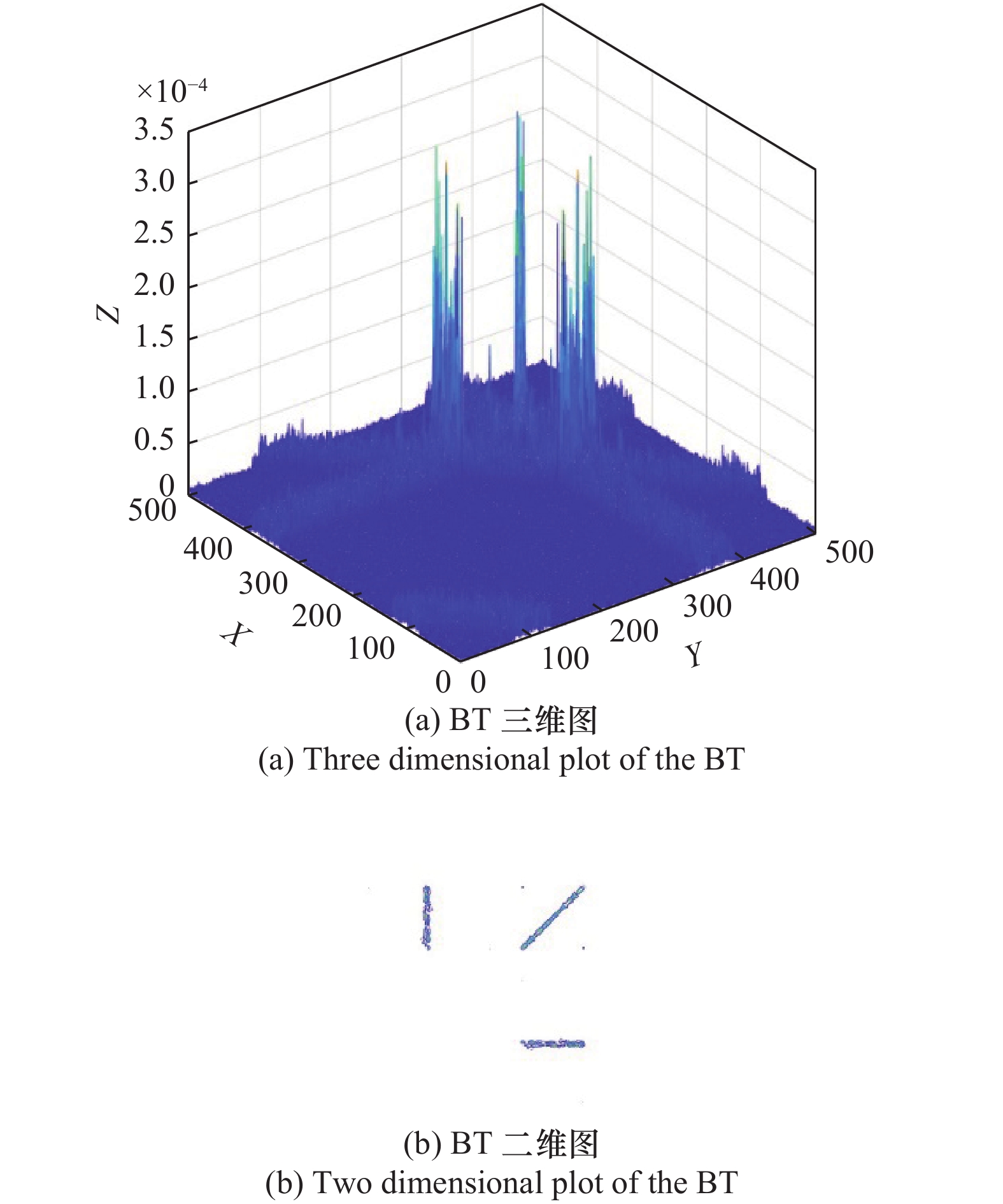
Fig.3
HHT feature projection of LFM signal"

Fig.4
STFT feature projection of LFM signal"
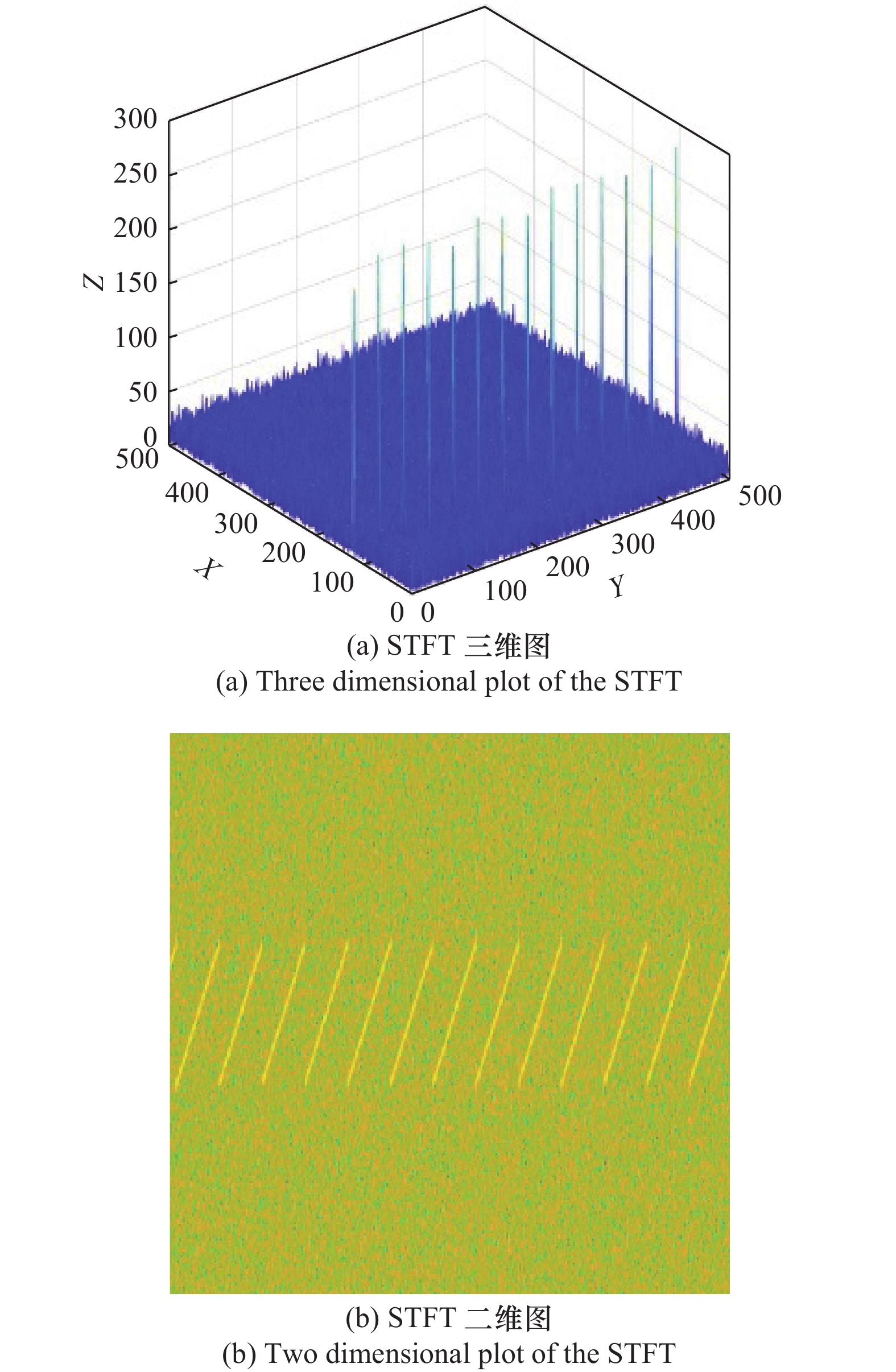
Fig.5
Structure diagram of the YOLOv8n classification network"
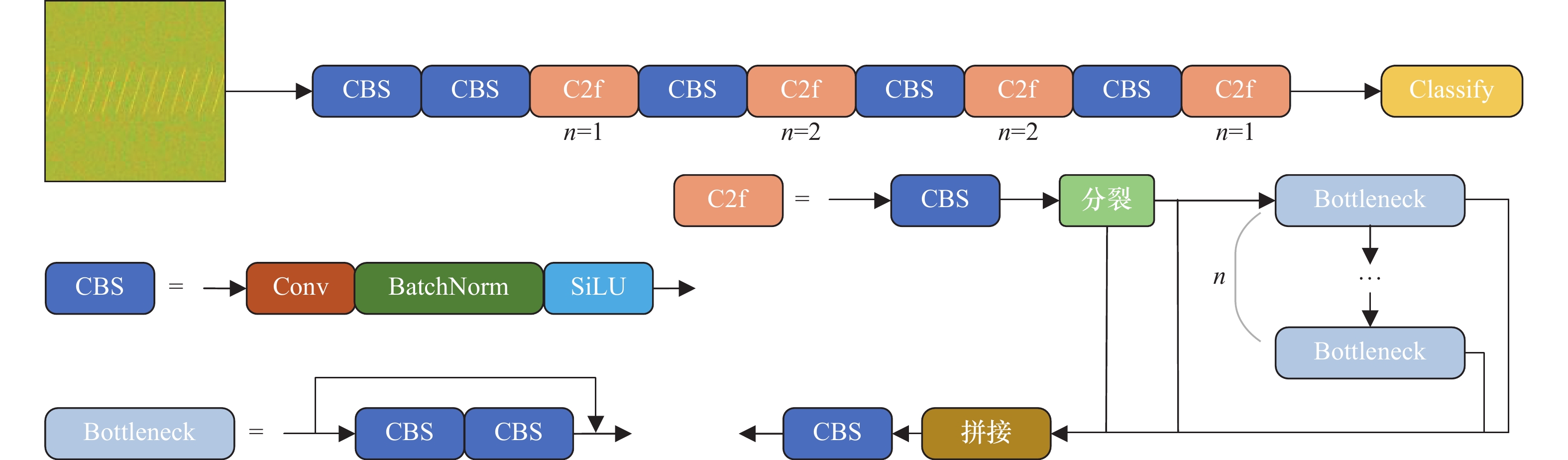
Fig.6
Flowchart of the feature extraction network"
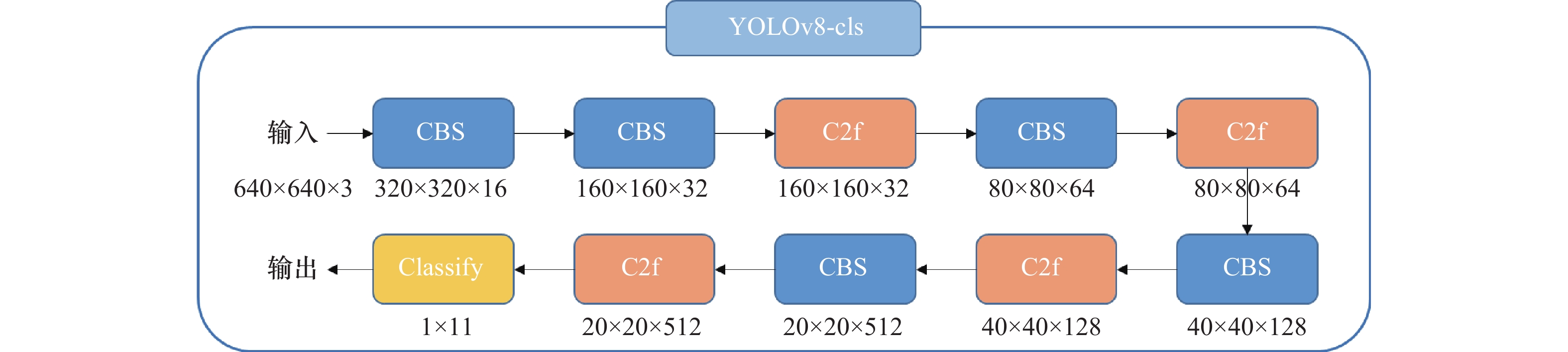
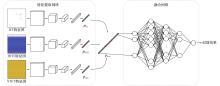
Fig.7
Structure diagram of the multi-feature fusion classification network"
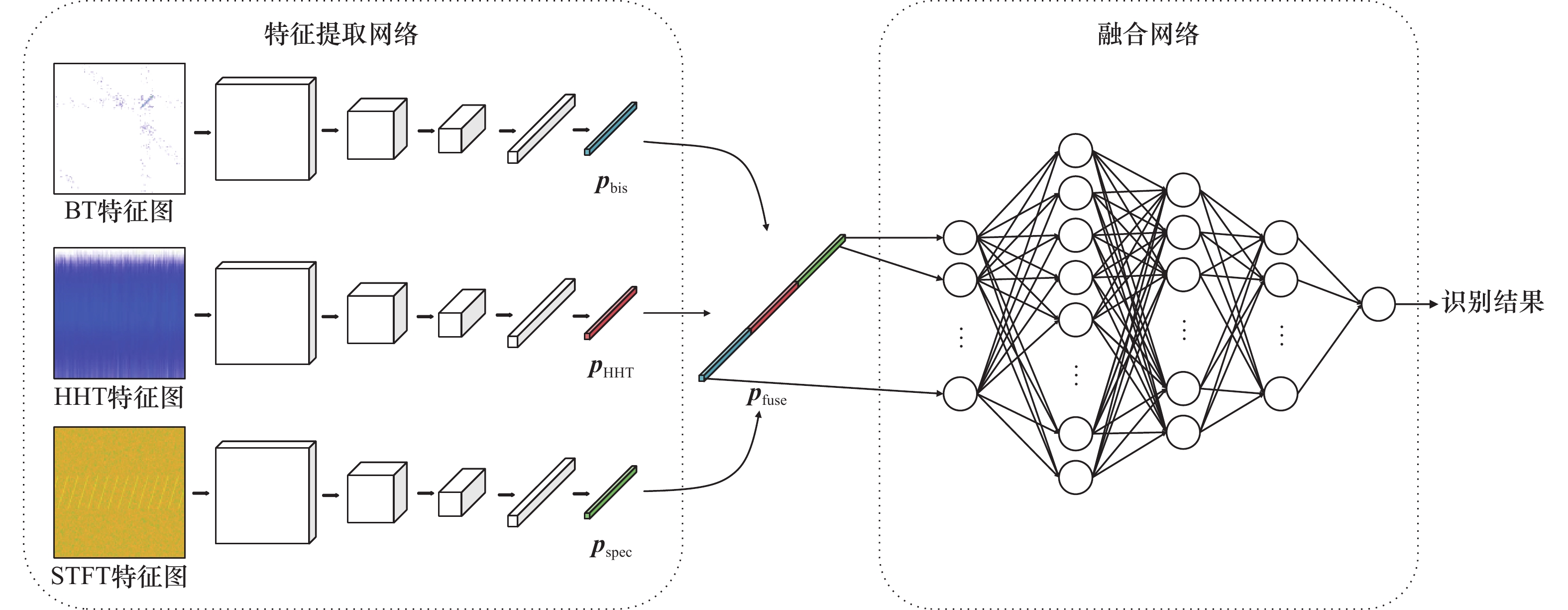
Table 2
Modeling parameters of interference signals"
| 参数 | 参数值 |
| 采样频率/MHz | 10 |
| INR范围/dB | −20~10 |
| INR步长/dB | 2 |
| 信号采样点数 | 131 328 |
Table 3
Key parameters of interference signals for different categories"
| 干扰类别 | 参数 | 参数值 | 干扰类别 | 参数 | 参数值 | |
| STJ | 干扰频率/MHz | 2 | BPSK | 码元速率/(kbit/s) | 500 | |
| MTJ | 干扰频率/MHz | 1.5 2 3 | QPSK | 码元速率/(kbit/s) | 500 | |
| LFM | 调频系数/(MHz/s) | 500 | 2ASK | 码元速率/(kbit/s) | 500 | |
| 调频带宽/MHz | 1 | |||||
| NoiFM | 调频系数/(Hz/v) | 500 | 2FSK | 码元速率/(kbit/s) | 500 | |
| 调频带宽/MHz | 1 | |||||
| NoiAM | 调频带宽/MHz | 1 | MSK | 码元速率/(kbit/s) | 500 | |
| PBNJ | 干扰带宽/MHz | 1 |
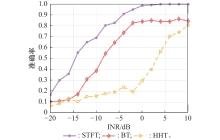
Fig.8
Experimental results of the single-feature method"
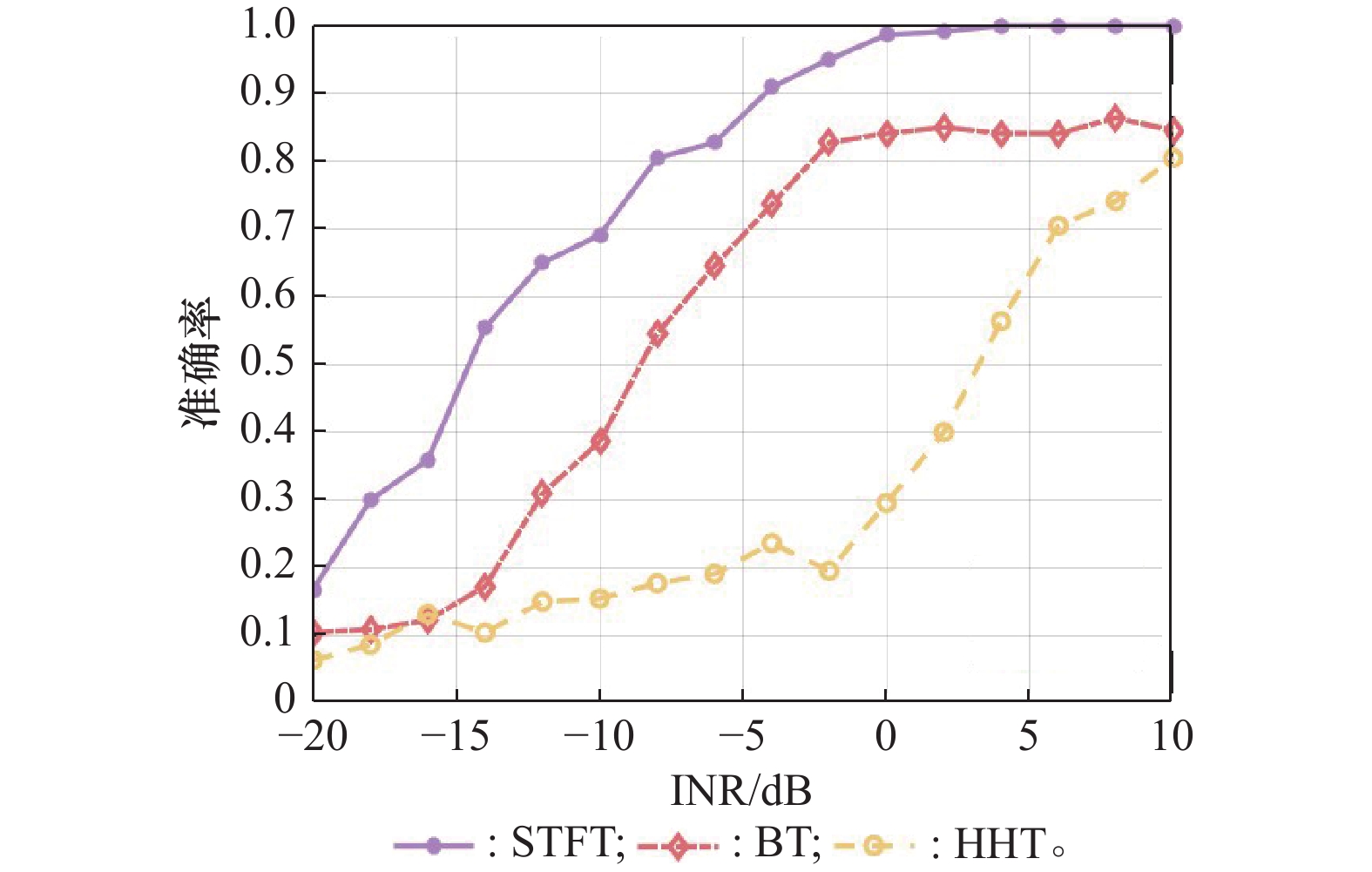
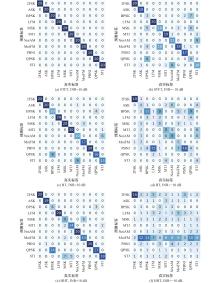
Fig.9
Confusion matrix of the single-feature method"

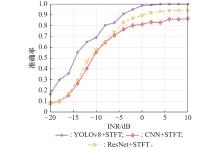
Fig.10
Experimental results of different recognition methods with single-feature"
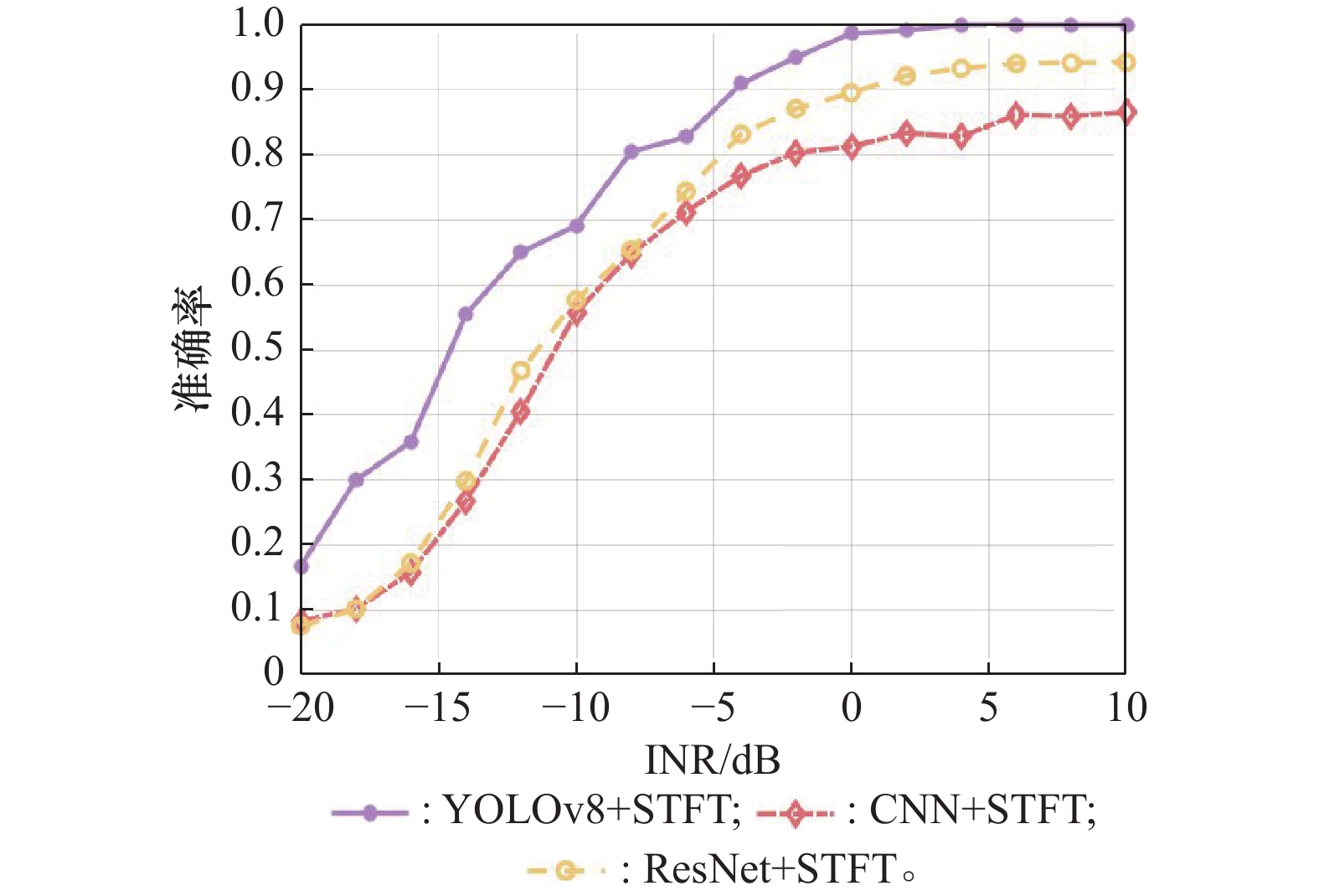
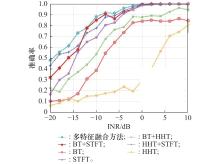
Fig.11
Experimental results of recognition methods with different feature"
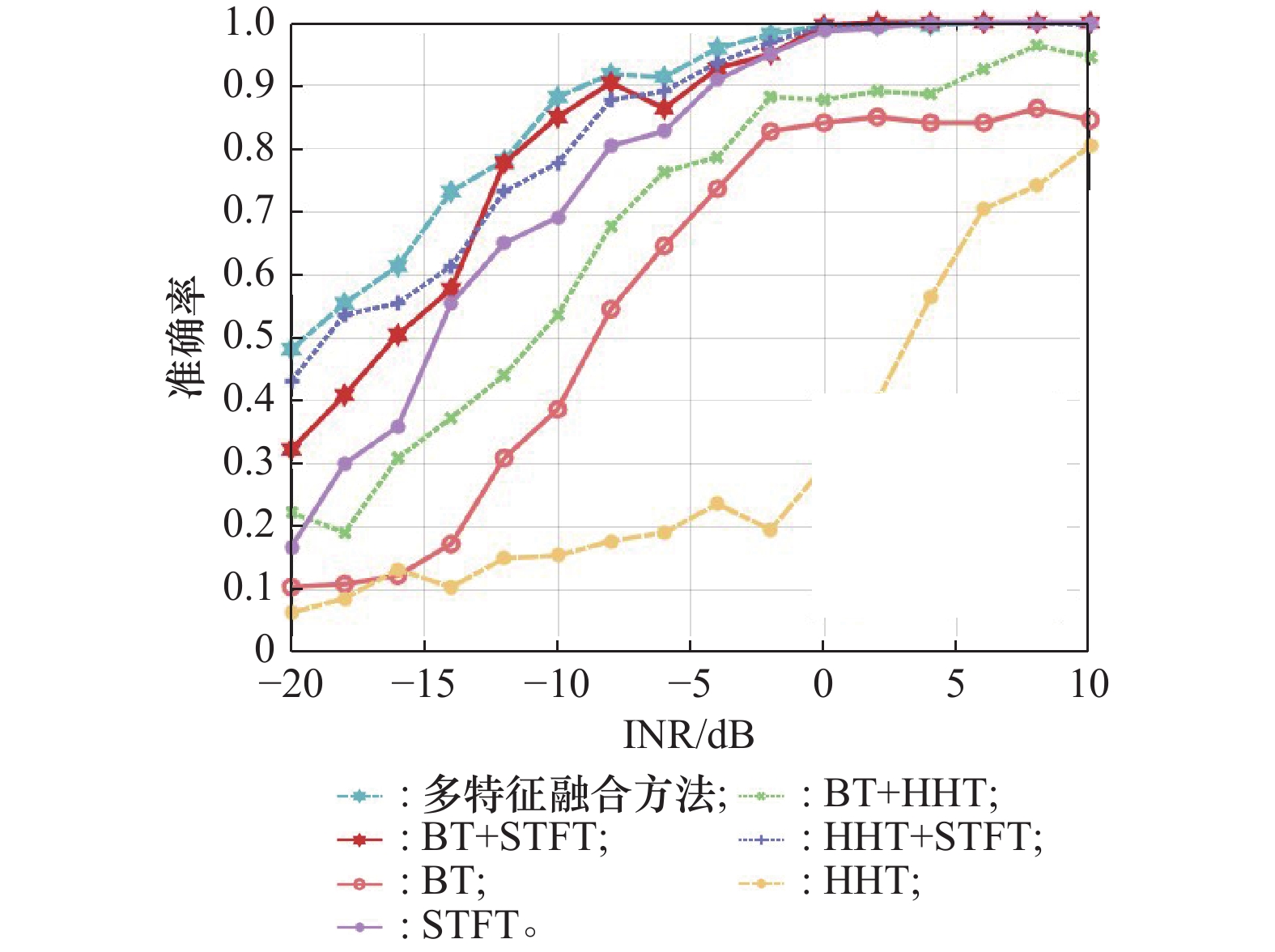
Table 4
Interference recognition accuracy of different feature %"
| 方法 | INR/dB | |||
| 10 | 0 | −10 | −20 | |
| BT+HHT+STFT | 100 | 99.55 | 88.18 | 48.18 |
| BT+HHT | 94.55 | 87.73 | 53.64 | 22.27 |
| BT+STFT | 100 | 99.55 | 85.00 | 32.27 |
| HHT+STFT | 100 | 99.55 | 77.73 | 43.18 |
| BT | 84.55 | 84.09 | 38.64 | 10.45 |
| HHT | 80.45 | 29.55 | 15.45 | 6.36 |
| STFT | 100 | 98.64 | 69.09 | 16.82 |
| 1 | RAHMAN M J A, KRUNZ M, ERWIN R. Interference mitigation using spectrum sensing and dynamic frequency hopping[C]//Proc. of the IEEE International Conference on Communications , 2012: 4421−4425. |
| 2 |
XIAO L, LIU J L, LI Q D, et al. User-centric view of jamming games in cognitive radio networks[J]. IEEE Trans. on Information Forensics and Security, 2015, 10 (12): 2578- 2590.
doi: 10.1109/TIFS.2015.2467593 |
| 3 |
DABCEVIC K, MUGHAL M O, MARCENARO L, et al. Cognitive radio as the facilitator for advanced communications electronic warfare solutions[J]. Journal of Signal Processing Systems, 2016, 83 (1): 29- 44.
doi: 10.1007/s11265-015-1050-0 |
| 4 | MUGHAL M O, NAWAZ T, MARCENARO L, et al. Cyclostationary-based jammer detection algorithm for wide-band radios using compressed sensing[C]//Proc. of the IEEE Global Conference on Signal and Information Processing, 2015: 280−284. |
| 5 | NUNES F D, SOUSA F M G. Jamming detection in GNSS signals using the sample covariance matrix[C]//Proc. of the 6th ESA Workshop on Satellite Navigation Technologies (Navitec 2012) & European Workshop on GNSS Signals and Signal Processing, 2012. |
| 6 | 邵正途, 冷毅, 葛代河, 等. 基于小波包分解和随机森林特征选择的雷达有源干扰识别[J]. 现代雷达, 2024, 46 (12): 45- 52. |
| SHAO Z T, LENG Y, GE D H, et al. Radar active interference recognition based on wavelet packet decomposition and random forest feature selection[J]. Modern Radar, 2024, 46 (12): 45- 52. | |
| 7 | KONG L, XU Z J, WANG J M, et al. A novel algorithm for jamming recognition in wireless communication[C]//Proc. of the 6th International Congress on Image and Signal Processing, 2013: 1473−1477. |
| 8 |
HAN H, REN Z Y, LI L, et al. Automatic modulation classification based on deep feature fusion for high noise level and large dynamic input[J]. Sensors, 2021, 21, 2117.
doi: 10.3390/s21062117 |
| 9 | SWINNEY C J, WOODS J C. GNSS jamming classification via CNN, transfer learning & the novel concatenation of signal representations[C]//Proc. of the International Conference on Cyber Situational Awareness, Data Analytics and Assessment, 2021. |
| 10 | WANG G S, REN Q H, SU Y Z. The interference classification and recognition based on SF-SVM algorithm[C]//Proc. of the IEEE 9th International Conference on Communication Software and Networks, 2017: 835−841. |
| 11 | ARJOUNE Y, SALAHDINE F, ISLAM Md S, et al. A novel jamming attacks detection approach based on machine learning for wireless communication[C]//Proc. of the International Conference on Information Networking, 2020: 459−464. |
| 12 | O’SHEA T J, CORGAN J, CLANCY T C. Convolutional radio modulation recognition networks[M]//JAYNE C, ILIADIS L, ed. Engineering Applications of Neural Networks. Cham: Springer International Publishing, 2016: 213−226. |
| 13 | LIU Q, ZHANG W. Deep learning and recognition of radar jamming based on CNN[C]//Proc. of the 12th International Symposium on Computational Intelligence and Design, 2019: 208−212. |
| 14 |
魏迪, 曾海彬, 洪锋, 等. 基于LSTM网络和特征融合的通信干扰识别[J]. 电讯技术, 2022, 62 (4): 450- 456.
doi: 10.3969/j.issn.1001-893x.2022.04.007 |
|
WEI D, ZENG H B, HONG F, et al. Communication interference recognition based on LSTM network and feature fusion[J]. Telecommunication Technology, 2022, 62 (4): 450- 456.
doi: 10.3969/j.issn.1001-893x.2022.04.007 |
|
| 15 |
STEINER J, PESIK J. Machine learning image recognition for GNSS jamming signals categorization[J]. Neural Network World, 2024, 34 (6): 341- 360.
doi: 10.14311/NNW.2024.34.019 |
| 16 | HE K M, ZHANG X Y, REN S Q, et al. Deep residual learning for image recognition[C]//Proc. of the IEEE Conference on Computer Vision and Pattern Recognition, 2016: 770−778. |
| 17 | REDMON J, DIVVALA S, GIRSHICK R, et al. You only look once: unified, real-time object detection[C]//Proc. of the IEEE Conference on Computer Vision and Pattern Recognition, 2016: 779−788. |
| 18 | ANNA T Q, REESE R D. YOLO for radio frequency signal classification[C]//Proc. of the IEEE International Symposium on Dynamic Spectrum Access Networks, 2024: 177−178. |
| 19 | LI R D, HU J H, LI S Q, et al. Blind detection of communication signals based on improved YOLO3[C]//Proc. of the 6th International Conference on Intelligent Computing and Signal Processing, 2021: 424−429. |
| 20 |
YAN W D, LIU W, BI H B, et al. YOLO-PD: abnormal signal detection in gas pipelines based on improved YOLOv7[J]. IEEE Sensors Journal, 2023, 23 (17): 19737- 19746.
doi: 10.1109/JSEN.2023.3296131 |
| 21 | WANG C Y, BOCHKOVSKIY A, LIAO H Y M. YOLOv7: trainable bag-of-freebies sets new state-of-the-art for real-time object detectors[C]//Proc. of the IEEE/CVF Conference on Computer Vision and Pattern Recognition , 2023: 7464−7475. |
| 22 | SARKAR S, GUO D N, CABRIC D. RadYOLOLet: radar detection and parameter estimation using YOLO and wavelet[J]. IEEE Trans. on Cognitive Communications and Networking, 2025, 11 (4): 2340- 2355. |
| 23 |
PENG R H, WU X R, WANG G H, et al. Intelligent recognition and information extraction of radar complex jamming based on time-frequency features[J]. Journal of Systems Engineering and Electronics, 2024, 35 (5): 1148- 1166.
doi: 10.23919/JSEE.2024.000073 |
| 24 | JOCHER G, CHAURASIA A, QIU J. Ultralytics YOLO[EB/OL]. [2024-08-31]. https://github.com/ultralytics/ultralytics. |
| 25 | 王鹏宇. 基于深度学习的无线通信干扰识别技术研究[D]. 成都: 电子科技大学, 2023. |
| WANG P Y. Research on wireless communication interference recognition technology based on deep learning[D]. Chengdu: University of Electronic Science and Technology of China, 2023. |
| [1] | Kun CHENG, Hongtao LEI, Zhixuan LYU. Lightweight unmanned aerial vehicle tracking method of improved YOLOv8 [J]. Systems Engineering and Electronics, 2026, 48(3): 737-750. |
| [2] | Long ZHANG, Lianhong ZHU, Bo YANG, Zhen LEI, Xuanming FENG. MFA-Net: a multimodal adaptive fusion network for intelligent recognition of anti-ship missiles in complex adversarial environments [J]. Systems Engineering and Electronics, 2026, 48(3): 894-907. |
| [3] | Yugang BAO, Haoxiang JIA, Danfeng ZHAO. Single image raindrop removal model based on high-order recursive network [J]. Systems Engineering and Electronics, 2026, 48(1): 12-21. |
| [4] | Haiqing CHEN, Liuying WANG, Gu LIU, Long WANG, Chaoqun GE, Mengzhou CHEN. Research progress on denoising algorithms for synthetic aperture radar images [J]. Systems Engineering and Electronics, 2026, 48(1): 94-105. |
| [5] | Kaiming LI, Yuanpeng ZHANG, Ying LUO, Xiaonan DAI. Research progress on radar target recognition of ballistic missile [J]. Systems Engineering and Electronics, 2025, 47(9): 2870-2889. |
| [6] | Ce JI, Xiangyu MA, Xiaoyu MU, Jiayi ZHAO. TS-GRU-VTA: vehicle channel estimation scheme based on deep learning [J]. Systems Engineering and Electronics, 2025, 47(9): 3093-3098. |
| [7] | Xiaowei YAN, Chong LING, Shengbin SHI. Design and implementation of a rapid detection system for surface unexploded submunitions [J]. Systems Engineering and Electronics, 2025, 47(8): 2639-2645. |
| [8] | Wanying ZHANG, Youbing GAO, Zeyi LI, Pengfei LI, Wei ZHANG. Background signal suppression algorithm based on dual-path feature fusion net [J]. Systems Engineering and Electronics, 2025, 47(7): 2406-2413. |
| [9] | Xinzheng ZHANG, Mengke YAN, Xiaolin ZHU. Noise pseudo-label tolerant semi-supervised SAR target recognition [J]. Systems Engineering and Electronics, 2025, 47(6): 1796-1805. |
| [10] | Zhijie JIANG, Heng SONG, Nan HU, Lanxi DUAN, Ping CAO. Target recognition and classification algorithm of MMW radar in tunnel [J]. Systems Engineering and Electronics, 2025, 47(5): 1453-1460. |
| [11] | Qianqi NIE, Minghui SHA, Yingshen ZHU, Chongyu WANG, Nianqiang CUI. Radar multi-component signal recognition method based on blind source separation combined with singular spectrum analysis [J]. Systems Engineering and Electronics, 2025, 47(4): 1168-1175. |
| [12] | Lei YUAN, Yanjuan YANG, Yi GUO, Peng DAI. Deep learning-based semi-blind identification algorithm for code rates of LDPC codes with correlated noise [J]. Systems Engineering and Electronics, 2025, 47(4): 1335-1345. |
| [13] | Xiarun SHEN, Ruonan LI, Haotian ZHANG. Server KPI anomaly detection based on CVAE-LSTM [J]. Systems Engineering and Electronics, 2025, 47(3): 1019-1027. |
| [14] | Xiaolin LIU, Mengjiao GUO, Zhuo LI. Adaptive graph convolutional recurrent network prediction method for flight delay based on Dueling DQN optimization [J]. Systems Engineering and Electronics, 2025, 47(2): 568-579. |
| [15] | Weihong FU, Xinyu ZHANG, Naian LIU. Single-channel blind source separation algorithm for co-frequency and co-modulation based on multi-scale fusion neural network [J]. Systems Engineering and Electronics, 2025, 47(2): 641-649. |
| Viewed | ||||||
|
Full text |
|
|||||
|
Abstract |
|
|||||