Systems Engineering and Electronics ›› 2026, Vol. 48 ›› Issue (5): 1706-1714.doi: 10.12305/j.issn.1001-506X.2026.05.26
• Guidance, Navigation and Control • Previous Articles Next Articles
Research on precision taming method of crystal oscillators based on DDS frequency micro-step
Yikang HAO1, Kun LIANG1,2,3,*, Tian YU1, Junliang ZHAO1, Baoying WEI1, Yufeng LI1, Zhiyu HE4
- 1. School of Automation and Intelligence,Beijing Jiaotong University,Beijing 100044,China
2. State Key Laboratory of Advanced Rail Autonomous Operation,Beijing Jiaotong University,Beijing 100044,China
3. Beijing Engineering Research Center for Electromagnetic Compatibility and Satellite Navigation,Beijing 100044,China
4. Signal & Communication Research Institute,China Academy of Railway Sciences Corporation Limited,Beijing 100081,China
-
Received:2025-02-11Online:2026-05-27Published:2026-05-27 -
Contact:Kun LIANG

CLC Number:
Cite this article
Yikang HAO, Kun LIANG, Tian YU, Junliang ZHAO, Baoying WEI, Yufeng LI, Zhiyu HE. Research on precision taming method of crystal oscillators based on DDS frequency micro-step[J]. Systems Engineering and Electronics, 2026, 48(5): 1706-1714.
share this article
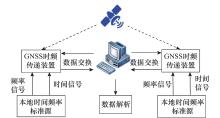
Fig.1
GNSS time transfer principle"
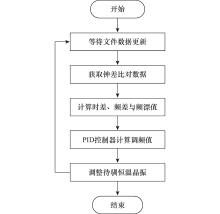
Fig.2
Flowchart of crystal oscillator taming"
Fig.3
Overall flowchat of crystal oscillator taming based on phase micro-stepper"
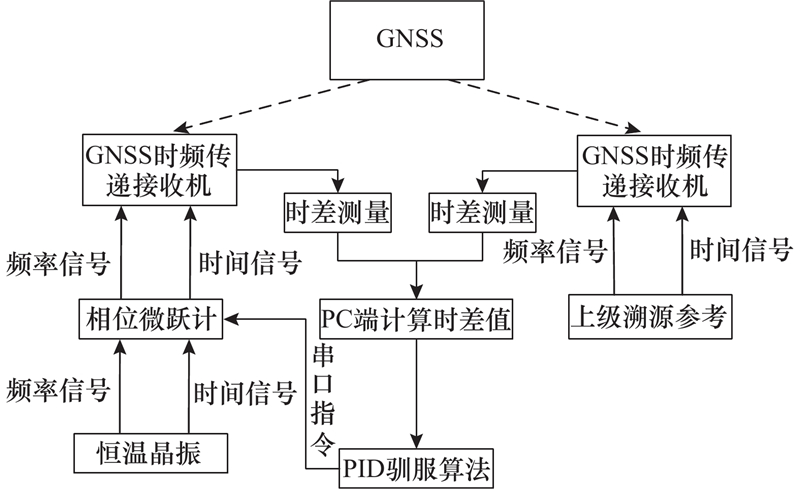
Fig.4
Integrated device of phase micro-stepper and crystal oscillator"
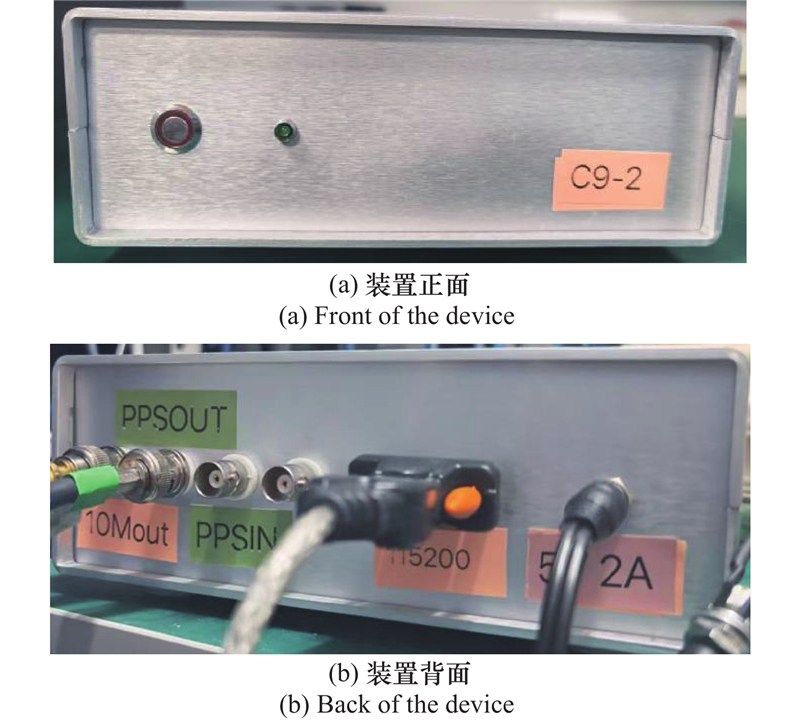
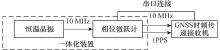
Fig.5
Hardware architecture diagram"
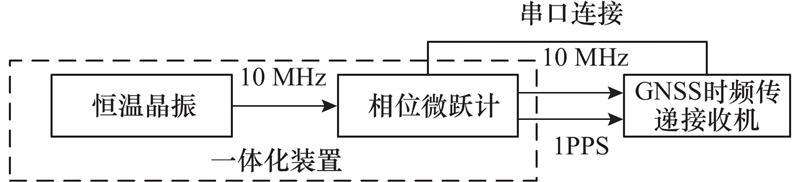
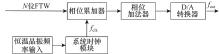
Fig.6
Operational principle diagram of DDS"
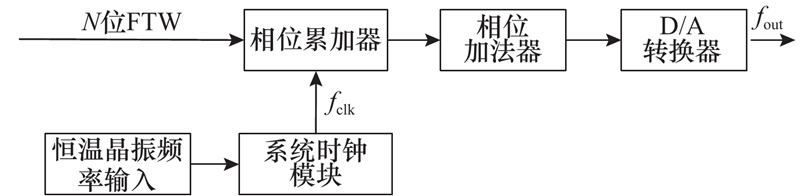
Fig.7
Relative frequency offset at initial output frequency"
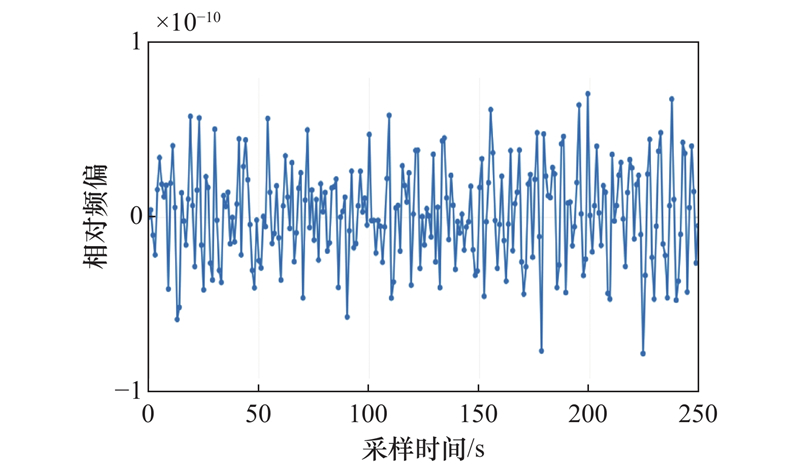
Fig.8
Relative frequency offset after adjusting by 0.6 mHz"
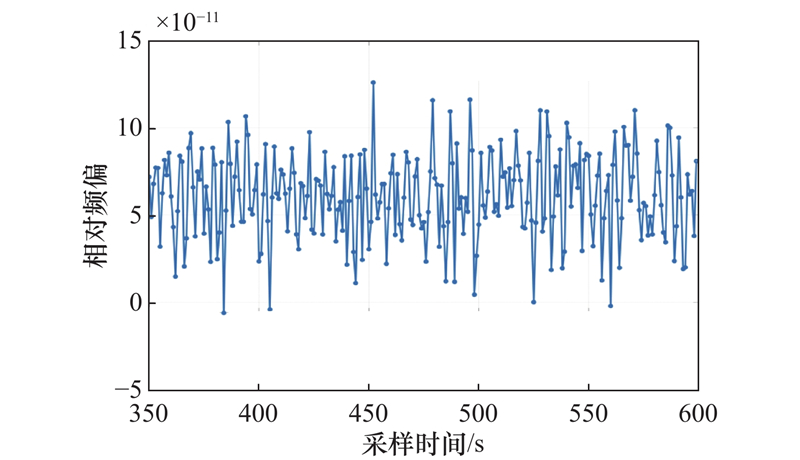
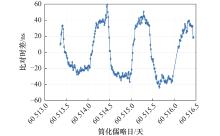
Fig.9
Comparison time difference of taming and controlling crystal oscillator and UTC time and frequency source before PID parameter optimization"
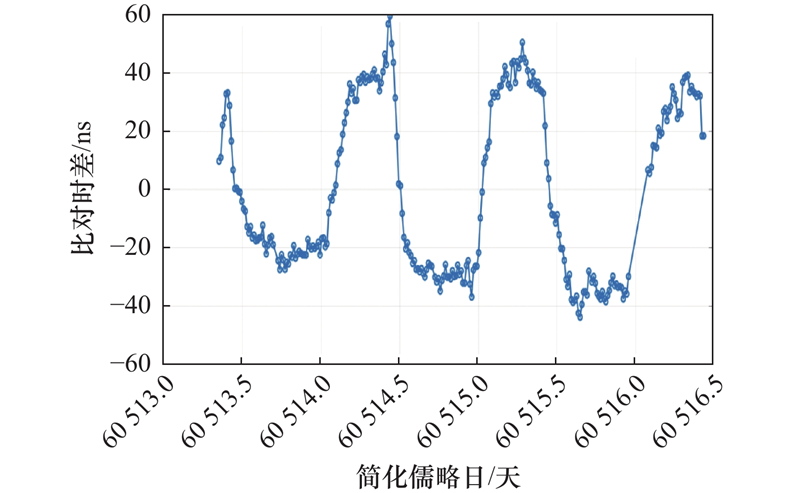
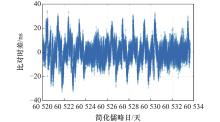
Fig.10
Comparison time difference of taming and controlling crystal oscillator under taming and UTC time and frequency source"
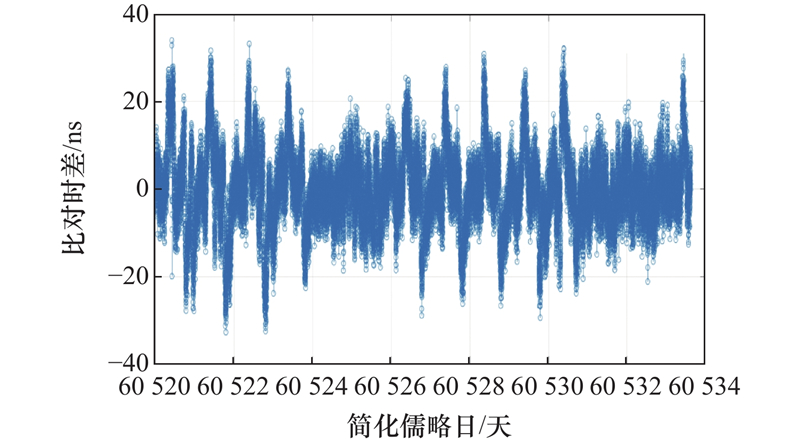
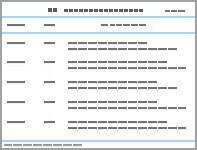
Table 1
Comparison time difference range of taming and controlling crystal oscillator and UTC time and frequency source"
| 参数 | 时差范围/ns | ||
| |∆t|≤10 | |∆t|≤20 | |∆t|≤25 | |
| 点数/总点数 | 34 945/39 303 | 38 433/39 303 | 39 086/39 303 |
| 占比/% | 88.91 | 97.79 | 99.45 |
Fig.11
Comparison of time stability"
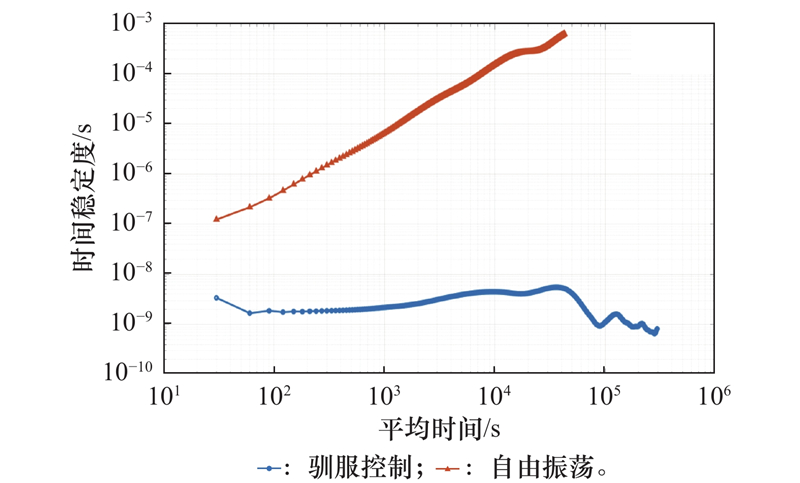
Fig.12
Comparison of frequency stability"
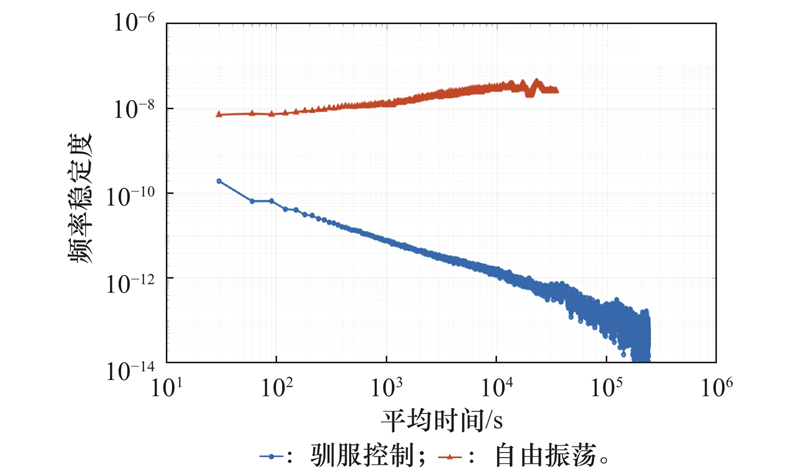
Table 2
Time stability and frequency stability of taming and controlling crystal oscillator"
| 平均时间/s | 时间稳定度/s | 频率稳定度 |
| 1 000 | 2.172×10⁻⁹ | 7.641×10⁻¹¹ |
| 10 000 | 4.470×10⁻⁹ | 1.253×10⁻¹² |
| 86 400 | 9.46×10⁻¹⁰ | 1.09×10⁻¹³ |
| 100 000 | 1.114×10⁻⁹ | 2.22×10⁻¹³ |
Table 3
Frequency stability of crystal oscillators free oscillation"
| 平均 时间/s | 本文使用晶振 | 文献[ | 文献[ |
| 100 | 7.300 4×10⁻⁹ | 3.81×10⁻¹² | 4.49×10⁻¹² |
| 1 000 | 1.240 9×10⁻⁸ | 5.96×10⁻¹² | 1.33×10⁻¹¹ |
| 10 000 | 3.323 8×10⁻⁸ | 1.31×10⁻¹¹ | 6.89×10⁻¹¹ |
Table 4
Frequency stability with different taming and controlling methods"
| 平均 时间/s | 本文控制方式 | 文献[ | 文献[ |
| 100 | 6.638 6×10⁻¹¹ | 7.41×10⁻¹¹ | 5.88×10⁻¹² |
| 1 000 | 7.641×10⁻¹² | 9.71×10⁻¹² | 4.89×10⁻¹² |
| 10 000 | 1.253×10⁻¹² | 1.99×10⁻¹² | 2.02×10⁻¹² |
Fig.13
Comparison of frequency stability free oscillation of different crystal oscillators"
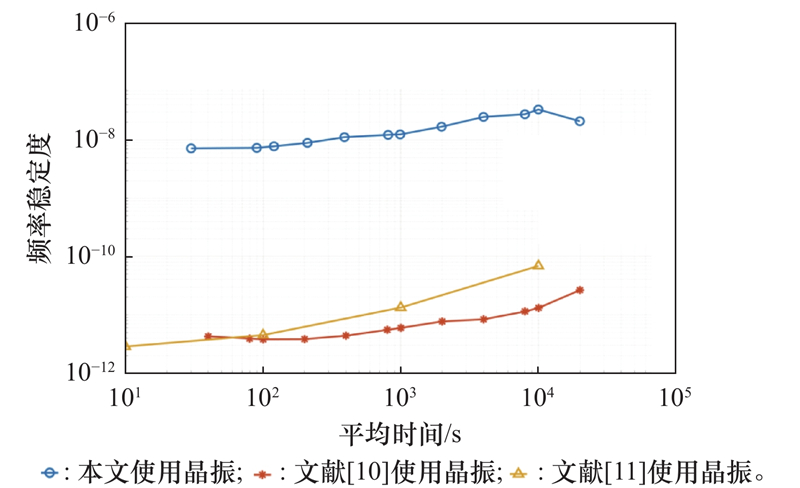
Fig.14
Comparison of frequency stability based on DDS frequency micro-step taming method and voltage-controlled taming method"
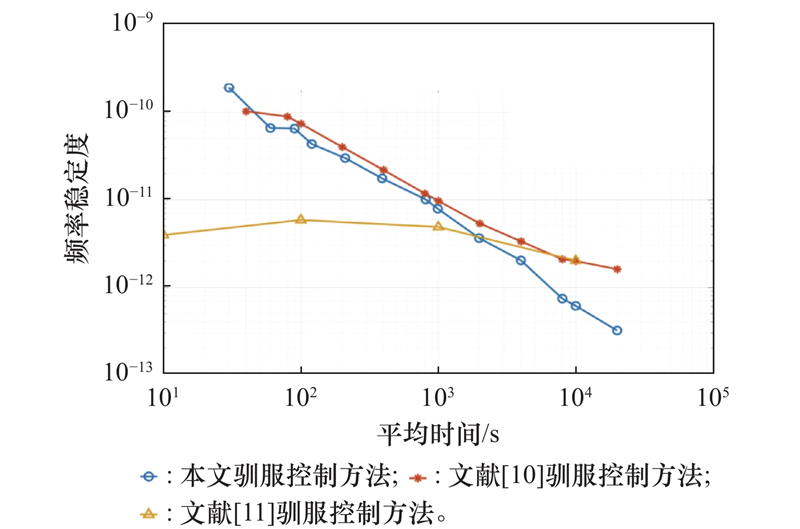
Fig.15
Comparison of frequency stability based on DDS frequency micro-step taming method and GPS locking rubidium atomic clock taming method"
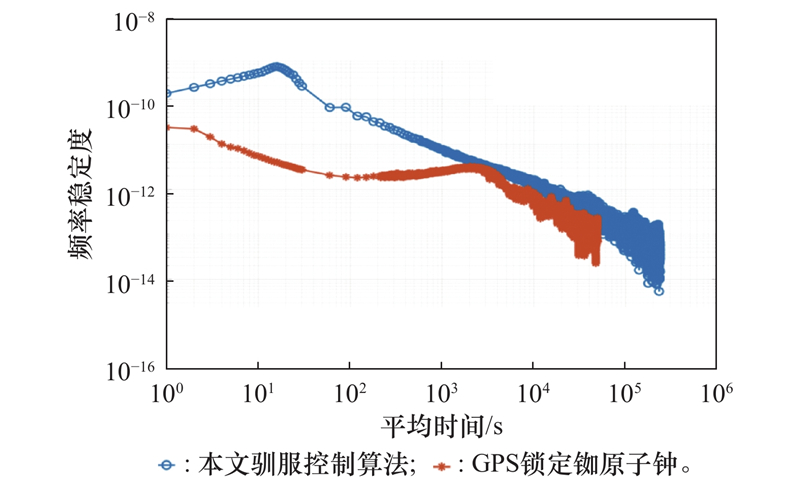
Table 5
Frequency stability based on DDS frequency micro-step taming method and GPSDO taming method"
| 平均时间/s | 本文驯服控制方法 | GPSDO |
| 1 | 1.354 3×10⁻¹⁰ | 2.376 6×10⁻¹¹ |
| 10 | 3.858 6×10⁻¹¹ | 5.468×10⁻¹² |
| 100 | 6.638 6×10⁻¹¹ | 1.875×10⁻¹² |
| 1 000 | 7.461×10⁻¹² | 2.431×10⁻¹² |
| 10 000 | 1.253×10⁻¹² | 8.02×10⁻¹³ |
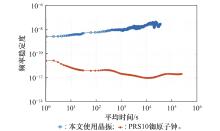
Fig.16
Comparison of frequency stability for the proposed crystal oscillator and PRS10 under freeoscillation"
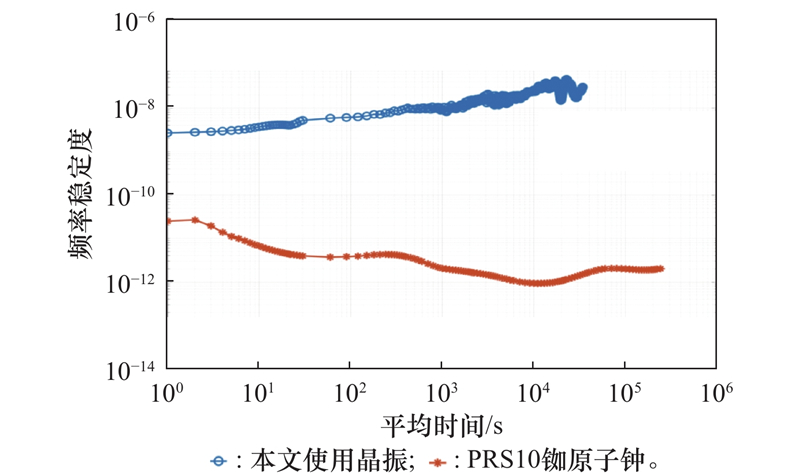
Table 6
Frequency stability between the proposed crystal oscillator and PRS10 under freeoscillation"
| 平均时间/s | 文中使用晶振 | PRS10 |
| 1 | 2.669 8×10⁻⁹ | 2.510 0×10−11 |
| 10 | 3.679 6×10⁻⁹ | 6.722×10⁻¹² |
| 100 | 7.300 4×10⁻⁹ | 3.800×10⁻¹² |
| 1 000 | 1.240 9×10⁻⁸ | 2.503×10⁻¹² |
| 10 000 | 3.323 8×10⁻⁸ | 9.32×10⁻¹³ |
| 1 |
BUI T, ELANGO A, LANDRY R J. FPGA-based autonomous GPS-disciplined oscillators for wireless sensor network nodes[J]. Sensors, 2022, 22 (9): 3135.
doi: 10.3390/s22093135 |
| 2 |
GOODWIN A J, EYTAN D, DIXON W, et al. Timing errors and temporal uncertainty in clinical databases-a narrative review[J]. Front Digit Health, 2022, 4, 932599.
doi: 10.3389/fdgth.2022.932599 |
| 3 |
MAJORAL M, ARRIBAS J, PRADES F C. Implementation of a high-sensitivity global navigation satellite system receiver on a system-on-chip field-programmable gate array platform[J]. Sensors, 2024, 24 (5): 1416.
doi: 10.3390/s24051416 |
| 4 |
NASIR A A, DURRANI S, MEHRPOUYAN H, et al. Timing and carrier synchronization in wireless communication systems: a survey and classification of research in the last 5 years[J]. EURASIP Journal on Wireless Communications and Networking, 2016, 2016, 180.
doi: 10.1186/s13638-016-0670-9 |
| 5 | YANG C Z, WANG Y L, HUA Y, et al. Investigation and design of disciplined clock system based on BDS[C]//Proc. of the IEEE 12th International Conference on Electronic Measurement & Instruments, 2015: 753-756. |
| 6 |
ACHENBACH R, FEUERSTACK-RAIBLE M, HILLER F, et al. A digitally temperature-compensated crystal oscillator[J]. IEEE Journal of Solid-State Circuits, 2000, 35 (10): 1502- 1506.
doi: 10.1109/4.871329 |
| 7 | LI H, ZHANG X J, LI Z H, et al. A novel high-precision method based on sequence weighted adaptive unscented Kalman filter for GPS disciplined crystal oscillator[C]//Proc. of the IEEE 12th PES Asia-Pacific Power and Energy Engineering Conference, 2020. |
| 8 |
SONG W, YAN D Y, SHI C, et al. BDS/GPS tens of picoseconds time synchronization method with application to communication network[J]. IEEE Internet of Things Journal, 2025, 12 (11): 17244- 17262.
doi: 10.1109/JIOT.2025.3534897 |
| 9 | 王习东, 杨业泉, 冯文杰, 等. 基于卫星授时和晶振驯服的高精度频率源系统设计[J]. 电子设计工程, 2025, 33 (9): 31- 37. |
| WANG X D, YANG Y Q, FENG W J, et al. Design of high precision frequency source system based on satellite-time and tamed OCXO[J]. Electronic Design Engineering, 2025, 33 (9): 31- 37. | |
| 10 | 刘苏谚. 基于北斗的OCXO自适应保持技术的研究[D]. 西安: 西安电子科技大学, 2023. |
| LIU S Y. Study on adaptive retention technology of OCXO based on Beidou[D]. Xi’an: Xidian University, 2023. | |
| 11 | 常盛. 基于1PPS信号驯服与保持的10MHz低相噪频率标准设计与实现[D]. 成都: 电子科技大学, 2024. |
| CHANG S. Design and Implementation of 10 MHz low phase noise frequency standard based on 1PPS signal disciplined oscillator and holdover technology[D]. Chengdu: University of Electronic Science and Technology of China, 2024. | |
| 12 | 王红建. 恒温晶体振荡器高精度时间维持的自适应修正算法研究[D]. 长沙: 湖南大学, 2017. |
| WANG H J. Adaptive correction algorithm for high precision time maintenance of oven controlled crystal oscillator[D]. Changsha: Hunan University, 2017. | |
| 13 | TSENG W H. Comparison of GNSS all-in-view (AV) and upsampled common-view (UCV) time transfers[C]//Proc. of the Joint Conference of the European Frequency and Time Forum and IEEE International Frequency Control Symposium, 2021. |
| 14 | WU J, ZHENG X N, XU J, Research on common view time frequency transfer based on RINEX format observation data[C]//Proc. of the International Seminar on Computer Science and Engineering Technology, 2022: 318−322. |
| 15 |
DEFRAIGNE P, PEITI G. CGGTTS-version 2E: an extended standard for GNSS time transfer[J]. International Journal of Scientific Metrology, 2015, 52 (6): G1.
doi: 10.1088/0026-1394/52/6/g1 |
| 16 |
MIAO X, HU C J, QIAO Y J. A novel two variables PID control algorithm in precision clock disciplining system[J]. Electronics, 2024, 13 (19): 3820.
doi: 10.3390/electronics13193820 |
| 17 | CUI B J, HOU X B, ZHOU D H. Methodological approach to GPS disciplined OCXO based on PID PLL[C]//Proc. of the 9th International Conference on Electronic Measurement & Instruments, 2009. |
| 18 |
COELHO L D S, GREBOGI R B. Chaotic synchronization using PID control combined with population based incremental learning algorithm[J]. Expert Systems with Applications, 2010, 37, 5347- 5352.
doi: 10.1016/j.eswa.2010.01.022 |
| 19 | ANG K H, CHONG G, LI Y. PID control system analysis, design, and technology[J]. IEEE Trans. on Control Systems Technology, 2005, 13 (4): 559- 576. |
| 20 |
LIN J N, ZHENG R J, ZHANG Y R, et al. CFHBA-PID algorithm dual-loop PID balancing robot attitude control algorithm based on complementary factor and honey badger algorithm[J]. Sensors, 2022, 22 (12): 4492.
doi: 10.3390/s22124492 |
| 21 |
PRITESH S, SUDHIR A. Review of fractional PID controller[J]. Mechatronics, 2016, 38, 29- 41.
doi: 10.1016/j.mechatronics.2016.06.005 |
| 22 | JIANG S T, WANG X. The design of a novel low phase noise anti-vibration OCXO[C]//Proc. of the Joint Conference of the European Frequency and Time Forum and IEEE International Frequency Control Symposium, 2017: 227−230. |
| 23 | 张永光. GPS驯服的高稳恒温晶振设计与实现[D]. 成都: 电子科技大学, 2020. |
| ZHANG Y G. Design and realization one kind of GPS disciplined high stability oven controlled crystal oscillator[D]. Chengdu: University of Electronic Science and Technology of China, 2020. | |
| 24 |
贾永刚. 金属洛氏硬度计示值误差不确定度评定[J]. 轻工标准与质量, 2017, (1): 34- 36.
doi: 10.3969/j.issn.1671-0711.2020.24.084 |
|
JIA Y G. Uncertainty evaluation of indication error for metal rock-well hardness testers[J]. Standard & Quality of Light Industry, 2017, (1): 34- 36.
doi: 10.3969/j.issn.1671-0711.2020.24.084 |
|
| 25 | 左朝阳. 基于北斗授时的时钟驯服与保持系统研究[D]. 西安: 西安电子科技大学, 2022. |
| ZUO Z Y. Research on a clock disciplining and holding system based on Beidou time service[D]. Xi’an: Xidian University, 2022. | |
| 26 | 韩艳菊, 杨科, 郑鸿耀. 改善高频宽压控晶振频率温度稳定性方法[J]. 宇航计测技术, 2014, 34 (6): 45- 48. |
| HAN Y J, YANG K, ZHENG H Y. Improved frequency temperature stability method for high frequency wide voltage controlled crystal oscillator[J]. Journal of Astronautic Metrology and Measurement, 2014, 34 (6): 45- 48. | |
| 27 | 李辉. 高精度时钟同步微步移相器的设计与实现[D]. 哈尔滨: 哈尔滨工程大学, 2009. |
| LI H. Design and realization of high precision clock synchronous micro-step phase-shifter[D]. Harbin: Harbin Engineering University, 2009. | |
| 28 |
肖波, 樊多盛, 王文利, 等. 一种高精度相位微跃1PPS信号发生器的研制[J]. 时间频率学报, 2019, 42 (4): 275- 283.
doi: 10.13875/j.issn.1674-0637.2019-04-0275-09 |
|
XIAO B, FAN D S, WANG W L, et al. Development of a high-precision phase micro stepper 1PPS signal generator[J]. Journal of Time and Frequency, 2019, 42 (4): 275- 283.
doi: 10.13875/j.issn.1674-0637.2019-04-0275-09 |
|
| 29 | 赵婧妍. 基于卫星共视系统的铷钟驯服技术研究[D]. 北京: 北京邮电大学, 2021. |
| ZHAO J Y. Research on rubidium clock taming technology based on satellite common view system[D]. Beijing: Beijing University of Posts and Telecommunications, 2021. | |
| 30 | 王宁, 吕志平, 王宇谱, 等. 不同采样间隔卫星钟差数据对钟差预报精度的影响与分析[C]//第6届中国卫星导航学术年会, 2015. |
| WANG N, LV Z P, WANG Y P, et al. Precision analysis of satellite clock for different sampling interval satellite clock bias data[C]//Proc. of the 6th China Satellite Navigation Conference, 2015. |
| No related articles found! |
| Viewed | ||||||
|
Full text |
|
|||||
|
Abstract |
|
|||||