Systems Engineering and Electronics ›› 2026, Vol. 48 ›› Issue (4): 1264-1282.doi: 10.12305/j.issn.1001-506X.2026.04.16
• Systems Engineering • Previous Articles
Applications and prospects of physics-informed neural networks in aerospace
Jiong LIN1( ), Peng GAO1,2, Wenxing HONG1,*
- 1. School of Aerospace Engineering,Xiamen University,Xiamen 361005,China
2. Aero Engine Academy of China,Beijing 101304,China
-
Received:2024-12-11Revised:2025-03-09Online:2025-05-20Published:2025-05-20 -
Contact:Wenxing HONG E-mail:linjiong1@stu.xmu.edu.cn

CLC Number:
Cite this article
Jiong LIN, Peng GAO, Wenxing HONG. Applications and prospects of physics-informed neural networks in aerospace[J]. Systems Engineering and Electronics, 2026, 48(4): 1264-1282.
share this article
Fig.1
Growth trend of research papers on PINN"
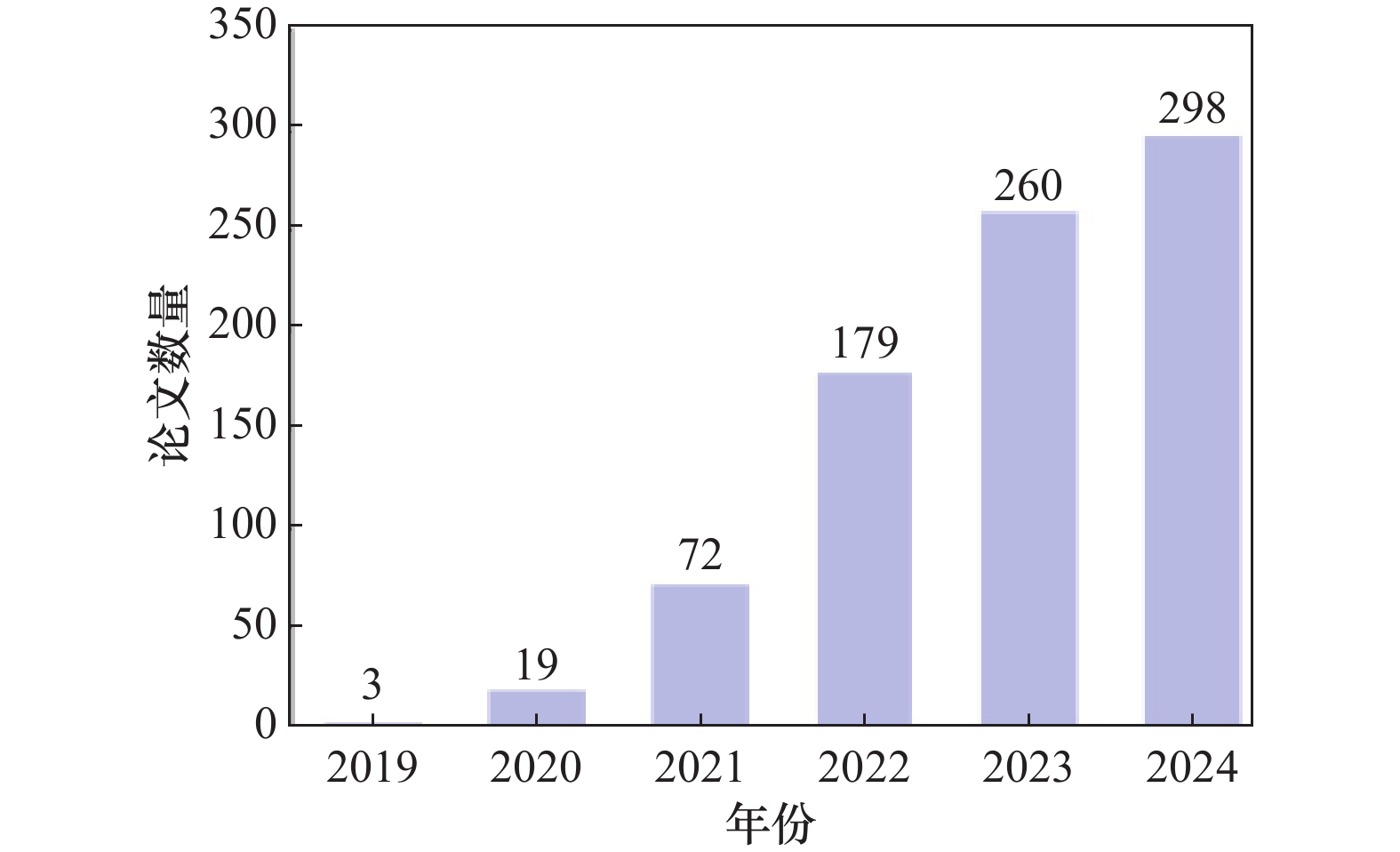
Fig.2
Network architecture of PINN"
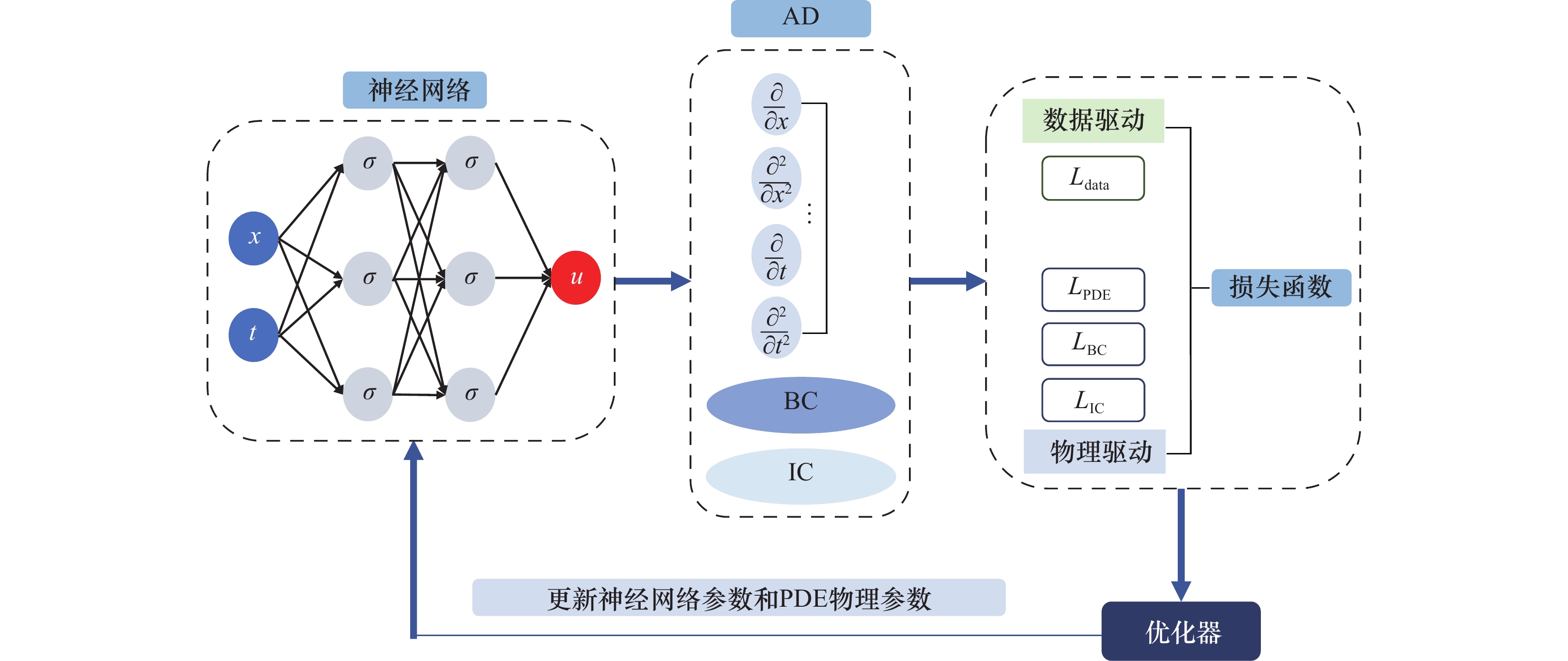
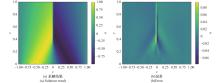
Fig.3
Solving the one-dimensional Burgers’ equation using PINN"
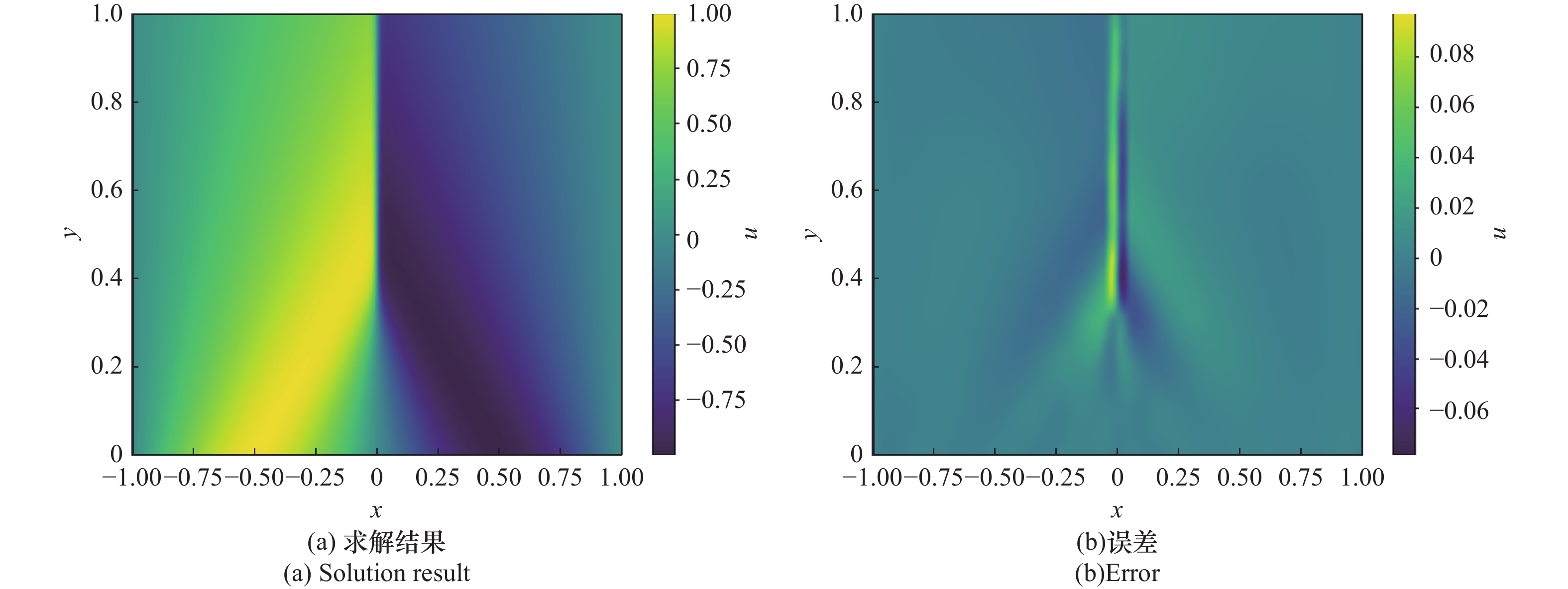
Table 1
Research on the backbone of PINN"
| 类型 | 文献 | 方法特点 |
| 前馈神经网络 | [ | 隐藏层个数为2到4,神经元数量为32。求解地下介质中的水力传导率、水头和浓度场 |
| [ | 隐藏层个数为5到8,神经元数量为250。用于金属增材制造过程建模,在适量标记数据下准确预测温度和熔池动态 | |
| [ | 采用隐藏层大于9的深层网络,用于解决流体力学问题 | |
| 循环神经网络 | [ | 通过循环神经网络执行常微分方程的数值积分,以有向图的形式表示物理信息核 |
| [ | 将物理信息融入长短期记忆网络,显著提高线性和非线性结构响应建模的精度,其表现优于传统长短期记忆网络 | |
| [ | 使用长短期记忆-PINN模型研究电池寿命预测问题。在电池温度范围较大时,较传统长短期记忆网络具有更低的预测误差 | |
| 卷积神经网络 | [ | 提出一种基于物理信息约束的卷积神经网络架构,解决不规则域上的参数化PDE问题 |
| [ | 提出一种用于模拟和预测高度异质性储层模型中的瞬态达西流动的物理信息深度卷积神经网络架构 | |
| [ | 使用结合卷积神经网络和PINN的两阶段混合学习框架,解决全反向电导率成像问题 | |
| 其他 | [ | 提出一种基于生成对抗网络的PINN方法,利用对抗性和物理信息损失的嵌入,求解湍流反应流的亚滤波问题 |
| [ | 将物理信息加入图神经网络,依靠稀疏传感器数据高效精确地预测氢气射流和扩散行为 | |
| [ | 在能够迅速逼近复杂数据分布的扩散模型[ |
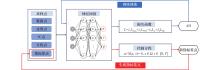
Fig.4
Framework of ST-PINN[46]"
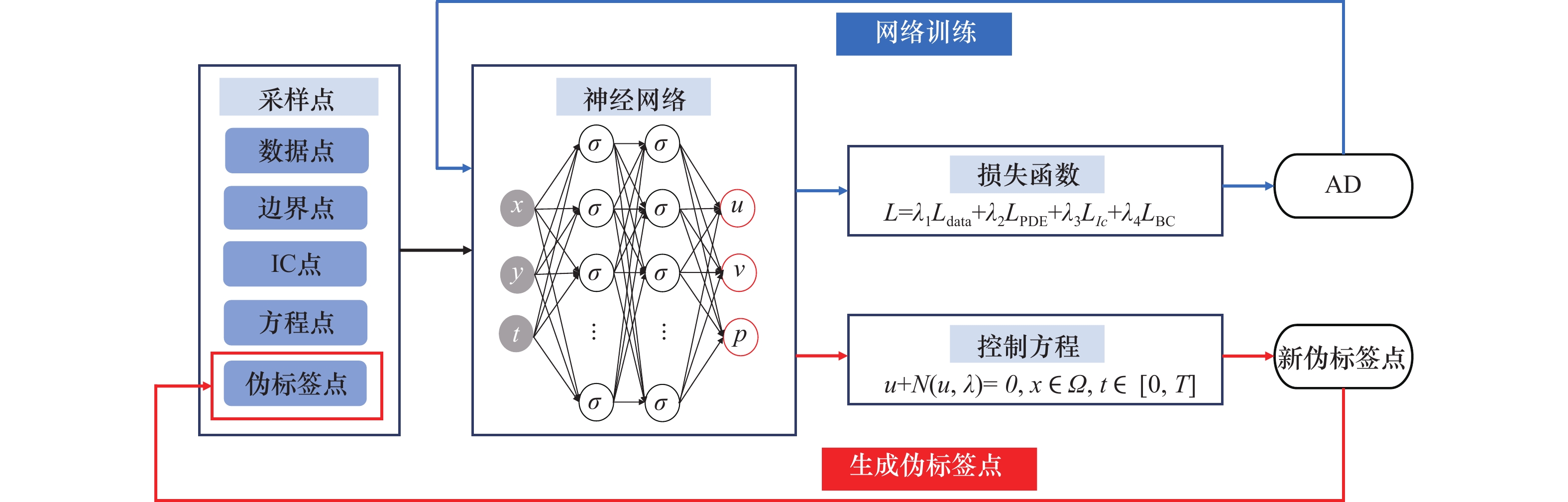
Fig.5
Framework of PINNsFormer[47]"
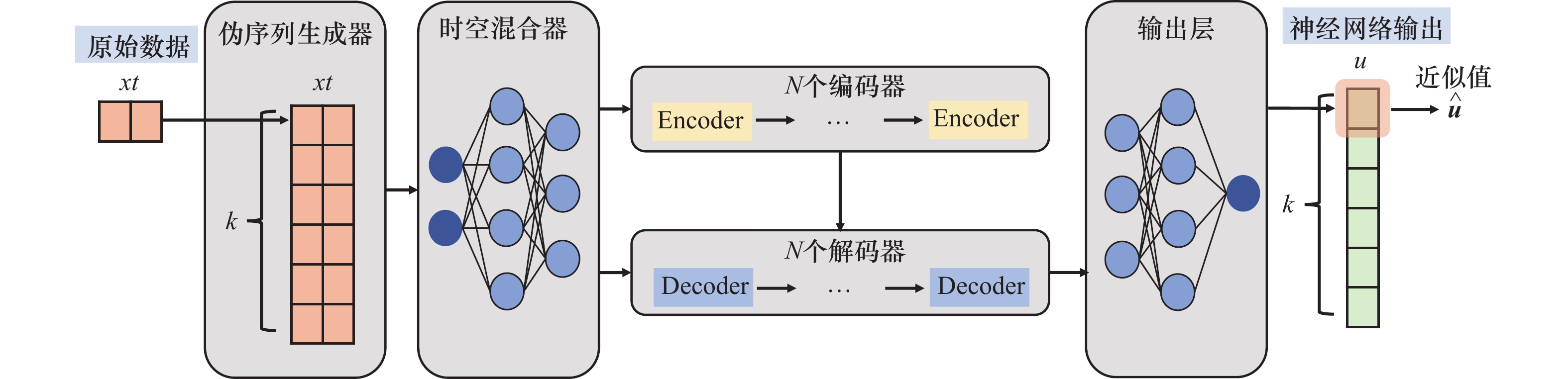
Fig.6
Outline of Pinnacle"
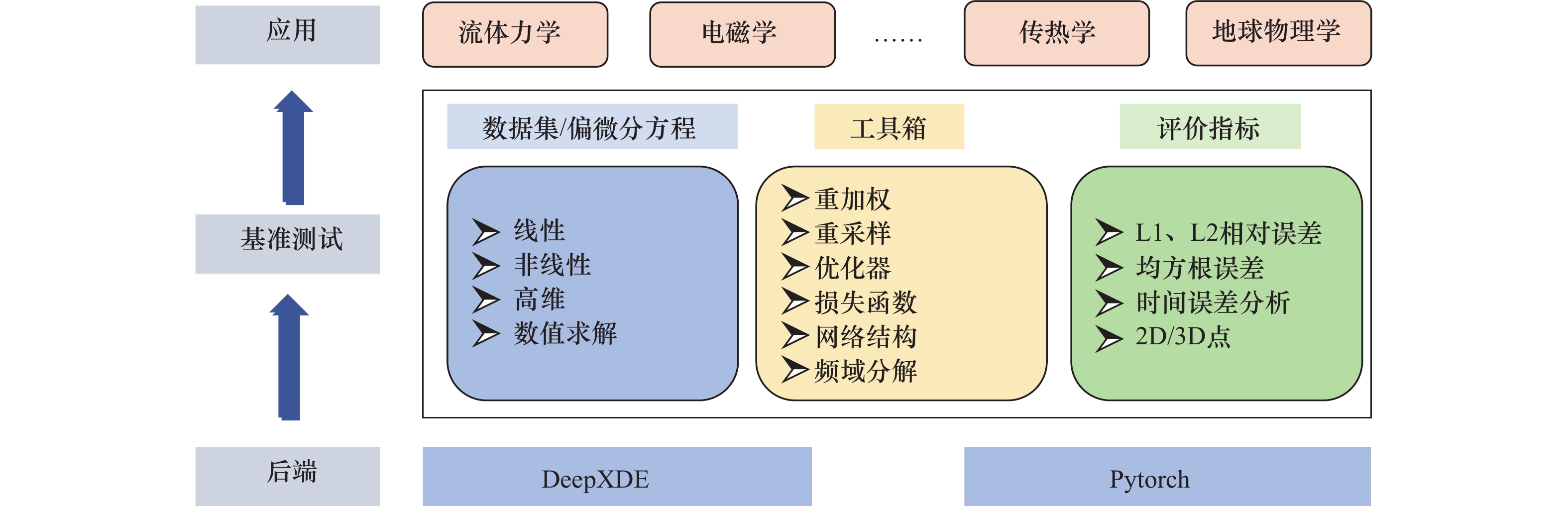
Fig.7
Physical information constraints in aerospace"
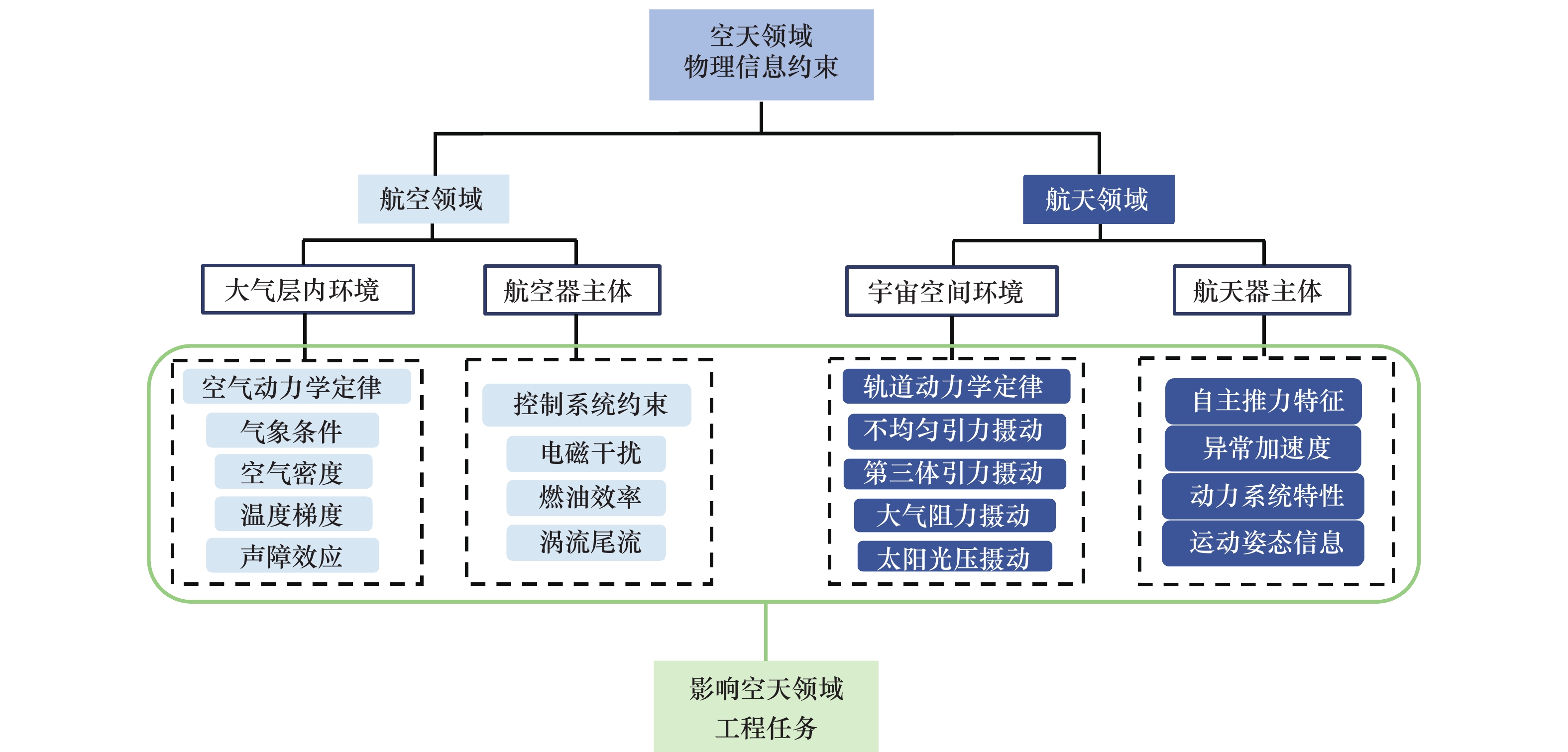
Fig.8
Schematic of spacecraft low-thrust OT method based on PINN[89]"
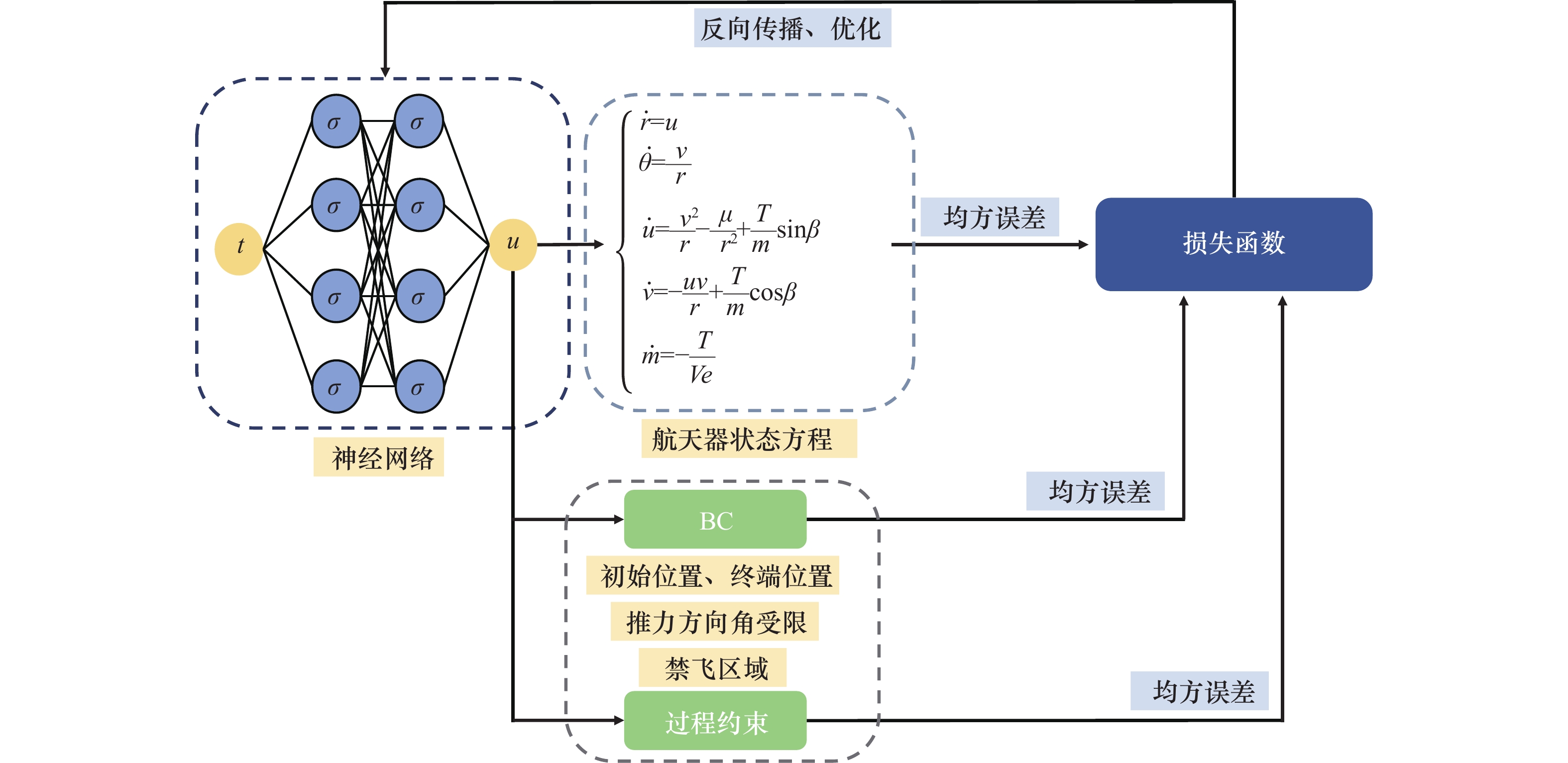
Fig.9
Methodology for MTOW prediction based on knowledge engineering and PINN[114]"
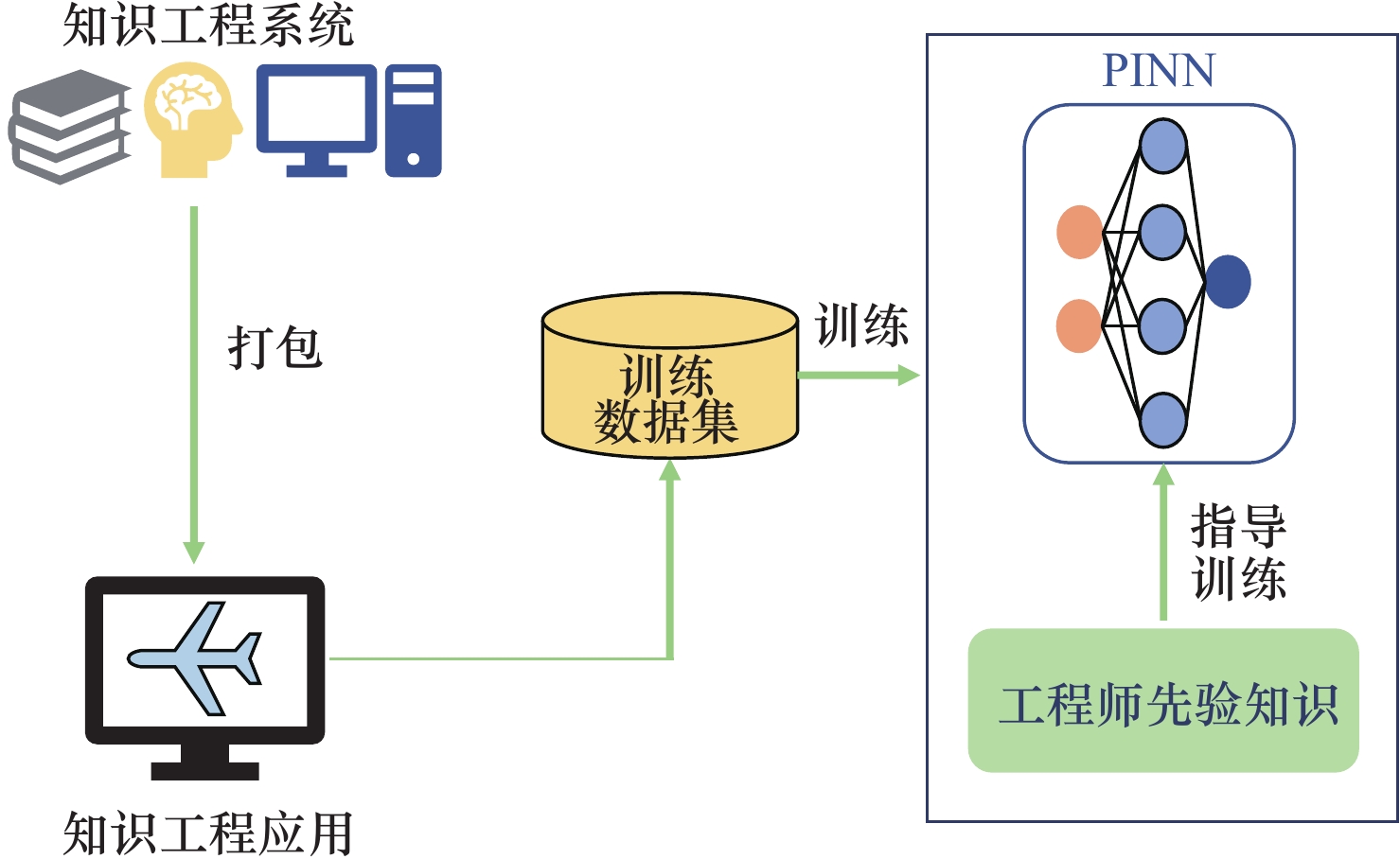
Table 2
Summary of existing research related to PINN in aero field"
| 应用领域 | 文献 | 研究对象 | 研究内容 | 创新或成果 |
| 航空流场重构 | [ | 低雷诺数流场 | 稳态和瞬态层流模拟 | 预测值与数值解法高度一致 |
| [ | 高速空气动力学 | 欧拉方程正逆向重构 | 在逆向问题表现出色 | |
| [ | 超音速流场 | 可压缩流动问题 | 利用密度梯度数据,超越传统方法 | |
| [ | 机翼 | 绕机翼无黏流动问题 | 高效求解流动模拟和形状逆设计的参数化问题 | |
| [ | 机翼 | 特定翼型的流场建模 | 实现升阻比的最大化设计 | |
| [ | 高超音速飞行器 | 高马赫数进气道流场 | 多尺度感知残差提升精度与效率 | |
| 气动数据 与飞行动力学 | [ | 飞机 | 气动参数辨识 | 含噪数据下能提高辨识精度 |
| [ | NACA0012翼型 | 气动数据建模 | 将PINN与CFD仿真结果结合,克服精度不足的问题 | |
| [ | 导弹 | 气动不确定性问题 | 利用增强输入变量的PINN和仿真时序数据,输出精确估计 | |
| [ | 空气动力学模型 | 非线性空气动力效应 | 极端飞行条件下生成高精度数据 | |
| 航空发动机工程 | [ | 航发燃烧机理 | 内部复杂的湍流燃烧 | 实现稀疏数据驱动的三维湍流燃烧高分辨率重构 |
| [ | 航发涡轮叶片 | 二维温度场反演 | 基于热力学控制方程损失项,提高温度场预测精度 | |
| [ | 旋转爆震发动机 | 燃烧室流场重构 | 基于少量观测数据,完成燃烧室流场全维高分辨率重构 | |
| [ | 航发RUL预测 | 航发故障模式识别 | 结合自注意力机制,在C-MAPSS数据集验证有效性 | |
| [ | 航发RUL预测 | 信息处理与特征提取 | 引入基于物理信息的自注意力编码器,在C-MAPSS数据集验证有效性 | |
| [ | 航发叶-盘系统 | 疲劳度分析 | 多场景验证,拓展新应用方向 | |
| 无人机技术 | [ | 四旋翼无人机 | 无人机动力学建模 | 结合PINN与后处理工具,为无人机控制器提供新技术途径 |
| [ | 四旋翼无人机 | 无人机系统估计 | 解决高度非线性和测量噪声难题,性能优于扩展卡尔曼滤波器 | |
| [ | 多旋翼无人机 | 无人机视觉伺服策略 | 提高处理速度,增强了机载相机与旋翼系统的鲁棒性 | |
| [ | 四旋翼无人机 | 无人机轨迹跟踪 | 使用物理引导残差RNN | |
| 扑翼动力学 | [ | 扑翼流动方程 | 扑翼气动性能预测 | 利用混合粗糙数据驱动的PINN,提升解算效率和精度 |
| 航空概念设计 | [ | 高超音速飞行器 | MTOW预测 | 在损失函数嵌入工程师先验知识 |
Table 3
Summary of existing research related to PINN in space field"
| 应用领域 | 文献 | 研究对象 | 研究内容 | 创新或成果 |
| 航天轨道力学 | [ | LEO卫星 | 轨道外推 | 将轨道轨迹建模为PDE,利用深度神经算子保证外推精度 |
| [ | 卫星与空间碎片 | 轨道外推 | 引入物理信息增强微分方程,提升1周内外推精度 | |
| [ | 近地同步轨道卫星 | 轨道状态估计 | 学习卫星推力特征、状态向量参数,并充分考虑卫星异常加速度 | |
| [ | 航天器 | OT | 基于状态方程和BC构建损失 | |
| [ | 航天器 | OT | 引入X-TFC,将间接法与PINN结合 | |
| [ | 航天器 | OD | 引入ELM,开发PILS,开创智能定轨流程 | |
| [ | 绕月航天器 | OD | 引入迁移学习,提升OD轨迹计算成功率 | |
| [ | 卫星与空间碎片 | 空间碎片规避 | 通过模拟非弹性碰撞事件,针对空间碎片状态估计表现优异 | |
| [ | 航天器 | 航天器追逃与轨道博弈 | 首次分析问题弱势方并提出博弈建模建议 | |
| [ | 航天器 | 小行星规避 | 结合X-TFC与PINN,优化碰撞规避策略 | |
| 天体引力与磁场建模 | [ | 核心坍缩超新星 | 湍流与星体爆炸 | 结合物理信息与卷积神经网络解析磁流体湍流 |
| [ | 恒星引力场 | 天体冲击波建模 | 克服空间多尺度物理环境中损失函数耦合导致的性能不佳 | |
| [ | 地月引力场 | 引力场建模 | 引力基础函数紧凑性和效率更高,消除了球谐函数模型的低效 | |
| [ | 小天体引力场 | 引力场建模 | 解决布里渊球内发散等问题,提高建模精度和抗噪性能 | |
| [ | 小天体引力场 | 引力场建模 | 改进不规则小天体引力分布计算方法 | |
| [ | 太阳磁场 | 磁场延伸部分测量 | 将观测数据与无力磁场模型结合,实现日冕磁场高效外推和演化模拟 | |
| [ | 木星磁场 | 磁场反演 | 精确解析木星内部磁场结构 | |
| 航天器能源管理 | [ | 锂离子电池 | 太空环境电池建模 | 将等效电路模型融入PINN |
| 天文与宇宙学 | [ | 脉冲星 | 三维磁层建模 | 复现现有研究的多种脉冲星轴对称磁层模型 |
| [ | 系外行星 | 大气辐射传输建模 | 提高行星大气内部吸收和散射现象计算精度 | |
| [ | 宇宙动力学 | 宇宙重子填充 | 引入重子转换效率理论,提升重子属性预测精度并复现金属丰度关系 |
Fig.10
Diagram of existing research related to PINN in aerospace"
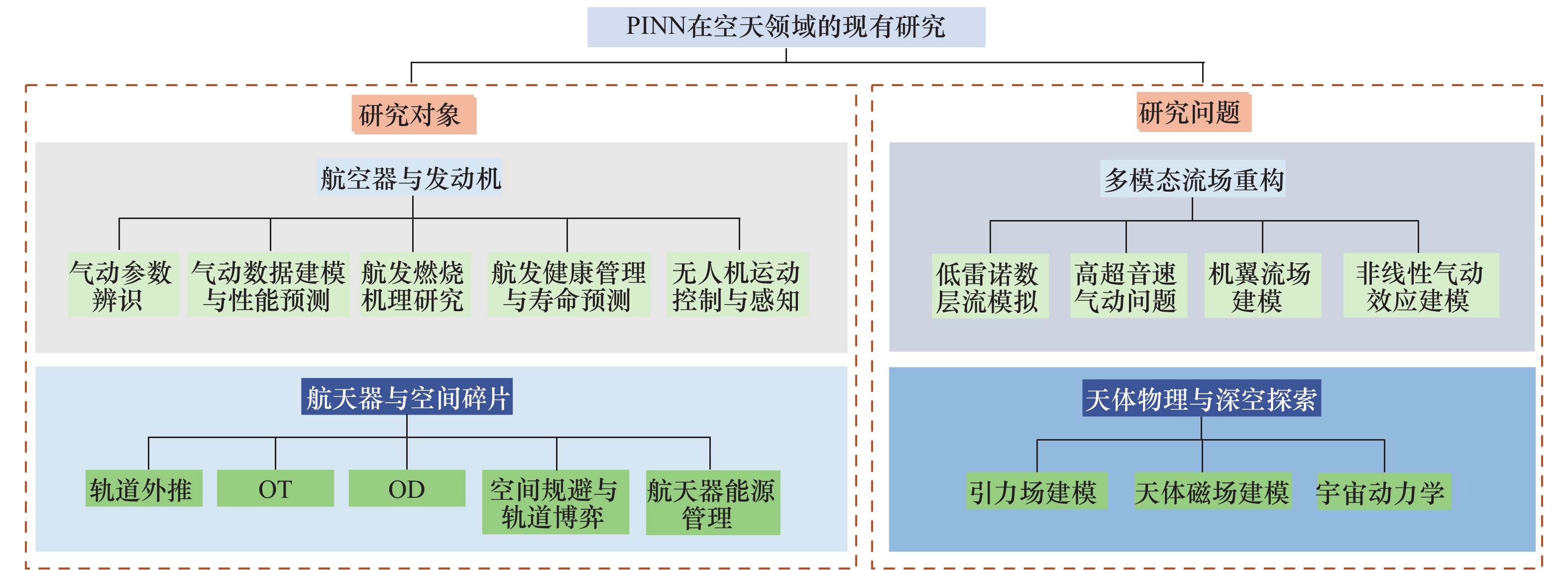
Fig.11
SGP4 propagation results for BEIDOU-2 GEO-8 Satellite"
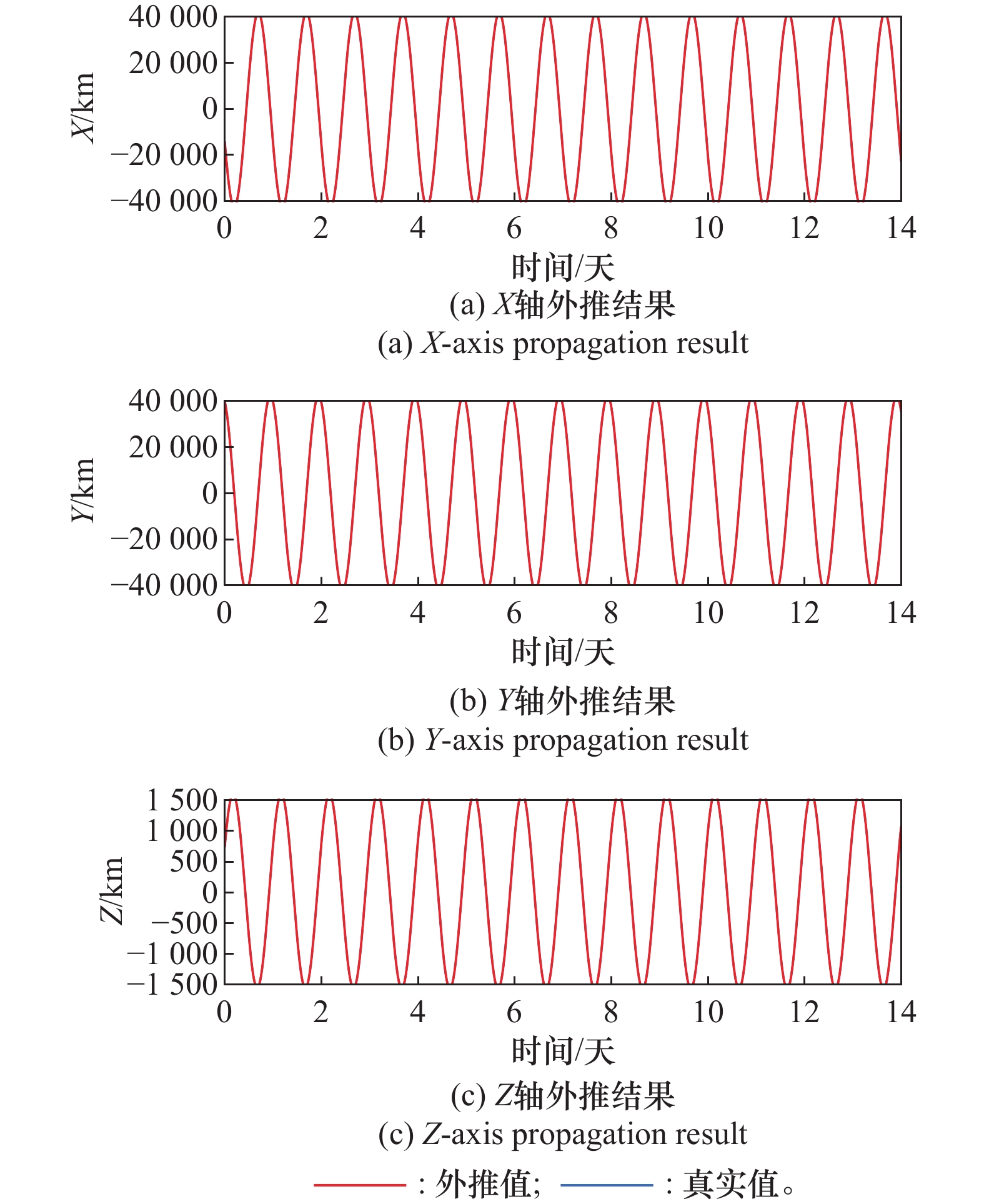
Fig.12
Error of propagation result of SGP4 relative to precise ephemeris"
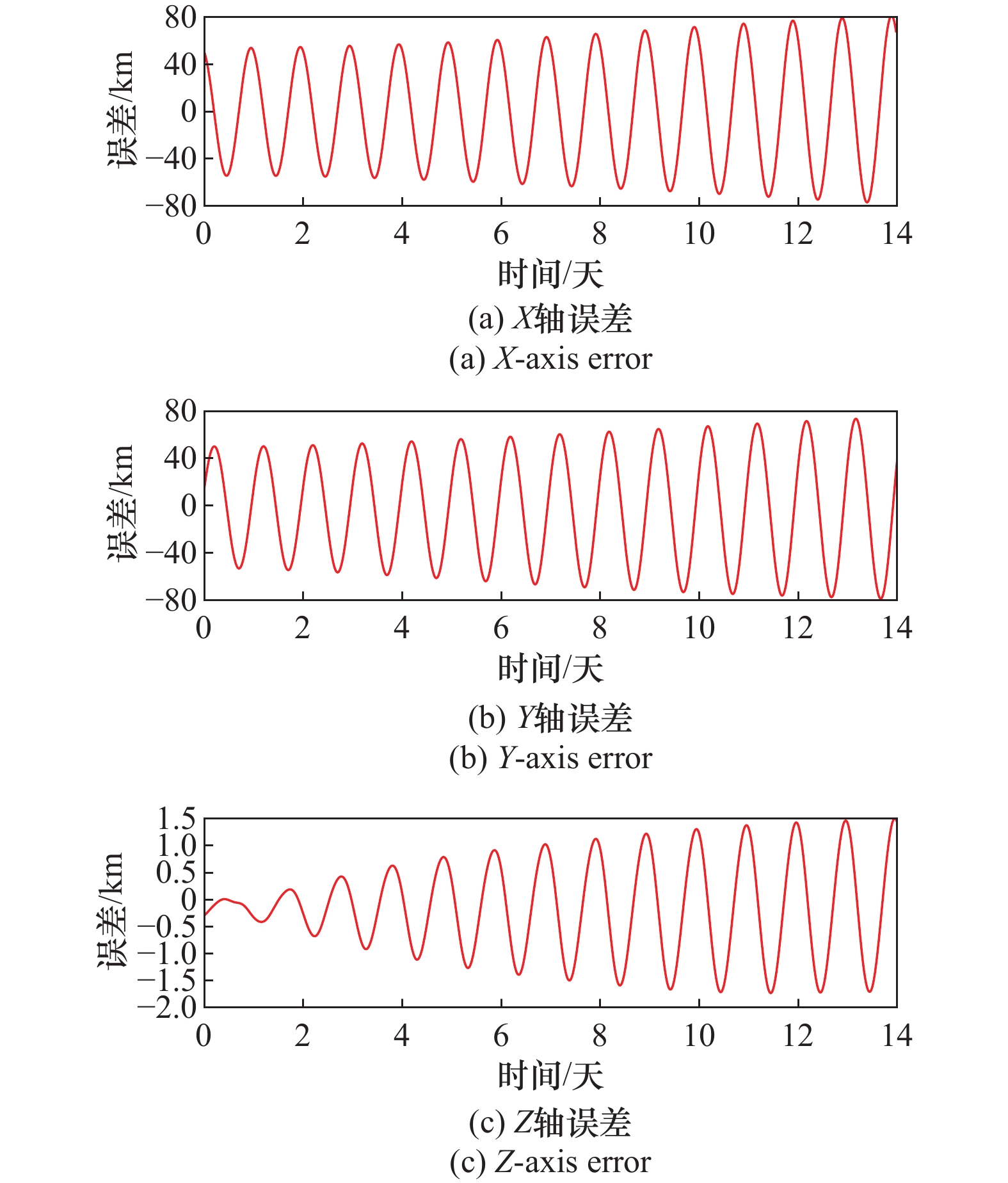
Table 4
SGP4 error indicator results"
| 误差指标 | X/km | Y/km | Z/km |
| RMSE | 46.01 | 45.53 | 0.87 |
| MAE | 41.04 | 40.63 | 0.71 |
| MaxAE | 81.81 | 79.00 | 1.73 |
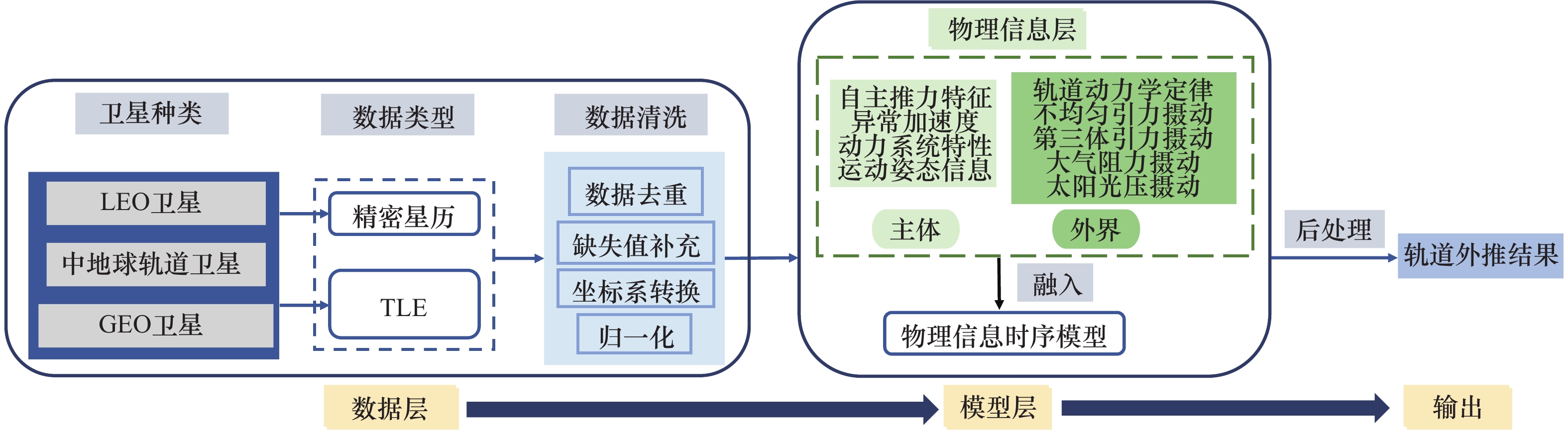
Fig.13
Diagram of satellite orbit propagation based on PINN"
| 1 | 韩淋. 中国空间站建设稳步推进[J]. 空间科学学报, 2021, 41 (5): 694- 695. |
| HAN L. Steady progress in the construction of China’s space station[J]. Chinese Journal of Space Science, 2021, 41 (5): 694- 695. | |
| 2 | 刘召芹, 彭嫚, 邸凯昌, 等. 嫦娥六号着陆点高精度视觉定位[J]. 遥感学报, 2024, 28 (6): 1648- 1655. |
| LIU Z Q, PENG M, DI K C, et al. High-precision visual localization of Chang’e-6[J]. Journal of Remote Sensing, 2024, 28 (6): 1648- 1655. | |
| 3 | CHEN Y. Impacts of China’s entry on the product line rivalry in the global cibil aircraft industry[D]. Macao: University of Saint Joseph, 2024. |
| 4 | 蔡伟, 王鑫, 蒋昕昊, 等. 基于解耦的小样本目标检测方法研究[J]. 系统工程与电子技术, 2024, 46 (9): 2941- 2950. |
| CAI W, WANG X, JIANG X H, et al. Research on few shot target detection method based on decoupling[J]. Systems Engineering and Electronics, 2024, 46 (9): 2941- 2950. | |
| 5 | 杨宗方, 张天骐, 马焜然, 等. 基于深层神经网络的信道编码类型盲识别[J]. 系统工程与电子技术, 2024, 46 (5): 1820- 1829. |
| YANG Z F, ZHANG T Q, MA K R, et al. Blind identification of channel coding types based on deep neural networks[J]. Systems Engineering and Electronics, 2024, 46 (5): 1820- 1829. | |
| 6 |
蔺瑞管, 王华伟, 车畅畅, 等. 基于LSTM分类器的航空发动机预测性维护模型[J]. 系统工程与电子技术, 2022, 44 (3): 1052- 1059.
doi: 10.12305/j.issn.1001-506X.2022.03.39 |
|
LIN R G, WANG H W, CHE C C, et al. Predictive maintenance model of aeroengine based on LSTM classifier[J]. Systems Engineering and Electronics, 2022, 44 (3): 1052- 1059.
doi: 10.12305/j.issn.1001-506X.2022.03.39 |
|
| 7 | 黄旭星, 李爽, 杨彬, 等. 人工智能在航天器制导与控制中的应用综述[J]. 航空学报, 2021, 42 (4): 106- 121. |
| HUANG X X, LI S, YANG B, et al. A review of artificial intelligence applications in spacecraft guidance and control[J]. Acta Aeronautica et Astronautica Sinica, 2021, 42 (4): 106- 121. | |
| 8 | 于登云, 张哲, 泮斌峰, 等. 深空探测人工智能技术研究与展望[J]. 深空探测学报 (中英文), 2020, 7 (1): 11- 23. |
| YU D Y, ZHANG Z, PAN B F, et al. Research and prospects of artificial intelligence technology in deep space exploration[J]. Journal of Deep Space Exploration (Chinese and English), 2020, 7 (1): 11- 23. | |
| 9 | 耿飞龙, 李爽, 黄旭星, 等. 基于深度神经网络的航天器姿态控制系统故障诊断与容错控制研究[J]. 中国空间科学技术, 2020, 40 (6): 1. |
| GENG F L, LI S, HUANG X X, et al. Fault diagnosis and fault-tolerant control of spacecraft attitude control systems based on deep neural networks[J]. China Space Science and Technology, 2020, 40 (6): 1. | |
| 10 | 洪端钦. 基于深度学习的空间碎片中长期轨道预报技术研究[D]. 厦门: 厦门大学, 2023. |
| HONG D Q. Medium and long-term orbit prediction technology for space debris based on deep learning[D]. Xiamen: Xiamen University, 2023. | |
| 11 |
姚保寅, 毛磊, 王智斌. 人工智能技术在航天装备领域应用探讨[J]. 现代防御技术, 2023, 51 (2): 33.
doi: 10.3969/j.issn.1009-086x.2023.02.004 |
|
YAO B Y, MAO L, WANG Z B. Applications of artificial intelligence in space equipment[J]. Modern Defense Technology, 2023, 51 (2): 33.
doi: 10.3969/j.issn.1009-086x.2023.02.004 |
|
| 12 |
RAISSI M, PERDIKARIS P, KARNIADAKIS G E. Physics-informed neural networks: a deep learning framework for solving forward and inverse problems involving nonlinear partial differential equations[J]. Journal of Computational Physics, 2019, 378, 686- 707.
doi: 10.1016/j.jcp.2018.10.045 |
| 13 |
李野, 陈松灿. 基于物理信息的神经网络: 最新进展与展望[J]. 计算机科学, 2022, 49 (4): 254- 262.
doi: 10.11896/jsjkx.210500158 |
|
LI Y, CHEN S C. Physics-informed neural networks: recent advances and prospects[J]. Computer Science, 2022, 49 (4): 254- 262.
doi: 10.11896/jsjkx.210500158 |
|
| 14 | 李道伦, 沈路航, 查文舒, 等. 基于神经算子与类物理信息神经网络智能求解新进展[J]. 力学学报, 2023, 56 (4): 875- 889. |
| LI D L, SHEN L H, ZHA W S, et al. New progress in intelligent solution of neural operators and physics-informed-methods[J]. Chinese Journal of Theoretical and Applied Mechanics, 2023, 56 (4): 875- 889. | |
| 15 |
CUOMO S, DI COLA V S, GIAMPAOLO F, et al. Scientific machine learning through physics–informed neural networks: where we are and what’s next[J]. Journal of Scientific Computing, 2022, 92 (3): 88.
doi: 10.1007/s10915-022-01939-z |
| 16 |
陈冲, 朱啸宇, 王芳, 等. 物理引导的深度学习研究综述: 进展、挑战和展望[J]. 计算机科学与探索, 2025, 19 (2): 277- 294.
doi: 10.3778/j.issn.1673-9418.2407056 |
|
CHEN C, ZHU X Y, WANG F, et al.. Comprehensive review of physics-guided deep learning: advancements, challenges, and perspective[J]. Journal of Frontiers of Computer Science and Technology, 2025, 19 (2): 277- 294.
doi: 10.3778/j.issn.1673-9418.2407056 |
|
| 17 |
CAI S Z, WANG Z C, WANG S F, et al. Physics-informed neural networks for heat transfer problems[J]. Journal of Heat Transfer, 2021, 143 (6): 060801.
doi: 10.1115/1.4050542 |
| 18 |
CAI S Z, MAO Z P, WANG Z C, et al. Physics-informed neural networks (PINNs) for fluid mechanics: a review[J]. Acta Mechanica Sinica, 2021, 37 (12): 1727- 1738.
doi: 10.1007/s10409-021-01148-1 |
| 19 |
ZHAO C, ZHANG F F, LOU W Q, et al. A comprehensive review of advances in physics-informed neural networks and their applications in complex fluid dynamics[J]. Physics of Fluids, 2024, 36 (10): 101301.
doi: 10.1063/5.0226562 |
| 20 |
LAGARIS I E, LIKAS A, FOTIADIS D I. Artificial neural networks for solving ordinary and partial differential equations[J]. IEEE Trans. on Neural Networks, 1998, 9 (5): 987- 1000.
doi: 10.1109/72.712178 |
| 21 |
PSICHOGIOS D C, UNGAR L H. A hybrid neural network-first principles approach to process modeling[J]. AIChE Journal, 1992, 38 (10): 1499- 1511.
doi: 10.1002/aic.690381003 |
| 22 |
LAGARIS I E, LIKAS A C, PAPAGEORGIOU D G. Neural-network methods for boundary value problems with irregular boundaries[J]. IEEE Trans. on Neural Networks, 2000, 11 (5): 1041- 1049.
doi: 10.1109/72.870037 |
| 23 |
DISSANAYAKE M W M G, PHAN-THIEN N. Neural-network-based approximations for solving partial differential equations[J]. Communications in Numerical Methods in Engineering, 1994, 10 (3): 195- 201.
doi: 10.1002/cnm.1640100303 |
| 24 | OWHADI H. Bayesian numerical homogenization[J]. Multiscale Modeling & Simulation, 2015, 13 (3): 812- 828. |
| 25 |
RAISSI M, PERDIKARIS P, KARNIADAKIS G E. Inferring solutions of differential equations using noisy multi-fidelity data[J]. Journal of Computational Physics, 2017, 335, 736- 746.
doi: 10.1016/j.jcp.2017.01.060 |
| 26 | BAYDIN A G, PEARLMUTTER B A, RADUL A A, et al. Automatic differentiation in machine learning: a survey[J]. Journal of Machine Learning Research, 2018, 18 (153): 1- 43. |
| 27 | CYBENKO G. Approximation by superpositions of a sigmoidal function[J]. Mathematics of Control, Signals and Systems, 1989, 2 (4): 303- 314. |
| 28 | BIN WAHEED U, HAGHIGHAT E, ALKHALIFAH T, et al. PINNeik: Eikonal solution using physics-informed neural networks[J]. Computers & Geosciences, 2021, 155, 104833. |
| 29 |
HE Q Z, BARAJAS-SOLANO D, TARTAKOVSKY G, et al. Physics-informed neural networks for multiphysics data assimilation with application to subsurface transport[J]. Advances in Water Resources, 2020, 141, 103610.
doi: 10.1016/j.advwatres.2020.103610 |
| 30 |
ZHU Q M, LIU Z L, YAN J H. Machine learning for metal additive manufacturing: predicting temperature and melt pool fluid dynamics using physics-informed neural networks[J]. Computational Mechanics, 2021, 67, 619- 635.
doi: 10.1007/s00466-020-01952-9 |
| 31 |
CHENG C, ZHANG G T. Deep learning method based on physics informed neural network with resnet block for solving fluid flow problems[J]. Water, 2021, 13 (4): 423.
doi: 10.3390/w13040423 |
| 32 | VIANA F A C, NASCIMENTO R G, DOURADO A, et al. Estimating model inadequacy in ordinary differential equations with physics-informed neural networks[J]. Computers & Structures, 2021, 245, 106458. |
| 33 |
LIU F Y, LI J L, WANG L B. PI-LSTM: physics-informed long short-term memory network for structural response modeling[J]. Engineering Structures, 2023, 292, 116500.
doi: 10.1016/j.engstruct.2023.116500 |
| 34 |
CHO G, ZHU D, CAMPBELL J J, et al. An LSTM-PINN hybrid method to estimate lithium-ion battery pack temperature[J]. IEEE Access, 2022, 10, 100594- 100604.
doi: 10.1109/ACCESS.2022.3208103 |
| 35 |
GAO H, SUN L, WANG J X. PhyGeoNet: physics-informed geometry-adaptive convolutional neural networks for solving parameterized steady-state PDEs on irregular domain[J]. Journal of Computational Physics, 2021, 428, 110079.
doi: 10.1016/j.jcp.2020.110079 |
| 36 |
ZHANG Z. A physics-informed deep convolutional neural network for simulating and predicting transient Darcy flows in heterogeneous reservoirs without labeled data[J]. Journal of Petroleum Science and Engineering, 2022, 211, 110179.
doi: 10.1016/j.petrol.2022.110179 |
| 37 | YANG X X, ZHANG Y M, CHEN H F, et al. A two-stage imaging framework combining CNN and physics-informed neural networks for full-inverse tomography: a case study in electrical impedance tomography (EIT)[J]. IEEE Signal Processing Leteis, 2025, 32, 1096- 1100. |
| 38 |
BODE M, GAUDING M, LIAN Z, et al. Using physics-informed enhanced super-resolution generative adversarial networks for subfilter modeling in turbulent reactive flows[J]. Proceedings of the Combustion Institute, 2021, 38 (2): 2617- 2625.
doi: 10.1016/j.proci.2020.06.022 |
| 39 |
ZHANG X Q, SHI J H, LI J J, et al. Hydrogen jet and diffusion modeling by physics-informed graph neural network[J]. Renewable and Sustainable Energy Reviews, 2025, 207, 114898.
doi: 10.1016/j.rser.2024.114898 |
| 40 | BASTEK J H, SUN W C, KOCHMANN D M. Physics-informed diffusion models[EB/OL]. [2024-10-11]. https://arxiv.org/abs/2403.14404. |
| 41 | , et al. Diffusion models: a comprehensive survey of methods and applications[J]. ACM Computing Surveys, 2023, 56 (4): 1- 39. |
| 42 |
JAGTAP A D, KHARAZMI E, KARNIADAKIS G E. Conservative physics-informed neural networks on discrete domains for conservation laws: applications to forward and inverse problems[J]. Computer Methods in Applied Mechanics and Engineering, 2020, 365, 113028.
doi: 10.1016/j.cma.2020.113028 |
| 43 | JAGTAP A D, KARNIADAKIS G E. Extended physics-informed neural networks (XPINNs): a generalized space-time domain decomposition based deep learning framework for nonlinear partial differential equations[J]. Communications in Computational Physics, 2020, 28(5): 2002−2041. |
| 44 |
PANG G F, LU L, KARNIADAKIS G E. fPINNs: fractional physics-informed neural networks[J]. SIAM Journal on Scientific Computing, 2019, 41 (4): A2603- A2626.
doi: 10.1137/18M1229845 |
| 45 |
宋家豪, 曹文博, 张伟伟. FD-PINN: 频域物理信息神经网络[J]. 力学学报, 2023, 55 (5): 1195- 1205.
doi: 10.6052/0459-1879-23-169 |
|
SONG J H, CAO W B, ZHANG W W. FD-PINN: frequency domain physics-informed neural network[J]. Chinese Journal of Theoretical and Applied Mechanics, 2023, 55 (5): 1195- 1205.
doi: 10.6052/0459-1879-23-169 |
|
| 46 | YAN J J, CHEN X H, WANG Z C, et al. ST-PINN: a self-training physics-informed neural network for partial differential Equations[C]//Proc. of the International Joint Conference on Neural Networks, 2023. |
| 47 | ZHAO Z Y, DING X Y, PRAKASH B A. Pinnsformer: a transformer-based framework for physics-informed neural networks[EB/OL]. [2024-10-11]. https://arXiv.org/obs/2307.11833. |
| 48 | VASWANI A. Attention is all you need [C]// Proc. of Conference of Neural Information Processing Systems. 2017: 6000−6010. |
| 49 |
CHEN Y, KOOHY S. GPT-PINN: generative pre-trained physics-informed neural networks toward non-intrusive meta-learning of parametric PDEs[J]. Finite Elements in Analysis and Design, 2024, 228, 104047.
doi: 10.1016/j.finel.2023.104047 |
| 50 |
, et al. DeepXDE: a deep learning library for solving differential equations[J]. SIAM Review, 2021, 63 (1): 208- 228.
doi: 10.1137/19M1274067 |
| 51 | ABADI M, BARHAM P, CHEN J, et al. {TensorFlow}: a system for {large-scale} machine learning[C]//Proc. of the 12th USENIX Symposium on Operating Systems Design and Implementation, 2016: 265–283. |
| 52 | HAO Z K, YAO J C, SU C, et al. Pinnacle: a comprehensive benchmark of physics-informed neural networks for solving PDEs[J]. Advances in Neural Information Processing Systems, 2024, 37, 76721- 76774. |
| 53 | HENNIGH O, NARASIMHAN S, NABIAN M A, et al. NVIDIA SimNet™: an AI-accelerated multi-physics simulation framework[C]//Proc. of the International Conference on Computational Science, 2021: 447–461. |
| 54 |
SAHLI COSTABAL F, YANG Y, PERDIKARIS P, et al. Physics-informed neural networks for cardiac activation mapping[J]. Frontiers in Physics, 2020, 8, 42.
doi: 10.3389/fphy.2020.00042 |
| 55 |
ZAPF B, HAUBNER J, KUCHTA M, et al. Investigating molecular transport in the human brain from MRI with physics-informed neural networks[J]. Scientific Reports, 2022, 12 (1): 15475.
doi: 10.1038/s41598-022-19157-w |
| 56 | STIASNY J, MISYRIS G S, CHATZIVASILEIADIS S. Physics-informed neural networks for non-linear system identification for power system dynamics[C]//Proc. of the IEEE Madrid PowerTech, 2021. |
| 57 | MISYRIS G S, VENZKE A, CHATZIVASILEIADIS S. Physics-informed neural networks for power systems[C]//Proc. of the IEEE Power & Energy Society General Meeting, 2020. |
| 58 |
KHAN A, LOWTHER D A. Physics informed neural networks for electromagnetic analysis[J]. IEEE Trans. on Magnetics, 2022, 58 (9)
doi: 10.1109/TMAG.2022.3198565 |
| 59 |
BAI Y, CHAOLU T, BILIGE S. The application of improved physics-informed neural network (IPINN) method in finance[J]. Nonlinear Dynamics, 2022, 107 (4): 3655- 3667.
doi: 10.1007/s11071-021-07146-z |
| 60 |
WANG D S, JIANG X T, SONG Y C, et al. Applications of physics-informed neural network for optical fiber communications[J]. IEEE Communications Magazine, 2022, 60 (9): 32- 37.
doi: 10.1109/MCOM.001.2100961 |
| 61 |
BARANIA H, ESMAEILPOUR M. On the application of physics informed neural networks (PINN) to solve boundary layer thermal-fluid problems[J]. International Communications in Heat and Mass Transfer, 2022, 132, 105890.
doi: 10.1016/j.icheatmasstransfer.2022.105890 |
| 62 |
ANTONELO E A, CAMPONOGARA E, SEMAN L O, et al. Physics-informed neural nets for control of dynamical systems[J]. Neurocomputing, 2024, 579, 127419.
doi: 10.1016/j.neucom.2024.127419 |
| 63 |
SU Y Q, CHEN X, LIU G R, et al. Implementation of real-time space target detection and tracking algorithm for space-based surveillance[J]. Remote Sensing, 2023, 15 (12): 3156.
doi: 10.3390/rs15123156 |
| 64 | 陈柯帆. 摄动对航天器轨道预报影响与插值预报分析[D]. 哈尔滨: 哈尔滨工程大学, 2020. |
| CHEN K F. Influence of perturbation and interpolation algorithm on orbit prediction of spacecraft[D]. Harbin: Harbin Engineering University, 2020. | |
| 65 | 袁旭, 朱圣英, 乔栋, 等. 小天体着陆动力学参数不确定性影响分析[J]. 深空探测学报, 2014, 1 (2): 134- 139. |
| YUAN X, ZHU S Y, QIAO D, et al. Analysis of the impact of dynamics parameter uncertainties on small celestial body landing[J]. Journal of Deep Space Exploration, 2014, 1 (2): 134- 139. | |
| 66 |
RAO C P, SUN H, LIU Y. Physics-informed deep learning for incompressible laminar flows[J]. Theoretical and Applied Mechanics Letters, 2020, 10 (3): 207- 212.
doi: 10.1016/j.taml.2020.01.039 |
| 67 |
MAO Z, JAGTAP A D, KARNIADAKIS G E. Physics-informed neural networks for high-speed flows[J]. Computer Methods in Applied Mechanics and Engineering, 2020, 360, 112789.
doi: 10.1016/j.cma.2019.112789 |
| 68 |
JAGTAP A D, MAO Z, ADAMS N, et al. Physics-informed neural networks for inverse problems in supersonic flows[J]. Journal of Computational Physics, 2022, 466, 111402.
doi: 10.1016/j.jcp.2022.111402 |
| 69 |
CAO W, SONG J, ZHANG W W. Solving high-dimensional parametric engineering problems for inviscid flow around airfoils based on physics-informed neural networks[J]. Journal of Computational Physics, 2024, 516, 113285.
doi: 10.1016/j.jcp.2024.113285 |
| 70 |
SUN Y, SENGUPTA U, JUNIPER M. Physics-informed deep learning for simultaneous surrogate modeling and PDE-constrained optimization of an airfoil geometry[J]. Computer Methods in Applied Mechanics and Engineering, 2023, 411, 116042.
doi: 10.1016/j.cma.2023.116042 |
| 71 |
GUO M M, DENG X, MA Y, et al. Hypersonic inlet flow field reconstruction dominated by shock wave and boundary layer based on small sample physics-informed neural networks[J]. Aerospace Science and Technology, 2024, 150, 109205.
doi: 10.1016/j.ast.2024.109205 |
| 72 | 付军泉, 钟伯文, 钟运琴, 等. 基于物理信息神经网络的飞机气动参数辨识方法[J]. 空气动力学学报, 2023, 41(9): 30−37. |
| FU J Q, ZHONG B W, ZHONG Y Q, et al. A physics informed neural network based method for aircraft aerodymanic parameter identification[J]. Acta Aerodynamica Sinica, 2023, 41(9): 30−37. | |
| 73 | 刘霞, 冯文晖, 连峰, 等. 基于物理信息神经网络的气动数据融合方法[J]. 空气动力学学报, 2023, 41(8): 87−96. |
| LIU X, FENG W H, LIAN F, et al. Aerodynamic data fusion method based on physics-informed neural network[J]. Acta Aerodynamica Sinica, 2023, 41(8): 87−96. | |
| 74 | NA K M, PARK J, JUNG K W, et al. Estimation of aerodynamic uncertainty in missile system using physics-informed neural network framework[C]//Proc. of the International Conference on Robot Intelligence Technology and Applications, 2022: 3–14. |
| 75 |
MICHEK N E, MEHTA P, HUEBSCH W W. Flight dynamic uncertainty quantification modeling using physics-informed neural networks[J]. AIAA Journal, 2024, 62 (11): 4234- 4246.
doi: 10.2514/1.J063992 |
| 76 |
LIU S, WANG H, CHEN J H, et al. High-resolution reconstruction of turbulent flames from sparse data with physics-informed neural networks[J]. Combustion and Flame, 2024, 260, 113275.
doi: 10.1016/j.combustflame.2023.113275 |
| 77 |
, et al. Two-dimensional temperature field inversion of turbine blade based on physics-informed neural networks[J]. Physics of Fluids, 2024, 36 (3): 037114.
doi: 10.1063/5.0190429 |
| 78 |
WANG X T, WEN H C, HU T, et al. Flow-field reconstruction in rotating detonation combustor based on physics-informed neural network[J]. Physics of Fluids, 2023, 35 (7): 076109.
doi: 10.1063/5.0154979 |
| 79 |
LIAO X Y, CHEN S W, WEN P F, et al. Remaining useful life with self-attention assisted physics-informed neural network[J]. Advanced Engineering Informatics, 2023, 58, 102195.
doi: 10.1016/j.aei.2023.102195 |
| 80 | VOLLERT S, THEISSLER A. Challenges of machine learning-based RUL prognosis: a review on NASA's C-MAPSS data set[C]//Proc. of the 26th IEEE International Conference on Emerging Technologies and Factory Automation, 2021. |
| 81 | ZHANG X W, LOU J Y, ZHANG J F, et al. Aero-engine remaining useful life prediction via physics-informed self-attention encoder[C]//Proc. of the Turbo Expo: Power for Land, Sea, and Air. American Society of Mechanical Engineers, 2024, 87967: V004T05A022. |
| 82 |
LI X Q, SONG L K, ChOY Y S, et al. Fatigue reliability analysis of aeroengine blade-disc systems using physics-informed ensemble learning[J]. Philosophical Transactions of the Royal Society A, 2023, 381 (2260): 20220384.
doi: 10.1098/rsta.2022.0384 |
| 83 |
SAN-JUAN J F, PEREZ I, SAN-MARTIN M, et al. Hybrid SGP4 orbit propagator[J]. Acta Astronautica, 2017, 137, 254- 260.
doi: 10.1016/j.actaastro.2017.04.015 |
| 84 |
PENG H, BAI X L. Artificial neural network–based machine learning approach to improve orbit prediction accuracy[J]. Journal of Spacecraft and Rockets, 2018, 55 (5): 1248- 1260.
doi: 10.2514/1.A34171 |
| 85 | ALESIANI F, TAKAMOTO M, KAMIYA T, et al. LEO satellite orbit prediction with physics informed machine learning[C]//Proc. of the Workshop on Machine Learning and the Physical Sciences, 2023. |
| 86 |
KARNIADAKIS G E, KEVREKIDIS I G, LU L, et al. Physics-informed machine learning[J]. Nature Reviews Physics, 2021, 3 (6): 422- 440.
doi: 10.1038/s42254-021-00314-5 |
| 87 | SUBRAMANIAN S, RAMNANI R, SENGUPTA S, et al. Orbit propagation from historical data using physics-informed neural ODEs[C]//Proc. of the International Conference on Machine Learning and Applications, 2023: 1643–1648. |
| 88 | VAREY J, RUPRECHT J D, TIERNEY M, et al. Physics-informed neural networks for satellite state estimation[C]//Proc. of the IEEE Aerospace Conference, 2024. |
| 89 | RAN J P, HU X X, YUAN X Q, et al. Physics-informed neural networks based low thrust orbit transfer design for spacecraft[C]//Proc. of the CAA Symposium on Fault Detection, Supervision and Safety for Technical Processes, 2023. |
| 90 |
SCHIASSI E, D’AMBROSIO A, DROZD K, et al. Physics-informed neural networks for optimal planar orbit transfers[J]. Journal of Spacecraft and Rockets, 2022, 59 (3): 834- 849.
doi: 10.2514/1.A35138 |
| 91 |
SCHIASSI E, FURARO R, LEAKE C, et al. Extreme theory of functional connections: a fast physics-informed neural network method for solving ordinary and partial differential equations[J]. Neurocomputing, 2021, 457, 334- 356.
doi: 10.1016/j.neucom.2021.06.015 |
| 92 | SCORSOGLIO A, GHILARDI L, FURFARO R. Orbit determination via physics informed neural networks in cislunar environment[C]// Proc. of the 31st American Astronautical Society/American Institute of Aeronautics and Astronautics Space Flight Mechanics Meeting, 2022. |
| 93 | SCORSOGLIO A, D’AMBROSIO A, GHILARDI L, et al. Physics-informed orbit determination for cislunar space applications[C]//Proc. of the Advanced Maui Optical and Space Surveillance (AMOS) Technologies Conference, 2023. |
| 94 | SCORSOGLIO A, FURFARO R. Orbit determination via physics informed neural networks[C]//Proc. of the 31st American Astronautical Society/American Institute of Aeronautics and Astronautics Space Flight Mechanics Meeting, 2021. |
| 95 | SCORSOGLIO A, D'AMBROSIO A, CAMPBELL T, et al. Orbit determination pipeline for geostationary objects using physics-informed neural networks[C]//Proc. of the American Institute of Aeronautics and Astronautics Science and Technology Forum, 2024: 1862. |
| 96 |
DING S F, XU X Z, NIE R. Extreme learning machine and its applications[J]. Neural Computing and Applications, 2014, 25, 549- 556.
doi: 10.1007/s00521-013-1522-8 |
| 97 | BADURA G P, VELEZ-REYES M, GUNTER B, et al. Regularizing training of physics informed neural networks (PINNs) for cislunar orbit determination via transfer learning[C]//Proc. of the Advanced Maui Optical and Space Surveillance (AMOS) Technologies Conference, 2024: 17. |
| 98 |
SINGH G, KUMAR V, BUDURU A B, et al. Tracking an untracked space debris after an inelastic collision using physics informed neural network[J]. Scientific Reports, 2024, 14 (1): 3350.
doi: 10.1038/s41598-024-51897-9 |
| 99 |
YANG F Y X, YANG L P, ZHU Y W. A physics-informed deep learning framework for spacecraft pursuit-evasion task assessment[J]. Chinese Journal of Aeronautics, 2024, 37 (5): 363- 376.
doi: 10.1016/j.cja.2024.02.011 |
| 100 | D’AMBROSIO A, SCHIASSI E, CURTI F, et al. Physics-informed neural networks for optimal proximity maneuvers with collision avoidance around asteroids[C]//Proc. of the AAS/AIAA Astrodynamics Specialist Conference, 2021. |
| 101 |
KARPOV P I, HUANG C, SITDIKOV I, et al. Physics-informed machine learning for modeling turbulence in supernovae[J]. The Astrophysical Journal, 2022, 940 (1): 26.
doi: 10.3847/1538-4357/ac88cc |
| 102 | MOSCHOU S P, HICKS E, PAREKH R Y, et al. Physics-informed neural networks for modeling astrophysical shocks[J]. Machine Learning: Science and Technology, 2023, 4 (3): 035032. |
| 103 |
MARTIN J, SCHAUB H. Physics-informed neural networks for gravity field modeling of the earth and moon[J]. Celestial Mechanics and Dynamical Astronomy, 2022, 134 (2): 13.
doi: 10.1007/s10569-022-10069-5 |
| 104 |
MARTIN J, SCHAUB H. Physics-informed neural networks for gravity field modeling of small bodies[J]. Celestial Mechanics and Dynamical Astronomy, 2022, 134 (5): 46.
doi: 10.1007/s10569-022-10101-8 |
| 105 |
AI G Z, YIN J H, CUI L Y. Learning gravity fields of small bodies: self-adaptive physics-informed neural networks[J]. The Astronomical Journal, 2024, 168 (6): 242.
doi: 10.3847/1538-3881/ad7951 |
| 106 |
JAROLIM R, THALMANN J K, VERONIG A M, et al. Probing the solar coronal magnetic field with physics-informed neural networks[J]. Nature Astronomy, 2023, 7 (10): 1171- 1179.
doi: 10.1038/s41550-023-02030-9 |
| 107 |
LIVERMORE P W, WU L Y, CHEN L W, et al. Reconstructions of Jupiter’s magnetic field using physics-informed neural networks[J]. Monthly Notices of the Royal Astronomical Society, 2024, 533 (4): 4058- 4067.
doi: 10.1093/mnras/stae1928 |
| 108 |
BOLTONS J, LUNINE J, STEVENSON D, et al. The juno mission[J]. Space Science Reviews, 2017, 213, 5- 37.
doi: 10.1007/s11214-017-0429-6 |
| 109 |
GU W B, PRIMATESTA S, RIZZO A. Physics-informed neural network for quadrotor dynamical modeling[J]. Robotics and Autonomous Systems, 2024, 171, 104569.
doi: 10.1016/j.robot.2023.104569 |
| 110 |
BIANCHI D, EPICOCO N, DI FERDINANDO M, et al. Physics-informed neural networks for UAV system estimation[J]. Drones, 2024, 8, 716.
doi: 10.3390/drones8120716 |
| 111 |
KAMATH A K, ANAVATTI S G, FEROSKHAN M. A Physics-informed neural network approach to augmented dynamics visual servoing of multirotors[J]. IEEE Trans. on Cybernetics, 2024, 54 (11): 6319- 6332.
doi: 10.1109/TCYB.2024.3413072 |
| 112 |
HONG S H, OU J, WANG Y. Physics-guided neural network and GPU-accelerated nonlinear model predictive control for quadcopter[J]. Neural Computing and Applications, 2023, 35 (1): 393- 413.
doi: 10.1007/s00521-022-07783-4 |
| 113 |
胡付佳, 周逸伦, 刘小民, 等. 采用混合粗糙数据物理信息神经网络的扑翼气动性能预测方法[J]. 西安交通大学学报, 2023, 57 (11): 194- 205.
doi: 10.7652/xjtuxb202311019 |
|
HU F J, ZHOU Y L, LIU X M, et al. Prediction method for flapping wing aerodynamic performance using a hybrid rough data physics-informed neural network[J]. Journal of Xi'an Jiaotong University, 2023, 57 (11): 194- 205.
doi: 10.7652/xjtuxb202311019 |
|
| 114 |
CHEN D, LI Y, GUO J R, et al. Estimation of hypersonic vehicle weight using physics-informed neural network supported by knowledge based engineering[J]. Expert Systems with Applications, 2022, 195, 116609.
doi: 10.1016/j.eswa.2022.116609 |
| 115 | FU H J, LIU Z G, CUI K X, et al. Physics-informed neural network for spacecraft lithium-ion battery modeling and health diagnosis[J]. IEEE/ASME Trans. on Mechatronics, 2024, 29, 3546- 3555. |
| 116 |
STEFANOU P, URBÁN J F, PONS J A. Solving the pulsar equation using physics-informed neural networks[J]. Monthly Notices of the Royal Astronomical Society, 2023, 526 (1): 1504- 1511.
doi: 10.1093/mnras/stad2840 |
| 117 |
DAHLBÜDDING D, MOLAVERDIKHANI K, ERCOLANO B, et al. Approximating Rayleigh scattering in exoplanetary atmospheres using physics-informed neural networks[J]. Monthly Notices of the Royal Astronomical Society, 2024, 533 (3): 3475- 3483.
doi: 10.1093/mnras/stae1872 |
| 118 | DAI Z, MOES B, VILALTA R, et al. Physics-informed neural networks in the recreation of hydrodynamic simulations from dark matter[J]. Monthly Notices of the Royal Astronomical Society, 2024, 527 (2): 3381- 3394. |
| 119 | 胡佳伟. 基于深度学习的高维流场建模方法研究[D]. 西安: 西北工业大学, 2024. |
| HU J W. Research on high dimensional flow field modeling method based on deeplearning[D]. Xi’an: Northwestern Polytechnical University, 2024. | |
| 120 | 陈明韬. 基于深度学习的卫星轨道预报方法研究[D]. 厦门: 厦门大学, 2023. |
| CHEN M T. Satellite orbit prediction method based on deep learning[D]. Xiamen: Xiamen University, 2023. | |
| 121 |
ZHANG R Y, LIU Y, SUN H. Physics-informed multi-LSTM networks for metamodeling of nonlinear structures[J]. Computer Methods in Applied Mechanics and Engineering, 2020, 369, 113226.
doi: 10.1016/j.cma.2020.113226 |
| 122 |
GENEDY R A, CHUNG M, SHORTRIDGE J E, et al. A physics-informed long short-term memory (LSTM) model for estimating ammonia emissions from dairy manure during storage[J]. Science of The Total Environment, 2024, 912, 168885.
doi: 10.1016/j.scitotenv.2023.168885 |
| 123 | PAN X, MOHAMMADI N, TAYLOR J E. River flood prediction based on physics-informed long short-term memory model[C]//Proc. of the Construction Research Congress, 2024: 208–216. |
| 124 | BRACHET A R, RICHARD P Y, HUDELOT C. Bond graphs for multi-physics informed neural networks for multi-variate time series[EB/OL]. [2024-10-11]. https://arxiv.org/abs/2405.13586. |
| 125 |
WEI D, ZHAO X Y. An accuracy analysis of the SGP4/SDP4 model[J]. Chinese Astronomy and Astrophysics, 2010, 34 (1): 69- 76.
doi: 10.1016/j.chinastron.2009.12.009 |
| 126 |
KIM H K, HAN C Y. Analytical and numerical approaches of a solar array thermalanalysis in a low-earth orbit satellite[J]. Advances in Space Research, 2010, 46 (11): 1427- 1439.
doi: 10.1016/j.asr.2010.08.023 |
| 127 |
XU X L, XIONG Y Q. Study on the orbit prediction errors of space objects based on historical TLE data[J]. Chinese Astronomy and Astrophysics, 2019, 43 (4): 563- 578.
doi: 10.1016/j.chinastron.2019.11.007 |
| 128 | 张梦钰, 豆亚杰, 陈子夷, 等. 深度强化学习及其在军事领域中的应用综述[J]. 系统工程与电子技术, 2024, 46 (4): 1297- 1308. |
| ZHANG M Y, DOU Y J, CHEN Z Y, et al. Review of deep reinforcement learning and its applications in military field[J]. Systems Engineering and Electronics, 2024, 46 (4): 1297- 1308. |
| [1] | Zeying YANG, Zhuo CHEN, Zhiming XU, Xiaofeng AI, Qihua WU, Ling WANG. Forward labeling method for ISAR image components of space targets [J]. Systems Engineering and Electronics, 2026, 48(4): 1165-1173. |
| [2] | Hongyu TIAN, Songhu GE, Yu GUO, Zhongpu CUI, Xiao LIANG. Communication interference recognition method based on multi-feature fusion under low interference-to-noise ratio conditions [J]. Systems Engineering and Electronics, 2026, 48(3): 1061-1071. |
| [3] | Kun CHENG, Hongtao LEI, Zhixuan LYU. Lightweight unmanned aerial vehicle tracking method of improved YOLOv8 [J]. Systems Engineering and Electronics, 2026, 48(3): 737-750. |
| [4] | Long ZHANG, Lianhong ZHU, Bo YANG, Zhen LEI, Xuanming FENG. MFA-Net: a multimodal adaptive fusion network for intelligent recognition of anti-ship missiles in complex adversarial environments [J]. Systems Engineering and Electronics, 2026, 48(3): 894-907. |
| [5] | Yugang BAO, Haoxiang JIA, Danfeng ZHAO. Single image raindrop removal model based on high-order recursive network [J]. Systems Engineering and Electronics, 2026, 48(1): 12-21. |
| [6] | Haiqing CHEN, Liuying WANG, Gu LIU, Long WANG, Chaoqun GE, Mengzhou CHEN. Research progress on denoising algorithms for synthetic aperture radar images [J]. Systems Engineering and Electronics, 2026, 48(1): 94-105. |
| [7] | Kaiming LI, Yuanpeng ZHANG, Ying LUO, Xiaonan DAI. Research progress on radar target recognition of ballistic missile [J]. Systems Engineering and Electronics, 2025, 47(9): 2870-2889. |
| [8] | Ce JI, Xiangyu MA, Xiaoyu MU, Jiayi ZHAO. TS-GRU-VTA: vehicle channel estimation scheme based on deep learning [J]. Systems Engineering and Electronics, 2025, 47(9): 3093-3098. |
| [9] | Xiaowei YAN, Chong LING, Shengbin SHI. Design and implementation of a rapid detection system for surface unexploded submunitions [J]. Systems Engineering and Electronics, 2025, 47(8): 2639-2645. |
| [10] | Wanying ZHANG, Youbing GAO, Zeyi LI, Pengfei LI, Wei ZHANG. Background signal suppression algorithm based on dual-path feature fusion net [J]. Systems Engineering and Electronics, 2025, 47(7): 2406-2413. |
| [11] | Xinzheng ZHANG, Mengke YAN, Xiaolin ZHU. Noise pseudo-label tolerant semi-supervised SAR target recognition [J]. Systems Engineering and Electronics, 2025, 47(6): 1796-1805. |
| [12] | Zhijie JIANG, Heng SONG, Nan HU, Lanxi DUAN, Ping CAO. Target recognition and classification algorithm of MMW radar in tunnel [J]. Systems Engineering and Electronics, 2025, 47(5): 1453-1460. |
| [13] | Qianqi NIE, Minghui SHA, Yingshen ZHU, Chongyu WANG, Nianqiang CUI. Radar multi-component signal recognition method based on blind source separation combined with singular spectrum analysis [J]. Systems Engineering and Electronics, 2025, 47(4): 1168-1175. |
| [14] | Lei YUAN, Yanjuan YANG, Yi GUO, Peng DAI. Deep learning-based semi-blind identification algorithm for code rates of LDPC codes with correlated noise [J]. Systems Engineering and Electronics, 2025, 47(4): 1335-1345. |
| [15] | Xiarun SHEN, Ruonan LI, Haotian ZHANG. Server KPI anomaly detection based on CVAE-LSTM [J]. Systems Engineering and Electronics, 2025, 47(3): 1019-1027. |
| Viewed | ||||||
|
Full text |
|
|||||
|
Abstract |
|
|||||