Systems Engineering and Electronics ›› 2025, Vol. 47 ›› Issue (12): 4203-4211.doi: 10.12305/j.issn.1001-506X.2025.12.32
• Communications and Networks • Previous Articles
Robust transmission method for IRS assisted satellite-terrestrial fusion considering queue stability
Xincheng HE1( ), Bai ZHAO1, Zhi LIN2, Zining WANG1, Jian OUYANG1,*
- 1. College of Communications and Information Engineering,Nanjing University of Posts and Telecommunications,Nanjing 210003,China
2. Anhui Province Key Laboratory of Electronic Restriction,National University of Defense Technology,Hefei 230037,China
-
Received:2024-08-02Revised:2025-02-03Online:2025-04-22Published:2025-04-22 -
Contact:Jian OUYANG E-mail:hexincheng20000116@163.com

CLC Number:
Cite this article
Xincheng HE, Bai ZHAO, Zhi LIN, Zining WANG, Jian OUYANG. Robust transmission method for IRS assisted satellite-terrestrial fusion considering queue stability[J]. Systems Engineering and Electronics, 2025, 47(12): 4203-4211.
share this article
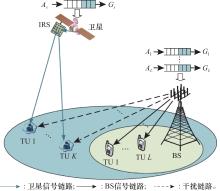
Fig.1
IRS-assisted downlink queueing transmission scenario in STIN"
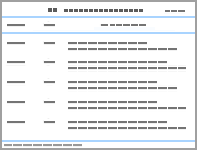
Table 1
Simulation parameters setting"
| 参数 | 数值 |
| 卫星轨道 | 地球静止轨道 |
| 卫星天线增益 | |
| 用户接收增益 | |
| 卫星天线数 | |
| IRS规模 | |
| BS天线数 | |
| 天线阵元间距 |
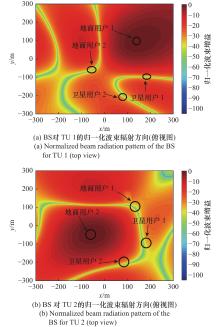
Fig.2
Normalized beam radiation patterns of the IRS and ground BS"
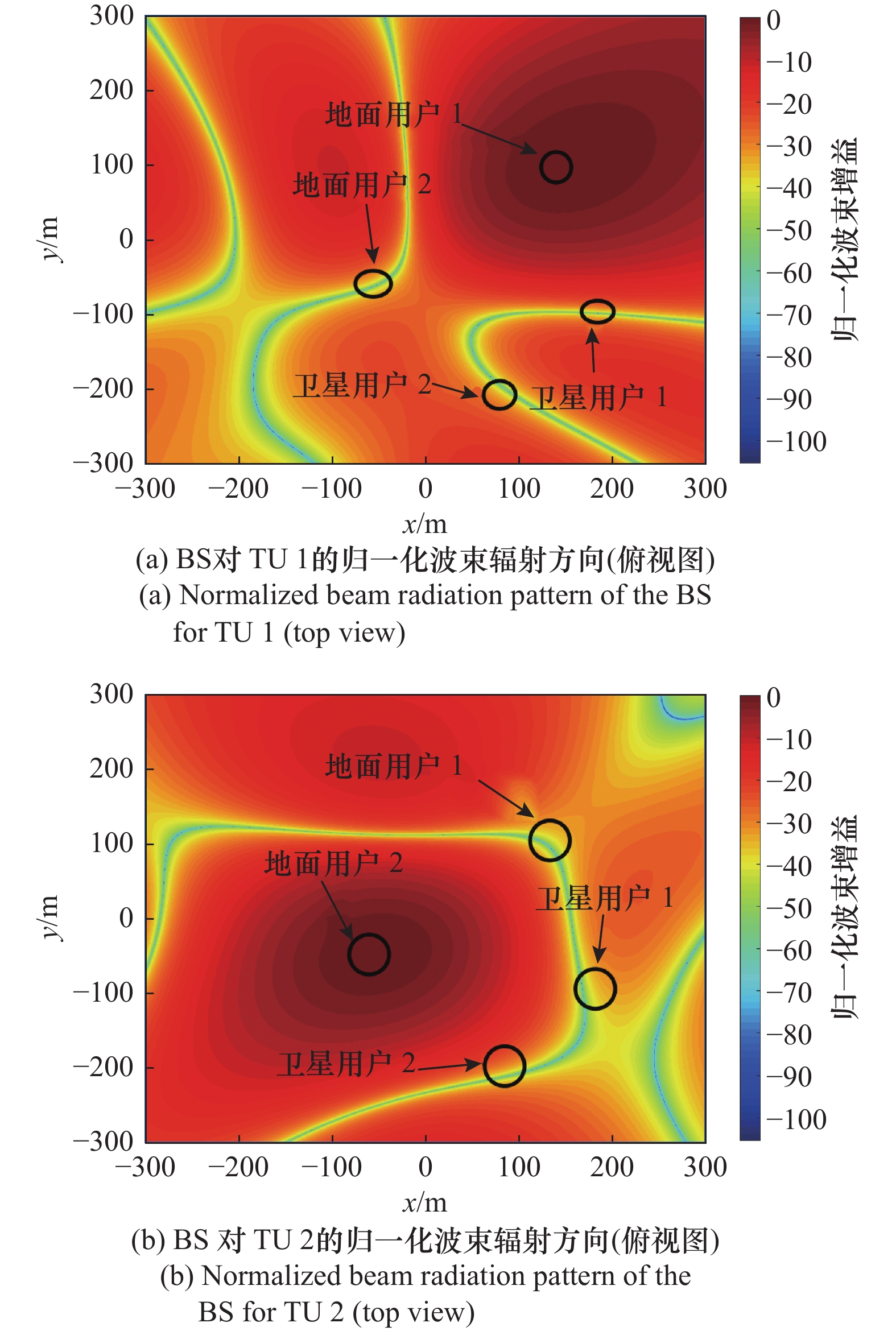
Fig.3
Actual performance of user received power in the proposed scheme versus the non-robust transmission scheme"
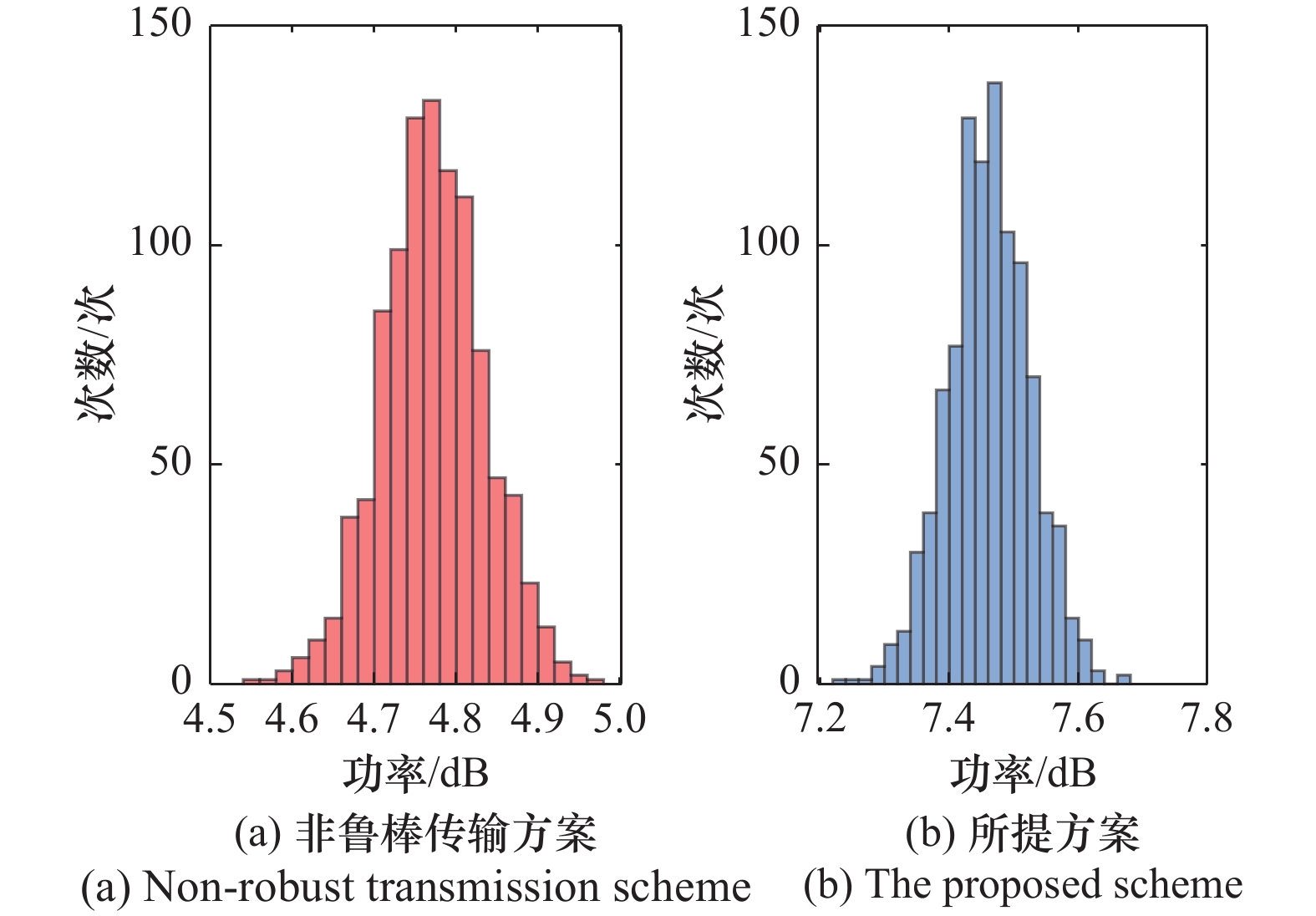
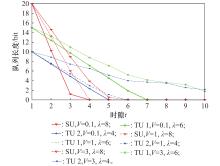
Fig.4
Convergence curves of system queue under different conditions"
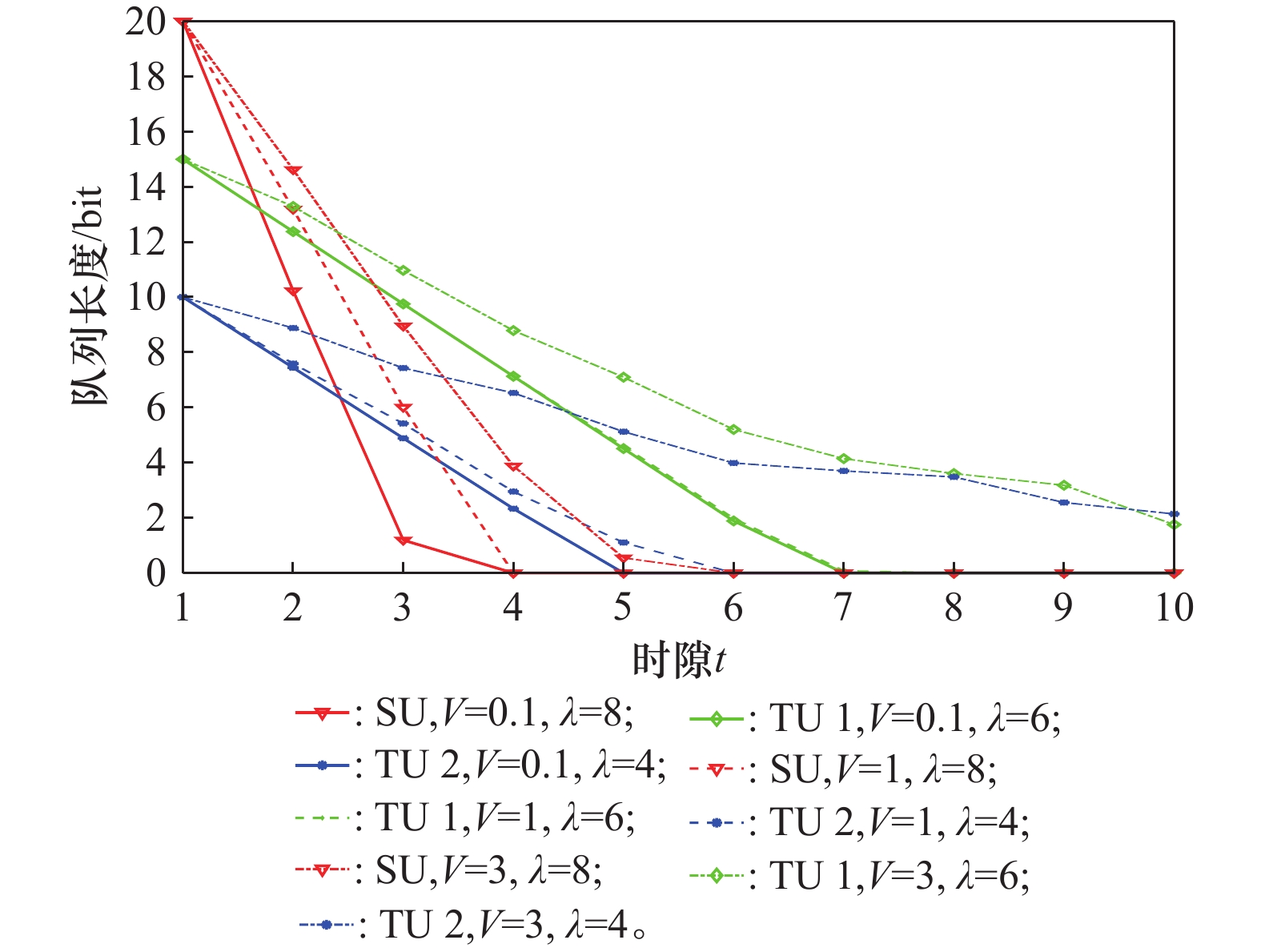
Fig.5
Relationship between system single-slot rate and maximum transmission power"
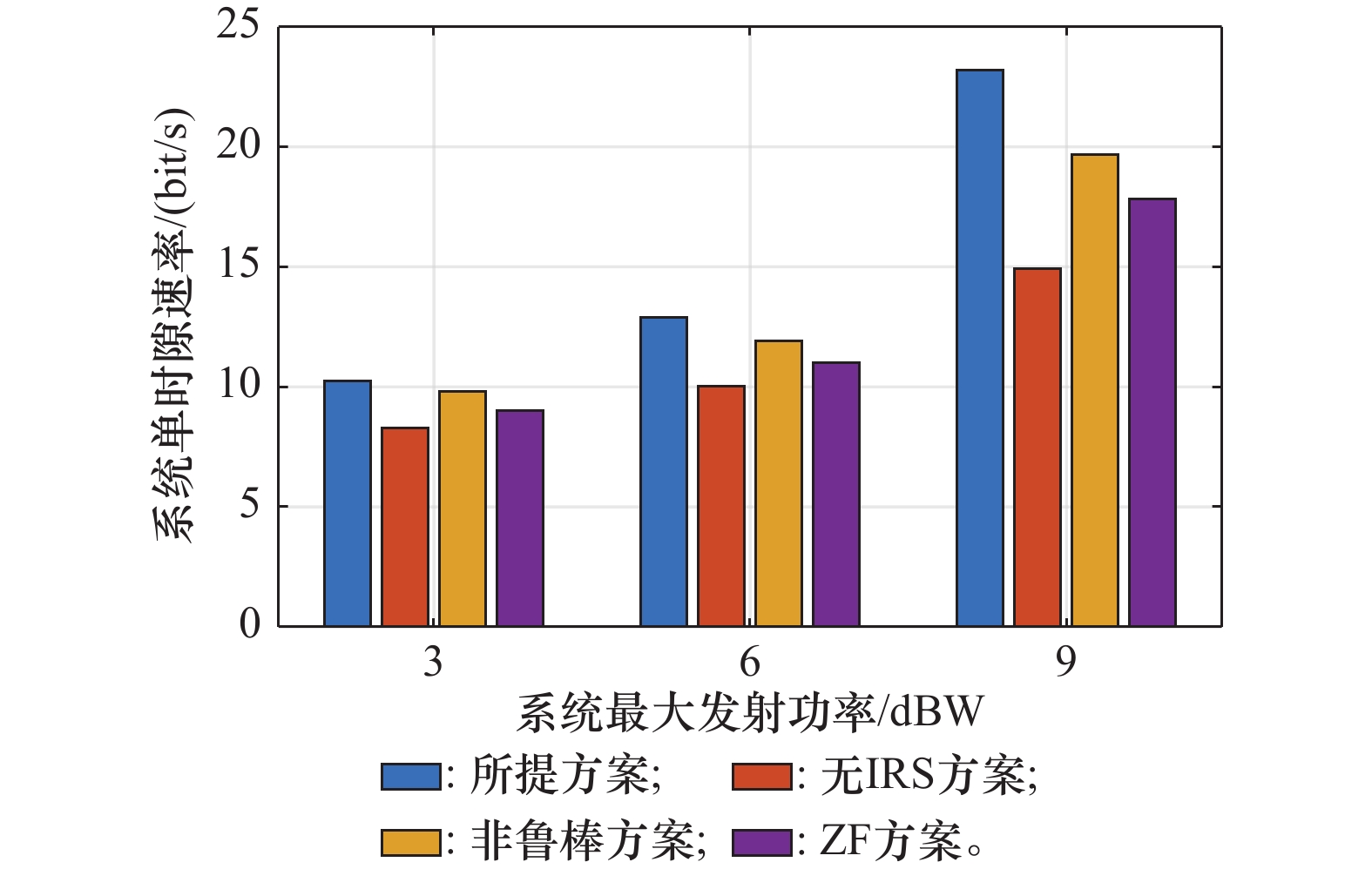
Fig.6
Average system power performance under different schemes"
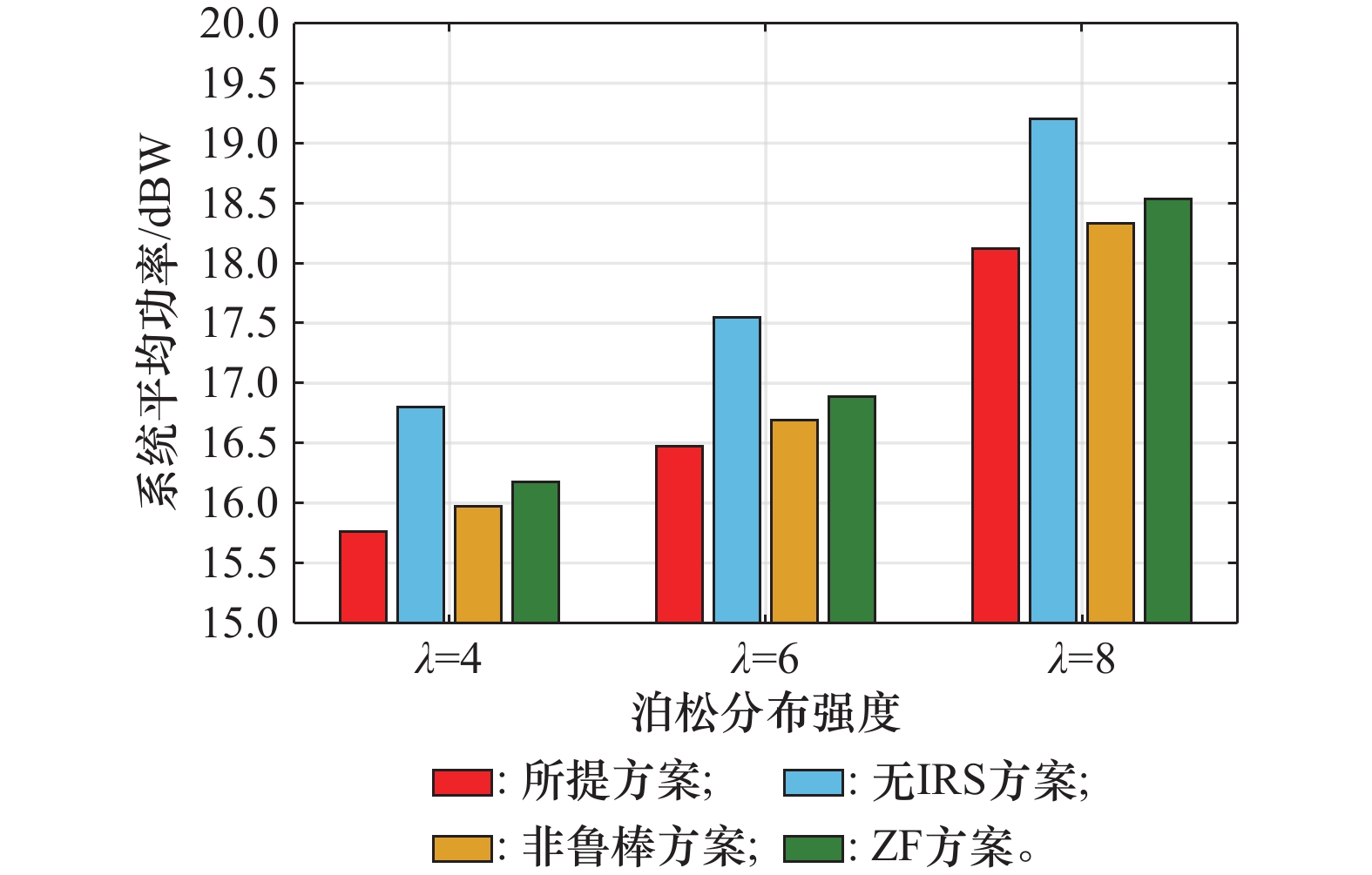
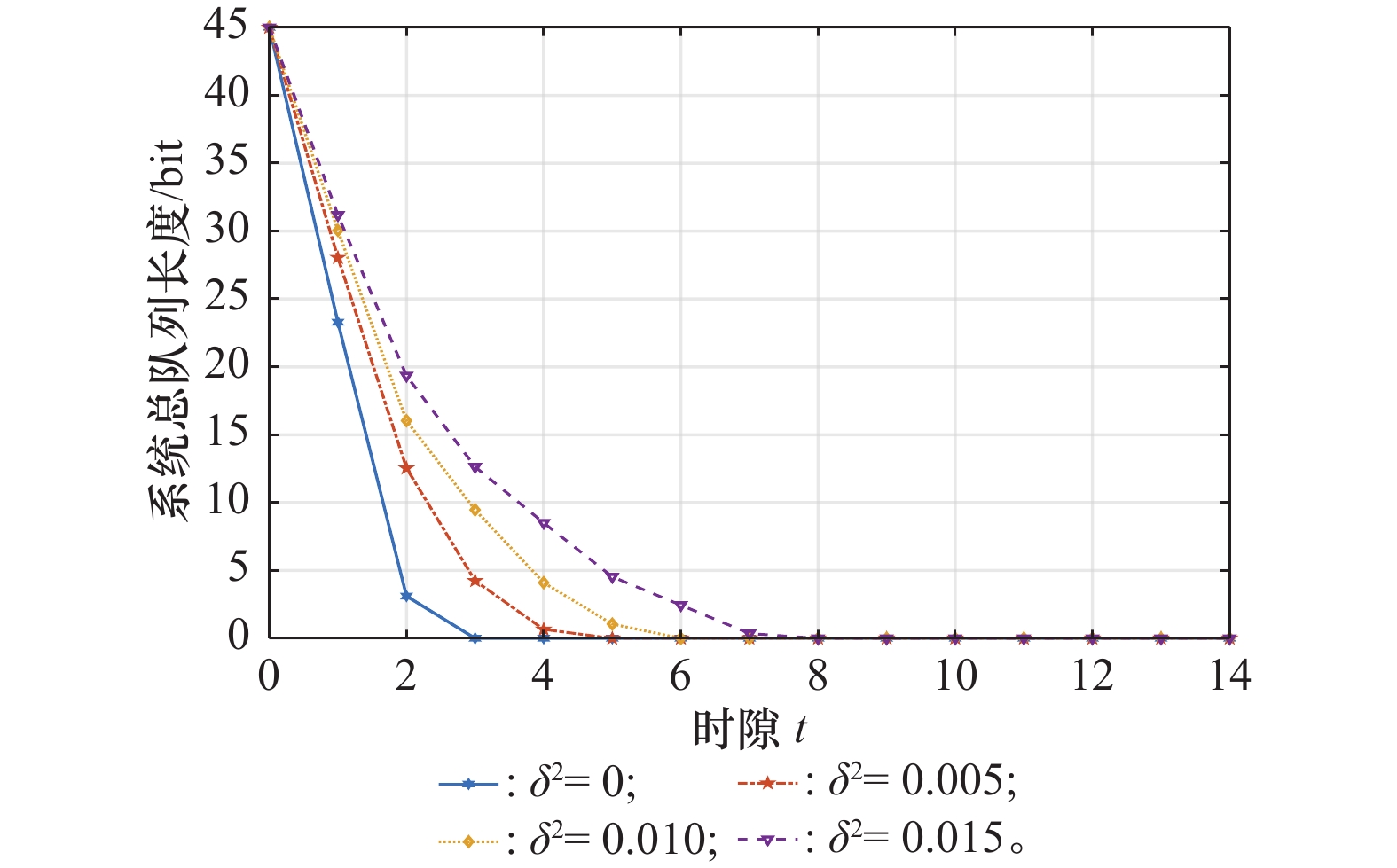
Fig.7
Convergence variation curves of the total system queue under different error conditions"
| 1 | AZARI M M, SOLANKI S, CHATZINOTAS S, et al. Evolution of non-terrestrial networks from 5G to 6G: a survey[J]. IEEE Communications Surveys & Tutorials, 2022, 24 (4): 2633- 2672. |
| 2 | TAN D K P, HE J, LI Y C. Integrated sensing and communication in 6G: motivations, use cases, requirements, challenges and future directions[C]//Proc. of the IEEE International Online Symposium on Joint Communications & Sensing, 2021. |
| 3 |
赵亚军, 郁光辉, 徐汉青. 6G 移动通信网络: 愿景、挑战与关键技术[J]. 中国科学: 信息科学, 2019, 49 (8): 963- 987.
doi: 10.1360/N112019-00033 |
|
ZHAO Y J, YU G H, XU H Q. 6G mobile communication networks: vision, challenges, and key technologies[J]. Scientia Sinica (Information), 2019, 49 (8): 963- 987.
doi: 10.1360/N112019-00033 |
|
| 4 | MAHBUB M, SHUBAIR R M. Energy efficient maximization of user association employing IRS in mm Wave multi-tier 6G networks[C]//Proc. of the IEEE International Conference on Sensing Communication, and Networking, 2022: 25−30. |
| 5 |
张平, 牛凯, 田辉, 等. 6G 移动通信技术展望[J]. 通信学报, 2019, 40 (1): 141- 148.
doi: 10.11959/j.issn.1000-436x.2019022 |
|
ZHANG P, NIU K, TIAN H, et al. Technology prospect of 6G mobile communications[J]. Journal on Communications, 2019, 40 (1): 141- 148.
doi: 10.11959/j.issn.1000-436x.2019022 |
|
| 6 |
LIN Z, LIN M, HUANG Y M, et al. Robust multi-objective beamforming for integrated satellite and high altitude platform network with imperfect channel state information[J]. IEEE Trans. on Signal Processing, 2019, 67 (24): 6384- 6396.
doi: 10.1109/TSP.2019.2952045 |
| 7 |
BANKEY V, UPADHYAY P K. Physical layer security of multiuser multi-relay hybrid satellite-terrestrial relay networks[J]. IEEE Trans. on Vehicular Technology, 2019, 68 (3): 2488- 2501.
doi: 10.1109/TVT.2019.2893366 |
| 8 | AN K, LIANG T. Hybrid satellite-terrestrial relay networks with adaptive transmission[J]. IEEE Trans. on Vehicular Technology, 2019, 68 (12): 12448- 12452. |
| 9 |
ALFATTANI S, JAAFAR W, HMAMOUCHE Y, et al. Aerial platforms with reconfigurable smart surfaces for 5G and beyond[J]. IEEE Communications Magazine, 2021, 59 (1): 96- 102.
doi: 10.1109/MCOM.001.2000350 |
| 10 |
顾晨伟, 林志, 林敏, 等. 卫星通信下行链路鲁棒安全波束成形设计[J]. 系统工程与电子技术, 2021, 43 (5): 1361- 1370.
doi: 10.12305/j.issn.1001-506X.2021.05.25 |
|
GU C W, LIN Z, LIN M, et al. Robust secure beamforming design for the downlink of satellite communications[J]. Systems Engineering and Electronics, 2021, 43 (5): 1361- 1370.
doi: 10.12305/j.issn.1001-506X.2021.05.25 |
|
| 11 |
RAZLIGHI M M, ZLATANOY N. Buffer-aided relaying for the two-hop full-duplex relay channel with self-interference[J]. IEEE Trans. on Wireless Communication, 2018, 17 (1): 477- 491.
doi: 10.1109/TWC.2017.2767582 |
| 12 |
NOMIKOS N, CHARALAMBOUS T, KRIKIDIS I, et al. A buffer-aided successive opportunistic relay selection scheme with power adaptation and inter-relay interference cancellation for cooperative diversity systems[J]. IEEE Trans. on Communication, 2015, 63 (5): 1623- 1624.
doi: 10.1109/TCOMM.2015.2416234 |
| 13 |
DUARTE F L, DELAMARE R C. Buffer-aided max-link relay selection for multi-way cooperative multi-antenna systems[J]. IEEE Communication Letters, 2019, 23 (8): 1423- 1436.
doi: 10.1109/LCOMM.2019.2919024 |
| 14 |
WANG N, HE C, GULLIVER T A, et al. Generalized queue-aware resource management and scheduling for wireless communications[J]. IEEE Access, 2015, 3, 1298- 1312.
doi: 10.1109/ACCESS.2015.2461007 |
| 15 |
JU H B, LIANG B, LI J D, et al. Dynamic joint resource optimization for LTE-advanced relay networks[J]. IEEE Trans. on Wireless Communications, 2013, 12 (11): 5668- 5678.
doi: 10.1109/TWC.2013.092513.121922 |
| 16 |
DING C, CHENG M, LIN M, et al. Dynamic transmission and computation resource optimization for dense LEO satellite assisted mobile-edge computing[J]. IEEE Trans. on Communications, 2023, 71 (5): 3087- 3102.
doi: 10.1109/TCOMM.2023.3253721 |
| 17 |
PAN C H, ZHOU G, ZHI K D, et al. An overview of signal processing techniques for RIS/IRS-aided wireless systems[J]. IEEE Journal of Selected Topics in Signal Processing, 2022, 16 (5): 883- 917.
doi: 10.1109/JSTSP.2022.3195671 |
| 18 | LIU Y W, LIU X, MU X D, et al. Reconfigurable intelligent surfaces: principles and opportunities[J]. IEEE Communications Surveys & Tutorials, 2021, 23 (3): 1546- 1577. |
| 19 |
党建, 李业伟, 朱永东, 等. 可重构智能表面通信系统的渐进信道估计方法[J]. 系统工程与电子技术, 2022, 44 (3): 998- 1006.
doi: 10.12305/j.issn.1001-506X.2022.03.32 |
|
DANG J, LI Y W, ZHU Y D, et al. Progressive channel estimation method for RIS-assisted communication system[J]. Systems Engineering and Electronics, 2022, 44 (3): 998- 1006.
doi: 10.12305/j.issn.1001-506X.2022.03.32 |
|
| 20 |
XU S, LIU J, CAO Y R, et al. Intelligent reflecting surface enabled secure cooperative transmission for satellite-terrestrial integrated networks[J]. IEEE Trans. on Vehicular Technology, 2021, 70 (2): 2007- 2011.
doi: 10.1109/TVT.2021.3055965 |
| 21 |
ZHAO B, LIN M, XIAO S J, et al. IRS empowered robust secure transmission for integrated satellite-terrestrial networks[J]. IEEE Wireless Communications Letters, 2023, 12 (2): 336- 340.
doi: 10.1109/LWC.2022.3225957 |
| 22 | 刘兴宇, 蒋志彪, 蒋天瑞, 等. 基于通信功率自适应的无人机集群协同导航控制方法[J]. 系统工程与电子技术, 2024, 46 (10): 3536- 3546. |
| LIU X Y, JIANG Z B, JIANG T R, et al. Cooperative navigation control strategy for UAV flocking based on communication adaptation[J]. Systems Engineering and Electronics, 2024, 46 (10): 3536- 3546. | |
| 23 |
ZENG P, QIAO D L, QIAN H F, et al. Joint beamforming design for IRS aided multiuser MIMO with imperfect CSI[J]. IEEE Trans. on Vehicular Technology, 2022, 71 (10): 10729- 10743.
doi: 10.1109/TVT.2022.3187066 |
| 24 | ZHAO D, LU H C, WANG Y Z, et al. Joint passive beamforming and user association optimization for IRS-assisted mm Wave systems[C]//Proc. of the IEEE Global Communications Conference, 2020. |
| 25 |
GE Y M, FAN J C. Active reconfigurable intelligent surface assisted secure and robust cooperative beamforming for cognitive satellite-terrestrial networks[J]. IEEE Trans. on Vehicular Technology, 2023, 72 (3): 4108- 4113.
doi: 10.1109/TVT.2022.3221756 |
| 26 |
NIU H H, CHU Z, ZHOU F H, et al. Robust design for intelligent reflecting surface-assisted secrecy SWIPT network[J]. IEEE Trans. on Wireless Communications, 2022, 21 (6): 4133- 4149.
doi: 10.1109/TWC.2021.3126833 |
| 27 |
WU G L, LI F, JANG H L. Analysis of multipath fading and Doppler effect with multiple reconfigurable intelligent surfaces in mobile wireless networks[J]. Entropy, 2022, 24 (2): 281.
doi: 10.3390/e24020281 |
| 28 |
王子宁, 林敏, 李菲, 等. 卫星网络和高空平台网络频谱共存下的分布式鲁棒波束成形算法[J]. 通信学报, 2023, 44 (12): 39- 49.
doi: 10.11959/j.issn.1000-436x.2023211 |
|
WANG Z N, LIN M, LI F, et al. Distributed robust beamforming algorithm for spectral coexistence in satellite and high altitude platform networks[J]. Journal on Communications, 2023, 44 (12): 39- 49.
doi: 10.11959/j.issn.1000-436x.2023211 |
|
| 29 | NEELY M J. Energy optimal control for time-varying wireless networks[J]. IEEE Trans. on Information Theory, 2006, 52(7): 2915−2934. |
| 30 | TASSIULAS L, EPHREMIDES A. Stability properties of constrained queueing systems and scheduling policies for maximum throughput in multi hop radio networks[C]// Proc. of the 9th IEEE Conference on Decision and Control, 1990: 2130−2132. |
| 31 | JIANG B, YAN Y C, YOU L, et al. Robust secure transmission for satellite communications[J]. IEEE Trans. on Aerospace and Electronic Systems, 2023, 59 (2): 1598- 1612. |
| [1] | Linzhi MENG, Xiaojuan SUN, Yuxin HU, Bin GAO, Guoqing SUN, Wenhao MU. Reinforcement learning task scheduling algorithm for satellite on-orbit processing [J]. Systems Engineering and Electronics, 2025, 47(6): 1917-1929. |
| [2] | Gang LIU, Yuhang LI, Qingxin YANG, Yi GUO. Channel estimation on intelligent reflecting surface based on compressed sensing [J]. Systems Engineering and Electronics, 2024, 46(7): 2490-2497. |
| [3] | Ruyan WANG, Kang WANG, Yaping CUI, Peng HE, Dapeng WU. Phase shifts design and channel alignment strategy for IRS-aided vehicular networks [J]. Systems Engineering and Electronics, 2024, 46(2): 761-769. |
| [4] | Zhigang JIN, Huan YIN, Yishan SU. Underwater acoustic adaptive power allocation algorithm based on imperfect CSI [J]. Systems Engineering and Electronics, 2023, 45(9): 2941-2948. |
| [5] | Dan WANG, Jinzhi LIU, Zhiqiang MEI, Jiamin LIANG. Channel capacity optimization based on IRS-aided multi-user communication system [J]. Systems Engineering and Electronics, 2022, 44(12): 3871-3879. |
| [6] | Xiaorong JING, Zhenyuan SONG, Yue LUO, Yudan MA. Design of physical layer safety scheme aided with IRS and artificial noise for MIMO communication systems [J]. Systems Engineering and Electronics, 2022, 44(10): 3266-3274. |
| [7] | Hui WANG, Jing ZHANG, Wanli CHENG. Energy-efficient multiuser-multichannel matching algorithm in NOMA systems [J]. Systems Engineering and Electronics, 2020, 42(11): 2636-2643. |
| [8] | QIU Bin, XIAO Hailin. Optimal power control for LTE vehicle-to-vehicle communication withimperfect channel state information#br# [J]. Systems Engineering and Electronics, 2018, 40(7): 1608-1614. |
| [9] | CHEN Xiaomin, SU Junxu, ZHU Qiuming, HU Xujun, FANG Zhu. Linear precoding scheme for MIMO twoway relay system with imperfect channel state information#br# [J]. Systems Engineering and Electronics, 2017, 39(12): 2796-2802. |
| Viewed | ||||||
|
Full text |
|
|||||
|
Abstract |
|
|||||