Systems Engineering and Electronics ›› 2025, Vol. 47 ›› Issue (10): 3257-3269.doi: 10.12305/j.issn.1001-506X.2025.10.13
• Sensors and Signal Processing • Previous Articles
Image dataset simulation constructing for SAR active interference classification and recognition
Fei GAO1,*( ), Ruida XI2(), Xiangwei XING3(), Yan XING1(), Qiang ZHANG2(), Hongxing DANG1()
- 1. Xi’an Branch of the Fifth Academy of China Aerospace Science and Technology Corporation (CASC),Xi’an 710100,China
2. School of Mechano-Electronic Engineering,Xidian University,Xi’an 710071,China
3. Unit 61646 of the PLA,Beijing 100192,China
-
Received:2024-10-08Online:2025-10-25Published:2025-10-23 -
Contact:Fei GAO E-mail:gaofei2004630@163.com;RuidaXi@stu.xidian.edu.cn;xingxiangwei@nudt.edu.cn;1061871653@qq.com;qzhang@xidian.edu.cn;danghongx@163.com

CLC Number:
Cite this article
Fei GAO, Ruida XI, Xiangwei XING, Yan XING, Qiang ZHANG, Hongxing DANG. Image dataset simulation constructing for SAR active interference classification and recognition[J]. Systems Engineering and Electronics, 2025, 47(10): 3257-3269.
share this article
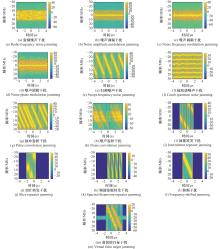
Fig.1
TFSs of 13 types of interference"
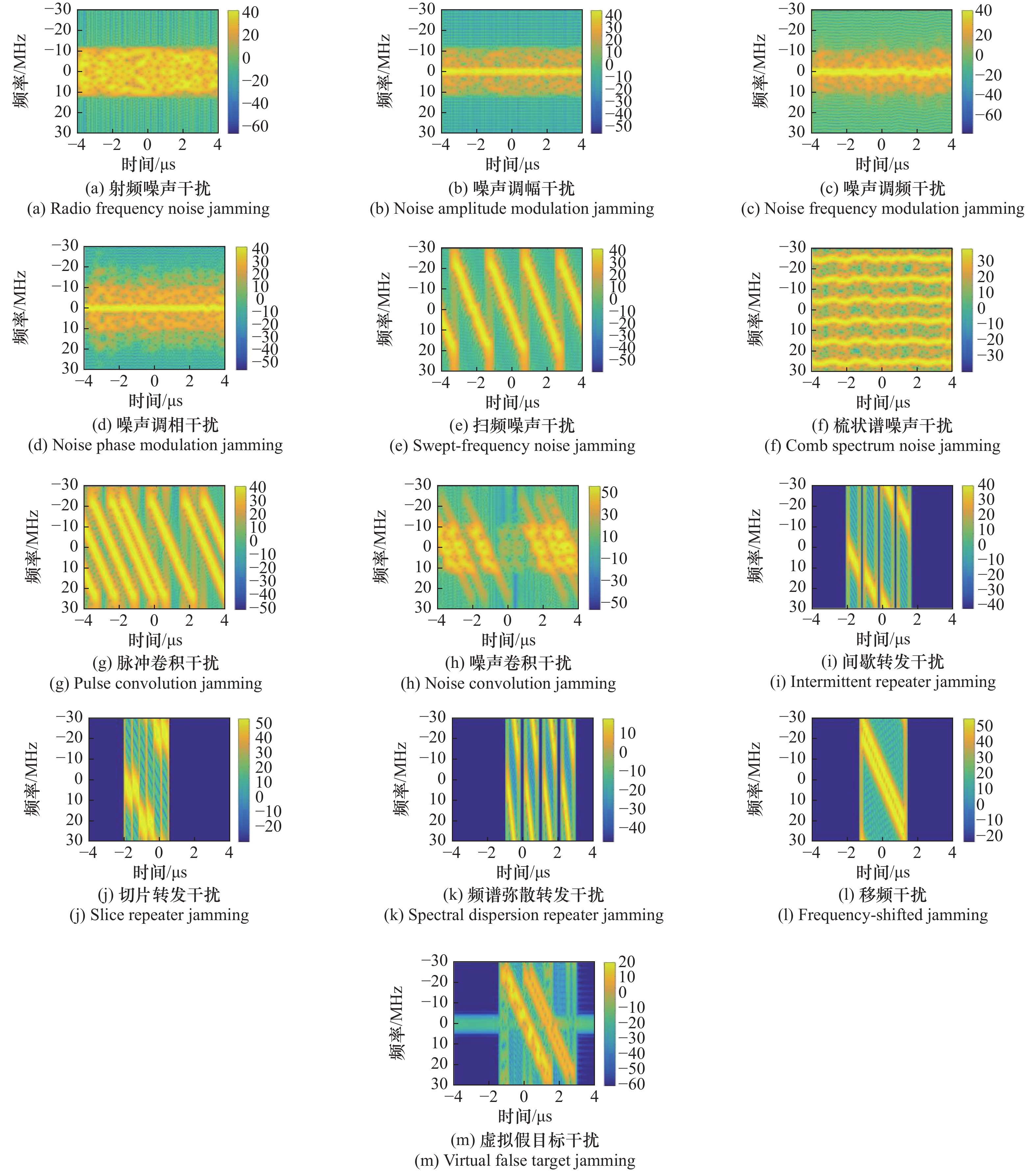
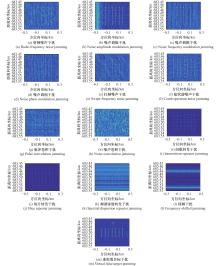
Fig.2
SAR images under 13 types of interference"

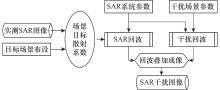
Fig.3
Dataset constructing strategy"
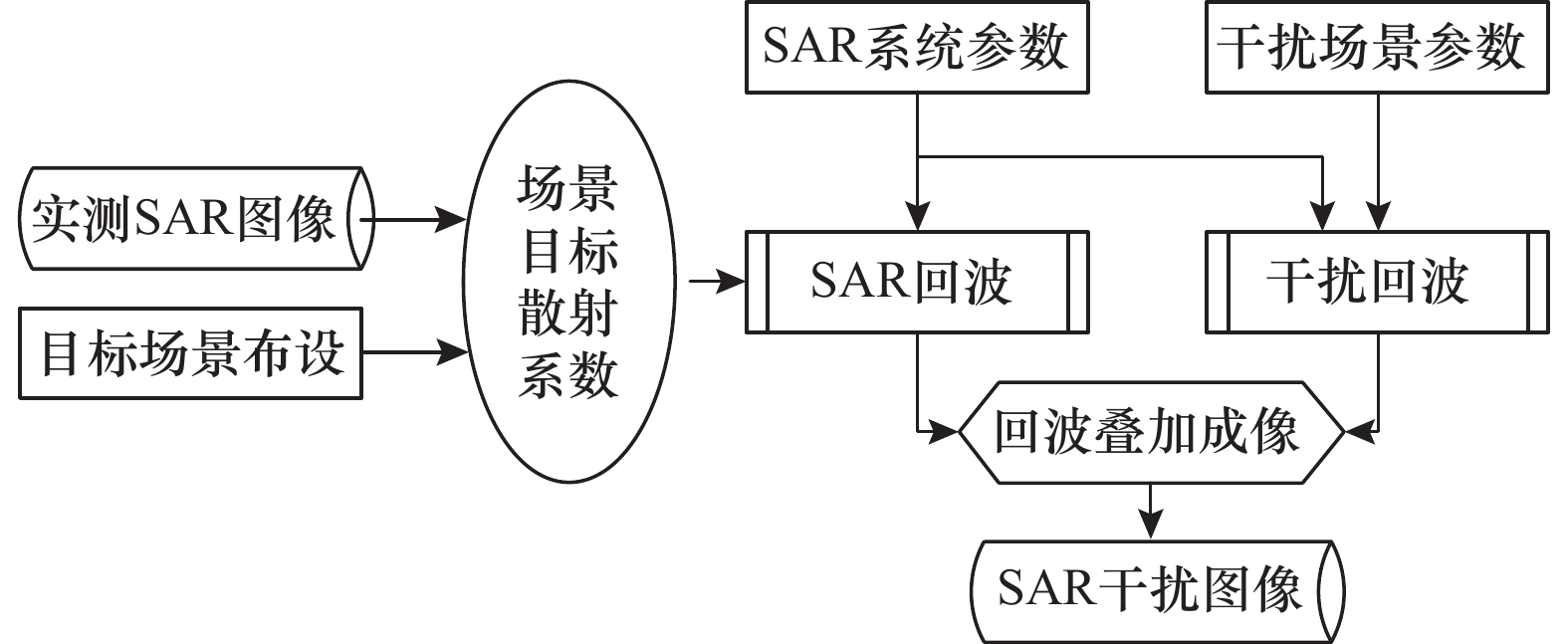
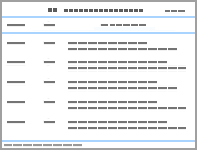
Table 1
Value description of main interference parameters"
| 干扰样式 | 干扰参数 | 取值说明 |
| 射频噪声、噪声调幅、噪声调频和噪声调相 | 输入干信比 | |
| 调制噪声带宽 | ||
| 干扰机位置 | 场景中心方位 | |
| 调幅斜率 | ||
| 调频斜率 | ||
| 调相斜率 | ||
| 扫频噪声和梳状谱噪声 | 输入干信比 | |
| 调制噪声带宽 | ||
| 干扰机位置 | 场景中心方位 | |
| 扫频范围 | ||
| 扫频周期 | ||
| 调频斜率 | ||
| 梳状谱噪声信号分量数 | ||
| 梳状谱噪声分量幅度 | ||
| 梳状谱噪声分量基带频点 | ||
| 梳状谱噪声分量调频斜率 | ||
| 脉冲卷积和噪声卷积 | 输入干信比 | |
| 调制噪声带宽 | ||
| 时延个数 | ||
| 幅度 | 1 | |
| 时延 | 场景方位中心 | |
| 噪声时长 | ||
| 间歇转发、切片转发、频谱弥散转发和移频 | 输入干信比 | |
| 干扰机位置 | 场景中心方位 | |
| 间歇转发次数 | ||
| 间歇转发干扰参数 | ||
| 采样转发间歇时间 | ||
| 切片转发分段数 | ||
| 切片转发干扰参数 | ||
| 频谱弥散转发次数 | ||
| 频谱弥散转发间隔时间 | ||
| 移频次数 | ||
| 移频量 | ||
| 虚拟假目标 | 输入干信比 | |
| 干扰机位置 | 场景中心方位 | |
| 虚拟假目标/散射点数 | ||
| 虚拟假目标/散射点位置 | 场景中心方位和距离均在 |
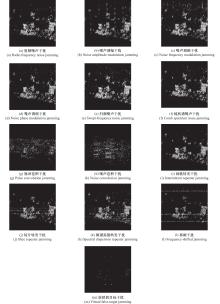
Fig.4
A set of image samples under 13 types of interference in the same target scene (waterfront)"

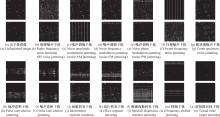
Fig.5
Comparison of two sets of simulated images under the same target scene (farmland) without interference and with 13 types of interference"

Fig.6
SAR image interference type classification model based on deformable self-attention vision Transformer"
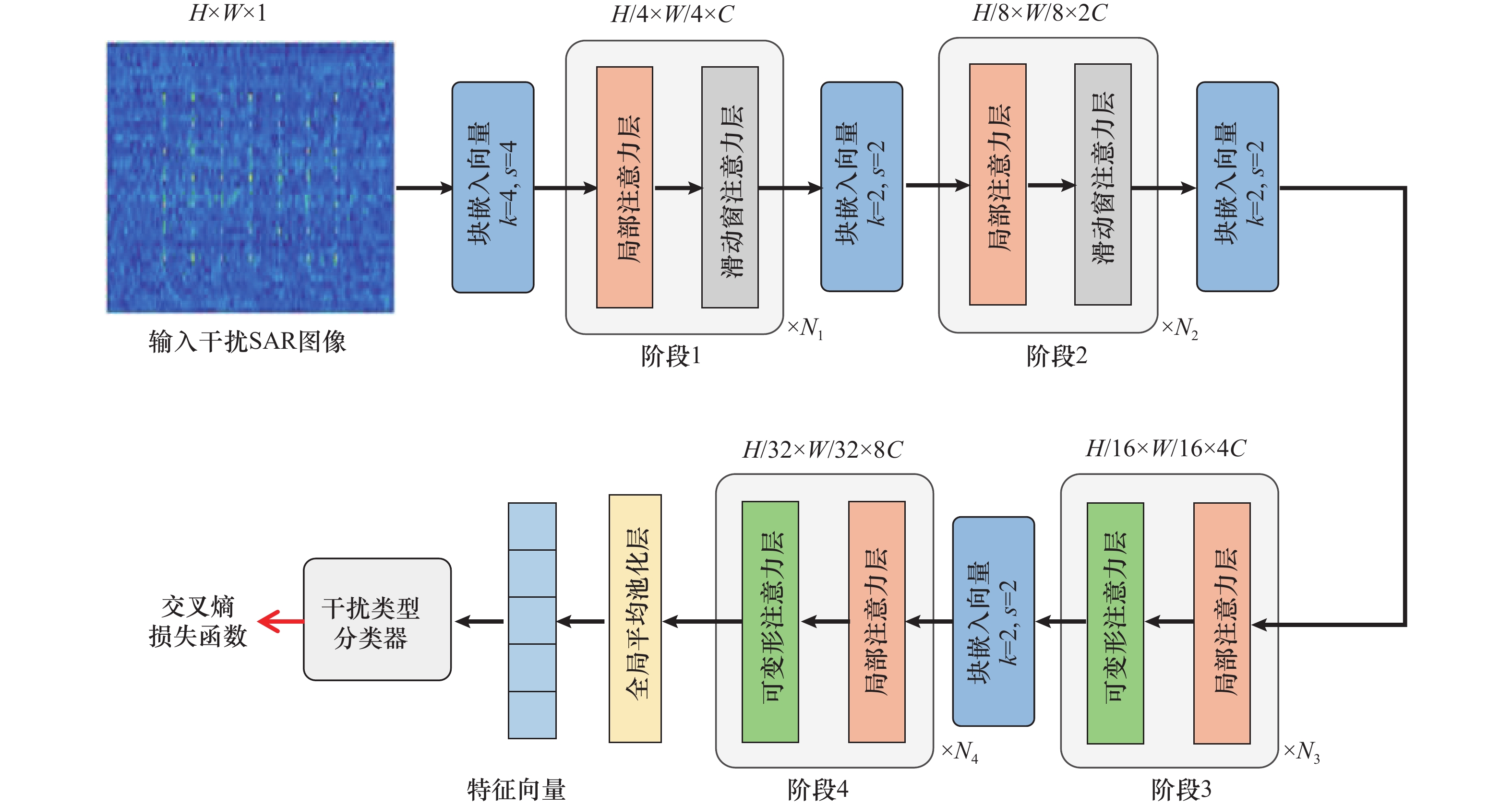
Fig.7
Deformable self-attention module"
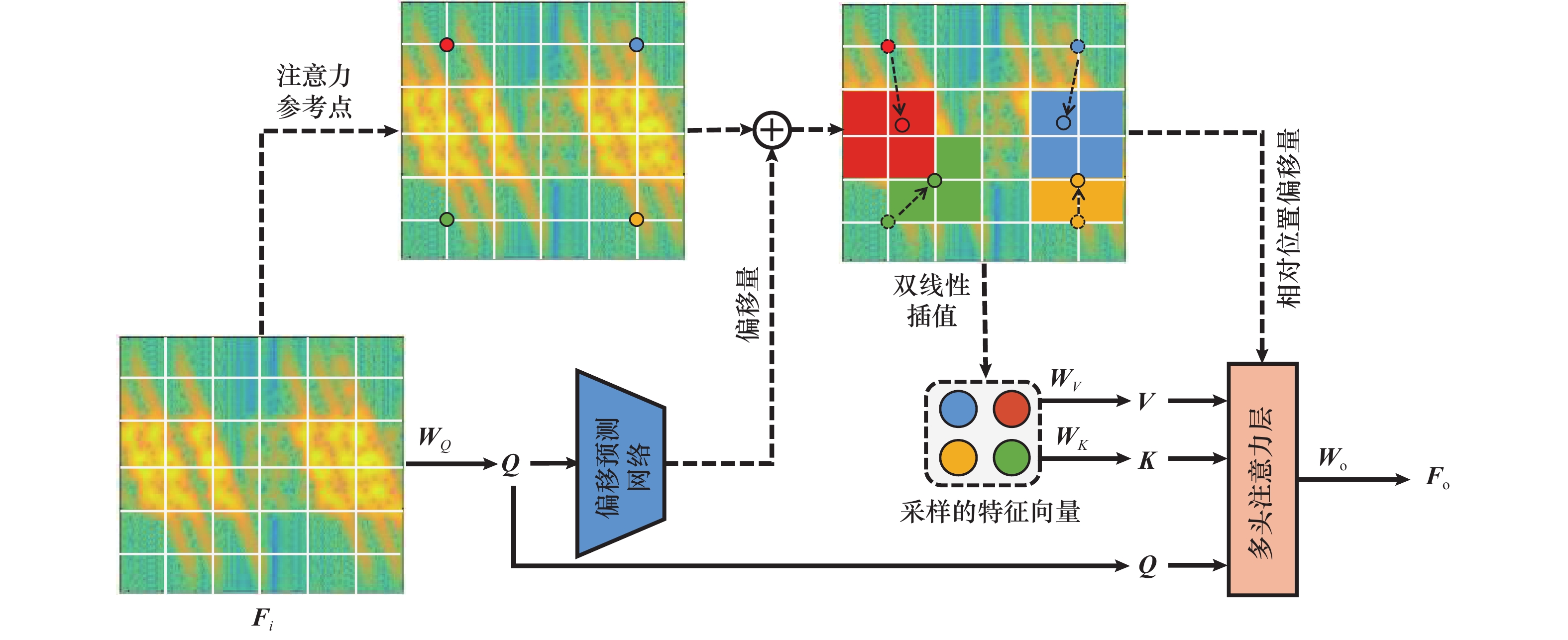
Table 2
Interference type identification results %"
| 模型 | 指标 | #1 | #2 | #3 | #4 | #5 | #6 | #7 |
| AlexNet | P | 90.5 | 95.4 | 58.5 | 50.0 | 54.7 | 60.0 | 63.9 |
| R | 69.1 | 85.6 | 71.1 | 68.0 | 66.0 | 43.3 | 73.2 | |
| VGG16 | P | 87.0 | 97.8 | 76.1 | 63.3 | 64.5 | 67.7 | 77.8 |
| R | 89.7 | 89.7 | 72.1 | 76.3 | 71.1 | 47.4 | 93.9 | |
| ResNet18 | P | 88.8 | 91.0 | 73.8 | 65.1 | 73.7 | 67.5 | 90.0 |
| R | 89.7 | 93.9 | 81.4 | 71.1 | 72.2 | 53.6 | 92.8 | |
| ResNet50 | P | 84.0 | 97.8 | 72.3 | 66.3 | 77.0 | 55.2 | 87.3 |
| R | 91.8 | 91.8 | 75.3 | 67.0 | 58.8 | 66.0 | 91.8 | |
| ResNet101 | P | 88.0 | 87.5 | 75.5 | 66.1 | 79.2 | 63.3 | 90.5 |
| R | 90.7 | 93.8 | 76.3 | 74.2 | 62.9 | 63.9 | 88.7 | |
| ViT-B/16 | P | 93.6 | 96.0 | 77.6 | 74.0 | 82.4 | 69.7 | 93.8 |
| R | 90.7 | 96.9 | 85.6 | 76.3 | 72.2 | 71.1 | 92.8 | |
| 本文模型 | P | 97.9 | 97.9 | 76.0 | 80.9 | 81.4 | 73.7 | 93.9 |
| R | 95.9 | 97.9 | 74.8 | 74.2 | 72.2 | 72.2 | 95.9 |
Table 3
Interference type identification results %"
| 模型 | 指标 | #8 | #9 | #10 | #11 | #12 | #13 | 平均值 | Acc |
| AlexNet | P | 85.1 | 100.0 | 98.9 | 96.9 | 100.0 | 100.0 | 81.0 | @1: 79.1 |
| R | 76.3 | 90.7 | 87.7 | 96.9 | 100.0 | 100.0 | 79.0 | @5: 96.5 | |
| VGG16 | P | 93.5 | 100.0 | 97.9 | 100.0 | 100.0 | 100.0 | 86.6 | @1: 86.2 |
| R | 88.7 | 98.0 | 95.9 | 98.0 | 100.0 | 100.0 | 86.2 | @5: 99.2 | |
| ResNet18 | P | 91.8 | 100.0 | 100.0 | 97.9 | 100.0 | 100.0 | 87.7 | @1: 87.7 |
| R | 91.2 | 95.9 | 99.0 | 99.0 | 100.0 | 100.0 | 87.7 | @5: 99.5 | |
| ResNet50 | P | 92.7 | 100.0 | 100.0 | 97.9 | 100.0 | 100.0 | 87.0 | @1: 86.4 |
| R | 91.8 | 92.8 | 99.0 | 97.9 | 100.0 | 100.0 | 86.4 | @5: 99.4 | |
| ResNet101 | P | 92.7 | 100.0 | 100.0 | 97.0 | 98.9 | 98.9 | 87.5 | @1: 87.4 |
| R | 91.8 | 96.9 | 97.9 | 98.9 | 100.0 | 100.0 | 87.4 | @5: 99.6 | |
| ViT-B/16 | P | 92.9 | 99.0 | 100.0 | 99.0 | 100.0 | 100.0 | 90.6 | @1: 90.5 |
| R | 94.9 | 98.9 | 98.9 | 98.9 | 100.0 | 98.9 | 90.5 | @5: 99.7 | |
| 本文模型 | P | 96.8 | 100.0 | 100.0 | 100.0 | 100.0 | 100.0 | 92.2 | @1: 92.1 |
| R | 73.8 | 100.0 | 100.0 | 100.0 | 100.0 | 100.0 | 92.1 | @5: 100.0 |
| 1 |
张庆君, 韩晓磊, 刘杰. 星载合成孔径雷达遥感技术进展及发展趋势[J]. 航天器工程, 2017, 26 (6): 1- 8.
doi: 10.3969/j.issn.1673-8748.2017.06.001 |
|
ZHANG Q J, HAN X L, LIU J. Technology progress and development trend of spaceborne synthetic aperture radar remote sensing[J]. Spacecraft Engineering, 2017, 26 (6): 1- 8.
doi: 10.3969/j.issn.1673-8748.2017.06.001 |
|
| 2 |
李亚超, 王家东, 张廷豪, 等. 弹载雷达成像技术发展现状与趋势[J]. 雷达学报, 2022, 11 (6): 943- 973.
doi: 10.12000/JR22119 |
|
LI Y C, WANG J D, ZHANG T H, et al. Present situation and prospect of missile-borne radar imaging technology[J]. Journal of Radar, 2022, 11 (6): 943- 973.
doi: 10.12000/JR22119 |
|
| 3 |
张健丰, 付耀文, 张文鹏, 等. 圆迹合成孔径雷达成像技术综述[J]. 系统工程与电子技术, 2020, 42 (12): 2716- 2734.
doi: 10.3969/j.issn.1001-506X.2020.12.07 |
|
ZHANG J F, FU Y W, ZHANG W P, et al. Review of CSAR imaging techniques[J]. Systems Engineering and Electronics, 2020, 42 (12): 2716- 2734.
doi: 10.3969/j.issn.1001-506X.2020.12.07 |
|
| 4 |
XU G, GAO Y D, LI J W, et al. InSAR phase denoising: a review of current technologies and future directions[J]. IEEE Geoscience and Remote Sensing Magazine, 2020, 8 (2): 64- 82.
doi: 10.1109/MGRS.2019.2955120 |
| 5 |
WANG G Y, ZHANG M, HUANG Y, et al. Robust two-dimensional spatial-variant map-drift algorithm for UAV SAR autofocusing[J]. Remote Sensing, 2019, 11 (3): 340.
doi: 10.3390/rs11030340 |
| 6 |
CHEN Z Y, ZHOU Y, ZHANG L R, et al. Ground moving target imaging and analysis for near-space hypersonic vehicle-borne synthetic aperture radar system with squint angle[J]. Remote Sensing, 2018, 10 (12): 1966.
doi: 10.3390/rs10121966 |
| 7 |
HUANG Y, LIAO G S, XU J W, et al. GMTI and parameter estimation for MIMO SAR system via fast interferometry RPCA method[J]. IEEE Trans. on Geoscience and Remote Sensing, 2018, 56 (3): 1774- 1787.
doi: 10.1109/TGRS.2017.2768243 |
| 8 | 李洋. 星载SAR弹射式干扰与抗干扰技术研究[D]. 成都: 电子科技大学, 2017. |
| LI Y. Research on technology of rebound jamming and anti-jamming to spaceborne SAR[D]. Chengdu: University of Electronic Science and Technology of China, 2017. | |
| 9 | 潘嵩. SAR欺骗式干扰关键技术研究[D]. 成都: 电子科技大学, 2016. |
| PAN S. Research on SAR deception jamming key technology[D]. Chengdu: University of Electronic Science and Technology of China, 2016. | |
| 10 | 林晓烘. 星载合成孔径雷达干扰与抗干扰技术研究[D]. 长沙: 国防科技大学, 2014. |
| LIN X H. Study on jamming and anti-jamming techniques for spaceborne synthetic aperture radar[D]. Changsha: National University of Defense Technology, 2014. | |
| 11 | 汪日超. 星载SAR压制式干扰与抗干扰技术研究[D]. 成都: 电子科技大学, 2017. |
| WANG R C. Research on spaceborne SAR compression interference and anti-jamming technology[D]. Chengdu: University of Electronic Science and Technology of China, 2017. | |
| 12 | 齐兆龙. SAR散射式欺骗干扰及其对抗技术研究[D]. 秦皇岛: 燕山大学, 2016. |
| QI Z L. Research on SAR scattering deception jamming and its countermeasure technology[D]. Qinhuangdao: Yanshan University, 2016. | |
| 13 | 黄榜. 基于频控阵的星载SAR干扰技术研究[D]. 成都: 电子科技大学, 2020. |
| HUANG B. The jamming research against spaceborne SAR using FDA[D]. Chengdu: University of Electronic Science and Technology of China, 2020. | |
| 14 | 赵明明. 基于SAR目标特征的欺骗式干扰技术研究[D]. 成都: 电子科技大学, 2019. |
| ZHAO M M. Research on deceptive jamming technology based on SAR target characteristics[D]. Chengdu: University of Electronic Science and Technology of China, 2019. | |
| 15 | 刘立新. 对波形捷变SAR和GMTI时频交叉乘积欺骗干扰方法研究[D]. 长沙: 国防科技大学, 2019. |
| LIU L X. Study on time-frequency cross-product deceptive interference method of waveform agile SAR and GMTI[D]. Changsha: National University of Defense Technology, 2019. | |
| 16 | 王梦科. SAR精细欺骗式干扰技术研[D]. 成都: 电子科技大学, 2020. |
| WANG M K. Research on fine deceptive jamming technology of SAR[D]. Chengdu: University of Electronic Science and Technology of China, 2020. | |
| 17 |
纪朋徽, 代大海, 吴昊, 等. SAR成像电子对抗技术综述[J]. 无线电工程, 2019, 49 (6): 508- 513.
doi: 10.3969/j.issn.1003-3106.2019.06.012 |
|
JI P H, DAI D H, WU H, et al. Review of SAR imaging electronic countermeasures[J]. Radio Engineering, 2019, 49 (6): 508- 513.
doi: 10.3969/j.issn.1003-3106.2019.06.012 |
|
| 18 | 荣鹏帅. SAR射频干扰抑制方法[D]. 西安: 西安电子科技大学, 2019. |
| RONG P S. Radio frequency interference mitigation for SAR[D]. Xi’an: Xidian University, 2019. | |
| 19 |
MEYER F J, NICOLL J B, DOULGERIS A P. Correction and characterization of radio frequency interference signatures in L-band synthetic aperture radar data[J]. IEEE Trans. on Geoscience and Remote Sensing, 2013, 51 (10): 4961- 4972.
doi: 10.1109/TGRS.2013.2252469 |
| 20 | BOLLIAN T, YOUNIS M, KRIEGER G. On-ground interference removal from SAR images with DBF-based measurements and autoregressive modelling[C]//Proc. of the 13th European Conference on Synthetic Aperture Radar, 2021: 1200−1204. |
| 21 | HUANG Y, LIU Y Y, GUAN X Y, et al. A novel space-time interference mitigation algorithm on multichannel SAR systems[J]. IEEE Trans. on Geoscience and Remote Sensing, 2023, 61, 5220316. |
| 22 | MAO Y, HUANG Y, YU X T, et al. An radio frequency interference mitigation approach for spaceborne SAR system in low SINR condition[J]. IEEE Trans. on Geoscience and Remote Sensing, 2023, 61, 5217414. |
| 23 | SHARMA G, BAZIL RAJ A A. Low complexity interference mitigation technique in IRCI-free SAR imaging algorithms[J]. IEEE Geoscience and Remote Sensing Letters, 2022, 19, 4511305. |
| 24 | LV Z S, FAN H T, CHEN Z, et al. Mitigate the LFM-PRFI in SAR data: joint down-range and cross-range filtering[J]. IEEE Trans. on Geoscience and Remote Sensing, 2023, 61, 5205918. |
| 25 | DING Y, DU J B, FAN W W, et al. RFI extraction for synthetic aperture radar in 2D domain based on low rank and sparsity property[C]//Proc. of the CIE International Conference on Radar, 2021: 1940−1944. |
| 26 | LI N, LV Z S, GUO Z W, et al. Time-domain notch filtering method for pulse RFI mitigation in synthetic aperture radar[J]. IEEE Geoscience and Remote Sensing Letters, 2022, 19, 4013805. |
| 27 | ZHANG H, HUANG Y, LI J, et al. Time-varying RFI mitigation for SAR systems via graph Laplacian clustering techniques[J]. IEEE Geoscience and Remote Sensing Letters, 2022, 19, 4010805. |
| 28 |
REIGBER A, FERRO-FAMIL L. Interference suppression in synthesized SAR images[J]. IEEE Geoscience and Remote Sensing Letters, 2005, 2 (1): 45- 49.
doi: 10.1109/LGRS.2004.838419 |
| 29 | DOERRY A W. Apodized RFI filtering of synthetic aperture radar images[R]. Albuquerque: Sandia National Laboratories, 2014. |
| 30 |
NATSUAKI R, MOTOHKA T, WATANABE M, et al. An autocorrelation-based radio frequency interference detection and removal method in azimuth-frequency domain for SAR image[J]. IEEE Journal of Selected Topics in Applied Earth Observations and Remote Sensing, 2017, 10 (12): 5736- 5751.
doi: 10.1109/JSTARS.2017.2775205 |
| 31 | 刘建洋. 基于时频域分析的电子干扰识别方法研究[D]. 成都: 电子科技大学, 2018. |
| LIU J Y. Research on electronic jamming identification method based on time frequency domain analysis[D]. Chengdu: University of Electronic Science and Technology of China, 2018. | |
| 32 | 姜正云, 舒汀, 何劲, 等. 基于并联深度学习网络的雷达有源干扰智能识别方法[J]. 现代雷达, 2021, 43 (10): 9- 14. |
| JIANG Z Y, SHU T, HE J, et al. Intelligent recognition method of radar active jamming based on parallel deep learning network[J]. Modern Radar, 2021, 43 (10): 9- 14. | |
| 33 | 杨兴宇, 阮怀林. 基于栈式稀疏自编码器的新型干扰识别[J]. 现代雷达, 2018, 40 (5): 21- 27. |
| YANG X Y, RUAN H L. Jamming identification algorithms of advanced jamming based on stacked sparse autoencoder[J]. Modern Radar, 2018, 40 (5): 21- 27. | |
| 34 | 任锴. 基于深度学习的压制式干扰环境下SAR目标识别方法研究[D]. 成都: 电子科技大学, 2019. |
| REN K. Research on target recognition and classification of SAR image in suppressive jamming environment based on deep learning[D]. Chengdu: University of Electronic Science and Technology of China, 2019. | |
| 35 | LI J S, TAO M L, ZHANG X, et al. A semantic cognition enhancment network for interference detection in Sentinel-1 SAR image[C]//Proc. of the CIE International Conference on Radar, 2021: 1923−1926. |
| 36 | NIE L, WEI S J, ZHANG H, et al. HPII-NET: a high-precision interference identification network for spaceborne SAR images[C]//Proc. of the IEEE International Geoscience and Remote Sensing Symposium, 2023: 7030−7033. |
| 37 | FAN W W, ZHOU F, RONG P S, et al. Interference mitigation for synthetic aperture radar using deep learning[C]//Proc. of the 6th Asia-Pacific Conference on Synthetic Aperture Radar, 2019. |
| 38 | ZHANG Z D, DING Y, FAN W W, et al. Wide-band interference mitigation for SAR based on generative adversarial network[C]//Proc. of the CIE International Conference on Radar, 2021: 1891−1900. |
| 39 | CEN X, LI Y C, HAN Z Y, et al. Self-supervised learning method for SAR multiinterference suppression[J]. IEEE Trans. on Geoscience and Remote Sensing, 2023, 61, 5220017. |
| 40 |
陈思伟, 崔兴超, 李铭典, 等. 基于深度CNN模型的SAR图像有源干扰类型识别方法[J]. 雷达学报, 2022, 11 (5): 897- 908.
doi: 10.12000/JR22143 |
|
CHEN S W, CUI X C, LI M D, et al. SAR image active jamming type recognition based on deep CNN model[J]. Journal of Radars, 2022, 11 (5): 897- 908.
doi: 10.12000/JR22143 |
|
| 41 | 刘强. 基于深度学习的雷达干扰识别技术[D]. 成都: 电子科技大学, 2020. |
| LIU Q. Radar interference recognition based on deep learning[D]. Chengdu: University of Electronic Science and Technology of China, 2020. | |
| 42 | 鲍秋香. 频率随机捷变雷达抗扫频干扰性能仿真[J]. 舰船电子对抗, 2021, 44 (5): 78- 81. |
| BAO Q X. Simulation of anti-sweep jamming performance of frequency random agility radar[J]. Shipboard Electronic Countermeasure, 2021, 44 (5): 78- 81. | |
| 43 | 吴雪松. 抗灵巧干扰雷达波形设计[D]. 成都: 电子科技大学, 2016. |
| WU X S. Design of radar waveforms for anti smart jamming[D]. Chengdu: University of Electronic Science and Technology of China, 2016. | |
| 44 |
黄洪旭, 黄知涛, 周一宇. 对合成孔径雷达的移频干扰研究[J]. 宇航学报, 2006, 27 (3): 463- 468.
doi: 10.3321/j.issn:1000-1328.2006.03.027 |
|
HUANG H X, HUANG Z T, ZHOU Y Y. A study on the shift-frequency jamming to SAR[J]. Journal of Astronautics, 2006, 27 (3): 463- 468.
doi: 10.3321/j.issn:1000-1328.2006.03.027 |
|
| 45 | 赵博. 合成孔径雷达欺骗干扰方法研究[D]. 西安: 西安电子科技大学, 2015. |
| ZHAO B. Study on methods of synthetic aperture radar deception jamming[D]. Xi’an: Xidian University, 2015. | |
| 46 | XIA Z F, PAN X R, SONG S J, et al. Vision transformer with deformable attention[C]//Proc. of the IEEE/CVF Conference on Computer Vision and Pattern Recognition, 2022: 4784−4793. |
| 47 |
KRIZHEVSKY A, SUTSKEVER I, HINTON G E. ImageNet classification with deep convolutional neural networks[J]. Communications of the ACM, 2017, 60 (6): 84- 90.
doi: 10.1145/3065386 |
| 48 | SIMONYAN K, ZISSERMAN A. Very deep convolutional networks for large-scale image recognition[C]//Proc. of the 3rd International Conference on Learning Representations, 2015. |
| 49 | HE K M, ZHANG X Y, REN S Q, et al. Deep residual learning for image recognition[C]//Proc. of the IEEE Conference on Computer Vision and Pattern Recognition, 2016: 770−778. |
| 50 | DOSOVITSKIY A, BEYER L, KOLESNIKOV A, et al. An image is worth 16x16 words: transformers for image recognition at scale[C]//Proc. of the 8th International Conference on Learning Representations, 2020. |
| [1] | Kaiming LI, Yuanpeng ZHANG, Ying LUO, Xiaonan DAI. Research progress on radar target recognition of ballistic missile [J]. Systems Engineering and Electronics, 2025, 47(9): 2870-2889. |
| [2] | Ce JI, Xiangyu MA, Xiaoyu MU, Jiayi ZHAO. TS-GRU-VTA: vehicle channel estimation scheme based on deep learning [J]. Systems Engineering and Electronics, 2025, 47(9): 3093-3098. |
| [3] | Weihong FU, Wenhong PENG, Naian LIU. SAR image small target detection method with hybrid attention optimization [J]. Systems Engineering and Electronics, 2025, 47(8): 2519-2526. |
| [4] | Xiaowei YAN, Chong LING, Shengbin SHI. Design and implementation of a rapid detection system for surface unexploded submunitions [J]. Systems Engineering and Electronics, 2025, 47(8): 2639-2645. |
| [5] | Xiaolu ZHANG, Yazhou CHEN, Min ZHAO. Prediction method and verification of in-band electromagnetic interference effect for unmanned aerial vehicle data link [J]. Systems Engineering and Electronics, 2025, 47(8): 2763-2773. |
| [6] | Wanying ZHANG, Youbing GAO, Zeyi LI, Pengfei LI, Wei ZHANG. Background signal suppression algorithm based on dual-path feature fusion net [J]. Systems Engineering and Electronics, 2025, 47(7): 2406-2413. |
| [7] | Ronghua TAO, Chun ZHOU, Baoqiang ZHANG, Zhentao YU, He QIAO, Cong LIU. Based on OBF inverse transform to eliminate square wave interference in airborne magnetic anomaly detection data [J]. Systems Engineering and Electronics, 2025, 47(7): 2110-2118. |
| [8] | Zhitao LONG, Zhijun CHENG, Chen FENG. Spatial characteristics analysis of radar anti-jamming test samples based on coupling constraint satisfaction [J]. Systems Engineering and Electronics, 2025, 47(7): 2136-2145. |
| [9] | Xiaohui BA, Wenfei WEN, Baigen CAI, Jian WANG, Wei JIANG, Linguo CHAI. Linear frequency modulation interference suppression method for GNSS signal [J]. Systems Engineering and Electronics, 2025, 47(7): 2339-2348. |
| [10] | Zhengyi ZHAO, Pulong NAN. Efficient space frequency adaptive processing method based on short-time Fourier transform [J]. Systems Engineering and Electronics, 2025, 47(6): 1778-1785. |
| [11] | Xinzheng ZHANG, Mengke YAN, Xiaolin ZHU. Noise pseudo-label tolerant semi-supervised SAR target recognition [J]. Systems Engineering and Electronics, 2025, 47(6): 1796-1805. |
| [12] | Xiao YAN, Qingping WANG, Weidong HU, Hongyu ZHU, Chao WANG. Dynamic interference resource allocation method based on starling migration [J]. Systems Engineering and Electronics, 2025, 47(5): 1385-1394. |
| [13] | Zhijie JIANG, Heng SONG, Nan HU, Lanxi DUAN, Ping CAO. Target recognition and classification algorithm of MMW radar in tunnel [J]. Systems Engineering and Electronics, 2025, 47(5): 1453-1460. |
| [14] | Qianqi NIE, Minghui SHA, Yingshen ZHU, Chongyu WANG, Nianqiang CUI. Radar multi-component signal recognition method based on blind source separation combined with singular spectrum analysis [J]. Systems Engineering and Electronics, 2025, 47(4): 1168-1175. |
| [15] | Lei YUAN, Yanjuan YANG, Yi GUO, Peng DAI. Deep learning-based semi-blind identification algorithm for code rates of LDPC codes with correlated noise [J]. Systems Engineering and Electronics, 2025, 47(4): 1335-1345. |
| Viewed | ||||||
|
Full text |
|
|||||
|
Abstract |
|
|||||