Systems Engineering and Electronics ›› 2024, Vol. 46 ›› Issue (8): 2857-2866.doi: 10.12305/j.issn.1001-506X.2024.08.33
• Communications and Networks • Previous Articles
Design and performance analysis of LPD communication waveform based on FrFT-FH structure
Xiaoyan NING1, Yifei YANG1, Kaifeng GUO2, Zhenduo WANG1,*
- 1. College of Information and Communication Engineering, Harbin Engineering University, Harbin 150001, China
2. System Engineering Institute of China State Shipbuilding Corporation Limited, Beijing 100094, China
-
Received:2023-06-25Online:2024-07-25Published:2024-08-07 -
Contact:Zhenduo WANG

CLC Number:
Cite this article
Xiaoyan NING, Yifei YANG, Kaifeng GUO, Zhenduo WANG. Design and performance analysis of LPD communication waveform based on FrFT-FH structure[J]. Systems Engineering and Electronics, 2024, 46(8): 2857-2866.
share this article

Fig.1
System model' s schematic diagram of FrFT-FH-TDR"
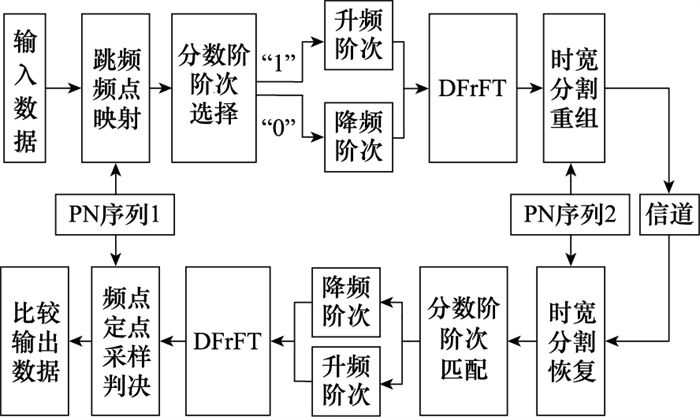

Fig.2
Frequency hopping pattern of FrFT-FH-TDR"
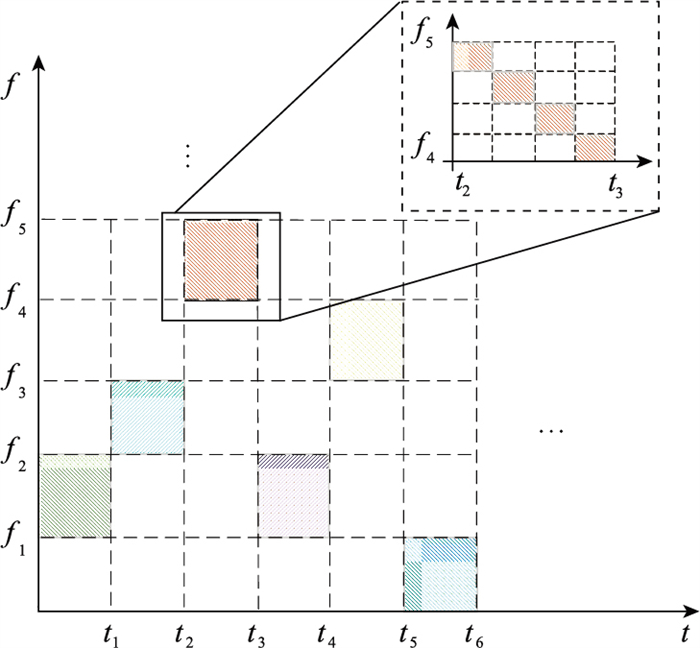

Fig.3
Curve of FrFT-FH-TDR time-domain waveform and time-frequency function"

Table 1
Parameter settings for each system"
| 参数 | 波形 | ||
| FrFT-FH | FrFT-FH-VT | FrFT-FH-TDR | |
| 时宽/μs | 64 | 64, 48, 80 | 64 |
| 带宽/MHz | 1.09 | 1.09 | 1.09 |
| 扩频因子 | 7 | 7 | 7 |
| 分割系数 | 1 | 1 | 4, 5, 6 |

Fig.4
Comparison of bit error rate performance curves of three systems in AWGN channel"

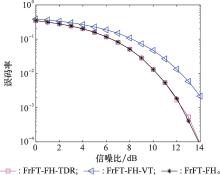
Fig.5
Comparison of bit error rate performance curves of three systems in fading channel"

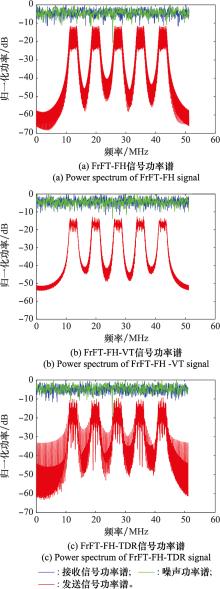
Fig.6
Comparison of signals' power spectrum characteristics"


Fig.7
Comparison of signals' fractional Fourier transform domain characteristics"

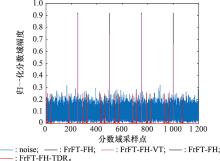
Fig.8
Comparison of slice features in fractional Fourier transform domain of signal matching order"

Table 2
Parameter settings for signals cepstrum"
| 波形 | 时宽系数 | 时宽/ms | 分割系数 |
| FrFT-FH | 1 | 1 | 1 |
| FrFT-FH-VT | 4 | 0.75, 1, 1.25, 1.5 | 1 |
| FrFT-FH-TDR | 1 | 1 | 3, 4, 5, 6 |

Fig.9
Comparison of cepstrum characteristics"
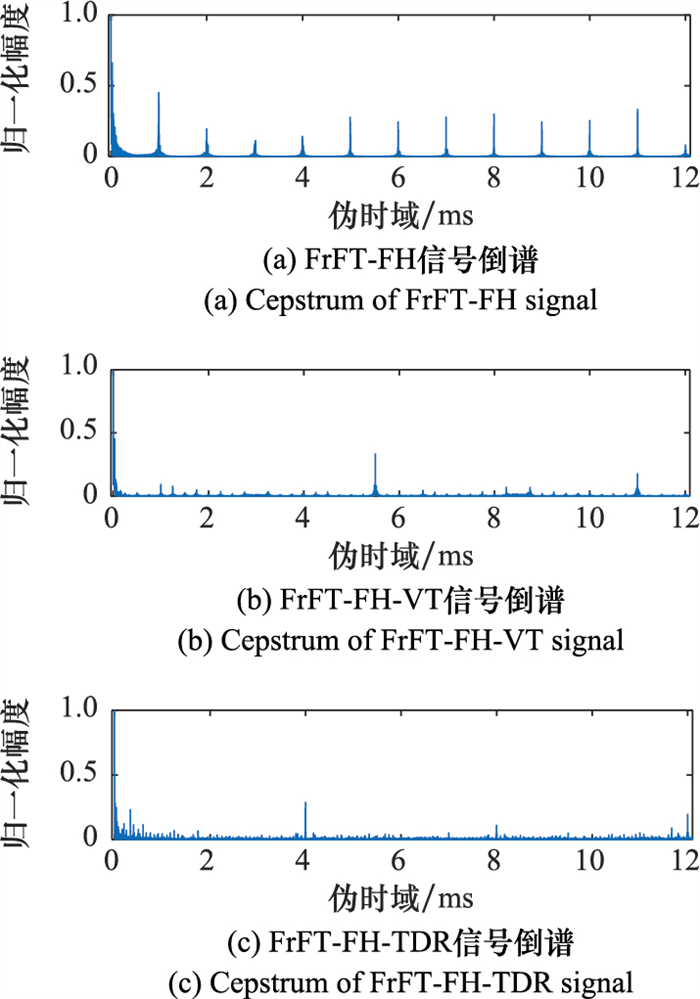

Fig.10
Curve of detection probability of single threshold energy detection"

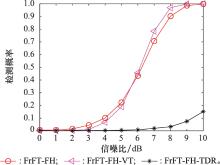
Fig.11
Curve of detection probability of detection probability in fractional Fourier transform domain"

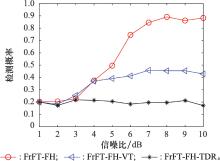
Fig.12
Curve of detection probability in periodic domain"

Table 3
Detection probabilities of individual signals under various feature domains"
| 特征域 | 信噪比为10 dB条件下的检测概率 | ||
| FrFT-FH | FrFT-FH-VT | FrFT-FH-TDR | |
| 功率谱域 | 0.1 | 0.1 | 0.1 |
| 分数阶傅里叶变换域 | 1 | 1 | 0.15 |
| 周期域 | 0.9 | 0.45 | 0.2 |
| 1 |
辜方林, 黄育侦, 赵莺, 等. 基于单载波频域均衡的直接序列扩频自适应抗干扰技术[J]. 通信学报, 2022, 43 (11): 26- 34.
doi: 10.11959/j.issn.1000-436x.2022213 |
|
GU F L , HUANG Y Z , ZHAO Y , et al. Adaptive anti-jamming technologies based on direct sequence spread spectrum and single carrier frequency domain equalization[J]. Journal on Communications, 2022, 43 (11): 26- 34.
doi: 10.11959/j.issn.1000-436x.2022213 |
|
| 2 | 李振东, 谭维凤, 康成斌, 等. 直接序列扩频系统抗干扰能力研究[J]. 电子与信息学报, 2021, 43 (1): 116- 123. |
| LI Z D , TAN W F , KANG C B , et al. Research on anti-interference ability of direct sequence spread spectrum system[J]. Journal of Electronics & Information Technology, 2021, 43 (1): 116- 123. | |
| 3 |
MA S Q , ZHANG Y Q , LI H , et al. Robust beamforming design for covert communications[J]. IEEE Trans.on Information Forensics and Security, 2021, 16, 3026- 3038.
doi: 10.1109/TIFS.2021.3071602 |
| 4 |
CHE B H , GAO C , MA R Q , et al. Covert wireless communication in multichannel systems[J]. IEEE Wireless Communications Letters, 2022, 11 (9): 1790- 1794.
doi: 10.1109/LWC.2022.3180993 |
| 5 |
HUANG K W , WANG H M , TOWSLEY D , et al. LPD communication: a sequential change-point detection perspective[J]. IEEE Trans.on Communications, 2020, 68 (4): 2474- 2490.
doi: 10.1109/TCOMM.2020.2969416 |
| 6 |
DIAMANT R , LAMPE L . Low probability of detection for underwater acoustic communication: a review[J]. IEEE Access, 2018, 6, 19099- 19112.
doi: 10.1109/ACCESS.2018.2818110 |
| 7 |
WANG B , GUAN X . Channel estimation for underwater acoustic communications based on orthogonal chirp division multiplexing[J]. IEEE Signal Processing Letters, 2021, 28, 1883- 1887.
doi: 10.1109/LSP.2021.3111569 |
| 8 | CHEN S Y, WANG T, TAO R, et al. The study on the perfor-mance of low detection and low interception of FRFT-OFDM[C]//Proc. of the 2nd International Conference on Instrumentation, Computer, Communication and Control, 2012: 1513-1517. |
| 9 |
ALLY D , HUAN H , TAO R , et al. Constant envelope FrFT OFDM: spectral and energy efficiency analysis[J]. Systems Engineering and Electronics, 2019, 30 (3): 467- 473.
doi: 10.21629/JSEE.2019.03.04 |
| 10 |
GOVONI M , LI H B , JOHN A , et al. Low probability of interception of an advanced noise radar waveform with linear-FM[J]. IEEE Trans.on Aerospace and Electronic Systems, 2013, 49 (2): 1351- 1356.
doi: 10.1109/TAES.2013.6494419 |
| 11 |
ZHANG C W , YUE J , JIAO L B , et al. A novel physical layer encryption algorithm for LoRa[J]. IEEE Communications Letters, 2021, 25 (8): 2512- 2516.
doi: 10.1109/LCOMM.2021.3078669 |
| 12 |
TU X B , XU X M , ZOU Z G , et al. Fractional Fourier domain hopped communication method based on chirp modulation for underwater acoustic channels[J]. Journal of Systems Engineering and Electronics, 2017, 28 (3): 449- 456.
doi: 10.21629/JSEE.2017.03.05 |
| 13 | 宁晓燕, 赵东旭, 朱云飞, 等. 基于离散分数阶傅里叶变换的二维跳频通信系统及性能分析[J]. 电子与信息学报, 2023, 45 (2): 497- 504. |
| NING X Y , ZHAO D X , ZHU Y F , et al. Two-dimensional frequency hopping communication system and performance analysis based on discrete fractional Fourier transform[J]. Journal of Electronics & Information Technology, 2023, 45 (2): 497- 504. | |
| 14 | 宁晓燕, 梁洪广, 王震铎, 等. 二维随机跳频系统性能分析[J]. 哈尔滨工程大学学报, 2022, 43 (2): 274- 281. |
| NING X Y , LIANG H G , WANG Z D , et al. Performance analysis of a two-dimensional random frequency hopping system[J]. Journal of Harbin Engineering University, 2022, 43 (2): 274- 281. | |
| 15 |
TAO R , MENG X Y , WANG Y . Transform order division multiplexing[J]. IEEE Trans.on Signal Processing, 2011, 59 (2): 598- 609.
doi: 10.1109/TSP.2010.2089680 |
| 16 |
肇启明, 张钦宇, 张乃通. 多进制chirp-rate键控调制及分数傅里叶变换法解调[J]. 通信学报, 2010, 31 (6): 1- 6.
doi: 10.3969/j.issn.1000-436X.2010.06.001 |
|
ZHAO Q M , ZHANG Q Y , ZHANG N T . Multiple chirp-rate shift keying and a demodulation method based on fractional Fourier transform[J]. Journal on Communications, 2010, 31 (6): 1- 6.
doi: 10.3969/j.issn.1000-436X.2010.06.001 |
|
| 17 |
CHEN X , LIU Z , WEI X Z . Fast FrFT-based algorithm for 3-D LFM source localization with uniform circular array[J]. IEEE Access, 2018, 6, 2130- 2135.
doi: 10.1109/ACCESS.2017.2781798 |
| 18 | SUN Q Y, ZHANG Y, WEI Y, et al. A novel multicomponent LFM signal detection based on fast block FrFT[C]//Proc. of the IET International Radar Conference, 2020: 1090-1094. |
| 19 | 宋耀辉, 黄仰超, 张衡阳, 等. 基于FrFT的多分量LFM信号检测与参数估计方法[J]. 北京航空航天大学学报, 2020, 46 (6): 1221- 1228. |
| SONG Y H , HUANG Y C , ZHANG H Y , et al. Multicomponent LFM signal detection and parameter estimation method based on FrFT[J]. Journal of Beijing University of Aeronautics and Astronautics, 2020, 46 (6): 1221- 1228. | |
| 20 |
张晓彤, 李书凯, 孙志国, 等. 时宽-波形基联合捷变的LPD通信波形[J]. 系统工程与电子技术, 2020, 42 (12): 2884- 2891.
doi: 10.3969/j.issn.1001-506X.2020.12.26 |
|
ZHANG X T , LI S K , SUN Z G , et al. LPD communication waveform of joint time width waveform agility[J]. Systems Engineering and Electronics, 2020, 42 (12): 2884- 2891.
doi: 10.3969/j.issn.1001-506X.2020.12.26 |
|
| 21 |
ZHANG W , MALLIK R , LETAIEF K . Optimization of coo-perative spectrum sensing with energy detection in cognitive radio networks[J]. IEEE Trans.on Wireless Communications, 2009, 8 (12): 5761- 5766.
doi: 10.1109/TWC.2009.12.081710 |
| 22 |
WANG T , HUAN H , TAO R , et al. Security-coded OFDM system based on multiorder fractional Fourier transform[J]. IEEE Communications Letters, 2016, 20 (12): 2474- 2477.
doi: 10.1109/LCOMM.2016.2611498 |
| 23 |
XU L Y , ZHANG F , TAO R . Fractional spectral analysis of randomly sampled signals and applications[J]. IEEE Trans.on Instrumentation and Measurement, 2017, 66 (11): 2869- 2881.
doi: 10.1109/TIM.2017.2728438 |
| 24 | 宋晨, 周良将, 吴一戎, 等. 基于自相关-倒谱联合分析的无人机旋翼转动频率估计方法[J]. 电子与信息学报, 2019, 41 (2): 255- 261. |
| SONG C , ZHOU L J , WU Y R , et al. An estimation method of rotation frequency of unmanned aerial vehicle based on auto-correlation and cepstrum[J]. Journal of Electronics & Information Technology, 2019, 41 (2): 255- 261. | |
| 25 |
MALLIK R , MURCH R . Channel capacity of an asymmetric constellation in Rayleigh fading with noncoherent energy detection[J]. IEEE Trans.on Wireless Communications, 2021, 20 (11): 7375- 7388.
doi: 10.1109/TWC.2021.3083497 |
| 26 |
LU X B , HUANG Y Z , YAN S H , et al. Energy-efficient co-vert wireless communication through probabilistic jamming[J]. IEEE Wireless Communications Letters, 2023, 12 (5): 932- 936.
doi: 10.1109/LWC.2023.3253075 |
| 27 |
ALLY D , HUAN H , TAO R . Constant envelope FrFT OFDM: spectral and energy efficiency analysis[J]. Journal of Systems Engineering and Electronics, 2019, 30 (3): 467- 473.
doi: 10.21629/JSEE.2019.03.04 |
| 28 |
HAN G T , ZHANG J K , MU X M . Joint optimization of energy harvesting and detection threshold for energy harvesting cognitive radio networks[J]. IEEE Access, 2016, 4, 7212- 7222.
doi: 10.1109/ACCESS.2016.2616353 |
| 29 | SUN Q Y, ZHANG Y, WEI Y, et al. A novel multicomponent LFM signal detection based on fast block FrFT[C]//Proc. of the IET International Radar Conference, 2020: 1090-1094. |
| 30 |
BADU P , STOICA P . Multiple hypothesis testing-based cepstrum thresholding for nonparametric spectral estimation[J]. IEEE Signal Processing Letters, 2022, 29, 2367- 2371.
doi: 10.1109/LSP.2022.3222949 |
| [1] | Zhiguo SUN, Yupeng SHA, Xiaoyan NING. Low detection probability communication technology based on NFM-BOK waveform [J]. Systems Engineering and Electronics, 2023, 45(12): 4030-4039. |
| [2] | Xiaotong ZHANG, Shukai LI, Zhiguo SUN, Hong XIE. LPD communication waveform of joint time width waveform agility [J]. Systems Engineering and Electronics, 2020, 42(12): 2884-2891. |
| Viewed | ||||||
|
Full text |
|
|||||
|
Abstract |
|
|||||