Systems Engineering and Electronics ›› 2020, Vol. 42 ›› Issue (1): 45-51.doi: 10.3969/j.issn.1001-506X.2020.01.07
Previous Articles Next Articles
Imaging of moving surface ships based on velocity synthetic aperture radar
Lin ZHANG( ), Yicheng JIANG*()
- School of Electronics and Information Engineering, Harbin Institute of Technology, Harbin 150001, China
-
Received:2018-11-30Online:2020-01-01Published:2019-12-23 -
Contact:Yicheng JIANG E-mail:zhanglin603@aliyun.com;jiangyc@hit.edu.cn -
Supported by:国家自然科学基金面上项目(61671490)

CLC Number:
Cite this article
Lin ZHANG, Yicheng JIANG. Imaging of moving surface ships based on velocity synthetic aperture radar[J]. Systems Engineering and Electronics, 2020, 42(1): 45-51.
share this article

Fig.1
Schematic diagram of the VSAR model"


Fig.2
Flow chart of VSAR algorithm"

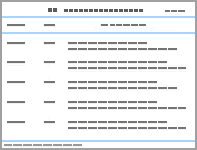
Table 1
Simulation parameters for a ship on the sea"
| 参数 | 参数值 |
| 载频/GHz | 1.5 |
| 场景中心斜距/km | 3 |
| 载机速度/(m/s) | 300 |
| 相控阵天线数 | 10 |
| 天线间距/m | 0.6 |
| PRF/Hz | 600 |
| 发射脉宽/μs | 1.5 |
| 发射带宽/MHz | 150 |
| A/D采样率/MHz | 300 |
| 舰船初始坐标(X, Y) | (10, 50) |
| 舰船径向速度/(m/s) | 6 |
| 舰船航向速度/(m/s) | 20 |

Fig.3
CA-CFAR detection of ship targets"


Fig.4
Velocity frequency spectrum of the spatial steering vector of antenna array"


Fig.5
Positioning accuracy contrast curve"

Table 2
Comparison of positioning accuracy of various algorithms"
| 算法 | 公式 | 定位精度/% |
| DPCA | 94~95 | |
| ATI | 90~93 | |
| VSAR | 96~97.5 |

Fig.6
VSAR imaging by equally spaced antennas of the antenna array"


Fig.7
Ship trajectory imaging"

| 1 | 汤立波, 李道京, 吴一戎, 等. 海面运动舰船目标的高分辨率SAR成像[J]. 电子与信息学报, 2006, 28 (4): 624- 627. |
| TANG L B , LI D J , WU Y R , et al. High resolution SAR imaging of moving ship targets at sea[J]. Journal of Electronics&Information Technology, 2006, 28 (4): 624- 627. | |
| 2 |
ALFREDO R , ANTONIO M . Use of Doppler parameters for ship velocity computation in SAR images[J]. IEEE Trans.on Geo-Science and Remote Sensing, 2016, 54 (7): 3995- 4011.
doi: 10.1109/TGRS.2016.2533023 |
| 3 | OUCHI K, HWANG S I.Improvement of ship detection accuracy by SAR multi-look cross-correlation technique using adaptive CFAR[C]//Proc.of the IEEE International Geoscience&Remote Sensing Symposium, 2010: 3716-3719. |
| 4 |
YANG J F , ZHANG Y H . Analysis on the azimuth shift of a moving target in SAR image[J]. Progress in Electromagnetics Research M, 2015, 42, 121- 134.
doi: 10.2528/PIERM15040202 |
| 5 | RUEGG M, MEIER E, NUESCH D.Constant motion, acceleration, vibration, and rotation of objects in SAR data[C]//Proc.of the SPIE International Society for Optical Engineering, 2005: 48-59. |
| 6 | PETTERSSON M I , SJOGREN T K , VU V T . Performance of moving target parameter estimation using SAR[J]. IEEE Trans.on Aerospace&Electronic Systems, 2015, 51 (2): 1191- 1202. |
| 7 |
DONG Z , CAI B , LIANG D N . Detection of ground moving targets for two-channel spaceborne SAR-ATI[J]. EURASIP Journal on Advances in Signal Processing, 2010.
doi: 10.1155/2010/230785 |
| 8 |
JANSEN R W , RAJ R G , LUKE R , et al. Practical multi-channel SAR imaging in the maritime environment[J]. IEEE Trans.on Geoscience and Remote Sensing, 2018, 56 (7): 4025- 4036.
doi: 10.1109/TGRS.2018.2820911 |
| 9 | LI G, XU J, PENG Y N, et al.Velocity layover solution in VSAR image[C]//Proc.of the CIE International Conference on Radar, 2006: 673-676. |
| 10 |
FRIEDLANDER B , PORAT B . VSAR:a high resolution radar system for detection of moving targets[J]. IEEE Proceeding Radar, Sonar and Navigation, 1997, 144 (4): 205- 218.
doi: 10.1049/ip-rsn:19971309 |
| 11 |
LOMBARDINI F , BORDONI F , GINI F , et al. Multibaseline ATI-SAR for robust ocean surface velocity estimation[J]. IEEE Trans.on Aerospace and Electronic Systems, 2004, 40 (2): 417- 433.
doi: 10.1109/TAES.2004.1309994 |
| 12 | LI X W, XIA X G. Multiple-frequency interferometric velocity SAR location and imaging of elevated moving target[C]//Proc.of the IEEE International Conference on Acoustics Speech&Signal Processing, 2010: 2810-2813. |
| 13 |
LI G , XU J , PENG Y N , et al. Location and Imaging of moving targets using nonuniform linear antenna array SAR[J]. IEEE Trans.on Aerospace and Electronic Systems, 2007, 43 (3): 1214- 1220.
doi: 10.1109/TAES.2007.4383613 |
| 14 | SLETTEN M, MENK S, TOPORKOV J, et al. The NRL multi aperture SAR system[C]//Proc.of the IEEE Radar Conference, 2015: 192-197. |
| 15 |
SLETTEN M A , ROSENBERG L , MENK S , et al. Maritime signature correction with the NRL multichannel SAR[J]. IEEE Trans.on Geoscience and Remote Sensing, 2016, 54 (11): 6783- 6790.
doi: 10.1109/TGRS.2016.2590958 |
| 16 |
SLETTEN M A . Demonstration of SAR distortion correction using a ground-based multichannel SAR test bed[J]. IEEE Trans.on Geoscience and Remote Sensing, 2013, 51 (5): 3181- 3190.
doi: 10.1109/TGRS.2012.2212710 |
| 17 | RAJ R G, JANSEN R W, LIPPS R D, et al. Velocity-ISAR: on the application of ISAR techniques to multichannel SAR imaging[C]//Proc.of the IEEE National Radar Conference, 2015: 1050-1055. |
| 18 |
LI X W , XIA X G . Location and imaging of elevated moving target using multi-frequency velocity SAR with cross-track interferometry[J]. IEEE Trans.on Aerospace and Electronic Systems, 2011, 47 (2): 1203- 1211.
doi: 10.1109/TAES.2011.5751252 |
| 19 | 李晶晶, 王首勇, 胡文琳. 基于多杂波分布模型的自适应单元平均恒虚警检测[J]. 空军雷达学院学报, 2005, 19 (3): 4- 7. |
| LI J J , WANG S Y , HU W L . Adaptive cell average cfar detection based on multi-clutter distribution model[J]. Journal of Air Force Radar Academy, 2005, 19 (3): 4- 7. | |
| 20 |
SCHWEGMANN C P , KLEYNHANS W , SALMON B P . Manifold adaptation for constant false alarm rate ship detection in south african oceans[J]. IEEE Journal of Selected Topics in Applied Earth Observations and Remote Sensing, 2015, 8 (7): 3329- 3337.
doi: 10.1109/JSTARS.2015.2417756 |
| 21 |
肖靖, 胡学成, 章宏, 等. 基于最小熵的斜视SAR多普勒调频率估计[J]. 现代雷达, 2013, 35 (1): 46- 54.
doi: 10.3969/j.issn.1004-7859.2013.01.010 |
|
XIAO J , HU X C , ZHANG H , et al. Estimation of the Doppler frequency modulation ratio based on minimum entropy criteria for highly squinted SAR[J]. Modern Radar, 2013, 35 (1): 46- 54.
doi: 10.3969/j.issn.1004-7859.2013.01.010 |
|
| 22 |
武昕伟, 朱兆达. 一种基于最小熵准则的SAR图像自聚焦算法[J]. 系统工程与电子技术, 2003, 25 (7): 867- 869.
doi: 10.3321/j.issn:1001-506X.2003.07.027 |
|
WU X W , ZHU Z D . A novel autofocus algorithm based on minimum entropy criteria for SAR images[J]. Systems Engineering and Electronics, 2003, 25 (7): 867- 869.
doi: 10.3321/j.issn:1001-506X.2003.07.027 |
|
| 23 | FINN H M , JOHNSON R S . Adaptive detection mode with threshold control as a function of spatially sampled clutter-level estimates[J]. RCA Review, 1968, 29 (9): 414- 464. |
| 24 | LIU Q X, WANG Z R, XIA W, et al. Ground moving target positioning with Doppler ambiguity and scene ambiguity in SAR[C]//Proc.of the 40th International Conference on Telecommunications and Signal Processing, 2017: 465-469. |
| 25 | 孙华东.多通道SAR地面运动目标检测与参数估计研究[D].哈尔滨:哈尔滨工业大学, 2009: 24-28. |
| SUN H D. Research on multi-channel SAR ground moving target detection and parameter estimations[D]. Harbin: Harbin Institute of Technology, 2009: 24-28. |
| [1] | Zhanling WANG, Chen PANG, Jiapeng YIN, Yongzhen LI, Xuesong WANG. Polarization control method for wideband phased array based on polarization state configuration [J]. Systems Engineering and Electronics, 2022, 44(3): 795-801. |
| [2] | Wenge XING, Chuanrui ZHOU, Cheng ZHOU. Research on key technology of detection and communication integration for phased array radar [J]. Systems Engineering and Electronics, 2022, 44(10): 3053-3058. |
| [3] | Wei JIANG, Wen SHENG, Wei QI, Shihua LIU. Survey on maintenance decision of large-scale phased array radar's T/R module [J]. Systems Engineering and Electronics, 2022, 44(1): 127-138. |
| [4] | Ao LIU, Zheng ZHOU, Shuangming LI. Phased array radar recognition method based on optimized sequence extraction [J]. Systems Engineering and Electronics, 2021, 43(3): 656-665. |
| [5] | Jisan LI, Wenbin CAI, Lixiang GENG, Rong LIU, Yuan REN. Variable date rate target tracking algorithm for rotating phased array radar [J]. Systems Engineering and Electronics, 2021, 43(3): 676-683. |
| [6] | Wei CHEN, Jijian ZHANG, Wenchong XIE, Yongliang WANG. Research on smart jamming signal model and suppression method for airborne phased array radar [J]. Systems Engineering and Electronics, 2021, 43(2): 343-350. |
| [7] | Ning WANG, Ming ZHOU, Guoqing LIU, Yuhao YANG, Jun SUN. Interframe noncoherent integration technology based on Chirp Z transform for sea surface target [J]. Systems Engineering and Electronics, 2021, 43(2): 383-389. |
| [8] | Zhizhong LIAO, Qi WANG. Influence and countermeasures of radar seeker pointing error on missile guidance [J]. Systems Engineering and Electronics, 2021, 43(2): 519-525. |
| [9] | XIA Liang, YANG Jiangping, CHANG Chunhe, WANG An’an. Safety study of large phased array radar software system [J]. Systems Engineering and Electronics, 2019, 41(8): 1755-1762. |
| [10] | LI Bo, ZHOU Jingyang, GAO Xiaoguang. Task schedule method of phased array radar based on auction algorithm [J]. Systems Engineering and Electronics, 2018, 40(8): 1736-1742. |
| [11] |
ZHANG Haowei, XIE Junwei, ZHANG Zhaojian, ZONG Binfeng, SHENG Chuan.
Scheduling based on the hybrid genetic particle swarm algorithm for the phased array radar [J]. Systems Engineering and Electronics, 2017, 39(9): 1985-1991. |
| [12] | JIANG Wei, SHENG Wen, YANG Li, FAN Yunlong. Spares optimization of phased array radar under the condition-based maintenance [J]. Systems Engineering and Electronics, 2017, 39(9): 2052-2057. |
| [13] | ZOU Gaoxiang, TONG Chuangming, WANG Tong, SUN Hualong. Study on modeling and electromagnetic scattering characteristics of composite rough surface of ground and ocean in adjacent region [J]. Systems Engineering and Electronics, 2017, 39(7): 1425-1438. |
| [14] | HU Zijun, ZHAI Haitao. Taskdriven TAS scheduling algorithm for airborne phased array radar [J]. Systems Engineering and Electronics, 2017, 39(3): 536-541. |
| [15] | ZHANG Haowei, XIE Junwei, SHI Junpeng, ZONG Binfeng, SHENG Chuan. Dynamic priority online interleaving scheduling algorithm for the air defense phased array radar [J]. Systems Engineering and Electronics, 2017, 39(3): 529-535. |
| Viewed | ||||||
|
Full text |
|
|||||
|
Abstract |
|
|||||