Systems Engineering and Electronics ›› 2026, Vol. 48 ›› Issue (8): 2581-2592.doi: 10.12305/j.issn.1001-506X.2026.08.07
• Sensors and Signal Processing • Previous Articles
Persymmetric adaptive detection algorithm for Swerling I fluctuating targets
Yuanyuan ZHENG1,2( ), Hongzhi GUO1(), Zishu HE1(), Haoqi WU1, Zhihang WANG1, Ziyang CHENG1
- 1. School of Information and Communication Engineering,University of Electronic Science and Technology of China,Chengdu 611731,China
2. The 14th Research Institute,China Electronics Technology Group Corporation,Nanjing 210039,China
-
Received:2025-05-19Revised:2025-08-04Accepted:2025-08-13Online:2025-11-27Published:2025-11-27 -
Contact:Zishu HE E-mail:zyy65682@sina.com;hongz_guo@126.com;zshe@uestc.edu.cn

CLC Number:
Cite this article
Yuanyuan ZHENG, Hongzhi GUO, Zishu HE, Haoqi WU, Zhihang WANG, Ziyang CHENG. Persymmetric adaptive detection algorithm for Swerling I fluctuating targets[J]. Systems Engineering and Electronics, 2026, 48(8): 2581-2592.
share this article
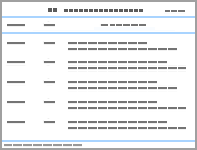
Table 1
Complexity of the proposed detectors"
| 检测器 | 检测统计量 | 计算复杂度 |
| PGLRT-1S | 式(46) | |
| PGLRT-2S | 式(56) | |
| PRAO | 式(80) | |
| PWALD | 式(83) | |
| PGDT | 式(86) |
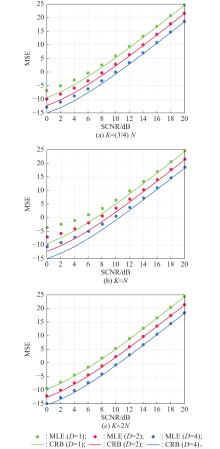
Fig.1
MSE and CRB versus SCNR curves of estimated value of target signal power"
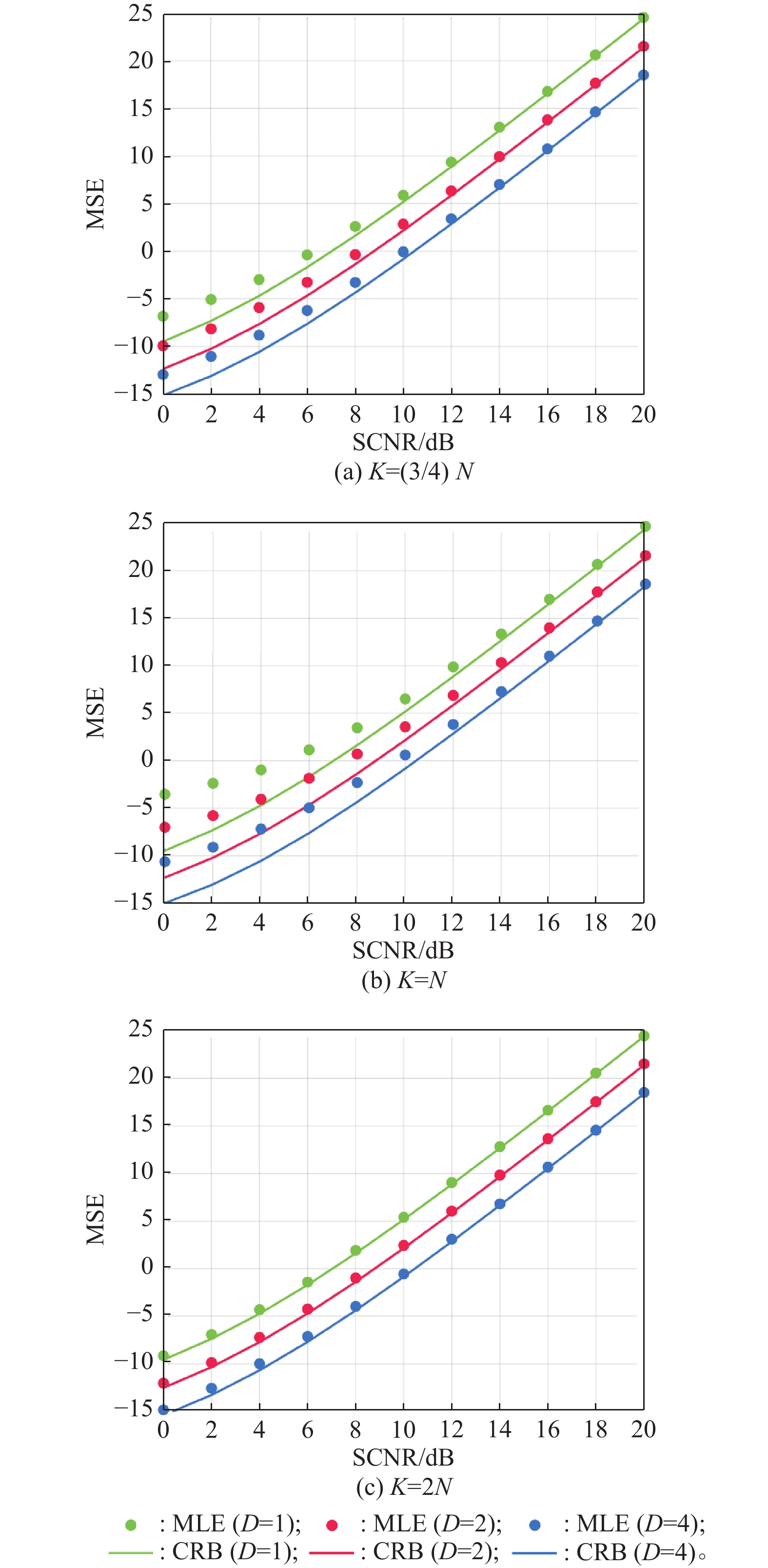
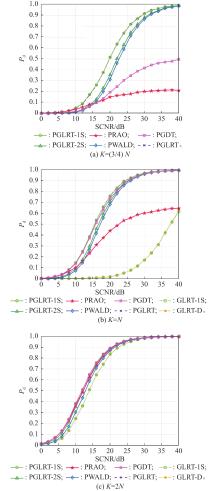
Fig.2
$ {P_{\mathrm{d}}} $ versus SCNR curves in point targets situation"
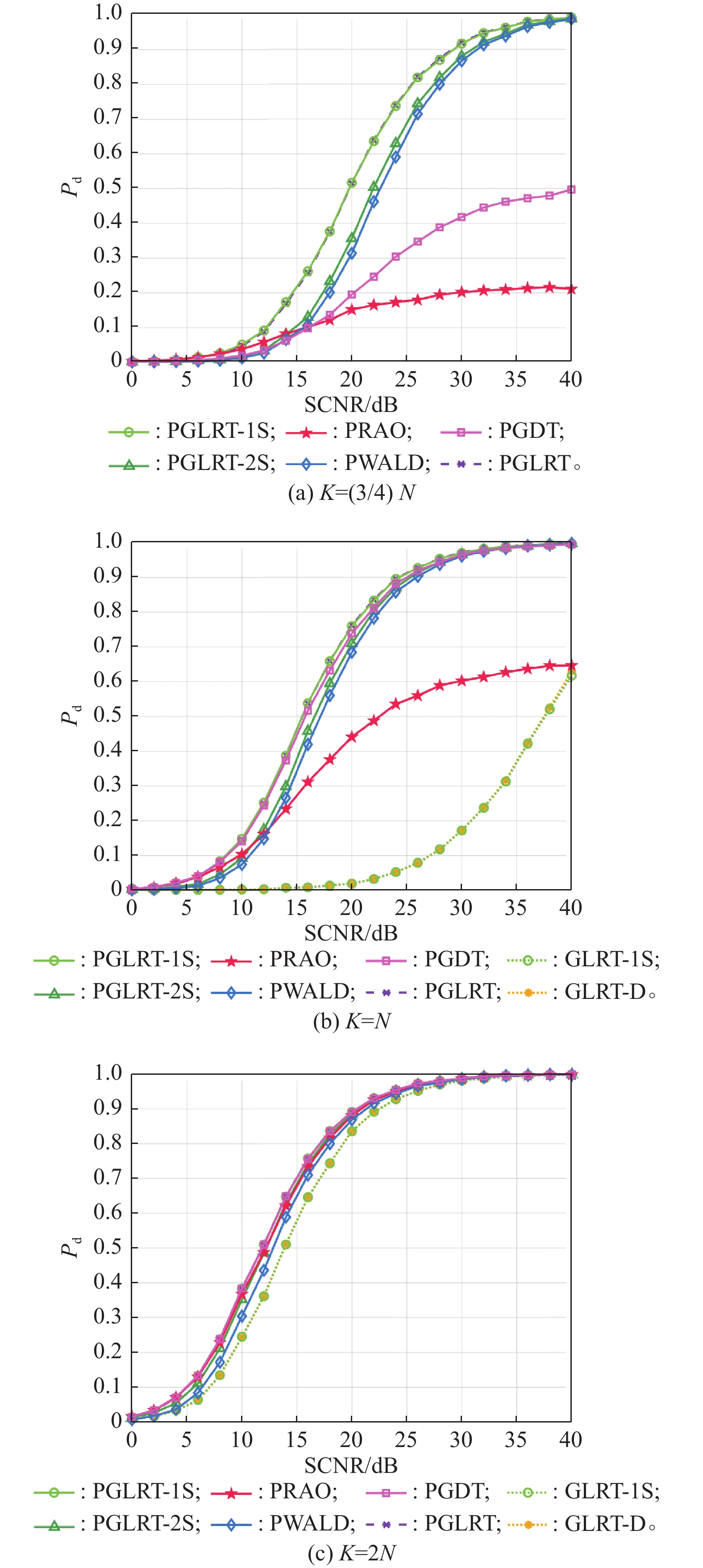
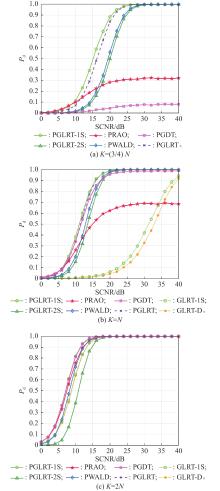
Fig.3
$ {P_{\mathrm{d}}} $ versus SCNR curves in range-extended target situation"
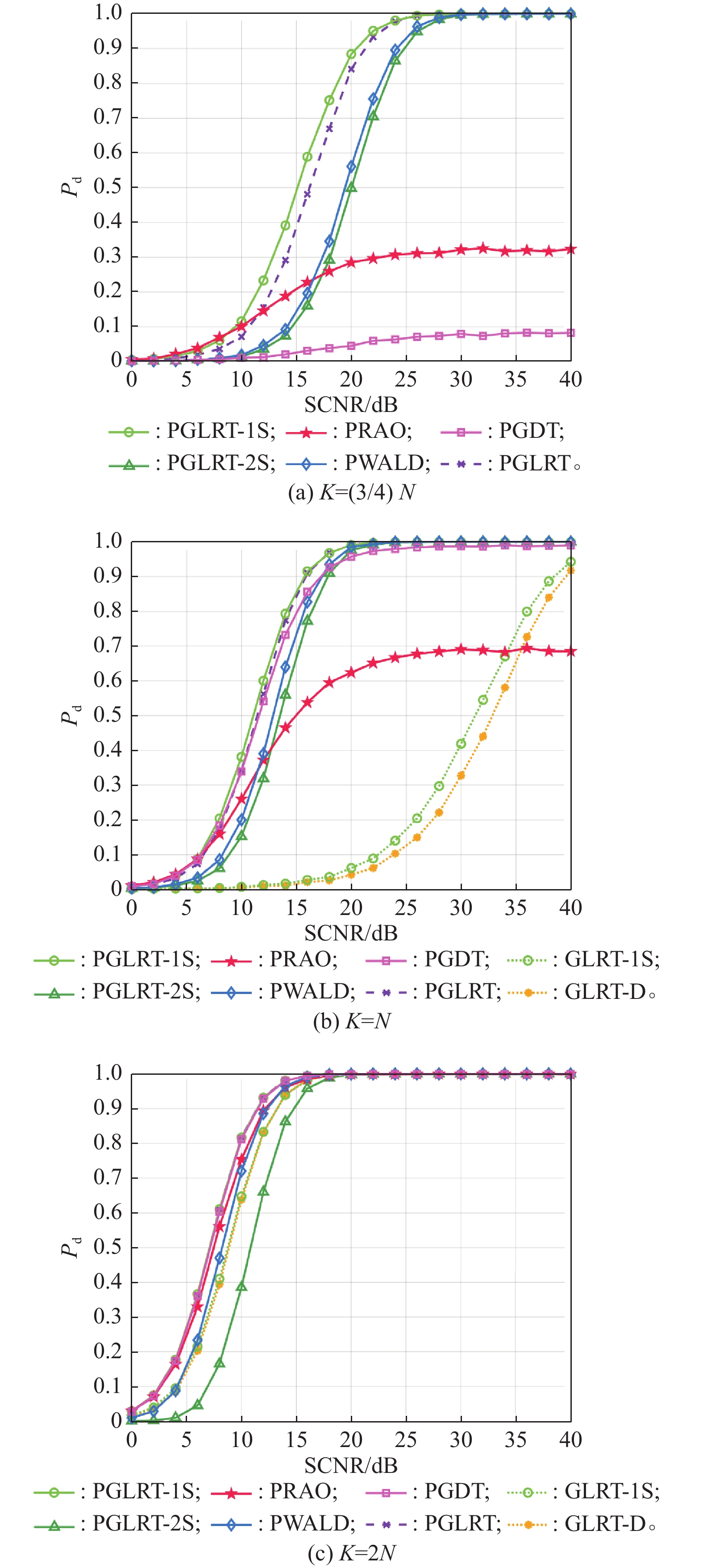
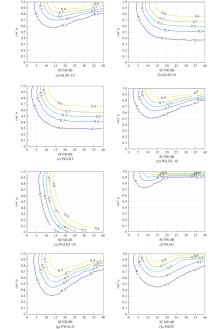
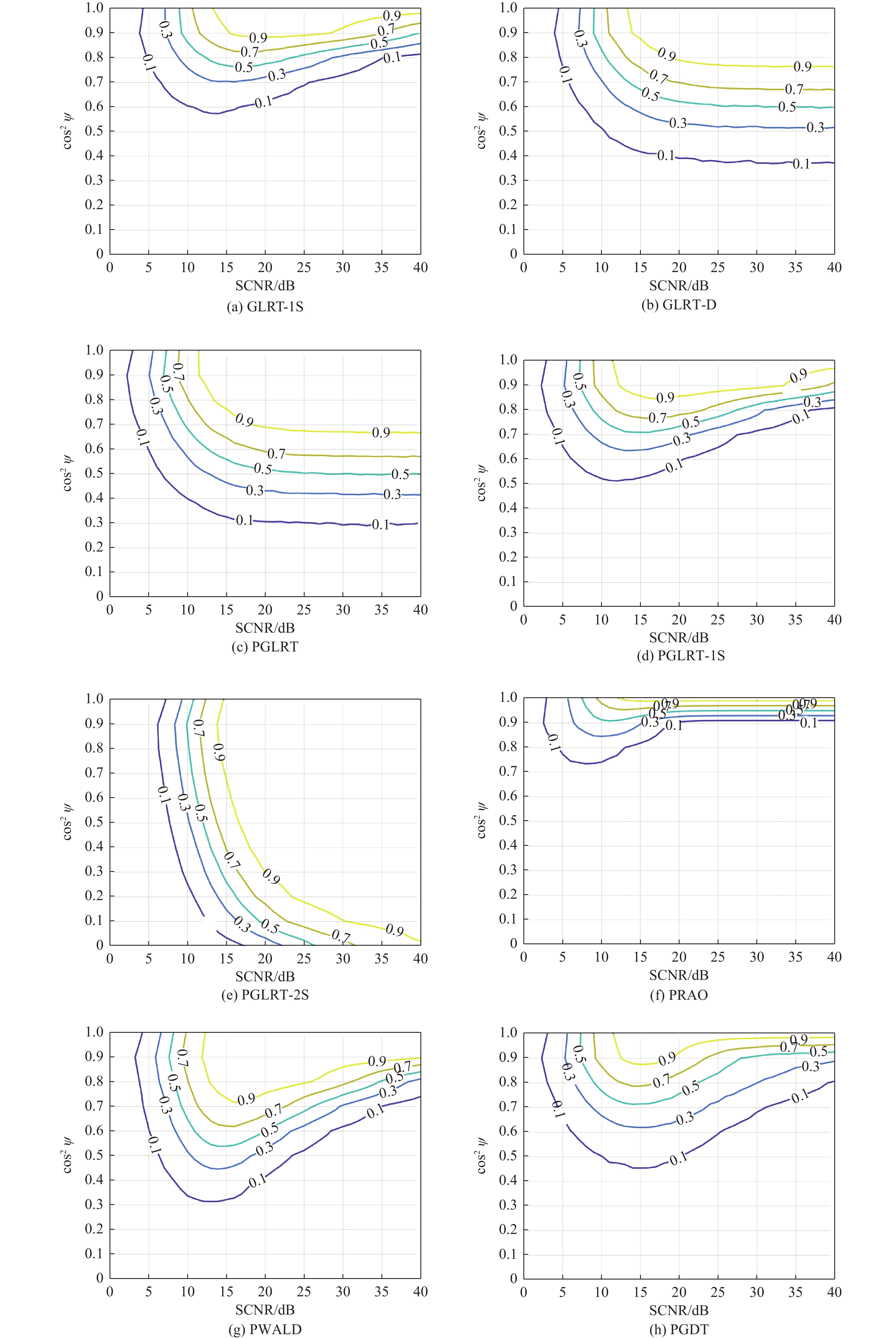
Fig.4
Contours of the proposed detectors and comparative detectors in the case of target signal mismatch"
| 1 | 王永良, 彭应宁. 空时自适应信号处理[M]. 北京: 清华大学出版社, 2000. |
| WANG Y L, PENG Y N. Space-time adaptive processing[M]. Beijing: Tsinghua University Press, 2000. | |
| 2 |
LIU W J, LIU J, HAO C P, et al. Multichannel adaptive signal detection: basic theory and literature review[J]. SCIENCE CHINA Information Sciences, 2022, 65 (2): 121301.
doi: 10.1007/s11432-020-3211-8 |
| 3 | HAO C P, ORLANDO D, LIU J, et al. Advances in adaptive radar detection and range estimation[M]. Singapore: Springer, 2022. |
| 4 | KELLY E J. An adaptive detection algorithm[J]. IEEE Trans. on Aerospace and Electronic Systems, 1986, 22 (2): 115- 127. |
| 5 |
PULSONE N B, RADER C M. Adaptive beamformer orthogonal rejection test[J]. IEEE Trans. on Signal Processing, 2001, 49 (3): 521- 529.
doi: 10.1109/78.905870 |
| 6 |
ORLANDO D, RICCI G. Adaptive radar detection and localization of a point-like target[J]. IEEE Trans. on Signal Processing, 2011, 59 (9): 4086- 4096.
doi: 10.1109/TSP.2011.2159602 |
| 7 |
WANG P, LI H B, HIMED B. A parametric moving target detector for distributed MIMO radar in non-homogeneous environment[J]. IEEE Trans. on Signal Processing, 2013, 61 (9): 2282- 2294.
doi: 10.1109/TSP.2013.2245323 |
| 8 |
ROBEY F C, FUHRMANN D R, KELLY E J, et al. A CFAR adaptive matched filter detector[J]. IEEE Trans. on Aerospace and Electronic Systems, 1992, 28 (1): 208- 216.
doi: 10.1109/7.135446 |
| 9 |
许述文, 石星宇, 水鹏朗. 复合高斯杂波下抑制失配信号的自适应检测器[J]. 雷达学报, 2019, 8 (3): 326- 334.
doi: 10.12000/JR19030 |
|
XU S W, SHI X Y, SHUI P L. An adaptive detector with mismatched signals rejection in compound Gaussian clutter[J]. Journal of Radars, 2019, 8 (3): 326- 334.
doi: 10.12000/JR19030 |
|
| 10 |
GUO H Z, WU H Q, WANG Z H, et al. Adaptive target detection in nonhomogeneous clutter and multipath environment[J]. IEEE Trans. on Aerospace and Electronic Systems, 2025, 61 (4): 9630- 9644.
doi: 10.1109/TAES.2025.3556660 |
| 11 |
SUN M R, LIU W J, LIU J, et al. Complex parameter Rao, Wald, gradient, and Durbin tests for multichannel signal detection[J]. IEEE Trans. on Signal Processing, 2022, 70, 117- 131.
doi: 10.1109/TSP.2021.3132485 |
| 12 |
LIU W J, LIU J, HUANG L, et al. Rao tests for distributed target detection in interference and noise[J]. Signal Processing, 2015, 117, 333- 342.
doi: 10.1016/j.sigpro.2015.06.012 |
| 13 |
WANG Z Z. Modified Rao test for distributed target detection in interference and noise[J]. Signal Processing, 2020, 172, 107578.
doi: 10.1016/j.sigpro.2020.107578 |
| 14 |
LIU J, LIU W J, CHEN X, et al. Wald test for adaptive array detection with general configuration[J]. IEEE Trans. on Aerospace and Electronic Systems, 2022, 58 (5): 4423- 4433.
doi: 10.1109/TAES.2022.3161863 |
| 15 |
WANG Z Y, CHEN H M, LI Y C, et al. Rao and Wald tests for moving target detection in forward scatter radar[J]. Remote Sensing, 2024, 16 (2): 211.
doi: 10.3390/rs16020211 |
| 16 |
TANG P Q, DONG R, LIU W J, et al. Adaptive multichannel detectors for distributed target based on gradient test[J]. Signal Processing, 2022, 191, 108350.
doi: 10.1016/j.sigpro.2021.108350 |
| 17 |
丁昊, 薛永华, 黄勇, 等. 均匀和部分均匀杂波中子空间目标的斜对称自适应检测方法[J]. 雷达学报, 2015, 4 (4): 418- 430.
doi: 10.12000/JR14133 |
|
DING H, XUE Y H, HUANG Y, et al. Persymmetric adaptive detectors of subspace signals in homogeneous and partially homogeneous clutter[J]. Journal of Radars, 2015, 4 (4): 418- 430.
doi: 10.12000/JR14133 |
|
| 18 |
CAI L J, WANG H. A persymmetric multiband GLR algorithm[J]. IEEE Trans. on Aerospace and Electronic Systems, 1992, 28 (3): 806- 816.
doi: 10.1109/7.256301 |
| 19 |
闫林杰, 郝程鹏, 殷超然, 等. 部分均匀环境下适用于空间对称线阵的修正广义似然比检测方法[J]. 雷达学报, 2021, 10 (3): 443- 452.
doi: 10.12000/JR20140 |
|
YAN L J, HAO C P, YIN C R, et al. Modified generalized likelihood ratio test detection based on a symmetrically spaced linear array in partially homogeneous environments[J]. Journal of Radars, 2021, 10 (3): 443- 452.
doi: 10.12000/JR20140 |
|
| 20 |
JIAN T, LIU J, ZHOU S H, et al. Target detection with persymmetric subspace models for steering vector mismatches in MIMO radars[J]. Digital Signal Processing, 2022, 126, 103480.
doi: 10.1016/j.dsp.2022.103480 |
| 21 | LIU W J, LIU J, LIU T, et al. Detector design and performance analysis for target detection in subspace interference[J]. IEEE Signal Processing Letters, 2022, 30, 618- 622. |
| 22 | LIU W J, HAN H, LIU J, et al. Multichannel radar adaptive signal detection in interference and structure nonhomogeneity[J]. SCIENCE CHINA Information Sciences, 2017, 60 (11): 112302. |
| 23 |
LIU W J, WANG Y L, LIU J, et al. Adaptive detection without training data in colocated MIMO radar[J]. IEEE Trans. on Aerospace and Electronic Systems, 2015, 51 (3): 2469- 2479.
doi: 10.1109/TAES.2015.130754 |
| 24 | SUN G H, LI M, TONG J, et al. Structured clutter covariance matrix estimation for airborne MIMO radar with limited training data[J]. IEEE Geoscience and Remote Sensing Letters, 2020, 19, 117- 131. |
| 25 |
SUN G H, ZHANG W, TONG J, et al. Knowledge-aided target detection for multistatic passive radar[J]. IEEE Access, 2019, 7, 53463- 53475.
doi: 10.1109/ACCESS.2019.2911910 |
| 26 | 丁鹭飞, 耿富录. 雷达原理[M]. 西安: 西安电子科技大学出版社, 2002. |
| DING L F, GENG F L. Radar principle[M]. Xi’an: Xidian University Press, 2002. | |
| 27 |
BESSON O, COLUCCIA A, CHAUMETTE E, et al. Generalized likelihood ratio test for detection of Gaussian rank-one signals in Gaussian noise with unknown statistics[J]. IEEE Trans. on Signal Processing, 2017, 65 (4): 1082- 1092.
doi: 10.1109/TSP.2016.2633241 |
| 28 |
BESSON O. Rao, Wald, and gradient tests for adaptive detection of Swerling I targets[J]. IEEE Trans. on Signal Processing, 2023, 71, 3043- 3052.
doi: 10.1109/TSP.2023.3306082 |
| 29 | CHAUMETTE E, VINCENT F, GINOLHAC G. Detection of Swerling III-IV rank-one signals in Gaussian noise with unknown statistics[C]// Proc. of the 52nd Asilomar Conference on Signals, Systems, and Computers, 2018: 2072−2076. |
| 30 |
BESSON O. Adaptive detection of Rician targets[J]. IEEE Trans. on Aerospace and Electronic Systems, 2023, 59 (4): 4700- 4708.
doi: 10.1109/TAES.2023.3234454 |
| 31 | LIU J, ORLANDO D, HAO C P, et al. Adaptive detection of multichannel signals exploiting persymmetry[M]. Boca Raton: CRC Press, 2022. |
| 32 |
LIU W J, LIU J, HUANG L, et al. Robust GLRT approaches to signal detection in the presence of spatial-temporal uncertainty[J]. Signal Processing, 2016, 118, 272- 284.
doi: 10.1016/j.sigpro.2015.06.026 |
| 33 |
LIU W J, ZHANG Z J, LIU J, et al. Detection of a rank-one signal with limited training data[J]. Signal Processing, 2021, 186, 108120.
doi: 10.1016/j.sigpro.2021.108120 |
| 34 |
MAIO AD, RICCI G. A polarimetric adaptive matched filter[J]. Signal Processing, 2001, 81 (12): 2583- 2589.
doi: 10.1016/S0165-1684(01)00150-5 |
| 35 |
HAO C P, GAZOR S, MA X C, et al. Polarimetric detection and range estimation of a point-like target[J]. IEEE Trans. on Aerospace and Electronic Systems, 2016, 52 (2): 603- 616.
doi: 10.1109/TAES.2015.140657 |
| 36 |
GERLACH K, STEINER M J. Adaptive detection of range distributed targets[J]. IEEE Trans. on Signal Processing, 1999, 47 (7): 1844- 1851.
doi: 10.1109/78.771034 |
| 37 |
LIU W J, WANG L C, DI Y S, et al. Adaptive energy detector and its application for mismatched signal detection[J]. Journal of Radars, 2015, 4 (2): 149- 159.
doi: 10.12000/JR14132 |
| [1] | Zhixun MA, Chaoran YIN, Tianqi WANG, Chengpeng HAO. Adaptive detection method of MIMO sonar incorporating prior knowledge [J]. Systems Engineering and Electronics, 2025, 47(7): 2383-2388. |
| [2] | Dongsheng ZHU, Xiaojing SU, Zhixun MA, Yingjie SHI. Design of adaptive detector for inhomogeneous clutter background [J]. Systems Engineering and Electronics, 2024, 46(11): 3613-3620. |
| [3] | Zhikai LIN, Weijian LIU, Lichang QIAN, Binbin LI, Bilei ZHOU, Zhaojian ZHANG, Hao CHEN. A weighted adaptive detector for mismatched subspace signal detection [J]. Systems Engineering and Electronics, 2023, 45(7): 1974-1980. |
| [4] | Kun ZOU, Lei LAI, Yanbo LUO, Wei LI. Radar signal detection with subspace constrained rank one interference [J]. Systems Engineering and Electronics, 2022, 44(1): 94-99. |
| [5] | JIAN Tao, HE You, LIAO Guisheng, WANG Jie, ZHOU Qiang. Adaptive structured detector of radar target with scarce secondary data [J]. Systems Engineering and Electronics, 2017, 39(2): 277-281. |
| [6] | SHI Sainan, SHUI Penglang, YANG Chunjiao, XU Shuwen. Radar target detection based on spatial correlation of inverse-Gaussian texture [J]. Systems Engineering and Electronics, 2017, 39(10): 2215-2220. |
| [7] | SHI Yanling, LIN Yufeng, WAN Ting. #br# Smooth adaptive detector for radar target in partially homogeneous#br# sea clutter environment [J]. Systems Engineering and Electronics, 2016, 38(12): 2745-2751. |
| [8] | ZHAO Yi-nan, JIANG Zhi-zhuo, TANG Chen-liang, ZHOU Zhi-quan. Adaptive detection of polarimetric MIMO radar in compound-Gaussian clutter [J]. Systems Engineering and Electronics, 2015, 37(11): 2474-2479. |
| [9] | LIU Wei-jian, XIE Wen-chong, Wang Yong-liang. AMF and ACE detectors based on diagonal loading [J]. Journal of Systems Engineering and Electronics, 2013, 35(3): 463-468. |
| Viewed | ||||||
|
Full text |
|
|||||
|
Abstract |
|
|||||