Systems Engineering and Electronics ›› 2026, Vol. 48 ›› Issue (7): 2153-2163.doi: 10.12305/j.issn.1001-506X.2026.07.03
• Electronic Technology • Previous Articles
Cooperative direct position determination method for satellite and shortwave signals based on multi-target spatial domain law constraints
Tiange YU1( ), Jiexin YIN1(), Ding WANG1(), Fuquan NIE2()
- 1. School of Information Systems Engineering,University of Information Engineering,Zhengzhou 450000,China
2. Henan Institute of Science and Technology,Xinxiang 453000,China
-
Received:2025-06-24Revised:2025-11-10Accepted:2025-12-04Online:2026-01-26Published:2026-01-26 -
Contact:Jiexin YIN E-mail:ytg0520@163.com;Cindyin0807@163.com;wang_ding814@aliyun.com;nfq@hist.edu.cn

CLC Number:
Cite this article
Tiange YU, Jiexin YIN, Ding WANG, Fuquan NIE. Cooperative direct position determination method for satellite and shortwave signals based on multi-target spatial domain law constraints[J]. Systems Engineering and Electronics, 2026, 48(7): 2153-2163.
share this article
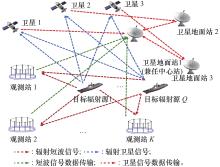
Fig.1
Schemtic diagram of cooperative direct position determination method for satellite and shortwave signals based on multi-target spatial domain law constraints"
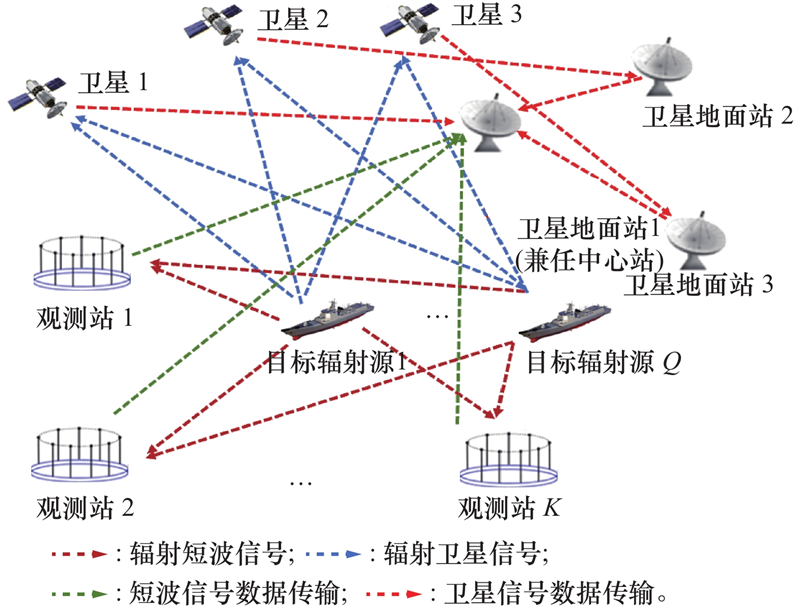
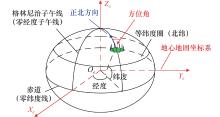
Fig.2
Geometric schemtic diagram of shortwave signal reception based on Earth’s ellipsoidal model"
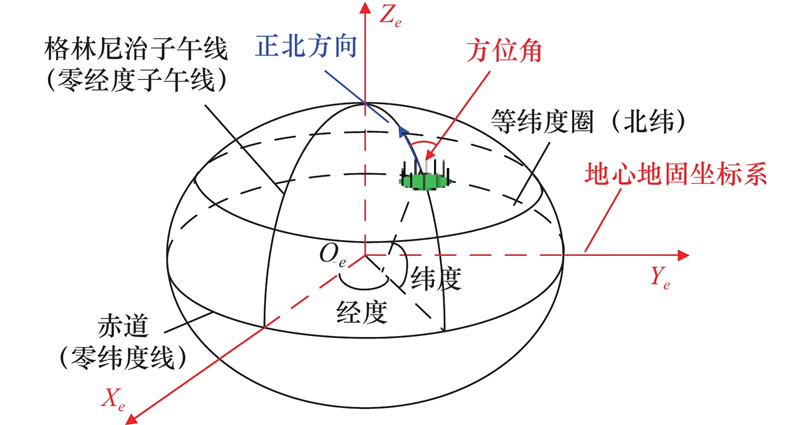
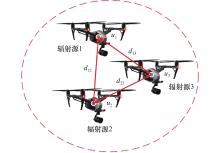
Fig.3
Schematic diagram of distance constraints between radiation sources"
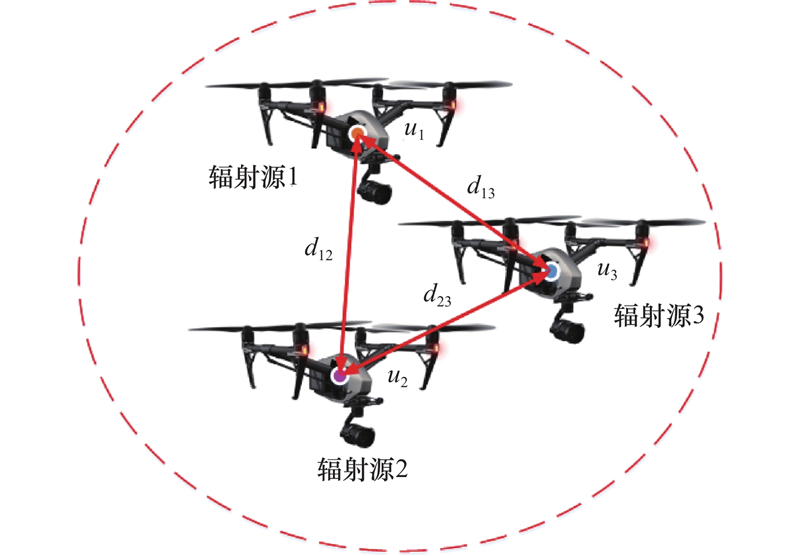
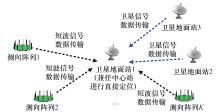
Fig.4
Schematic diagram of shortwave and satellite signals data transmission"
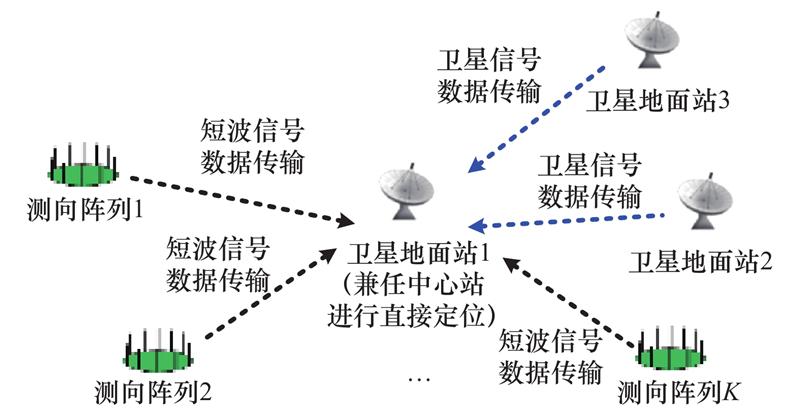
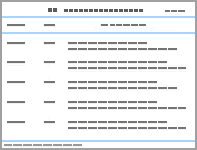
Table 1
Key parameter settings for the proposed algorithm"
| 参数类型 | 取值 |
| 拉格朗日乘子初始值 | 2 |
| 惩罚系数 | 10 |
| 迭代步长因子 | 0.9 |
| 2个目标定位场景的距离约束/km | 48.41 |
| 3个目标定位场景的距离约束/km | 66.46 |
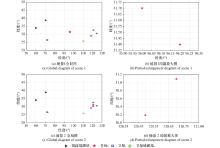
Fig.5
Location scenarios of different target radiation sources locations(two targets)"
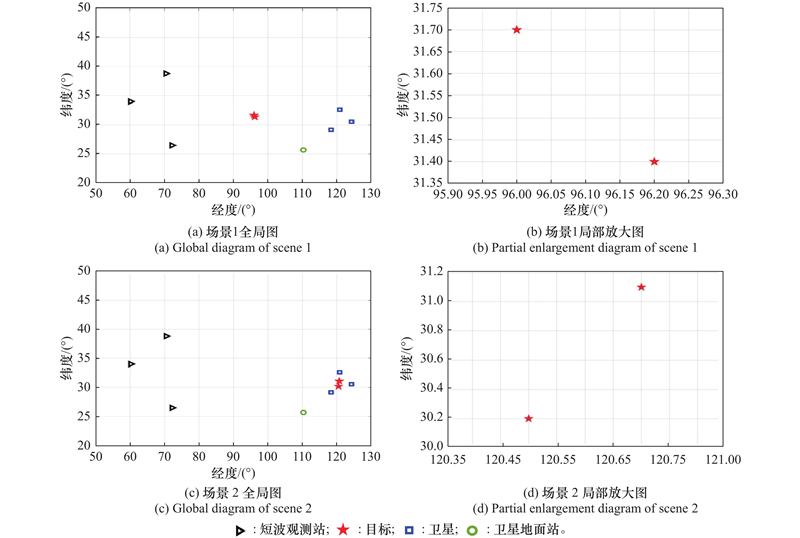
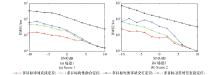
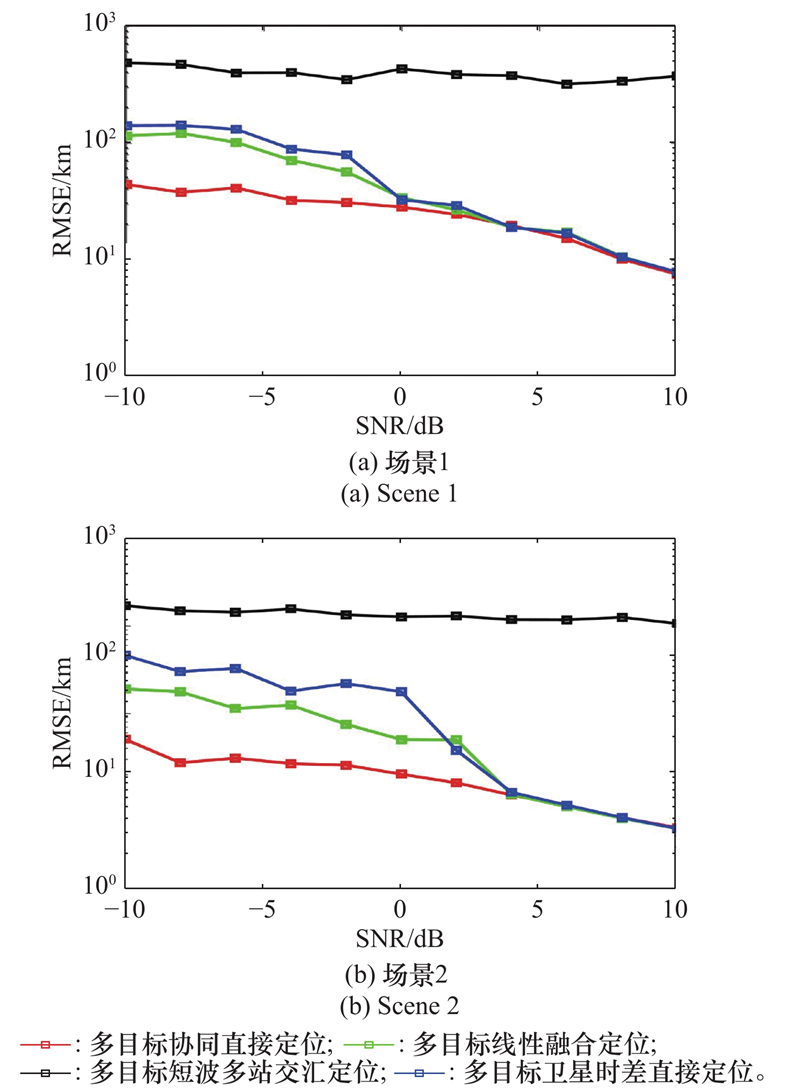
Fig.6
Variation curves of localization RMSE with SNR for four methods in different target radiation sources location scenarios (two targets)"
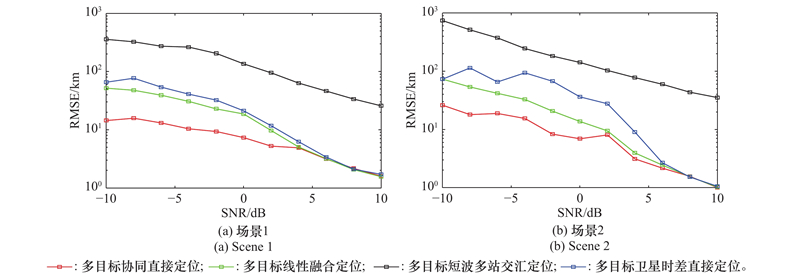
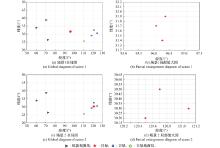
Fig.7
Location scenarios of different target radiation sources locations(three targets)"
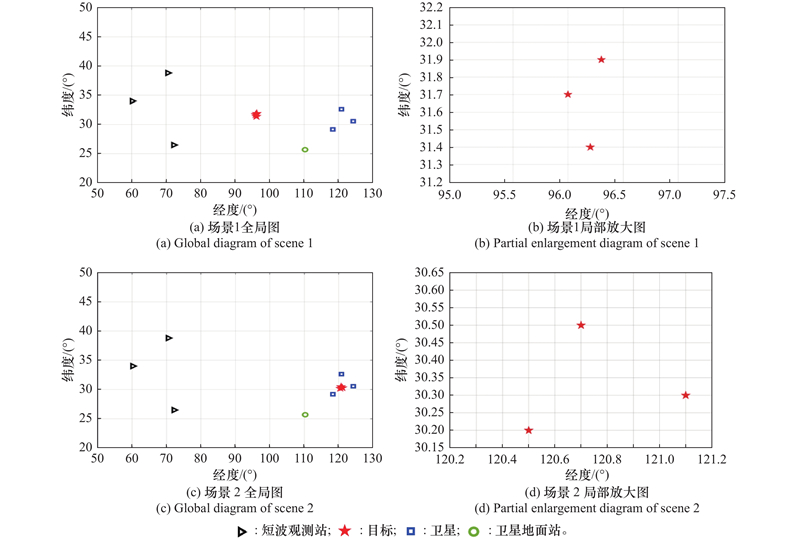
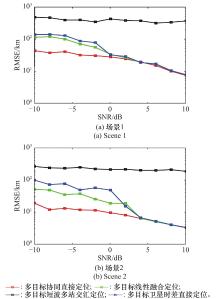
Fig.8
Variation curves of localization RMSE with SNR for four methods in different target radiation sources location scenarios (three targets)"
| 1 |
SHU F, YANG S P, QIN Y L. Approximate analytic quadratic-optimization solution for TDOA-based passive multi-satellite localization with Earth constraint[J]. IEEE Access, 2016, 4, 9283- 9292.
doi: 10.1109/ACCESS.2016.2636318 |
| 2 | LI S J, ZHANG Q Y, DENG B Y, et al. A fast and accurate LEO satellite-based direct position determination assisted by TDOA measurements[J]. China Communications, 2022, 19 (1): 92- 103. |
| . [J]. 2022, 19 (1): 92- 103. | |
| 3 | POISEI A R. 电子战目标定位方法[M]. 屈晓旭, 罗勇, 等译. 北京: 电子工业出版社, 2008. |
| POISEI A R. Electronic warfare target localization method[M]. QU X X, LUO Y, et al. trans. Beijing: Electronic Industry Press, 2008. | |
| 4 |
王鼎, 尹洁昕, 高路, 等. 一种协同二维DOA和TDOA观测量的超视距短波辐射源定位新方法[J]. 雷达学报, 2024, 13 (6): 1135- 1156.
doi: 10.12000/JR24136 |
|
WANG D, YIN J X, GAO L, et al. A new method for over-the-horizon shortwave radiation source localization with two-dimensional DOA and TDOA observations[J]. Radar Journal, 2024, 13 (6): 1135- 1156.
doi: 10.12000/JR24136 |
|
| 5 |
邵凯, 聂芝荣. 星地通信中基于压缩感知的 OTFS 信道估计[J]. 电讯技术, 2025 (2): 214- 222.
doi: 10.20079/j.issn.1001-893x.241007001 |
|
SHAO K, NIE Z R. Channel estimation of OTFS based on compressive sensing in satellite-ground communication[J]. Telecommunication Technology, 2025 (2): 214- 222.
doi: 10.20079/j.issn.1001-893x.241007001 |
|
| 6 |
王鼎, 尹洁昕, 郑娜娥, 等. 收发未精确同步条件下非相关多运动辐射源TOAs/FOAs协同定位方法[J]. 电子学报, 2024, 52 (2): 550- 563.
doi: 10.12263/DZXB.20230524 |
|
WANG D, YIN J X, ZHENG N E, et al. A cooperative localization method for TOAs/FOAs of uncorrelated multi-motion radiation sources under the condition of imprecise synchronization of transceivers[J]. Electronics Letters, 2024, 52 (2): 550- 563.
doi: 10.12263/DZXB.20230524 |
|
| 7 |
胡欣珏, 李麒, 刘佳仑, 等. 船舶远程驾控卫星−岸基集成网络技术研究现状及展望[J]. 中国舰船研究, 2025, 20 (1): 15- 24.
doi: 10.19693/j.issn.1673-3185.04264 |
|
HU X J, LI Q, LIU J L, et al. Research status and prospects of satellite-shore-based integrated network technology for remotely-controlled ships[J]. Chinese Journal of Ship Research, 2025, 20 (1): 15- 24.
doi: 10.19693/j.issn.1673-3185.04264 |
|
| 8 |
YIN J X, WANG D, YANG X, et al. Combination of land-based and satellite-based OTH geolocations using differentiable exact penalty method[J]. IEEE Trans. on Aerospace and Electronic Systems, 2022, 58 (3): 2363- 2382.
doi: 10.1109/TAES.2021.3133303 |
| 9 |
YANG J R. Measurement of amplitude and phase differences between two RF signals by using signal power detection[J]. IEEE Microwave and Wireless Components Letters, 2014, 24 (3): 206- 208.
doi: 10.1109/LMWC.2013.2293665 |
| 10 |
BALLAL T, BLEAKLEY C J. Phase-difference ambiguity resolution for a single-frequency signal in the near-field using a receiver triplet[J]. IEEE Trans. on Signal Processing, 2010, 58 (11): 5920- 5926.
doi: 10.1109/TSP.2010.2062180 |
| 11 | CARTER G C. Coherence and time delay estimation[M]. Piscataway: IEEE Press, 1993. |
| 12 |
CHAN Y T, HO K C. A simple and efficient estimator for hyperbolic location[J]. IEEE Trans. on Signal Processing, 1994, 42 (8): 1905- 1915.
doi: 10.1109/78.301830 |
| 13 |
ULMAN R, GERANIOTIS E. Wideband TDOA/FDOA processing using summation of short-time CAF’s[J]. IEEE Trans. on Signal Processing, 2002, 47 (12): 3193- 3200.
doi: 10.1109/78.806065 |
| 14 |
HO K C, LU X N, KOVAVISARUCH L. Source localization using TDOA and FDOA measurements in the presence of receiver location errors: analysis and solution[J]. IEEE Trans. on Signal Processing, 2007, 55 (2): 684- 696.
doi: 10.1109/TSP.2006.885744 |
| 15 |
ZHANG S R, XING M D. A novel Doppler chirp rate and baseline estimation approach in the time domain based on weighted local maximum-likelihood for an MCHRWS SAR system[J]. IEEE Geoscience and Remote Sensing Letters, 2017, 14 (3): 299- 303.
doi: 10.1109/LGRS.2016.2633359 |
| 16 |
ZHANG W Q. Fast Doppler rate estimation based on fourth-order moment spectrum[J]. Electronics Letters, 2015, 51 (23): 1926- 1928.
doi: 10.1049/el.2015.2182 |
| 17 |
TRINH-HOANG M, VIBERG M, PESAVENTO M. Partial relaxation approach: an eigenvalue-based DOA estimator framework[J]. IEEE Trans. on Signal Processing, 2018, 66 (23): 6190- 6203.
doi: 10.1109/TSP.2018.2875853 |
| 18 |
WU X H, ZHU W P, YAN J. A high resolution DOA estimation method with a family of nonconvex penalties[J]. IEEE Trans. on Vehicular Technology, 2018, 67 (6): 4925- 4938.
doi: 10.1109/TVT.2018.2817638 |
| 19 |
CATOVIC A, SAHINOGLU Z. The Cramer-Rao bounds of hybrid TOA/RSS and TDOA/RSS location estimation schemes[J]. IEEE Communications Letters, 2004, 8 (10): 626- 628.
doi: 10.1109/LCOMM.2004.835319 |
| 20 |
LI X R. RSS-based location estimation with unknown pathloss model[J]. IEEE Trans. on Wireless Communications, 2006, 5 (12): 3626- 3633.
doi: 10.1109/TWC.2006.256985 |
| 21 |
AMAR A, WEISS A J. A decoupled algorithm for geolocation of multiple emitters[J]. Signal Processing, 2007, 87 (10): 2348- 2359.
doi: 10.1016/j.sigpro.2007.03.008 |
| 22 |
WEISS A J. Direct position determination of narrowband radio frequency transmitters[J]. IEEE Signal Processing Letters, 2004, 11 (5): 513- 516.
doi: 10.1109/LSP.2004.826501 |
| 23 | AMAR A, WEISS A J. Direct position determination (DPD) of multiple known and unknown radio-frequency signals[C]// Proc. of the 12th European Signal Processing Conference. Vienna, Austria, 2004: 1115-1118. |
| 24 | AMAR A, WEISS A J. Direct position determination of multiple radio signals[C]//Proc. of the IEEE International Conference on Acoustics, 2004 |
| 25 |
LU Z Y, BA B, WANG J H, et al. A direct position determination method with combined TDOA and FDOA based on particle filter[J]. Chinese Journal of Aeronautics, 2018, 31 (1): 161- 168.
doi: 10.1016/j.cja.2017.11.007 |
| 26 | ZHOU L J, ZHU W Q, LUO J Q, et al. Direct positioning maximum likelihood estimator using TDOA and FDOA for coherent short-pulse radar[J]. IET Radar, Sonar & Navigation, 2017, 11(10): 1505–1511. |
| 27 |
王云龙, 吴瑛. 联合时延与多普勒频率的直接定位改进算法[J]. 西安交通大学学报, 2015, 49 (4): 123- 129.
doi: 10.7652/xjtuxb201504020 |
|
WANG Y L, WU Y. Improved algorithm for direct positioning using joint delay and Doppler frequency[J]. Journal of Xi’an Jiaotong University, 2015, 49 (4): 123- 129.
doi: 10.7652/xjtuxb201504020 |
|
| 28 | 杨泽宇. 协同多维信息的无源定位技术研究 [D]. 郑州: 信息工程大学, 2020. |
| YANG Z Y. Research on passive localization technology with cooperative multidimensional information [D]. Zhengzhou: Information Engineering University, 2020. | |
| 29 | JIA C G, WANG D, YIN J X, et al. Joint multiple sources localization using TOA measurements based on Lagrange programming neural network[J]. IEEE Access, 2018, 3247- 3263. |
| 30 |
CAREVIC D. Automatic estimation of multiple target positions and velocities using passive TDOA measurements of transients[J]. IEEE Trans. on Signal Processing, 2007, 55 (2): 424- 436.
doi: 10.1109/TSP.2006.885745 |
| 31 |
LAI Y, YI W, WYMEERSCH H, et al. Joint detection and localization of multiple moving targets in a distributed radar system[J]. IEEE Sensors Journal, 2024, 24 (17): 27914- 27925.
doi: 10.1109/JSEN.2024.3432636 |
| 32 | JAIN A, PAGANI P, FLEURY R, et al. Efficient time domain HF geolocation using multiple distributed receivers[C]//Proc. of the European Conference on Antennas and Propagation, 2017: 1852-1856. |
| 33 |
JAIN A, PAGANI P, FLEURY R, et al. HF source geolocation using an operational TDOA receiver network: experimental results[J]. IEEE Antennas and Wireless Propagation Letters, 2018, 17 (9): 1643- 1647.
doi: 10.1109/LAWP.2018.2860459 |
| 34 |
XU C, CAI H T, GAO S Z, et al. A method for HF skywave source geolocation in unknown ionosphere environments and experimental results[J]. IEEE Antennas and Wireless Propagation Letters, 2023, 22 (5): 1059- 1063.
doi: 10.1109/LAWP.2022.3232399 |
| 35 | ZHANG T N, MAO X P, ZHAO C L, et al. A novel grid selection method for sky-wave time difference of arrival localization[J]. IET Radar, Sonar & Navigation, 2019, 13(4): 538-549. |
| 36 | NORMAN R J, DYSON P L. HF radar backscatter inversn technique[J]. Radio Science, 2006, 41 (4): 1- 10. |
| 37 | ZHU P, ZHANG Y N, YANG G B, et al. Development of backscatter sounding single-site location system[J]. IET Radar, Sonar & Navigation, 2016, 10 (3): 632- 636. |
| 38 | 郭福成, 李金洲, 张敏. 无源定位原理与方法 [M]. 北京: 国防工业出版社, 2021. |
| GUO F C, LI J Z, ZHANG M. Principles and methods of passive localization [M]. Beijing: National Defense Industry Press, 2021. | |
| 39 | 刘公绪, 李龙, 路建民, 等. 无线信号交汇定位的奇异解问题表征与解决[J]. 中国科学: 信息科学, 2022, 52 (11): 1992- 2010. |
| LIU G X, LI L, LU J M, et al. Representation and solution of singular positioning issues from wireless signal intersection location technology[J]. SCIENCE CHINA Information Sciences, 2022, 52 (11): 1992- 2010. |
| [1] | Jie DENG, Jiexin YIN, Bin YANG. Direct position determination method of fourth-order cumulant for noncircular signals [J]. Systems Engineering and Electronics, 2023, 45(9): 2690-2697. |
| [2] | Yi MAO, Yongsheng DUAN, Zhongrui HUANG, Junning ZHANG. Direct position determination algorithm based on maximum complex correntropy target in impulsive noise environment [J]. Systems Engineering and Electronics, 2023, 45(9): 2651-2658. |
| [3] | Yunhua RAO, Hualiang ZHU, Zhijie ZHENG. Direct position determination of transmitter based on cooperative target in passive radar [J]. Systems Engineering and Electronics, 2023, 45(2): 394-400. |
| [4] | PENG Geng, HUANG Zhi-tao, LI Qiang, JIANG Wen-li. Doppler frequency shift estimation and compensation for LEO and MEO satellite signals [J]. Journal of Systems Engineering and Electronics, 2009, 31(2): 256-260. |
| Viewed | ||||||
|
Full text |
|
|||||
|
Abstract |
|
|||||