Systems Engineering and Electronics ›› 2024, Vol. 46 ›› Issue (11): 3621-3630.doi: 10.12305/j.issn.1001-506X.2024.11.04
• Electronic Technology • Previous Articles Next Articles
Realization of multi-station time difference measurement based on parameter characteristics mapping
Wangjie CHEN1,2, Weiqiang ZHU2,*, Zhenhong FAN1, Jian LIU2
- 1. School of Electronic and Optical Engineering, Nanjing University of Science and Technology, Nanjing 210094, China
2. Nanjing Electronic Equipment Institute, Nanjing 210007, China
-
Received:2023-09-26Online:2024-10-28Published:2024-11-30 -
Contact:Weiqiang ZHU

CLC Number:
Cite this article
Wangjie CHEN, Weiqiang ZHU, Zhenhong FAN, Jian LIU. Realization of multi-station time difference measurement based on parameter characteristics mapping[J]. Systems Engineering and Electronics, 2024, 46(11): 3621-3630.
share this article

Fig.1
Concept of frequency domain cross correlation time delay estimation method"
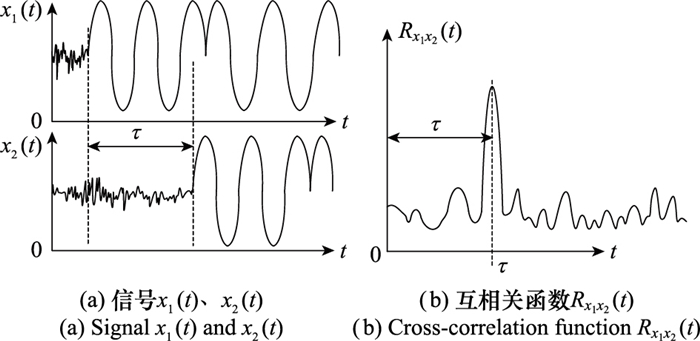

Fig.2
Distributed positioning diagram"


Fig.3
Timing relations of TDOA between master station and slave station"


Fig.4
FPGA hardware implementation flowchart for frequency domain cross correlation method"


Fig.5
Normalized fitting interpolation simulation image after compression"

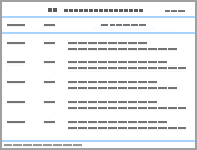
Table 1
FFT input/output bit width and FPGA resource usage table"
| 输入位宽 | 截位模式(输出位宽=输入位宽) | 不截位模式(全精度输出) | |||||||
| 输出位宽 | 乘法器DSP48E1 | 存储器BlockRAMs | 寄存器SliceRegisters | 输出位宽 | 乘法器DSP48E1 | 存储器BlockRAMs | 寄存器SliceRegisters | ||
| 8 | 8 | 17 | 6 | 1 678 | 21 | 17 | 9 | 1 829 | |
| 12 | 12 | 17 | 6 | 1 934 | 25 | 28 | 10 | 2 181 | |
| 16 | 16 | 17 | 6 | 2 242 | 29 | 34 | 14 | 3 543 | |
| 20 | 20 | 25 | 8 | 2 604 | 33 | 45 | 16 | 3 900 | |
| 24 | 24 | 25 | 8 | 2 912 | 37 | 61 | 17 | 4 114 | |
| 28 | 28 | 34 | 10 | 3 634 | 41 | 68 | 19 | 4 474 | |
| 32 | 32 | 34 | 10 | 4 212 | 45 | 71 | 22 | 5 715 | |
| 34 | 34 | 34 | 10 | 4 408 | 47 | 74 | 23 | 5 938 | |

Fig.6
Peak effective bit width of FFT output for various types of signals"
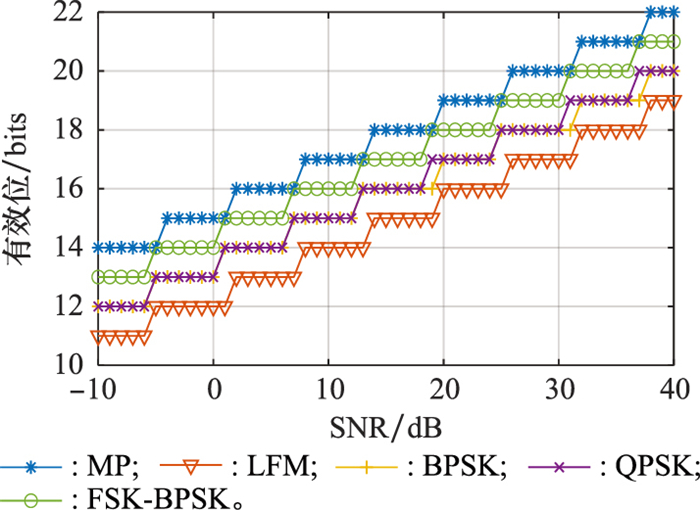

Fig.7
FPGA hardware implementation flowchart for dynamic compression sensing"

Table 2
Comparison table of FPGA resources before and after optimization"
| FPGA资源类型 | 优化前使用值 | 优化后使用值 | 优化比例/% |
| 寄存器Slice Registers | 38 056 | 23 020 | 39.5 |
| 查找表Slice LUTs | 28 761 | 16 250 | 43.5 |
| 存储器Block RAMs | 85 | 43 | 49.4 |
| 乘法器DSP48 E1 | 99 | 49 | 50.5 |

Fig.8
Comparison of time difference error by different dynamic compression bit widths"


Fig.9
Statistical chart of measurement difference before and after dynamic compression under different SNR"
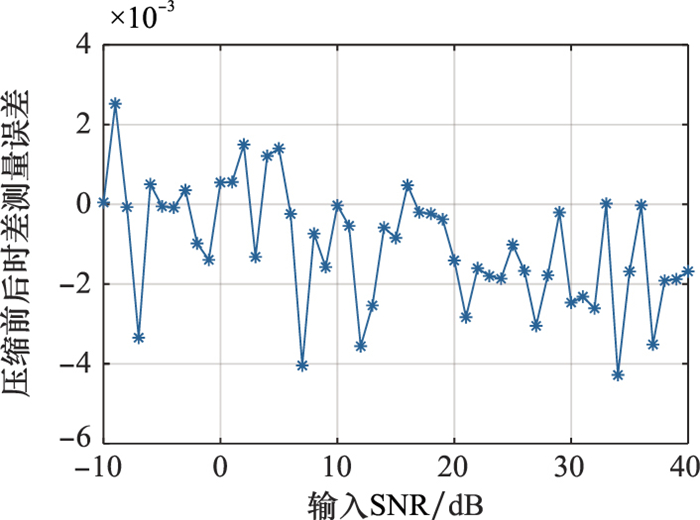

Fig.10
Phase difference feature"


Fig.11
LZSS compression algorithm flowchart"


Fig.12
Spectral data compression rate for various types of signals"

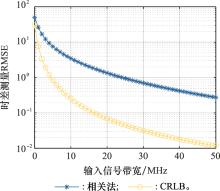
Fig.13
Comparison of simulated measurements under different bandwidths"


Fig.14
Comparison between simulation and actual measurement under different SNR"


Fig.15
Flight test schematic diagram"


Fig.16
Root mean square plot of the time difference between the master station and the three slave stations receiving data"


Fig.17
Distribution map of radiation source positioning error"

| 1 |
WILLIAM D C R , JOSE A A J . An emitter localization method based on multiple differential doppler measurements[J]. IEEE Latin America Transactions, 2022, 20 (4): 537- 544.
doi: 10.1109/TLA.2022.9675458 |
| 2 |
WU Y J , XU C Q , LING P , et al. Multidimen-sional scaling-based TDOA localization scheme using an auxiliary line[J]. IEEE Signal Processing Letters, 2016, 23 (4): 546- 550.
doi: 10.1109/LSP.2016.2537371 |
| 3 |
SHI X F , ANDERSON B D O , MAO G , et al. Robust localization using time difference of arrivals[J]. IEEE Signal Processing Letters, 2016, 23 (10): 1320- 1324.
doi: 10.1109/LSP.2016.2569666 |
| 4 | QIU F Y, DING S F. Research on multi-platform time difference location technology[C]//Proc. of the IEEE 5th International Conference on Signal and Image Processing, 2020: 813-817. |
| 5 | BOLE M, CHAO T, LI P Z, et al. A TDOA localization method for complex environment localization[C]//Proc. of the Big Data Mining and Information Processing on Journal of Physics Conference Series, 2021, 2004: 012003. |
| 6 |
WANG Z W , HU D X , ZHAO Y J , et al. Real-time passive localization of TDOA via neural networks[J]. IEEE Communications Letters, 2021, 25, 3320- 3324.
doi: 10.1109/LCOMM.2021.3097065 |
| 7 |
PETR H , JIRI V , JANA O . The complete analytical solution of the TDOA localization method[J]. Defence Science Journal, 2022, 72 (2): 227- 235.
doi: 10.14429/dsj.72.16933 |
| 8 |
TALMON A , MICHAEL W , ROEE D . A time difference of arrival based target motion analysis for localization of underwater vehicles[J]. IEEE Trans.on Vehicular Technology, 2022, 71 (1): 326- 338.
doi: 10.1109/TVT.2021.3120201 |
| 9 | LIANG Z D , YI W J . Application of improved particle swarm optimization algorithm in TDOA[J]. AIP Advances, 2022, 12 (2): 227- 235. |
| 10 |
LI W C , LI Y , WEI P , et al. A closed-form localization algorithm using angle-of-arrival and difference time of scan time measurements in scan-based radar[J]. IEEE Trans.on Aerospace and Electronic Systems, 2019, 55 (1): 511- 515.
doi: 10.1109/TAES.2018.2890353 |
| 11 | JIANG F , ZHANG Z K . An improved underwater TDOA/AOA joint localisation algorithm[J]. The Institution of Engineering and Technology Communications, 2021, 15, 802- 814. |
| 12 |
SADJAD I , MOHAMMAD P , MOHAMM-AD J H , et al. Bi-static target localization based on inaccurate TDOA-AOA mea-surements[J]. Signal, Image and Video Processing, 2022, 16 (1): 239- 245.
doi: 10.1007/s11760-021-01985-4 |
| 13 |
XU D , WEN M , EMANUEL A P H , et al. TDOA-based robust sound source localization with sparse regularization in wireless acoustic sensor networks[J]. IEEE/ACM Trans.on Audio, Speech and Language Processing, 2022, 30, 1108- 1123.
doi: 10.1109/TASLP.2022.3153251 |
| 14 |
ZOU Y B , LIU H P . Semidefinite programming methods for alleviating clock synchronization bias and sensor position errors in TDOA localization[J]. IEEE Signal Processing Letters, 2020, 27, 241- 245.
doi: 10.1109/LSP.2020.2965822 |
| 15 |
何胜阳, 杜杰朋, 赵雅琴, 等. 基于TDOA的无人机集群协同单目标定位[J]. 系统工程与电子技术, 2023, 45 (1): 1- 8.
doi: 10.12305/j.issn.1001-506X.2023.01.01 |
|
HE S Y , DU J P , ZHAO Y Q , et al. TDOA-based cooperative single target location using UAV cluster[J]. Systems Engineering and Electronic, 2023, 45 (1): 1- 8.
doi: 10.12305/j.issn.1001-506X.2023.01.01 |
|
| 16 | YAO H R, ZOU C M, WANG G X, et al. Station distribution optimization algorithm of TDOA passive location based on adaptive matching reconnaissance area[C]//Proc. of the 2nd International Conference on Electronics, Communications and Information Technology, 2021: 1173-1177. |
| 17 | 王程民, 平殿发, 宋斌斌, 等. 基于粒子群算法的多机无源定位系统优化布站[J]. 计算机与数字工程, 2021, 49 (3): 487- 492. |
| WANG C M , PING D F , SONG B B , et al. Optimization of multi-machine passive positioning system based on PSO[J]. Computer and Digital Engineering, 2021, 49 (3): 487- 492. | |
| 18 |
WANG Y Z , ZHOU T , YI W , et al. A GDOP-based performance description of TOA localization with uncertain measurements[J]. Remote Sensing, 2022, 14 (4): 910.
doi: 10.3390/rs14040910 |
| 19 | OYANG X X, CAO J M, ZHAO P Y. TDOA and AOA combined location accuracy analysis with two stations[C]//Proc. of the 2nd International Conference on Control, Automation and Artificial Intelligence, 2017: 429-432. |
| 20 | GUO Q X, ZHANG L B, TAO X F. Research on singular value point of target azimuth aided passive time-difference-of-arrival[C]//Proc. of the Chinese Institute of Electronics International Conference on Radar, 2016. |
| 21 |
王洪, 金尔文, 刘昌忠, 等. 多点定位TOA精确估计及同步误差校正算法[J]. 系统工程与电子技术, 2013, 35 (4): 835- 839.
doi: 10.3969/j.issn.1001-506X.2013.04.26 |
|
WANG H , JIN E W , LIU C Z , et al. Accurate estimation of TOA and calibration of synchronization error for multilateration[J]. Systems Engineering and Electronics, 2013, 35 (4): 835- 839.
doi: 10.3969/j.issn.1001-506X.2013.04.26 |
|
| 22 |
WANG D X , GUO R , XING N , et al. Performance analysis of two RDSS positioning modes of BeiDou-3 system[J]. Astrodynamics, 2022, 6 (3): 317- 327.
doi: 10.1007/s42064-022-0140-6 |
| 23 | XU R , ZHAO J F , TIAN X , et al. Scheme of BeiDou high-precision time synchronization technology[J]. Journal of Navigation and Positioning, 2023, 11 (1): 154- 158. |
| 24 | ZHANG J H , DONG S W , YUAN H B , et al. Study on PPP time comparison based on BeiDou-3 new signal[J]. IEEE Instrumentation & Measurement Magazine, 2022, 8, 30- 40. |
| 25 |
杨健, 刘渝, 狄慧. 基于时差校正的长基线宽带测向算法[J]. 系统工程与电子技术, 2013, 35 (1): 20- 28.
doi: 10.3969/j.issn.1001-506X.2013.01.04 |
|
YANG J , LIU Y , DI H . Long baseline direction finding algorithm of wideband based on time-delay correction[J]. Systems Engineering and Electronics, 2013, 35 (1): 20- 28.
doi: 10.3969/j.issn.1001-506X.2013.01.04 |
|
| 26 | SUN H M , JIA R S , DU Q Q , et al. Cross-correlation analysis and time delay estimation of a homologous micro-seismic signal based on the Hilbert-Huang transform[J]. Computers & Geosciences, 2016, 91, 98- 104. |
| 27 | ROBERT H . Time delay estimation of random signals using cross-correlation with Hilbert transform[J]. Measurement, 2019, 146, 792- 799. |
| 28 | LUO Z H , ZHOU F J , LEI L , et al. A Kalman filter and optimal Fourier fransform rank combined cross correlation algorithm for time-difference extraction[J]. Science and Technology, 2021, 21 (12): 4982- 4989. |
| 29 | 郑恩明, 陈新华, 孙长瑜. 一种水下声信号未知频率的时延差估计方法[J]. 振动与冲, 2014, 33 (9): 190- 194. |
| ZHENG E M , CHEN X H , SUN C Y . A time delay difference estimation method for unknown frequency of underwater acoustic signals[J]. Journal of Vibration and Shock, 2014, 33 (9): 190- 194. | |
| 30 | MA X X , TARING B , CHEN H , et al. A maximum-likelihood TDOA localization algorithm using difference-of-convex programming[J]. IEEE Signal Processing Letters, 2021, 28, 309- 313. |
| 31 | ZHANG L , WU X L . On the application of cross correlation function to subsample discrete time delay estimation[J]. Digital Signal Processing, 2006, 16, 682- 694. |
| 32 | 孙兵, 李龙骧, 罗景青. 协同侦察系统增加猝发探测功能的定位技术[J]. 航天电子对抗, 2016, 32 (3): 9- 12. |
| SUN B , LI L X , LUO J Q . Location technology of synergy reconnaissance system adding instantaneous detection function[J]. Aerospace Electronic Warfare, 2016, 32 (3): 9- 12. | |
| 33 | HOU M J , WU H L , PENG J G , et al. Long-range and high-precision localization method for underwater bionic positioning system based on joint active-passive electrolocation[J]. Scientific Reports, 2023, 13 (1): 21475. |
| 34 | ZHANG J L. A FPGA-based parallel method of bridge data compression[C]//Proc. of the International Conference on Power Electronics and Power Transmission, 2021. |
| 35 | MAHESH R , VINOD A P , EDMUND M K L , et al. Filter bank channelizers for multi-standard software defined radio receivers[J]. Journal of Signal Processing Systems, 2021, 62, 157- 171. |
| 36 | DUAN X Z , SU S , MEI N . Transmitting electric power system dynamics in SCADA using polynomial fitting[J]. Science in China Series E: Technological Sciences, 2009, 52 (4): 937- 943. |
| 37 |
李晓辉, 万宏杰, 樊韬, 等. 基于多相滤波的高精度延时设计及实现[J]. 系统工程与电子技术, 2023, 45 (1): 25- 31.
doi: 10.12305/j.issn.1001-506X.2023.01.04 |
|
LI X H , WAN H J , FAN T , et al. Design and implementation of high precision delay based on polyphase filtering[J]. Systems Engineering and Electronics, 2023, 45 (1): 25- 31.
doi: 10.12305/j.issn.1001-506X.2023.01.04 |
|
| 38 | SMITH J P , BAILEY J I , TUTHILL J , et al. A high-throughput oversampled polyphase filter bank using vivadio HLS and PYNQ on a RFSoc[J]. IEEE Open Journal of Circuits and Systems, 2021, 2, 241- 252. |
| 39 | XIE Y L , JIANG P , GU Y , et al. Dual-source detection and identification system based on UAV radio frequency signal[J]. IEEE Trans.on Instrumentation and Measurement, 2021, 70, 9509437. |
| 40 | CHACKO J D , HENG C H , LIAN Y . A hybrid data compression scheme for power reduction in wireless sensors for IoT[J]. IEEE Trans.on Biomedical Circuits and Systems, 2017, 11 (2): 245- 254. |
| 41 | SIYA M , YOU W A , YU Z . A content-independent method for LFM signal source identification[J]. AEU-International Journal of Electronics and Communications, 2022, 143 (1): 154024. |
| 42 | LIU X L , XIAO B , WANG C Y . Optimal target function for the fractional Fourier transform of LFM signals[J]. Circuits, Systems, and Signal Processing, 2022, 41, 4160- 4173. |
| [1] | Guodong JIN, Yuanliang XUE, Lining TAN, Jiankun XU. Advances in object tracking algorithm based on siamese network [J]. Systems Engineering and Electronics, 2022, 44(6): 1805-1822. |
| [2] | Jiazheng PEI, Yong HUANG, Baoxin CHEN, Jian GUAN, Xiaolong CHEN. Robust fast adaptive pulse compression method based on linearly constrained minimum variance principle [J]. Systems Engineering and Electronics, 2022, 44(12): 3621-3630. |
| [3] | Yang LIU, Jingxia LI, Tian GUO, Bingjie WANG, Hang XU, Li LIU. Golay complementary code radar for high signal-to-clutter ratio detection of underground pipeline [J]. Systems Engineering and Electronics, 2020, 42(5): 1050-1056. |
| [4] | Ai DONG, Mang XIA, Zhi LI, Zhimin ZHUO. Research on air distributed coordinated time difference measurement system target location technology [J]. Systems Engineering and Electronics, 2020, 42(4): 799-805. |
| [5] | XU Chengqian, MA Yanan. Construction of frequency hopping sequence set with two dimensional time frequency low hit zone [J]. Systems Engineering and Electronics, 2017, 39(4): 905-909. |
| [6] | DAN Bo, JIANG Yong-hua, LI Jing-jun, LU Yi. Adaptive angular sector segmentation method for radar HRRP [J]. Systems Engineering and Electronics, 2014, 36(11): 2178-2185. |
| [7] | ZHAO Yong-bo, LI Hui, QIN Chun-miao. DFCW-LFM waveform design based on GASA algorithm [J]. Systems Engineering and Electronics, 2014, 36(11): 2186-2191. |
| [8] | XIA Gui-fen, ZHU Huai-cheng, HUANG Pei-kang. Performance analysis of radial velocity measurements for a modulated stepped frequency radar [J]. Journal of Systems Engineering and Electronics, 2011, 33(3): 534-538. |
| [9] | ZENG Xiang-neng, ZHANG Yong-shun, DONG Zhen, GUO Yi-duo. Cross correlation assimilation for MIMO radar waveform utilized space-time coding technology [J]. Journal of Systems Engineering and Electronics, 2011, 33(11): 2404-2408. |
| [10] | HUANG Ying, LEI Jing. Research on recognition of modulation signals in satellite communication [J]. Journal of Systems Engineering and Electronics, 2009, 31(6): 1303-1306. |
| [11] | ZHENG Yuan, HU Ying-Hui, DENG Yun-kai. Analysis of radar imaging and deception using chaotic FM signal [J]. Journal of Systems Engineering and Electronics, 2009, 31(5): 1071-1074. |
| [12] | HUANG Yao, XIA Yu-li, LEI Hong. Moving-target detection and parameter estimation method for dual-channel SAR [J]. Journal of Systems Engineering and Electronics, 2009, 31(2): 342-346. |
| Viewed | ||||||
|
Full text |
|
|||||
|
Abstract |
|
|||||